저작자표시-비영리-변경금지 2.0 대한민국 이용자는 아래의 조건을 따르는 경우에 한하여 자유롭게
l 이 저작물을 복제, 배포, 전송, 전시, 공연 및 방송할 수 있습니다. 다음과 같은 조건을 따라야 합니다:
l 귀하는, 이 저작물의 재이용이나 배포의 경우, 이 저작물에 적용된 이용허락조건 을 명확하게 나타내어야 합니다.
l 저작권자로부터 별도의 허가를 받으면 이러한 조건들은 적용되지 않습니다.
저작권법에 따른 이용자의 권리는 위의 내용에 의하여 영향을 받지 않습니다. 이것은 이용허락규약(Legal Code)을 이해하기 쉽게 요약한 것입니다.
Disclaimer
저작자표시. 귀하는 원저작자를 표시하여야 합니다.
비영리. 귀하는 이 저작물을 영리 목적으로 이용할 수 없습니다.
변경금지. 귀하는 이 저작물을 개작, 변형 또는 가공할 수 없습니다.
공학박사 학위논문
IoT strategy to solve condensation problem in
residential building
사물 인터넷을 활용한 주거용 건물에서의 결로 해결 방안
2020 년 8 월
서울대학교 대학원
건축학과
이 준 혜
IoT strategy to solve condensation problem in residential building
사물 인터넷을 활용한 주거용 건물에서의 결로 해결 방안
지도 교수 여 명 석
이 논문을 공학박사 학위논문으로 제출함
2020 년 4 월
서울대학교 대학원
건 축 학 과
이 준 혜
이준혜의 공학박사 학위논문을 인준함
2020 년 6 월
위 원 장 박 철 수 (인) 부위원장 여 명 석 (인) 위 원 박 진 철 (인) 위 원 송 승 영 (인) 위 원 김 선 숙 (인)
III
Abstract
The building technology have been developed in a way to minimize damage from inadvertent moisture penetration and generation in the living space. Researches and building technologies related with the condensation in building is actively reviewed with applying appropriate combinations of insulation and ventilation. However, condensation still ranks high on the list of defect dispute issues for newly built apartment buildings in Korea.
The building industry is trying to solve the issue by increasing the design criteria for condensation prevention. However, this may cause other unintended effects which this study was designed to address: The aim was to provide an Internet of Things (IOT) concept approach solution for preventing condensation in the balconies of Korean apartments, which is reported to be the most problematic space in a residential unit.
The research proceeded as follows to solve the condensation in the balcony space. Long-term monitoring was conducted to identifying the cause of condensation to derive a strategy to prevent condensation. The monitoring result revealed not only the construction factors of the balcony but also occupancy activity influences condensation. Condensation prevention effect through control of these factors were reviewed by EnergyPlus simulation (Insulation thickness and ventilation rate) and the control of occupancy activities were reviewed with the use of a field experiment. However, the uncertainty related to
IV
the moisture generation rate by the occupants made it difficult to ascertain the building’s physical parameter values. Although restricting the occupancy activity effectively lowered the moisture generation to prevention condensation occurrence.
Although a method to control the behavior of occupancy dose not ensure the effectiveness from the engineering point of view, it was confirmed that it is feasible by combining technology with the concept of IoT. Author installed IoT experiment onsite accessed by internet WiFi. Real-time data value collection and analysis algorithms are processed through micro-processor (Raspberry Pi) to operate the balcony door actuator and ventilation fan installed inside the balcony. As a result of the experiment it was confirmed that the condensation prevention control combined with the Internet of Things shorten the condensation occurrence time.
In this study, as a method for solving condensation in buildings categorized into fixed parameter and occupancy parameter. Fixed parameters are considered during design phase while occupancy parameters are applicable during use stage.
Occupancy parameters are actively respond to changes in the indoor environment by using IoT technology to block the moisture transfer and remove generated moisture while fixed parameters are a way to reflect the possibility of condensation to derive insulation thickness and ventilation rate. Previously, the indoor condition of building was left to the autonomy of the occupants
V
after building have been constructed. Through this study provides a vision of designing to control the architectural feature in use stage of building is possible.
Keyword : Condensation, Korean apartment building, balcony space, Internet of Things (IoT), micro-processor (Raspberry Pi) Student Number : 2013-30934
VI
Table of Contents
ABSTRACT... III
CHAPTER 1. INTRODUCTION ... 1
1.1. BACKGROUND AND PURPOSE ... 1
1.2.SCOPE AND METHOD ... 7
CHAPTER 2. EXISTING STRATEGIES FOR CONDENSATION CONTROL ... 11
2.1.CONVENTIONAL KOREAN BALCONIES ... 11
2.2.DESIGN CRITERIA FOR CONDENSATION CONTROL ... 14
2.2.1. Temperature Difference Ratio ... 14
2.2.2. Moisture control design ... 15
2.3.PRELIMINARY STUDY OF CONDENSATION PREVENTION ... 16
2.3.1. Preliminary studies on unheated space condensation ... 16
2.3.2. The solution application by Korean industry... 17
2.4.SUMMARY ... 19
CHAPTER 3. INVESTIGATION OF THE INFLUENCE OF CONDENSATION BY OCCUPANCY PATTERNS ... 21
3.1.MEASUREMENT SETUP ... 22
3.1.1. Monitoring target space ... 22
3.1.2. Data collection points and sensor information ... 25
3.1.3. Data collection status ... 27
3.2CAUSES OF CONDENSATION IN THE BALCONY SPACE... 30
3.2.1. Seasonal influence of condensation ... 30
3.2.2. The influence of the daily schedule on condensation ... 36
3.2.3 The influence of activity on condensation ... 40
3.3.CONTROL PARAMETERS DERIVED FROM DIAGNOSIS ... 48
3.3.1. Fixed parameters ... 49
3.3.2. Occupancy parameters ... 50
3.4.SUMMARY ... 51
VII
CHAPTER 4. EVALUATION OF CONTROL PARAMETERS ... 53
4.1.EVALUATION OF FIXED PARAMETERS... 54
4.1.1. Simulation model setup and validation ... 54
4.1.2. Insulation thickness evaluation... 60
4.1.3. Ventilation rate evaluation ... 62
4.2.EVALUATION OF OCCUPANCY PARAMETERS ... 64
4.2.1. Onsite experiment setup ... 64
4.2.2. Moisture transfer control evaluation ... 67
4.2.3. Moisture removal evaluation ... 70
4.3.LIMITATIONS OF CONTROL PARAMETERS AND OCCUPANCY PARAMETERS ... 71
4.4. SUMMARY ... 73
CHAPTER 5. APPLICATION OF THE INTERNET OF THINGS FOR CONDENSATION CONTROL ... 77
5.1. INTERNET OF THINGS (IOT) APPLICATION ... 77
5.1.1. The concept of the Internet of Things ... 77
5.1.2. Application cases involving the Internet of Things ... 80
5.2.THE INTERNET OF THINGS EXPERIMENT SETUP ... 81
5.2.1. Microprocessor device setup with wireless communication ... 81
5.2.2. Sensor and actuator connection with the physical element ... 84
5.2.3. Condensation determination ... 89
5.3.THE ALGORITHM BASED ON THE OCCUPANCY PARAMETERS ... 91
5.3.1. Activity detection-based control ... 92
5.3.2. Sensor value-interpreted control ... 97
5.4.SUMMARY ... 102
CHAPTER 6. FEASIBILITY OF IOT APPLICATION AT HOME ... 105
6.1.RESULT OF THE ONSITE IOT EXPERIMENT ... 105
6.1.1. Door control for preventing moisture transfer by condensation detection inside balcony ... 105
VIII
6.1.2. Intermittent fan operation by condensation detection inside balcony . 108
6.1.3. Control algorithm by combining and applying different parameters .. 111
6.2.LEVELS OF APPLICATION WITH FEASIBILITY ... 115
6.2.1. The IoT application level for condensation control ... 115
6.2.2. The effectiveness of condensation reduction among the different levels ... 118
6.4SUMMARY ... 121
CHAPTER 7. CONCLUSION ... 123
REFERENCES ... 127
국 문 초 록 ... 130
APPENDIX ... 133
IX
List of Tables
Table 2. 1. Insulation strategy for condensation prevention by Korean
construction companies ...18
Table 3. 1. Information on the monitoring building ...24
Table 3. 2. Measurement instrument information ...26
Table 3. 3. Amount of collected data for analysis ...28
Table 3. 4. Condensation occurrence hours according to surface location ...35
Table 3. 5. The timing of condensation detection when activities were recorded ...45
Table 4. 1. Measurement instrument information ...65
Table 5. 1. Measurement instrument information ...84
Table 6. 1. The sensors and parts requirements for create different levels of IoT devices ...116
X
List of Figures
Figure 1. 1. Defect ratio by type of dispute resolution by dispute resolution
committee of Ministry of Land, Infrastructure and Transport in Korea ... 3
Figure 1. 2. Condensation reports survey by types of rooms in newly constructed apartment units ... 5
Figure 1. 3. Diagram for research process ...10
Figure 2. 1. The comparison between a Korean balcony and the dictionary definition of a balcony ...12
Figure 2. 2. Balcony floor plan designed for service area as laundry room and auxiliary kitchen ...13
Figure 2. 3. Balcony used as laundry room and pantry...13
Figure 3. 1. The occupied monitoring unit. ...23
Figure 3. 2. Floor plan of monitoring unit ...24
Figure 3. 3. Measurement sensor locations ...26
Figure 3. 4. The sensor installation on the monitoring unit ...27
Figure 3. 5. Seasonal monitoring data collection ...29
Figure 3. 6. Boxplot chart of measured values during winter and summer monitoring period ...32
Figure 3. 7. Condensation location on the balcony space during winter and summer ...34
Figure 3. 8. Surface temperature changes in 24 hours ...35
Figure 3. 9. Condensation occurrence by daily schedule according to monitoring period of winter ...36
Figure 3. 10. The frequency of the condensation by time ...37
Figure 3. 11. Condensation occurrence with temperature and relative humidity changes during morning time ...38
Figure 3. 12. Condensation occurrence with temperature and relative humidity changes during evening time ...39
Figure 3. 13. Temperature and relative humidity changes related to equipment (washer machine) use inside the balcony ...41
Figure 3. 14. Temperature and relative humidity changes near the door opening, with activity ...41
Figure 3. 15. Boxplot result of condensation occurrence by the occupancy activity ...42
Figure 3. 16. Relative humidity change while the washing machine was in use ...43
Figure 3. 17. Relative humidity change when it was detected that the balcony door was opened or closed...44 Figure 3. 18. Control parameters categorized as fixed and occupancy
XI
parameters ...49
Figure 4. 1. EnergyPlus model validation ...58
Figure 4. 2 . Absolute humidity for validating the moisture transferred by the airflow network ...59
Figure 4. 3. Influence of insulation thickness on condensation duration (in hours) on the north-facing wall surface and window surface during winter, and the condensation reduction success rate. ...61
Figure 4. 4. Ventilation rate influence on condensation duration (in hours) on the north-facing wall surface and window surface during winter, and the condensation reduction success rate. ...61
Figure 4. 5. North-facing wall surface and window surface temperatures during winter with condensation reduction success rate ...63
Figure 4. 6. Floor plan of the field experiment unit in Incheon, Korea ...66
Figure 4. 7. Sensor and moisture generation equipment location for onsite experiment ...66
Figure 4. 8. Experiment set up with sensors (a) Field measurement site view to balcony; (b) Field measurement site view to Kitchen ...67
Figure 4. 9. Moisture transfer by door control experiment to evaluate condensation prevention: (a) temperature; (b) humidity; and (c) absolute humidity. ...69
Figure 4. 10. Moisture generation and removal by natural ventilation experiment ...71
Figure 5. 1. Concept diagram of Internet of Things ...79
Figure 5. 2. Floor plan of the site experiment unit in Kyungi-do, Uljungbu, Korea. ...82
Figure 5. 3. The IoT experimental setup showing the sensor, actuator, and microprocessor locations. ...83
Figure 5. 4. Micro-processor (Raspberry Pi 3B) used for onsite experiment...83
Figure 5. 5. GPIO board sensor arrangement located in Kitchen ...85
Figure 5. 6. GPIO board sensor arrangement located in balcony 1 ...86
Figure 5. 7. GPIO board sensor arrangement located in balcony 2 ...87
Figure 5. 8. Solenoid valve connected on kitchen faucet and swing door operator installed on balcony door ...88
Figure 5. 9. Ventilation fan attached on balcony ceiling and humidifier located on balcony to imitate moisture production ...88
Figure 5. 10. Group of surface and air sensor location for comparing the condensation determination ...91
Figure 5. 11. Condensation detected after washer equipment starts to operate inside the balcony space ...94
Figure 5. 12. Condensation detected middle of the washer equipment operation inside the balcony space ...94
XII
Figure 5. 13. Condensation detected during the door opening activity ...95
Figure 5. 14. Condensation remained after the door opening activity ...95
Figure 5. 15. Non-condensation detected during the door opening activity ...96
Figure 5. 16. Multiple activities increased the possibility of condensation duration time. ...96
Figure 5. 17. Relative humidity values of measured locations by non- condensation and condensation during balcony door opening activity ...98
Figure 5. 18. Relative humidity values of measured locations by condensation during balcony door opening activity ...100
Figure 5. 19. Algorithm for IoT strategy of condensation prevention ...101
Figure 6. 1. Automatic control strategy for moisture generation case ...106
Figure 6. 2. Algorithm process of balcony door control ...107
Figure 6. 3. Automatic control strategy for moisture generation case ...109
Figure 6. 4. Algorithm process of ventilation fan control ...110
Figure 6. 5. Experiment result of fan operation ...112
Figure 6. 6. Experiment result of both fan and balcony door operation ...112
Figure 6. 7. Algorithm process of ventilation fan control ...113
Figure 6. 8. Algorithm process of ventilation fan and balcony door control .114 Figure 6. 9. Combination of control device by different levels of output ...117
Figure 6. 10. Control algorithm for sensor alarm notification as an output ....119 Figure 6. 11. Result of condensation reduction by applying level 2 or level 3 .120
XIII
Symbols
SYMBOL MEANING UNIT
𝐴" Area of the jth adjacent surface 𝑚$
𝐶& Discharge Coefficient -
𝐶' Specific heat capacity of air J/kg K
𝐶( Sensible heat capacity multiplier -
𝐶),+ Volumetric heat capacity for the ith node (V𝐶'𝐶()
𝐹./+0," Fraction of internal gain from jth internal gain object
defined in the RoomAir -
𝐹1234," Fraction of output or supply air to the ith node from
jth HVAC equipment -
𝐹+ Fraction of zone air volume for ith node -
ℎ+," heat transfer coefficient between the jth adjacent
surface and ith node 𝑊/𝑚$𝐾
ℎ9," Moisture transfer coefficient between the jth adjacent
surface 𝑘𝑔/𝑚$𝑠
𝑚̇ Air mass flowrate Kg/s
𝑚̇3>?+," Mass flow rate from the jth node to the ith node Kg/s
𝑚̇@A',+," supply mass flow rate from the jth HVAC equipment Kg/s
𝑁+,3>? AFN objects connected to the ith node -
𝑁+,1234 HVAC Equipment objects which provide supply air to
the ith node -
𝑁+,@AC number of adjacent surface with convective heat
transfer for the ith node defined in the Room Air - 𝑁+,. number of internal gains for the ith node -
𝑄̇+," Amount of internal sensible gain at the jth internal gain W
XIV
SYMBOL MEANING UNIT
object and ith node
t Temperature °C
𝑡& Dew-point Temperature °C
𝑇 Temperature K
𝑇@A'" Supply Air temperature at the jth HVAC equipment °C
𝑇),+ Air temperature at the ith zone °C
𝑝H Water vapor partial pressure kPa
𝑝H@ Water vapor saturation pressure Pa
𝑊 Opening Width m
𝑊),+ Air humidity ratio at the ith zone Kg/kg
𝑣 Air flow velocity m/s
V Zone air Volume 𝑚J
𝜌 Density 𝑘𝑔/𝑚J
1
Chapter 1. Introduction
1.1 Background and Purpose
1.2 Scope and Method
1.1. Background and Purpose
Built environments have been developed to reduce the factors affected by water content, with the aim of improving the comfortability of indoor conditions. However, one of the factors, which occurs due to the dynamics of indoor and outdoor conditions of temperature and humidity changes, creates the condensation.
This surface moisture accumulation causes biological activities which deteriorate the performance of building materials.1,2 This increases the maintenance costs during the use of the building. In addition to that, the dampness of building materials and the biological reactions contribute to the growth of molds which creates inadequate indoor air quality. This phenomenon may threaten occupants’ health. When people are exposed to molds, it may cause severe health conditions such as respiratory illness,
1 Hannu Viitanen et al., "Moisture and Bio-Deterioration Risk of Building Materials and Structures," Journal of Building Physics 33, no. 3 (2010).
2 HLSC Hens, "Fungal Defacement in Buildings: A Performance Related Approach,"
HVAC&R Research 5, no. 3 (1999).
2
asthma, and allergies.3 , 4 , 5 According to the World Health Organization, childhood asthma cases are related to condensation within the home. 6 Therefore, achieving condensation-free housing is an important aspect of the economic and environmental impacts on occupants’ health.
For several decades, many researchers have accomplished condensation prevention through the use of carefully chosen building components. Building envelopes with adequate insulation strategies have been suggested to increase thermal resistance for the prevention of moisture on wall surfaces and layers.7,8 Proper insulation spacers for double-glazed windows have been validated.9 The mechanical ventilation strategies to compensate for thermal resistance have been suggested and developed.10 The results of these studies have provided guidelines for condensation-free building designs for updating old buildings that need renovation.
3 Maria H Garrett et al., "Indoor Airborne Fungal Spores, House Dampness and Associations with Environmental Factors and Respiratory Health in Children," Clinical and Experimental Allergy 28, no. 4 (1998).
4 Robert K Bush et al., "The Medical Effects of Mold Exposure," Journal of Allergy and Clinical Immunology 117, no. 2 (2006).
5 William J Fisk, Quanhong Lei-Gomez, and Mark J Mendell, "Meta-Analyses of the
Associations of Respiratory Health Effects with Dampness and Mold in Homes," Indoor air 17, no. 4 (2007).
6 MS Jaakkola et al., "Indoor Dampness and Mold Problems in Homes and Asthma Onset in Children," Environmental burden of disease associated with inadequate housing-A method guide to the quantification of health effects of selected housing risks in the WHO European Region. Geneva: World Health Organization (2011).
7 Rachel Becker, "Effects of Heating Patterns on Internal Surface Temperatures and Risk of Condensation," Building and Environment 28, no. 3 (1993).
8 Mohammed A Hamdan, "Layered Wall Design to Prevent Moisture Condensation on Its inside Surface," Energy conversion and management 43, no. 14 (2002).
9 Seung-Yeong Song et al., "Evaluation of inside Surface Condensation in Double Glazing Window System with Insulation Spacer: A Case Study of Residential Complex," Building and environment 42, no. 2 (2007).
10 Jing Liu, Hiroyoshi Aizawa, and Hiroshi Yoshino, "Cfd Prediction of Surface Condensation on Walls and Its Experimental Validation," ibid.39, no. 8 (2004).
3
Although a strong foundation of condensation strategies exists in the field of building engineering, the condensation problem still exists – even in newly built residential environments.
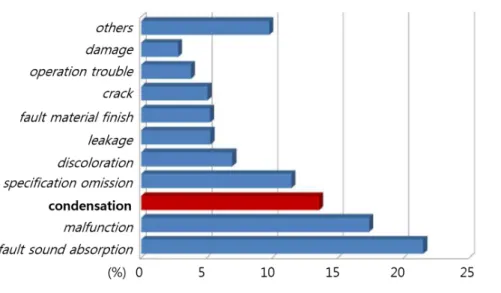
In Korea, as shown in Figure 1.1, there is a dispute between consumers and constructors related to condensation defects on newly constructed residential buildings. These types of problems ranked third-highest based on data collected from 2010 to 2015.11 This is the highest ranked after the defect categories of fault sound absorption and malfunction defects, according to data obtained from “Defect Review Dispute Resolution Committee”
under the Ministry of Land, Infrastructure and Transport in Korea.
Figure 1. 1. Defect ratio by type of dispute resolution by dispute resolution committee of Ministry of Land, Infrastructure and Transport
in Korea12
11 Seung-Yeong Song, "'Development of Building Technology to Improve the Living Performance Closely Related with Lifestyle to Realize the Housing Welfare', Research Group Report(2-Year)," Ewha Womans University 3 (2016).
12 Ibid.
4
The most vulnerable location for condensation defects in residential units is the north-facing balcony, which is an unheated, semi-outdoor space in the unit. Based on owners’ pre-survey complaint reports on a newly constructed apartment complex in Incheon, Korea, the occupants of 442 units reported condensation complaints during the first four months after construction was complete (October 2015 to January 2016). As shown on Figure 1.2, resorted data by the types of rooms for each unit show that north-facing balconies ranked highest for condensation, according to reported locations. The results were repeated by other researchers in South Korea in 2007. Moon et al.,13 for example, surveyed the occupants of 466 apartment units who reported a high number of mold complaints and discovered that the area of mold development on the balcony accounted for about 90% of the total. Thus, balcony space in Korean residential buildings is specifically designed to address known condensation problems.
Also, the balcony is a critical location for controlling the mold spores which may spread throughout the entire residential unit.
13 Hyeun Jun Moon and Hwa-Yong Kim, "The Relationships between the Extent of Mould Problems and Physical Building Characteristics in High-Rise Apartment Buildings,"
Proceeding of Clima 2007 WellBeing Indoors 5 (2007).
5
Figure 1. 2. Condensation reports survey by types of rooms in newly constructed apartment units
The report on repeated problems provides information on the same place within each unit of the entire building. The existing solutions for condensation-related problems are suggested as being for applicable during the early design stage, in order to cope with the foreseen occupancy condition. However, after a residential building is completed with the considered design, the dynamics of the indoor condition vary by the occupancy profile of each type of space, and there is the possibility of an early design failure. Moreover, the residential buildings’ occupancy schedule and activities are irregular, unlike those of office or commercial types of buildings with a more predictable schedule and with dynamic changes to latent heat. Fortunately, the growing trend of the IoT (Internet of Things) concept provides us with a possibility for overcoming design limitations. The IoT was developed by the proliferation of wireless sensor networks in which where sensors,
6
actuators, and the internet framework are used to form a smart environment.14 IoT applications have been utilized in many types of equipment such as smart speakers, smart lighting control, air conditioners, refrigerators, and energy meters in home HVAC systems,15 so there is the possibility of solving the condensation problem with IoT technology concepts.
The aim of this study was to create a condensation-free house by applying a design solution with automation such as IoT technology. The issue of the condensation problem involves a dispute among the different groups in the building industry, from designers to consumers, due to the increased costs of maintenance fees and the impacts of certain design choices on occupants’ health. However, research on condensation in buildings has been saturated for decades and its responsibility has been passed down to the practical field. Due to the realization of the power of home automation technologies, the possibility of a different solution for building condensation has opened up;
however, the application strategy is up in the air. Therefore, the objective of this study was to review the feasibility of an IoT approach in providing a condensation solution for the balcony space, which is the most problematic location in a residential unit.
During the process of the research, the following questions related to the objective were investigated:
14 Jayavardhana Gubbi et al., "Internet of Things (Iot): A Vision, Architectural Elements, and Future Directions," Future generation computer systems 29, no. 7 (2013).
15 Margaret Rouse, "Iot Devices (Internet of Things Devices)," (2018).
7
• Why do Korean balcony spaces have a condensation problem?
• Why is it necessary to apply the IoT approach to solving the condensation problem in residential buildings?
• How to merge IoT technology to the environmental engineering of a building?
1.2. Scope and Method
Within the scope of this work, the overall space was considered rather than one component of the building in order to review the overall impact of condensation. Although there are two types of condensation (surface and interstitial), in this study, only surface condensation was considered in determining the feasibility of the solutions. As mentioned above, the space to be reviewed was targeted to the north-facing balconies, where many condensation problems appear.
The following steps were carried out for the research:
1) Consideration of existing condensation prevention strategies for unheated spaces (Ch. 2)
The existing prevention strategies for unheated spaces in residential buildings, whose conditions are similar to those of Korean balcony spaces, were investigated.
Before proposing new condensation control measures for balcony areas, the development of the
8
characteristics of Korean balconies were considered for limitation of the control strategy, and preliminary studies were reviewed. The work was based on the guidelines for required temperatures and humidity levels for condensation prevention, existing solutions and applications in construction companies in Korea, and the results from a literature review.
2) Investigation of control parameters (Ch. 3)
In order to derive the control parameters, diagnosis of the condensation problem on balcony spaces was conducted by field measurement analysis. Long-term monitoring was conducted on the occupied residential units in different seasonal periods. The condensation and measuring point correlations were analyzed for conclusions regarding the control parameters according to the occupancy patterns.
3) Evaluation of the validity of control parameters (Ch. 4) With the parameters derived from activities in the second step, the control parameters were evaluated for their effectiveness as well as feasibility. The parameters were defined by the occupancy parameters and solid parameters were used to conduct the validation by the site experiment and simulation. During this analysis, it was concluded that it was necessary to apply the occupancy parameters, and that this would require the adoption of real-time control.
9
4) IoT application with the development of a control strategy and algorithm (Ch. 5)
Applying a real-time control algorithm requires knowing when to operate with the derived parameters established in the second step. The concept of the IoT and the occupancy parameters were interwoven in order to derive the control algorithm for the IoT application. Data generated by the sensors has continually increased the amount of data, which gave rise to the concept of Big Data. To control condensation, it is necessary to process the real-time data that is gathered by the sensors. The control algorithm was derived from the analysis of the field- measured occupancy conditions.
5) Application of control algorithm based on site experiment results (Ch. 6)
The results of IoT control measures employed in typical residential units were evaluated for feasibility.
10
Figure 1. 3. Diagram for research process
11
Chapter 2. Existing Strategies for Condensation Control
2.1. Conventional Korean Balconies 2.2. Design criteria for condensation
control
2.3. The solution application by industry in Korea
2.1. Conventional Korean Balconies
The typical Korean balcony was developed from the traditional lifestyle and real estate situation in Korea. A balcony is defined as “a platform projecting from the wall of a building and enclosed by a parapet or railing.”16 However, as shown in Figure 2.1 (b) Korean balcony is a part of the residential unit that is enclosed by an exterior wall and window. In Korea, balconies are projected from the residential unit to view the outside, and are defined as a connection between the outdoor and indoor space.
The installation of glass windows in balconies was legalized in the early 1990s to reduce noise from the outdoor environment and thermally mitigate the heating space.17 As shown in Figure 2.2,
16 Merriam-Webster Dictionary, "Merriam-Webster," On-line at http://www. mw. com/home.
htm (2002).
17 CS Park, "Emerging from Customary Design for Balcony Space in Apartment," J. Archit.
12
due to the internal and external divisions, some residents have used their balconies as a laundry area and auxiliary kitchen, with the storage space being used as a pantry, rather than as an area for relaxation and obtaining a view of the outside.18 Also, in Korea, the balcony space is considered as an additional service area because the entire area of the balcony is not counted with the net floor area of the entire unit; only half of the balcony floor area is counted.19 Therefore, the balcony space is fully equipped in terms of functionality but it is built without considering it as a part of the living space, and hence it is constructed without any thermal insulation on the wall and without a heating system.
(a) Dictionary definition of Balcony20 (b) Korean Balcony21 Figure 2. 1. The comparison between a Korean balcony
and the dictionary definition of a balcony
Inst. Korea Plan 20 (2004).
18 Sun-Young Kim and Chan-Ohk Oh, "A Study of Current Status and Residents' Needs of Balcony Extension in Korean Apartment Housing," Korean Institute of Interior Design Journal 21 (2012).
19 Buildling Policy Division (MOLIT), "Enforcement Decree of the Building Act," ed.
Infrastructure and Transport (MOLIT) Ministry of Land. http://www.law.go.kr/법령/건축 법%20시행령/제119조
20 https://skylineengineeredaluminum.com/portfolio/balconies/
21 http://backpackbees.com/wp-content/uploads/2011/03/DSCF1271.jpg
13
Figure 2. 2. Balcony floor plan designed for service area as laundry room and auxiliary kitchen
Figure 2. 3. Balcony used as laundry room and pantry
14
2.2. Design criteria for condensation control
In order to provide the proper solution for building condensation control, design results that meet the range of the design criteria must be satisfied. The design criteria provide boundary conditions for deriving the design solution. In this section, an overview is provided relevant to the temperature difference ratio and the moisture balance method used to check whether the boundary condition is appropriate for counting during the creation of a condensation solution.
2.2.1. Temperature Difference Ratio
Most countries, such as Austria, Switzerland, France, the Netherlands, and Japan, use the Temperature Differential Ratio (TDR) of wall and thermal bridges as a design standard for reducing condensation. In the case of France and the Netherlands, there are different temperature ratios for humidity and temperature conditions, unlike other countries that provide a single indoor and outdoor temperature and humidity value for TDR. This follows ISO 10211: Thermal bridges in building construction provides the temperature factor for the thermal bridge area22.
Similarly, in Korea, the “Design Criteria for preventing condensation in multi-unit dwelling” suggests a TDR for
22 EN ISO, "10211: Thermal Bridges in Building Construction–Heat Flows and Surface Temperatures–Detailed Calculations (Iso 10211: 2007)," (CEN, 2007); ibid.
15
condensation reduction.23 The subjects of TDR are the windows directly contacting doors, wall joints, and the outside air of apartment houses. The outdoor temperature is different depending on the region, but the indoor temperature and humidity (25° C, 50%) is the same in all regions. The TDR value that must be observed in each region is a value that can maintain a temperature higher than the dew point temperature at 25° C and 50%, based on the room temperature and humidity.
2.2.2. Moisture control design
ASHRAE (American Society of Heating, Refrigerating and Air-conditioning Engineering) standard 160-2009 calls for indoor moisture generation as a default value for designs, with consideration for the effect of moisture.24 This standard provides criteria for selecting design values for initial moisture conditions, indoor temperatures, indoor humidity, air pressure, airflows, weather data, and rain loads. Its purpose is to provide more precise information on the latent load of the building to calculate the energy load required for the building to be comfortable. The values are mostly collected and measured values, in an effort to standardize the measurement of moisture generation in indoor spaces. Therefore, the design criteria considered for the moisture load may differ according to cultural and social factors.
23 Housing Construction Supply Division (MOLIT), "Design Critera to Prevent Condensation in Multi-Unit Dwelling," ed. Infrastrcture and Transport) MOLIT (Ministry of Land (2016).
http://www.law.go.kr/행정규칙/공동주택결로방지를위한설계기준
24 ASHRAE Standard, "Standard 160-2009: Criteria for Moisture Control Design Analysis in Buildings," American Society of Heating, Refrigerating and Air-Conditioning Engineers, Atlanta (2009).
16
2.3. Preliminary study of condensation prevention
2.3.1. Preliminary studies on unheated space condensation The authors of previous studies of condensation-related problems in unheated residential spaces have suggested a different methodology for investigating the movement of water vapor to prevent condensation problems. Gutt25 investigated attic areas by calculating water vapor transport and diffusion and proved this method using field measurement data. The results showed that moisture is largely transported by airflow, rather than by diffusion through the ceiling, and he suggested blocking the openings and cracks through which it is connected to the living area. Bludau et al. 26 performed investigations using a hygrothermal simulation program (WUFI) on a cool roof, which is effective for lowering the temperature; however, it introduces condensation problems in cold regions. Data on heat and moisture transport through building components have indicated that having a darker color for the roof surface may be better for increase the temperature of roof to prevent condensation. Janssens and Hens27 presented a sensitivity analysis of the condensation problem in lightweight roof systems used in cold climates. Their results showed that air leakage is a significant cause of condensation and that it is necessary to incorporate building codes for achieving an
25 GS Gutt, "Condensation in Attics: Are Vapor Barriers Really the Answer?," Energy and Buildings 2, no. 4 (1979).
26 Christian Bludau, Daniel Zirkelbach, and Hartwig M Künzel, "Condensation Problems in Cool Roofs," Interface, the Journal of RCI 27, no. 7 (2009).
27 A. Janssens and H. Hens, "Interstitial Condensation Due to Air Leakage: A Sensitivity Analysis," Journal of Thermal Envelope and Building Science 27, no. 1 (2003).
17
adequate air barrier system. However, because air leakage control is uncertain in building practices, they also suggested other solutions such as increasing thermal resistance and enhancing the removal of vapor from the inner surface by using a vapor- permeable underlay. Moon et al.28 used a hygrothermal simulation to analyze the risk of mold growth on the wall of a utility room and balcony space in Korean apartment buildings. The use of appropriate ventilation rates and allowable moisture production activity numbers is suggested for minimizing the risk of mold growth. The leaders of previous studies have diagnose the condensation problem of unheated spaces in residential buildings and provided ideal methods by which to control uncertain air leakage and moisture production, but this restricts the occupants’ freedom.
2.3.2. The solution application by Korean industry
Korean construction companies have established and implemented their own design criteria to prevent balcony condensation. For those companies that have confirmed that the balcony condensation prevention design standard is applied, the insulation is installed on the wall facing the outside air, and the detailed standards are different for each company. Some have implemented design standards that combine both insulation and natural ventilation. When the basis for calculating the thickness of
28 Hyeun Jun Moon et al., "Evaluation of Mould Growth Risk in Apartment Houses Using Hygrothermal Simulation," Building Simulation. Sydney, Australia: International Building Performance Simulation Association (2011).
18
insulation was presented (company A), the condensation was examined by fixing the balcony’s relative humidity to 60%.
The Korean Land & Housing Corporation conducted a study on the construction of a natural ventilation system on the exterior wall of the balcony to reduce the occurrence of condensation on the balcony. The specification defines this as a structural installation ventilation pipe and as being outside of the structure where PVC pipes are buried in the upper and lower parts of the outer wall of the front and back, but for internal use with a rain cap and airflow control device.29 A vent with a cap is attached to the pipe. The effective area of ventilation is specified to secure more than 35 cm2, and it is actually applied to new apartment buildings.
Table 2. 1. Insulation strategy for condensation prevention by Korean construction companies
29 Jong-Yeop; Lee Kim, Jong-Sung; Hwang, Ha-Jin; , "Condensaiton Reduction Test Evalution of Balcony Space," (Land & Housing Corporation, 2006).
Company Insulation type and
thickness Significant
A THK 30 condensation prevention insulation
B THK 30 Expanded poly syrol.
Type 1-2 (1종 2호)
C
THK 30 polyurethane foam THK 30 Expanded poly syrol.
Type 1-2 (1종 2호)
Ventilation opening
(diameter:100mm) 1 location
19
2.4. Summary
The balconies in Korean residential building is functioning as utility rooms with constructed as unheated space which constructed without any thermal insulation on the wall and a heating system. There is design criterial for condensation preventing condensation in residential buildings in Korea with the TDR (Temperature Differential Ratio) methods based on ISO 10211. However, this design criteria is not applicable for the balcony spaces since the balcony area is excluded space for the regulation for prevention and the TDR value is driven based on the condition with indoor temperature and humidity as 25° C and 50%.
The existing studies for condensation strategies are controlling the air movement and lessen the heat loss form the cold surfaces. The preliminary studies strategies for condensation on unheated spaces suggested to apply the insulation, prevention
THK 20 Expanded poly syrol.
Type 1-2 (1종 2호)
Ventilation opening (diameter:
100mm) 2 location (upper, lower)
D THK 20 condensation prevention insulation
E
THK 10 condensation prevention insulation
Surface wall which is indirect to outdoor
THK 20 polyurethane foam with vapor barrio (type no.1)
Surface wall which is direct to outdoor
20
infiltration by layering the vapor barrier and restricted the moisture production activities in the unheated spaces. The Korean construction companies established own design criteria to apply insulation to prevent balcony condensation. However, many of the prevention strategies in field is more depends on the temperature control rather than the ventilation strategy, since the ventilation strategy is based on the design criteria of moisture generation rate. This moisture generation rate varies by the cultural and social factors.
21
Chapter 3. Investigation of the Influence of Condensation by Occupancy Patterns
3.1. Measurement setup
3.2. Causes of condensation in the balcony space
3.3. Control parameters derived from diagnosis
A typical balcony in Korea is designed as a utility room with unheated space. Slight changes to the temperature and humidity easily create condensation on the surface of unconditioned space.
For this step in the study, diagnosis of the condensation problem on balconies was performed by using field measurements. From the measurement analysis, the control parameters were derived for the condensation strategy. While the temperature change was stable due to the capacitance of the structure, the moisture changes were dynamic due to the activities inside the balcony space. In order to consider the influence of humidity according to occupancy, field measurements were conducted in the occupied residential units for two different seasonal periods.
22
3.1. Measurement setup
The onsite monitoring measurement setup was located on the north-facing balcony of a newly constructed, occupied unit.
The sensor was located based on the TDR calculation by the design criteria of condensation prevention by the Korean government. The sensor values were data logged and the condensation level was determined by the microprocessor. Some data are missing from the measurement period; however, a reasonable amount was collected for diagnosing condensation occurrence in relation to occupancy behavior.
3.1.1. Monitoring target space
To diagnose the condensation level without the influence of the building’s deterioration and water leakage, the onsite monitoring measurement conducted three years after the completion of construction. In order to consider the occupancy influence on the condensation level, the unit selected was a real family home, rather than a vacant unit, as shown in Figure 3.1.
The household included two adults with a child and a one-year- old baby. Because of the baby, the unit is actively occupied during the daytime throughout the week. These circumstances made it easy to collect information on the occupants’ influence on the condensation data. A brief overview of the unit information is shown in Table 3.1.
The investigation was conducted on a north-facing balcony, which is the most vulnerable location for condensation to
23
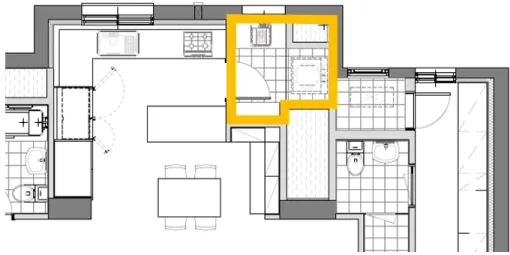
occur. As shown in Figure 3.2, the unit is a typical, 84 m2-type plan, which is the standardized national housing floor plan layout in Korea. This type of floor plan has two balcony spaces, a north- facing balcony adjacent to the kitchen, and a south-facing balcony connected to the master bedroom. Compared to south-facing balconies, north-facing balconies easily create condensation due to less direct solar radiation and the effects of moisture generation and transfer from the kitchen activities.
a. The occupied kitchen view b. The balcony view Figure 3. 1. The occupied monitoring unit.
24
Table 3. 1. Information on the monitoring building
Site Location H apt, Goun-dong, Sejong City, South Korea Building Residential Apartment
Building Structure Type Reinforced concrete structure
Building Completion 2015. 08
Unit floor location 5th floor
Unit Area 84 m2
Balcony Area 3.57 m2
Figure 3. 2. Floor plan of monitoring unit
25
3.1.2. Data collection points and sensor information
Air temperature and relative humidity sensors and surface temperature sensors were installed in each of four zones to collect environmental measurements. The sensors were connected to the Raspberry Pi microprocessor for simultaneous measurement and functioning as a data logger. Details of the measuring instrument, including sensor accuracy, are shown in Table 3.2.
The monitored measuring points are shown in Figure 3.3.
Three zone air sensors were set up in the balcony space and one was in the kitchen to detect micro changes in temperature and humidity in relation to the occupants’ activities. As shown in Figure 3.4, the air temperature and humidity sensors were attached to the balcony door frame, balcony window frame, and shelf above the laundry machine so as to not interrupt the flow of traffic. The surface temperature sensors were located in the corner, next to the thermal bridge for heat loss and the designated location for the TDR measuring points (from “Design criteria to prevent condensation in multi-unit dwelling”30 by the South Korean government).
In order to detect motion information from the balcony entrance and the window (when it was opened for ventilation), magnetic sensors were attached where the frame and opening meets. In order to detect laundry machine use, an electrostatic touch sensor was applied over the laundry machine start button.
30 (MOLIT).
26
Figure 3. 3. Measurement sensor locations
Table 3. 2. Measurement instrument information Main Unit
Data logger
Micro-processor:
Raspberry Pi 3B
Sensor
Zone Temp, RH
DHT 2231
Temp: ±0.5°C most uses Humidity: ± 2-5 % most uses Surface
Temp
K-type Thermocouple 32
(Nickel-Chrominum/ Nickel-Alumel) Temp: ±2.2°C
Motion Detection
Magnetic proximity sensor - AMS38B 832T Digital Touch Capacity sensor - TTP223B
31 http://www.adafruit.com/product/385
32 https://www.thermocoupleinfo.com/type-k-thermocouple.htm
27
a. Main board located in balcony space with zone air sensor
b. Window surface and zone air sensor near window
c. Door magnetic sensor with zone air sensor on door frame Figure 3. 4. The sensor installation on the monitoring unit
3.1.3. Data collection status
The monitoring took place during two seasonal periods: the cooling period (June 8, 2018 to August 29, 2018) and the heating period (December 1, 2018 to February 20, 2019). Measurements were taken every 60 seconds to determine the level of condensation by calculating the dew point temperature from the zone air temperature and the relative humidity sensor value in comparison to the nearby surface temperature. The measured values from sensors and values were calculated by the microprocessor; these were collected for every hour and the data were saved to csv files.
28
Some data went missing either due to a problem with an individual sensor or with the microprocessor. Because of miscellaneous problems with the sensors, several days’ worth of data are missing, as shown in Figure 3.5. However, as shown in Table 3.3, more than 50% of the overall data were successfully collected for diagnosing the balcony’s and kitchen’s environmental changes related to occupancy activities.
Table 3. 3. Amount of collected data for analysis Season Measured
Period (min)
Missing Data (min)
Proportion of missing data per measured period (%)
Winter 118081 19094 16%
Summer 119521 48928 40%
29
Figure 3. 5. Seasonal monitoring data collection
30
3.2 Causes of condensation in the balcony space
3.2.1. Seasonal influence of condensation
Data from the monitoring taken for two different opposite weather conditions over the course of two seasonal periods show the temperature differences between the outdoor and indoor (conditioned) spaces. Radial floor heating is a conventional feature in Korean residences for use during the heating period, and each room space is individually heated except for the balcony. During the cooling period, a tower-type air-conditioner is operated to cool the indoor space.
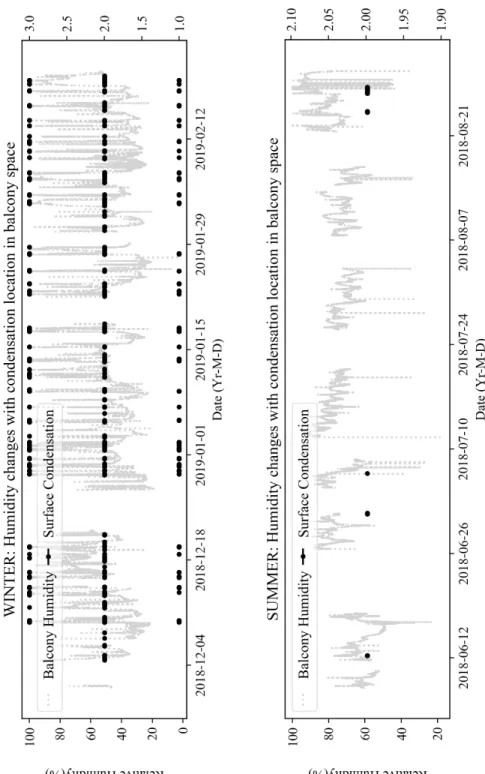
Condensation was detected in the balcony space almost every monitoring day of the winter season, while a few cases of condensation were found during the summer season. The average, measured value of the temperature and humidity of the kitchen (conditioned space), balcony (unconditioned space), and the outdoors was analyzed for the seasonal influence on condensation.
During winter, the average kitchen temperature was 25 °C, which was set up for heating by the radiant floor heating system.
The balcony space’s environmental condition is influenced by both the indoor, conditioned space and the outdoors. The balcony space was more influenced by the outdoor weather temperature when the average temperature was 7 °C, the outdoor was an average of 0 °C. During the summer, the average temperature and humidity of the three spaces were similar; there was no thermal distinction.
As shown in Figure 3.6 (a), the average temperature difference among the three zones during summer was within one degree.
31
During winter, the average relative humidity became higher from the conditioned space to the outdoors, as shown in Figure 3.6 (b). Since the relative humidity depends on the temperature, it was compared to the absolute humidity. The absolute humidity shows that the water vapor in the conditioned space was higher than the outdoor as shown in Figure 3.6(c).
32
(a) Temperature Changes
(b) Relative Humidity Changes
(c)Absolute Humidity Changes
Figure 3. 6. Boxplot chart of measured values during winter and summer monitoring period
Kitchen Door Window Outdoor ßInside Balconyà
Kitchen Door Window Outdoor ßInside Balconyà
Kitchen Door Window Outdoor ßInside Balconyà
Kitchen Door Window Outdoor ßInside Balconyà
Kitchen Door Window Outdoor ßInside Balconyà
Kitchen Door Window Outdoor ßInside Balconyà
24.95
7.17
-0.08
28.08 27.56 27.24
67.47
73.32
73.76
24.61
47.12 59.44
0.05
0.03
0.02
0.16
0.17 0.16
33
The temperature and humidity difference between the conditioned and outdoor space was large during the winter season, which easily created balcony space for detecting the condensation. Based on this analysis, it is postulated that the balcony space is influenced by the low outdoor temperatures and vapor pressure is influenced by the conditioned space.
The most vulnerable location for condensation is the window surface of balcony, where condensation frequently occurred even during the summer period. As shown in Figure 3.7 winter condition, condensation was found on the upper corner, lower corner, and window surface during winter while the few cases of condensation only occurred on the window surface during summer, as shown in Figure 3.7 summer condition.
As shown in Table 3.4, the condensation occurrence was larger than any other measured points of the surface since the thermal resistance of the glass was small. As shown in Figure 3.8, the daily surface temperature fluctuations of winter and summer show that the window surface temperature followed the pattern of the outdoor temperature, while the temperature fluctuation of the balcony wall surface changed less.
34
Figure 3. 7. Condensation location on the balcony space during winter and summer
35
Figure 3. 8. Surface temperature changes in 24 hours Table 3. 4. Condensation occurrence hours according to surface
location Season Lower
Corner (hr)
Upper Corner (hr)
Window surface (hr)
Balcony door frame (hr)
Total (hr)
Winter 48.5 36.5 149.8 2.1 163
Summer 0 0 10 0.5 10.5
36
3.2.2. The influence of the daily schedule on condensation Along with the long period of monitoring in the occupied apartment unit, there was a daily activity schedule in the kitchen that influenced the condensation in the balcony space. This resulted in an easily recognized pattern that was categorized based on the data relating to condensation occurrence times and the schedule. During the winter monitoring period of 73 days (disregarding the days with missing data), condensation was found on 59 days, which accounts for almost 80% of the monitoring days.
In Figure 3.9 an analysis of the daily condensation occurrence times is presented, showing that condensation was frequently detected around seven in the morning.
Figure 3. 9. Condensation occurrence by daily schedule according to monitoring period of winter
37
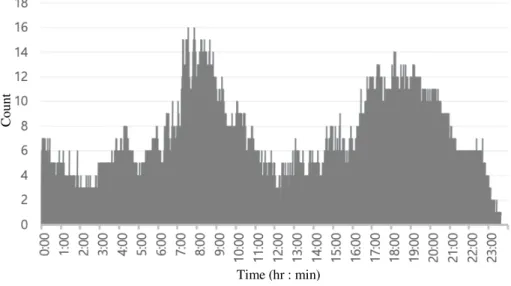
The balcony condensation had a high correlation with the use of the kitchen, especially when the kitchen was being used to prepare meals for the entire family. Figure 3.10 shows that the condensation usually occurred around seven in the morning (with 16 cases) and six at night (with 14 cases). However, during lunchtime, since the house was occupied by one adult and baby, the activity influence on the condensation problem was less than it was at breakfast and dinner times.
A closer look at the temperature and humidity changes in the morning and night schedule graph showed that the humidity fluctuated in the kitchen space, and when this happened it influenced the humidity of the balcony space. Figure 3.11 and Figure 3.12 represents the case in which the door was opened and the humidity changes by humidity transferred into the space.
Figure 3. 10. The frequency of the condensation by time Time (hr : min)
00 15 30 45 60 75 90 105 120
Count
38
(a) Morning case 1
(b) Morning case 2
Figure 3. 11. Condensation occurrence with temperature and relative humidity changes during morning time
7:00 7:15 7:30 7:45 8:00 8:15 8:30 8:45 9:00
7:00 7:15 7:30 7:45 8:00 8:15 8:30 8:45 9:00 00 15 30 45 60 75 90 105 120
7:30 7:45 8:00 8:15 8:30 8:45 9:00 9:15 9:30
7:30 7:45 8:00 8:15 8:30 8:45 9:00 9:15 9:30
00 15 30 45 60 75 90 105 120 (hr : min)
00 15 30 45 60 75 90 105 120
(hr : min) 00 15 30 45 60 75 90 105 120
39
(a) Evening case 1
(b) Evening case 2
Figure 3. 12. Condensation occurrence with temperature and relative humidity changes during evening time
17:30 18:00 18:30 19:00 19:30 20:00 20:30 21:00 21:30
17:30 18:00 18:30 19:00 19:30 20:00 20:30 21:00 21:30
18:00 18:30 19:00 19:30 20:00 20:30 21:00
18:00 18:30 19:00 19:30 20:00 20:30 21:00
00 30 60 90 120 150 180 (hr : min)
00 15 30 45 60 75 90 105 120
(hr : min) 00 15 30 45 60 75 90 105 120
40
3.2.3 The influence of activity on condensation
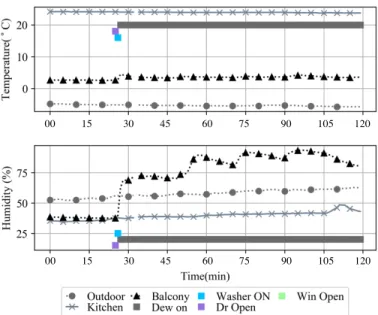
The moisture generation activity in the balcony and the moisture transfer activity caused the increase of relative humidity, which caused the condensation. During the monitoring period, not only were temperature and humidity monitored but also, human activity in the balcony space was checked the by the sensors. Any time the balcony door opened or the window opened, it was detected by the magnetic sensors. The use of the washing machine located in the balcony space was also detected by the touch sensor applied to the “On” button on the washer. The washing machine was used at least once a week during the measurement period; this occurred mostly during the weekend or on holidays, as shown in Table 3.5. When the laundry touch sensor was touched for machine operation, the relative humidity increased immediately, as shown in Figure 3.13.
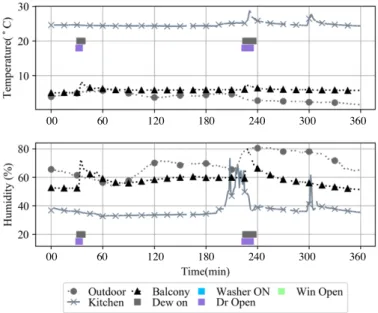
The moisture transfer from the kitchen space was caused by the balcony door opening when the warm air from the conditioned space entered the balcony with the high humidity.
Although the balcony air temperature was also influenced by the kitchen temperature when the door was open, an increase in temperature was not sufficient to prevent condensation in the space. There were several cases reported for condensation occurring when the balcony door was opened or when there was activity in the area, as shown in Table 3.5. Figure 3.14 also shows that the condensation occurred when the balcony door was opened.
41
Figure 3. 13. Temperature and relative humidity changes related to equipment (washer machine) use inside the balcony
Figure 3. 14. Temperature and relative humidity changes near the door opening, with activity
00 15 30 45 60 75 90 105 120
00 15 30 45 60 75 90 105 120
00 60 120 180 240 300 360
00 60 120 180 240 300 360