Original Article
Received: Jul 7, 2017; Revised: Sep 11, 2017; Accepted: Sep 13, 2017; Published online Nov 16, 2017 Correspondence to: Hwancheol Son https://orcid.org/0000-0001-5033-0153
Department of Urology, SMG-SNU Boramae Medical Center, 20 Boramae-ro 5-gil, Dongjak-gu, Seoul 07061, Korea.
Tel: +82-2-870-2391, Fax: +82-2-870-3863, E-mail: [email protected]
Changes in Erectile Function after Photoselective Vaporization of the Prostate with a 120-W GreenLight High-Performance System Laser: 2-Year Follow-Up
Juhyun Park, Sung Yong Cho, Min Chul Cho, Hyeon Jeong, Hwancheol Son
Department of Urology, SMG-SNU Boramae Medical Center, Seoul National University College of Medicine, Seoul, Korea
Purpose: To evaluate the impact of photoselective vaporization of the prostate (PVP) with a 120-W GreenLight high-performance system on erectile function in a 2-year follow-up study.
Materials and Methods: One hundred seventy-seven patients who underwent PVP during 2008 to 2012 were analyzed retrospectively. The patients were divided into 5 groups according to their preoperative 5-item International Index of Erectile Function (IIEF-5) scores: Group I (IIEF-5: 5∼7, n=28), II (IIEF-5: 8∼11, n=47), III (IIEF-5: 12∼16, n=43), IV (IIEF-5: 17∼21, n=34), and V (IIEF-5: 22∼25, n=25). The patients were assessed before surgery and 6, 12, and 24 months after the PVP. Their International Prostate Symptom Score/quality of life, maximum urinary flow rate/post-void residual urine volume, and IIEF-5 scores were measured at each visit.
Results: The mean age and presence of hypertension were significantly different among the 5 groups. Perioperative parameters and postoperative complication rates showed no statistical differences. After PVP, voiding parameters were significantly improved in all the groups and sustained during the 2-year follow-up. The postoperative IIEF-5 scores fell slightly overall, while group V showed the largest significant deterioration. In multivariate analysis, body mass index (BMI) was the only independent predictor of decreased erectile function after PVP.
Conclusions: Erectile function declined in all the groups after PVP, with the most extensive deterioration observed in patients with normal erectile function preoperatively. Preoperative BMI was the only independent risk factor for a meaningful decrease in erectile function after PVP.
Key Words: Erectile dysfunction; Laser therapy; Prostatic hyperplasia
INTRODUCTION
Sexual health and well-being has a direct effect on over- all quality of life (QoL) [1,2]. The prevalence of erectile
dysfunction (ED), which can thus impact QoL, is increas- ing as the population ages [3]. ED is usually accompanied by benign prostatic hyperplasia (BPH) in elderly patients [4], and the pathophysiology of ED and BPH is very closely
https://doi.org/10.5534/wjmh.17027
www.wjmh.org
related [5,6]. Several recent studies have reported that medical therapy for ED or BPH could each influence the other [5,6]. From the surgeon’s point of view, the idea that surgical treatment for BPH might affect ED is a focus of cur- rent research [7-13].
Although many researchers have examined changes in erectile function after photoselective vaporization of the prostate (PVP), published findings are inconsistent [7-12].
For example, Paick et al [7] reported that sexual function- ing improved after PVP, whereas Bruyère et al [8] con- cluded that erectile function after PVP did not improve or was similar to that before PVP. In contrast, Hossack and Woo [9] reported a significant decrease in erectile func- tion after PVP.
These conflicting results might be due to variation in pa- tient characteristics. For example, some of the studies in- cluded mainly patients with normal erectile function [9], whereas others involved mainly patients with underlying ED [7,8]. The analytic methods used to evaluate changes in erectile function also differed. Although most of the studies used the same questionnaire (i.e., the 5-item International Index of Erectile Function [IIEF-5]), they used different definitions of what constituted a significant change in erectile function [7-14]. Thus, based on the cur- rent literature, it is not possible to draw any conclusions about the impact of PVP on erectile function. Unlike the previous studies, we divided the patients into 5 groups ac- cording to their baseline IIEF-5 scores and evaluated the change in erectile function after treatment with a 120-W GreenLight high-performance system (HPS)-PVP.
MATERIALS AND METHODS
We retrospectively reviewed 493 consecutive patients who underwent HPS-PVP for symptomatic BPH at SMG- SNU Boramae Medical Center between January 2008 and December 2012.
A single surgeon (H.S.) performed all the HPS-PVP.
Preoperatively, all the patients were asked to fill out an International Prostate Symptom Score (IPSS)/QoL ques- tionnaire, which included questions about underlying dis- eases, such as diabetes mellitus and hypertension. Their IIEF-5 scores were also recorded. Laboratory tests includ- ing a test for prostate-specific antigen were performed,
and the shape and size of the prostate were evaluated us- ing transrectal ultrasonography. Uroflowmetry, including the post-void residual urine volume (PVR), was included in the routine preoperative checklists.
Perioperatively, the operative time, lazing time and to- tal applied energy were recorded. Postoperative compli- cations were reported and classified according to the Clavien-Dindo system. All the HPS-PVP patients visited the center at postoperative 1, 3, 6, 12, and 24 months. At each visit, their IPSS and IIEF-5 scores were recorded, and uroflowmetry with PVR was performed.
Patients with a previous history of BPH surgery or pelvic surgery were excluded from the analysis. Patients with other malignant diseases and neurogenic components were excluded. And patients with no sexual activity were also excluded. Ultimately, a total of 177 patients were in- cluded in this analysis. Their preoperative and perioper- ative findings were reviewed, and their postoperative 6-month, 1-year, and 2-year follow-up outcomes were ret- rospectively assessed.
The patients were divided into 5 groups according to their preoperative IIEF-5 scores: Group I (IIEF-5: 5∼7, se- vere erectile dysfunction, n=28), II (IIEF-5: 8∼11, moder- ate erectile dysfunction, n=47), III (IIEF-5: 12∼16, mild to moderate erectile dysfunction, n=43), IV (IIEF-5: 17∼21, mild erectile dysfunction, n=34), and V (IIEF-5: 22∼25, no erectile dysfunction, n=25). A meaningful change in postoperative erectile function was defined as more than a 5-point increase or decrease between the preoperative and postoperative 6-month IIEF-5 scores [9]. Based on this definition, we analyzed the preoperative risk factors for an increase or decrease in erectile function using a multi- variate analysis.
1. Ethics statement
The study protocol was approved by the Institutional Review Board (IRB No. 26-2016-123) and the procedure in the present study complies with the Declaration of Helsinki (Edinburgh revision, 2000). Informed consent was waived by the IRB.
2. Statistical analysis
Statistically significant differences in the preoperative and postoperative parameters of the 5 subgroups were an-
Table 1. Preoperative clinical parameters
Variable Group I Group II Group III Group IV Group V p-value
Age (y) 69.8±5.8 65.9±7.7a 65.8±7.5a 61.3±6.7b 62.0±7.5b <0.001
BMI (kg/m2) 24.8±2.4 23.8±3.4 25.2±2.8 25.0±3.3 24.1±3.1 0.207
HTN 20 (71.4)a 19 (40.4) 15 (34.9) 12 (35.3) 10 (40.0) 0.022
DM 3 (10.7) 9 (19.1) 5 (11.6) 6 (17.6) 2 (8.0) 0.629
PSA (ng/mL) 4.3±5.9 4.7±7.0 3.2±4.7 5.2±8.5 2.5±3.2 0.411
Prostate volume (mL) 49.5±33.6 44.3±18.9 50.7±29.1 49.9±27.9 40.1±16.2 0.436
IPSS score 18.0±8.5 19.5±7.7 18.2±6.7 18.7±7.5 18.2±8.8 0.909
QoL score 3.8±1.5 3.8±1.2 3.9±1.3 4.0±1.1 4.0±1.6 0.976
Qmax (mL/s) 10.8±5.9 10.4±4.3 10.2±5.6 10.3±4.0 11.0±5.1 0.971
PVR (mL) 69.3±67.7 92.1±122.7 71.1±68.0 49.4±45.5 71.5±80.0 0.302
Values are presented as mean±standard deviation or number (%).
Group I: 5-item International Index of Erectile Function (IIEF-5) 5~7 (n=28), Group II: IIEF-5 8~11 (n=47), Group III:
IIEF-5 12~16 (n=43), Group IV: IIEF-5 17~21 (n=34), Group V: IIEF-5 22~25 (n=25), BMI: body mass index, HTN:
hypertension, DM: diabetes mellitus, PSA: prostate-specific antigen, IPSS: International Prostatic Symptom Score, QoL: quality of life, Qmax: maximum urinary flow rate, PVR: post-void residual urine volume.
a,bSignificantly different from other groups and no significant difference within groups marked with a or b.
Table 2. Perioperative findings and postoperative complications
Variable Group I Group II Group III Group IV Group V p-value
Perioperative parameter
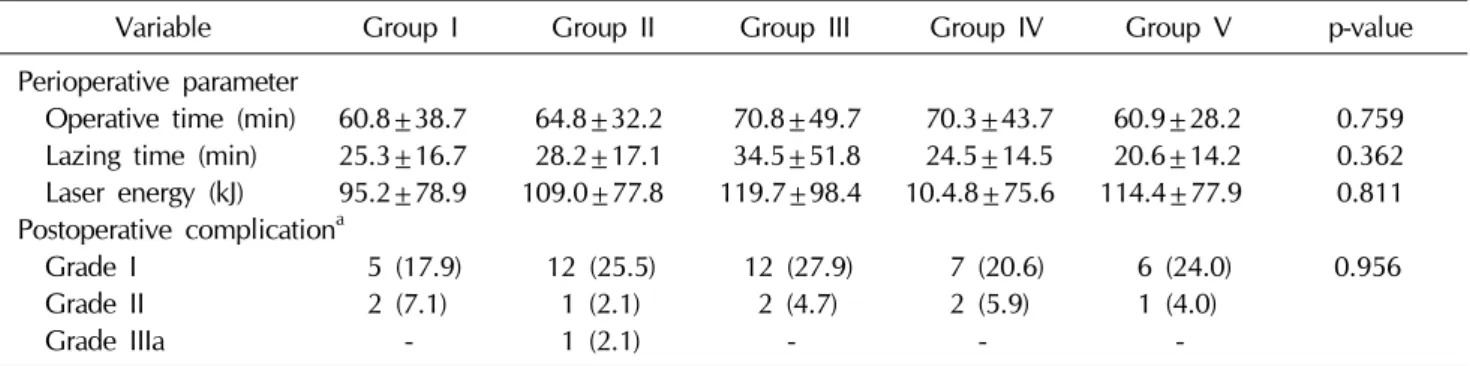
Operative time (min) 60.8±38.7 64.8±32.2 70.8±49.7 70.3±43.7 60.9±28.2 0.759 Lazing time (min) 25.3±16.7 28.2±17.1 34.5±51.8 24.5±14.5 20.6±14.2 0.362 Laser energy (kJ) 95.2±78.9 109.0±77.8 119.7±98.4 10.4.8±75.6 114.4±77.9 0.811 Postoperative complicationa
Grade I 5 (17.9) 12 (25.5) 12 (27.9) 7 (20.6) 6 (24.0) 0.956
Grade II 2 (7.1) 1 (2.1) 2 (4.7) 2 (5.9) 1 (4.0)
Grade IIIa - 1 (2.1) - - -
Values are presented as mean±standard deviation or number (%).
alyzed using one-way ANOVA and post hoc tests. To com- pare the pre- and postoperative clinical variables, an anal- ysis of variance or a paired t-test and Wilcoxon’s sign- ed-rank test were used. To evaluate preoperative risk fac- tors for a meaningful change in the IIEF-5 score, a logistic regression analysis was used. A p-value of <0.05 was con- sidered statistically significant, and commercially avail- able statistical software (IBM SPSS ver. 22.0; IBM Co., Armonk, NY, USA) was used to analyze the data.
RESULTS
The preoperative clinical parameters of the 5 groups are
summarized in Table 1. Among the parameters, the pa- tient’s age and presence of hypertension significantly dif- fered in the 5 groups. Older age was associated with lower IIEF-5 scores. The presence of hypertension was higher in Group I than the other groups. Perioperative parameters, such as the operative time, applied energy, and post- operative complication rates showed no statistical differ- ences (Table 2).
The postoperative follow-up rates at 6 months, 1 year, and 2 years were 64.4%, 51.4%, and 43.5%, respectively.
After HPS-PVP, subjective and objective voiding parame- ters were significantly improved and sustained during the 2 years in all the groups (Fig. 1).
www.wjmh.org Fig. 1. (A) Change in mean International Prostate Symptom Score (IPSS) scores from preoperative (Preop) visit to postoperative 2-year visit per each group (Groups were divided into 5 groups according to their Preop 5-item International Index of Erectile Function (IIEF-5) scores: Group I [IIEF-5: 5~7, n=28], II [IIEF-5: 8~11, n=47], III [IIEF-5: 12~16, n=43], IV [IIEF-5: 17~21, n=34], and V [IIEF-5:
22~25, n=25].); (B) Quality of life (QoL) scores; (C) Maximum flow rates (Qmax); and (D) post-void residual (PVR) urine volume. *p<
0.05, significant change compared with preop visit.
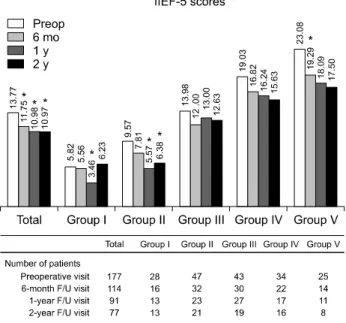
When we analyzed all the patients, there was a sig- nificant postoperative decline in their IIEF-5 scores.
However, in the analysis of each group, the pattern of de- crease varied among the groups. Group V showed the greatest deterioration of IIEF-5 after PVP (Fig. 2).
At postoperative 6 months, there were meaningful changes in the IIEF-5 scores of 55/114 patients (48.2%), with a postoperative increase in 18 cases (15.8%) and a decrease in 37 cases (32.5%). In the multivariate analysis of the preoperative clinical parameters, there was no sig- nificant risk factor associated with a postoperative in- crease in the IIEF-5 scores. On the other hand, body mass index (BMI) (odds ratio=1.184, p=0.044) was the only
preoperative parameter associated with a meaningful de- crease in the postoperative IIEF-5 scores after PVP (Table 3).
DISCUSSION
Recent studies have suggested that BPH is usually ac- companied by ED [15-17]. Despite the improvement in voiding symptoms after BPH surgery, the reported adverse impact of the surgery on erectile function is a major con- cern [4]. Generally, BPH surgery is irreversible. Thus, pro- viding accurate and detailed information to patients about potential adverse effects of the surgical procedure is very
Table 3. Multivariate logistic regression analysis of preoperative predictors for meaningful change in IIEF-5 score after PVP
Variable IIEF-5 score increase IIEF-5 score decrease
OR (95% CI) p-value OR (95% CI) p-value
Age 0.928 (0.844~1.020) 0.123 1.051 (0.979~1.127) 0.168
BMI 1.098 (0.887~1.360) 0.389 1.184 (1.005~1.396) 0.044
DM 0.383 (0.042~3.508) 0.396 0.501 (0.113~2.224) 0.363
HTN 1.791 (0.523~6.135) 0.353 0.552 (0.202~1.507) 0.246
PSA 0.930 (0.748~1.156) 0.513 0.995 (0.914~1.082) 0.900
Prostate volume 1.018 (0.989~1.047) 0.229 1.011 (0.992~1.032) 0.262
IPSS socre 0.955 (0.861~1.060) 0.388 0.960 (0.888~1.038) 0.307
QoL score 0.950 (0.574~1.572) 0.841 1.252 (0.818~1.916) 0.302
Qmax 1.048 (0.935~1.175) 0.423 1.011 (0.918~1.1013) 0.831
PVR 0.998 (0.988~1.008) 0.666 1.001 (0.995~1.007) 0.695
IIEF-5 score 0.944 (0.834~1.069) 0.363 0.987 (0.899~1.084) 0.781
IIEF-5: 5-item International Index of Erectile Function, PVP: photoselective vaporization of the prostate, OR: odds ratio, CI:
Fig. 2. Change in mean International Index of Erectile Function (IIEF-5) scores from preoperative (preop) visit to postoperative 2-year visit for all patients and per each group (Groups were divided into 5 groups according to their preoperative 5-item IIEF-5 scores: Group I [IIEF-5: 5~7, n=28], II [IIEF-5: 8~11, n=47], III [IIEF-5: 12~16, n=43], IV [IIEF-5: 17~21, n=34], and V [IIEF-5: 22~25, n=25].), *p<0.05, significant change compared with preop visit. Combined table showed the number of patients at each visit per group. F/U: follow-up.
important. Various surgical methods have been in- troduced and developed for symptomatic BPH, and the
sexual impact of these methods has been investigated [18-20].
Many researchers have studied changes in erectile func- tion after PVP, but they have not reached a conclusion about the effect of PVP on erectile function [7-14]. As men- tioned earlier, Paick et al [7] reported that sexual function- ing improved after 6 months following treatment with 80-W potassium-titanyl-phosphate (KTP) PVP. Bruyère et al [8] prospectively analyzed the 2-year, long-term out- comes of 149 patients after KTP-PVP in 2010. They con- cluded that, in most cases, the erectile function after PVP was similar to that before PVP. In contrast, Hossack et al [9]
reported that erectile function significantly decreased after HPS-PVP from the prospective study of 328 patients with a 1-year follow-up.
The main cause of these discrepancies is considered to be the variation among the study populations. The mean preoperative IIEF-5 scores were 11.3 in Paick’s study, 8.0 in Bruyère’s study, and 18.4 in Hossack’s study [7-9]. We hypothesized that if the study were to include patients with severe preoperative ED, the postoperative effect of PVP on erectile function would be non-significant, where- as if the study population were composed of patients with normal erectile function, PVP would have a negative ef- fect on erectile function.
In this hypothesis, the changes in erectile function after
www.wjmh.org
PVP might depend on the preoperative erectile function.
Therefore, to evaluate the change in erectile function after PVP, we classified the patients into different groups ac- cording to their baseline IIEF-5 scores. Interestingly, our results showed that the erectile function declined in all the groups after HPS-PVP, with the most notable deterioration observed in patients with normal preoperative erectile function. On closer inspection after dividing the groups, the erectile function of preoperatively normal patients was significantly reduced function at the 6-month visit after PVP. Meanwhile, the previous ED patients did not show a significant change after the surgery.
Comparing the preoperative and postoperative 6- month IIEF-5 scores, 3 patients (10.7%) in group I, 5 pa- tients (10.6%) in group II, 6 patients (14.0%) in group III, and 4 patients (11.8%) in group IV had an increase of more than 5 points in their IIEF-5 scores. There was no sig- nificant increase in the IIEF-5 scores in group V. On the other hand, there was a meaningful decrease in the IIEF-5 scores of 1 patient (3.6%) in group I, 15 patients (31.9%) in group II, 11 patients (25.6%) in group III, 7 patients (20.6%) in group IV, and 3 patients (12.0%) in group V.
The pattern of change in erectile function varied according to the group (Table 1).
The effect of PVP on erectile function is still controver- sial. Thermal injury theory is one of the possible mecha- nisms to explain ED after PVP. Retrograde ejaculation after PVP could also be a cause of sexual dissatisfaction and lead to ED [8,21].
Voiding parameters were significantly improved and sustained at postoperative 2 years, but they were not asso- ciated with the preoperative IIEF-5 scores. Recent studies have shown that the pathophysiology of lower urinary in- fections that accompany BPH, and that of ED are similar.
Therefore, medical treatments for BPH could affect ED and improve erectile function [5,6]. However, in the cur- rent study, the degree of improvement in voiding symp- toms was not associated with a change in erectile function.
In the present study, we performed a multivariate analy- sis of the postoperative 6-month IIEF-5 scores to identify the risk factors associated with a change in erectile function. In the immediate postoperative period, a patient could experience discomfort, resulting in decreased sex- ual activity. Although it is impossible to evaluate the effect
of surgery on erectile function, we judged that 6 post- operative months was enough time for a patient to recover from the temporary effects of the surgery and for normal sexual function to return. We used the postoperative 6-month IIEF-5 score as the main marker of the effect of the surgery and the 1- and 2-year follow-up IIEF-5 scores as markers of gradual progress after surgery. In the current study, patients with a higher BMI had a risk of decreased erectile function after the PVP. High BMI is one of the common risk factors for ED because metabolic syndrome, including obesity, could affect endothelial dysfunction of penile tissue and result in ED [22].
Urologists should inform patients about all possible complications after BPH surgery including deterioration of sexual function. Careful consultation and selection of appropriate patients for PVP is the first step. Reduction of applied energy during PVP and avoiding perioperative complications after PVP would also be helpful in prevent- ing sexual dysfunction after PVP [21,23].
Our study may be limited by its retrospective nature. To avoid selection bias, we applied strict exclusion and in- clusion criteria. The initial review was performed with 177/493 (35.9%) of all consecutive patients. In the end, the final analysis included about 43.5% of the initial pa- tients due to a lack of clinical information and follow-up loss. In addition, we did not assess other comorbidities, medications, and lifestyle factors, including diet and phys- ical activity that could affect erectile function. However, this is the first study of changes in erectile function to take into account preoperative erectile function and to identify the potential preoperative risk factors that may be asso- ciated with a significant change in erectile function after PVP.
CONCLUSIONS
The erectile function declined in all the groups after PVP, with an especially significant deterioration observed in patients with normal preoperative erectile function.
Preoperative BMI was the only independent risk factor for a meaningful decrease in erectile function after PVP.
Disclosure
The authors have no potential conflicts of interest to disclose.
Author Contribution
Research conception & design: Park J, Son H. Data acquisition:
Park J, Cho SY, Cho MC, Jeong H, Son H, Data analysis and inter- pretation: Park J, Cho SY, Cho MC, Jeong H, Son H. Statistical analy- sis: Park J, Cho MC, Son H. Drafting of the manuscript: Park J, Son H.
Critical revision of the manuscript: Park J, Son H. Approval of final manuscript: all authors.
ORCID
Juhyun Park, https://orcid.org/0000-0002-5549-9756 Sung Yong Cho, https://orcid.org/0000-0001-9271-6951 Min Chul Cho, https://orcid.org/0000-0001-7288-1706 Hyeon Jeong, https://orcid.org/0000-0002-0744-1402 Hwancheol Son, https://orcid.org/0000-0001-5033-0153
REFERENCES
1. Kaiser FE. Sexuality and impotence in the aging man. Clin Geriatr Med 1991;7:63-72.
2. Litwin MS, Nied RJ, Dhanani N. Health-related quality of life in men with erectile dysfunction. J Gen Intern Med 1998;13:159-66.
3. Kubin M, Wagner G, Fugl-Meyer AR. Epidemiology of erec- tile dysfunction. Int J Impot Res 2003;15:63-71.
4. Bruskewitz RC. Quality of life and sexual function in pa- tients with benign prostatic hyperplasia. Rev Urol 2003;5:
72-80.
5. Cellek S, Cameron NE, Cotter MA, Fry CH, Ilo D. Microvas- cular dysfunction and efficacy of PDE5 inhibitors in BPH-LUTS. Nat Rev Urol 2014;11:231-41.
6. Carson CC, Rosenberg M, Kissel J, Wong DG. Tadalafil: a therapeutic option in the management of BPH-LUTS. Int J Clin Pract 2014;68:94-103.
7. Paick JS, Um JM, Kim SW, Ku JH. Influence of high-power potassium-titanyl-phosphate photoselective vaporization of the prostate on erectile function: a short-term follow-up study. J Sex Med 2007;4:1701-7.
8. Bruyère F, Puichaud A, Pereira H, Faivre d'Arcier B, Rouanet A, Floc'h AP, et al. Influence of photoselective va- porization of the prostate on sexual function: results of a prospective analysis of 149 patients with long-term fol- low-up. Eur Urol 2010;58:207-11.
9. Hossack TA, Woo HH. Sexual function outcome following photoselective vaporisation of the prostate. Int Urol Nephrol 2012;44:359-64.
10. Kavoussi PK, Hermans MR. Maintenance of erectile func-
11. Spaliviero M, Strom KH, Gu X, Araki M, Culkin DJ, Wong C. Does Greenlight HPS(TM) laser photoselective vapor- ization prostatectomy affect sexual function? J Endourol 2010;24:2051-7.
12. Kumar A, Vasudeva P, Kumar N, Nanda B, Jha SK, Kumar R, et al. A prospective study on the effect of photoselective va- porization of prostate by 120-W high-performance system laser on sexual function. J Endourol 2014;28:1115-20.
13. Kang DH, Cho KS, Ham WS, Choi YD, Lee JY. A systematic review and meta-analysis of functional outcomes and com- plications following the photoselective vaporization of the prostate and monopolar transurethral resection of the prostate. World J Mens Health 2016;34:110-22.
14. Guo Z, Jin X. The volume of prostate can impact the male sexual function following photoselective vaporization of the prostate: results of a prospective analysis of 128 patients with 2-year follow-up. Int Urol Nephrol 2013;45:961-6.
15. Rosen R, Altwein J, Boyle P, Kirby RS, Lukacs B, Meuleman E, et al. Lower urinary tract symptoms and male sexual dys- function: the multinational survey of the aging male (MSAM-7). Eur Urol 2003;44:637-49.
16. Lee JH, Kwon H, Park YW. Association of lower urinary tract symptom/benign prostatic hyperplasia measures with international index of erectile function 5 in middle-aged po- licemen of Korea and the role of metabolic syndrome and testosterone in their relationship. Urology 2013;82:1008-12.
17. Egan KB, Burnett AL, McVary KT, Ni X, Suh M, Wong DG, et al. The co-occurring syndrome-coexisting erectile dys- function and benign prostatic hyperplasia and their clinical correlates in aging men: results from the national health and nutrition examination survey. Urology 2015;86:570-80.
18. Frieben RW, Lin HC, Hinh PP, Berardinelli F, Canfield SE, Wang R. The impact of minimally invasive surgeries for the treatment of symptomatic benign prostatic hyperplasia on male sexual function: a systematic review. Asian J Androl 2010;12:500-8.
19. Bell JR, Laborde E. Update on the sexual impact of treat- ment for benign prostatic hyperplasia. Curr Urol Rep 2012;
13:433-40.
20. Son H, Song SH, Paick JS. Current laser treatments for be- nign prostatic hyperplasia. Korean J Urol 2010;51:737-44.
21. Marra G, Sturch P, Oderda M, Tabatabaei S, Muir G, Gontero P. Systematic review of lower urinary tract symp- toms/benign prostatic hyperplasia surgical treatments on men's ejaculatory function: Time for a bespoke approach?
Int J Urol 2016;23:22-35.
22. Demir O, Demir T, Kefi A, Secil M, Comlekci A, Yesil S, et al. Penile vascular impairment in erectile dysfunction pa- tients with metabolic syndrome: penile Doppler ultrasound findings. Urol Int 2009;82:175-8.
23. Franco G, De Nunzio C, Federico G, Laurenti C. Evaluation of sexual activity after prostatic surgery for benign prostatic hyperplasia assessed by pre-operative and post-operative