* Corresponding author: (E-mail) [email protected], [email protected]
Status, Distribution and Diversity of Invasive Forest Undergrowth Species in the Tropics: a Study from Northeastern Bangladesh
Md. Habibur Rahman*, Mohammed Abu Sayed Arfin Khan, Most. Jannatul Fardusi, and Bishwajit Roy Department of Forestry and Environmental Science, School of Agriculture and Mineral Sciences, Shahjalal University of
Science and Technology, Sylhet-3114, Bangladesh
ABSTRACT : This paper analyzes data on the composition, status, diversity, and distribution pattern of invasive forest undergrowth species in a protected area (Khadimnagar National Park) of Northeastern Bangladesh. Assessment was done by means of stratified random sampling to diversify the invasive forest undergrowth species. For vegetation survey, 45 plots were taken randomly in (2 m × 2 m) circular plot from three topographical regions namely top of the hill, middle slope and plain land (15 plots from each region) and a total of 715 individuals, 22 invasive species belonging to 17 families were recorded from the study site. Among invasive species, shrubs constitute 10 species, herbs 9 species, and vines 3 species respectively. Mass number of invasive undergrowth species was grows in plain land (45.45%) followed by middle slope (31.82%). Based on the survey, invasive undergrowth plants of study areas were also categorized into three degrees of invasiveness e.g., highly invasive, moderately invasive and potentially invasive. Herbs, shrubs, and vines constitute the highest density at Chromolaema odorata (Linn.) King. (1.09), relative density at Chromolaema odorata (Linn.) King. 6.85%; highest and lowest frequency was calculated at Cassia alata L. (64.44%) and Diplazium esculentum (24.44%); for relative frequency the highest was Cassia alata L., which occupies 6.64%. Determination of the abundance of the different species revealed that Cassia alata L., constitutes (3.36) followed by Pteris cretica Wilsonii (3.14) of the area. The presence of invasive undergrowth species always reduced the number of associated species. Therefore, an extensive in-depth long-term investigation, proper policy formulation and management interventions and further study and continuous monitoring on their impacts need to be triggered targeting the control of the invasive undergrowth species of this protected area.
In this aspect, national and international organization could help to conserve its biodiversity.
Keywords : Protected area, Invasive undergrowth species, Diversity index, Quantitative structure, Biodiversity, Bangladesh
INTRODUCTION
In the humid tropical forests, invasive species is an increasingly important disturbance factor and it affects the species composition and the spatial distribution of plants and animals (SCBD, 2001a). Invasive species are a current focus of interest of ecologists, biological conservationists and natural resources managers due to their rapid spread, threat to biodiversity and damage to ecosystems. Invasions may alter hydrology, nutrient accumulation and cycling, and carbon sequestration on grasslands (Polley et. al., 1997).
The global extent and rapid increase in invasive species is homogenizing the world’s flora and fauna (Mooney and Hobbs, 2000) and is recognized as a primary cause of global biodiversity loss (Czech and Krausman, 1997; Wilcove
and Chen, 1998). Bio-invasion may be considered as a significant component on global change and one of the major causes of species extinction (Drake et. al., 1989).
Invasion of biological organisms (e.g. plants, animals, microbes, etc.) in any ecosystem can be referred as bio- invasion. Bio-invasion is a process or phenomenon; it can mean aggressive introduction of invasive species into a new place, new environment, or within the same ecosystem with a different role. This role might be a negative one and that should affect the ecosystems adversely (Biswas, 2003). Biological invasions are now considered one of the main threats to the world’s biodiversity (Mooney and Hobbs, 2000). Invasion success depends on the ecological attributes of the invading plant, the characteristics of the invasion site, and a range of stochastic short-term events
(Davis et· al., 2000). Indeed, the spread of invasive species is now recognized as one of the greatest threats to the ecological and economic well being of the planet (GISP, 2004). It is considered that invasive species can only spread into natural vegetation because of disturbance (Biswas, 2003). Shine et. al., (2000), defined invasive species - “an alien species that becomes established in natural or semi- natural ecosystems or habitat is an agent of change and threatens native biological diversity”. According to SCBD (2001b) invasive alien species-, “species introduced delib- erately or unintentionally outside their natural habitats, where they have the ability to establish themselves, invade, out-compete natives, and take over the new environment”.
Biological species invasions alter ecological systems in a multitude of ways. Worldwide an estimated 80% of enda- ngered species could suffer from losses due to competition with or predation by invasive species (Pimentel et. al., 2005). Invasive species can change the functions of ecosystems.
Introduced species that spread from plantations to natural and semi-natural areas, and into areas set aside for conse- rvation and water production, have considerable impacts on ecosystem properties and functions (de Wit et. al., 2001).
Generally, invasive species are introduced for their rapid growth, efficient dispersal capabilities, large reproductive output, and tolerance to a broad range of environmental condition (Campbell, 2005).
Natural forest of Bangladesh has been facing a serious problems, about large portions of it have already been lost, only a small percentage of forest cover leaving the country. A few researchers across the country, (see for examples, Hossain, 2005; Khan et. al., 2007; Mukul, 2007;
Mukul et. al., 2008; Chowdhury and Koike, 2010) estimated that the total amount of forest cover is nearly about 2.53 million hectares representing approximately 17.5% of the country’s total surface area but according to the document of FAO (2006 and 2007), this figure is only about 0.871 million hectares. However, in 2008, Bangladesh Forest Department published the data on total forest land of Bangladesh is 2.52 million hectares (BFD, 2008). Forests of Sylhet division have substantial ecological and economic importance at local, national, and global scales. Over the
past decades, invasive species have spread significantly in the ecosystem. Invasive species occur outside their natural range. They are non-native plants and animals that harm or cause danger to native plants and animals or other aspects of biodiversity. Invasive species occur in all groups of plants and animals and grow or reproduce at a speed generally faster than the indigenous species. They include competitors, predators, pathogens and parasites. Invasive species compete with native species for nutrients, sunlight, space, soil moisture, etc. They have invaded almost every type of native ecosystem and caused species extinctions.
In Bangladesh various research work have been done to identify the invasive species, their extent, impact on ecos- ystem and biodiversity but no study was so far carried out solely on the status of invasive species as forest underg- rowth, their impact, etc. Therefore, this study will provide the baseline information for the policy makers to understand the status, composition, diversity and structure of forest undergrowth invasive species, as well as to formulate biodiversity conservation planning highlighting prevention of invasive undergrowth species from the forests of Bangladesh along with for using them as sustainable basis (positive impact) and maintenance significant of biodiversity.
METHODOLOGY Study area
Sylhet, situated in the northeastern region of Bangladesh, supports a considerable portion of the country’s forestlands with diversified landscapes including plain lands, hills, reed lands, and fresh water swamp depressions. Sylhet Forest Division laying between 23°55’-25°12’ north latitude and 90°55’-92°30’ east longitude, consists of 46,976 hectares reserve forests, 4,426 hectares acquired forests, 2,160.97 hectares Unclassified State Forest (USF) and 24,109 hectares proposed reserve forests. The whole region is rich in floral diversity including herbs, shrubs, trees, climbers, bamboos, canes, reeds, grasses, and epiphytes (Patwary, 1999). Sylhet is located on the northern bank of the Surma River. The physiography of Sylhet comprises mainly of hill soils,
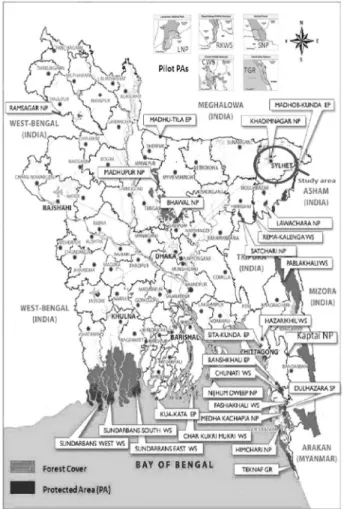
Fig. 1. Location map of the study area
encompassing a few large depressions known locally as
“beels”. The Sylhet Forest Division is extended over four districts, namely Sylhet, Sunamgonj, Moulvibazar, and Hobigonj under the central circle of the Forest Department.
The study was conducted in and around the Khadimnagar National Park (Fig. 1) of Bangladesh. The area was selected purposively considering its unique geo-physical features, richness in biological diversity and households’ dependency on forest resources. Khadimnagar national park is located at North Sylhet Range-1 (sub division) in Sylhet Forest Division under tropical evergreen and semi-evergreen bio- geographic zone. The Khadimnagar National Park formerly known as Khadimnagar Reserve Forest was declared as national park in 2006. National park belongs to the categ- ory-II of IUCN protected area management categories.
Presently, there are 23 notified protected areas in Bangla- desh. The Protected areas of Bangladesh cover nearly
1.7% of total landmass and 11.08% of total forest area of the country (Mukul, 2007). Total area of this national park is 679 hectares, surrounded by three tea gardens, and is submerged with several watersheds locally known as
“chara”. The hills of this area are generally low and gently sloping. Soil ranges from clay loams to pale brown (acidic) clay loams on the hills. The tropical monsoon climate prevails in the area with average maximum temp- erature of 30.7°C and average minimum temperature of 18.9°C. The average annual rainfall is 3931 mm, most of which falls between June-September (BBS/UNDP, 2005).
The forest area is undulating with slopes and hillocks, locally called tilla, ranging from 10-50 m and are scattered in the forest. The study forests are drained by a number of small, sandy-bedded streams, all of which dry out following the end of rainy season in October-November.
This forest is semi deciduous tropical forest, where tall trees are deciduous and the under storey evergreen.
Methods
For this research work, the primary data was collected from early October 2009 to late January 2010. The present study was conducted in two phases namely, topographical site selection and sample plot selection. Data collection from the topographical strata namely top of the hill, middle of the hill and plain land was carried out at the first phase and sample plot selection at the second phase.
Sample plot selection
Total 45 sample plots, 15 from each location, were randomly selected for study. The optimum quadrate size of 2 m × 2 m circular was determined as it minimize the edge effect of taking sample plots. Primary data was coll- ected about invasive species status, and composition, such as counted number of herbs, shrubs, vines, etc. and recorded this for further analysis. The main objective of this survey is to explore the status, diversity, and richness of the invasive species in the Khadimnagar National Park area.
Fig. 2. Status of invasiveness of recorded species of Khadimnagar National park, Bangladesh
Fig. 3. Statistics of invasive undergrowth species of Khadimnagar National park, Bangladesh Quantitative analysis
Within each plot, the number and name of all the plants were counted and recorded. Different species in the area have been gathered and representative samples have been collected for herbarium preparations. The collected speci- mens were identified following Prain (1903), Brandis (1906) and Heinig (1925) and local people and taxonomist.
Density, relative density, frequency, relative frequency, abundance, and Importance Value Index (IVI) were calcu- lated through Shukla and Chandal (2000) and Dallmeier et. al., (1992). In the present study, five diversity indexes were analyzed to get a clear picture of invasive plants diversity of the study area.
1. The Shannon-winner diversity index was calculated according to Michael (1990):
H = -∑ PiLnPi
Where, H = Index of species diversity; Pi = (Number of individuals of one species / Total number of individuals in the samples).
2. Species diversity index was calculated according to Odum (1971): SDI= S/N
Where, SDI = Diversity index; S = number of species;
N = No. of individuals.
3. Species richness index (R) was estimated according to Margelef (1958): R=S-1/logN
Where, R = Species richness index; S= total number of species; N = total number of individuals of all the species.
4. Species evenness index (E), was estimated by following formula given by Pielou (1966): E= H/logS Where, E = Species evenness index; H = Shannon- winner index of diversity; S = Total number of species.
RESULTS Species composition
In the present study, 22 invasive species belonging to 17 families and 715 individuals were identified. The
family Cimpositae, Compositae, Convolvulaceae and Verbenaceae dominates containing two species each. The remaining families contained only one species each (App- endix 1). The present study also explored the invasiveness of the invasive undergrowth species. Among the 22 species highest number of species is fall under the category moderately invasive (10 species) followed by highly invasive (8 species) and the remaining are potentially invasive (4 species) (Fig. 2). Considering the life forms of the invasive undergrowth species, shrubs 10 species (45%) out of 22 were the most frequently encountered invasive species followed by herbs 9 species (41%) and vines 3 species (14%) (Fig. 3 & Appendix 1). Most of the species were found growing in the park, while some are found along roadsides, in wasteland, fallow land, and tea gardens. The invasive undergrowth species composition of Khadimnagar National Park is higher; this might be due to the previous degraded condition of the forest and protective measures were taken very recently after declaring it as a National Park.
Table 1. Status of different invasive undergrowth species at different topography
Topographical site Total species (%) Herbs (%) Shrubs (%) Vines (%)
Top of the hill 22.73 40 60 0.00
Middle slope 31.82 42.86 42.86 14.28
Plain land 45.45 40 40 20
Source: Analysis of field data 2010
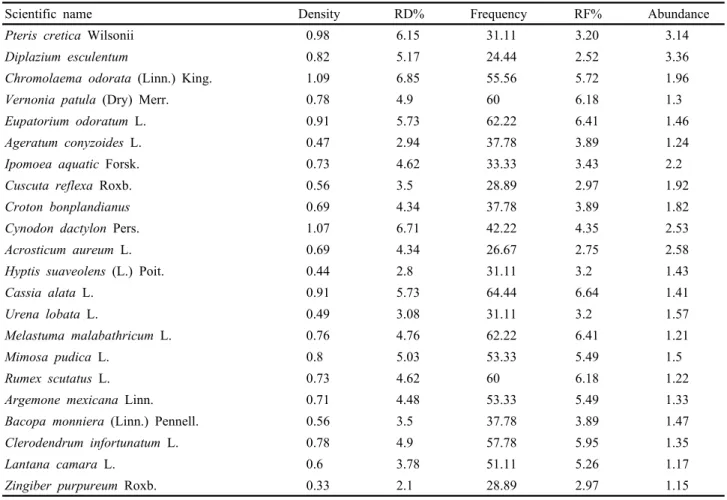
Table 2. Density (D), Frequency (F), Abundance (A), Relative density (RD) Relative Frequency (RF), of invasive undergrowth species in the study area
Scientific name Density RD% Frequency RF% Abundance
Pteris cretica Wilsonii 0.98 6.15 31.11 3.20 3.14
Diplazium esculentum 0.82 5.17 24.44 2.52 3.36
Chromolaema odorata (Linn.) King. 1.09 6.85 55.56 5.72 1.96
Vernonia patula (Dry) Merr. 0.78 4.9 60 6.18 1.3
Eupatorium odoratum L. 0.91 5.73 62.22 6.41 1.46
Ageratum conyzoides L. 0.47 2.94 37.78 3.89 1.24
Ipomoea aquatic Forsk. 0.73 4.62 33.33 3.43 2.2
Cuscuta reflexa Roxb. 0.56 3.5 28.89 2.97 1.92
Croton bonplandianus 0.69 4.34 37.78 3.89 1.82
Cynodon dactylon Pers. 1.07 6.71 42.22 4.35 2.53
Acrosticum aureum L. 0.69 4.34 26.67 2.75 2.58
Hyptis suaveolens (L.) Poit. 0.44 2.8 31.11 3.2 1.43
Cassia alata L. 0.91 5.73 64.44 6.64 1.41
Urena lobata L. 0.49 3.08 31.11 3.2 1.57
Melastuma malabathricum L. 0.76 4.76 62.22 6.41 1.21
Mimosa pudica L. 0.8 5.03 53.33 5.49 1.5
Rumex scutatus L. 0.73 4.62 60 6.18 1.22
Argemone mexicana Linn. 0.71 4.48 53.33 5.49 1.33
Bacopa monniera (Linn.) Pennell. 0.56 3.5 37.78 3.89 1.47
Clerodendrum infortunatum L. 0.78 4.9 57.78 5.95 1.35
Lantana camara L. 0.6 3.78 51.11 5.26 1.17
Zingiber purpureum Roxb. 0.33 2.1 28.89 2.97 1.15
Source: Analysis of field data 2010
The frequency occurrence of the species varied according to topography of the study site. Therefore, this study also calculated the distribution status of invasive undergrowth species in different topographical strata (such as plain land, middle slope, and top of the hill) in the study area that results were given in Table 1. It was initiate that the mass number of invasive undergrowth species grows in plain land (45.45%) followed by middle slope (31.82%) and remaining 22.73% in the top of the hill. The invasive undergrowth species in the category of shrub constituted
the highest amount in the top of the hills (60%) and in case of plain lands (40%) and middle slopes (42.875%) shows the ration between shrubs and herbs are same. The existed vines species was only found to grow in plain lands (20%) and middle slopes (14.28%).
Quantitative characters of the invasive undergrowth species The quantitative structures of invasive vegetation of the study area were based on the i) Density, ii) Relative density,
Table 3. Different diversity indexes for invasive undergrowth species in the study area Categories
The Shannon-Winner diversity Index: H = -∑ PiLnPi
Species diversity index:
SDI= S/N
Species richness index:
R=S-1/logN
Species evenness index:
1. E= H/logS
3.05 0.03 7.36 2.27
Source: Analysis of field data 2010
iii) Frequency, iv) Relative frequency and v)Abundance.
Following (Table 2) was illustrating the quantitative structure of invasive undergrowth plants:
The five species with highest density were Chromolaema odorata (Linn.) King. (1.09), Cynodon dactylon Pers. (1.07), Pteris cretica Wilsonii (0.98), Eupatorium odoratum L.
and Cassia alata L. both (0.91). The highest relative density was found for Chromolaema odorata (Linn.) King. (6.85%), Cynodon dactylon Pers. (6.71%) followed by Pteris cretica Wilsonii (6.15%), Cassia alata L. (5.73%).
The highest frequency was found in Cassia alata L.
((64.44%); Eupatorium odoratum L. and Melastuma mal- abathricum L. each (62.22%) respectively followed by Vernonia patula (Dry) Merr. and Rumex scutatus L. both (60%), Clerodendrum infortunatum L. (57.78%). The highest relative frequency was found in Cassia alata L. (6.64%) followed by two species namely Eupatorium odoratum L., Melastuma malabathricum L. (6.41%) consequently.
For herbs, shrubs and vines, the highest abundance were calculated for Diplazium esculentum (3.36), Pteris cretica Wilsonii (3.14) followed by Acrosticum aureum L.
(2.58), Cynodon dactylon Pers. (2.53). Zingiber purpureum Roxb. (1.15) followed by Lantana camara L. (1.17) have shown the lowest abundance.
Diversity indexes of invasive undergrowth species
Table 3, shows the different diversity indexes for invasive undergrowth species. In the present study, it was found that Shannon-winner index, Species diversity index, Species richness index and Species evenness index were 3.05, 0.03, 7.36, and 2.27 respectively. Higher the value of div- ersity, greater will be the stability of community (Rahman et. al., 2000). Comparing to the above research findings,
Khadimnagar National Park though declared as protected area recently but its invasive species richness index was higher. Therefore, it is very much alarming to prevent the harmful invasive species and a national programme must be initiated to distinguish the harmful from the harmless species and to identify the use and impacts of the former and latter. The Government should be cautious in introdu- cing alien species in plantation programs and should esta- blish clear and effective quarantine regulations for alien (invasive) species that this park may be convert as a very species rich protected area without harmful invasive unde- rgrowth species.
DISCUSSION
Bangladesh is thought to have more than 300 invasive species, which grow either widely cultivated throughout the country. In 19th century, the British were first introduced invasive species in Bangladesh. A good number of alien species are weedy in nature. In Bangladesh, alien species were first introduced as garden or ornamental plants.
Some of them are so well established that they dominant the plants and become noxious to weeds of forests and wetlands (Hossain and Pasha, 2001). The main aim of introduction of invasive species in Bangladesh is to increase productivity of forest resources that support the needs of a huge population. However, a lot of confusion and contr- adiction still exists in the country regarding the definition and term used for invasive alien species. Very few authors’ deals with invasive alien species and their natural habitat in the country (see for example Zabala, 1990;
Rahman, 1997; Ameen, 1999; Hossain and Pasha, 2001;
Barua et. al., 2001; Biswas, 2003; Islam et. al., 2003;
Bhuiyan, 2004; Biswas et. al., 2007; Zuberi and Akter, 2007; Mukul et. al., 2008; Akter and Zuberi, 2009).
Table 4. Impact of invasiveness by invasive undergrowth species in Khadimnagar National park, Bangladesh
Impact Invasive species
Compete with indigenous plants for light, nutrients and moisture
Clerodendrum infortunatum L., Lantana camara L., Melastuma malabathricum L., Urena lobata L., Eupatorium odoratum L.
Impede natural regeneration Pteris cretica Wilsonii, Diplazium esculentum, Mimosa pudica L., Cynodon dactylon Pers., Acrosticum aureum L., Cassia alata L.
Replace indigenous plant communities Cynodon dactylon Pers., Lantana camara L., Eupatorium odoratum L., Chromolaema odorata (Linn.) King., Urena lobata L., Rumex scutatus L.
Source: Analysis of field data 2010
Moreover, due to lack of complete and proper scientific inventory many invasive species are still unknown.
During the study-diversified types of invasive plants were observed, which are mainly trees, shrubs, herbs, grass and climbers but our study was conducted only the undergrowth invasive plants. Several authors (see above) have studied various aspects of Invasive Alien Species (IAS) in Bangladesh to classify a plant species as an invasive alien species the authors have followed the available literature. Mukul et. al., 2008 was conducted a study in Satchari National Park, Sylhet recorded a total of 19 invasive alien species belonging to 12 different families;
among 15 of them were found to have been reported as invasive alien species from various literature.
The invasive plants composition of Khadimnagar National Park is rich compared to state research works although in the present study 22 species were found. This condition might be increase if protective measures will not take very recently after declaring it as a National Park. To address this problem effectively, public awareness about invasive species have to be developed and participatory approach to control the invasive weeds adopted. Students, researchers and common people should understand the risk and impact associated with invasive species and should be motivated to work for eradication of these noxious plants controlling their reproduction and spread.
Impact of invasive species
During past few decades a remarkable amount of forest all over the world has brought and protected under different IUCN management categories but nearly half of
these legally protected areas are heavily used (usually illegally) for agriculture and forest product extraction (McNeely and Scherr, 2003). The magnitude of global biodiversity situation is undoubtedly threatened million times higher than any time of its history (FAO, 2006).
Biodiversity conservation is however essential to improve and alter this crisis. Protected areas have long been the most effective and widespread measure for conserving forests and biodiversity (Lewis, 1996). There is a growing concern about the ecological and economic impacts invasive species have on ecosystems worldwide. Land clearing and human habitation put significant pressure on local species and disturbed habitat is often prone to invasions that can have adverse effects on local ecosystems, changing ecosy- stem functions. A declaration to Article 8 (section h) of the United Nation’s Convention on Biological Diversity (UNCBD, 1992) mentioned that, “each contracting party, shall as far as possible and as appropriate, put off the introduction of, control or get rid of those alien species which threaten ecosystems, habitats or species”. Bangladesh is a signatory country of UNCBD, so it is must be bound to follow the Convention agreement, but it is remorseful that very little has been done in empowering the Protocols on bio-safety and control of invasive species in the forests as well as whole country. Presently, a complete list of invasive species in Bangladesh was not available due to lack of attention in this regard. From the field visit, study found invasive species in every plot (all 45 plots). In Table 4, given a list of impact of invasiveness by invasive species in the Khadimnagar National park. From Table 4, it was found that the invasive species shows mainly three negative impacts with associate species. These are competing
Appendix 1. Recorded invasive undergrowth plants from Khadimnagar National Park of Bangladesh with their invasion status and suspected origin
Family Scientific Name Local Name LFa Invasivenessb Suspected origin and reference(s)
Athyriaceae
Pteris cretica Wilsonii Fern H HI North America (USDA/ARS/GRIN, 2010)
Diplazium esculentum Dekhi shak H PI Throughout Asia and Oceania (Copeland, 1942)
Cimpositae
Chromolaema odorata (Linn.)
King. Asam pata S HI Native to tropical America (Islam, 1991)
Vernonia patula (Dry) Merr. Shialmutra H MI Taiwan (Stone, 1970)
Compositae
Eupatorium odoratum L. Assam lata S HI Central south America and tropical America (Raizada, 2007)
Ageratum conyzoides L. Dochondi S MI Native in Central and South America (Raizada, 2007)
Convolvulaceae
Ipomoea aquatic Forsk. Kolmishak V PI Tropical Africa (Islam, 1991)
Cuscuta reflexa Roxb. Shornolata V MI Europe, North America (Machado and Zetsche, 1990; Costea et. al., 2006) Euphorbiaceae Croton bonplandianus Bon morich S MI South America (Islam, 1991; Das, 1982).
Labiatae Hyptis suaveolens (L.) Poit. Tokma S PI Hawaii, Puerto Rico, Columbia (Wagner et. al., 1990)
Leguminosae Cassia alata L. Dadmardan S PI Amazon region and Tropical Asia (Wikipedia, 2010a)
Malvaceae Urena lobata L. Bon Ukhra S MI USA (Louisiana; Hawaii, Florida) (USDA /ARS/GRIN, 2010) Melastomaceae Melastuma malabathricum L. Bon tej pata S HI USA (Wagner et. al.,1990)
Mimosoidea Mimosa pudica L. Lazzaboti H MI South America (Hossain and Pasha, 2001)
Papaveraceae Argemone mexicana Linn. Shialkata H MI Tropical America and Mexico (Islam, 1991; Das, 1982).
Poaceae Cynodon dactylon Pers. Durba grass H MI North Africa, Asia and Australia and southern Europe. (Wikipedia, 2010b) Polygonaceae Rumex scutatus L. Bon palong H HI Europe. Occasionally naturalized in
Britain (Das, 1982)
Polypodiaceae Acrosticum aureum L. Tiger fern H HI Caribbean Territories, North America (GBIF, 2010)
Scrophulariseeae Bacopa monniera (Linn.) Pennell. Brahmishak V MI
Australasia, Asia-Temperate, Africa, Sri Lanka, China, Taiwan, and Vietnam, southern states of the USA
(Wikipedia, 2010a).
Verbenaceae
Clerodendrum infortunatum L. Vat pata S HI
Philippines Myanmar; Thailand Nepal, Pakistan, Indonesia and India
(USDA/ARS/GRIN, 2010)
Lantana camara L. Komola
lantana S HI
Neotropics, tropical and subtropical America (Binggeli et. al. 1998; Raizada, 2007)
Zingiberaceae Zingiber purpureum Roxb. Bon ada H MI Caribbean (NPDC, 2010) Source: Analysis of field data 2010
Key: aLF=Life forms; bInvasiveness= HI, highly invasive; MI, Moderately invasive; PI, Potentially invasive.
with indigenous plants for light, nutrients, and moisture, impede natural regeneration, and replace indigenous plant communities. They are fast growing and most of them have deep root penetration. As a result, they can uptake more water and nutrient from the soil. Because of their invasiveness, the amount of microorganism in the upper layer of soil is in very limited amount. Mycorrhizae enrich the soil fertility by decomposing litter. There is limited amount of natural regeneration. Due to the openness, soil surface temperature is increasing which is not a good sign for indigenous species. The negative ecological impact of invasive species highlighted in this study stresses several reasons for concern.
Ecological association
During the field visit, it was found that, few invasive species show some kind of ecological association. In the three topographical sites the invasive species Clerodendrum infortunatum L., Vernonia patula (Dry) Merr. Argemone mexicana Linn. were mostly associated with Tectona grandis. In the Khadimnagar National park, other invasive species such as Rumex scutatus L., Acrosticum aureum L., Urena lobata L., Zingiber casumnar and Cuscuta reflexa Roxb. mostly associate with plantation species like Tectona grandis, Michelia champaca, Syzygium grande, Chickrasia tabularis, Artocarpus chaplasha and Dipterocarpus turbinatus. Other invasive species like, Chromolaema odorata (Linn.) King., Cynodon dactylon Pers., Eupatorium odoratum L., Mimosa pudica L., Clerodendrum infortun- atum L., Lantana camara L. were found growing along roadsides, in waste and fallow lands, tea gardens. Acrosticum aureum L., Diplazium esculentum, Pteris cretica Wilsonii and Ipomoea aquatic Forsk. were found mostly along watershed areas.
CONCLUDING REMARKS
Invasive forest undergrowth species are able to invade new habitats and constantly extend their distribution, thereby representing a threat to native species, human health, or
other economic or social interests. Still the native plant species of the country have been enriched with new species and varieties introduced from overseas but the invasive plants are becoming a major threat to natural ecosystems and other species. In recent times, higher anthropogenic and change in the disturbance regimes resulted in the depletion of the species diversity as well as invasion of other plants. Furthermore, in our study area increased human population has resulted in increased demands for natural resources, leading to severe resource exhaustion, especially deforestation. A number of invasive species are known, or would appear, to have a major impact on Sylhet Forest ecosystem. These species affect the forest ecosystem through different ways. These negative impacts are ecolo- gical, economic, and environmental. In Khadimnagar National park, as far as our exploration shows invasion is still at convenient stage. Adequate measures should be taken to protect Khadimnagar National Park from this problem. In spite of this, extensive in-depth long-term investigation on the invasive plants of Khadimnagar National park and further study is highly recommended to reexamine the present findings. Proper policy formulation and management interventions also need to be triggered targeting the control of the invasive plants of Khadimnagar National park as well as Sylhet Forest Division. The national and international organization and media concerned with biod- iversity conservation should give more emphasis on well plan and have to be ensured scientific management of forest so that it would be a potential biodiversity conserv- ation area of Bangladesh.
REFERENCES
Akter, A., and M. I. Zuberi. 2009. Invasive alien species in Northern Bangladesh: Identification, inventory and impacts. International Journal of Biodiversity and Conservation 1(5):129-134.
Ameen, M. 1999. Development of Guiding Principles for the Prevention of Impacts of Alien Species. Consultative workshop.
The 4th Meeting of SBSTTA to CBD, IUCN Bangladesh, Dhaka, May 25, 1999.
Barua, S. P., Khan, M. M. H., and A. H. M. A. Reza. 2001. The Status of Alien Invasive Species in Bangladesh and their Impact on the Ecosystems. In: Alien Invasive Species- Report of workshop
on Alien Invasive Species, Balakrishna, P. (eds.). IUCN Regional Biodiversity Programme of Asia, Colombo, Sri Lanka, pp. 1-7.
BBS/UNDP. 2005. Compendium of Environment statistics of Bang- ladesh. Bangladesh Bureau of Statistics/United Nations Development Programme, Ministry of Planning, Government of the People’s Republic of Bangladesh. pp. 11-227.
BFD. 2008. Bangladesh Forest Department. Ministry of Environment and Forest, Government of the People’s Republic of Bangladesh, Dhaka. Available online at www.bforest.gov.bd; last accessed Mar. 07, 2010.
Bhuiyan, B. A. 2004. Major Invasive Alien Species of Bangladesh.
Invasive Species and the Compendium programme at CAB international. Available online at: www.gisinetworkorg/Documents/
ProceedingsPDF/GISINProc2004AppE.Pdf; last accessed Mar. 7, 2010.
Binggeli, P., Hall J. B. and J. R. Healey. 1998. An overview of invasive woody plants in the tropics. School of Agricultural and Forest Sciences, University of Wales, Bangor.
Biswas, S. R. 2003. Invasive plants of Sundarbans. In: Interim report under SBCP project, IUCN Bangladesh, pp. 34.
Biswas, S. R., Choudhury, J. K., Nishat, A., and Rahman, M. M.
2007. Do invasive plants threaten the Sundarbans mangrove forest of Bangladesh? Science Direct, For. Ecol. Manage. 245:19.
Brandis, D. 1906. Indian Trees. Periodical Experts Book Agency, Delhi, India; 1906 (rep1978): p. 767.
Campbell, S. 2005. A global perspective on forest invasive species:
the problem, causes, and consequences. In: The unwelcome guests-Proceedings of the Asia- Pacific Forest Invasive Species Conference, McKenzie, P., Brown, C., S. Jianghua, and Jian, W.
(eds). FAO-RAP, Bangkok, pp. 9-10.
Chowdhury, M. S. H., and M. Koike. 2010. An overview on the protected area system for forest conservation in Bangladesh.
Journal of Forestry Research 21(1):111-118.
Copeland, E. B. 1942. Edible Ferns. American Fern Journal 32 (4):
121-126.
Costea, M., Nesom, G. L. and S. Stefanovic. 2006. Taxonomy of the Cuscuta pentagona complex (Convolvulaceae) in North America. Sida 22(1):151-175.
Czech, B., and P. R. Krausman. 1997. Distribution and causation of species endangerment in the United States. Science 277:116-117.
Dallmeier, F., Kabel, M., and R. Rice. 1992. Methods for long- term biodiversity inventory plots in protected tropical forests. In:
Long- term monitoring of biological diversity in tropical forest areas methods for establishment and inventory of permanent plots, MAB digest II, Dallmeier (eds.). UNESCO, Paris, pp.
11-46.
Das, S. 1982. Introduction of exotics in the plantation forestry of Bangladesh. Proc. Second Bangladesh National Conference on Forestry, Dhaka. pp. 85-93.
Davis, M. A., Grime, J. P. and K. Thompson. 2000. Fluctuating resources in plant communities: a general theory of invasiblity.
Journal of Ecology 88:528-534.
de Wit, M. P., Crookes, D. J., and B. W. van Wilgen. 2001.
Conflicts of interest in environmental management: estimating
the costs and benefits of a tree invasion. Biological Invasions 3:
167-178.
Drake, J. A., Mooney, H. A., Castri, F. D., Groves, R. H., Kruger, F. J., Aejmamek, M., and M. Williamson. 1989. Biological Invasions: a global perspective. Chichester: John Wiley and Sons.
FAO. 2006. Global Forest Resource Assessment 2005: Progress towards sustainable forest management. Food and Agriculture Organization of the United Nations, Rome, Italy. FAO Forestry Paper 147, p. 320.
FAO. 2007. State of the world’s forests 2007. Food and Agriculture Organization of the United Nations, Rome, Italy, pp. 144.
GBIF. 2010. Biodiversity occurrence data accessed through GBIF Data Portal. Available online at: www.itis.gov/servlet/SingleRpt/
SingleRpt?search_topic=TSN&search_value=17305; last accessed Mar. 06, 2010.
GISP. 2004. Tropical Asia invaded: the growing danger of invasive alien species. The Global Invasive species programme. p.64.
Heining, R. L. 1925. List of plants of Chittagong collectorate and Hill Tracts. Darjeeling press, India.
Hossain, M. K., and M. K. Pasha. 2001. Alien invasive plants in Bangladesh and their impacts on the ecosystem. In: Assessment and Management of Alien Species that Threatened Ecosystem:
Habitats and Species. Secretariat of the Convention on Biological Diversity, Montreal, Canada. CBD, Technical Paper No. 1, pp.
73-75.
Hossain, M.K. 2005. Conversion of dipterocarps-dominant natural forests to short rotation plantations- an unrecoverable threat to the native dipterocarps in Bangladesh. Available online at:
www.apafri.org/8thdip/Session%204/S4_Hossain.doc; last accessed Mar. 07, 2010.
Islam, A.K.M.N. 1991. Two centuries of plant studies in Bangladesh and adjacent regions.Asiatic Society of Bangladesh, Dhaka, Bangladesh.
Islam, M. M., Amin, A. S. M. R., and S. K. Sarker. 2003. National Report on Alien Invasive Species of Bangladesh. In: Invasive Alien Species in South-Southeast Asia: National Reports on Directory of Resources, Pallewatta, N., Reaser, J.K. and A.T.
Gutierrez. (eds.), Global Invasive Species Programme, Cape Town, South Africa, pp. 7-24.
Khan, M.A.S.A., Uddin, M. B., Uddin, M. S., Chowdhury, M. S.
H. and S. A. Mukul. 2007. Distribution and Status of Forests in the Tropic: Bangladesh Perspective. Proc. Pakistan Acad. Sci.
44(2):145-153.
Lewis, C. (eds.) 1996. Managing conflicts in Protected Areas. Keystone Center and IUCN. Gland, Switzerland, pp.100.
Machado, M. A., and Zetsche, K. 1990. A structural, functional and molecular analysis of plastids of the holoparasites Cuscuta reflexa and Cuscuta europaea. Planta 181:91-96.
Margalef, R. 1958. Information theory in ecology. General Systematics 3:36-71.
McNeely, J., and S. Scherr. 2003. Ecoagriculture: Strategies to feed the world and conserve wild biodiversity. Island Press, Washington, D.C.
Michael, P. 1990. Ecological methods for field and laboratory
investigation. Tata Mc Graw Hill Publishing Co. Ltd., New Delhi, India. pp. 404.
Mooney, H. A., and R. J. Hobbs. 2000. Invasive Species in a Changing World. Island Press, Washington, DC.
Mukul, S. A. 2007. Biodiversity conservation strategies in Bangladesh:
The state of protected areas. Tigerpaper 34(3):28-32.
Mukul, S. A., Uddin, M. B. Uddin, M. S. and M.A.S.A. Khan.
2008. Protected areas of Bangladesh: current status and efficacy for biodiversity conservation. Proc. of Pakistan Acad. Sc. 45(2):
59-68.
Mukul, S.A., Uddin, M. B., and M. R. Tito. 2008. Study on the Status and various uses of Invasive Alien Plant Species in and around Satchari National Park, Sylhet, Bangladesh. In: TigerPaper, FAO. Volume XXXV: No. 4 (October- December, 2008), pp.6-9.
NPDC. 2010. Plant database. Available online at: www.plants.usda.gov;
last accessed Mar. 04,2010.
Odum, P. 1971. Fundamentals of Ecology. W. B. Sounder Co., Philadelphia, USA.
Patwary, A. H. 1999. Sylhet Forest Division: At a glance (in Bengali). Sylhet Forest Division, Bangladesh Forest Department, Ministry of Environment and Forest, Government of the People’s Republic of Bangladesh, Dhaka. p-56.
Pielou, E. C. 1996. Species diversity and pattern diversity in the study of ecological succession. Journal of Theoretical Biology 10:370-383.
Pimentel, D., Zuniga, R., and D. Morrison. 2005. Update on the environmental and economic costs associated with alien-invasive species in the United States. Ecological Economics 52:273-288.
Polley, H. W., Johnson, H. B., and H. S. Mayeux. 1997. Leaf physiology, production, water use, and nitrogen dynamics of the grassland invader Acacia smallii at elevated CO2 concentrations.
Tree-Physiology 17(2):89-96.
Prain, D. 1903. Bengal Plants, Vol. (1and 2); Calcutta, India.
Rahman, A. K. A. 1997. Fish Marketing in Bangladesh. In: Open- water Fisheries of Bangladesh, Chu-Fa Tsai, M Yousuf Ali (eds.). BCAS/University Press Limited, Dhaka.
Rahman, M. L., Hossain, M. K., and Q. M. N. Karim. 2000.
Diversity and composition of tree species in Chunati Wildlife Sanctuary of Chittagong Forest Division, Bangladesh. The Chittagong University Journal of Forest Science 24(1):89-97.
Raizada, P. 2007. Invasive Species: The concept, invasion process, and impact and management of invaders. Archives of Enviro
News. India ISED Newsletter 13(3):12-15.
SCBD. 2001a. Assessment and management of alien species that threaten ecosystems, habitats and species. Abstracts of keynote addresses and posters presented at the sixth meeting of the Subsidiary Body on Scientific, Technical and Technological Advice, held in Montreal, Canada, from 12 to 16 March 2001.
Montreal, Secretariat of the Convention on Biological Diversity, (CBD Technical Paper no. 1), pp. 78.
SCBD. 2001b. Assessment and management of alien species that threaten ecosystems, habitats and species. Abstracts of keynote addresses and posters presented at the sixth meeting of the Subsidiary Body on Scientific, Technical and Technological Advice, held in Montreal, Canada, from 12 to 16 March 2001.
Montreal, Secretariat of the Convention on Biological Diversity, (CBD Technical Paper no. 1), pp. 1.
Shine, C., Williams, N. and L. Gundling. 2000. A guide to designing legal and institutional frameworks on alien invasive species.
IUCN , Switzerland and United Kingdom. Vol. 40.
Shukla, R. S. and P. S. Chandel. 2000. Plant Ecology and Soil Science. 9th Edn. S. Chand and Company Limited. Ramnagor, New Delhi-110055. pp. 121-376.
Stone, B. C. 1970. The flora of Guam. Micronesica 6(1):659.
UNCBD. 1992. Convention on biological diversity, Text and Annexes, the Interim Secretariat for the UNCBD, Geneva Executive Center.
USDA/ARS/GRIN. 2010. National Genetic Resources Program online database. Available online at: www.plants.usda.gov; last accessed Mar. 10, 2010.
Wagner, W. L., Herbst, D. R. and S. H. Sohmer. 1990. Manual of the flowering plants of Hawai'i, 2 vols.
Wikipedia. 2010a. Available online at: www.en.wikipedia.org/wiki/
Bacopa_monnieri; www.ars-grin.gov/cgi-bin/npgs/html/taxon.pl?102292;
last accessed Mar. 04, 2010.
Wikipedia. 2010b. Available online at: www.en.wikipedia.org/wiki/
Cynodon_dactylon; last accessed Mar. 04, 2010.
Wilcove, D. S., and L.Y. Chen. 1998. Management costs for endangered species. Conserv. Biol. 12:1405-1407.
Zabala, N. Q. 1990. Silviculture of species, development of profess- ional education in the Forestry Sector. Bangladesh Institute of Forestry, Chittagong University, Bangladesh.
Zuberi, M. I., and A. Akter. 2007. An account of invasive alien species (IAS) of flowering plants in Bangladesh. Plant Environment Development 1(1):67-74.
(Received June 16, 2010; Accepted November 23, 2010)