* Corresponding author: (E-mail) [email protected]
Comparison of Plant Diversity of Natural Forest and Plantations of Rema-Kalenga Wildlife
Sanctuary of Bangladesh
Norul Alam Sobuj*, and Mizanur Rahman
Department of Forestry and Environmental Science, School of Agriculture and Mineral Sciences, Shah Jalal University of Science and Technology, Sylhet-3114, Bangladesh
ABSTRACT : The purpose of the study was to assess and compare the diversity of plant species (trees, shrubs, herbs) of natural forest and plantations. A total of 52 plant species were recorded in the natural forest, of which 16 were trees, 15 were shrubs and 21 were herbs. On the contrary, 31 species of plants including 11 trees, 8 shrubs and 12 herbs were identified in plantation forest. Shannon-Wiener diversity index were 2.70, 2.72 and 3.12 for trees, shrubs and herbs respectively in the natural forest.
However, it was 2.35 for tree species, 2.31 for shrub species and 2.81 for herb species in the plantation forest. Jaccard’s similarity index showed that 71% species of trees, 44% species of shrubs and 43% species of herbs were same in plantations and natural forest.
Keywords : Shannon-Wiener diversity index, Jaccard’s similarity index, Natural forest, Plantation forest, Plant diversity
INTRODUCTION
Biodiversity is the relationship between species and their pattern of richness (Young and Swiacki, 2006). The preservation of biodiversity is now a central issue of world conservation strategies. Bangladesh is a part of the Indo-Burma region which is one of the ten global hot spot areas for biodiversity and supposed to have 7000 endemic plant species (Mittermeier et al., 1998). Due to its unique geo-physical location Bangladesh is a heritage of rich biological diversity (Chowdhury, 2001; Nishat et al., 2002). About 5,700 species of angiosperms alone, including 68 woody legumes, 130 fiber yielding plants, 500 medicinal plants, 29 orchids, three species of gymno- sperms and 1700 pteridophytes have been recorded from Bangladesh (Troup, 1975; Khan, 1977; Firoz et al., 2004).
In Bangladesh, plantation establishment was started in the Chittagong Hill Tracts with Teak (Tectona Grandis) at its high value since 1871. In 1921 it was expanded to other hilly regions but total annual plantation area never exceeded 400 ha/year (GoB, 1992). After 1950, even
though Teak continued to predominate, other species (Dipterocarpus spp., Lagerstroemea spp., Artocarpus spp., Cedrela sp., Gmelina sp. ect.) were planted on a sizable scale (GoB, 1992). The main objectives were to meet the demand of timber, increase the productivity and financial profit, supply industrial raw material and timber, and achieve self reliance of forest products (Pant, 1990).
Plantations exceed natural forests any time in stumpage, the usual means of evaluating timber value. But natural forests produce a much wider range of goods beyond timber.
Beyond that the natural forest provides environmental services more effectively than plantations. The services include ecological stability, watershed protection, genetic resources conservation, recreation and tourism (Panayatou and Ashton, 1992).
The Rema-kalenga Wildlife Sanctuary is a tropical evergreen and semi-evergreen forest (Mountfort and Poore, 1968; Sarker and Haq, 1985,) and much of it is primary forest (Uddin et al., 2002). A floristic survey conducted by BCAS (1997) in Rema-kalenga Wildlife Sanctuary and recorded 72 species of vascular plants.
Natural forests of the sanctuary were converted by raising long rotation plantations (of Tectona grandis, Swietenia mahagoni, Dipterocarpus turbinatus, Albizia procera, Shorea robusta, Gmelina arborea, Dalbergia sissoo, Toona ciliata, Aquilaria malacensis, Lagerstroemia speciosa, Artocarpus chaplasha, Syzygium grande, etc) taken up from late twenties for production forestry. From ecological and conservation view point, assessment of biodiversity of any habitat or locality has been regarded as one of the vital issue for careful preservation, promotion and management of the variety of life-forms (Alam and Masum, 2005). The objective of this paper is to compare the diversity of plant species (trees, shrubs, herbs) of natural forest and plantation forest of the study site. Therefore, adequate measures would be taken to conserve and enrich its diversity according to forest types.
MATERIALS AND METHODS Study site
Rema-Kalenga Wildlife Sanctuary is located at Chun- arughat upazila (sub-district; administrative entity) of Habigonj district in Sylhet division. It is about 130 km east-north east of Dhaka and about 80 km south south-west of Sylhet city. With an area of 1795 ha, the Wildlife Sanctuary was established in 1996. Previously it was Tarap Hill Reserve Forest (NSP, 2007). The sanctuary encompasses several hills of different elevations and the low-laying valleys. The highest peak of the hills is about 67 m from the sea level (Rizvi, 1970). The hills are composed of Upper Tertiary rocks in which sandstone largely predominates (Ahmad, 1970) along with siltstones and mudstones, locally altered to slates and shales. Soil of the sanctuary varies from clay to sandy loam exceedingly fertile and show low pH. In some cases, soils texture consists of yellowish red sandy clay mixed with granules of magniferous iron ore (Ahmed, 1970). The sanctuary enjoys a most tropical climate characterized by a period of high precipitation from April to September
and five months of relatively dry period from November to March.
Methods
The study was carried out through stratified random quadrate method. Data were collected from both the plantations and natural forest of the sanctuary. The vegetation analysis was carried out by 24, 20 m × 20 m sample plots placed randomly for tree layer. From each forest site equal 12 sample plots were taken. For herb and shrub species 5, 2 m × 2 m sample plots were nested within each plot of tree layer (Total 120 plots, 60 from natural forest and 60 from plantation forest). After collection of field data, they were analyzed for richness, Shannon- Wiener diversity index and Jaccard’s similarity index.
Species richness
At its simplest level, diversity can be defined as the number of species found in a community, a measure known as Species Richness. Species richness was determined following Whittaker (1976) by tabulating the number of tree, shrub and herb species in the natural and plantation forest of the study area.
The Shannon- Wiener diversity index
One of the most commonly used measures of species diversity is the Shannon- Wiener diversity index. It combines two quantifiable measures; 1. the species richness (the number of species in the community) and 2. species equitability (how even are the numbers of individuals of each species). The higher the number, the higher is the species diversity. The index equals zero when there is only a single species, increases with richness and evenness, and commonly has a value between 1.5 and 3.5 for many sampled ecological communities (Legendre and Legendre, 1998). The Shannon- wiener index for diversity was calculated according to Michael (1990) and it is as follows:
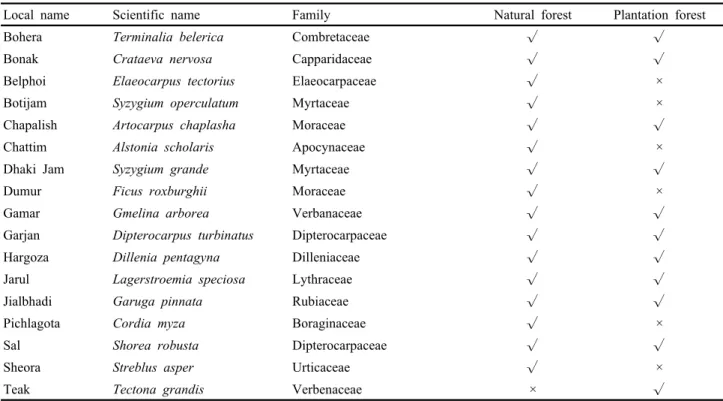
Table 1. Tree species composition in natural and plantation forest of the study area
Local name Scientific name Family Natural forest Plantation forest
Bohera Terminalia belerica Combretaceae √ √
Bonak Crataeva nervosa Capparidaceae √ √
Belphoi Elaeocarpus tectorius Elaeocarpaceae √ ×
Botijam Syzygium operculatum Myrtaceae √ ×
Chapalish Artocarpus chaplasha Moraceae √ √
Chattim Alstonia scholaris Apocynaceae √ ×
Dhaki Jam Syzygium grande Myrtaceae √ √
Dumur Ficus roxburghii Moraceae √ ×
Gamar Gmelina arborea Verbanaceae √ √
Garjan Dipterocarpus turbinatus Dipterocarpaceae √ √
Hargoza Dillenia pentagyna Dilleniaceae √ √
Jarul Lagerstroemia speciosa Lythraceae √ √
Jialbhadi Garuga pinnata Rubiaceae √ √
Pichlagota Cordia myza Boraginaceae √ ×
Sal Shorea robusta Dipterocarpaceae √ √
Sheora Streblus asper Urticaceae √ ×
Teak Tectona grandis Verbenaceae × √
Note: √ = presence; × = absence H = - ∑ PiLnPi
Where, H = Index of species diversity
Pi = Number of individuals of one species / Total number of individuals in the samples Jaccard’s similarity index
The Jaccard’s (1912) index is a valuable tool because it allows one to determine whether two communities are composed of similar species.
The Jaccard’s Index is calculated as Jaccard’s Index = A/ (A+B+C)
Where, A = total number of species present in both communities
B = the number of species present in community 1 but not 2
C = the number of species present in community 2 but not 1
If the Jaccard’s Index is equal to one (B=0 & C=0),
all species are shared between the two communities. If the Jaccard’s Index is near 0, few if any species are shared.
RESULTS Composition of tree species in the study area
A total of 16 species of trees distributed into 13 families were recorded from the natural forest of the study site. The dominant families were Dipterocarpaceae, Moraceae and Myrtaceae containing 2 species each. The remaining families were represented by single species.
On the contrary, there were 11 tree species belonged to 9 families found in the plantation forest of the study area.
It was found that family Dipterocarpaceae and Verbenaceae comprised the highest number of species (2 species each).
Rest of the families occupied one species each. In the present study, 10 species were common occurred both in the plantations and natural forest. These were Terminalia belerica, Crataeva nervosa, Artocarpus chaplasha, Syzygium
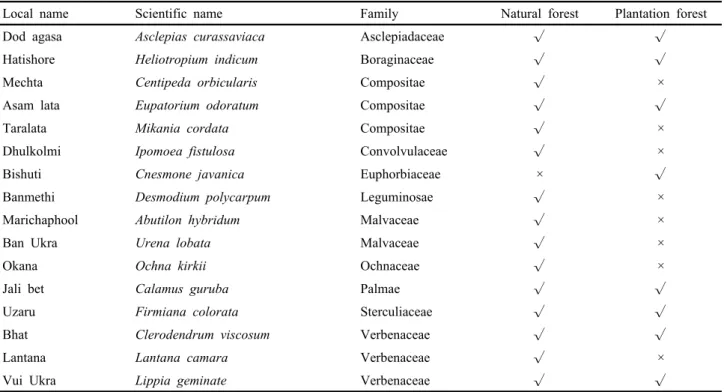
Table 2. Shrub species composition in natural and plantation forest of the study area
Local name Scientific name Family Natural forest Plantation forest
Dod agasa Asclepias curassaviaca Asclepiadaceae √ √
Hatishore Heliotropium indicum Boraginaceae √ √
Mechta Centipeda orbicularis Compositae √ ×
Asam lata Eupatorium odoratum Compositae √ √
Taralata Mikania cordata Compositae √ ×
Dhulkolmi Ipomoea fistulosa Convolvulaceae √ ×
Bishuti Cnesmone javanica Euphorbiaceae × √
Banmethi Desmodium polycarpum Leguminosae √ ×
Marichaphool Abutilon hybridum Malvaceae √ ×
Ban Ukra Urena lobata Malvaceae √ ×
Okana Ochna kirkii Ochnaceae √ ×
Jali bet Calamus guruba Palmae √ √
Uzaru Firmiana colorata Sterculiaceae √ √
Bhat Clerodendrum viscosum Verbenaceae √ √
Lantana Lantana camara Verbenaceae √ ×
Vui Ukra Lippia geminate Verbenaceae √ √
Note: √ = presence; × = absence
grande, Gmelina arborea, Dipterocarpus turbinatus, Dillenia pentagyna, Lagerstroemia speciosa, Garuga pinnata and Cordia myza. However, there were 6 species namely, Elaeocarpus tectorius, Syzygium operculatum, Alstonia scholaris, Ficus roxburghii, Cordia myza and Streblus asper recorded only from natural forest. On the other hand, one species named Tectona grandis was confined to plantation site only (Table 1).
Composition of shrub species in the study area
During the present study, 15 species of shrubs under 10 families were identified in the natural forest. The highest number of species were belonged to Compositae and Verbenaceae families (3 species each) followed by Malvaceae (2 species). Rest of the families contained one species each. In contrast, 8 species of shrubs of 7 families were recorded from the plantation sites. Most of the species was represented by Verbenaceae contained 2 species, while the remaining 6 families had one species each. There were 7 species namely, Asclepias curassaviaca,
Heliotropium indicum, Eupatorium odoratum, Calamus guruba, Firmiana colorata, Clerodendrum viscosum and Lippia geminate found in the both types of forests.
However, eight of the total recorded species were limited to natural forest. These were Centipeda orbicularis, Mikania cordata, Ipomoea fistulosa, Desmodium polycarpum, Abutilon hybridum, Urena lobata, Ochna kirkii and Lantana camara. But, Cnesmone javanica was the only species found no where of natural forest (Table 2).
Composition of herb species in the study area
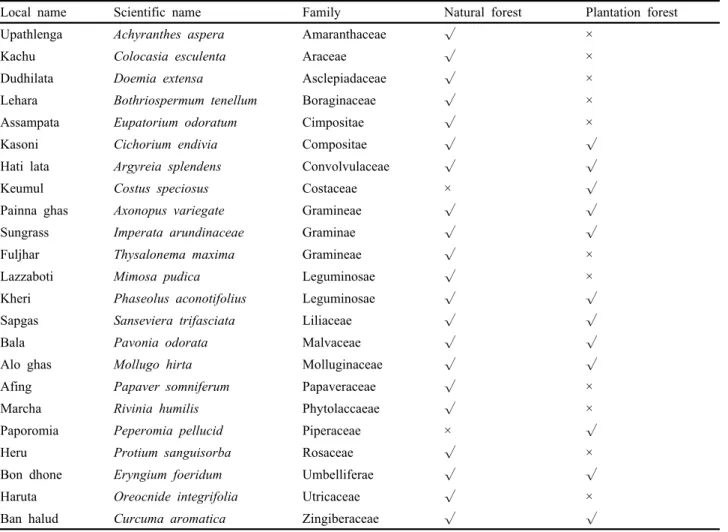
Herb species inventory of the natural forest of the study area yielded a total of 21 species belonged to 17 families. It was found that the family Gramineae occupied the highest number of species (3 species) followed by Compositae and Leguminosae (2 species each). The remaining families contained one species each. On the other hand, 12 species of herbs of 11 families were identified in the plantation forest. The family Gramineae dominated containing two species, whereas the remaining
Table 3. Herb species composition in natural and plantation forest of the study area
Local name Scientific name Family Natural forest Plantation forest
Upathlenga Achyranthes aspera Amaranthaceae √ ×
Kachu Colocasia esculenta Araceae √ ×
Dudhilata Doemia extensa Asclepiadaceae √ ×
Lehara Bothriospermum tenellum Boraginaceae √ ×
Assampata Eupatorium odoratum Cimpositae √ ×
Kasoni Cichorium endivia Compositae √ √
Hati lata Argyreia splendens Convolvulaceae √ √
Keumul Costus speciosus Costaceae × √
Painna ghas Axonopus variegate Gramineae √ √
Sungrass Imperata arundinaceae Graminae √ √
Fuljhar Thysalonema maxima Gramineae √ ×
Lazzaboti Mimosa pudica Leguminosae √ ×
Kheri Phaseolus aconotifolius Leguminosae √ √
Sapgas Sanseviera trifasciata Liliaceae √ √
Bala Pavonia odorata Malvaceae √ √
Alo ghas Mollugo hirta Molluginaceae √ √
Afing Papaver somniferum Papaveraceae √ ×
Marcha Rivinia humilis Phytolaccaeae √ ×
Paporomia Peperomia pellucid Piperaceae × √
Heru Protium sanguisorba Rosaceae √ ×
Bon dhone Eryngium foeridum Umbelliferae √ √
Haruta Oreocnide integrifolia Utricaceae √ ×
Ban halud Curcuma aromatica Zingiberaceae √ √
Note: √ = presence; × = absence
families were represented by single species each. Study revealed that 10 species such as Cichorium endivia, Argyreia splendens, Axonopus variegate, Imperata arundinaceae, Phaseolus aconotifolius, Sanseviera trifasciata, Pavonia odorata, Mollugo hirta, Eryngium foeridum and Curcuma aromatica were common in both types of forests. But, 11 species namely, Achyranthes aspera, Colocasia esculenta, Doemia extensa, Bothriospermum tenellum, Eupatorium odoratum, Thysalonema maxima, Mimosa pudica, Papaver somniferum, Rivinia humilis, Protium sanguisorba and Oreocnide integrifolia were reported only in natural forest.
Costus speciosus and Peperomia pellucid were identified in plantation forest only (Table 3).
Diversity indices of plant species of natural forest and plantations of the study area
Table 4 illustrates the Shannon-Wiener diversity index and the Jaccard’s similarity index of plantation forest and natural forest of the study area. The Shannon-Wiener diversity index is the most widely used species diversity measure. A rich ecosystem with high species diversity has a large value for the Shannon-Wiener diversity index (H), whereas an ecosystem with little diversity has a low H. With regard to the tree species, Shannon-Wiener diversity index of natural forest was 2.70, while it was 2.35 for plantation forest. Regarding shrub species, Shannon-Wiener diversity index was 2.72 in natural forest and 2.31 in plantation forest. With respect to the
Table 4. Diversity indices of plant species of natural and plantation forest of the study area
Diversity index Tree Shrub Herb
Natural Plantation Natural Plantation Natural Plantation
Shannon- Wiener index 2.70 2.35 2.72 2.31 3.12 2.81
Jaccard’s similarity index 0.71 0.44 0.43
herb species, Shannon- Wiener diversity index were 3.12 and 2.81 in natural and plantation forest respectively.
Therefore, natural forest of the study area was more diverse than plantation forest. Although the Shannon- Wiener diversity index provides us with method of quantifying the degree to which species in a community are represented, the Jaccard’s similarity index allows us to quantify the degree of overlap between the species in the two communities. The lower the values of the similarity index, the higher the heterogeneity. Jaccard’s similarity index were 0.71 for trees, 0.44 for shrubs, and 0.43 for herb species in the study site. Result demonstrated that 71% tree species was common between natural and plantation forest. In case of shrubs, 44% species were overlapped between plantation and natural forest.
Concerning herbs, 43% species was similar to both types of forests. So, composition of plant species was varied between the two forests.
DISCUSSION
Distinguishing plant communities has been at the centre of plant science for centuries, with a traditional focus on the distribution, composition and classification of plant communities (Kashian et al., 2003). Plant communities are differentiated from each other based on indicator species in combination with a distinctive floristic composition. The latter is considered as one of the major distinguishing characters of a community (Dansereau, 1960). In the study area, there were some species those occurred either in plantation forest or natural forest only and constituted different species composition. Plantation forest of the study site was comparatively undisturbed than natural forest. Natural forest was disturbed by illegal felling and cattle grassing.
These disturbances may play a role to the higher richness of natural forest than plantations. Mishra et al. (2004) reported that moderately or slightly disturbed tropical forests tend to support more number of species in comparison with a forest which is dense and undisturbed.
Though the diversity of trees was higher in natural forest but, density of tree species was higher in the plantation forest than natural forest. Plantation was carried out by 2 m × 2 m spacing, while natural forest represented irregular and scattered distribution of tree species. Light intensity is correlated with the tree density of any forest.
Lower number of trees facilitate more open place in the forest area and forest ground receive more sunlight.
Richness and abundance of understorey vegetation are dependent upon the amount of light available. Shrub and herb species diversity were higher in the natural forest than plantation forest. The reason behind this may be due to the availability of more light in natural site than plant- ations. Uemura (1994) reported that the species diversity of understorey vegetation in different environments vary with light condition. Dense shade creates a photosynthetically inactive light regime at the ground level (Fetcher et al., 1983; Turton and Duff, 1992). It was also found that the basic difference between the richest and poorer understorey communities at a wooded meadow site in Estonia is the degree of light penetration through the vegetation (Kull and Zobel, 1991).
CONCLUSION
One of the most universal features of natural systems is that species richness, the number of different species co-occurring in a given area, varies enormously from place to place. Species richness may differ substantially between areas with comparable environments. In the
study site, differences were observed in the number of tree, shrub and herb species, families and vegetation composition between plantations and natural forest. In the plantation forest, richness of tree species is regulated by the management authority. They select the species according to their management objectives, site suitability and associate species. Lower density of tree species in the natural forest contributes to the higher richness of shrubs and herbs. Several herbs and shrubs were restricted only to natural forest of the study site. Management with care in the study area may lead one of the biodiversity richest areas of the country.
ACKNOWLEDGEMENTS
Authors would like to thank Md. Borhan Uddin M.Sc.
Student under the Department of Mathematics, Shah Jalal University of Sciences and Technology, Sylhet, Bangladesh for his support during field visits. Authors are also express deepest gratitude to the forest officers of the study area for their constant support in field survey.
LITERATURE CITED
Ahmad, N. (1970) Working plan for the forests of the Sylhet division for the period (1963- 64 to 1982-83): Working Plan Division 2, CTG. E. P. Dacca. East Pakistan Government Press, Dhaka.
Alam, M.S., Masum K.M. (2005). Status of Homestead Biodiversity in the Offshore Island of Bangladesh. Res J Agr Biol Sci. 1(3):
246-253.
BCAS. (1997) Biological Survey. Final Report. Prepared for Forest Resources Management Project, Forest Department. Bangladesh Centre for Advanced Studies. Dhaka.
Chowdhury. Q.I. (ed.) (2001) Bangladesh: State of Bio-diversity, Forum of Environmental Journalists of Bangladesh (FEJB), Dhaka.
Dansereau, P. 1960. The origin and growth of plant communities. In:
Growth in Living System: Proceedings of International Symposium on Growth, Zarrow, M. X. (ed.). Purdue University, Indiana.
Basic Books, New York, pp. 573-603.
Fetcher, N., B.R. Strain, Oberbauer. S.F. (1983) Effects of light regime on the growth, leaf morphology, and water relations of seedlings of two species of tropical trees. Oecologia 58: 314-319.
Firoz, R., S.M. Mobasher, M. Waliuzzaman, Alam. M.K. (eds.) (2004) Proceedings of the Regional Workshops on National Biodiversity Strategy and Action Plan. IUCN, Bangladesh Country Office,
Dhaka.
GoB. (1992) Forestry master plan, Vol. Forest policy. Ministry of Environment and Forest, Government of Bangladesh, Dhaka.
Jaccard, P. (1912) The distribution of flora in alpine zone. New Phytol. 11: 37-50.
Kashian, D.M., B.V. Barnes, Walker. W.S. (2003) Ecological species groups of landform level ecosystems dominated by jack pine in northern Lower Michigan, USA. Plant Ecol. 166(1):
75-91.
Khan, M.S. (1977) Flora of Bangladesh. Report 4, Camelinanceae, Bangladesh National Herbarium, Bangladesh Agriculture Research Council (BARC), Dhaka.
Kull, K., Zobel. M. (1991) High species richness in an Estonian wooded meadow. J Veg Sci. 2: 711-714.
Legendre, P., Legendre. L. (1998) Numerical Ecology. Elsevier Science B.V.
Michael, P. (1990) Ecological methods for field and laboratory investigation. Tata Mc Graw Hill Publishing Co. Ltd., New Delhi, India.
Mishra, B.P., O.P. Tripathi, R.S. Tripathi, Pandey. H.N. (2004) Effects of anthropogenic disturbance on plant diversity and community structure of a sacred grove in Meghalaya, northeast India. Biodivers. Conserv. 13(2): 421-436.
Mittermeier, R.A., N. Myers, J.B. Thomsen, G.A. Da Fonseca, Olivieri. S. (1998) Biodiversity hotspots and major tropical wilderness areas: approaches to setting conservation priorities, Conserv Biol.
12: 516-520.
Mountfort, G., Poore. D. (1968) Report on the second World Wildlife Fund Expedition to Pakistan. Unpublished report.
Nishat, A., S.M. Huq, I. Barua, S. Reza, A.H.M. Ali, Moniruzzaman.
K.A.S. (eds.) (2002) Bio-ecological Zones of Bangladesh. IUCN, Bangladesh Country Office, Dhaka.
NSP. (2007) Socio-Economic Field Surveys at Nishorgo Pilot Sites.
Final Report, Prepared for International Resources Group, Nishorgo Support Project, Dhaka.
Panayatou, T., Ashton. P.S. (1992) Not by Timber Alone: Economics and Ecology for Sustaining Tropical Forests. Island Press, Washington, D.C., USA.
Pant, M.M. (1990) Forest resource Management. Field Document 2.
Institute of Forestry and environmental Sciences, Chittagong University, Bangladesh and Food and Agriculture Organization (FAO), Rome, Italy.
Rizvi, S.N.H. (1970) East Pakistan District Gazetteers for Sylhet.
Government of East Pakistan Services and General Administration Department, Dhaka.
Sarker, S.U., Haq. A.K.M.F. (1985) Country report on national park, wildlife sancturies and game reserves of Bangladesh.
Prepared for the 25th working-session of IUCN’s Commission on National Parks and Protected areas. Corbett National Park, India, 4-8 February 1985.
Troup, R.S. (1975) Silviculture of Indian Trees. Forest Research Institute Press, Dehradun, India.
Turton, S.M., Duff, G.A. (1992) Light environments and floristic composition across an open forest-rainforest boundary in northeastern
Queensland. Aust J Ecol. 17: 415-423.
Uddin, M.Z., M.S. Khan, Hassan. M.A. (2002) An annotated checklist of angiospermic flora of Rema-Kalenga Wildlife Sanctuary (Habiganj) in Bangladesh –I. Liliopsida (Monocots). Bangladesh Journal of Plant Taxonomy. 9(2): 57-66.
Uemura, S. (1994) Patterns of leaf phenology in forest understory.
Can J Bot. 72: 409-414.
Whittaker, R.H. (1976) Evolution and measurement of species diversity. Taxonomy 21: 231-51.
Young, S., Swiacki. L.N. (2006) Surveying the Forest Biodiversity of Evansburg State Park: Plant Community Classification and Species Diversity Assessment. Int J Bot. 2(3): 293-299.
(Received May 30, 2011; Accepted September 17, 2011)