• 검색 결과가 없습니다.

An Analytical Appraisal of Building Information Modelling (BIM) Guidelines to Identify Variations in the Procedures

N/A
N/A
Protected

Academic year: 2021

Share "An Analytical Appraisal of Building Information Modelling (BIM) Guidelines to Identify Variations in the Procedures"

Copied!
14
0
0

로드 중.... (전체 텍스트 보기)

전체 글

(1)

An Analytical Appraisal of Building Information Modelling (BIM) Guidelines to Identify Variations in the Procedures

Das, Dakshata

1)

・ Moon, Sungkon

2)

Received July 21, 2016; Received September 21, 2016 / Accepted September 21, 2016

ABSTRACT: The usage of Building Information Modelling (BIM) in building projects has enabled improvement in project planning, implementation and collaboration process amongst various stakeholders within architecture, engineering and construction (AEC) industry. However, variations exist in the current practices of BIM implementation and coordination process in the industry. These variations result in inconsistent degree of BIM use across the construction industry. This inconsistency gives rise to several managerial and technological challenges such as data interoperability issues and purposeful integration and exchange of information within the BIM components. In order to tackle the issue, it is essential to analyse the different BIM approaches employed by the industry practitioners.

BIM guidelines serve as a critical link between the BIM model, and its subsequent execution. They therefore provide the best reflection of BIM application and processes. This research paper aims to address the variations existing in BIM practices across the construction industry. It includes an extensive study of 21 existing, publicly available BIM-based guidelines in order to establish an understanding of the present state of practice and deduce issues and concerns related to them. All guidelines analysed in this paper are first categorised based on authorship and the release date for efficient comparison. The points of similarity and difference between them are thereby realized and outlined. In addition, the transition of project implementation process from traditional methods to BIM technology is also explained. The existence of inconsistencies in the BIM guidelines reviewed in this paper reflects the need of a BIM ‘Code Compliance Check’. The Code Compliance Check will serve as a regulatory project guideline that will further improve the potential of BIM by incorporating a consistent BIM modelling methodology for the entire construction industry.

KEYWORDS: Building Information Modelling, Deliverable exchange format, BIM implementation process, BIM Guidelines, BIM deliverables, Protocols, Project delivery, Automated Code Compliance, BIM requirements

1)정회원, Dept. of Civil and Construction Engineering, Swinburne University of Technology, Postgraduate Student, 석사과정 (100057572@

student.swin.edu.au)

2)정회원, Dept. of Civil and Construction Engineering; and Centre for Sustainable Infrastructure (CSI), Swinburne University of Technology 조교수, 공학박사 ([email protected]) (교신저자)
DOI: http://dx.doi.org/10.13161/kibim.2016.6.3.001

1. Background and Introduction

Building Information Modelling (BIM) is defined as a com- bination of interacting technologies, processes and policies that generates a “methodology to manage the essential building design and project data in digital format throughout the building’s life-cycle” (H. Penttila, 2006). According to The National Building Information Modelling Standard Committee (NBIMS), BIM is “a digital representation of physical and functional characteristics of a facility. As such it serves as a shared knowledge resource for information about a facility forming a reliable basis for decisions during its lifecycle from

inception onward” (NBIMS, 2007).

BIM is receiving wide support from the construction industry

because it is a single 3-D model that is applied across the

entire life cycle of the building project. This includes all building

project phases such as project design, project planning,

construction management, constructability assessment, design

checks/analyses, life-cycle feasibility assessment and facilities

management. BIM technology also provides substantial benefits

across all these project development phases (B. Becerik-

Gerber, S. Rice, 2010). During the preconstruction phase,

BIM benefits include design conflicts identification, aid in

prefabrication of the facility components, and precise

(2)

geometric representation of elements of the facility (Z. Shen, R. Issa, 2010; S. Staub-French, A. Khanzode, 2007; R. Manning, J. Messner, 2008). During construction phase, BIM use results in lesser rework, decreases in information requests and increases in client satisfaction. All these benefits are attributed to complete visualization, enhanced phasing, efficient scheduling, and improved construction management facilitated by easier information exchange (NBIMS, 2007; C.

Matta, C. Kam, 2005; CRC for Construction Innovation, 2007). With respect to the whole lifecycle of a facility, the benefits include control of life cycle costs, cohesive lifecycle data, accurate and easier updating of changes across the conceptual development (C. Matta, C. Kam, 2005; S. Staub- French, A. Khanzode, 2007; R. Manning, J. Messner, 2008).

These benefits BIM offers are vital for empowering industry professionals to work in collaboration through the project life cycle and at the same time, allow them to focus on higher order functions like problem solving and creativity (General Services Administration(GSA), 2007).

However, since BIM is a new and emerging technology, there is a need for the establishment of a framework that sets up best practices for enabling detailed yet effective definition and implementation of BIM in any country (A.G.

Kimmance, 2002). This is why the capability for digital transfer of information which is the underlying concept of BIM, em- phasises on the need for guidelines. The guidelines serve as a fundamental component of BIM policy and help in achieving the expected outcomes for all BIM-use projects.

Several industry organizations, such as National Institute for Building Sciences (NIBS), Associated General Contractors (AGC) are employing specialty groups that are working on adaptation of BIM within the Architecture, Engineering, Construction, and Facility Management (AEC/FM) industry by developing guidelines so as to utilise, generate, and adopt the Building Information Models (General Services Administration, 2007; Association of General Contractors, 2006; R. Miller, 2007). In addition, the construction industry drivers have been developing guidelines to define the BIM deliverable and requirement controls for all phases of the building project, thereby supporting their BIM initiatives.

Guidelines serve explicit purpose for every organisation of the building industry; and hence, there exists variations in BIM guidelines in order to accommodate the intended

project-specific requirements or discipline/subject area specific requirements. Due to this, there is an inconsistency in the quality of design planning and subsequent execution of BIM projects across the world. This paper will address the variations as well as similarities in the pattern of different existing BIM guidelines. From the study of all the relevant articles, journals, documents and books as mentioned under References in this paper, it was observed that there were no past studies done on these variations in the BIM guidelines and its probable consequences.

This paper includes a comparative analysis of 21 existing, publicly available BIM guidelines including those that are completed or in development. These guidelines are either developed by third-party organisations or by owner organi- sations. The research presents a careful review on these guidelines, in order to arrive at the overlapping i.e., common and unique points between them, reflect upon varying implementation and design details amongst them as well as understand the current state of practice. The paper also contains an analysis of how the 21 guidelines reflect the continuous growth in utilisation of BIM facilities, with time.

The benefit from the research would lie in identifying the variations defined by the existing guidelines. According to the initial investigation, insufficient efforts have been made with the goal of analysing recent published BIM guidelines.

The following section presents the literature review that will guide the research methodology.

2. Literature Review

2.1 BIM guidelines: The purpose

Representation of all the information needed to describe buildings throughout the whole design, construction and management process has long been an objective for those applying information technology in building (C. Eastman, 1999).

Due to the use of BIM in construction projects, the col- laboration process among stakeholders in an AEC project is improved (NBIMS, 2007). To accommodate further enhancement in the collaboration process, there is an inclination towards the development, creation and subsequent usage of BIM guidelines in several countries.

BIM guidelines contain recommended regulatory controls

that are however, non-mandatory. They are descriptive and

(3)

optional documents that should be viewed as best practices.

These BIM guidelines are typically in the form of national documents that suggests regulatory controls for the BIM implementation (Kassem, M., Succar, B. and Dawood, N., 2013).

If a country or a construction agency adheres to these guidelines, the resulting enhanced collaboration can bring about a wide range of benefits owing to the mere imple- mentation of BIM concept.

2.2 Importance of BIM guidelines

The AEC industry heavily depends on collaboration, having different teams communicating among each other through the building life-cycle phases. For each of these teams, there are different nomenclatures, vocabularies, geometries, com- puting paradigms, data formats, and so on. These teams typically come together in a building information modelling (BIM) environment (Eastman, C., Teicholz, P., Sacks, R. and Liston, K. 2011; Smith, D.K. and Tardif, M., 2009). In order to facilitate better collaboration among them, inside and outside the BIM environment, it is important to suggest BIM guidelines for information exchange on which the teams in an AEC project agree (Nawari, N.O., 2012).

BIM guidelines need to be formalized in the form of docu- ments that include a description of the processes, detailed procedures, and the requirements that is suggested to be followed, for the development and implementation of BIMs.

BIM guidelines guarantee an agreed form and quality of information, enabling the information to be used and reused among the partners that agree upon the standard (BSI, 2013).

Through this system, it is possible to make processes and products interchangeable. It enables identification of processes and products with optimal parameters which consequently reduces variety and its associated high costs. Such a process is intended to meet the needs of users, focussing on com- patibility and contributing to better communication and under- standing (Allen, R.H. and Sriram, R.D., 2000; UNIDO, 2006).

2.3 Variations in BIM guidelines and its consequent effects on quality of BIM delivery

BIM guidelines are critical for communication process between stakeholders and specialists, nationally or internationally that takes place throughout the life span of the project (International Alliance for Interoperability (IAI), 1999).

However, the degree of developments in BIM guidelines differs from country to country, state to state and even organisation to organisation. This is because the extent to which BIM facilities are utilised by its users vary from one another. For example, in some countries, BIM adoption is developing at a fast rate: BIM guidelines are not just available, but are also becoming a mandating criteria for public projects;

examples are GSA, MAP-21 (US), Public Procurement Service (China/South Korea), Senate Properties (Finland) and Statsbygg (Norway). In other countries like Singapore, Sweden and UK, several construction firms are still in the process of enforcing or implementing the BIM guidelines. One example is the European parliament that has suggested the application of electronic tools, such as BIM, for all building projects that are publicly funded in the EU by 2016 (CEN European Com- mittee for Standardisation, 2015). In rest of the countries, the concept of BIM has not even been promoted or encouraged, let alone guided or mandated. Therefore, representation of data, data exchange requirements, compliance criteria, and overall design process requirements are generally tailored to fit every project’s requirement and stakeholder’s ex- perience with BIM. This results in ambiguity in terms of homogeneity in BIM guidelines which makes maintenance of high quality of design planning and delivery difficult.

Variations in BIM guidelines also pose other challenges such as data interoperability issues, computability of digital design data, lack of appropriate strategies for effective mean- ingful information exchange and issues related to information integration amongst the BIM components (Azhar, 2011).

In a gist, Building Information Modelling is a growing area of study that has been incorporated in a broad range of knowledge domain like the Architecture, Engineering, Con- struction (AEC) and Operations (MEP) industry. Due to their divergence of study in terms of the objectives and areas of concern relating to BIM, there is a need for a systematic investigation of the BIM implementation process in order to tackle the issue and potentially solve it. BIM guidelines provide the best reflection of all BIM approaches and it is therefore essential to analyse how these guidelines differ from one another, organisation vice, across several countries.

To understand the intricate and essential areas of all the

guidelines being reviewed, it is also beneficial to find out

the overlapping or common content included in them.

(4)

At least 60% of the construction companies in the US adopted BIM-based approach to conduct their coordination activities due to its realised potential till 2013 (McGraw-Hill Construction, 2013). Considering the growth of BIM usage in projects as mentioned throughout this section, it is also important to demonstrate how the BIM’s potential has been utilised or evolved over the years. This will help encourage the complete adaptation of BIM in construction projects, thereby enabling superior building practices throughout the world.

3. Research Methodology

3.1 Data Collection

Considering the main objective of this research, which was to carry out a detailed analysis of BIM guidelines, the first step undertaken was to procure the materials for study i.e., the guidelines.

The list of BIM guidelines covered in this paper are the ones that are freely accessible to the public over the internet. All the 21 BIM guidelines from various organisations across the world were downloaded in their latest version for review and analysis.

3.2 Data Classification

The BIM guidelines procured and under study were classified and categorized based on the following two criteria.

3.2.1 Classification based on “Authorship”

It was crucial to classify the BIM guidelines based on Authorship to have a better understanding of who were the major contributors towards the envisaged maximum utilisation of BIM technology.

Owner organisations, also referred to as individual industry organisations are the ones directly involved in a project;

such as contractors and design companies. Third party organisations are the ones that are indirectly involved with projects and provide assistance to various industry practitioners i.e., owner organisations. Third party organisations include non-government and non-profit organisations.

Considering the inevitable role of owner organisations and the conditional role of third-party organisation in any project,

emphasis was established more on the study of the BIM guidelines that were developed by owner organisations.

Another major factor for implementing this sense of priority was the fact that most of the third party organisations develop their BIM guidelines by referencing the ones that are developed by the renowned industrial owner organisations.

This is because of their lack of experience in BIM-based project execution. Owner organisations, on the other hand, develop their guidelines independently, referring to past experiences and knowledge in the field of BIM-based projects. In addition, they regularly update their guidelines to enhance efficiency in BIM-project delivery.

3.2.2 Classification based on “Date of Release”

The 21 BIM guidelines under review in this paper were classified on the basis of their release date to analyse how the BIM usage has evolved over time. BIM has an ever growing potential and it is crucial to realise and envision its growth at present as well as in the future to encourage worldwide, homogenous use of BIM technology in the con- struction industry.

3.3 Procedure for the analysis

As discussed in detail under Literature Review, there exists variations in the BIM objectives and areas of concern within the AECO industry. This in turn, results in the construction organisations tailoring the BIM guidelines according to their requirements. It was also realised that there is a need for a systematic and thorough investigation of the BIM methodology employed for projects across the world. Keeping these points in mind, the research was carried out based on extensive study of the 21 BIM guidelines in support of the outcomes from the Literature Review. The following steps were undertaken for the analysis:

3.3.1 The first step was to understand the goals and objectives of all the BIM guidelines under review and then analyse how all of them were typically structured, by relying upon intensive literature study.

3.3.2 The BIM Execution Plan (BEP) employed in each

guideline encompassing the pre-schematic, schematic,

design development and construction document phase

were carefully read and re-read to spot the minor points

(5)

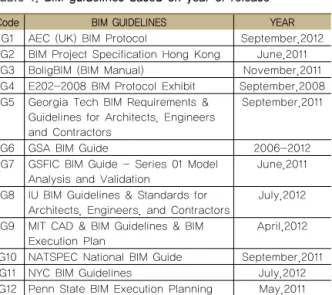
Table 1. BIM guidelines based on year of release

Code BIM GUIDELINES YEAR

G1 AEC (UK) BIM Protocol September,2012 G2 BIM Project Specification Hong Kong June,2011 G3 BoligBIM (BIM Manual) November,2011 G4 E202-2008 BIM Protocol Exhibit September,2008 G5 Georgia Tech BIM Requirements &

Guidelines for Architects, Engineers and Contractors

September,2011

G6 GSA BIM Guide 2006-2012

G7 GSFIC BIM Guide - Series 01 Model

Analysis and Validation June,2011 G8 IU BIM Guidelines & Standards for

Architects, Engineers, and Contractors July,2012 G9 MIT CAD & BIM Guidelines & BIM

Execution Plan April,2012

G10 NATSPEC National BIM Guide September,2011

G11 NYC BIM Guidelines July,2012

G12 Penn State BIM Execution Planning

Guide May,2011

Table 1. Continued

Code BIM GUIDELINES YEAR

G13 SDCCD BIM Standards for Architects,

Engineers & Contractors January,2012

G14 Singapore BIM Guide May,2012

G15 State of Ohio BIM Protocol October,2012 G16 Texas A&M Attachment D - BIM

Execution Plan March,2012

G17 Texas Facilities Commission Professional Architectural/Engineering Guidelines

April,2012

G18 The Contractor’s Guide to BIM September,2006 G19 The USACE BIM Road Map (ERDC

TR-06-10) October,2006

G20 The VA BIM Guide April,2010

G21 USC BIM Guidelines April,2012

Table 2. Authorship: owner organisation

Code NAME COUNTRY ORGANIZATION

G12 BIM Project Execution

Planning Guide US Penn State

G5 Georgia Tech BIM Requirements &

Guidelines for Architects, Engineers and

Contractors

US Georgia Tech

G6 GSA BIM Guide US GSA

G7 GSFIC BIM Guide - Series 01 Model Analysis and Validation

US Georgia State

G8 IU BIM Guidelines &

Standards for Architects, Engineers, and Contractors

US IU

G9 MIT CAD & BIM Guidelines & BIM Execution Plan

US MIT

G11 NYC BIM Guidelines US New York City G13 SDCCD BIM Standards

for Architects, Engineers

& Contractors

US SDCCD

G14 Singapore BIM Guide SGP BCA

G15 State of Ohio Building Information Modeling Protocol

US State of Ohio

G16 Texas A&M Attachment D

- BIM Execution Plan US Texas A&M G17 Texas Facilities

Commission Professional Architectural/Engineerin g Guidelines

US State of Texas

G19 The USACE BIM Road

Map (ERDC TR-06-10) US USACE

G20 The VA BIM Guide US VA

G21 USC BIM Guidelines US USC

of detail that were exclusive from one another (UNIQUE POINTS).

3.3.3 At the same time, the common processes or practices between all the guidelines were also identified (OVERLAPPING POINTS).

3.3.4 Another crucial aspect analysed was the extent to which BIM’s potential was indicated to have been utilised over the years. This was done by first listing the 21 BIM guidelines according to their ‘Date of Release’. The guidelines were then studied along the timeline to understand the growth in the development of BIM through the years.

3.3.5 As mentioned in the steps above, the unique and the overlapping points were identified. These have been demonstrated in tabular form. The degree of use of BIM facilities over time have also been represented in tabular form. All these findings are laid out under Research Findings along with a discussion to support them.

The next section provides an overview of all the BIM guidelines that have been reviewed in this paper based on the Date of Release and Authorship.

4. Overview of the BIM guidelines

4.1 Classification based on the Year of Release Through the Literature Review, the ever-increasing number of practitioners adopting BIM across the world was realised. In order to show this, the release date of all the 21 BIM guidelines were first laid out as per step 3.3.4 of

‘Procedure for Analysis’.

4.2 Classification based on Authorship

The classification of BIM guidelines based on Authorship

(Owner organisation and Third-Party organisation) as explained

in detail in Section 3.2.1 of ‘Research Methodology’, was

done to establish a sense of priority upon the BIM guidelines

(6)

Table 3. Authorship: third party organisation

Code NAME COUNTRY ORGANIZATION

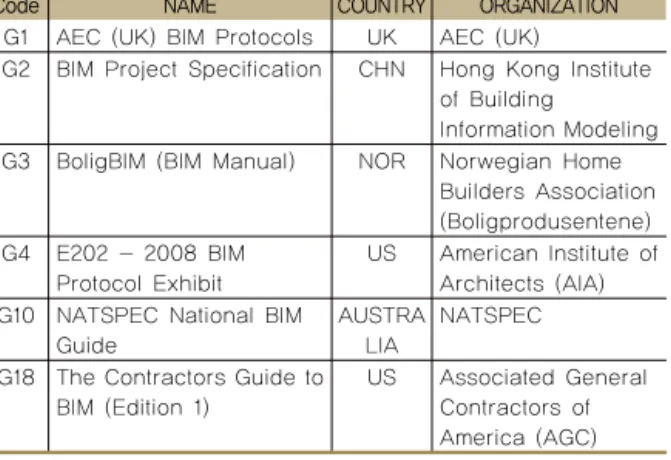
G1 AEC (UK) BIM Protocols UK AEC (UK)

G2 BIM Project Specification CHN Hong Kong Institute of Building Information Modeling G3 BoligBIM (BIM Manual) NOR Norwegian Home

Builders Association (Boligprodusentene) G4 E202 - 2008 BIM

Protocol Exhibit US American Institute of Architects (AIA) G10 NATSPEC National BIM

Guide AUSTRA

LIA NATSPEC G18 The Contractors Guide to

BIM (Edition 1) US Associated General Contractors of America (AGC)

that were to be emphasised upon more. This classification aided in spotting the major developments in the BIM guidelines, as more stress was given upon those that were formulated by owner organisations.

5. General description of the reviewed BIM guidelines and manuals

After classifying the 21 BIM guidelines, the next step undertaken as per Section 3.3.1 of ‘Procedure for Analysis’

under Research Methodology, was to establish a better under- standing of the goals and objective of these guidelines. This section therefore, provides an overview of all the BIM guidelines that are included in this paper. The study of the goals and objectives was done to comprehend every guideline’s visions towards BIM implementation for the present as well as the future.

G1. AEC (UK) BIM Protocol– United Kingdom

AEC (UK) BIM Protocol Version 2.0 is a combination of previously provided documents from Version 1 (2009) that can be referred to by any BIM-use project team. It also builds on UK standards documents for a concise and precise system for BIM software implementation.

Version 2.0 of AEC (UK) BIM Protocol was formulated after AEC committee underwent reconstitution in 2009, employing new members with significant experience in BIM.

G2. Hong Kong Institute of BIM (HKIBIM) – BIM Project Specification

BIM Project Specification – Hong Kong is a standard that

is used to provide an aid with defining the scope of work in a BIM project, the deliverables and the roles and re- sponsibilities of the participants involved in the project. This provides the general guidelines for a project’s BIM application.

G3. BoligBIM (BIM Manual)

Boligprodusentene i.e., Norwegian Home Builders Association released version 1.0 of BoligBIM (BIM Manual) to provide general modelling methodology that is adopted for residential dwelling project planning.

G4. E202-2008 BIM Protocol Exhibit

The American Institute of Architects’ (AIA) E202-2008 BIM Protocol Exhibit is written by users from industry-wide.

It specifies the contractual structure for BIM management across a project. It is the first document by AIA that is exclusively written to expand the reach of BIM on projects.

It also provides an environment for model authors to display their work for the benefit of downstream designers, engineers, cost estimators, contractors and fabricators.

G5. Georgia Tech BIM Requirements & Guidelines for Architects, Engineers and Contractors Georgia Tech Facilities Management

Georgia Tech BIM Requirements and Guidelines for Architects, Engineers, and Contractors prescribes a series of requirements so as to arrive at an ideal framework to facilitate coordination between various departments like the Georgia State Finance and Investment Commission, Georgia Tech and Board of Regents. The guide helps the stakeholders involved in the project to prioritise every requirement from project to project.

G6. GSA BIM Guide Series

General Services Administration’s (GSA) BIM Guide Series is written to provide guidelines for BIM practices for design, construction as well as modernisation of projects. The main objective of this series is to encourage value added BIM implementation on federal projects.

G7. GSFIC BIM Guide - Series 01 Model Analysis and Validation

GSFIC BIM Guide - Series 01 Model Analysis and Validation

(7)

is a guide which provides assistance to A/Es (architects and engineers) of GSFIC with the BIM-based projects. The series-1 by GSFIC describes only the Design Requirements of BIM.

The A/E are required to comply by these requirements.

G8. IU BIM Guidelines & Standards for Architects, Engineers, and Contractors

Indiana University’s (IU) BIM Guidelines and Standards for Architects, Engineers, and Contractors is tailored for the A/E department that are involved in projects with a total project funding of above $5M or the projects that use BIM technology as the mode of project delivery.

G9. MIT CAD & BIM Guidelines & BIM Execution Plan MIT CAD and BIM Guidelines is primarily written in order to enhance the use of BIM technology by using electronic models and drawings that are consistent with the requirements of MIT Departments of Facilities’ BIM and CAD environment.

All documents that are being delivered to MIT need to comply to these standards/requirements.

G10. NATSPEC National BIM Guide

The NATSPEC National BIM Guide as well as the Object/

Element matrix is adapted from The VA BIM Guide 2010. This guide is assisted by other supporting documents i.e., NATSPEC Project BIM Brief, NATSPEC BIM Reference Schedule, NATSPEC BIM Object/Element Matrix that are used in conjunction or simultaneously with each other.

G11. NYC BIM Guidelines

The New York City (NYC) has released the New York City BIM Guidelines with the objective of enhancing process of project safety review. The contents that are provided by contractors are provided in standardised form in this guideline. The New York City (NYC) encourages submitting the safety logistics electronically in a 3D BIM format. The guide aims to provide a standardised version of BIM guidelines that can be utilised by all Public Building projects within New York City.

G12. Penn State - BIM Project Execution Planning Guide The Penn State’s BIM Project Execution Planning Guide, released in 2009 is written to assist facility projects with a detailed planning procedure for the execution of BIM. The

guideline insists on owners to have a clear understanding of their goals. It also encourages practitioners to enhance communication between all the departments facilitating BIM project implementation throughout all phases of the facility.

The guideline gives a detailed description of the BIM execution plan including code validation.

G13. SDCCD BIM Standards for Architects, Engineers &

Contractors

The San Diego Community College District (SDCCD) BIM Standards for Architects, Engineers and Contractors is ap- plicable on all new construction projects as well as modernisation projects. The guide stresses on the use of BIM for the executing the design, construction and facilities management for all new and existing facilities. The guide is a revised version of the Version 1 SDCCD BIM Standards that was released in 2010.

G14. Singapore BIM Guide (Building and Construction Authority) The Singapore BIM Guide is written in the form of a general reference for developing BIM Execution Plan, which includes the roles and responsibilities of each member of the project.

It consists of BIM Specifications as well as BIM Modelling and Collaboration Procedures.

G15. State of Ohio BIM Protocol

The State of Ohio BIM Protocol is written for all state agencies, organisations and institutes, to provide a consistent and precise model development plan and a feasible man- agement plan.

G16. Texas A&M University System: Attachment D - BIM Execution Plan

Texas A&M University System Attachment D - BIM Execution Plan regards BIM as an enabler that is information specific.

The objective of the guide is to provide a systematic BIM implementation process utilising the concepts of sustainable information strategies and interoperability to enhance integrated decision making, reduce the wastage of manpower, produce documentation of precise and higher quality, and reuse in- formation in a sustainable way

G17. Texas Facilities Commission Professional Architectural/

Engineering Guidelines

(8)

Texas Facilities Commission Professional Architectural/

Engineering Guidelines is a highly detailed document providing lots of information needed by professional service providers in addition to the general BIM standard requirements.

G18. The Contractor’s Guide to BIM (Edition 1)

The Associated General Contractors of America’s (AGC) Contractors’ Guide to BIM is written to provide guidance to the contractors or users who are seeking information about BIM. The guide describes the steps to get started with Virtual Design and Construction (VDC) which is the starting point of BIM.

G19. USACE BIM Road Map (ERDC-SR-12-2)

The US Army Corps of Engineers’ (USACE) Road Map and Contract Requirements are two sets of documents to define a process for the implementation of BIM.

USACE BIM Roadmap outlines the implementation plans and strategies to be used with BIM technology for an improved planning, design, and construction process. BIM Contract Requirements provides the Minimum Modelling Requirement Matrix (M3) which is used to communicate the modelled content within BIM deliverables.

G20. The VA BIM Guide

The Construction and Facilities Management (CFM) de- partment of The US Department of Veterans Affairs (VA) helps in providing design, project management, design and construction standards, and services related to environmental and historical preservation. The VA BIM Guide is written to be applied by the architects, engineers, contractors and consultants to deliver a cost-effective support and high quality delivery requirement protocol incorporating the BIM process requirements with the Integrated Project Delivery methodology.

G21. USC BIM Guidelines

USC BIM Guidelines is written to describe the scope of work from the design and construction point of view. It also defines the deliverables required for all BIM-based new USC projects. The guide also addresses deliverables for major renovation projects in the form of design-bid-build format.

6. Research Findings

An extensive study of the 21 BIM guidelines was carried out, keeping in mind the objective of this research paper which was to review, analyse and arrive at the points of similarities and dissimilarities in the patterns of all these BIM guidelines. These Research Findings are explained below.

Deliverable File Exchange Format

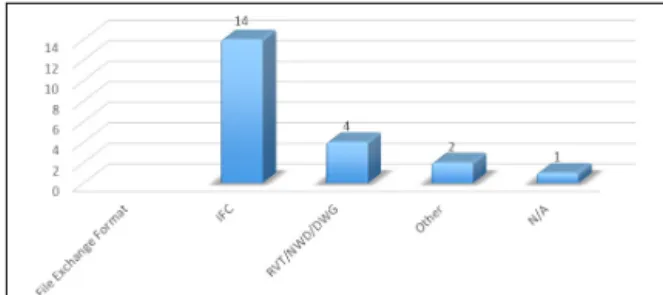
As seen in Figure 1 Deliverable File Exchange Format, the most commonly accepted and used file exchange format was the Industry Foundation Classes (IFC). As depicted, 14 out of the 21 BIM guidelines adopted IFC as their mode of file exchange. The next common file formats used were the ones generated using Autodesk products like Revit, Navisworks and AutoCAD (RVT/NWD/DWG).

Figure 1. Deliverable file exchange format

Deliverable File Format

As depicted in Figure 2 Deliverable File Format, the highest percentage of the 21 BIM guidelines that were reviewed required native files, accompanied by 2D documents files in formats like Portable Document Format (PDF), AutoCAD drawing format (DWG) etc. as deliverables. The remaining guidelines required IFC files mandatorily in the deliverables package.

Figure 2. Deliverable file format

(9)

Table 5. Unique content in BIM guidelines BIM GUIDELINES UNIQUE CONTENT The VA BIM Guide The U.S. Department of Veterans

Affairs (VA) used Space and Equipment Planning System (VA-SEPS), defined as a

data-based planning tool which is shared by or is used in conjunction by VA, Army, Navy and Air Force to develop a Program for Design (PFD).

Input associated with requirements regarding medical need was provided in order to generate space requirements and associated medical equipment. The PFD contained a list of rooms or spaces as well as medical requirement with the corresponding computer codes.

These codes assisted in tracking related information through the design and construction phases.

AEC (UK) BIM Protocol The protocol did not define the detailed requirements w.r.t model content, delivery requirements and data exchange format.

NATSPEC National BIM

Guide The Guide's structure was such that it every edition of National BIM Guide to be used as a "core reference document". Also, all the editing was confined to the Project BIM Brief. These attributes allowed this protocol to be tailored in accordance to individual projects.

The information contained in the guide was also updated and upgraded according to the need of the users from edition-to-edition, but at the same time, adhered to a consistent framework.

Texas Facilities Commission Professional

Architectural/Engineerin g Guidelines

Template files were provided for state projects, that contained Texas Facilities Commission's "custom standard objects". The custom standard objects included predefined information on materials and configurations.

USACE BIM Roadmap The main objective of this Guideline was to describe the strategy and implementation of BIM technology in U.S Army Corps of Engineers' including civil works and military construction relating to business processes. It also contained the process that was involved for working with U.S Army Corps of Engineers' AEC (Architectural Engineering Construction) software vendors and industry partners.

BoligBIM (BIM Manual) –

Norway Norwegian Homebuilders

Association BIM Manual, Version 1.0 by BoligBIM was developed to provide practical aid for project planning process for residential dwellings. It provided in depth information on particular areas like, energy calculations, ventilation and roof trusses.

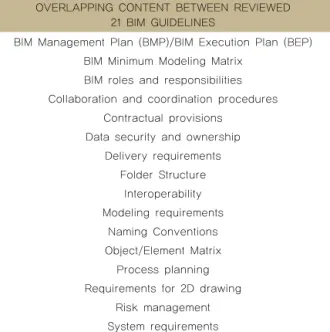
Overlapping content in the BIM guidelines:

The overlapping or common points in all the BIM guidelines that were reviewed are shown in Table 4 below:

Table 4. Overlapping points of BIM guidelines OVERLAPPING CONTENT BETWEEN REVIEWED

21 BIM GUIDELINES

BIM Management Plan (BMP)/BIM Execution Plan (BEP) BIM Minimum Modeling Matrix

BIM roles and responsibilities Collaboration and coordination procedures

Contractual provisions Data security and ownership

Delivery requirements Folder Structure

Interoperability Modeling requirements

Naming Conventions Object/Element Matrix

Process planning Requirements for 2D drawing

Risk management System requirements

Unique points in the BIM guidelines

There were some points of difference that existed in several guidelines that were exclusive and did not exist in the others. They have been mentioned in Table 5 below:

The development of Automated Code Compliance Check:

None of the BIM guidelines that were analysed specified or mentioned the formulation of BIM modelling requirements to cater automated code compliance checking. However, Automated Code Compliance Check was mentioned under Section 7.11,

“Additional BIM uses” in The VA BIM Guide, revealing their interest in extending BIM usage to automated code checking.

NYC BIM Guidelines also regarded this check as a potential for future BIM use. This need was also acknowledged by Singapore’s Building and Construction Authority (BCA) as they had launched Construction and Real Estate NETwork (CORENET) e-submission (Corenet e-submission, 2001) industry in 2001 for the building and construction industry. They started accepting BIM e-submission i.e., architectural, structural &

MEP to the regulatory agencies, 2011 onwards.

Evolution of BIM guidelines

The Section 2: Literature Review, reflects upon the

(10)

Table 5. Continued

BIM GUIDELINES UNIQUE CONTENT GSFIC BIM Guide -

Series 01 Model Analysis and Validation

The Guide specified that a construction permit issued by the State Fire Marshal was a pre-requisite for all state projects;

which reviewed the GSFIC managed projects' compliance with life safety codes. This Life Safety Review utilized spatial components of the BIM model.

Singapore BIM Guide CORENET (Construction and Real Estate NETwork) was launched by the Building and Construction Authority (BCA) for e-submission for the construction industry in 2001. In 2011, BCA started accepting e-submissions of BIM to the regulatory agencies including architectural, structural and MEP submissions.

MIT CAD and BIM

Guidelines An Electronic File Q/A Checklist in Appendix A was provided that had to be complied with i.e., reviewed and followed in regards to electronic drawings and models before delivering documentation to MIT.

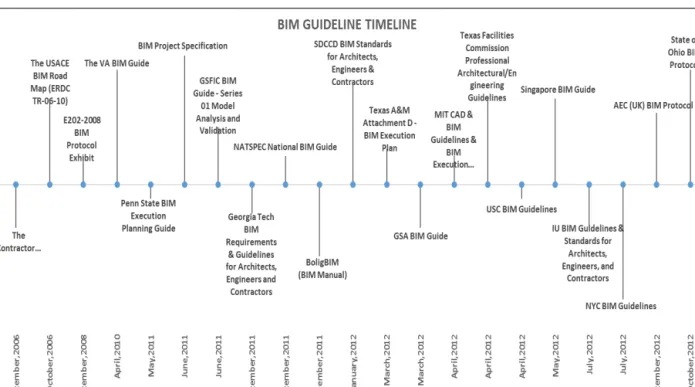
Figure 3. Timeline of the reviewed BIM guidelines growth in the evolution of BIM practices through the years.

This is because of an ever-increasing support for BIM from technical professionals of the AEC/FM industry who are transitioning from employing 2-D to complete BIM adoption.

The popularity and necessity of BIM is credited to its ability

to streamline construction processes by an effort to eradicate the interdisciplinary inefficiencies, prevalent in the construction industry over several decades. To maximize the benefits from BIM, the construction industry professionals are revising the guidelines to incorporate as much information as possible.

Even between 2012 to now, many specialized tools have been developed as major innovations for maximizing BIM’s potential. For example, Revit, developed only recently has been considered central to the present transition phase.

After reviewing the guidelines, a pattern of growth was observed in almost all in terms of BIM use and implementation.

A few of them mentioned the possible development of newer versions of their guidelines based on the BIM use experiences.

This proves that there will be further progress in the coming years and that the industry will continue to incorporate BIM till the ultimate potential is reached.

In order to demonstrate the growth of BIM use in the

construction industry over the years, a timeline with the

release date of the 21 BIM guidelines reviewed in this paper

was created, as in Figure 3: Timeline of the reviewed BIM

guidelines. This timeline has been presented in conjunction

with a table incorporating examples that reflect growth in

the degree of BIM incorporation over the years which is

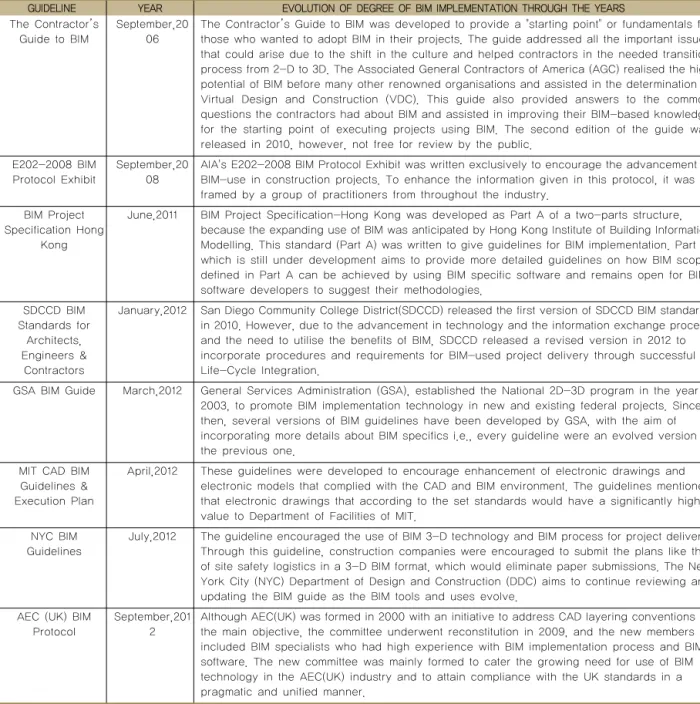
expressed in Table 6 below.

(11)

Table 6. Growth in the level of BIM implementation with time

GUIDELINE YEAR EVOLUTION OF DEGREE OF BIM IMPLEMENTATION THROUGH THE YEARS The Contractor’s

Guide to BIM September,20

06 The Contractor’s Guide to BIM was developed to provide a "starting point" or fundamentals for those who wanted to adopt BIM in their projects. The guide addressed all the important issues that could arise due to the shift in the culture and helped contractors in the needed transition process from 2-D to 3D. The Associated General Contractors of America (AGC) realised the high potential of BIM before many other renowned organisations and assisted in the determination of Virtual Design and Construction (VDC). This guide also provided answers to the common questions the contractors had about BIM and assisted in improving their BIM-based knowledge for the starting point of executing projects using BIM. The second edition of the guide was released in 2010, however, not free for review by the public.

E202-2008 BIM

Protocol Exhibit September,20

08 AIA's E202-2008 BIM Protocol Exhibit was written exclusively to encourage the advancement of BIM-use in construction projects. To enhance the information given in this protocol, it was framed by a group of practitioners from throughout the industry.

BIM Project Specification Hong

Kong

June,2011 BIM Project Specification-Hong Kong was developed as Part A of a two-parts structure, because the expanding use of BIM was anticipated by Hong Kong Institute of Building Information Modelling. This standard (Part A) was written to give guidelines for BIM implementation. Part B, which is still under development aims to provide more detailed guidelines on how BIM scope defined in Part A can be achieved by using BIM specific software and remains open for BIM software developers to suggest their methodologies.

SDCCD BIM Standards for

Architects, Engineers &

Contractors

January,2012 San Diego Community College District(SDCCD) released the first version of SDCCD BIM standards in 2010. However, due to the advancement in technology and the information exchange process and the need to utilise the benefits of BIM, SDCCD released a revised version in 2012 to incorporate procedures and requirements for BIM-used project delivery through successful Life-Cycle Integration.

GSA BIM Guide March,2012 General Services Administration (GSA), established the National 2D-3D program in the year 2003, to promote BIM implementation technology in new and existing federal projects. Since then, several versions of BIM guidelines have been developed by GSA, with the aim of incorporating more details about BIM specifics i.e., every guideline were an evolved version of the previous one.

MIT CAD BIM Guidelines &

Execution Plan

April,2012 These guidelines were developed to encourage enhancement of electronic drawings and electronic models that complied with the CAD and BIM environment. The guidelines mentioned that electronic drawings that according to the set standards would have a significantly higher value to Department of Facilities of MIT.

NYC BIM

Guidelines July,2012 The guideline encouraged the use of BIM 3-D technology and BIM process for project delivery.

Through this guideline, construction companies were encouraged to submit the plans like that of site safety logistics in a 3-D BIM format, which would eliminate paper submissions. The New York City (NYC) Department of Design and Construction (DDC) aims to continue reviewing and updating the BIM guide as the BIM tools and uses evolve.

AEC (UK) BIM

Protocol September,201

2 Although AEC(UK) was formed in 2000 with an initiative to address CAD layering conventions as the main objective, the committee underwent reconstitution in 2009, and the new members included BIM specialists who had high experience with BIM implementation process and BIM software. The new committee was mainly formed to cater the growing need for use of BIM technology in the AEC(UK) industry and to attain compliance with the UK standards in a pragmatic and unified manner.

7. Recommendations

As explained in the Section Research Findings, all the BIM guidelines that were reviewed covered a broad range of aspects in terms of BIM implementation process, and hence provided a variety of BIM use cases. The issue of inconsistency prevalent in the BIM guidelines issued by organisations and construction companies across the world, can be tackled by the generation of an “Automated Code Compliance Check” (Fiatech, 2013).

“Interoperability” is a combination of software interoperability and modelling interoperability. Software interoperability includes

management of data exchange between different systems.

Modelling interoperability includes management and imple- mentation of collaborative relationships between the stakeholders as well as compliance between BIM design procedures (Joao Pocas Martins, 2013; Norber W. Young Jr et al., 2007).

BIM researchers have been making efforts to promote

advanced interoperability among various software and

modelling processes. The development of automated code

compliance check has been regarded as a driver of seamless,

unified and lossless interoperability. This is because the

automatic code checking system will promote consistent

quality BIM practices by enabling smooth workflow between

(12)

designers and code checkers. Applying an international checker for code compliance to a project an organisation’s standard codes will result in advanced interoperability and diminish the variations that exist in BIM practices by enabling a set standard of high quality project delivery.

Amongst the BIM guidelines that were reviewed in this paper, none of them specified the formulation of BIM modelling requirements for the ‘Automated Code Compliance Checking’.

However, a few of them mentioned it as a potential use in BIM projects in the future.

Due to the potential strengths and benefits BIM offers, the number of BIM use projects are ever growing, and this advancement in construction field is considered a boon. At the same time, while building officials, architects, engineers, designers and construction owners have always understood the importance of criticality in terms of time, accuracy, as well as uniform code review, the industry has recently also started to experience a “paradigm shift” (M. Ibrahim, R.

Krawczyk, G. Schipporeit, 2004). This is why there is a need for development of an Automated Code Compliance Check that will help in creating a consistent, stable and reliable BIM modelling methodology that will restructure or streamline the BIM processes resulting in a guideline all organisations need to comply by to facilitate a faster, and more accurate process of code checking.

8. Conclusion

As explained in detail in this paper, BIM guidelines have been an aid in creating reliable and valuable information.

It incorporates a well-coordinated, consistent and systematic approach, which ensures an efficient data sharing and communication system and maximises the project delivery mechanism. BIM guidelines typically contain the data structure, identifier controls, BIM model and file exchange requirement controls. All these information, allow all the stakeholders to have a better and homogeneous understanding of all the fundamentals of BIM, such as what, how and when the information needs to be exchanged. BIM guidelines also standardises the format for information exchange for any project. However, at the same time, BIM guidelines only allow consistent framework of BIM implementation within a state, nation or organisation, and not on a global level.

This paper included the identification and analysis of 21 current BIM-use initiatives in the form of BIM guidelines, that were executed in the past or still underway and publicly available. All the guidelines were carefully reviewed in order to enhance the understanding of their contents and how they varied from one another. On carrying out extensive study, it was observed that there exists an inconsistency between the various guidelines in terms of several aspects like defining the Level of Development (done for specific projects), file exchange mechanism, file exchange format, delivery mechanism and project regulations, permits and compliance criteria.

Since an area of improvement was established after performing this research, a possible way to do so was also included under “Section 7: Recommendations” in this paper.

It specified the need for an Automated Code Compliance use case to cater all BIM related projects around the world that would in turn, establish a consistent framework for all aspects of a BIM Implementation Plan throughout the world.

Some of the guidelines mentioned the use of automated code compliance as a future prospect. But due to the ever expansive nature of BIM technology, it is necessary that the concept is implemented as soon as possible so that all the organisations across the world can benefit equally.

References

A.G. Kimmance. (2002). An integrated Product and Process Information Modelling System for On-Site Construction.

Thesis (Ph. D.)-University of Loughborough, UK.

AEC (UK) BIM Protocol AEC(UK). (2012). AEC (UK) BIM Protocol. <http://aecuk.files.wordpress.com/2012/09/

aecukbimprotocol-v2-0.pdf>

Allen, R.H. and Sriram, R.D. (2000). The role of standards in innovation. Technological Forecasting and Social Change, Vol. 64 Nos 2-3, 171-181, <http://linkinghub.

elsevier.com/retrieve/pii/S0040162599001043>

Association of General Contractors(AGC). (2006). The Contractors’ Guide to Building Information Modelling.

pp.48.

Azhar, S. (2011). Building Information Modeling (BIM): Trends, Benefits, Risks and Challenges for the AEC Industry.

ASCE Journal of Leadership and Management in Engineering,

(13)

11 (3), 241-252.

B. Becerik-Gerber. (2010). S. Rice, The perceived value of building information modelling in the US building industry.

ITcon 15, 185–201.

BoligBIM (BIM Manual) Norwegian Home Builders Association.

(2011). BoligBIM (BIM Manual). <http://boligprodusentene.

no/english/bim-manual-in-english-article126-138.html>

BSI. (2013). PAS 1192-2 Specification for Information Management for the Capital/Delivery Phase of Construction Projects Using Building Information Modelling. BSI Standards Limited, London.

C. Eastman. (1999). Building Product Models: Computer Environments Supporting Design and Construction. CRC Press LLC, USA.

C. Matta, C. Kam. (2005). The GSA’s BIM Pilot Program.

<http://bim.arch.gatech.edu/data/reference/gsaBIM.pd f 20058>

CEN European Committee for Standardisation (2015).

CEN/TC442 – building information modelling (BIM).

<https://standards.cen.eu/dyn/www/f?p=204:7:0::::FS P_ORG_ID:1991542&cs=16AAC0F2C377A541DCA571910 561FC17F>

CRC for Construction Innovation, Adopting BIM for Facilities Management: Solutions for Managing the Sydney Opera House. <http://eprints.qut.edu.au/27582/1/27582.pdf 2007>

E202-2008 BIM Protocol Exhibit American Institute of Architects. (2008). AIA E202-2008 BIM Protocol Exhibit.

<http://www.aia.org/contractdocs/training/bim/aias078 742>

Eastman, C., Teicholz, P., Sacks, R. and Liston, K. (2011).

BIM Handbook: A Guide to Building Information Modeling for Owners, Managers, Designers, Engineers, and Contractors.

2nd ed., John Wiley & Sons, Inc., Hoboken, NJ.

Fiatech. (2013). A Report to Fiatech AutoCodes Project.

https://www.cvent.com/Pub/eMarketing/Pages/WebE mail.aspx?emstub=ea925cdc-4216-4c7f-8000-d97efe 5ad34c

General Services Administration(GSA). (2007). Building In- formation Modelling Guide Series 1. pp. 6.

Georgia State Financing and Investment Commission. (2011).

GSFIC BIM Guide. <http://gsfic.georgia.gov/documents/

building-information-modeling-bim-guide>

Georgia Tech BIM Requirements & Guidelines for Architects,

Engineers and Contractors Georgia Tech Facilities Management. (2011). Georgia Tech BIM Requirements &

Guidelines for Architects, Engineers and Contractors.

<http://www.facilities.gatech.edu/dc/standards/bim.php>

GSA BIM Guide Series GSA. (2006-2012). BIM Guide Series.

<http://www.gsa.gov/bim>

GSFIC BIM Guide - Series 01 Model Analysis and Validation H. Penttila. (2006). Describing the changes in architectural information technology to understand design complexity and free-form architectural expression. ITCON 11 Special Issue: The Effects of CAD on Building Form and Design Quality, 395–405.

Hong Kong Institute of BIM (HKIBIM) – BIM Project Specification HKIBIM. (2011). BIM Project Specification. <http://www.

hkibim.org/?p=1937>

International Alliance for Interoperability(IAI). (1999).

<http://www.iaiweb.lbl.gov>

IU BIM Guidelines & Standards for Architects, Engineers, and Contractors Indiana University Architect’s Office and Engineering Services. (2012). U BIM Guidelines & Standards for Architects, Engineers, and Contractors. <http://www.

iu.edu/~vpcpf/consultant-contractor/standards/bim-s tandards.html>

Joao Pocas Martins, A. M. (2013). LicA: A BIM based automated code-checking application for water distribution systems. Automation in Construction, pp. 12-23.

Kassem, M., Succar, B. and Dawood, N. (2013). A proposed approach to comparing the BIM maturity. Proceedings of the CIB W78 2013: 30th International Conference, Beijing, 370-375.

M. Ibrahim, R. Krawczyk, G. Schipporeit. (2004). A web-based approach to transferring architectural information to the construction site based on the BIM object concept, CAADRIA 2004 Conference, Seoul, South Korea, 1–10.

McGraw-Hill Construction. (2013). Information mobility: improving team collaboration through movement of project information.

SmartMarket report, McGraw-Hill, New York. <http://enr.

construction.com/engineering/pdf/News/Information_M obility_SMR_2013.pdf>

MIT CAD & BIM Guidelines & BIM Execution Plan Massachusetts Institute of Technology (MIT) Department of Facilities.

(2011). MIT CAD & BIM Guidelines & BIM Execution Plan.

<http://web.mit.edu/facilities/maps/index.html>

(14)

National Building Information Modelling Standard (NBIMS).

(2007). Overview, Principles and Methodologies, Version 1.0 — Part 1. <http://www.wbdg.org/pdfs/NBIMSv1_p1.pdf>

NATSPEC National BIM Guide NATSPEC. (2011). NATSPEC National BIM Guide. <http://bim.natspec.org/>

Nawari, N.O. (2012). BIM standards: advancement and industry deployment. Proceedings of the 14th International Conference on Computing in Civil and Building Engineering, Moscow State University of Civil Engineering, Moscow.

Norber W. Young Jr, Jones, S. A. & Bernstein, H. M. (2007).

Smart Market Report Interoperability Issue. Bedford, UK:

McGraw Hill Construction. NYC BIM Guidelines New York City Department of Design & Construction. (2012). BIM Guidelines. <http://www.nyc.gov/html/ddc/html/pubs/

publications.html>

Penn State - BIM Project Execution Planning Guide Computer Integrated Construction Research Program.

(2010). BIM Project Execution Planning Guide – Version 2.0. April 16, 2010, The Pennsylvania State University, University Park, PA, USA. <http://bim.psu.edu>

R. Manning, J. Messner (2008). Case studies in BIM implementation for programming of healthcare facilities.

ITcon 13, 446–455.

R. Miller. (2007). United States National Building Information Modelling Standard, version 1, part 1: Overview, Principles, and Methodologies. National Institute of Building Sciences (NIBS), pp.183. <http://www.wbdg.org/pdfs/NBIMSv1_p1.pdf>

R. Sacks, R. Barak. (2006). Quantitative assessment of the impact of 3D modelling of building structures on engineering productivity. in: H. Rivard, E. Miresco (Eds.), 11th International Conference on Computing in Civil and Building Engineering, Montreal, Canada, 1186–1195.

S. Staub-French, A. Khanzode. (2007). 3D and 4D modeling for design and construction coordination: issues and lessons learned. ITCON 12, 381–407.

SDCCD BIM Standards for Architects, Engineers & Contractors San Diego Community College District. (2012). BIM Standards for Architects, Engineers & Contractors. <http://public.

sdccdprops-n.com/CR/Pages/Standards.aspx>

Singapore BIM Guide (Building and Construction Authority) Building and Construction Authority. (2011). Singapore BIM guide. <http://www.corenet.gov.sg/integrated_

submission/bim/BIM_Guide.htm> Corenet e-submission.

<http://www.corenet.gov.sg/integrated_submission/bim /BIMe_submission.htm>

Smith, D.K. and Tardif, M. (2009). Building Information Modeling: A Strategic Implementation Guide for Architects, Engineers, Constructors. And Real Estate Asset Managers.

John Wiley & Sons, Inc., Hoboken, NY.

State of Ohio BIM Protocol State of Ohio Facilities Construction Commission. (2012). State of Ohio Building Information Modeling Protocol. <http://das.ohio.gov/Divisions/General ervices/ StateArchitectsOffice/BIMProtocol.aspx>

Texas A&M University System: Attachment D - BIM Execution Plan Texas A&M University System. (2012). Attachment D - BIM Execution Plan. <http://esbd.cpa.state.tx.us/

docs/710/100928_1.pdf>

Texas Facilities Commission Professional Architectural/

Engineering Guidelines Texas Facilities Commission.

(2012). Texas Facilities Commission Professional Architectural/

Engineering Guidelines. <http://www.tfc.state.tx.us/divisions/

facilities/prog/construct/formsindex/>

The Contractor’s Guide to BIM (Edition 1) Associated General Contractors of America. (2006). The Contractor’s Guide to BIM. <http://store.agc.org/Construction-Delivery/ Building- Information-Modeling-BIM/2928>

The VA BIM Guide VA. (2010). The VA BIM Guides.

<http://www.cfm.va.gov/til/bim/BIMGuide/lifecycle.htm>

UNIDO. (2006). Role of standards, a guide for small and medium-sized companies. <www.unido.org/fileadmin/

media/documents/pdf/tcb_role_standards.pdf>

University of Southern California - Facilities Management Services. (2012). Building Information Modeling (BIM) Guidelines. <http://www.usc.edu/fms/technical/cad/BIM Guidelines.html>

USACE BIM Road Map (ERDC-SR-12-2)

USACE. (2012). The US Army Corps of Engineers Roadmap for Life-Cycle Building Information Modeling (BIM).

<https://cadbim.usace. army.mil/default.aspx?p=a&t=1

&i=13>

USC BIM Guidelines

Z. Shen, R. Issa. (2010). Quantitative evaluation of the BIM

assisted construction detailed cost estimates. 234–257

수치

Table 2. Authorship: owner organisation
Table 3. Authorship: third party organisation
Figure 1. Deliverable file exchange format
Table 4. Overlapping points of BIM guidelines OVERLAPPING CONTENT BETWEEN REVIEWED
+3

참조

관련 문서

• Theme : Confidence Building Measures in cyberspace Session I: Existing and potential threats in cyberspace Session II: CBMs in the context of cyber security?.

• 이명의 치료에 대한 매커니즘과 디지털 음향 기술에 대한 상업적으로의 급속한 발전으로 인해 치료 옵션은 증가했 지만, 선택 가이드 라인은 거의 없음.. •

I agree to collection and usage of my personal information by KNU Office of International Affairs in accordance with Personal Information Protection Act

(2007), “The relationship between school building conditions and student achievement at the middle school level in the commonwealth of Virginia,” Ed.D,

The index is calculated with the latest 5-year auction data of 400 selected Classic, Modern, and Contemporary Chinese painting artists from major auction houses..

IEA, Passive Solar Retrofitting of the University of Ioannina New School of Philosophy Building, Greece, IEA Energy Conservation in Building and Community Systems, Annex36

The meeting resulted in the training of twenty seven national officials, experts in comprehensive disaster risk management, building resilience, climate

The PDRI was originally designed to evaluate the definition of an entire unit, building, facility, or item of infrastructure. On smaller retro-fit projects, the facilitator