* Corresponding author : Sang-Hoon Lee, National Institute of Animal Science, RDA, Cheonan 330-801, Korea.
Tel: +82-41-580-6754, E-mail: [email protected]
Research Article
Identification of Copper and Cadmium Induced Genes in Alfalfa Leaves through Annealing Control Primer Based Approach
Ki-Won Lee
1, Md. Atikur Rahman
1, Muhammad Zada
1, Dong-Gi Lee
2, Ki-Yong Kim
1, Tae Young Hwang
1, Hee Jung Ji
1and Sang-Hoon Lee
1*
1
Grassland & Forages Division, National Institute of Animal Science, Rural Development Administration, Cheonan, 330-801, Republic of Korea,
2Division of Life Sciences, Korea Basic Science Institute, Daejeon, 305-806, Korea
ABSTRACT
The present research investigated copper and cadmium stress-induced differentially expressed genes (DEGs) using annealing control primers (ACP) with the differential display reverse transcription polymerase chain reaction technique in alfalfa (Medicago sativa L. cv. Vernal) leaves. Alfalfa leaves were subjected to 250 µM of copper and cadmium treatment for a period of 6 h. A total of 120 ACPs was used. During copper and cadmium treatment, 6 DEGs were found to be up or down regulated. During copper stress treatment, 1 DEG was up-regulated, and 3 novel genes were discovered. Similarly, during cadmium stress treatment, 1 DEG was up-regulated and 5 novel genes were identified. Among all 6 DEGs, DEG-4 was identified as the gene for trans-2,3-enoyl-CoA reductase, DEG-5 was identified as the gene for senescence-associated protein DIN1 and DEG-6 was identified for caffeic acid O-methyltransferase. All the up-regulated genes may play a role in copper and cadmium stress tolerance in alfalfa.
(Key words : Alfalfa, Cadmium, Copper, Gene, Leaf)
. INTRODUCTION
Soil contamination by the heavy metals (HMs) is of the serious problem for the agricultural production that has detrimental impact to plants and animals (Clemente et al., 2005). HMs are toxic for plants that inhibits plant growth and development. However, several HMs are knows as macronutrients are needed in small amount for plant growth and development, cupper (Cu) is such a metal (Halliwell et al., 1984). Soil Cu may present in several forms: in soil solution, lattice structure of minerals, on soil exchange site and in organic residues. Especially in arid regions, while the soil pH higher (>7.0), the soluble cupper can respond to form copper oxide (CuO), CuCO
3, or mixed hydroxy- carbonate mineral species (Ponizovsky et al., 2007). Cu is strongly absorbed to soil organic matter; excess amount of copper mostly impairs root growth by inhibition of lateral root development (Pahlsson et al., 1989). Morphological symptoms including stunted growth, necrosis or chlorosis may appear that impairs photochemical reactions in plants
(Pierzynski et al., 2000). Among HMs Cd is more toxic for living organisms, Cd toxicity alters of chloroplast ultra- structure, low photosynthesis rate, and high stomatal resistance (Souza et al., 2011). Compared to other HMs, Cd is very mobile in soil and readily enters in plant tissues (Gao et al., 2013). Plant roots are the primary sensing organs for stress perception. HMs can be accumulated or transmitted from roots to shoots that may initiate oxidative stress response. However, oxidative stress is the initial response and common phenomenon of HM toxicity in plant.
In previous study (Peralta et al., 2000), investigated that
alfalfa (Medicago sativa L.) seed germination and plant
growth is affected by chromium (Cr) and Cadmium (Cd) at
10 ppm concentration which was significant but Manganese
(Mg) hadn’t effect on them. However, at high amount of
Cu and Cd induces oxidative stress, exhibits plant growth
inhibition and imbalance of cellular redox status that alters
the whole defense mechanism comprised with numerous
enzymatic and metabolic processes in plants. As a consequence
reactive oxygen species (ROS) is accumulated subsequently
oxidative stress is induced in plants. Therefore, it is imperative to search potential genes/proteins candidate that may protect plants from oxidative stress injury. In this study, we applied a annealing control primer (ACP) based approach to profile suitable candidates that induced in response to Cu and Cd stresses.
. MATERIALS AND METHODS 1. Plant material and heavy metals treatment
Alfalfa seeds (Medicago sativa L. cv. Vernal) were obtained from the National Institute of Animal Science, Rural Development Administration, Republic of Korea were considered as study materials. Seeds were placed for the surface sterilization then transferred in to plastic pots containing potting mixed (Horticulture Nursery Medium, Biomedia, Korea) and grown in growth chamber maintained temperature at 25°C, photoperiod of 14-h, 400 µmol m
2s
1irradiance and relative humidity of 60~70%. Pots were irrigated regularly. At two week of growing seedlings were exposed to copper (CuSO
4, 250 µM) and cadmium (CdCl
2, 250 µM) solutions. Cu and Cd treatments were subjected for one time and maintained up to 48 hours (Fig. 1).
Control plants were irrigated with normal water. An extra pot was used for each treatment to maintain the leaching of the solutions that used. Three biological repeats were done for each treatment. After two days plant leaves were collected from control, Cu, and Cd treated samples, immediately frozen in liquid nitrogen stored then stored at
80°C until use.
2. RNA extraction and first-strand cDNAs synthesis
Total RNAs were extracted and from leaf sample tissue using Plant RNeasy mini kit (Qiagen, CA, USA) and GeneFishing
TMmini kit (Seegene, Seoul, Korea). The RNA samples were used for first stand cDNA synthesis. The reverse transcription reaction was maintained for 1.5 h at temperature of 42ºC using the method of Lee et al. (2009).
The volume of the final reaction mixture was 20 µL containing 3 µg (7.5 µL) of purified total RNA; 4 µL of 5× reaction buffer (Promega, Madison, WI, USA); 5 µL
of dNTPs (each 2 mM); 2 µL of 10 µM dT-ACP1 (5´- CTGTGAATGCTGCGACTACGATIIIIIT(18)-3´); 0.5 µL of RNasin RNase Inhibitor (40 U/µL; Promega); and 1 µL of Moloney murine leukemia virus reverse transcriptase (200 U/µL; Promega). After completion of cDNA synthesis 80 µL of ultra-purified water was added for the dilution of cDNA and for GeneFishing
TMPCR.
3. ACP-based GeneFishing
TMreverse transcription chain reaction
GeneFishing
TMDEG kit (Seegene, Seoul, South Korea) were used for DEG (differentially expressed genes) identification by ACP-based PCR method (Lee et al., 2009).
The amplified PCR product were separated on 2% agarose gel with nucleic acid staining solution (Boca Scientific Inc, USA), Stress induced DEGs were observed visually, selected and extracted from gels by using by using the GENCLEAN II Kit (Q-BIO gene, Carlsbad, CA, USA).
4. Gene cloning and sequence analysis
Targeted genes were cloned in to TOPO TA cloning vector (Invitrogen, Carlsbad, CA, USA) according to the manufacturer’s protocol. The cloned plasmids were sequenced with an ABI PRISM 3100 Genetic Analyzer (Applied Biosystems, Foster City, CA, USA) using the M13 forward primer (5’-CGCCAGGGTTTTCCCAGTCACGA-3’) or M13 reverse primer (5’-AGCGGATAA CAATTTCAC- ACAGGA-3’) containing a total of 23 and 24 oligonucleotides, respectively. Blastx program of NCBI (http://www.ncbi.nlm.nih.gov/BLAST/) was used for the confirmation and identification of the sequencing data.
. RESULTS AND DISCUSSION
1. Copper (Cu) and cadmium (Cd)-induced genes in alfalfa leaf
In this study we identified Cu and Cd stress-responsive
genes in alfalfa leaf through annealing control primer
(ACP)-based geneFishing approach. Total of 120 arbitrary
Gene Fishing primers (GPs) were analyzed. Among total of
Fig. 1. Effect of copper (Cu) and cadmium (Cd) stresses in alfalfa seedlings. Plants are exposed to 250 µM Cu and 250 µM Cd solutions for 48 h.
Photograph represents control plant exposed to water only (A), Cu treated alfalfa seedlings (B), and Cd treated alfalfa seedlings (C).
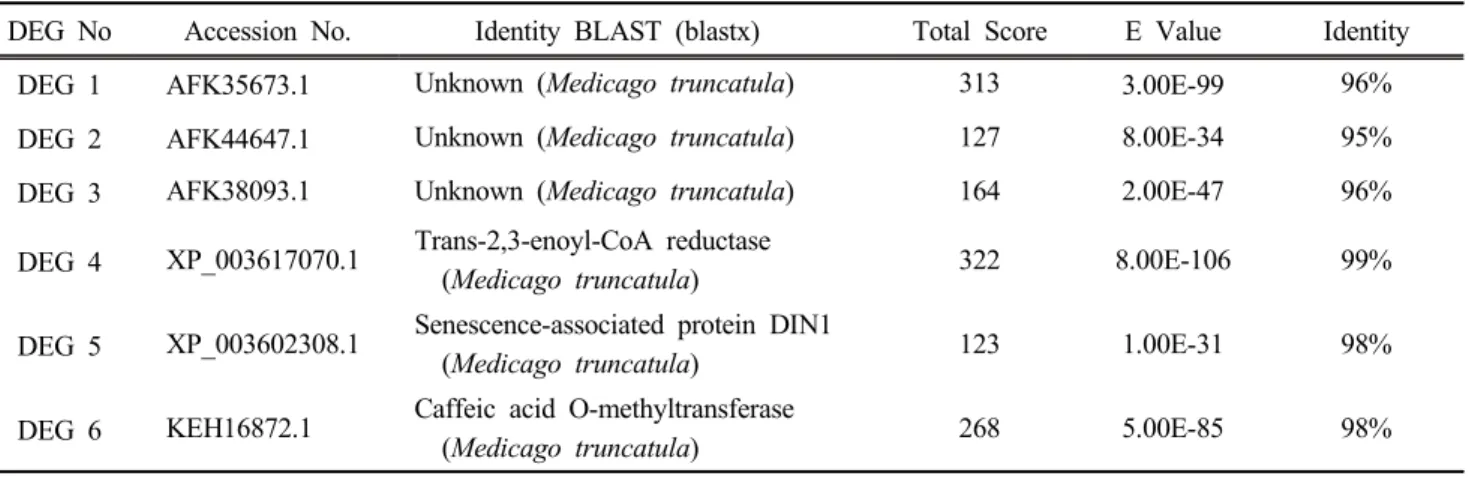
Table 1. Copper (Cu) and cadmium (Cd)-induced differentially expressed genes (DEGs) search by BLASTP (http://www.ncbi.nlm.nih.gov/BLAST/)
DEG No Accession No. Identity BLAST (blastx) Total Score E Value Identity
DEG 1 AFK35673.1 Unknown (Medicago truncatula) 313 3.00E-99 96%
DEG 2 AFK44647.1 Unknown (Medicago truncatula) 127 8.00E-34 95%
DEG 3 AFK38093.1 Unknown (Medicago truncatula) 164 2.00E-47 96%
DEG 4 XP_003617070.1 Trans-2,3-enoyl-CoA reductase
(Medicago truncatula) 322 8.00E-106 99%
DEG 5 XP_003602308.1 Senescence-associated protein DIN1
(Medicago truncatula) 123 1.00E-31 98%
DEG 6 KEH16872.1 Caffeic acid O-methyltransferase
(Medicago truncatula) 268 5.00E-85 98%
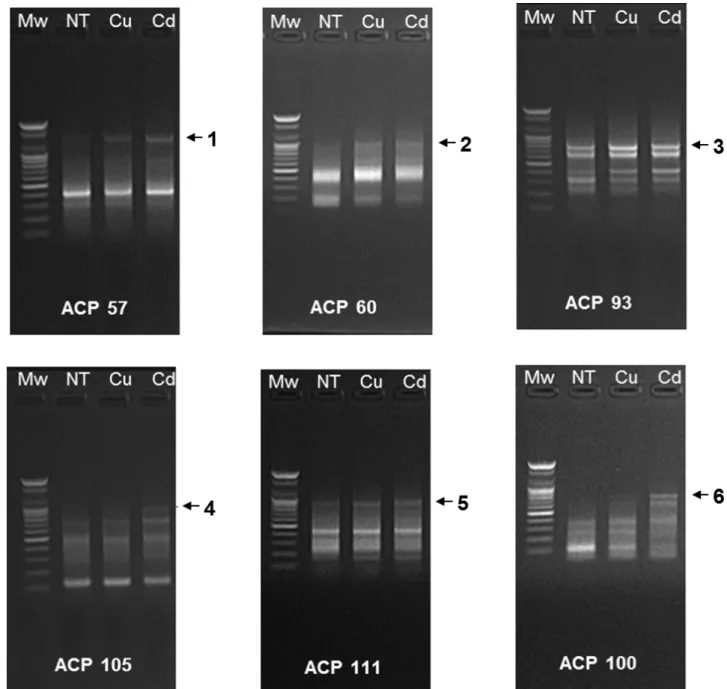
120 GPs, differentially expressed DNA bands were found in 6 GPs under the influence of Cu and Cd treatments. Total 6 DEGs (DEG-1, 2, 3, 4, 5 and 6) induced in response of either Cu or Cd stress (Fig. 2). In this study, DEG-1 DEG-1, DEG-2 and DEG-3 were induced under Cu and Cd stresses which were encoded as unknown genes confirmed by NCBI (http://www.ncbi.nlm.nih.gov/BLAST/) program BlastX was used for-homologue searches (Table 1).
We identified trans-2,3-enoyl-CoA reductase (DEG-4) is a key enzyme for the final step of fatty acid elongation.
Fatty acids (FA) are comprised by major component of membrane lipids and considered as building block of membrane (Hajduch et al., 2006). In addition, long chain fatty acids are essential biological compound present in cuticular waxes, seed storage triglycerols and sphingolipids in plants but the clear function of this enzyme is poorly
documented under stress conditions. Zheng et al. (2005), observed that during plant morphogenesis enoyl-CoA reductase gene contribute in fatty acid synthesis and cell expansion. In our study, trans-2,3-enoyl-CoA reductase is induced in response of Cd stress that is indicating that DEG-4 is Cd-induced gene in alfalfa leaf. Therefore, DEG-4 in alfalfa leaf may contribute in metal stress defense by participating in fatty acid synthesis process that may have pivotal role in the limitation of non-stomatal water loss and stress defense.
Senescence-associated protein DIN1 (DEG-5) was involved in senescence process in plant. In our observation we found that DEG-5 was induced under Cu and Cd stresses.
According to previous report (Mantri et al., 2007), this gene was differentially regulated in leaf and flower in chickpea tolerant cultivar under drought, salt and cold stresses that supports to our results in term of abiotic stress tolerance in plant. Therefore, it is reasonable to assume that up- regulation of DEG-5 possibly a indication of Cu and Cd stresses tolerance of alfalfa plant.
DEG-6 was identified as encoding for caffeic acid
O-methyl transferase (Table 1; Fig. 2) that catalyzes the
biosynthesis of monolignols, are produced by a branch of
the phenylpropanoid pathway. Several pigment including
signal and defense molecules including monolignols are
played a role in stress homeostasis. Report in earlier (Tu et
al., 2010), caffeic acid O-methyl transferase (COMT)
involved in stress avoidance by lignin synthesis in perennial
rye grass and maize. In our study, COMT was expressed
during Cd treatment. Therefore our study suggests that
Fig. 2. Amplification of target cDNA fragments using annealing control primer (ACP)-based approach. The representative photograph of agarose gel showing the induction of differentially expressed genes (DEGs) response to copper (Cu) and cadmium (Cd) stresses. The arrows indicate Cu and Cd-induced DEGs in alfalfa leaf compared to the non-treated plants (control). Mw represents the, DNA ladder; NT, non-treated plants; Cu, copper treated leaf sample; Cd, cadmium treated leaf sample of alfalfa plants.
COMT may involve in Cd stress tolerance in alfalfa.
. CONCLUSION
Among the abiotic stresses, heavy metal stress is a serious issue in forage crop production. In this study, we
applied, annealing control primers (ACP)-based reverse
transcription polymerase chain reaction approach for
identification of copper and cadmium stressed responsible
differentially expressed genes (DEGs) in alfalfa (Medicago
sativa L. cv. Vernal) leaves. Among 120 ACPs, 6 DEGswere induced in response of Cu and Cd stresses. Among
all 6 DEGs, 1 DEG was identified for trans-2,3-enoyl-CoA reductase, 1 for senescence-associated protein DIN1 and 1 for caffeic acid O-methyltransferase. This study provides a base for the identification of new genes in response of heavy metal stresses, suggesting that identified promising candidates would be useful for the new insights of forage and other plant improvement.
. ACKNOWLEDGEMENTS
This work was supported by the “Cooperative Research Program for Agriculture Science & Technology Develop- ment (Project No. PJ008599042015)” and Postdoctoral Fellowship Program of 2015, National Institute of Animal Science, Rural Development Administration, Republic of Korea.
. REFERENCES
Clemente, R., Walker, D.J. and Bernal, M.P. 2005. Uptake of heavy metals and As by Brassica juncea grown in a contaminated soil in Aznalcóllar (Spain): the effect of soil amendments. Environ- mental Pollution. 138:46-58.
Gao, J., Sun, L., Yang, X. and Liu, J.-X. 2013. Transcriptomic analysis of cadmium stress response in the heavy metal hyperaccumulator Sedum alfredii Hance. PLoS ONE 8(6):
e64643.
Hajduch, M., Casteel, J.E., Hurrelmeyer, K.E., Song, Z., Agrawal, G.K. and Thelen, J.J. 2006. Proteomic analysis of seed filling in Brassica napus. Developmental characterization of metabolic isozymes using high-resolution two-dimensional gel electro- phoresis. Plant Physiology. 141(1):32-46.
Halliwell, B. and Gutteridge, J. 1984. Oxygen toxicity, oxygen radicals, transition metals and disease. Biochemical Journal. 219:
1-14.
Lee, S.H., Lee, K.W., Kim, K.Y., Choi, G.J., Yoon, S.H., Ji. H.C.,
Seo, S., Lim, Y.C. and Nagib, A. 2009. Identification of salt-stress induced differentially expressed genes in barley leaves using the annealing control-primer-based GeneFishing technique.
African Journal of Biotechnology. 8(7):1326-1331.
Mantri, N.L., Ford, R., Coram, T.E. and Pang, E.C.K. 2007.
Transcriptional profiling of chickpea genes differentially regulated in response to high-salinity, cold and drought, BMC Genomics.8 (303):1-14
Pahlsson, A.B. 1989. Toxicity of heavy metals (Zn, Cu, Cd, Pb) to vascular plants: A literature review. Water Air and Soil Pollution. 47:287-319.
Peralta, J.R., Gardea-Torresdey, J.L. and Tiemann, K.J. 2000. Study of the effects of heavy metals on seed germination and plant growth on alfalfa plant (Medicago sative) grown in soild media.
Proceedings of the 2000 Conference on Hazardous Wast Research. pp: 135-140.
Pierzynski, G.M., Sims, J.T. and Vance, G.F. 2000. Soils and environmental quality. p. 459. Boca Raton, FL: CRC Press.
Ponizovsky, A.A., Allen, H.E. and Ackerman, A.J. 2007. Copper activity in soil solutions of calcareous soils. Environmental Pollution. 145:1-6.
Souza, V.L., de Almeida, A.A., Lima, S.G., Cascardo, J.C.M., da Silva, C., Mangabeira, P.A. and Gomes, F.P. 2011. Morpho- physiological responses and programmed cell death induced by cadmium in Genipa americana L. (Rubiaceae). Biometals. 24:
59-71.
Tu, Y., Rochfort, S., Liu, Z., Ran, Y., Griffith, M., Badenhorst, P., Louie, G.V., Bowman, M.E., Smith, K.F., Noel, J.P., Mouradov, A. and Spangenberg, G. 2010. Functional analyses of caffeic acid O-Methyltransferase and Cinnamoyl-CoA-reductase genes from perennial ryegrass (Lolium perenne). Plant Cell. 22(10):3357-3373.
Zheng, H., Rowland, O. and Kunst, L. 2005. Disruptions of the Arabidopsis enoyl-CoA reductase gene reveal an essential role for very long-chain fatty acid synthesis in cell expansion during plant morphogenesis. Plant Cell. 17:1467-1481.
(Received September 5, 2015 / Revised September 7, 2015 / Accepted September 14, 2015)