* Corresponding author: Md. Atikur Rahman, Grassland & Forages Division, National Institute of Animal Science, Rural Development Administration, Cheonan 31000, Republic of Korea. Tel: +82-41-580-6767, E-mail: [email protected]
Short Communication
Salt-induced Differential Gene Expression in Italian Ryegrass (Lolium multiflorum Lam.) Revealed by Annealing Control Primer Based GeneFishing approach
Ki-Won Lee, Sang-Hoon Lee, Gi Jun Choi, Hee Jung Ji, Tae Young Hwang, Won Ho Kim and Md. Atikur Rahman *
Grassland & Forages Division, National Institute of Animal Science, Rural Development Administration, Cheonan, 330-801, Republic of Korea
ABSTRACT
Salt stress is one of the most limiting factors that reduce plant growth, development and yield. However, identification of salt-inducible genes is an initial step for understanding the adaptive response of plants to salt stress. In this study, we used an annealing control primer (ACP) based GeneFishing technique to identify differentially expressed genes (DEGs) in Italian ryegrass seedlings under salt stress. Ten-day-old seedlings were exposed to 100 mM NaCl for 6 h. Using 60 ACPs, a total 8 up-regulated genes were identified and sequenced. We identified several promising genes encoding alpha-glactosidase b, light harvesting chlorophyll a/b binding protein, metallothionein-like protein 3B-like, translation factor SUI, translation initiation factor eIF1, glyceraldehyde-3-phosphate dehydrogenase 2 and elongation factor 1-alpha. These genes were mostly involved in plant development, signaling, ROS detoxification and salt acclimation. However, this study provides new molecular information of several genes to understand the salt stress response. These genes would be useful for the enhancement of salt stress tolerance in plants.
(Key words : Italian Ryegrass, Salt Stress, GeneFishing)
Ⅰ. INTRODUCTION
Salt stress is one of the most detrimental factors that reduce plant growth and yield globally. Approximately, 77 million hectors of cultivated land (~ 5% of total land) is greatly affected by salt stress (Munns et al., 1999). A series of physiological, biochemical, molecular and morphological changes is induced by salt stress in plants (Khan et al., 2016).
Salt stress induced ionic toxicity in cells is due to presence of high level of Na
+, and Cl
-ions. As a consequence of stress, several free radicals including reactive oxygen species (ROS) may generate in plant cells. ROS induces lipid peroxidations that lead to oxidative stress induced cellular injury in plants (Sharma et al., 2012). However, plants have innate ability to survive salinity stress by using the complex adaptive mechanisms. For instance, plant can tolerate salt stress by maintaining the homeostasis of intercellular ions (Na
+, Cl
-) at plasma membrane by vacuolar compartmentation. In addition, plants have evolved to maintain osmotic potential by cytoplasmic accumulation of osmoprotectants (Diédhiou et al.,
2008). Therefore, the identification of salt-stress-induced differentially expressed genes (DEGs) would be potential step for understanding the adaptive response of plants to salinity stress.
Italian ryegrass (Lolium multiflorum Lam.) is one of the
most cultivated forage crops in Korea, moderately tolerant to
salinity. Numerous regulatory proteins/enzymes have been
identified in several fodder crops including tall fescue (Martin
et al., 2012), perennial ryegrass (Hu et al., 2012), alfalfa
(Rahman et al., 2015), and vetiver grass (Liu et al., 2016)
which is mediate gene expression under salt stress. Plants
respond to salt stress at different stages including physiological
and molecular levels. Advance genomic tools provide the clear
understanding of global gene expression in plants. Regulation
of gene expression, signaling and salt stress tolerance have
been demonstrated in model plant Arabidopsis (Song et al.,
2016), rice (Kawasaki et al., 2001), barley (Hurkman et
al.,1996) and soybean (Chen et al., 2014). Despite of great
progresses in this field, there are still some molecular issues
which need further exploration for Italian ryegrass.
Several molecular techniques are used to gene expression profiling in plants. For instance, serial analysis of gene expression (SAGE) used to define number and abundance of transcript in plant cells. High-density cDNA microarray approach was applied to understand the benefit of gene function in forage and turf species (Humphreys, 2005).
Suppression subtractive hybridization (SSH) is a polymerase chain reaction (PCR) applied to target range of transcript and low abundant genes in plants (Sahu et al., 2012). In recent we are successfully using annealing control primer (ACP)-based GeneFishing technique to identify the DEGs in plants (Rahman et al., 2016b). This ACP-based system increases the annealing specificity to the template and amplifies only the genuine gene products. However, the knowledge about mechanisms of Italian ryegrass responding to salt stress at seedling stage has rarely been reported. Therefore, the objective of this study is to screen salt stress-induced genes in Italian ryegrass seedlings, as well as to identify a set of key genes which played a pivotal under salt tolerance.
Ⅱ. MATERIAL AND METHODS 1. Plant materials and salt treatment
Italian ryegrass (Lolium multiflorum Lam. cv. Florida-80) seeds were obtained from Grassland and Forages Division, National Institute of Animal Science (NIAS), Rural Development Administration (RDA), Cheonan, Korea. Italian ryegrass seeds were surface sterilized by 70% ethanol followed by washed three times by Mlli-Q, subsequently treated in 30%
sodium hypochlorite (NaOCl) for 30 min, placed on germination medium containing half MS (Murashige & Skoog) and 3% sucrose. Growth chamber temperature was maintained at 25 °C with of 400 µmol m
-2s
-1light intensity and 14-h/8 h light and dark cycle. One-week old seedlings were exposed to liquid MS medium containing 100 mM NaCl for 6 h, while control plants were treated with normal MS medium. After 6 h of salt treatment the seedlings were washed three times with Milli-Q water, immediately frozen in liquid N2 and preserved at -80 °C until use.
2. Total RNA isolation and first stand cDNA synthesis
Total RNA was isolated from treated and control Italian ryegrass using plant RNeasy mini kt (Qiagen USA). The RNA sample was used for the synthesis of the first stand cDNAs by reverse transcriptase. The reserve transcription reaction was performed for 1.5 h at 42°C using 20 μl containing 3 μg of the purified total RNA, 4 μl of 5x reaction buffer (Promega, USA), 5 μl of dNTPs (2 mmol each); 2 µl of 10 µM dT-ACP1 [5´-CTGTGAATGCTGCGACTACGA TIIIIIT(18)-3´];
0.5 µl of RNasin RNase Inhibitor (40 U/µl; Promega); and 1 µl of Moloney murine leukemia virus reverse transcriptase (200 U/µl; Promega). After completion of first-strand cDNAs synthesis, samples were diluted independently by adding 80 µl of ultra-purified water, and subsequently prepared for GeneFishingTM method.
3. Annealing control primer (ACP)-based GeneFishing
TMreverse transcription polymerase chain reaction
An annealing control primer (ACP)–based PCR technique was performed for isolation of DEGs. In this process gene fishing-kit (Seegene, Korea)was used. Briefly, the second strand cDNA synthesis was conducted using PCR protocol and experimental method of Lee et al. (2011). The amplified PCR products were collected then separated using 1% agarose gel containing 5 µl/100 ml RedSafe™ nucleic acid staining solution (ABC Scientific, USA).
4. Gene cloning and sequence analysis
Salt-induced DEGs were isolated from the gel by using the GENCLEAN II Kit (Q-BIO gene, USA), followed by cloned into a TOPO TA cloning vector (Invitrogen, USA) according to the manufacturer’s instruction. The sequences of cloned plasmids were performed by ABI PRISM 3100 Genetic Analyzer (Applied Biosystems, USA) using the M13 forward primer (5’-CGCCAGGGTTTTCCCAGTCACGA-3’) and M13 reverse primer (5’-AGCGGATAACAATTTCACACAGGA-3’).
Finally, the sequences of specific genes were confirmed from NCBI database using Blast tool. (https://blast.ncbi.nlm.nih.gov/
Blast)
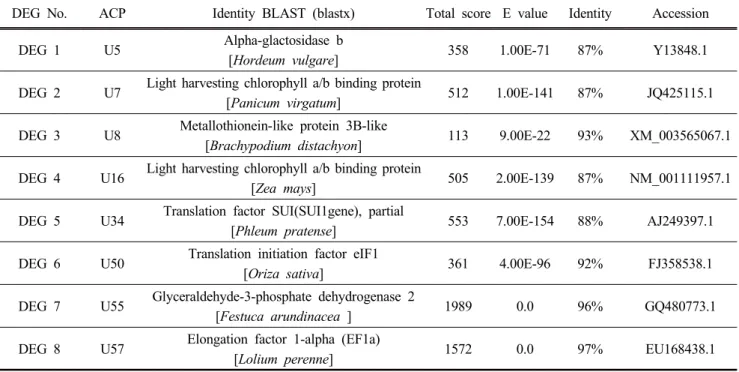
Table 1. Salt (NaCl)-stress induced differentially expressed genes (DEGs) in Italian ryegrass seedlings identified by sequence analysis. The sequences were searched by BLASTX (http://www.ncbi.nlm.nih.gov/BLAST/).
DEG No. ACP Identity BLAST (blastx) Total score E value Identity Accession
DEG 1 U5 Alpha-glactosidase b
[Hordeum vulgare] 358 1.00E-71 87% Y13848.1
DEG 2 U7 Light harvesting chlorophyll a/b binding protein
[Panicum virgatum] 512 1.00E-141 87% JQ425115.1
DEG 3 U8 Metallothionein-like protein 3B-like
[Brachypodium distachyon] 113 9.00E-22 93% XM_003565067.1
DEG 4 U16 Light harvesting chlorophyll a/b binding protein
[Zea mays] 505 2.00E-139 87% NM_001111957.1
DEG 5 U34 Translation factor SUI(SUI1gene), partial
[Phleum pratense] 553 7.00E-154 88% AJ249397.1
DEG 6 U50 Translation initiation factor eIF1
[Oriza sativa] 361 4.00E-96 92% FJ358538.1
DEG 7 U55 Glyceraldehyde-3-phosphate dehydrogenase 2
[Festuca arundinacea ] 1989 0.0 96% GQ480773.1
DEG 8 U57 Elongation factor 1-alpha (EF1a)
[Lolium perenne] 1572 0.0 97% EU168438.1
Ⅲ. RESULTS AND DISCUSSION
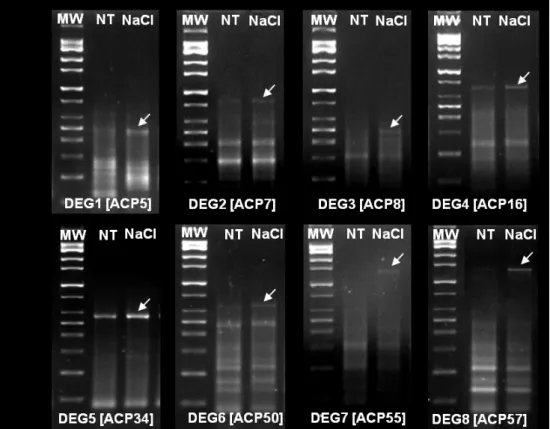
In this study, we identified several salt-induced DEGs including alpha-glactosidase b (named as DEG 1), light harvesting chlorophyll a/b binding protein (DEGs 2, and 4), metallothionein-like protein 3B-like (DEG 3), translation factor SUI (DEG5), translation initiation factor eIF1 (DEG 6), glyceraldehyde-3-phosphate dehydrogenase 2 (DEG 7) and elongation factor 1-alpha (DEG 8) in Italian ryegrass seedlings (Fig. 1; Table1). In the following sections, we discussed the potential role of these genes in focus of previous genomics and physiological studies in plant system.
In this study, DEG1 was identified as alpha-glactosidase b (α-Gal b) that induced by salt stress in Italian ryegrass seedlings (Fig. 1). Plant α-Gals belong to glycoside hydrolase family 27, which have essential role during plant leaf development (Chrost, 2007). In addition, it has been reported that α-Gal involved in freezing tolerance in plants ( Pennycooke et al., 2003). Here, the up-regulation of α -Gal gene indicates that α-Gal might be also involved in salt tolerance in Italian ryegrass. Light harvesting chlorophyll a/b binding protein (LHCB; DEGs 2, and 4) is a key apoproteins of the light- harvesting complex of photosystem II (PSII), involved in guard
cell signaling suggest that it is possibly involved in salt stress tolerance. Recently, it has been found LHBC gene expression is regulated by several environmental cues and stress signals were induced and transmitted among the plants cells (Liu et al., 2013).
We identified metallothionein-like protein 3B-like (MT3B;
DEG3) that was up-regulated by salt stress. Plant metaloproteins (MTs) belong to cysteine rich protein family. Recently it has been found that the type 1 metallothionein gene is induced by NaCl and CdCl2, involved in detoxification of heavy metal ion, also protected ROS induced cellular injury (Yang et al., 2015).
In our study, the up-regulation of MT3B gene indicates abiotic stress induced gene that may enhance salt tolerance in Italian ryegrass seedlings. DEG5 was identified as translation factor Shortened Uppermost Internode (SUI). The SUI1family of genes has important role in stem development of plants (Yin et al., 2013). We speculate that the up-regulation of SUI gene involved in cell expansion in Italian ryegrass seedlings. It has been demonstrated that overexpression of SUI1 and SUI2 induced outgrowth of internodes during vegetative development in rice (Yin et al., 2013). However, this observation supports to our speculation that provide the role of SUI gene family in plants.
A gene (DEG6) encoded translation initiation factor eIF1,
Figure 1. Annealing control primer based GeneFishing approach. Agarose gel image shows differentially expressed genes (DEGs) response to salt (NaCl) stress. Arrows indicate the induced DEGs compared to non-treatment.
MW, molecular weight size marker; NT, non-treatment; NaCl, 100 mM salt treatment; ACP, annealing control gene fishing primer.
played pivotal role in abiotic stress tolerance in rice plants (Rangan et al., 2009). The overexpression of sugar beet eIFIA (BveIF1A) improved salt tolerance in model plant A. thaliana (Rausell et al., 2003). Moreover, it has been found that the expression of rice eIF1 (OseIF1) gene is induced by ABA, and osmotic stress (Rangan et al., 2009). However, the above discussion supports to up-regulated initiation factor eIF1 that might be useful for enhancement of salt stress tolerance in plants.
Glyceraldehyde 3-phosphate dehydrogenase (GAPDH; DEG7) is a ubiquitous enzyme that catalyzes the conversion of glycerate-3-phosphate (3-PGA) to glyceraldehyde-3-phosphate in the presence of ATP and NADPH. In this study, the up-regulation of glyceraldehyde 3-phosphate dehydrogenase 2 might be involved in salt tolerance in Italian ryegrass. As a similar observation has been documented, genome wide profiling of GAPDH genes revealed that GAPDHs are involved in abiotic stress response (Zeng et al., 2016). However, the expression of several homologs of GAPDHs including gapA/B, gapC, gapCp
and gapN indicates that these genes may play pivotal role in abiotic stress tolerance in wheat.
Interestingly, eukaryotic elongation factor 1 alpha (eEF1a;
DEG8) also identified in Italian ryegrass seedling response to
salt stress. eEF1a is an important component for protein
biosynthesis, and it involved in signal transduction, DNA
replication/repair protein networks regulation, molecular
chaperone-like activity, and plant development (Suhandono et
al., 2014). In this study, we observed that eEF1a (DEG7) is
up-regulated at seedling stage of Italian ryegrass after salt
treatment. It has been previously reported that eEF1A genes in
cassava (MeEF1A1) were expressed in early stages of plant
development, and also eEF1A induced by several environmental
stimuli including high temperature, drought and light
(Suhandono et al., 2014). Recently, the eEF1a was identified
in Urochloa brizantha (Takamori et al., 2017), elongation factor
Tu was regulated by drought stress in alfalfa (Rahman et al.,
2016a). However, from the above discussion it suggests that
eEF1A gene has multifunction that can contribute in plant development under external stimuli.
Ⅳ. CONCLUSION
In this study, several differentially expressed genes including alpha-glactosidase b, light harvesting chlorophyll a/b binding protein, metallothionein-like protein 3B-like, translation factor SUI, translation initiation factor eIF1, glyceraldehyde-3-phosphate dehydrogenase 2 and elongation factor 1-alpha were identified using annealing control primer-based GeneFishing-technique.
These genes were significantly up-regulated by salt stress in Italian ryegrass seedlings. These genes were involved in plant development, signaling, ROS detoxification and salt acclimation.
The identification of these genes would be useful as promising candidates for the salt stress tolerant crop production.
Ⅴ. ACKNOWLEDGMENTS
This study was supported by the “Cooperative Research Program for Agriculture Science & Technology Development (Project No.
PJ01193504)” and Postdoctoral Fellowship Program of 2017, National Institute of Animal Science, Rural Development Administration, Republic of Korea
Ⅵ. REFERENCES
Chen, X., Chen, Z., Zhao, H., Zhao, Y., Cheng, B. and Xiang, Y. 2014.
Genome-wide analysis of soybean HD-Zip gene family and expression profiling under salinity and drought treatments. PLOS ONE. 9:e87156.
Chrost, B., Kolukisaoglu, U., Schulz, B. and Krupinska, K. 2007. An α -galactosidase with an essential function during leaf development.
Planta. 225:311-320.
Diédhiou, C.J., Popova, O.V., Dietz, K.J. and Golldack, D. 2008. The SUI-homologous translation initiation factor eIF-1 is involved in regulation of ion homeostasis in rice. Plant Biology. 10:298-309.
Hu, L., Li, H., Pang, H. and Fu, J. 2012. Responses of antioxidant gene, protein and enzymes to salinity stress in two genotypes of perennial ryegrass (
Lolium perenne
) differing in salt tolerance. Journal ofPlant Physiology. 169:146-156.
Humphreys, M. O. 2005. Molecular breeding for the genetic improvement of forage crops and turf: Proceedings of the 4th International Symposium on the Molecular Breeding of Forage and Turf, a Satellite Workshop of the XXth International Grassland Congress, Aberystwyth, Wales. p. 286.
Hurkman, W.J. and Tanaka, C.K. 1996. Effect of salt stress on germin gene expression in barley roots. Plant Physiology. 110:971-977.
Kawasaki, S., Borchert, C., Deyholos, M., Wang, H., Brazille, S., Kawai, K., Galbraith, D. and Bohnert, H.J. 2001. Gene expression profiles during the initial phase of salt stress in rice. The Plant Cell.
13:889-906.
Khan, M.S. and Hemalatha, S. 2016. Biochemical and molecular changes induced by salinity stress in
Oryza sativa
L. Acta Physiologiae Plantarum. 38:167.Lee, K.-W., Choi, G. J., Kim, K.-Y., Ji, H. C., Zaman, R. and Lee S.-H.
2011. Identification of drought induced differentially expressed genes in barley leaves using theannealing control-primer-based GeneFishing technique. Australian Journal of Crop Science.
5:1364-1369.
Liu, R., Xu, Y.-H., Jiang, S.-C., Lu, K., Lu, Y.-F., Feng, X.-J., Wu, Z., Liang, S., Yu, Y.-T., Wang, X.-F. and Zhang, D.-P. 2013.
Light-harvesting chlorophyll a/b-binding proteins, positively involved in abscisic acid signalling, require a transcription repressor, WRKY40, to balance their function. Journal of Experimental Botany. 64:5443-5456.
Liu, W.-G., Liu, J.-X., Yao, M.-L. and Ma, Q.-F. 2016. Salt tolerance of a wild ecotype of vetiver grass (
Vetiveria zizanioide
s L.) in southern China. Botanical Studies 57:27.Martin, R.C., Glover-Cutter, K., Baldwin, J.C. and Dombrowski, J.E.
2012. Identification and characterization of a salt stress-inducible zinc finger protein from
Festuca arundinacea
. BMC Research Notes. 5:66.Munns, R., Cramer, G.R. and Ball, M.C. 1999. Interactions between rising CO2, soil salinity, and plant growth. In:Carbon dioxide and environmental stress. Luo, Y., Mooney, H.A., (Eds) Academic Press. pp. 139-167.
Pennycooke, J.C., Jones, M.L. and Stushno, V.C. 2003. Down-regulating α -galactosidase enhances freezing tolerance in transgenic petunia.
Plant Physiology. 133:1-9.
Rahman, M.A., Alam, I., Kim, Y.-G., Ahn, N.-Y., Heo, S.-H., Lee, D.-G., Liu, G. and Lee, B.-H. 2015. Screening for salt-responsive proteins in two contrasting alfalfa cultivars using a comparative proteome approach. Plant Physiology and Biochemistry.
89:112-122.
Rahman, M.A., Kim Y.-G., Alam, I., Liu G., Lee, H., Lee, J.J. and Lee, B.-H. 2016a. Proteome analysis of alfalfa roots in response to water
deficit stress. Journal of Integrative Agriculture. 15:1275-1285.
Rahman, M.A., Lee S-H, Kim K-Y, Park, H.S., Hwang, T.Y., Choi, G.J.
and Lee, K.-W. 2016b. Arsenic-induced differentially expressed genes identified in
Medicago sativa
L. roots. Journal of The Korean Society of Grassland and Forage Science. 36:243-247.Rangan, L., Rout, A., Sudarshan, M. and Gregorio, G. 2009. Molecular cloning, expression and mapping of the translational initiation factor eIF1 gene in
Oryza sativa
. Functional Plant Biology. 36:442-452.Rausell, A., Kanhonou, R., Yenush, L., Serrano, R. and Ros, R. 2003.
The translation initiation factor eIF1A is an important determinant in the tolerance to NaCl stress in yeast and plants. The Plant Journal. 34:257-267.
Sahu, B.B. and Shaw, B.P. 2009. Isolation, identification and expression analysis of salt-induced genes in
Suaeda maritima
, a natural halophyte,using PCR-based suppression subtractive hybridization.BMC Plant Biology. 9:69-69.
Sharma, P., Jha, A.B., Dubey, R.S. and Pessarakli, M. 2012. Reactive oxygen species, oxidative damage, and antioxidative defense mechanism in plants under stressful conditions. Journal of Botany.
Article ID 217037:1-26.
Song, X., Yu, X., Hori, C., Demura, T., Ohtani, M. and Zhuge, Q. 2016.
Heterologous overexpression of poplar SnRK2 genes enhanced salt stress tolerance in
Arabidopsis thaliana
. Frontiers in Plant Science. 7:612.Suhandono, S., Apriyanto, A. and Ihsani, N. 2014. Isolation and characterization of three cassava elongation factor 1 alpha (MeEF1A) promoters. PLOS ONE. 9:e84692.
Takamori, L.M., Pereira, A.V.C., Maia Souza, G, Vieira, L.G.E. and Ferreira Ribas, A. 2017. Identification of endogenous reference genes for RT-qPCR expression analysis in
Urochloa brizantha
under abiotic stresses. Scientific Reports. 7:8502.Yang, M., Zhang, F., Wang, F., Dong, Z., Cao, Q. and Chen, M. 2015.
Characterization of a type 1 metallothionein gene from the stresses-tolerant plant
Ziziphus jujuba
. International Journal of Molecular Sciences. 16:16750-16762.Yin, H., Gao, P., Liu, C., Yang, J., Liu, Z. and Luo, D. 2013.
SUI-family genes encode phosphatidylserine synthases and regulate stem development in rice. Planta. 237:15-27.
Zeng, L., Deng, R., Guo, Z., Yang, S. and Deng, X. 2016. Genome-wide identification and characterization of Glyceraldehyde-3-phosphate dehydrogenase genes family in wheat (
Triticum aestivum
). BMC Genomics. 17:240.(Received : August 29, 2017 | Revised : September 18, 2017 | Accepted : September 18, 2017)