Relationships between Serum Adiponectin with
Metabolic Syndrome and Components of Metabolic Syndrome in Non-Diabetic Koreans: ARIRANG Study
Sang-Baek Koh,
2,3Junghan Yoon,
1,3Jang-Young Kim,
1,3Byung-Su Yoo,
1,3Seung-Hwan Lee,
1,3Jong-Ku Park,
2,3and Kyung-Hoon Choe
1Departments of 1Cardiology and 2Preventive Medicine, Wonju College of Medicine, Yonsei University, Wonju;
3Institute of Genomic Cohort, Yonsei University, Wonju, Korea.
Received: December 24, 2009 Revised: May 6, 2010 Accepted: June 14, 2010
Corresponding author: Dr. Jang-Young Kim, Department of Cardiology, Wonju College of Medicine, Yonsei University, 162 Ilsan-dong, Wonju 220-701, Korea.
Tel: 82-33-741-0342, Fax: 82-33-747-0409 E-mail: [email protected]
∙ The authors have no financial conflicts of interest.
© Copyright:
Yonsei University College of Medicine 2011 This is an Open Access article distributed under the terms of the Creative Commons Attribution Non- Commercial License (http://creativecommons.org/
licenses/by-nc/3.0) which permits unrestricted non- commercial use, distribution, and reproduction in any medium, provided the original work is properly cited.
Purpose: Growing evidence suggests that hypoadiponectinemia may play a sig- nificant role in the development of metabolic syndrome (MetS). Therefore, the re- lationships between serum adiponectin with MetS and components of MetS were investigated in non-diabetic samples of drawn from the Koreans general popula- tion. Materials and Methods: We performed a cross-sectional study in samples of older Koreans (age > 40 years) including 2,471 men and 3,463 women. MetS was defined according to the Asian modified criteria of the National Cholesterol Education Program Adult Treatment Panel III report. Serum adiponectin concen- trations were measured by radioimmunoassay. Results: The median adiponectin level in MetS was significantly lower than that in non-MetS subjects in men (6.00 vs. 8.00 µg/mL, p < 0.001) and women (10.12 vs. 11.74 µg/mL, p < 0.001). Adi- ponectin concentration was negatively correlated with waist circumference and levels of triglyceride, C-reactive protein (CRP), fasting glucose, and insulin, and positively correlated with high-density lipoprotein and age in both genders (p <
0.001). In a multivariate regression model after adjustment for age, body mass in- dex, smoking, CRP, and lipid profiles, the odds ratio of MetS comparing extreme quartiles of adiponectin distribution was 0.32 [95% confidence interval (CI), 0.20 to 0.50] in men and 0.57 (95% CI, 0.43 to 0.76) in women. Conclusion: Adipo- nectin levels are independently associated with the phenotype of MetS, as well as components of MetS in the non-diabetic Korean general population.
Key Words: Adiponectin, metabolic syndrome, Korea
INTRODUCTION
Metabolic syndrome (MetS) is characterized by interrelated risk factors [hyperten- sion, hypertriglyceridemia, low high-density lipoprotein (HDL) cholesterol, and elevated fasting glucose) and insulin resistance that identify individuals at in- creased risk for type 2 diabetes and progression of cardiovascular disease.1
Adiponectin is the most abundant serum adipokine that has been recognized as a
4) hypertension: systolic blood pressure ≥ 130 mmHg, dia- stolic blood pressure ≥ 85 mmHg; and 5) high fasting glu- cose: serum glucose concentration ≥ 110 mg/dL. To evalu- ate the consistency of our findings, we also used the criteria of the International Diabetes Federation (IDF),8 central obe- sity (waist circumference ≥ 90 cm in men or ≥ 80 cm in wom- en, modified using WHO Asia Pacific guidelines) plus any two of the following four factors: 1) elevated triglyceride level: > 150 mg/dL (1.69 mmol/L); 2) reduced HDL choles- terol: < 40 mg/dL (1.04 mmol/L) in males or < 50 mg/dL (1.29 mmol/L) in females; 3) elevated blood pressure: sys- tolic blood pressure (BP) ≥ 130 or diastolic BP ≥ 85 mmHg;
and 4) elevated fasting plasma glucose ≥ 100 mg/dL.
Laboratory measurements
A venous blood sample was drawn from each subject after fasting for 12 hours or overnight. The samples were stored at - 80°C until assay. The samples for adiponectin concentration were analysed within one week after centrifugation. The se- rum concentrations of adiponectin were measured by radio- immunoassay (RIA)(LINCO Research, Inc., St. Louis, MO, USA). The intra-assay and interassay coefficients of varia- tion for serum adiponectin assays ranged between 2.9% and 6.6%. Fasting glucose and insulin were determined by a glu- cose oxidase-based assay and double-antibody RIA, respec- tively. Serum total cholesterol and triglyceride concentrations were determined by enzymatic methods. HDL-cholesterol was measured enzymatically after heparin and calcium pre- cipitation. Insulin resistance was calculated using the homeo- stasis assessment (HOMA-IR) model using the following formula: fasting insulin (µIU/mL) x fasting plasma glucose (mmol/L)/22.5.
Statistical analysis
Continuous variables are presented as means and standard deviations for clinical characteristics or medians and inter- quartile ranges for adiponectin levels. These were compared using the unpaired t-test or the Mann-Whitney U-test. The distribution of adiponectin concentrations was markedly skewed and log-transformed in analyses where normality was required. Pearson’s correlation coefficients were used to establish the relationships between adiponectin concen- trations (log-transformed) and clinical or laboratory param- eters of MetS.
Multivariate stepwise logistic regression analysis was used to assess the independent association for the presence or ab- sence of MetS as the dichotomous dependant variable in key regulator of insulin sensitivity, tissue inflammation, en-
dothelial function, and lipid metabolism.1-3 Moreover, a growing body of evidence suggests that hypoadiponec- tinemia may play a significant role in the development of MetS.4,5 However, little is known about the significance of circulating adiponectin as a surrogate marker for MetS itself and components of MetS in a non-diabetic general popula- tion. Therefore, we sought to address this question and to identify potential relationships between circulating adiponec- tin concentration and MetS as well as components of MetS.
MATERIALS AND METHODS
Study subjects
The study subjects were selected from four rural areas as en- rolled in the Korean Genomic Rural Cohort (KGRC), an on- going epidemiologic study conducted on a representative sample of older (age > 40) Koreans. A total of 5,934 Korean non-diabetic adult subjects (2,471 men and 3,463 women) were enrolled in the KGRC between November 2005 and December 2006. None of the subjects had a self-reported medical history of cardiovascular disease, diabetes, or cancer, and all responded to a questionnaire on their medical-social history and life style characteristics. Subjects were excluded if they had been treated with any agents for hypertension (n = 676), hyperlipidemia (n = 563), or obesity (n = 102).
The study subjects are expected to be followed with bi- annual health check-ups with a physical examination, sero- logic tests, and genomic studies for ten years. All subjects provided informed consent, and the study protocol was ap- proved by the Institutional Review Board of Wonju Chris- tian Hospital.
Definition of MetS
We used the definition for MetS suggested by the National Cholesterol Education Program Adult Treatment Panel III report (ATP III).6 However, the criterion for abdominal obesi- ty was adopted from the World Health Organization (WHO) Asian Pacific Guideline.7 We defined MetS as the presence of at least three of the following abnormalities: 1) abdomi- nal obesity: waist circumference ≥ 90 cm in men or ≥ 80 cm in women, modified using Asia Pacific WHO guidelines; 2) hypertriglyceridemia: a serum triglyceride concentration ≥ 150 mg/dL (1.69 mmol/L); 3) low HDL cholesterolemia: a serum HDL cholesterol concentration < 40 mg/dL (1.04 mmol/L) for men or < 50 mg/dL (1.29 mmol/L) in women,
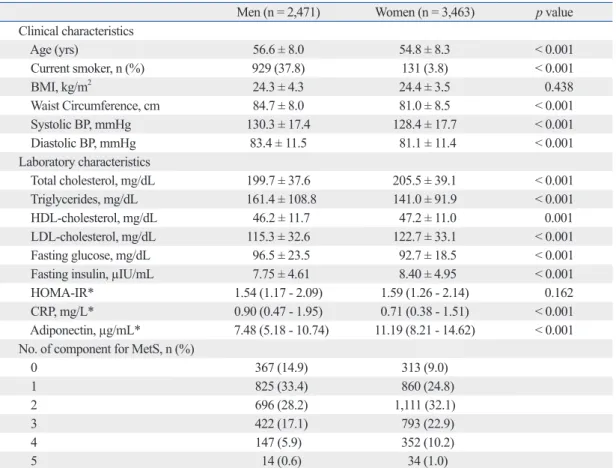
study cohort. The median adiponectin level in women (11.19 µg/mL) was significantly higher than in men (7.48 µg/mL)(p < 0.001). The proportion of three or more char- acteristics for MetS was 23.6 % in men, compared with 34.1 % in women by ATP III.
For every component of MetS examined, adiponectin levels were significantly lower in subjects who had compo- nents of MetS than those who did not in both genders (p <
0.001), with the exception of high blood pressure (p = 0.075 in men and 0.720 in women)(Table 2). The median adipo- nectin level in MetS was also significantly lower than that in non-MetS subjects for men (6.00 vs. 8.00 µg/mL, p <
0.001) and women (10.12 vs. 11.74 µg/mL, p < 0.001).
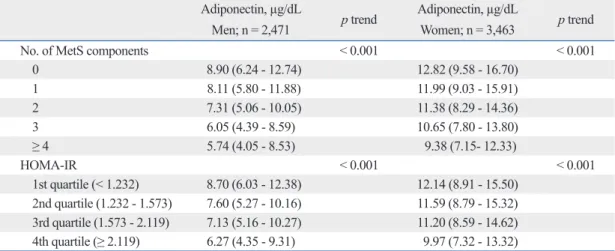
Table 3 shows interrelationships between serum adipo- nectin levels and the total numbers of MetS components and HOMA-IR in both genders. A significantly linear de- crease in adiponectin levels was observed according to total numbers of MetS components in both men and women.
The median serum adiponectin levels in men with 0, 1, 2, 3, or ≥ 4 components of MetS were 8.90, 8.11, 7.31, 6.05, and quartiles of adiponectin values. Quartile cut-points were 5.18,
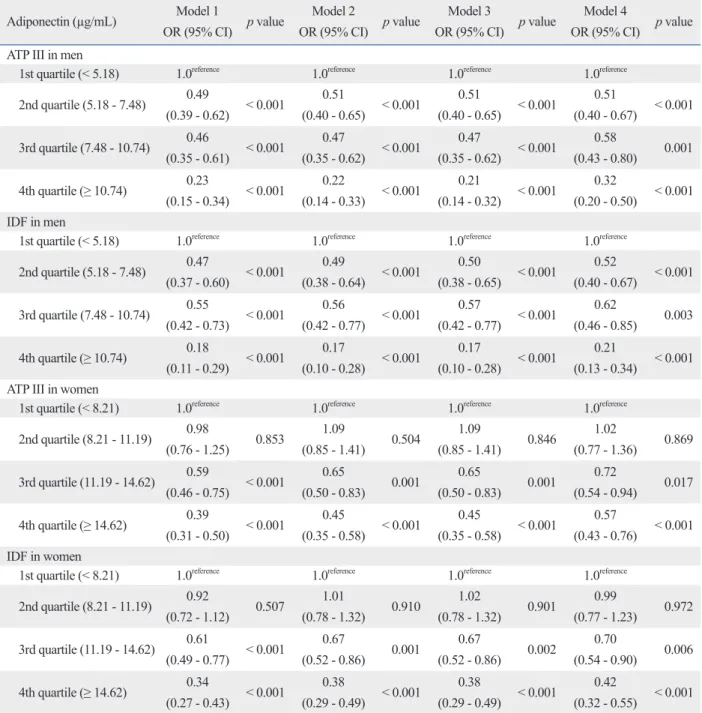
7.48, and 10.74 µg/mL for men (n = 2,471) and 8.21, 11.19, and 14.62 µg/mL for women (n = 3,463). Results are ex- pressed as odds ratios (ORs) together with 95% confidence intervals (CI).
Age-adjusted ORs were first calculated (model 1), and the results were further adjusted for BMI as the continuous variable and smoking status as the dichotomous variable (model 2). Additional adjustments were carried out with CRP as the continuous variable (model 3) and cholesterol profile as the continuous variable (total cholesterol and HDL-cholesterol, model 4).
All analyses were performed using the SPSS statistical package for Windows (version 12.0, SPSS, Chicago, IL, USA), and p values < 0.05 were considered significant.
RESULTS
Table 1 shows the clinical and biochemical features of the Table 1. Baseline Characteristics of the Cohort Population
Men (n = 2,471) Women (n = 3,463) p value
Clinical characteristics
Age (yrs) 56.6 ± 8.0 54.8 ± 8.3 < 0.001
Current smoker, n (%) 929 (37.8) 131 (3.8) < 0.001
BMI, kg/m2 24.3 ± 4.3 24.4 ± 3.5 0.438
Waist Circumference, cm 84.7 ± 8.0 81.0 ± 8.5 < 0.001
Systolic BP, mmHg 130.3 ± 17.4 128.4 ± 17.7 < 0.001
Diastolic BP, mmHg 83.4 ± 11.5 81.1 ± 11.4 < 0.001
Laboratory characteristics
Total cholesterol, mg/dL 199.7 ± 37.6 205.5 ± 39.1 < 0.001
Triglycerides, mg/dL 161.4 ± 108.8 141.0 ± 91.9 < 0.001
HDL-cholesterol, mg/dL 46.2 ± 11.7 47.2 ± 11.0 0.001
LDL-cholesterol, mg/dL 115.3 ± 32.6 122.7 ± 33.1 < 0.001
Fasting glucose, mg/dL 96.5 ± 23.5 92.7 ± 18.5 < 0.001
Fasting insulin, µIU/mL 7.75 ± 4.61 8.40 ± 4.95 < 0.001
HOMA-IR* 1.54 (1.17 - 2.09) 1.59 (1.26 - 2.14) 0.162
CRP, mg/L* 0.90 (0.47 - 1.95) 0.71 (0.38 - 1.51) < 0.001
Adiponectin, µg/mL* 7.48 (5.18 - 10.74) 11.19 (8.21 - 14.62) < 0.001 No. of component for MetS, n (%)
0 367 (14.9) 313 (9.0)
1 825 (33.4) 860 (24.8)
2 696 (28.2) 1,111 (32.1)
3 422 (17.1) 793 (22.9)
4 147 (5.9) 352 (10.2)
5 14 (0.6) 34 (1.0)
Values are expressed as mean ± SD or number (%) if not stated otherwise.
BMI, body mass index; BP, blood pressure; HDL, high density lipoprotein; LDL, low density lipoprotein; HOMA-IR, homeostasis assess- ment-insulin resistance; CRP, C-reactive protein; MetS, metabolic syndrome.
*Values are expressed as median (lower quartile-upper quartile), p value from Mann-Whitney U test.
= - 0.050), waist circumference (r = - 0.281), body mass index (BMI)(r = - 0.056), C-reactive protein (hsCRP)(r = - 0.053), fasting insulin (r = - 0.119), glucose (r = - 0.116), and HOMA- IR (r = - 0.193), and positively correlated with HDL choles- terol (r = 0.219) and age (r = 0.222). However, no significant relationship was found between systolic or diastolic blood pressure in men.
In women, adiponectin levels were negatively correlated with triglyceride levels (r = - 0.128), waist circumference (r
= - 0.208), BMI (r = - 0.094), hsCRP (r = - 0.113), fasting in- sulin (r = - 0.110), glucose (r = - 0.064), and HOMA-IR (r = 5.74 µg/L, respectively (p trend < 0.001), while those in
women were 12.82, 11.99, 11.38, 10.65, and 9.38 µg/L, re- spectively (p trend < 0.001). Using the HOMA-IR, we also estimated the indices of insulin resistance among all sub- jects. The serum adiponectin levels showed a significantly linear decrease with increasing quartiles of HOMA-IR in both men and women (p trend < 0.001).
We estimated the correlation coefficients between serum adiponectin levels and various parameters of MetS. In men, adiponectin levels were negatively correlated with triglycer- ide (r = - 0.153), low density lipoprotein (LDL) cholesterol (r
Table 2. Median Serum Adiponectin Levels (Interquartile Ranges) among the Cohort According to the Pres- ence or Absence of Each Component of the MetS Defined as ATP III
Men
n = 2,471 Present Absent p value
Obesity (n = 571) 6.14 (4.31 - 9.03) 7.86 (5.54 - 11.33) < 0.001
Hypertriglyceridemia (n = 1,036) 6.75 (4.74 - 9.75) 8.16 (5.66 - 11.59) < 0.001 Low HDL-cholesterol (n = 755) 6.63 (4.74 - 9.26) 7.89 (5.49 - 11.40) < 0.001 High blood pressure (n = 1,493) 7.30 (5.08 - 10.34) 7.80 (5.31 - 11.22) 0.075 Abnormal glucose (n = 249) 6.42 (4.52 - 9.80) 7.61 (5.29 - 10.95) < 0.001
≥ 3 characteristics (n = 456) 6.00 (4.32 - 8.53) 8.00 (5.62 - 11.33) < 0.001 Women
n = 3,463 Present Absent p value
Obesity (n = 1,221) 10.32 (7.66 - 13.50) 12.08 (8.97 - 15.64) < 0.001
Hypertriglyceridemia (n = 1,155) 10.21 (7.62 - 13.51) 11.72 (8.66 - 15.16) < 0.001 Low HDL- cholesterol (n = 2,184) 10.83 (7.95 - 14.08) 12.03 (8.97 - 15.35) < 0.001 High blood pressure (n = 1,729) 11.24 (8.19 - 14.70) 11.14 (8.28 - 15.54) 0.720 Abnormal glucose (n = 264) 10.18 (7.36 - 13.55) 11.28 (8.31 - 14.48) < 0.001
≥ 3 characteristics (n = 1,172) 10.12 (7.62 - 13.41) 11.74 (8.80 - 15.22) < 0.001 Values are expressed as median (lower quartile-upper quartile), p value from Mann-Whitney U-test.
ATP III, National Cholesterol Education Program Adult Treatment Panel III report; MetS, metabolic syndrome; HDL, high density lipo- protein.
Table 3. Distribution of Serum Adiponectin Levels among the Cohort According to Presence of 0, 1, 2, 3, or ≥ 4 Components of MetS and Quartile of HOMA-IR in Men (n = 2,471) and Women (n = 3,463)
Adiponectin, µg/dL
Men; n = 2,471 p trend Adiponectin, µg/dL
Women; n = 3,463 p trend
No. of MetS components < 0.001 < 0.001
0 8.90 (6.24 - 12.74) 12.82 (9.58 - 16.70)
1 8.11 (5.80 - 11.88) 11.99 (9.03 - 15.91)
2 7.31 (5.06 - 10.05) 11.38 (8.29 - 14.36)
3 6.05 (4.39 - 8.59) 10.65 (7.80 - 13.80)
≥ 4 5.74 (4.05 - 8.53) 9.38 (7.15- 12.33)
HOMA-IR < 0.001 < 0.001
1st quartile (< 1.232) 8.70 (6.03 - 12.38) 12.14 (8.91 - 15.50) 2nd quartile (1.232 - 1.573) 7.60 (5.27 - 10.16) 11.59 (8.79 - 15.32) 3rd quartile (1.573 - 2.119) 7.13 (5.16 - 10.27) 11.20 (8.59 - 14.62) 4th quartile (≥ 2.119) 6.27 (4.35 - 9.31) 9.97 (7.32 - 13.32) Values are expressed as median (lower quartile-upper quartile).
HOMA-IR, homeostasis assessment-insulin resistance; MetS, metabolic syndrome; No., number
0.67), 0.58 (95% CI 0.43-0.80), and 0.32 (95% CI 0.20- 0.50), respectively, by ATP III criteria, whereas 0.52 (95% CI 0.40-0.67), 0.62 (95% CI 0.46-0.85), and 0.21 (95% CI 0.13- 0.34), respectively, by IDF criteria. In the case of women, full adjustment ORs for MetS were 1.02 (95% CI 0.77-1.36), 0.72 (95% CI 0.54-0.94), and 0.57 (95% CI 0.43-0.76), re- spectively, by ATP III criteria, whereas 0.99 (95% CI 0.77- 1.23), 0.70 (95% CI 0.54-0.90), and 0.42 (95% CI 0.32- - 0.133), and positively correlated with HDL cholesterol (r =
0.169), and age (r = 0.187). However, there was no signifi- cant relationship between LDL cholesterol and systolic or diastolic blood pressure in women.
Table 4 shows ORs of MetS as a dependant variable, de- fined by the ATP III and IDF, across quartiles of adiponec- tin. Full adjustment (age, BMI, smoking, CRP, and choles- terol levels) ORs for MetS in men were 0.51 (95% CI 0.40-
Table 4. Odds Ratio for Metabolic Syndrome Defined by ATP III and IDF Criteria According to Adiponectin
Adiponectin (µg/mL) Model 1
OR (95% CI) p value Model 2
OR (95% CI) p value Model 3
OR (95% CI) p value Model 4
OR (95% CI) p value ATP III in men
1st quartile (< 5.18) 1.0reference 1.0reference 1.0reference 1.0reference 2nd quartile (5.18 - 7.48) 0.49
(0.39 - 0.62) < 0.001 0.51
(0.40 - 0.65) < 0.001 0.51
(0.40 - 0.65) < 0.001 0.51
(0.40 - 0.67) < 0.001 3rd quartile (7.48 - 10.74) 0.46
(0.35 - 0.61) < 0.001 0.47
(0.35 - 0.62) < 0.001 0.47
(0.35 - 0.62) < 0.001 0.58
(0.43 - 0.80) 0.001 4th quartile (≥ 10.74) 0.23
(0.15 - 0.34) < 0.001 0.22
(0.14 - 0.33) < 0.001 0.21
(0.14 - 0.32) < 0.001 0.32
(0.20 - 0.50) < 0.001 IDF in men
1st quartile (< 5.18) 1.0reference 1.0reference 1.0reference 1.0reference 2nd quartile (5.18 - 7.48) 0.47
(0.37 - 0.60) < 0.001 0.49
(0.38 - 0.64) < 0.001 0.50
(0.38 - 0.65) < 0.001 0.52
(0.40 - 0.67) < 0.001 3rd quartile (7.48 - 10.74) 0.55
(0.42 - 0.73) < 0.001 0.56
(0.42 - 0.77) < 0.001 0.57
(0.42 - 0.77) < 0.001 0.62
(0.46 - 0.85) 0.003 4th quartile (≥ 10.74) 0.18
(0.11 - 0.29) < 0.001 0.17
(0.10 - 0.28) < 0.001 0.17
(0.10 - 0.28) < 0.001 0.21
(0.13 - 0.34) < 0.001 ATP III in women
1st quartile (< 8.21) 1.0reference 1.0reference 1.0reference 1.0reference 2nd quartile (8.21 - 11.19) 0.98
(0.76 - 1.25) 0.853 1.09
(0.85 - 1.41) 0.504 1.09
(0.85 - 1.41) 0.846 1.02
(0.77 - 1.36) 0.869 3rd quartile (11.19 - 14.62) 0.59
(0.46 - 0.75) < 0.001 0.65
(0.50 - 0.83) 0.001 0.65
(0.50 - 0.83) 0.001 0.72
(0.54 - 0.94) 0.017 4th quartile (≥ 14.62) 0.39
(0.31 - 0.50) < 0.001 0.45
(0.35 - 0.58) < 0.001 0.45
(0.35 - 0.58) < 0.001 0.57
(0.43 - 0.76) < 0.001 IDF in women
1st quartile (< 8.21) 1.0reference 1.0reference 1.0reference 1.0reference 2nd quartile (8.21 - 11.19) 0.92
(0.72 - 1.12) 0.507 1.01
(0.78 - 1.32) 0.910 1.02
(0.78 - 1.32) 0.901 0.99
(0.77 - 1.23) 0.972 3rd quartile (11.19 - 14.62) 0.61
(0.49 - 0.77) < 0.001 0.67
(0.52 - 0.86) 0.001 0.67
(0.52 - 0.86) 0.002 0.70
(0.54 - 0.90) 0.006 4th quartile (≥ 14.62) 0.34
(0.27 - 0.43) < 0.001 0.38
(0.29 - 0.49) < 0.001 0.38
(0.29 - 0.49) < 0.001 0.42
(0.32 - 0.55) < 0.001 Model 1: adjusted for age; Model 2: adjusted for age, BMI and smoke; Model 3: adjusted for age, BMI, smoke and CRP; Model 4: adjusted for age, BMI, smoke, CRP, total cholesterol and HDL-cholesterol.
ATP III, National Cholesterol Education Program Adult Treatment Panel III report; IDF, International Diabetes Federation; OR, odds ratio; CI, confidence intervals.
hypertension have produced conflicting results in clinical settings.12,17-20 Adamczak, et al.17 reported that adiponectin levels are reduced in those with hypertension compared to BMI matched normotensive controls. In contrast, however, some studies found that adiponectin levels per se are not as- sociated with systolic and diastolic blood pressure,12,20 and that higher adiponectin concentrations are also found in hy- pertensive patients.19 Epidemiologic data suggest that five components responsible for MetS are clustered in various age and ethnic groups.12,21-23 Our present cohort showed a clustering of waist circumference, HDL-cholesterol, tri- glyceride, and adiponectin levels and insulin resistance.
However, blood pressure levels clustered into a separate fac- tor of MetS, consistent with the results of the epidemiologic studies of Meigs, et al.23 and Mohan, et al.12 Thus, the rela- tionship between adiponectin and blood pressure warrants further study with samples drawn from other populations.
Another significant finding of the present study is that mean adiponectin levels were found to decrease significant- ly with increasing numbers of MetS components in both men and women (p < 0.0001). In the WOSCOPS study, risk increased as the number of metabolic abnormalities rose up to 3.7-fold for risk of coronary heart disease (CHD) risk and 24-fold for diabetes in men with four or more baseline abnormalities.24 In the NHANES II survey, when those with no MetS risk factors were used as a reference group, the hazard ratios for CHD mortality were 2.10 (95%
CI, 1.05 to 4.19) for those with one to two MetS risk factors and 3.51 (95% CI, 1.81 to 6.81) for those with MetS.25 The results of those large cohort studies indicate that the hazard ratios of coronary artery disease, diabetes and CHD mortal- ity increase as the number of MetS components increase.
Therefore, adiponectin might be a valid surrogate marker to expand traditional risk-factor-based treatment strategy.
Recent studies have shown that adiponectin levels have an inverse association with new onset type 2 diabetes in popula- tion-based studies. Adiponectin concentrations in the top ter- tile had a 60% lower risk of incident type 2 in caucacian.26 In addition, the link between adiponectin levels and new onset diabetes was stronger in obese men and women.27
While there are strong associations with low adiponectin levels and elevated risk of diabetes, controversies exist on the associations between adiponectin levels and vascular events. The initial data that higher adiponectin predisposes individuals to lower vascular risk has now been challenged.28 High adiponectin levels have been linked to high rates of all-cause and cardiovascular mortality in prospective stud- 0.55), respectively, by IDF criteria.
ca
DISCUSSION
We performed a large-scale cross-sectional study in an Asian non-diabetic sample to determine the relationships between serum adiponectin levels and MetS as well as its components. Our results clearly showed that serum adipo- nectin is strongly associated with the MetS phenotype, and correlated with MetS components. Furthermore, serum adi- ponectin is an independent protective adipokine for MetS in men and women under both ATP III and IDF criteria.
The adipocytes are active endocrine secretory cells that re- lease adipokines including tumor necrosis factor (TNF)-α, interleukins (IL), leptin, visfatin, and adiponectin.9 Adipo- nectin is the most abundant adipokine secreted by adipose cells that may regulator of insulin sensitivity. Adiponectin itself is also regulated by metabolic stress as well as a num- ber of hormones, such as catecholamines, glucocorticoids, IL-6, TNF-α, growth hormone, thiazolidinediones and an- drogens.10 Therefore, adiponectin is closely related obesity with metabolic derangement including insulin resistance.
In the present study, data were analyzed according to gender because mean serum adiponectin levels in men were typically lower than those in women (8.41 vs. 11.88 µg/mL, p < 0.001), despite higher prevalence of MetS in women. Such gender differences in adiponectin levels have been previously reported.11-13 Androgen levels may play a role in gender differences, because androgens appear to have an inhibitory effect on adiponectin.14 Thus, it has been suggested that one cause of higher incidence of atheroscle- rotic disease in men is decreased adiponectin concentration, since adiponectin is an anti-atherogenic protein.
In the present study, circulating adiponectin levels were found to be associated significantly with the individual com- ponents of MetS, CRP, and HOMA-IR. These results support the insulin-sensitizing, anti-inflammatory, and anti-dyslipid- emic activities for adiponectin, consistent with reports from other investigators.11-13,15 On the other hand, systolic and di- astolic blood pressures were clearly not associated with se- rum adiponectin levels. In recent animal studies, adiponec- tin-KO mice on a high salt diet developed hypertension, which was ameliorated by adiponectin replenishment. These results suggest that hypoadiponectinemia contributes to the development of obesity-related hypertension.16 However, studies of the relationship between adiponectin levels and
3143-421.
7. World Health Organization Western Pacific Region International Obesity Task Force. The Asia-Pacific perspective: redifing obesity and its treatment, Sydney. Heath Communications Australia Pty Limited; 2000.
8. Alberti KG, Zimmet P, Shaw J; IDF Epidemiology Task Force Consensus Group. The metabolic syndrome--a new worldwide definition. Lancet 2005;366:1059-62.
9. Berg AH, Scherer PE. Adipose tissue, inflammation, and cardio- vascular disease. Circ Res 2005;96:939-49.
10. Koerner A, Kratzsch J, Kiess W. Adipocytokines: leptin--the clas- sical, resistin--the controversial, adiponectin--the promising, and more to come. Best Pract Res Clin Endocrinol Metab 2005;19:
525-46.
11. Kim SM, Cho KH, Park HS. Relationship between plasma adipo- nectin levels and the metabolic syndrome among Korean people.
Endocr J 2006;53:247-54.
12. Mohan V, Deepa R, Pradeepa R, Vimaleswaran KS, Mohan A, Velmurugan K, et al. Association of low adiponectin levels with the metabolic syndrome--the Chennai Urban Rural Epidemiology Study (CURES-4). Metabolism 2005;54:476-81.
13. Ryo M, Nakamura T, Kihara S, Kumada M, Shibazaki S, Taka- hashi M, et al. Adiponectin as a biomarker of the metabolic syn- drome. Circ J 2004;68:975-81.
14. Nishizawa H, Shimomura I, Kishida K, Maeda N, Kuriyama H, Nagaretani H, et al. Androgens decrease plasma adiponectin, an insulin-sensitizing adipocyte-derived protein. Diabetes 2002;51:
2734-41.
15. Cnop M, Havel PJ, Utzschneider KM, Carr DB, Sinha MK, Boyko EJ, et al. Relationship of adiponectin to body fat distribu- tion, insulin sensitivity and plasma lipoproteins: evidence for inde- pendent roles of age and sex. Diabetologia 2003;46:459-69.
16. Ohashi K, Kihara S, Ouchi N, Kumada M, Fujita K, Hiuge A, et al. Adiponectin replenishment ameliorates obesity-related hyper- tension. Hypertension 2006;47:1108-16.
17. Adamczak M, Wiecek A, Funahashi T, Chudek J, Kokot F, Matsu- zawa Y. Decreased plasma adiponectin concentration in patients with essential hypertension. Am J Hypertens 2003;16:72-5.
18. Furuhashi M, Ura N, Higashiura K, Murakami H, Tanaka M, Moniwa N, et al. Blockade of the renin-angiotensin system in- creases adiponectin concentrations in patients with essential hy- pertension. Hypertension 2003;42:76-81.
19. Mallamaci F, Zoccali C, Cuzzola F, Tripepi G, Cutrupi S, Parlon- go S, et al. Adiponectin in essential hypertension. J Nephrol 2002;15:507-11.
20. Yang WS, Lee WJ, Funahashi T, Tanaka S, Matsuzawa Y, Chao CL, et al. Plasma adiponectin levels in overweight and obese Asians. Obes Res 2002;10:1104-10.
21. Aizawa Y, Kamimura N, Watanabe H, Aizawa Y, Makiyama Y, Usuda Y, et al. Cardiovascular risk factors are really linked in the metabolic syndrome: this phenomenon suggests clustering rather than coincidence. Int J Cardiol 2006;109:213-8.
22. Edwards KL, Burchfiel CM, Sharp DS, Curb JD, Rodriguez BL, Fujimoto WY, et al. Factors of the insulin resistance syndrome in nondiabetic and diabetic elderly Japanese-American men. Am J Epidemiol 1998;147:441-7.
23. Meigs JB, D’Agostino RB Sr, Wilson PW, Cupples LA, Nathan DM, Singer DE. Risk variable clustering in the insulin resistance syndrome. The Framingham Offspring Study. Diabetes 1997;46:
1594-600.
24. Sattar N, Gaw A, Scherbakova O, Ford I, O’Reilly DS, Haffner
ies.29,30 The roles of adiponectin in vascular outcome are currently not clear and further studies are needed.
Therefore, the present cohort study (KGRC cohort), which was based on 10,000 rural Korean individuals, could define prognostic or additional values for adiponectin to predict a hard endpoint for cardiovascular disease in the future.
Several limitations of the present study must be consid- ered. First, this study was cross-sectional in design and was not intended to assess a cause-and-effect relationship be- tween serum adiponectin and MetS or its components. How- ever, the strength of our results was the fact that this study was based on a large population from representative rural regions of Korea. Second, the study included only one bio- logically homogeneous east Asian sample. Nevertheless, we believe that these data are likely to be applied to other east Asian populations, because studies with other ethnic groups have linked circulating adiponectin to MetS in clini- cal settings.12,31
ACKNOWLEDGEMENTS
This work was supported in part by a grant of the Korea Centers for Disease Control and Prevention (Serial Num- ber: 2006-347-2400-2440-215).
REFERENCES
1. Ouchi N, Kihara S, Arita Y, Maeda K, Kuriyama H, Okamoto Y, et al. Novel modulator for endothelial adhesion molecules: adipo- cyte-derived plasma protein adiponectin. Circulation 1999;100:
2473-6.
2. Okui H, Hamasaki S, Ishida S, Kataoka T, Orihara K, Fukudome T, et al. Adiponectin is a better predictor of endothelial function of the coronary artery than HOMA-R, body mass index, immunore- active insulin, or triglycerides. Int J Cardiol 2008;126:53-61.
3. Matsushita K, Tamakoshi K, Yatsuya H, Wada K, Otsuka R, Take- fuji S, et al. Further inflammatory information on metabolic syn- drome by adiponectin evaluation. Int J Cardiol 2008;124:339-44.
4. Matsuzawa Y, Funahashi T, Kihara S, Shimomura I. Adiponectin and metabolic syndrome. Arterioscler Thromb Vasc Biol 2004;24:
29-33.
5. Whitehead JP, Richards AA, Hickman IJ, Macdonald GA, Prins JB. Adiponectin--a key adipokine in the metabolic syndrome. Dia- betes Obes Metab 2006;8:264-80.
6. National Cholesterol Educution Program (NCEP) Expert Panel on Detection, and Treatment of High Blood Cholesterol in Adults (Adult Treatment Panel III). Third Report of the National Choles- terol Education Program (NCEP) Expert Panel on Detection, Evaluation, and Treatment of High Blood Cholesterol in Adults (Adult Treatment Panel III) final report. Circulation 2002;106:
and women: the hoorn study. Diabetes Care 2006;29:2498-503.
28. Pischon T, Girman CJ, Hotamisligil GS, Rifai N, Hu FB, Rimm EB. Plasma adiponectin levels and risk of myocardial infarction in men. JAMA 2004;291:1730-7.
29. Laughlin GA, Barrett-Connor E, May S, Langenberg C. Associa- tion of adiponectin with coronary heart disease and mortality: the Rancho Bernardo study. Am J Epidemiol 2007;165:164-74.
30. Wannamethee SG, Whincup PH, Lennon L, Sattar N. Circulating adiponectin levels and mortality in elderly men with and without cardiovascular disease and heart failure. Arch Intern Med 2007;
167:1510-7.
31. Rothenbacher D, Brenner H, März W, Koenig W. Adiponectin, risk of coronary heart disease and correlations with cardiovascular risk markers. Eur Heart J 2005;26:1640-6.
SM, et al. Metabolic syndrome with and without C-reactive pro- tein as a predictor of coronary heart disease and diabetes in the West of Scotland Coronary Prevention Study. Circulation 2003;
108:414-9.
25. Malik S, Wong ND, Franklin SS, Kamath TV, L’Italien GJ, Pio JR, et al. Impact of the metabolic syndrome on mortality from coronary heart disease, cardiovascular disease, and all causes in United States adults. Circulation 2004;110:1245-50.
26. Wannamethee SG, Lowe GD, Rumley A, Cherry L, Whincup PH, Sattar N. Adipokines and risk of type 2 diabetes in older men. Dia- betes Care 2007;30:1200-5.
27. Snijder MB, Heine RJ, Seidell JC, Bouter LM, Stehouwer CD, Nijpels G, et al. Associations of adiponectin levels with incident impaired glucose metabolism and type 2 diabetes in older men