38
Misfolded Proteins in Neurodegenerative Dementias:
Molecular Mechanisms
Hyun Duk Yang, M.D., Dong-Hwan Ho, M.S., Myoung-Jea Yi, M.D., Wongi Seol, Ph.D., SangYun Kim, M.D.*
Inam Neuroscience Research Center, Department of Neurology, Sanbon Medical Center, Wonkwang University College of Medicine, Gunpo; Department of Neurology*, Seoul National University College of Medicine & Seoul National University Bundang Hospital, Seoul, Korea
During recent years, there has been remarkable progress with respect to the identification of molecular mechanisms and underlying pathology of neurodegenerative dementias. The latest evidence indicates that a common cause and pathological mechanism of diverse neurodegenerative dementias can be found in the increased production, misfolding, aggregation, and accumulation of specific proteins such as β-amyloid, tau protein, α-synuclein, prion protein, polyglutamine, transactive response DNA-binding pro- tein (TARDBP or TDP-43), or fused in sarcoma (FUS). The conformational variants of these proteins range from small oligomers to the characteristic pathologic inclusions. However, it is noteworthy that a certain pathology can be a hallmark of a certain dementia, but there is a substantial overlap between dif- ferent pathologies and different types of dementias. In this review, molecular mechanisms and patholo- gies of different neurodegenerative dementias will be summarized from the perspective of proteins rather than from the viewpoint of individual dementias. We will also review recent evidence surrounding these protein misfolding disorders, the role of toxic oligomers, cell-to-cell transmission, and the links between the misfolded proteins, along with the general therapeutic strategies for the protein misfolding disorders.
Received: March 30, 2012 Revision received: May 21, 2012 Accepted: May 21, 2012
Address for correspondence Hyun Duk Yang, M.D.
Inam Neuroscience Research Center, Department of Neurology, Sanbon Medical Center, Wonkwang University College of Medicine, 1142 Sanbon-dong, Gunpo 435-040, Korea
Tel: +82-31-390-2422 Fax: +82-31-390-2422 E-mail: [email protected]
*The work was supported by a grant from
Wonkwang University in 2011. Key Words: Neurodegenerative disorders, Protein misfolding disorders, Dementia
INTRODUCTION
In the last several years, noticeable progress has been made in regard to the identification of underlying molecular and pathologic mechanisms of neurodegenerative disorders in which dementias are the major clinical presentation. Although the exact causes of most dementias have not been fully un
derstood, studies suggest that the increased production, mis
folding, aggregation, and accumulation of proteins are a com
mon factor in the development of many neurodegenerative dementias [14].
This diverse group includes Alzheimer’s disease (AD), de
mentia with Lewy bodies (DLB), Parkinson’s disease with de
mentia (PDD), multiple system atrophies (MSAs), fronto
temporal lobar degeneration (FTLD), progressive supranu
clear palsy (PSP), corticobasal degeneration (CBD), Hunting
ton’s disease (HD) and related polyglutamine diseases, and prion diseases.
The proteins which are overproduced, misfolded, and pa
thologically aggregate include βamyloid (Aβ), tau protein, αsynuclein, prion protein, polyglutamine, transactive re
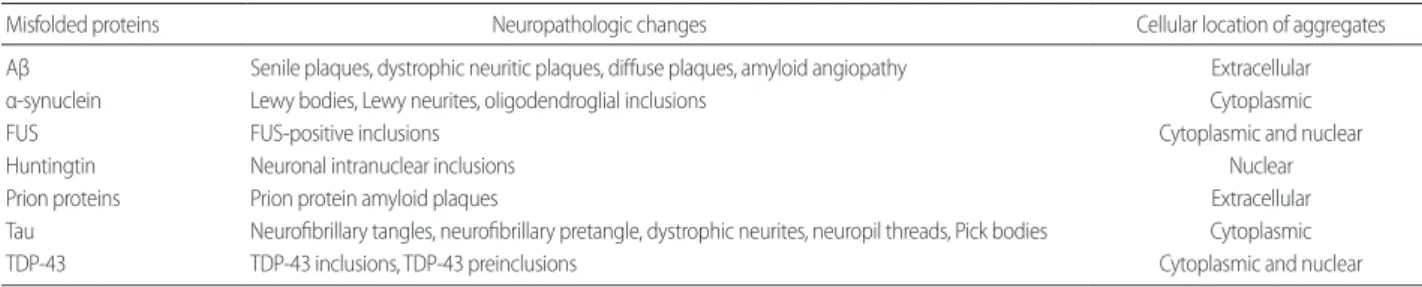
sponse DNAbinding protein (TARDBP or TDP43), and fused in sarcoma (FUS) protein. Molecular classification based on these proteins comprises βamyloidopathies, tauopathies, α synucleinopathies, prionopathies, polyglutaminopathies, TDP43 proteinopathies, and FUS proteinopathies (Table 1).
These are collectively called protein conformational disorders, protein misfolding disorders, proteinopathies, or proteopa
thies.
Although some protein aggregations are hallmarks of cer
tain dementias, for example, extracellular senile plaques and intracellular neurofibrillary tangles in AD, they are not exclu
sively found in any singular type of dementia. One type of dementia may have multiple types of protein aggregations and one type of protein aggregation may be found through various dementias.
In this review, we attempted to determine the roles of mis
folded proteins in order to understand the pathologic origin of neurodegenerative dementias, and demonstrated the inter
connectedness of misfolded proteins and neurodegenerative dementias.
1. General principles
1) The mechanisms of misfolding and aggregation
The canonical features of these neurodegenerative disor
ders is that a specific protein can enfold into an alternative conformation which is stable, precipitates its aggregation, and is deposited in tissues in a fibrillar form [13]. These fibrillar deposits share similar morphological and tinctorial charac
teristics with amyloids. In general, the naïve protein consists of αhelices and random coils, whereas the misfolded protein is composed of rich βstructures which are insoluble and im
plicated in diseases [5, 6]. During misfolding and aggregation, a large conformational change in the proteins takes place, for
ming a misfolded intermediate with exposed hydrophobic fragments. This intermediate has a tendency to aggregate and stabilize, giving rise to the formation of oligomers, protofibrils, fibrils, and finally aggregates or inclusions (Fig. 1). The expo
sure of hydrophobic sequences of the misfolded proteins to the surface is considered critical for protein aggregation [2, 3, 68]. The aggregation of proteins follows nucleationdepen
dent polymerization, in which the critical event is oligomer formation that is soluble but serves as a nucleus to direct fur
ther elongation of aggregates. This process is characterized by a slow lag phase which is followed by a rapid growth to form polymers [911]. An imbalance between production, aggre
gation, and clearance of proteins brings about accumulation of misfolded proteins. In general, the accumulation of these misfolded proteins causes oxidative and neuroinflammatory damage leading to subsequent neurotransmitter, synaptic, and mitochondrial dysfunctions.
2) Selective neuronal vulnerability
The diverse phenotypes of different protein misfolding dis
orders may come from the selective vulnerability of neurons or glial cells to the specific misfolded proteins. The relation
Table 1. Misfolded proteins and neuropathologic changes
Misfolded proteins Neuropathologic changes Cellular location of aggregates
Aβ Senile plaques, dystrophic neuritic plaques, diffuse plaques, amyloid angiopathy Extracellular
α-synuclein Lewy bodies, Lewy neurites, oligodendroglial inclusions Cytoplasmic
FUS FUS-positive inclusions Cytoplasmic and nuclear
Huntingtin Neuronal intranuclear inclusions Nuclear
Prion proteins Prion protein amyloid plaques Extracellular
Tau Neurofibrillary tangles, neurofibrillary pretangle, dystrophic neurites, neuropil threads, Pick bodies Cytoplasmic
TDP-43 TDP-43 inclusions, TDP-43 preinclusions Cytoplasmic and nuclear
Aβ, β-amyloid; FUS, fused in sarcoma; TDP-43, transactive response (TAR)-DNA-binding protein or TARDBP.
Degradation Native
monomer Misfolded
monomer Oligomer Protofibril Fibril Inclusion, Aggregates OR
Fig. 1. Pathogenesis of protein misfolding diseases. Naïve proteins are misfolded, self-accumulate, and form oligomers, protofibrils, fibrils, and eventually aggregates or inclusions. An imbalance between produc- tion, aggregation, and clearance of proteins brings about accumulation of misfolded proteins. The mature forms are more resistant to degrada- tion than the intermediate species. The common toxic effects of the misfolded proteins may include oxidative stress, neuroinflammatory damage, and disturbed neurotransmitter, synaptic, and mitochondrial functions.
ship between the phenotypes and the brain regions affected is more pronounced in the early stage of the diseases than in the later stages in which there are more extensive and diverse manifestations.
Postmortem analyses of human brains have revealed a char
acteristic pathological pattern of the deposition of specific proteins. Aβ plaques appear first in the neocortex, followed by the allocortex and the subcortical structures in AD [12
15]. Tau pathologies first appear in the locus coeruleus and transentorhinal area including the entorhinal cortex, and then spread to the amygdala and interconnected neocortical areas in AD [15, 16]. The mutant polyglutamines also have their own specific groups of neurons showing selective vulnerabil
ity to each protein in polyglutaminopathies [17]. Huntingtin (HTT) begins to appear in the striatum in HD. αSynuclein initially accumulates in the lower brainstem centers and as
cends to the limbic and cortical association areas in PD [18, 19], while in contrast, αsynuclein first appears in the cortex in DLB [20]. Although why different proteins are prone to accumulate in specific brain areas is still unknown, it has been speculated that local changes in expression or posttransla
tional modifications of the specific proteins may account for the regional selectivity of early involvement [4].
In addition to the regional selectivity, these protein deposits may have different pathological and clinical features, depend
ing on whether the aggregates accumulate predominantly in neurons or in glial cells, or intracellularly or extracellularly (Table 1). Unlike other αsynucleinopathies or protein mis
folding disorders, the pathological deposition of αsynuclein in MSA is predominant in oligodendrocytes, forming oligo
dendroglial inclusions [21]. Aβ and prion proteins accumu
late extracellularly, tau and αsynuclein aggregate in the cyto
plasm, HTT assembles in the nucleus, and TDP43 and FUS proteins accumulate primarily in the cytoplasm but are also found in the nucleus [2224].
2. Basic pathologies of neurodegenerative dementias
1) β-Amyloid (Aβ) and β-amyloidopathies
Under physiological conditions, Aβ may attenuate excit
atory transmission at the synapse and suppress neuronal hy
peractivity [25]. Aβ peptides are produced by proteolysis of
the neuronal transmembrane amyloid precursor protein (APP) through sequential cleavage by β and γsecretases, by way of the amyloidogenic pathway. Monomers of Aβ40 are more pre
valent than the highly toxic and aggregationprone Aβ42 spe
cies [2628]. However, the predominant pathway of amyloid metabolism is through the nonamyloidogenic pathway, in which APP is processed by α and γsecretases forming a sol
uble fragment of APP (sαAPP) which may have protective and neurotrophic effects [29]. Multiple genetic and environ
mental factors may shift this equilibrium toward the increased formation of Aβ42 species which is followed by oligomeriza
tion, aggregation, and deposition as insoluble fibers of amy
loid plaques. Nonetheless, Aβ also makes up diffuse plaques that contain nonfibrillar deposits of peptides. Neprilysin and insulindegradingenzyme (IDE) degrade Aβ monomers and oligomers to maintain the steadystate levels of Aβ [3032].
Among the various forms of Aβ, soluble oligomers and inter
mediate fibrils are known to be the most toxic [33].
Although Aβ deposits are one of the pathological hallmarks of AD, amyloid plaques are also found in other dementias in
cluding DLB [34, 35], PDD [36], Down syndrome [3739], CreutzfeldtJakob disease (CJD) and GerstmannSträussler
Scheinker disease (GSS) [4042] (Table 2).
2) Tau and tauopathies
Tau protein, one of the microtubuleassociated proteins (MAPs), is abundant in axons and promotes the assembly and stabilization of microtubule and intracellular transport.
Hyperphosphorylated tau, which is caused by a combination of excessive kinase and decreased phosphatase activities, be
comes insoluble, is detached from microtubules, and selfag
gregates into pair helical filaments (PHFs) and straight fila
ments [43]. Similar to Aβ oligomers, intermediate aggregates are toxic [44]. PHFs sequester toxic intermediate species and are considered to be protective [45, 46].
Neurofibrillary lesions contain aggregated filaments which are formed by abnormal phosphorylation of tau protein. Neu
rofibrillary lesions include not only neurofibrillary tangles (NFTs), but also neuropil threads and dystrophic neurites.
NFTs accumulate around the nuclei and dystrophic neurites and neuropil threads accumulate in axons and dendrites. Dys
trophic neurites are usually associated with amyloid plaque
cores to form neuritic plaques.
Although there has been a poor correlation between the severity of neuronal loss, dementia, and the distribution of amyloid plaques, several studies supported that NFTs parallel with the severity of AD dementia [15, 4749].
Neurofibrillary lesions are also characteristically part of the main pathology in several neurodegenerative dementias oth
er than AD, which are termed tauopathies. Some tauopathies also show the combined amyloid plaques, while other tauop
athies show only abundant neurofibrillary lesions without amyloid plaques. The former group includes Down syndrome [3739] and some cases of CJD and GerstmannSträussler
Scheinker disease (GSS) [4042], while the latter encompass
es CBD [5053], PSP [5456], MSA [57], neurodegeneration with brain iron accumulation (NBIA, formerly known as HallervordenSpatz disease) [58], Pick’s disease [5961], and
FTDP17 [62, 63]. However, MSA, NBIA, some subtypes of AD also have prominent αsynuclein lesions. In AD, tau pa
thology is largely limited to neurons, whereas some other tauopathies such as MSA, PSP, CBD, and FTDP17 demon
strate both neuronal and glial inclusions [6467].
3) α-Synuclein and α-synucleinopathies
αSynuclein is a 140residue neuronal protein which is found mostly in the neuronal presynaptic terminal in an un
folded form under normal physiological conditions. This protein was first identified as the precursor protein for non
amyloid constituents of senile plaques in AD [68]. It is pre
sumed to support the regulation of the release of synaptic vesicles and the stabilization of soluble Nethylmaleimide
sensitive factor attachment protein receptor (SNARE) family proteins including synaptobrevin2 and vesicleassociated Table 2. Misfolded proteins and dementias
Misfolded proteins Aβ α-synuclein FUS Huntingtin Prion proteins Tau TDP-43
AD √√ √ √√
ALS/PDC* √√ √√
CBD √√
DLB √ √√ √
DM √ √
Down’s syndrome √√ √√
FTLD
BIBD √√
bvFTD* √√ √√ √√
c9FTD/ALS √√
FTD/ALS* √√ √√
FTDP-17 √√
IBMPFD √√
NIFID √√
Pick’s disease √√
PNFA* √√ √√
SD* √ √√
HD √√
MSA √√ √
NBIA √√ √√
PDD √ √√ √
CJD √ √√ √
PSP √√
√√, major component; √, minor component.
*For ALS/PDC, bvFTD, FTD/ALS, PNFA, and SD, these may have one of the different pathologies depending on each case. It does not mean that different pathologies shown in the table are found simultaneously.
Aβ, β-amyloid; AD, Alzheimer’s disease; ALS/PDC, amyotrophic lateral sclerosis-Parkinsonism-dementia complex of Guam; BIBD, bvFTD, behavioral variant FTD; c9FTD/ALS, chromosome 9p-linked frontotemporal dementia and amyotrophic lateral sclerosis; CBD, corticobasal degeneration; CJD, Creutzfeldt-Jakob disease; DLB, dementia with Lewy bodies; DM, Dystrophia myotonica; FFI, fatal familial insomnia; FTD/ALS, frontotemporal dementia and amyotrophic lateral sclerosis; FTDP-17, frontotemporal dementia and parkinsonism linked to chromosome 17; FTLD, Frontotemporal lobar degeneration; FUS, fused in sarcoma; GSS, Gerstmann-Sträussler-Scheinker disease; HD, Huntington’s dis- ease; IBMFPD, Inclusion body myopathy, Paget’s disease of the bone and frontotemporal dementia; MSA, Multiple system atrophy; NBIA, neurodegeneration with brain iron accumulation; NIFID, neuronal intermediate filament inclusion disease; basophilic inclusion body disease; PDD, Parkinson disease with dementia; PNFA, progressive nonfluent aphasia; PSP, progressive supranuclear palsy; SD, semantic dementia; TDP-43, transactive response (TAR)-DNA-binding protein or TARDBP.
membrane protein 2 (VAMP2) [69, 70]. Genomewide asso
ciation studies (GWASs) have shown that SNCA gene which encodes αsynuclein is linked to sporadic PD [71] and the missense point mutations in the SNCA gene and the multi
plications of the gene loci have been found in SNCA in fami
lies with autosomal dominant PD [72]. Pathological deposits of αsynuclein have been identified within aggregates in the forms of Lewy bodies and Lewy neurites in patients with PD and DLB, and oligodendroglial inclusions in MSA patients, collectively termed αsynucleino pathies [73]. However, AD and neurodegeneration with brain iron accumulation (NBIA, formerly known as HallervordenSpatz disease) are known to have abnormal deposition of αsynuclein [74, 75]. The patho
genic mechanisms underlying the aberrant functions of αsyn
uclein still remain poorly understood, but some possibilities including alteration of neurotransmitter release, lysosomal dysfunction, calcium homeostasis, cytoskeletal effects, and mitochondrial dysfunction have been suggested [76].
4) Prion protein and prionopathies
PrPC (normal cellular prion protein isoform) is the natural prion protein encoded by the PRNP gene. PrPC is a glycopro
tein which is expressed in the cells in the central nervous sys
tem (CNS) and the immune system [77]. In the brain, the ex
pression of PrPC is notably observed in neuronal synaptic membranes and is also expressed in astrocytes [78]. PrPC has been shown to be involved in signal transduction and to in
teract with several intracellular signaling proteins [79]. Al
though the understanding of the biologic functions of PrPC remains elusive, it is known to not be essential for cell surviv
al [80]. However, the conversion of PrPC to the pathogenic PrPSc (PrP scrapie) ends up resulting in neurodegeneration [81, 82]. PrPC acts as the raw material for conversion to PrPSc [83]. Thus, these corrupted molecules easily selfaggregate and elicit neuronal injury. Although the exact mechanism of transmission remains uncertain, it is believed that prions can spread to other cells by synaptic transport [84].
In humans, a variety of prion diseases (prionopathies or transmissible spongiform encephalopathies) are present, in
cluding CJD, GSS, fatal familial insomnia, and kuru [83, 85], although the diseases are uncommon. Prion diseases are uni
que in that the same disease can have genetic, sporadic, and
infectious (transmissible) origins and in that prion disease is the only infectious cerebral proteopathy [83, 84]. However, several studies implicated prionlike transmission of protein aggregates or inclusions in the initiation and spread of vari
ous neurodegenerative disorders [84, 8690].
5) Huntingtin and polyglutaminopathies
Huntingtin (HTT) is a cytoplasmic protein which is found to be associated with synaptic vesicles and microtubules. In Huntington’s disease (HD), the CAG repeats in the HD gene are suggested to be expanded by dynamic mutation as other trinucleotide repeat expansion disorders [91] and mutant HTT proteins with an expanded polyglutamine tract are pro
duced. Mutant proteins are prone to toxic conformational changes and accumulate into insoluble aggregates as neuro
nal intranuclear inclusions (NIIs) [9294]. These processes are common features among polyglutamine diseases which include HD, spinocerebellar ataxia 1, 2, 3, 6, 7, and 17 (SCA1/
2/3/6/7/17), dentatorubralpallidoluysian atrophy (DRPLA), and spinal and bulbar muscular atrophy (SBMA, also known as Kennedy’s disease). Among them, SCA17 and DRPLA in
clude dementia as one of the cardinal manifestations, similar to HD [9597]. The counterparts of HTT are TATAbinding protein gene (TBP) and atrophin 1 in SCA17 and DRPLA, respectively [98100].
6) Transactive response DNA-binding protein of 43kDa (TDP-43) and TDP-43 proteinopathies
TDP43 is a ubiquitously expressed 414residue protein which is mainly localized inside the nucleus under physiolog
ical conditions and is able to shuttle between the nucleus and the cytoplasm in a transcriptiondependent manner by virtue of the presence of a nuclear localization sequence (NLS) and nuclear export sequence (NES) [101]. It regulates diverse pro
cesses of gene expression including transcription and splicing through RNA and DNA binding. It contains two RNA recog
nition motifs (RRMs) that allow for binding to nucleic acids and a Cterminal glycinerich domain (GRD) which is im
portant for proteinprotein interactions and essential for sol
ubility and cellular localization. Disruption of the RRM chang
es nuclear distribution by decreasing the level of TDP43 in the nucleoplasm. Deletion of the Cterminal GRD elicits the
formation of nuclear and cytoplasmic aggregates.
TDP43 pathology is, along with tau pathology, also the main cause for some clinical subtypes of FTLD such as be
havioral variant FTD (bvFTD), semantic dementia (SD), and progressive nonfluent aphasia (PNFA) [102, 103] and amyo
trophic lateral sclerosisParkinsonismdementia complex of Guam (ALS/PDC) [104].
TDP43 has been identified as the major protein aggrega
tion in frontotemporal dementia and amyotrophic lateral scle
rosis (FDT/ALS), one of the subtypes of frontotemporal lobar degeneration with ubiquitin inclusions (FTLDU) [105]. Pa
thologic TPD43 is ubiquitinated, hyperphosphorylated, and cleaved to produce Cterminal fragments. Remarkably, it is consistently observed that normal nuclear localization of TDP
43 is lacking in inclusionbearing neurons. In addition to the TDP43 inclusions, TDP43 preinclusions, which are observ
ed cell bodies without inclusions, are a common neuropatho
logic finding. They show diffuse or granular cytoplasmic TDP
43 staining and do not colocalize with ubiquitin [106].
In FTLD, TDP43 positive aggregates are found in most sporadic cases as well as in familial forms. Familial forms are caused by mutations in the TAR-DNA binding protein (TAR- DBP) gene [107], progranulin (GRN) genes [105, 108], and valosin containing protein (VCP) genes [109]. Recently, it has been found that an expanded hexanucleotide repeat in chro
mosome 9 open reading frame 72 (C9ORF72) is the most common mutation in FTD/ALS families with TDP43 pa
thology [110, 111]. However, the causative relationship be
tween TDP43 pathology and the mutation remains unclear at this time.
7) Fused in sarcoma (FUS) and FUS proteinopathies
FUS, also known as translocated in liposarcoma (TLS) or heterogeneous ribonucleoprotein (hnRNP) P2, is a 526resi
due protein identified as a protooncogene that causes lipo
sarcoma via chromosomal translocation [112]. FUS is an RNA
binding protein like TDP43 and comprises the RRM domain, GRD, and NLS/NES, which are arranged differently in vari
ous proteins from TDP43. The FUS protein is a nuclear pro
tein and is involved in DNA repair and RNA splicing regula
tion [113, 114].
Mutations within the FUS gene in the GRD and the Cter
minus of FUS protein impair nuclear import and lead to re
distribution to the cytoplasm, consequently affecting FUS
dependent RNA metabolism.
FUS pathology is observed in the majority of FTLD cases with ubiquitinpositive, and TDP43 negative pathology (FT
LDFUS) [115117]. FTLDFUS cases are characterized by negative family history, disease onset at young age, presence of bvFTD, and caudate atrophy. FUSpositive inclusions are also found in basophilic inclusion body disease [118] and neu
ronal intermediate filament inclusion disease [24].
FUS has been identified to misfold and aggregate in distinct subtypes of FTLDU (FTD/ALS), similar to TDP43 but with TDP43 negative pathology [116, 119]. Contrary to TDP43, no association of posttranslational modifications such as ubi
quitination, phosphorylation, or truncation has been identi
fied.
3. Links between proteins
Some of the protein misfolding diseases have more than one pathology, as some proteins are commonly found in more than one disease (Table 2). The understanding of the interac
tion between the misfolded proteins will help elucidate in part the complexity of the protein misfolding disorders.
1) β-amyloid (Aβ) and tau
Several experimental studies support that the accumula
tion of Aβ precedes and trigger the aggregation of tau [120
123], which is consistent with the amyloid cascade hypothe
sis. Furthermore, Aβinduced neuronal dysfunction was pre
vented by tau reduction [124], and morphological analysis showed that taudepleted neurons revealed no evidence of degeneration in the presence of Aβ [125]. These results are supported by prior evidence that Aβ promotes the activation of glycogen synthase kinase3β (GSK3β) through the insulin and Wnt signaling pathways, with subsequent tau phosphor
ylation [126129].
2) β-amyloid (Aβ) and α-synuclein
AD patients develop features of PD and vice versa. More
over, Aβ pathology and αsynuclein pathology can be found in both AD and DLB/PDD. It has been found that Aβ and
αsynuclein synergistically interact to cause neurodegenera
tion in the transgenic mouse model [130]. Aβ promoted the aggregation and intraneuronal accumulation of αsynuclein and the development of motor deficits, supporting that Aβ may contribute to the development of DLB or PDD by pro
moting αsynuclein aggregation. Although αsynuclein did not affect Aβ pathology, it aggravated the cognitive deficits, suggesting that αsynuclein may augment the Aβindependent neurotoxicity of Aβ [131, 132].
3) β-amyloid (Aβ) and prion protein
It has been reported that prion protein which Aβ binds is required for the impairment of synaptic plasticity mediated by Aβ oligomers [133]. It has also been found that the region of importance for the interaction between prion proteins and Aβ resides at the extreme aminoterminus of prion protein [134]. The role of prion protein in Aβinduced toxicity was confirmed by a recent study showing that prion protein is re
quired for disrupting hippocampal synaptic plasticity by Aβ peptides [135].
4) α-Synuclein and tau
GWASs have shown that there are strong associations with PD for SNCA, LRRK2, and MAPT [71], suggesting function
al links among these proteins that affect the cytoskeleton. Oli
gomeric αsynuclein indirectly augments the phosphoryla
tion of tau presumably via GSK3β or other kinases and de
stabilizes the microtubules, which in turn may promote the formation of αsynuclein oligomers and cause further disrup
tion of microtubules [136139]. Additionally, leucinerich re
peat kinase 2 (LRRK2, also known as dardarin) which is en
coded by LRRK2, an autosomal dominant inherited PD gene, can increase the phosphorylation of tau through GSK3β and Ste20 kinase [140142]. These findings suggest a synergistic interaction between αsynuclein and LRRK2 that involve tau.
5) Transactive response DNA-binding protein (TARDBP or TDP-43) and fused in sarcoma (FUS) protein
Both TDP43 and FUS are the cytoplasmic RNAbinding proteins which play critical roles in the development of fron
totemporal lobar degeneration with ubiquitinpositive inclu
sions (FTLUU) and ALS. These proteins are transported to
the nucleus via import receptors and also contribute to stress granule formation. Although the exact mechanisms for the accumulation of TDP43 and FUS and the resultant neuro
degeneration are currently unclear [119], it has been propos
ed that excessive mislocation of the proteins along with atax
in2 into the cytoplasm causes dysfunction of the RNA quar
antine system, inducing a joined cascade of neurodegenera
tion which is promoted by ataxin2 [143].
4. Some issues under debate
1) The relationship between soluble oligomers and insoluble inclusions
Determining which particular species of the misfolded pro
teins are neurotoxic has been under debate. Several experi
ments are in favor of the toxicity of soluble oligomeric species [33, 4446, 144]. However, this oligomeric speciesinduced toxicity does not indicate that the insoluble inclusions are in
nocent. There has still been evidence that these inclusions are toxic [145, 146], but other data support that the insoluble in
clusions may be neuroprotective [45, 46, 147, 148].
Considering that oligomers are found around and within the amyloid plaques and are toxic to adjacent neurons [149
151], it has been suggested that inclusions serve as reservoirs for oligomers that can diffuse away from the inclusions and cause synaptic or neuronal toxicity [152]. The inclusions may initally sequester toxic soluble oligomers, but, eventually the reservoirs are overwhelmed and can no longer be protective.
Mass effect of the inclusions on surrounding neurons seems to be plausabe but it has been shown that senile plaques did not exert any mass lesion effects on neighboring cells [153].
Nonetheless, whether it can be the case for other protein mis
folding disoders needs to be further investigated.
2) Cell-to-cell disease transmission
Pathological similarities between prion diseases and AD suggest that the prionlike formation and seeding of protein
aceous lesions may be involved in the pathogenesis of disease [154157].
The deposition of Aβ deposits were found in axonally in
terconnected areas following the injection of Aβ aggregates into the brain, suggesting it spreads through neuronal path
ways [157159]. The accumulation of abnormal tau starts in the entorhinal cortex (ERC) in the earliest stage of AD, and then spreads to the hippocampus followed by the neocortical regions [15]. However, it has been poorly explored whether tau pathology in the ERC initiates spreading to other struc
tures, or that the pathology in the extrahippocampal areas begins independently. Using a transgenic mouse model ex
pressing the pathological human tau protein primarily in the ERC, it has been demonstrated that tau pathology which be
gan in the ERC spreads out from one neuron to other neu
rons outside of the ERC across synapses [160]. This study re
sult confirms observations from previous studies suggesting the transsynaptic celltocell spread hypothesis for AD [161, 162].
αSynuclein pathology in PD starts in the anterior olfactory nucleus and the lower brainstem centers and ultimately as
cends to the cortex [18, 19]. A recent study showed that puri
fied αsynuclein fibrils are internalized into primary mouse hippocampal cells by endocytosis, recruit soluble endogenous αsynuclein, and promote the formation of insoluble Lewy bodies or neurites [163]. In this study, the aggregates of αsyn
uclein appeared early in the axon terminals and later in the cell body, suggesting propagation along the axon and eventu
ally to other cells. The report reinforces the earlier conclusions suggesting αsynuclein pathology from dying neurons is con
veyed to neighboring neurons through celltocell transmis
sion [19, 164, 165], which is similar to the transmission of misfolded prion proteins in CJD [166].
Furthermore, the prionlike celltocell transmission of the lesions has also been demonstrated in polyglutamine and TDP43 aggregates [167, 168]. However, the mode of cellto
cell transmission for these proteins remains unclear.
5. General therapeutic strategies for protein misfolding disorders
Despite remarkable progress in the understanding of the pathomechanisms of protein misfolding disorders, there has been no successful diseasemodifying therapy for them as this has been the case in AD. Therapeutic strategies targeted for the misfolded and aggregated proteins have been proposed:
1) stabilization of the normal protein conformation; 2) inhi
bition of the protein misfolding by interfering with posttrans
lational modification; 3) unfolding the misfolded proteins; 4) inhibition of protein oligomerization by compounds binding to monomers; 5) inhibition of protein aggregation with small molecules that bind to aggregates and further interfere with the recruitment of monomers; 6) upregulating molecular cha
perones; 7) enhancing the clearance mechanisms by immu
nization; and 8) gene therapy [4, 169, 170]. The combinations of more than one strategy, particularly in the earliest stages of the diseases are expected to be the most effective treatments for patients with disorders in the near future.
CONCLUSIONS
The misfolding and aggregation of proteins have been re
garded as central events in the development of various neu
rodegenerative dementias. The common pathological mech
anisms of these disorders are increased production, misfold
ing, aggregation, and accumulation of specific proteins, with the conformational variants ranging from small oligomers to the characteristic inclusions. However, there is a substantial overlap between different pathologies and different demen
tias evidenced by the existence of the interactions between the misfolded proteins, although certain pathologies can be a hallmark of certain dementias. There has been remarkable progress in understanding the role of toxic oligomers and cell
tocell transmission. The understanding of the pathomecha
nistic roles of misfolded proteins will be the fundamental ba
sis for the identification of biomarkers in the earliest stage of dementia, and should facilitate the development of effective treatments which can modify the natural course of the de
mentia.
REFERENCES
1. Carrell RW, Lomas DA. Conformational disease. Lancet 1997; 350:
134-8.
2. Dobson CM. Protein misfolding, evolution and disease. Trends Bio- chem Sci 1999; 24: 329-32.
3. Soto C. Protein misfolding and disease; protein refolding and therapy.
FEBS Lett 2001; 498: 204-7.
4. Soto C. Unfolding the role of protein misfolding in neurodegenerative diseases. Nat Rev Neurosci 2003; 4: 49-60.
5. Serpell LC, Blake CC, Fraser PE. Molecular structure of a fibrillar Alzh- eimer’s A beta fragment. Biochemistry 2000; 39: 13269-75.
6. Serpell LC, Berriman J, Jakes R, Goedert M, Crowther RA. Fiber dif- fraction of synthetic alpha-synuclein filaments shows amyloid-like cross- beta conformation. Proc Natl Acad Sci U S A 2000; 97: 4897-902.
7. Teplow DB. Structural and kinetic features of amyloid beta-protein fi- brillogenesis. Amyloid 1998; 5: 121-42.
8. Tagliavini F, Prelli F, Verga L, Giaccone G, Sarma R, Gorevic P, et al.
Syn thetic peptides homologous to prion protein residues 106-147 form amyloid-like fibrils in vitro. Proc Natl Acad Sci U S A 1993; 90: 9678- 82.
9. Jarrett JT, Berger EP, Lansbury PT. The C-terminus of the beta protein is critical in amyloidogenesis. Ann N Y Acad Sci 1993; 695: 144-8.
10. Scherzinger E, Sittler A, Schweiger K, Heiser V, Lurz R, Hasenbank R, et al. Self-assembly of polyglutamine-containing huntingtin fragments into amyloid-like fibrils: implications for Huntington’s disease patholo- gy. Proc Natl Acad Sci U S A 1999; 96: 4604-9.
11. Wood SJ, Wypych J, Steavenson S, Louis JC, Citron M, Biere AL. Al- pha-synuclein fibrillogenesis is nucleation-dependent. Implications for the pa thogenesis of Parkinson’s disease. J Biol Chem 1999; 274: 19509- 12.
12. Thal DR, Rüb U, Orantes M, Braak H. Phases of A beta-deposition in the human brain and its relevance for the development of AD. Neurolo- gy 2002; 58: 1791-800.
13. Buckner RL, Snyder AZ, Shannon BJ, LaRossa G, Sachs R, Fotenos AF, et al. Molecular, structural, and functional characterization of Al- zheimer’s disease: evidence for a relationship between default activity, amyloid, and memory. J Neurosci 2005; 25: 7709-17.
14. Walker LC, Jucker M. Amyloid by default. Nat Neurosci 2011; 14: 669- 70.
15. Braak H, Braak E. Neuropathological stageing of Alzheimer-related changes. Acta Neuropathol 1991; 82: 239-59.
16. Braak H, Del Tredici K. The pathological process underlying Alzheim- er’s disease in individuals under thirty. Acta Neuropathol 2011; 121:
171-81.
17. Zoghbi HY, Orr HT. Glutamine repeats and neurodegeneration. Annu Rev Neurosci 2000; 23: 217-47.
18. Braak H, Del Tredici K, Bratzke H, Hamm-Clement J, Sandmann-Keil D, Rüb U. Staging of the intracerebral inclusion body pathology associ-
ated with idiopathic Parkinson’s disease (preclinical and clinical stages).
J Neurol 2002; 249 Suppl 3: III/1-5.
19. Braak H, Del Tredici K, Rüb U, de Vos RA, Jansen Steur EN, Braak E.
Staging of brain pathology related to sporadic Parkinson’s disease. Neu- robiol Aging 2003; 24: 197-211.
20. Halliday GM, McCann H. Human-based studies on alpha-synuclein deposition and relationship to Parkinson’s disease symptoms. Exp Neu- rol 2008; 209: 12-21.
21. Gai WP, Power JH, Blumbergs PC, Blessing WW. Multiple-system at- rophy: a new alpha-synuclein disease? Lancet 1998; 352: 547-8.
22. Forman MS, Trojanowski JQ, Lee VM. Neurodegenerative diseases: a decade of discoveries paves the way for therapeutic breakthroughs. Nat Med 2004; 10: 1055-63.
23. Neumann M, Kwong LK, Truax AC, Vanmassenhove B, Kretzschmar HA, Van Deerlin VM, et al. TDP-43-positive white matter pathology in frontotemporal lobar degeneration with ubiquitin-positive inclusions. J Neuropathol Exp Neurol 2007; 66: 177-83.
24. Neumann M, Roeber S, Kretzschmar HA, Rademakers R, Baker M, Mackenzie IR. Abundant FUS-immunoreactive pathology in neuronal intermediate filament inclusion disease. Acta Neuropathol 2009; 118:
605-16.
25. Kamenetz F, Tomita T, Hsieh H, Seabrook G, Borchelt D, Iwatsubo T, et al. APP processing and synaptic function. Neuron 2003; 37: 925-37.
26. Haass C, Selkoe DJ. Soluble protein oligomers in neurodegeneration:
lessons from the Alzheimer’s amyloid beta-peptide. Nat Rev Mol Cell Biol 2007; 8: 101-12.
27. Gandy S, Martins R, Buxbaum J. Molecular and cellular basis for anti- amyloid therapy in Alzheimer disease. Alzheimer Dis Assoc Disord 2003;
17: 259-66.
28. Selkoe D, Schenk D. Alzheimer’s disease: molecular understanding pre- dicts amyloid-based therapeutics. Annu Rev Pharmacol Toxicol 2003;
43: 545-84.
29. Furukawa K, Sopher BL, Rydel RE, Begley JG, Pham DG, Martin GM, et al. Increased activity-regulating and neuroprotective efficacy of al- pha-secretase-derived secreted amyloid precursor protein conferred by a C-terminal heparin-binding domain. J Neurochem 1996; 67: 1882-96.
30. Kanemitsu H, Tomiyama T, Mori H. Human neprilysin is capable of degrading amyloid beta peptide not only in the monomeric form but also the pathological oligomeric form. Neurosci Lett 2003; 350: 113-6.
31. Qiu WQ, Walsh DM, Ye Z, Vekrellis K, Zhang J, Podlisny MB, et al. In- sulin-degrading enzyme regulates extracellular levels of amyloid beta- protein by degradation. J Biol Chem 1998; 273: 32730-8.
32. Leissring MA, Farris W, Chang AY, Walsh DM, Wu X, Sun X, et al. En- hanced proteolysis of beta-amyloid in APP transgenic mice prevents pla- que formation, secondary pathology, and premature death. Neuron 2003;
40: 1087-93.
33. Walsh DM, Selkoe DJ. A beta oligomers - a decade of discovery. J Neu- rochem 2007; 101: 1172-84.
34. Jellinger KA, Attems J. Prevalence and impact of vascular and Alzheim- er pathologies in Lewy body disease. Acta Neuropathol 2008; 115: 427- 36.
35. Merdes AR, Hansen LA, Jeste DV, Galasko D, Hofstetter CR, Ho GJ, et al. Influence of Alzheimer pathology on clinical diagnostic accuracy in dementia with Lewy bodies. Neurology 2003; 60: 1586-90.
36. Jellinger KA. Significance of brain lesions in Parkinson disease demen- tia and Lewy body dementia. Front Neurol Neurosci 2009; 24: 114-25.
37. Giaccone G, Tagliavini F, Linoli G, Bouras C, Frigerio L, Frangione B, et al. Down patients: extracellular preamyloid deposits precede neuritic degeneration and senile plaques. Neurosci Lett 1989; 97: 232-8.
38. Flament S, Delacourte A, Mann DM. Phosphorylation of Tau proteins:
a major event during the process of neurofibrillary degeneration. A com- parative study between Alzheimer’s disease and Down’s syndrome. Brain Res 1990; 516: 15-9.
39. Cork LC. Neuropathology of Down syndrome and Alzheimer disease.
Am J Med Genet Suppl 1990; 7: 282-6.
40. Ghetti B, Tagliavini F, Masters CL, Beyreuther K, Giaccone G, Verga L, et al. Gerstmann-Sträussler-Scheinker disease. II. Neurofibrillary tan- gles and plaques with PrP-amyloid coexist in an affected family. Neu- rology 1989; 39: 1453-61.
41. Tagliavini F, Giaccone G, Prelli F, Verga L, Porro M, Trojanowski JQ, et al. A68 is a component of paired helical filaments of Gerstmann-Sträu- ssler-Scheinker disease, Indiana kindred. Brain Res 1993; 616: 325-9.
42. Hsiao K, Dlouhy SR, Farlow MR, Cass C, Da Costa M, Conneally PM, et al. Mutant prion proteins in Gerstmann-Sträussler-Scheinker disease with neurofibrillary tangles. Nat Genet 1992; 1: 68-71.
43. Iqbal K, Alonso AeC, Chen S, Chohan MO, El-Akkad E, Gong CX, et al. Tau pathology in Alzheimer disease and other tauopathies. Biochim Biophys Acta 2005; 1739: 198-210.
44. Khlistunova I, Biernat J, Wang Y, Pickhardt M, von Bergen M, Gazova Z, et al. Inducible expression of Tau repeat domain in cell models of tau- opathy: aggregation is toxic to cells but can be reversed by inhibitor drugs.
J Biol Chem 2006; 281: 1205-14.
45. Oddo S, Vasilevko V, Caccamo A, Kitazawa M, Cribbs DH, LaFerla FM. Reduction of soluble Abeta and tau, but not soluble Abeta alone,
ameliorates cognitive decline in transgenic mice with plaques and tan- gles. J Biol Chem 2006; 281: 39413-23.
46. Lee HG, Perry G, Moreira PI, Garrett MR, Liu Q, Zhu X, et al. Tau phos- phorylation in Alzheimer’s disease: pathogen or protector? Trends Mol Med 2005; 11: 164-9.
47. McKee AC, Kosik KS, Kowall NW. Neuritic pathology and dementia in Alzheimer’s disease. Ann Neurol 1991; 30: 156-65.
48. Arriagada PV, Growdon JH, Hedley-Whyte ET, Hyman BT. Neurofi- brillary tangles but not senile plaques parallel duration and severity of Alzheimer’s disease. Neurology 1992; 42: 631-9.
49. Neve RL, Robakis NK. Alzheimer’s disease: a re-examination of the amyloid hypothesis. Trends Neurosci 1998; 21: 15-9.
50. Paulus W, Selim M. Corticonigral degeneration with neuronal achro- masia and basal neurofibrillary tangles. Acta Neuropathol 1990; 81:
89-94.
51. Ksiezak-Reding H, Morgan K, Mattiace LA, Davies P, Liu WK, Yen SH, et al. Ultrastructure and biochemical composition of paired helical filaments in corticobasal degeneration. Am J Pathol 1994; 145: 1496- 508.
52. Mori H, Nishimura M, Namba Y, Oda M. Corticobasal degeneration: a disease with widespread appearance of abnormal tau and neurofibril- lary tangles, and its relation to progressive supranuclear palsy. Acta Neu- ropathol 1994; 88: 113-21.
53. Wakabayashi K, Oyanagi K, Makifuchi T, Ikuta F, Homma A, Homma Y, et al. Corticobasal degeneration: etiopathological significance of the cytoskeletal alterations. Acta Neuropathol 1994; 87: 545-53.
54. Bancher C, Lassmann H, Budka H, Grundke-Iqbal I, Iqbal K, Wiche G, et al. Neurofibrillary tangles in Alzheimer’s disease and progressive su- pranuclear palsy: antigenic similarities and differences. Microtubule- associated protein tau antigenicity is prominent in all types of tangles.
Acta Neuropathol 1987; 74: 39-46.
55. Flament S, Delacourte A, Verny M, Hauw JJ, Javoy-Agid F. Abnormal Tau proteins in progressive supranuclear palsy. Similarities and differ- ences with the neurofibrillary degeneration of the Alzheimer type. Acta Neuropathol 1991; 81: 591-6.
56. Schmidt ML, Huang R, Martin JA, Henley J, Mawal-Dewan M, Hurtig HI, et al. Neurofibrillary tangles in progressive supranuclear palsy con- tain the same tau epitopes identified in Alzheimer’s disease PHFtau. J Neuropathol Exp Neurol 1996; 55: 534-9.
57. Papp MI, Kahn JE, Lantos PL. Glial cytoplasmic inclusions in the CNS of patients with multiple system atrophy (striatonigral degeneration, ol- ivopontocerebellar atrophy and Shy-Drager syndrome). J Neurol Sci
1989; 94: 79-100.
58. Eidelberg D, Sotrel A, Joachim C, Selkoe D, Forman A, Pendlebury WW, et al. Adult onset Hallervorden-Spatz disease with neurofibrillary pathology. A discrete clinicopathological entity. Brain 1987; 110(Pt 4):
993-1013.
59. Perry G, Stewart D, Friedman R, Manetto V, Autilio-Gambetti L, Gam- betti P. Filaments of Pick’s bodies contain altered cytoskeletal elements.
Am J Pathol 1987; 127: 559-68.
60. Murayama S, Mori H, Ihara Y, Tomonaga M. Immunocytochemical and ultrastructural studies of Pick’s disease. Ann Neurol 1990; 27: 394- 405.
61. Lieberman AP, Trojanowski JQ, Lee VM, Balin BJ, Ding XS, Greenberg J, et al. Cognitive, neuroimaging, and pathological studies in a patient with Pick’s disease. Ann Neurol 1998; 43: 259-65.
62. Wilhelmsen KC, Lynch T, Pavlou E, Higgins M, Nygaard TG. Local- ization of disinhibition-dementia-parkinsonism-amyotrophy complex to 17q21-22. Am J Hum Genet 1994; 55: 1159-65.
63. Foster NL, Wilhelmsen K, Sima AA, Jones MZ, D’Amato CJ, Gilman S.
Frontotemporal dementia and parkinsonism linked to chromosome 17:
a consensus conference. Conference Participants. Ann Neurol 1997; 41:
706-15.
64. Papp MI, Lantos PL. Accumulation of tubular structures in oligoden- droglial and neuronal cells as the basic alteration in multiple system at- rophy. J Neurol Sci 1992; 107: 172-82.
65. Nishimura M, Namba Y, Ikeda K, Oda M. Glial fibrillary tangles with straight tubules in the brains of patients with progress ive supranuclear palsy. Neurosci Lett 1992; 143: 35-8.
66. Spillantini MG, Bird TD, Ghetti B. Frontotemporal dementia and Par- kinsonism linked to chromosome 17: a new group of tauopathies. Brain Pathol 1998; 8: 387-402.
67. Iwatsubo T, Hasegawa M, Ihara Y. Neuronal and glial tau-positive in- clusions in diverse neurologic diseases share common phosphorylation characteristics. Acta Neuropathol 1994; 88: 129-36.
68. Uéda K, Fukushima H, Masliah E, Xia Y, Iwai A, Yoshimoto M, et al.
Molecular cloning of cDNA encoding an unrecognized component of amyloid in Alzheimer disease. Proc Natl Acad Sci U S A 1993; 90: 11282-6.
69. Burré J, Sharma M, Tsetsenis T, Buchman V, Etherton MR, Südhof TC. Alpha-synuclein promotes SNARE-complex assembly in vivo and in vitro. Science 2010; 329: 1663-7.
70. Vekrellis K, Rideout HJ, Stefanis L. Neurobiology of alpha-synuclein.
Mol Neurobiol 2004; 30: 1-21.
71. Nalls MA, Plagnol V, Hernandez DG, Sharma M, Sheerin UM, Saad M,
et al. Imputation of sequence variants for identification of genetic risks for Parkinson’s disease: a meta-analysis of genome-wide association studies. Lancet 2011; 377: 641-9.
72. Hardy J, Lewis P, Revesz T, Lees A, Paisan-Ruiz C. The genetics of Par- kinson’s syndromes: a critical review. Curr Opin Genet Dev 2009; 19:
254-65.
73. Kahle PJ. Alpha-Synucleinopathy models and human neuropathology:
similarities and differences. Acta Neuropathol 2008; 115: 87-95.
74. Neumann M, Adler S, Schlüter O, Kremmer E, Benecke R, Kretzsch- mar HA. Alpha-synuclein accumulation in a case of neurodegeneration with brain iron accumulation type 1 (NBIA-1, formerly Hallervorden- Spatz syndrome) with widespread cortical and brainstem-type Lewy bodies. Acta Neuropathol 2000; 100: 568-74.
75. Pollanen MS, Dickson DW, Bergeron C. Pathology and biology of the Lewy body. J Neuropathol Exp Neurol 1993; 52: 183-91.
76. Vekrellis K, Xilouri M, Emmanouilidou E, Rideout HJ, Stefanis L. Pa- thological roles of α-synuclein in neurological disorders. Lancet Neurol 2011; 10: 1015-25.
77. Manson J, West JD, Thomson V, McBride P, Kaufman MH, Hope J.
The prion protein gene: a role in mouse embryogenesis? Development 1992; 115: 117-22.
78. Moser M, Colello RJ, Pott U, Oesch B. Developmental expression of the prion protein gene in glial cells. Neuron 1995; 14: 509-17.
79. Martins VR, Linden R, Prado MA, Walz R, Sakamoto AC, Izquierdo I, et al. Cellular prion protein: on the road for functions. FEBS Lett 2002;
512: 25-8.
80. Büeler H, Fischer M, Lang Y, Bluethmann H, Lipp HP, DeArmond SJ, et al. Normal development and behaviour of mice lacking the neuronal cell-surface PrP protein. Nature 1992; 356: 577-82.
81. Aguzzi A, Heikenwalder M. Prion diseases: Cannibals and garbage piles.
Nature 2003; 423: 127-9.
82. Aguzzi A, Polymenidou M. Mammalian prion biology: one century of evolving concepts. Cell 2004; 116: 313-27.
83. Prusiner SB. Shattuck lecture--neurodegenerative diseases and prions.
N Engl J Med 2001; 344: 1516-26.
84. Aguzzi A, Rajendran L. The transcellular spread of cytosolic amyloids, prions, and prionoids. Neuron 2009; 64: 783-90.
85. Brown K, Mastrianni JA. The prion diseases. J Geriatr Psychiatry Neu- rol 2010; 23: 277-98.
86. Walker LC, Levine H, Mattson MP, Jucker M. Inducible proteopathies.
Trends Neurosci 2006; 29: 438-43.
87. Soto C, Estrada L, Castilla J. Amyloids, prions and the inherent infec-
tious nature of misfolded protein aggregates. Trends Biochem Sci 2006;
31: 150-5.
88. Frost B, Diamond MI. Prion-like mechanisms in neurodegenerative diseases. Nat Rev Neurosci 2010; 11: 155-9.
89. Brundin P, Melki R, Kopito R. Prion-like transmission of protein aggre- gates in neurodegenerative diseases. Nat Rev Mol Cell Biol 2010; 11:
301-7.
90. Goedert M, Clavaguera F, Tolnay M. The propagation of prion-like pro- tein inclusions in neurodegenerative diseases. Trends Neurosci 2010; 33:
317-25.
91. Richards RI, Sutherland GR. Dynamic mutation: possible mechanisms and significance in human disease. Trends Biochem Sci 1997; 22: 432-6.
92. Shao J, Diamond MI. Polyglutamine diseases: emerging concepts in pa- tho genesis and therapy. Hum Mol Genet 2007; 16 Spec No. 2: R115-23.
93. Schaffar G, Breuer P, Boteva R, Behrends C, Tzvetkov N, Strippel N, et al. Cellular toxicity of polyglutamine expansion proteins: mechanism of transcription factor deactivation. Mol Cell 2004; 15: 95-105.
94. Nagai Y, Inui T, Popiel HA, Fujikake N, Hasegawa K, Urade Y, et al. A toxic monomeric conformer of the polyglutamine protein. Nat Struct Mol Biol 2007; 14: 332-40.
95. Koide R, Onodera O, Ikeuchi T, Kondo R, Tanaka H, Tokiguchi S, et al. Atrophy of the cerebellum and brainstem in dentatorubral pallido- luysian atrophy. Influence of CAG repeat size on MRI findings. Neurol- ogy 1997; 49: 1605-12.
96. Bauer P, Laccone F, Rolfs A, Wüllner U, Bösch S, Peters H, et al. Trinu- cleotide repeat expansion in SCA17/TBP in white patients with Hun- tington’s disease-like phenotype. J Med Genet 2004; 41: 230-2.
97. Schöls L, Bauer P, Schmidt T, Schulte T, Riess O. Autosomal dominant cerebellar ataxias: clinical features, genetics, and pathogenesis. Lancet Neurol 2004; 3: 291-304.
98. Koide R, Ikeuchi T, Onodera O, Tanaka H, Igarashi S, Endo K, et al.
Unstable expansion of CAG repeat in hereditary dentatorubral-pallido- luysian atrophy (DRPLA). Nat Genet 1994; 6: 9-13.
99. Nucifora FC, Ellerby LM, Wellington CL, Wood JD, Herring WJ, Sawa A, et al. Nuclear localization of a non-caspase truncation product of atrophin-1, with an expanded polyglutamine repeat, increases cellular toxicity. J Biol Chem 2003; 278: 13047-55.
100. Nakamura K, Jeong SY, Uchihara T, Anno M, Nagashima K, Nagashima T, et al. SCA17, a novel autosomal dominant cerebellar ataxia caus ed by an expanded polyglutamine in TATA-binding protein. Hum Mol Genet 2001; 10: 1441-8.
101. Ayala YM, Zago P, D’Ambrogio A, Xu YF, Petrucelli L, Buratti E, et al.
Structural determinants of the cellular localization and shuttling of TDP- 43. J Cell Sci 2008; 121: 3778-85.
102. Seelaar H, Rohrer JD, Pijnenburg YA, Fox NC, van Swieten JC. Clini- cal, genetic and pathological heterogeneity of frontotemporal dementia:
a review. J Neurol Neurosurg Psychiatry 2011; 82: 476-86.
103. Nakano I. Frontotemporal lobar degeneration (FTLD) concept and clas- sification update. Rinsho Shinkeigaku 2011; 51: 844-7.
104. Geser F, Winton MJ, Kwong LK, Xu Y, Xie SX, Igaz LM, et al. Patho- logical TDP-43 in parkinsonism-dementia complex and amyotrophic lateral sclerosis of Guam. Acta Neuropathol 2008; 115: 133-45.
105. Neumann M, Sampathu DM, Kwong LK, Truax AC, Micsenyi MC, Chou TT, et al. Ubiquitinated TDP-43 in frontotemporal lobar degen- eration and amyotrophic lateral sclerosis. Science 2006; 314: 130-3.
106. Brandmeir NJ, Geser F, Kwong LK, Zimmerman E, Qian J, Lee VM, et al. Severe subcortical TDP-43 pathology in sporadic frontotemporal lo- bar degeneration with motor neuron disease. Acta Neuropathol 2008;
115: 123-31.
107. Benajiba L, Le Ber I, Camuzat A, Lacoste M, Thomas-Anterion C, Cou- ratier P, et al. TARDBP mutations in motoneuron disease with fronto- temporal lobar degeneration. Ann Neurol 2009; 65: 470-3.
108. Cairns NJ, Neumann M, Bigio EH, Holm IE, Troost D, Hatanpaa KJ, et al. TDP-43 in familial and sporadic frontotemporal lobar degenera- tion with ubiquitin inclusions. Am J Pathol 2007; 171: 227-40.
109. Neumann M, Mackenzie IR, Cairns NJ, Boyer PJ, Markesbery WR, Smith CD, et al. TDP-43 in the ubiquitin pathology of frontotemporal dementia with VCP gene mutations. J Neuropathol Exp Neurol 2007;
66: 152-7.
110. DeJesus-Hernandez M, Mackenzie IR, Boeve BF, Boxer AL, Baker M, Rutherford NJ, et al. Expanded GGGGCC hexanucleotide repeat in non- coding region of C9ORF72 causes chromosome 9p-linked FTD and ALS.
Neuron 2011; 72: 245-56.
111. Renton AE, Majounie E, Waite A, Simón-Sánchez J, Rollinson S, Gibbs JR, et al. A hexanucleotide repeat expansion in C9ORF72 is the cause of chromosome 9p21-linked ALS-FTD. Neuron 2011; 72: 257-68.
112. Crozat A, Aman P, Mandahl N, Ron D. Fusion of CHOP to a novel RNA- binding protein in human myxoid liposarcoma. Nature 1993; 363: 640-4.
113. Vance C, Rogelj B, Hortobágyi T, De Vos KJ, Nishimura AL, Sreedhar- an J, et al. Mutations in FUS, an RNA processing protein, cause familial amyotrophic lateral sclerosis type 6. Science 2009; 323: 1208-11.
114. Kwiatkowski TJ, Bosco DA, Leclerc AL, Tamrazian E, Vanderburg CR, Russ C, et al. Mutations in the FUS/TLS gene on chromosome 16 cause familial amyotrophic lateral sclerosis. Science 2009; 323: 1205-8.
115. Urwin H, Josephs KA, Rohrer JD, Mackenzie IR, Neumann M, Authi- er A, et al. FUS pathology defines the majority of tau- and TDP-43-ne- ga tive frontotemporal lobar degeneration. Acta Neuropathol 2010; 120:
33-41.
116. Neumann M, Rademakers R, Roeber S, Baker M, Kretzschmar HA, Mackenzie IR. A new subtype of frontotemporal lobar degeneration with FUS pathology. Brain 2009; 132: 2922-31.
117. Seelaar H, Klijnsma KY, de Koning I, van der Lugt A, Chiu WZ, Azm- ani A, et al. Frequency of ubiquitin and FUS-positive, TDP-43-negative frontotemporal lobar degeneration. J Neurol 2010; 257: 747-53.
118. Munoz DG, Neumann M, Kusaka H, Yokota O, Ishihara K, Terada S, et al. FUS pathology in basophilic inclusion body disease. Acta Neuro- pathol 2009; 118: 617-27.
119. Mackenzie IR, Rademakers R, Neumann M. TDP-43 and FUS in amy- otrophic lateral sclerosis and frontotemporal dementia. Lancet Neurol 2010; 9: 995-1007.
120. Oddo S, Caccamo A, Kitazawa M, Tseng BP, LaFerla FM. Amyloid de- position precedes tangle formation in a triple transgenic model of Al- zheimer’s disease. Neurobiol Aging 2003; 24: 1063-70.
121. Oddo S, Caccamo A, Shepherd JD, Murphy MP, Golde TE, Kayed R, et al. Triple-transgenic model of Alzheimer’s disease with plaques and tangles: intracellular Abeta and synaptic dysfunction. Neuron 2003; 39:
409-21.
122. Götz J, Chen F, van Dorpe J, Nitsch RM. Formation of neurofibrillary tangles in P301l tau transgenic mice induced by Abeta 42 fibrils. Sci- ence 2001; 293: 1491-5.
123. Lewis J, Dickson DW, Lin WL, Chisholm L, Corral A, Jones G, et al.
Enhanced neurofibrillary degeneration in transgenic mice expressing mutant tau and APP. Science 2001; 293: 1487-91.
124. Roberson ED, Scearce-Levie K, Palop JJ, Yan F, Cheng IH, Wu T, et al.
Reducing endogenous tau ameliorates amyloid beta-induced deficits in an Alzheimer’s disease mouse model. Science 2007; 316: 750-4.
125. Rapoport M, Dawson HN, Binder LI, Vitek MP, Ferreira A. Tau is es- sential to beta -amyloid-induced neurotoxicity. Proc Natl Acad Sci U S A 2002; 99: 6364-9.
126. Townsend M, Mehta T, Selkoe DJ. Soluble Abeta inhibits specific signal transduction cascades common to the insulin receptor pathway. J Biol Chem 2007; 282: 33305-12.
127. Magdesian MH, Carvalho MM, Mendes FA, Saraiva LM, Juliano MA, Juliano L, et al. Amyloid-beta binds to the extracellular cysteine-rich do main of Frizzled and inhibits Wnt/beta-catenin signaling. J Biol Chem 2008; 283: 9359-68.
128. Ishiguro K, Shiratsuchi A, Sato S, Omori A, Arioka M, Kobayashi S, et al. Glycogen synthase kinase 3 beta is identical to tau protein kinase I generating several epitopes of paired helical filaments. FEBS Lett 1993;
325: 167-72.
129. Alvarez G, Muñoz-Montaño JR, Satrústegui J, Avila J, Bogónez E, Díaz- Nido J. Lithium protects cultured neurons against beta-amyloid-induced neurodegeneration. FEBS Lett 1999; 453: 260-4.
130. Masliah E, Rockenstein E, Veinbergs I, Sagara Y, Mallory M, Hashi- moto M, et al. beta-amyloid peptides enhance alpha-synuclein accu- mulation and neuronal deficits in a transgenic mouse model linking Alzheimer’s disease and Parkinson’s disease. Proc Natl Acad Sci U S A 2001; 98: 12245-50.
131. Mucke L, Masliah E, Yu GQ, Mallory M, Rockenstein EM, Tatsuno G, et al. High-level neuronal expression of abeta 1-42 in wild-type human amyloid protein precursor transgenic mice: synaptotoxicity without pla- que formation. J Neurosci 2000; 20: 4050-8.
132. Halliday G, Brooks W, Arthur H, Creasey H, Broe GA. Further evidence for an association between a mutation in the APP gene and Lewy body formation. Neurosci Lett 1997; 227: 49-52.
133. Laurén J, Gimbel DA, Nygaard HB, Gilbert JW, Strittmatter SM. Cellu- lar prion protein mediates impairment of synaptic plasticity by amy- loid-beta oligomers. Nature 2009; 457: 1128-32.
134. Chen S, Yadav SP, Surewicz WK. Interaction between human prion protein and amyloid-beta (Abeta) oligomers: role OF N-terminal resi- dues. J Biol Chem 2010; 285: 26377-83.
135. Freir DB, Nicoll AJ, Klyubin I, Panico S, Mc Donald JM, Risse E, et al.
Interaction between prion protein and toxic amyloid β assemblies can be therapeutically targeted at multiple sites. Nat Commun 2011; 2: 336.
136. Chen L, Jin J, Davis J, Zhou Y, Wang Y, Liu J, et al. Oligomeric alpha- synuclein inhibits tubulin polymerization. Biochem Biophys Res Com- mun 2007; 356: 548-53.
137. Jensen PH, Hager H, Nielsen MS, Hojrup P, Gliemann J, Jakes R. Al- pha-synuclein binds to Tau and stimulates the protein kinase A-cata- lyzed tau phosphorylation of serine residues 262 and 356. J Biol Chem 1999; 274: 25481-9.
138. Qureshi HY, Paudel HK. Parkinsonian neurotoxin 1-methyl-4-phenyl- 1,2,3,6-tetrahydropyridine (MPTP) and alpha-synuclein mutations promote Tau protein phosphorylation at Ser262 and destabilize micro- tubule cytoskeleton in vitro. J Biol Chem 2011; 286: 5055-68.
139. Haggerty T, Credle J, Rodriguez O, Wills J, Oaks AW, Masliah E, et al.
Hyperphosphorylated Tau in an α-synuclein-overexpressing transgenic model of Parkinson’s disease. Eur J Neurosci 2011; 33: 1598-610.