ORIGINAL ARTICLE
표준 삼제 요법에 실패한 헬리코박터 파일로리 감염 환자에서의 7일 Bismuth 포함 사제 요법과 14일 Moxifloxacin 포함 삼제 요법의 제균율 비교 연구
김성은*, 노지훈1*, 박무인, 박선자, 문원, 김재현, 정경원, 허재준
고신대학교 의과대학 내과학교실, 동의의료원 내과1
Effect of 7-day Bismuth Quadruple Therapy versus 14-day Moxifloxacin Triple Therapy for Second-line Helicobacter pylori Eradication Therapy
Sung Eun Kim*, Ji Hun Roh1*, Moo In Park, Seun Ja Park, Won Moon, Jae Hyun Kim, Kyoungwon Jung and Jae Joon Heo Department of Internal Medicine, Kosin University College of Medicine; Department of Internal Medicine, Dong-eui Medical Center1, Busan, Korea
Background/Aims: Both bismuth-containing quadruple therapy and moxifloxacin-containing triple therapy have been suggested as second-line eradication therapy for Helicobacter pylori (H. pylori) infection. We aimed to evaluate the efficacy of 14-day moxi- floxacin-containing triple therapy (14-EAM) in second-line H. pylori eradication in comparison to 7-day bismuth-containing quadruple therapy (7-RBMT).
Methods: From January 2011 to December 2015, a total of 569 patients who failed to respond to first-line triple therapy and who subsequently received second-line 7-RBMT or 14-EAM were retrospectively enrolled. The eradication rates were identified using per-protocol (PP) analysis. H. pylori eradication was confirmed by a 13C-urea breath test (UBiT-IR300®; Otsuka Electronics, Co., Ltd., Osaka, Japan) or a rapid urease test (CLOtest®; Delta West, Bentley, Australia) at least 4 weeks after completion of eradication therapy.
Results: A total of 487 and 82 patients received 7-RBMT and 14-EAM, respectively. PP eradication rates were 93.6% (366/391; 95%
CI, 91.0-95.9%) with 7-RBMT and 73.8% (48/65; 95% CI, 63.1-84.6%) with14-EAM (p<0.001). Therefore, the eradication rates with 7-RBMT were significantly higher than with 14-EAM according to the PP analysis. The adverse event rate was 17.1% (67/391) with 7-RBMT and 7.7% (5/65) with 14-EAM (p=0.065). In terms of risk factors, multivariate analysis revealed that 14-EAM (OR, 5.47; 95%
CI, 2.74-10.93) was related to H. pylori eradication failure.
Conclusions: 7-RBMT may be an effective second-line therapy in patients who failed to respond to first-line triple therapy in Korea, where there is a high prevalence of H. pylori infection. (Korean J Gastroenterol 2019;73:26-34)
Key Words: Helicobacter pylori; Disease eradication; Bismuth tripotassium dicitrate; Moxifloxacin
Received October 1, 2018. Revised December 5, 2018. Accepted December 19, 2018.
CC This is an open access article distributed under the terms of the Creative Commons Attribution Non-Commercial License (http://creativecommons.org/licenses/
by-nc/4.0) which permits unrestricted non-commercial use, distribution, and reproduction in any medium, provided the original work is properly cited.
Copyright © 2019. Korean Society of Gastroenterology.
교신저자: 박무인, 49267, 부산시 서구 감천로 262, 고신대학교 의과대학 내과학교실
Correspondence to: Moo In Park, Department of Internal Medicine, Kosin University College of Medicine, 262 Gamcheon-ro, Seo-gu, Busan 49267, Korea. Tel:
+82-51-990-6719, Fax: +82-51-990-5055, E-mail: [email protected], ORCID: https://orcid.org/0000-0003-2071-6957
Financial support: This research was supported by a start-up fund through the National Research Foundation of Korea (NRF) funded by the Ministry of Science, ICT and Future Planning (Grant no. 2017R1C1B5017457). The funding source had no role in the design, collection, analysis, or interpretation of the data. In addition, they were not involved in the decision to submit the draft.
Conflicts of interest: None.
* The first two authors contributed equally to this work as co-first authors of this paper.
INTRODUCTION
Helicobacter pylori (H. pylori) is one of the most common causes of chronic bacterial infection in humans: it is thought that nearly one-half of the entire world population has been infected by H. pylori.1 In addition, H. pylori is widely known to be related to chronic gastritis, peptic ulcers, mucosa-asso- ciated lymphoid tissue lymphoma, and gastric cancer. Therefore, the International Agency for Research on Cancer, a branch of the World Health Organization, categorizes H. pylori as a definite gastric carcinogen (group I).2
The eradication of H. pylori is a serious issue for improving public health. However, the efficacy of first-line clarithromycin- containing triple therapy, which is generally composed of proton pump inhibitor (PPI), amoxicillin, and clarithromycin, is con- sistently declining worldwide.3 This tendency is similar in Korea, and the eradication rates of H. pylori using clarithromycin-con- taining triple therapy, reported at 84.9-87.5% from 2001 to 2007 and 80.0-81.4% from 2008 to 2010 (p<0.0001), have shown a decreasing trend over the past 10 years in Korea.4 Thus, a potent second-line regimen is required for successful H. pylori eradication.
There are several guidelines for H. pylori eradication in the East and the West, and various regimens are recommended for second-line therapy. Bismuth-containing quadruple therapy, usually consisting of bismuth, tetracycline, metronidazole, and PPI, is recommended in Korea5 and China.6 However, metroni- dazole-containing triple therapy, which is composed of amox- icillin, metronidazole, and PPI, is recommended in Japan.7 According to Western guidelines, the Maastricht V/Florence consensus report recommended a bismuth-containing quad- ruple therapy or a fluoroquinolone-containing triple therapy for second-line therapy for H. pylori eradication in patients who failed clarithromycin-containing triple therapy.8 Several studies evaluated the H. pylori eradication rates between bis- muth-containing quadruple therapy and fluoroquinolone-con- taining triple therapy; however, the results are conflicting.9-12 From this background, the aims of this study are to investigate the efficacy, compliance, and adverse effects of 14-day moxi- floxacin-containing triple therapy in second-line H. pylori erad- ication compared with 7-day bismuth-containing quadruple therapy.
SUBJECTS AND METHODS
1. Study population
Patients who failed first-line 7-day clarithromycin-containing triple therapy (standard-dose PPI, 1.0 g amoxicillin, and 0.5 g clarithromycin, twice daily) and who received second-line H.
pylori eradication therapy at either Kosin University Gospel Hospital or Dong-eui Medical Center, which are located in the same city in Korea, from January 2011 to December 2015 were retrospectively enrolled in the current study. H. pylori positivity was confirmed using a 13C-urea breath test (UBiT-IR300®; Otsuka Electronics, Co., Ltd., Osaka, Japan) or a rapid urease test (CLOtest®; Delta West, Bentley, Australia) before and after eradication therapy. Patients with poor com- pliance or who were lost to follow-up were excluded. Patients lost to follow-up were defined as patients who received the second-line H. pylori eradication therapy with unknown results, regardless of eradication success or failure. Compliance was classified as good or poor according to the pill count in the medical records. Patients who took 80% or more of their pre- scribed medicine were placed in the good compliance category, and those who took <80% of their prescribed medicine were included in the poor compliance category.
Demographic features, such as smoking and alcohol hab- its, diabetes mellitus, hypertension, endoscopic diagnoses, and adverse events associated with eradication therapy, were also evaluated. All patients underwent endoscopy, and endo- scopic diagnoses (e.g., gastric ulcers, duodenal ulcers, gastric and duodenal ulcers, a previous endoscopic submucosal dis- section state due to adenoma or early gastric cancer, muco- sa-associated lymphoid tissue lymphoma, nodular gastritis, gastric polyps, or dyspepsia) were verified by endoscopy or endoscopy with a biopsy. The occurrence of adverse events after eradication therapy was confirmed by a review of the patient’s medical records. The Institutional Review Board of Kosin University Gospel Hospital approved this study (IRB file No. 2016-10-021).
2. H. pylori eradication therapy and follow-up We prescribed 7-day bismuth-containing quadruple therapy for patients at Kosin University Gospel Hospital and 14-day moxifloxacin-containing triple therapy for patients at Dong-eui Medical Center for second-line H. pylori eradication therapy.
Bismuth-containing quadruple therapy consisted of 20 mg of
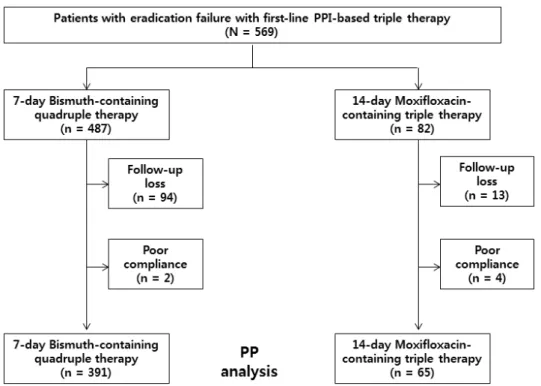
Fig. 1. Flowchart of study participants. PPI, proton pump inhibitor; PP, per-protocol.
rabeprazole twice daily, 300 mg of tripotassium dicitrato bis- muthate, 500 mg of metronidazole three times daily, and 500 mg of tetracycline four times daily for 7 days (7-RBMT).
Moxifloxacin-containing triple therapy was comprised of 40 mg of esomeprazole twice daily, 1.0 g of amoxicillin twice daily, and 400 mg of moxifloxacin once daily for 14 days (14-EAM).
A 13C-urea breath test (UBiT-IR300®) or a rapid urease test (CLOtest®) was conducted to assess H. pylori eradication at least 4 weeks after treatment completion. Before the 13C-urea breath test (UBiT-IR300®) or rapid urease test (CLOtest®), pa- tients suspended PPI or histamine (H2) receptor antagonist treatment for at least 2 weeks.
3. Rapid urease test (CLOtest®)
An endoscopic biopsy of the gastric mucosa was performed to verify H. pylori infection with the rapid urease test (CLOtest®).
The site of the gastric mucosal biopsy was the antrum and/or corpus, and normal or near-normal gastric mucosa with little atrophy or intestinal metaplasia was obtained. The tissue sam- ple was immersed in rapid urea reagent. The result was consid- ered positive when the reagent color changed from yellow to red within 12 hours. If there was no change in the reagent color, it was considered negative.
4. 13C-urea breath test (UBiT-IR300®)
Prior to collection of the first breath sample, patients fasted for at least 4 hours. Afterwards, patients took 100 mg tablets of 13C-urea (UBiTkitTM, Otsuka Pharmaceutical Co., Ltd., Tokyo, Japan) with 100 mL of water orally, and the second breath sample was collected 20 minutes after taking the tablets.
The obtained breath samples were analyzed using the
13C-urea breath test (UBiT-IR300®). The cut-off value in the procedure was set at 2.5‰.
5. Statistical analyses
All statistical analyses were performed with the Statistical Package for the Social Sciences software version 20.0 (SPSS Inc., Chicago, IL, USA). The H. pylori eradication rate was iden- tified by per-protocol (PP) analysis. Patients with poor com- pliance or those lost to follow-up were excluded when we con- ducted the PP analysis. The trends in eradication rates of H. pylori were analyzed with linear-by-linear association.
Categorical variables were analyzed using Chi-square (χ2) tests, and continuous variables were analyzed using Student’s t-tests. Univariate and multivariate logistic regression tests were utilized for identification of risk factors and presented as an OR and 95% CI. A p-value of <0.05 was considered statistically significant.
Table 1. Baseline Characteristics of the Subjects
Variable 7-day bismuth-containing quadruple therapy (n=487b)
14-day moxifloxacin-containing triple therapy
(n=82b) p-value
Age (years) 54.3±11.5 55.7±11.9 0.311
Gender 0.072
Male 261 (53.6) 53 (64.6)
Female 226 (46.4) 29 (35.4)
Cigarette smoking 215/481 (44.7) 49/81 (60.5) 0.011a
Alcohol intake 128/481 (26.6) 31/81 (38.3) 0.034a
Diabetes mellitus 53/481 (11.0) 6/81 (7.4) 0.433
Hypertension 95/481 (19.8) 21/81 (25.9) 0.235
Endoscopic diagnosis
Gastric ulcer 167 (34.4) 39 (47.6) 0.025a
Duodenal ulcer 141 (29.0) 22 (26.8) 0.792
Gastric ulcer+duodenal ulcer 26 (5.3) 2 (2.4) 0.407
Post ESD due to adenoma or EGC 66 (13.2) 2 (2.4) 0.003a
Othersc 87 (18.1) 17 (20.8) 0.538
Values are presented as mean±standard deviation or n (%).
ESD, endoscopic submucosal dissection; EGC, early gastric cancer; MALT, mucosa-associated lymphoid tissue.
aIndicates statistical significance; bTotal number of enrolled patients. Missing values were not included. The number behind the dash is the total number of subjects who answered each question; cOthers include MALT lymphoma, dyspepsia, gastric polyp and gastritis.
Table 2. Outcomes of the Eradication Therapies
7-day bismuth-containing quadruple therapy (n=487)
14-day moxifloxacin-containing triple therapy
(n=82) p-value
Eradication rate
Per-protocol 366/391 (93.6) 48/65 (73.8) <0.001a
95% CI 91.0-95.9 63.1-84.6
Compliance 485 (99.6) 78 (95.1) 0.005a
Values are presented as n (%).
CI, confidence interval.
aIndicates statistical significance.
RESULTS
1. Patient characteristics
Between January 2011 to December 2015, 569 patients failed the first-line clarithromycin-containing triple therapy.
Initially, 487 patients received 7-RBMT and 82 patients re- ceived 14-EAM for second-line eradication therapy. In the 7-RBMT group, 94 patients (19.3%) were lost to follow-up and two patients (0.4%) were excluded due to poor compliance.
In the 14-EAM group, 13 patients (15.9%) were lost to fol- low-up and four patients (4.9%) were excluded due to poor compliance. Therefore, 391 patients in the 7-RBMT group and 65 patients in the 14-EAM group were included as subjects for PP analysis (Fig. 1).
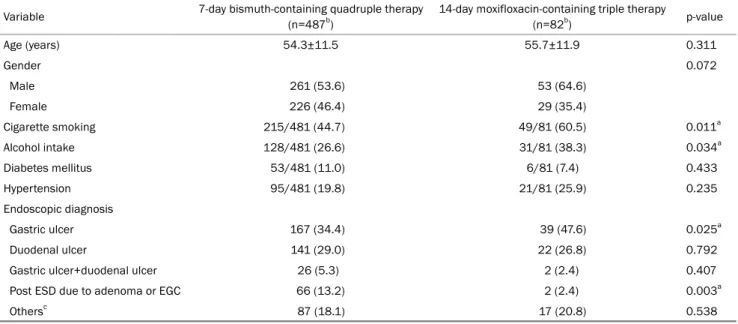
Among the baseline characteristics, the proportion of pa- tients with a history of cigarette smoking (60.5% vs. 44.7%, respectively; p=0.011), and alcohol intake (38.3% vs. 26.6%, respectively; p=0.034) was statistically higher in the 14-EAM group. In terms of the endoscopic diagnosis, the rate of gastric ulcer occurrence was statistically higher in the 14-EMA group (47.6% vs. 34.4%, respectively; p=0.025); however, the rate of post endoscopic submucosal dissection was statistically higher in the 7-RBMT group (13.2% vs. 2.4%, respectively;
p=0.003). There were no significant differences in age, dia- betes, hypertension, or other endoscopic findings between the two groups (Table 1).
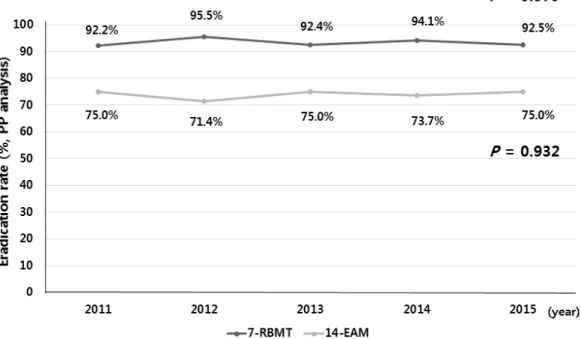
Fig. 2. Helicobacter pylori eradication rates of second line 7-day bismuth-containing quadruple therapy (---●, p=0.579) and 14-day moxifloxacin-containing triple therapy (---●, p=0.932) according to year. PP, per-protocol.
Table 3. Side Effects after the Eradication Therapies
7-day bismuth-containing quadruple therapy (n=391)
14-day moxifloxacin-containingtriple therapy
(n=65) p-value
Diarrhea 15 (3.9) 2 (3.1) 1.000
Bloating or abdominal pain 19 (4.9) 1 (1.5) 0.334
Nausea or vomiting 23 (5.9) 1 (1.5) 0.228
Skin rash 2 (0.5) 1 (1.5) 0.370
Othersa 8 (2.1) 0 (0) -
Total 67 (17.1) 5 (7.7) 0.065
Values are presented as n (%).
aOthers include myalgia, headache and bitter sensation in the mouth.
2. H. pylori eradication rates
Table 2 reveals the eradication rate of H. pylori based on the PP analysis, and Fig. 2 presents the annual eradication rates of H. pylori according to each eradication regimen. The eradication rates by PP analysis were 93.6% (366/391; 95%
CI, 91.0-95.9%) and 73.8% (48/65; 95% CI, 63.1-84.6%) in the 7-RBMT group and 14-EAM group, respectively (p<0.001).
Annual eradication rates from 2011 to 2015 were 92.2%, 95.5%, 92.4%, 94.1%, and 92.5%. Consecutively, in the 7-RBMT group (p=0.579) and 75.0%, 71.4%, 75.0%, 73.7%, and 75.0%, consecutively, in the 14-EAM group by PP analysis (p=0.932) (Fig. 2). The compliance rate was significantly high- er in the 7-RBMT group (99.6% vs. 95.1%, respectively;
p=0.005) (Table 2).
3. Adverse effects of eradication therapy
Adverse effects were recorded in 67 patients (17.1%) in the 7-RBMT group and five patients (7.7%) in the 14-EAM group (p=0.065). The adverse events were mild or moderate in all patients. The most common adverse events were nau- sea or vomiting (23/391, 5.9%), bloating or abdominal pain (19/391, 4.9%), and diarrhea (15/391, 3.9%) in the 7-RBMT group, and diarrhea (2/65, 3.1%), bloating or abdominal pain (1/65, 1.5%), nausea or vomiting (1/65, 1.5%), and skin rash (1/65, 1.5%) in the 14-EAM group (Table 3).
4. Related factors for eradication failure
Table 4 shows the related factors for eradication failure.
Univariate analysis verified that female (p=0.036) and
Table 4. Clinical Factors Related to Eradication Failure of Second-line Eradication Therapies Eradication success
(n=414)
Eradication failure (n=42)
Univariated p-value
Multivariate p-valueb
Adjusted OR (95% CI)b
Age (years) 54.4±11.5 53.2±12.6 0.505 0.447 0.99 (0.96-1.02)
Gender
Male 228 (93.4) 16 (6.6)
Female 186 (87.7) 26 (12.3) 0.036a 0.119 1.73 (0.87-3.44)
Eradication therapy
7-RBMT 366 (93.6) 25 (6.4)
14-EAM 48 (73.8) 17 (26.2) <0.001a <0.001a 5.47 (2.74-10.93)a
Residence
Rural 90 (90.9) 9 (9.1)
Urban 324 (90.8) 33 (9.2) 0.963 0.411 0.71 (0.31-1.61)
Cigarette smoking
No 296 (90.8) 30 (9.2)
Yes 114 (91.2) 11 (8.8) 0.894 0.301 1.61 (0.65-3.98)
Alcohol intake
No 217 (88.9) 27 (11.1)
Yes 193 (93.2) 14 (6.8) 0.113 0.522 0.75 (0.32-1.79)
Diabetes mellitus
No 363 (90.8) 37 (9.2)
Yes 47 (92.2) 4 (7.8) 1.000 0.92 0.94 (0.30-2.96)
Hypertension
No 324 (91.0) 32 (9.0)
Yes 86 (90.5) 9 (9.5) 0.843 0.520 1.32 (0.57-3.09)
Values are presented as mean±standard deviation or n (%).
OR, odds ratio; CI, confidence interval; 7-RBMT, 7-day bismuth-containing quadruple therapy; 14-EAM, 14-day moxifloxacin-containing triple therapy.
aIndicates statistical significance; bLogistic model including terms of age, gender, type of eradication therapy, residence, cigarette smoking, alcohol intake, diabetes mellitus and hypertension.
14-EAM (p<0.001) were significantly associated with erad- ication failure. 14-EAM (OR, 5.47; 95% CI, 2.74-10.93;
p<0.001) was significantly related to H. pylori eradication ther- apy failure. There was no statistically significant association between eradication failure and other factors, such as age, gender, residence, smoking, alcohol, diabetes mellitus, and hypertension.
DISCUSSION
Bismuth-containing quadruple therapy is a widely used sec- ond-line H. pylori eradication therapy, but moxifloxacin-contain- ing triple therapy has been suggested as an alternative sec- ond-line therapy for H. pylori infection.8,12,13 A meta-analysis study reported that moxifloxacin-containing triple therapy was more effective than bismuth-containing quadruple therapy in the second-line eradication of H. pylori.12 However, a recent
study in Korea revealed that 7-RBMT has remained efficacious as a second-line regimen over the last 10 years, and there have been no significant changes in eradication rates with time (eradication rate range: 83.2-93.7%, p=0.352).4 In addi- tion, the eradication rates of 14-day moxifloxacin-containing triple therapy range from 82.8-98.1%, which are similar to those of bismuth-containing quadruple therapy.14 Several stud- ies have investigated the effects of second-line H. pylori erad- ication therapies, including bismuth-containing quadruple ther- apy and moxifloxacin-containing triple therapy.12 However, to the best of our knowledge, this is the first study to directly compare 7-day bismuth-containing quadruple therapy and 14-day moxifloxacin-containing triple therapy.
Generally, well-known correlating factors of H. pylori erad- ication failure include resistance to antibiotic agents and poor patient compliance with regard to medication.15 In the case of first-line triple therapy, clarithromycin resistance is a critical
determinant for eradication success. For bismuth-containing quadruple therapy, metronidazole resistance is considered an important factor for deciding the success of eradication,16 be- cause resistance to tetracycline is low in the most countries.17,18 Even in Korea where the antibiotic resistance rate of H. pylori is high, the resistance rate to tetracycline was reported to be similar for the past 11 years (p=0.761),19 whereas the rate of metronidazole resistance is usually 20-40% in Western countries and 50-80% in developing countries.20 A recent study in Korea demonstrated that the resistance rate of met- ronidazole was stable from 2003-2012 (p=0.418) with a prev- alence of 26.0-35.8%.21 Resistance to fluoroquinolones also affects the H. pylori eradication rate, and, unfortunately, the prevalence of fluoroquinolone resistance is rapidly increasing worldwide.16 A recent study reported a high rate of resistance to levofloxacin (53.01%), moxifloxacin (46.57%), and cipro- floxacin (44.28%) in Italy.22 Lee et al.21 also revealed the prev- alence of levofloxacin (34.6%) and moxifloxacin (34.6%) re- sistance in Korea, and showed that the resistance rates of levofloxacin (p<0.001) and moxifloxacin (p<0.001) sig- nificantly increased over the past 10 years. When they ana- lyzed the data by the primary and secondary resistance, a statistically significant increase was shown in the secondary resistance rate to moxifloxacin (p=0.025); the prevalence of secondary moxifloxacin resistance was 50.0% from 2009 to 2012.
In the current study, the H. pylori eradication failure rate associated with 14-EAM was significantly higher than that as- sociated with 7-RBMT; the OR was 5.47 (p<0.001). The H.
pylori eradication rate for second-line 7-RBMT was identified as 93.6% in PP analysis. However, the eradication rate of mox- ifloxacin-containing triple therapy was unsuitable for the gen- erally accepted standard. In general, acceptable H. pylori eradication therapies should have a success rate of at least 90% irrespective of the presence of antibiotic resistance.16,23 Unfortunately, we were unable to evaluate the antibiotic re- sistant state of H. pylori due to the retrospective design of this study. Nevertheless, when we reflect upon previous stud- ies concerning the antibiotic susceptibility of H. pylori in Korea, bismuth-containing quadruple therapy might be con- sidered for second-line H. pylori eradication therapy in Korea.
With regard to the treatment duration, the shorter treatment duration seen with bismuth-containing quadruple therapy was more effective than the longer treatment duration associated
with moxifloxacin-containing triple therapy in this study.
Treatment duration of bismuth-containing quadruple therapy is an important factor in eradication success when the tradi- tional bismuth-containing quadruple therapy is prescribed.24 It is known that metronidazole resistance could be overcome by prolongation of treatment duration.25 A meta-analysis study revealed that bismuth-containing quadruple therapy for 10-14 days was more efficient than when it was given for either 1-3 days, 4 days, or 7 days.26 However, this is thought to be applicable only to first-line H. pylori quadruple eradication therapies. In patients who are non-naïve to H. pylori eradication therapy, namely, those who failed first-line eradication therapy, the 7-day treatment duration of bismuth-containing quadruple therapy seemed sufficient.23 Several studies reported that the eradication rates of second-line bismuth-containing quadruple therapy were similar in patients with treatment durations of 7, 10, and 14 days.27,28 A recent randomized controlled trial in Korea also reported that the 7-day second-line bismuth-con- taining quadruple therapy was not statistically inferior to the 14-day bismuth-containing quadruple therapy.29 Even if 7-day bismuth-containing quadruple therapy showed unacceptable eradication rates in areas where antibiotic resistance to metro- nidazole is ≥40%,24 more studies are required to investigate the efficacy, cost, safety, and ideal duration of bismuth-contain- ing quadruple therapy as a second-line eradication therapy.
Although there was no statistical difference, the rate of adverse effects in the 7-RBMT group tended to be higher than that of the 14-EAM group in this study. A meta-analysis re- ported that the rate of side effects associated with moxi- floxacin-containing triple therapy was statistically lower than that of bismuth-containing quadruple therapy (OR, 0.27; 95%
CI, 0.18-0.4).12 Recently, a single capsule with a composite of bismuth, metronidazole, and tetracycline has been devel- oped to make the bismuth-containing quadruple therapy sim- pler for patients, and the results of studies of this new medi- cation, including eradication rate, compliance, and safety pro- files, were inspiring.30,31 Therefore, the compliance and ad- verse effect rates of bismuth-containing quadruple therapy is expected to improve in the future.
This study has several limitations. First, many patients in the present study were lost to follow-up. In addition, there was a large difference in the number of patients between the two group. These could affect the results as bias. Second, we did not investigate cytochrome P450 2C19 (CYP2C19) me-
tabolism, which induces many drug metabolism pathways, in- cluding that for PPI. Therefore, a disparity in CYP2C19 genotypes can influence the eradication rate. In addition, the rates of cigarette smoking and alcohol intake were higher in the 14-EAM group compared to the 7-RBMT group. In previous studies, several factors have been presumed to be the cause of erad- ication failure, including age, sex, smoking, alcohol, and diabetes.32-35 However, a direct relationship between these factors and eradication failure remains controversial.32-35 Therefore, it is uncertain but unlikely that these factors could have had a significant influence on the current study.
In conclusion, compared to 14-day moxifloxacin-containing triple therapy, 7-day bismuth-containing quadruple therapy might provide benefits for patients who failed first-line triple therapy. In addition, the present study suggests that the poor compliance and high adverse event rates associated with bis- muth-containing quadruple therapy could be overcome by its relative short duration for eradication therapy. Additional well-designed, prospective, large-scale studies are required to confirm the appropriate second-line therapy for H. pylori eradication.
REFERENCES
1. Pounder RE, Ng D. The prevalence of Helicobacter pylori infection in different countries. Aliment Pharmacol Ther 1995;9 Suppl 2:
S33-S39.
2. IARC working group on the evaluation of carcinogenic risks to hu- mans: some industrial chemicals. Lyon, 15-22 February 1994.
IARC Monogr Eval Carcinog Risks Hum 1994;60:1-560.
3. Yeo YH, Shiu SI, Ho HJ, et al. First-line Helicobacter pylori erad- ication therapies in countries with high and low clarithromycin re- sistance: a systematic review and network meta-analysis. Gut 2018;67:20-27.
4. Shin WG, Lee SW, Baik GH, et al. Eradication rates of Helicobacter pylori in Korea over the past 10 years and correlation of the amount of antibiotics use: nationwide survey. Helicobacter 2016;21:266-278.
5. Kim SG, Jung HK, Lee HL, et al. Guidelines for the diagnosis and treatment of Helicobacter pylori infection in Korea, 2013 revised edition. J Gastroenterol Hepatol 2014;29:1371-1386.
6. Chinese Society of Gastroenterology, Chinese Study Group on Helicobacter pylori, Liu WZ, Xie Y, et al. Fourth Chinese national consensus report on the management of Helicobacter pylori infection. J Dig Dis 2013;14:211-221.
7. Asaka M. A new approach for elimination of gastric cancer deaths in Japan. Int J Cancer 2013;132:1272-1276.
8. Malfertheiner P, Megraud F, O'Morain CA, et al. Management of Helicobacter pylori infection-the Maastricht V/Florence con-
sensus report. Gut 2017;66:6-30.
9. Lee ST, Lee DH, Lim JH, et al. Efficacy of 7-day and 14-day bis- muth-containing quadruple therapy and 7-day and 14-day moxi- floxacin-based triple therapy as second-line eradication for Helicobacter pylori infection. Gut Liver 2015;9:478-485.
10. Cao Z, Chen Q, Zhang W, et al. Fourteen-day optimized levo- floxacin-based therapy versus classical quadruple therapy for Helicobacter pylori treatment failures: a randomized clinical trial. Scand J Gastroenterol 2015;50:1185-1190.
11. Kim MS, Kim N, Kim SE, et al. Long-term follow up Helicobacter pylori reinfection rate after second-line treatment: bismuth-con- taining quadruple therapy versus moxifloxacin-based triple therapy. BMC Gastroenterol 2013;13:138.
12. Wu C, Chen X, Liu J, Li MY, Zhang ZQ, Wang ZQ. Moxifloxacin-con- taining triple therapy versus bismuth-containing quadruple ther- apy for second-line treatment of Helicobacter pylori infection: a meta-analysis. Helicobacter 2011;16:131-138.
13. Zagari RM, Romano M, Ojetti V, et al. Guidelines for the manage- ment of Helicobacter pylori infection in Italy: the III working group consensus report 2015. Dig Liver Dis 2015;47:903-912.
14. Hwang JJ, Lee DH, Lee AR, et al. Efficacy of 14-d vs 7-d moxi- floxacin-based triple regimens for second-line Helicobacter pylo- ri eradication. World J Gastroenterol 2015;21:5568-5574.
15. Mégraud F. H pylori antibiotic resistance: prevalence, im- portance, and advances in testing. Gut 2004;53:1374-1384.
16. Graham DY, Fischbach L. Helicobacter pylori treatment in the era of increasing antibiotic resistance. Gut 2010;59:1143-1153.
17. Megraud F, Coenen S, Versporten A, et al. Helicobacter pylori re- sistance to antibiotics in Europe and its relationship to antibiotic consumption. Gut 2013;62:34-42.
18. Boyanova L, Mitov I. Geographic map and evolution of primary Helicobacter pylori resistance to antibacterial agents. Expert Rev Anti Infect Ther 2010;8:59-70.
19. Lee JY, Kim N, Kim MS, et al. Factors affecting first-line triple ther- apy of Helicobacter pylori including CYP2C19 genotype and anti- biotic resistance. Dig Dis Sci 2014;59:1235-1243.
20. Mégraud F, Lehours P. Helicobacter pylori detection and anti- microbial susceptibility testing. Clin Microbiol Rev 2007;20:
280-322.
21. Lee JW, Kim N, Kim JM, et al. Prevalence of primary and secon- dary antimicrobial resistance of Helicobacter pylori in Korea from 2003 through 2012. Helicobacter 2013;18:206-214.
22. Di Giulio M, Di Campli E, Di Bartolomeo S, et al. In vitro anti- microbial susceptibility of Helicobacter pylori to nine antibiotics currently used in Central Italy. Scand J Gastroenterol 2016;51:
263-269.
23. Gisbert JP, McNicholl AG. Optimization strategies aimed to in- crease the efficacy of H. pylori eradication therapies. Helicobacter 2017;22:e.12392.
24. Lu H, Zhang W, Graham DY. Bismuth-containing quadruple therapy for Helicobacter pylori: lessons from China. Eur J Gastroenterol Hepatol 2013;25:1134-1140.
25. Mégraud F, Lamouliatte H. Review article: the treatment of re- fractory Helicobacter pylori infection. Aliment Pharmacol Ther 2003;17:1333-1343.
26. Fischbach L, Evans EL. Meta-analysis: the effect of antibiotic re- sistance status on the efficacy of triple and quadruple first-line therapies for Helicobacter pylori. Aliment Pharmacol Ther 2007;
26:343-357.
27. Gisbert JP, Pajares JM. Review article: Helicobacter pylori "rescue"
regimen when proton pump inhibitor-based triple therapies fail.
Aliment Pharmacol Ther 2002;16:1047-1057.
28. de Boer WA, Driessen WM, Potters VP, Tytgat GN. Randomized study comparing 1 with 2 weeks of quadruple therapy for eradicat- ing Helicobacter pylori. Am J Gastroenterol 1994;89:1993-1997.
29. Chung JW, Lee JH, Jung HY, et al. Second-line Helicobacter py- lori eradication: a randomized comparison of 1-week or 2-week bismuth-containing quadruple therapy. Helicobacter 2011;16:
289-294.
30. Malfertheiner P, Bazzoli F, Delchier JC, et al. Helicobacter pylori eradication with a capsule containing bismuth subcitrate potas- sium, metronidazole, and tetracycline given with omeprazole versus clarithromycin-based triple therapy: a randomised,
open-label, non-inferiority, phase 3 trial. Lancet 2011;377:
905-913.
31. Delchier JC, Malfertheiner P, Thieroff-Ekerdt R. Use of a combina- tion formulation of bismuth, metronidazole and tetracycline with omeprazole as a rescue therapy for eradication of Helicobacter pylori. Aliment Pharmacol Ther 2014;40:171-177.
32. Kim SE, Park MI, Park SJ, et al. Second-line bismuth-containing quadruple therapy for Helicobacter pylori eradication and impact of diabetes. World J Gastroenterol 2017;23:1059-1066.
33. Suzuki T, Matsuo K, Ito H, et al. Smoking increases the treatment failure for Helicobacter pylori eradication. Am J Med 2006;119:
217-224.
34. Moayyedi P, Chalmers DM, Axon AT. Patient factors that predict failure of omeprazole, clarithromycin, and tinidazole to eradicate Helicobacter pylori. J Gastroenterol 1997;32:24-27.
35. Kim SE, Park MI, Park SJ, et al. Trends in Helicobacter pylori erad- ication rates by first-line triple therapy and related factors in erad- ication therapy. Korean J Intern Med 2015;30:801-807.