http://dx.doi.org/10.3988/jcn.2014.10.3.210 J Clin Neurol 2014;10(3):210-215
Validation of a Korean Version of the Insomnia Severity Index
Yong Won Cho,a Mei Ling Song,b Charles M. Morinc
aDepartment of Neurology, Keimyung University Dongsan Medical Center, Daegu, Korea
bDepartment of Graduate School in Nursing Science, College of Nursing, Keimyung University, Daegu, Korea
cEcole de Psychologie, Universite Laval, Québec, QC, Canada
Received September 23, 2013 Revised November 3, 2013 Accepted January 10, 2014 Correspondence Yong Won Cho, MD, PhD Department of Neurology, Keimyung University Dongsan Medical Center,
56 Dalseong-ro, Jung-gu, Daegu 700-712, Korea Tel +82-53-250-7831 Fax +82-53-250-7840 E-mail [email protected]
Background and PurposezzThe purposes of this study were to standardize and validate a Korean version of the Insomnia Severity Index (ISI-K), and to evaluate its clinical usefulness.
MethodszzWe translated the ISI into Korean and then translated it back into English to check its accuracy. The 614 patients with sleep disorders who were enrolled in this study comprised 169 with primary insomnia, 133 with comorbid insomnia, and 312 with obstructive sleep apnea. All subjects underwent one night of polysomnography (PSG) and completed the Korean versions of both the Pittsburgh Sleep Quality Index (PSQI-K) and the Epworth Sleepiness Scale, as well as the ISI-K. The ISI-K was compared to these sleep scales and various PSG sleep parameters.
ResultszzThe internal consistency the ISI-K total score was confirmed by a Cronbach’s alpha of 0.92, and the item-to-total-score correlations (item-total correlations) ranged from 0.65 to 0.84, suggesting adequate reliability. The correlation between the ISI-K total score and PSQI-K was 0.84, which suggested adequate convergent validity. Low-to-moderate correlations were obtained between the ISI-K total score and PSG-defined sleep parameters: 0.22 for sleep onset latency, 0.38 for wake after sleep onset, and 0.46 for sleep efficiency. A cutoff score of 15.5 on the ISI-K was optimal for discriminating patients with insomnia. The test-retest scores over a 4-week interval with 34 subjects yielded a correlation coefficient of 0.86, suggesting excellent temporal stability.
ConclusionszzThe findings of this study show that the ISI-K is a reliable and valid instrument for assessing the severity of insomnia in a Korean population. J Clin Neurol 2014;10(3):210-215 Key Wordszz sleep, insomnia, reliability, validity.
Open Access
cc This is an Open Access article distributed under the terms of the Cre- ative Commons Attribution Non-Commercial License (http://creative- commons.org/licenses/by-nc/3.0) which permits unrestricted non-com- mercial use, distribution, and reproduction in any medium, provided the ori- ginal work is properly cited.
Introduction
Insomnia is one of the most common sleep disorders, with prevalence rates in general populations reportedly ranging from 12.8% to 38.3%,1-3 including 22.8% in Koreans.4 Insomnia can cause impairment of several daytime cognitive functions (e.g., attention, concentration, and memory)5 that can lower efficien- cy at work6,7 and increase the risks of injuries and traffic colli- sions6,8 and of falls in older adults.9 Insomnia is also a prevalent complaint in clinical practice that can present with several oth-
er comorbid medical or psychiatric disorders.10 When left un- treated, insomnia may aggravate or increase other conditions or delay recovery.11-13 It is therefore necessary to recognize in- somnia early and initiate the appropriate treatment.
Polysomnography (PSG) is regarded as a reliable method for obtaining objective information on several sleep parameters.
However, it is expensive and is not recommended for routine screening for insomnia. On the other hand, the Korean version of the Pittsburgh Sleep Quality Index (PSQI-K)14 and the Ko- rean version of the Epworth Sleepiness Scale (KESS)15 are re- liable and valid instruments for subjectively assessing sleep quality, sleep disturbances, and daytime sleepiness, but neither of these instruments is specifically designed for assessing in- somnia.
The Insomnia Severity Index (ISI) is a brief self-report ques-
tionnaire that measures the patient’s perception of insomnia se- verity.16 The ISI has been validated for several age groups from adolescence17 to the elderly,18 and is reported to be a useful as- sessment instrument for individuals with psychiatric diseas- es,19,20 cancer,21 and other clinical diseases.16,22,23 The ISI has been translated into several languages, including Chinese,24 Hindi,25 Spanish,26 and Arabic,27 with these language versions demonstrating adequate psychometric properties. However, there is no standardization for Korean. The purposes of the present study were to develop a Korean version of the ISI (ISI- K) using standard translation procedures, and to verify its va- lidity and reliability as a screening measure of insomnia in a Korean population.
Methods
Translation of the ISI into Korean
The ISI comprises seven items that evaluate difficulty falling asleep and staying asleep, problems waking up too early, satis- faction with current sleep patterns, interference with daily functions, noticeability of impairment attributed to sleep prob- lems, and distress caused by the sleep problem. Each of the ISI items is rated on a scale of 0–4; the total score ranges from 0 to 28, with a higher score indicating greater insomnia severity.
The total ISI scores are divided into four subcategories: 0–7, no clinically significant insomnia; 8–14, subthreshold insomnia;
15–21, moderate insomnia; and 22–28, severe insomnia. A cut- off score of 15 has been used as the threshold for clinically sig- nificant insomnia, and a score below 8 has been used to define remission after treatment (i.e., no longer meets the criteria for insomnia).28
Linguistic validation was achieved by having two sleep spe- cialists translate the original ISI questionnaire into Korean; the Korean version was then translated back into English by one sleep specialist and one linguist, both of whom were fluent in Korean and English. Comparison of the original ISI with the fi- nal back-translated version was performed by individuals who were fluent in both languages and who were not involved in the research study. The final ISI-K was obtained after comple- tion of these standard procedures.
Subjects
A sample of patients was sequentially selected from those who visited a regional sleep center between August 2009 and May 2012; all participants were older than 18 years, and all met the criteria for one or more of the following disorders: primary in- somnia, comorbid insomnia, or obstructive sleep apnea (OSA).
The Diagnostic and Statistical Manual of Mental Disorders, fourth edition, text revision is used to diagnose primary insom- niacs, the primary complaint of which is difficulty initiating or
maintaining sleep, or nonrestorative sleep, for at least 1 month.29 Comorbid insomniacs meet the criteria of primary insomniacs, but are also diagnosed as simultaneously having another dis- ease, such as a psychiatric disorder or medical disorder. Such comorbid disorders were diagnosed through an interview using sleep questionnaires. OSA was diagnosed for those with a Re- spiratory Disturbance Index greater than 5, based on the second edition of the International Classification of Sleep Disorders.30
All subjects completed the ISI-K, KESS,15 second edition of the Beck Depression Inventory,31 and PSQI-K,14 and sub- mitted to overnight PSG. In order to examine test-retest reli- ability, 34 subjects were randomly selected to undergo a retest at a 4-week interval without treatment. The required sample size was calculated using the G-power 3.1.3 program based on an effect size of dz=0.5, an error probability of 0.05, and a statistical power of 0.80.
The PSQI-K and PSG were used as a subjective and an ob- jective gold standard, respectively. The PSQI is a widely used measure of sleep quality32 and has been used in previous stud- ies as a convergent measure with ISI in other language ver- sions.24,26,27 PSG was used as the primary diagnosis tool for other sleep disorders, and as a complementary instrument for the evaluation of insomnia, although it is not indicated for the routine evaluation of this condition.33,34
The study and all procedures were approved by the institu- tional review board of a regional university hospital in Korea.
Statistical analysis
The data analyses were performed using SPSS version 18.0 (SPSS Inc., Chicago, IL, USA). The data are presented as mean±SD values, and p<0.05 was considered indicative of statistical significance. Descriptive statistics were used for ex- amining the demographic data, test-retest reliability was exam- ined with a paired-samples t-test, and internal consistency was examined with Cronbach’s alpha coefficient. The correlations between ISI-K, KESS, and PSQI-K scores and various sleep parameters from PSG [sleep onset latency (SOL), wake after sleep onset (WASO), and sleep efficiency] were examined us- ing Pearson’s correlation coefficient. In addition, the receiver operating characteristic (ROC) curve was used to determine the optimal cutoff score based on its sensitivity and specificity;
a perfect medical test would have 100% sensitivity and 100%
specificity, corresponding to the upper left-hand corner (0, 1) on the ROC curve.35-37 The discriminative ability of the test across the full range of cutoffs was reflected by the area under the curve (AUC).35 A perfect test would have an AUC of 1.0; a commonly applied rule of thumb is that a test with an AUC greater than 0.9 has high accuracy, while 0.7–0.9 indicates moderate accuracy, 0.5–0.7 indicates low accuracy, and 0.5 is considered a chance result.38,39
Results
Demographic characteristics
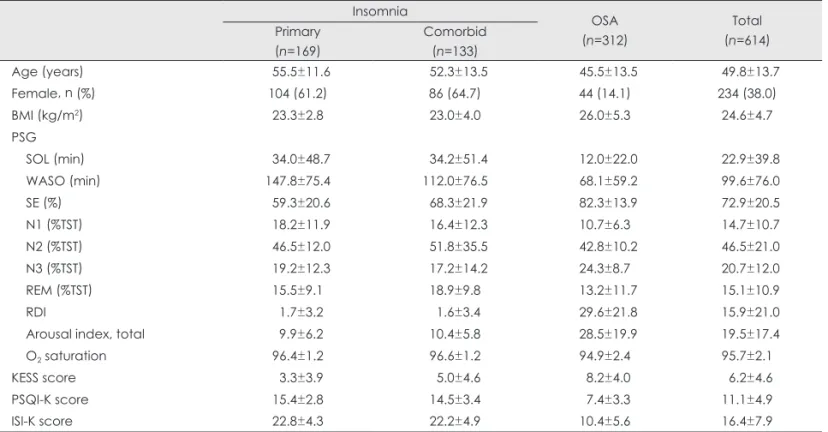
The entire sample comprised 614 patients with sleep disor- ders, including 169 with primary insomnia, 133 with comor- bid insomnia, and 312 with OSA. The age was 49.8±13.7 years. The gender ratios (i.e., percentage of women) in the pri- mary insomnia, comorbid insomnia, and OSA groups were 61.2%, 64.7%, and 14.1%, respectively. The sleep efficiency, SOL, WASO, and KESS, PSQI-K, and ISI-K scores were 72.9±20.5%, 22.9±39.8 min, 99.6±76.0 min, 6.2±4.6, 11.1±
4.9, and 16.4±7.9, respectively. The other demographic and clinical characteristics of the subjects are listed in Table 1.
Reliability of the ISI-K
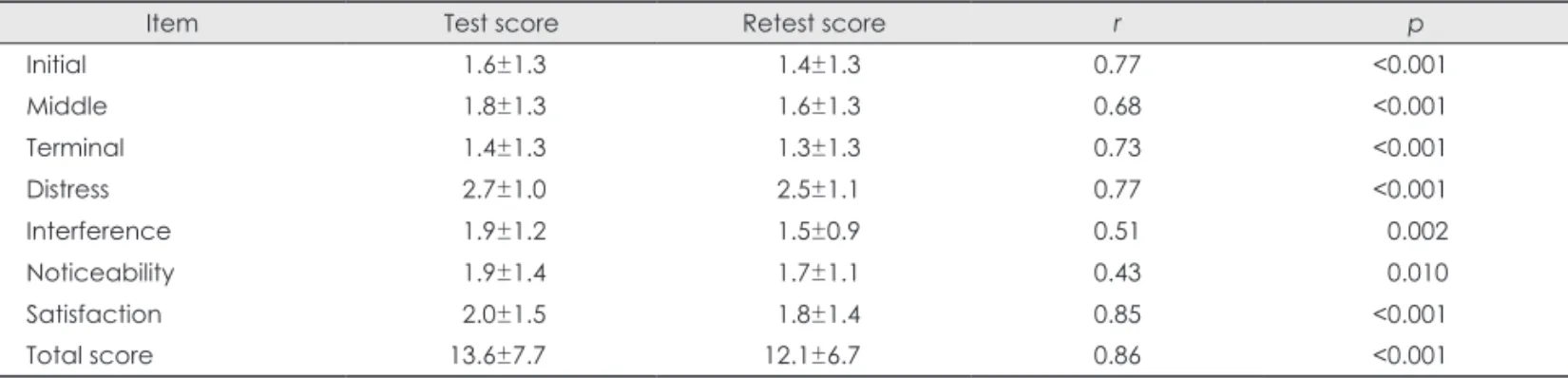
Cronbach’s alpha of the ISI-K was 0.92, which indicated a high internal consistency, and did not change substantially even after deleting any of the items on the scale. The item-total cor- relations ranged from 0.65 to 0.84, suggesting good homoge- neity of the items for measuring the severity of insomnia (Ta- ble 2). The test-retest correlation was 0.86 for the total score (p<0.001), and ranged from 0.43 to 0.85 (Table 3) for the sev- en components.
Validity of the ISI-K
There was a strong positive correlation between the total ISI- K score and other subjective sleep assessment tools, and the PSQI-K score (r=0.84, p<0.01), suggesting that patients with more severe perceived insomnia also reported worse sleep quality; and a weak negative correlation with the KESS score (r=-0.29, p<0.01), indicating that those with more severe in- somnia reported less daytime sleepiness (Table 4).
The correlations between ISI-K and PSG parameters were as follows: there was a weak positive correlation between item 1 of the ISI-K (difficulty falling asleep) and SOL (r=0.22, p<
0.01), a moderate positive correlation between item 2 of the Table 1. Demographic and clinical characteristics of the subjects
Insomnia OSA
(n=312)
Total (n=614) Primary
(n=169)
Comorbid (n=133)
Age (years) 55.5±11.6 52.3±13.5 45.5±13.5 49.8±13.7
Female, n (%) 104 (61.2) 86 (64.7) 44 (14.1) 234 (38.0)
BMI (kg/m2) 23.3±2.8 23.0±4.0 26.0±5.3 24.6±4.7
PSG
SOL (min) 34.0±48.7 34.2±51.4 12.0±22.0 22.9±39.8
WASO (min) 147.8±75.4 112.0±76.5 68.1±59.2 99.6±76.0
SE (%) 59.3±20.6 68.3±21.9 82.3±13.9 72.9±20.5
N1 (%TST) 18.2±11.9 16.4±12.3 10.7±6.3 14.7±10.7
N2 (%TST) 46.5±12.0 51.8±35.5 42.8±10.2 46.5±21.0
N3 (%TST) 19.2±12.3 17.2±14.2 24.3±8.7 20.7±12.0
REM (%TST) 15.5±9.1 18.9±9.8 13.2±11.7 15.1±10.9
RDI 1.7±3.2 1.6±3.4 29.6±21.8 15.9±21.0
Arousal index, total 9.9±6.2 10.4±5.8 28.5±19.9 19.5±17.4
O2 saturation 96.4±1.2 96.6±1.2 94.9±2.4 95.7±2.1
KESS score 3.3±3.9 5.0±4.6 8.2±4.0 6.2±4.6
PSQI-K score 15.4±2.8 14.5±3.4 7.4±3.3 11.1±4.9
ISI-K score 22.8±4.3 22.2±4.9 10.4±5.6 16.4±7.9
Data are mean±SD or n (%) values.
BMI: body mass index, ISI-K: Korean version of the Insomnia Severity Index, KESS: Korean version of the Epworth Sleepiness Scale, N1:
stage 1, N2: stage 2, N3: slow-wave sleep, PSG: polysomnography, PSQI-K: Korean version of the Pittsburg Sleep Quality Index, RDI:
Respiratory Disturbance Index, REM: rapid eye movement, SE: sleep efficiency, SOL: sleep onset latency, TST: total sleep time, WASO:
wake after sleep onset.
Table 2. Item-total correlations and Cronbach’s alpha for the ISI- K (n=614)
Item Corrected item-total correlation
Cronbach’s alpha if item deleted
Initial 0.80 0.90
Middle 0.84 0.90
Terminal 0.74 0.91
Distress 0.80 0.91
Interference 0.74 0.91
Noticeability 0.65 0.92
Satisfaction 0.77 0.90
Cronbach’s alpha 0.92
ISI-K: Korean version of the Insomnia Severity Index.
ISI-K (difficulty staying asleep) and WASO (r=0.38, p<0.01), and a moderate negative correlation between the total score of the ISI-K and sleep efficiency (r=-0.46, p<0.01) (Table 4).
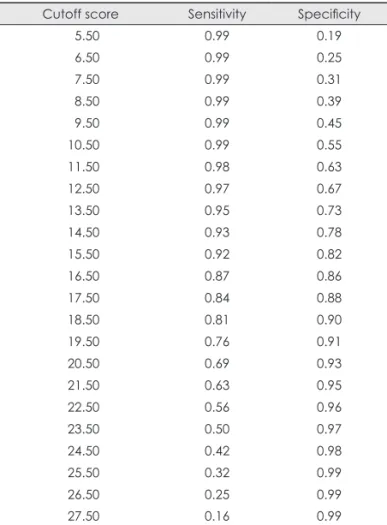
The ROC curve was used to evaluate the sensitivity and specificity of the ISI-K (Fig. 1). An AUC of 0.93 (95% confi- dence interval=0.92–0.95) was obtained. The sensitivity and
specificity values corresponding to various ISI-K cutoff scores for discriminating between patients with and without insom- nia are presented in Table 5. A cutoff score of 15.5 had a sen- sitivity of 0.92 and specificity of 0.82.
Discussion
The findings of this study show that the ISI-K measures the se- verity of insomnia similarly to the original ISI.16 There was a high degree of internal consistency, with the Cronbach’s alpha of 0.92 exceeding the usually accepted value of 0.70.40 The item-total correlations ranged from 0.65 to 0.84, thus also ex- ceeding the usual accepted value of 0.30.41 The value of Cron- bach’s alpha was higher than 0.74, which was first established for examining the validation of clinical tests,16 and similar to those achieved by the Arabic27 and Hindi25 versions of the ISI (0.92 and 0.91, respectively). However, the item-total corre- lations of the current research were more stable than those of the Arabic27 and Hindi25 versions (0.49–0.92 and 0.56–0.87, respectively). For the test-retest reliability, the total score changed from 13.6±7.7 to 12.1±6.7 over the 4-week inter- val. The correlation coefficient for the test-retest total scores was high, at 0.86.
The present results suggest that the ISI-K exhibits good convergent/discriminant validity with other subjective sleep- related instruments measuring sleep quality (PSQI-K) and sleepiness (KESS). The ESS has been used widely to assess the propensity for daytime sleepiness, especially among pa- tients with OSA.15,42 Daytime sleepiness may be a consequence of inadequate sleep, but it is not a common complaint of pa- tients with insomnia. There have been reports of patients with insomnia tending to have slightly elevated ESS scores (most- ly among patients with comorbid OSA), but such elevations are not necessarily predictive of insomnia.43 The present study found a correlation between the ISI-K and KESS, which may be due to some of the insomnia patients also having OSA.
OSA patients achieved higher scores on the KESS and lower scores on the ISI-K, while insomnia patients tended to exhib- Table 3. Item-total correlations and Cronbach’s alpha for the test-retest reliability of the ISI-K (n=34)
Item Test score Retest score r p
Initial 1.6±1.3 1.4±1.3 0.77 <0.001
Middle 1.8±1.3 1.6±1.3 0.68 <0.001
Terminal 1.4±1.3 1.3±1.3 0.73 <0.001
Distress 2.7±1.0 2.5±1.1 0.77 <0.001
Interference 1.9±1.2 1.5±0.9 0.51 0.002
Noticeability 1.9±1.4 1.7±1.1 0.43 0.010
Satisfaction 2.0±1.5 1.8±1.4 0.85 <0.001
Total score 13.6±7.7 12.1±6.7 0.86 <0.001
Data are mean±SD values.
ISI-K: Korean version of the Insomnia Severity Index.
Table 4. Correlations between ISI-K, PSQI-K, and KESS scores, and PSG data (n=614)
ISI-K PSQI-K KESS PSG
SOL WASO SE
Initial 0.29*
Middle 0.38*
Total score 0.84* –0.29* 0.22* 0.40* –0.46*
*Correlation is significant at the 0.01 level (two-tailed).
ISI-K: Korean version of the Insomnia Severity Index, KESS: Kore- an version of the Epworth Sleepiness Scale, PSG: polysomnog- raphy, PSQI-K: Korean version of the Pittsburg Sleep Quality In- dex, SE: sleep efficiency, SOL: sleep onset latency, WASO:
wake after sleep onset.
1.0
0.8
0.6
0.4
0.2
0.0
ROC curve
Sensitivity
1-Specificity
0.2 0.4 0.6 0.8 1.0
Fig. 1. Receiver operating characteristics (ROC) curve for the Korean version of the Insomnia Severity Index.
it the opposite result. These results can be interpreted as show- ing that more severe insomnia can cause lower sleep quality, but that the severity of insomnia will not increase the severity of excessive daytime sleepiness.
We also used the PSG data as an objective measure of sleep;
the ISI-K score exhibited a low-to-moderate correlation with various PSG parameters. The coefficient for the correlation between “difficulty falling asleep” on the ISI-K and SOL of the PSG was 0.29, which was lower than that found in the original research (0.45),16 but similar to that found in research into insomnia among cancer patients (0.26).21 The coefficient for the correlation between “difficulty staying asleep” on the ISI-K and WASO of the PSG was 0.38, which was a higher than that found in the original ISI study (0.16)16 and in the aforementioned study on cancer patients (0.07).21 The correla- tion between the total score of the ISI-K and sleep efficiency from the PSG (coefficient=-0.46) was stronger than that report- ed in the original ISI study (coefficient=-0.09).16 Although the correlations between the ISI-K and PSG data were not espe- cially strong in our study, they were statistically significant, and indicate the presence of adequate convergent validity.16
The ROC curve was used to evaluate the sensitivity and specificity of the ISI-K. The analysis showed that a cutoff score
of 15.5 had a sensitivity and specificity of 0.92 and 0.81, re- spectively, and is similar to the optimal cutoff score found in the original study (15.0).19 Thus, the ISI-K can be considered as a first-line tool for screening insomnia patients in Korean.
Our study was subject to some limitations. First, it was con- ducted at a regional sleep center in Korea and so was limited to community patients; however, since the questions of the ISI- K did not have local characteristics, there were no regional differences and hence the ISI-K did not need to be changed.
Second, we did not include any healthy controls without sleep problems, and additional studies that include such participants are needed. Third, we did not strictly assess for the presence of comorbid disorders, such as psychiatric disorders.
In conclusion, within the limitations of this study, the ISI-K can be considered a valid and reliable tool for assessing the se- verity of insomnia in Koreans. In addition, it is useful as a sim- ple screening tool to identify patients who suffer from insomnia.
Conflicts of Interest
The authors have no financial conflicts of interest.
REFERENCES
1. Morphy H, Dunn KM, Lewis M, Boardman HF, Croft PR. Epidemiol- ogy of insomnia: a longitudinal study in a UK population. Sleep 2007;30:274-280.
2. Ohayon MM. Epidemiology of insomnia: what we know and what we still need to learn. Sleep Med Rev 2002;6:97-111.
3. Zailinawati A, Ariff K, Nurjahan M, Teng C. Epidemiology of insom- nia in Malaysian adults: a community-based survey in 4 urban areas.
Asia Pac J Public Health 2008;20:224-233.
4. Cho YW, Shin WC, Yun CH, Hong SB, Kim J, Earley CJ. Epidemiol- ogy of insomnia in Korean adults: prevalence and associated factors. J Clin Neurol 2009;5:20-23.
5. Fortier-Brochu E, Beaulieu-Bonneau S, Ivers H, Morin CM. Insomnia and daytime cognitive performance: a meta-analysis. Sleep Med Rev 2012;16:83-94.
6. Laraqui S, Hossini OL, Tripodi D, Manar N, Aoudi YE, Caubet A, et al. [Prevalence and risk factors of attention disorders of professional drivers in Morocco]. Sante Publique 2011;23:89-100.
7. Fernandez-Mendoza J, Calhoun S, Bixler EO, Pejovic S, Karataraki M, Liao D, et al. Insomnia with objective short sleep duration is associat- ed with deficits in neuropsychological performance: a general popula- tion study. Sleep 2010;33:459-465.
8. Chen YY, Wu KC. Sleep habits and excessive daytime sleepiness cor- relate with injury risks in the general population in Taiwan. Inj Prev 2010;16:172-177.
9. Mahgoub N, Majdak P, Friedman DB, Klimstra S. Insomnia and risk of falling in older adults. J Neuropsychiatry Clin Neurosci 2012;24:E5- 10. Morin CM, Benca R. Chronic insomnia. Lancet 2012;379:1129-1141.E6.
11. Osorio RS, Pirraglia E, Agüera-Ortiz LF, During EH, Sacks H, Ayappa I, et al. Greater risk of Alzheimer’s disease in older adults with insom- nia. J Am Geriatr Soc 2011;59:559-562.
12. Sofi F, Cesari F, Casini A, Macchi C, Abbate R, Gensini GF. Insomnia and risk of cardiovascular disease: a meta-analysis. Eur J Prev Cardiol 2014;21:57-64.
13. Haack M, Scott-Sutherland J, Santangelo G, Simpson NS, Sethna N, Mullington JM. Pain sensitivity and modulation in primary insomnia.
Table 5. Sensitivity and specificity for various cutoff scores of the ISI-K
Cutoff score Sensitivity Specificity
5.50 0.99 0.19
6.50 0.99 0.25
7.50 0.99 0.31
8.50 0.99 0.39
9.50 0.99 0.45
10.50 0.99 0.55
11.50 0.98 0.63
12.50 0.97 0.67
13.50 0.95 0.73
14.50 0.93 0.78
15.50 0.92 0.82
16.50 0.87 0.86
17.50 0.84 0.88
18.50 0.81 0.90
19.50 0.76 0.91
20.50 0.69 0.93
21.50 0.63 0.95
22.50 0.56 0.96
23.50 0.50 0.97
24.50 0.42 0.98
25.50 0.32 0.99
26.50 0.25 0.99
27.50 0.16 0.99
ISI-K: Korean version of the Insomnia Severity Index.
Eur J Pain 2012;16:522-533.
14. Sohn SI, Kim do H, Lee MY, Cho YW. The reliability and validity of the Korean version of the Pittsburgh Sleep Quality Index. Sleep Breath 2012;16:803-812.
15. Cho YW, Lee JH, Son HK, Lee SH, Shin C, Johns MW. The reliability and validity of the Korean version of the Epworth sleepiness scale.
Sleep Breath 2011;15:377-384.
16. Bastien CH, Vallières A, Morin CM. Validation of the Insomnia Sever- ity Index as an outcome measure for insomnia research. Sleep Med 2001;2:297-307.
17. Chung KF, Kan KK, Yeung WF. Assessing insomnia in adolescents:
comparison of Insomnia Severity Index, Athens Insomnia Scale and Sleep Quality Index. Sleep Med 2011;12:463-470.
18. Sierra JC, Guillén-Serrano V, Santos-Iglesias P. [Insomnia Severity In- dex: some indicators about its reliability and validity on an older adults sample]. Rev Neurol 2008;47:566-570.
19. Morin CM. Insomnia: Psychological Assessment and Management.
New York: Guilford Press, 1993.
20. Morin CM, Belleville G, Bélanger L, Ivers H. The Insomnia Severity Index: psychometric indicators to detect insomnia cases and evaluate treatment response. Sleep 2011;34:601-608.
21. Savard MH, Savard J, Simard S, Ivers H. Empirical validation of the Insomnia Severity Index in cancer patients. Psychooncology 2005;14:
429-441.
22. Omachi TA. Measures of sleep in rheumatologic diseases: Epworth Sleepiness Scale (ESS), Functional Outcome of Sleep Questionnaire (FOSQ), Insomnia Severity Index (ISI), and Pittsburgh Sleep Quality Index (PSQI). Arthritis Care Res (Hoboken) 2011;63 Suppl 11:S287- S296.
23. Tang NK, Wright KJ, Salkovskis PM. Prevalence and correlates of clinical insomnia co-occurring with chronic back pain. J Sleep Res 2007;16:85-95.
24. Yu DS. Insomnia Severity Index: psychometric properties with Chi- nese community-dwelling older people. J Adv Nurs 2010;66:2350- 2359.
25. Lahan V, Gupta R. Translation and validation of the insomnia severity index in hindi language. Indian J Psychol Med 2011;33:172-176.
26. Fernandez-Mendoza J, Rodriguez-Muñoz A, Vela-Bueno A, Olavarrie- ta-Bernardino S, Calhoun SL, Bixler EO, et al. The Spanish version of the Insomnia Severity Index: a confirmatory factor analysis. Sleep Med 2012;13:207-210.
27. Suleiman KH, Yates BC. Translating the insomnia severity index into Arabic. J Nurs Scholarsh 2011;43:49-53.
28. Morin CM, Vallières A, Guay B, Ivers H, Savard J, Mérette C, et al.
Cognitive behavioral therapy, singly and combined with medication, for persistent insomnia: a randomized controlled trial. JAMA 2009;
301:2005-2015.
29. First MB, Frances A, Pincus HA. DSM-IV-TR Handbook of Differen- tial Diagnosis. Washington, DC: American Psychiatric Press, 2002.
30. American Academy of Sleep Medicine. The International Classifica- tion of Sleep Disorders: Diagnostic & Coding Manual. 2nd ed. West- chester: American Academy of Sleep Medicine, 2005.
31. Sung HM, Kim JB, Park YN, Bai DS, Lee SH, Ahn HN. A study on the reliability and the validity of Korean version of the Beck Depres- sion Inventory-II(BDI -II). J Korean Soc Biol Psychiatry 2008;14:201- 212.
32. Buysse DJ, Reynolds CF 3rd, Monk TH, Berman SR, Kupfer DJ. The Pittsburgh Sleep Quality Index: a new instrument for psychiatric prac- tice and research. Psychiatry Res 1989;28:193-213.
33. Littner M, Hirshkowitz M, Kramer M, Kapen S, Anderson WM, Bai- ley D, et al. Practice parameters for using polysomnography to evalu- ate insomnia: an update. Sleep 2003;26:754-760.
34. Reite M, Buysse D, Reynolds C, Mendelson W. The use of polysom- nography in the evaluation of insomnia. Sleep 1995;18:58-70.
35. Akobeng AK. Understanding diagnostic tests 3: Receiver operating characteristic curves. Acta Paediatr 2007;96:644-647.
36. Perkins NJ, Schisterman EF. The inconsistency of “optimal” cutpoints obtained using two criteria based on the receiver operating characteris- tic curve. Am J Epidemiol 2006;163:670-675.
37. Zweig MH, Campbell G. Receiver-operating characteristic (ROC) plots: a fundamental evaluation tool in clinical medicine. Clin Chem 1993;39:561-577.
38. Fischer JE, Bachmann LM, Jaeschke R. A readers’ guide to the inter- pretation of diagnostic test properties: clinical example of sepsis. Inten- sive Care Med 2003;29:1043-1051.
39. Swets JA. Measuring the accuracy of diagnostic systems. Science 1988;240:1285-1293.
40. Bland JM, Altman DG. Cronbach’s alpha. BMJ 1997;314:572.
41. Ferketich S. Focus on psychometrics. Aspects of item analysis. Res Nurs Health 1991;14:165-168.
42. Johns MW. Daytime sleepiness, snoring, and obstructive sleep apnea.
The Epworth Sleepiness Scale. Chest 1993;103:30-36.
43. Sanford SD, Lichstein KL, Durrence HH, Riedel BW, Taylor DJ, Bush AJ. The influence of age, gender, ethnicity, and insomnia on Epworth sleepiness scores: a normative US population. Sleep Med 2006;7:319- 326.