64 Copyright © 2012 Korean Neurotraumatology Society CLINICAL ARTICLE
Korean J Neurotrauma 2012;8:64-67 ISSN 2234-8999
Introduction
Vertebroplasty, a surgical procedure developed by Gal- ibert and Deramond in 1987, involves the injection of bone cement into a collapsed vertebral body.9) The main indica- tions of vertebroplasty have been extended to painful os- teoporotic compression fractures, vertebral myelomas, and metastases and so on.14,16)
Several previous studies have evaluated the radiological
changes in vertebral body height, kyphotic angle, and spi- nal canal diameter after vertebroplasty.2,8,11,15,18,24) However, there are few reports on the changes in the spinal canal of patients with preoperative canal encroachment.1) Further- more, because vertebroplasty can aggravate spinal canal encroachment, its use in the treatment of osteoporotic burst fractures accompanied with preoperative canal encroach- ment remains debatable. Therefore, we evaluated the chang- es in spinal canal diameter after percutaneous vertebroplasty.
Materials and Methods
Patients
From January 2005 to October 2010, we performed verte- broplasty in total 201 patients. Inclusion criteria was osteo- porotic bursting fracture patients with 5 to 20% canal en-
Preliminary Report of Percutaneous Vertebroplasty for the Treatment of the Burst Fractures
with Spinal Canal Encroachment
Ji Won Choi, MD, Je Hoon Jeong, MD, PhD, Il Young Shin, MD, Seung-Myung Moon, MD and Hyung Sik Hwang, MD
Department of Neurosurgery, Hangang Sacred Heart Hospital, College of Medicine, Hallym University, Seoul, Korea
Objective: Percutaneous vertebroplasty is a minimally invasive procedure to relieve or decrease pain in patients with os- teoporotic compression fractures. However, vertebroplasty in the osteoporotic burst fracture patients with preoperative ca- nal encroachment are still being debated, because it can aggravate spinal canal encroachment. The objects of this study is evaluation of the changes in spinal canal narrowing after percutaneous vertebroplasty.
Methods: Inclusion criteria was osteoporotic bursting fracture patients with 5 to 20% canal encroachment (less than 5 mm).
Exclusion criteria included pathological fractures, unstable vertebral fractures involving the posterior column, and severe neurological deficit. We measured the changes in spinal canal narrowing by pre- and postoperative computed tomography.
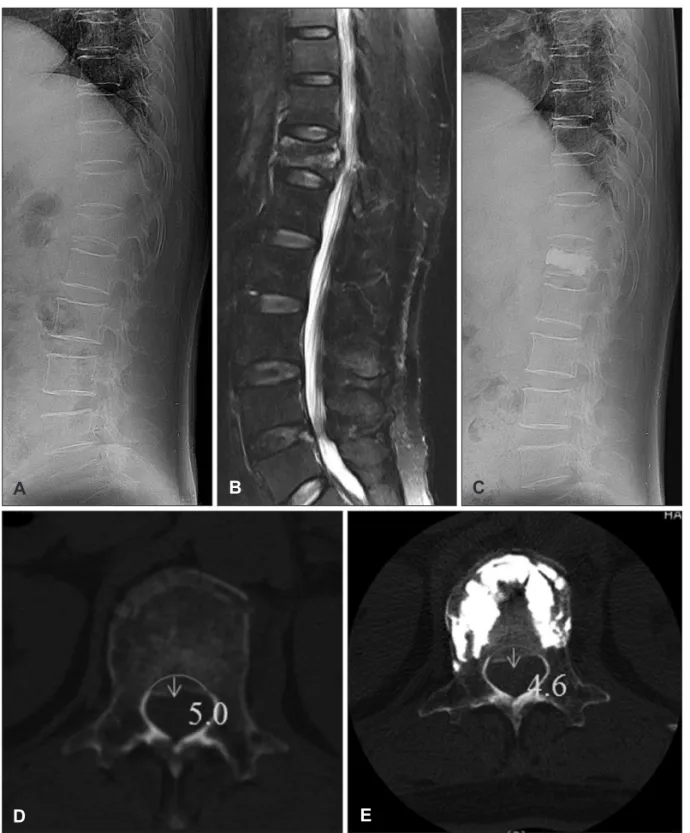
Degree of canal encroachment was measured as the distance between the imaginary line along the posterior margin of the bony fragment and the maximal anterior imaginary line of the spinal canal in the axial CT scan.
Results: This study was based on 10 patients (1 male and 9 female; age range, 52-89 years; mean age, 75 years). The mean decrease in the compression rate of the vertebral body height was 14.4% (43.4% to 29%). The mean decrease in the kyphotic angle was 4.3° (11.7° to 7.4°). The mean preoperative canal encroachment were 3.5 mm and postoperative canal encroach- ment was 3.7 mm, respectively. The mean preoperative VAS score was 4.3 and postoperative VAS score was 1.4.
Conclusion: Vertebroplasty can be a safe treatment option for osteoporotic burst fractures with preoperative minimal canal encroachment.
(Korean J Neurotrauma 2012;8:64-67) KEY WORDS: Vertebroplasty ㆍSpinal injuries ㆍOsteoporotic fractures ㆍKyphosis ㆍSpinal canal.
Received: March 2, 2012 / Revised: April 4, 2012 Accepted: April 6, 2012
Address for correspondence: Je Hoon Jeong, MD, PhD Department of Neurosurgery, Hangang Sacred Heart Hospital, College of Medicine, Hallym University, 94-200 Yeongdeungpo- dong, Yeongdeungpo-gu, Seoul 150-719, Korea
Tel: +82-2-2639-5650, Fax: +82-2-2676-7020 E-mail: [email protected]
online©MLComm
www.neurotrauma.or.kr 65
Ji Won Choi, et al.
croachment and bone mineral density lower than -3.0.
Exclusion criteria included pathological fractures, unstable vertebral fractures involving the posterior column, and se- vere neurological deficits.
Patients under 80 years old were treated with postural reduction preoperatively during about 2 weeks but patients over 80 years old were performed vertebroplasty immedi-
ately after the onset. Pre- and postoperative computed to- mography (CT) was performed in all patients. After discharge, X-ray follow up was done in the outpatient office. We re- viewed the radiological and clinical data retrospectively.
Vertebroplasty technique
The patients were placed in a prone position. An 11-G
FIGURE 1. A: 73-year-old female patient had a burst fracture of T12 on initial plain film. B: magnetic resonance image T2 weighted image shows the collapsed vertebra with canal encroachment. C: After the percutaneous vertebroplasty, the height of the vertebral body was increased and kyphotic angle was decreased. D: Encroachment of the bone fragment was measured in the axial plane by using a distance from the line between the posterior margin of the bony fragment and maximal anterior imaginary line of the spi- nal canal in axial computed tomography scan. E: After the percutaneous vertebroplasty, there is no exacerbation with canal encroach- ment.
D E
A B C
66 Korean J Neurotrauma 2012;8:64-67
Vertebroplasty for the Treatment of the Burst Factures with Spinal Canal Encroachment
vertebroplasty needle was inserted via a transpedicular ap- proach by using Siremobil Iso-C3D (Siemens Medical So- lutions, Erlangen, Germany). The needle tip was placed at the anterior one third of the vertebral body. Once the nee- dle was placed inside the vertebral body, and the liquid and powder component of polymethylmethacrylate (PMMA) were mixed and injected steadily 1.5 cc per 1 min through the needle under fluoroscopic guidance. PMMA was in- jected using uni- or bilateral pedicle needles. After verte- broplasty, the patients were rested in a supine position for 3-4 h.
Radiological assessment
We measured the radiological changes by pre- and post- operative simple X-ray and three dimensional computed tomography. Degree of canal encroachment was measured as the distance between the imaginary line along the pos- terior margin of the bony fragment and the maximal ante- rior imaginary line of the spinal canal in the axial CT scan (Figure 1). We also measured the vertebral body height in the anterior portions of the vertebra and the wedge angle in the midsagittal plane, as previously described.11,12)
Results
Ten consecutive patients (9 women and 1 man) with frac- tured vertebrae were treated using vertebroplasty. The av- erage age of these patients was 75.1 years (range, 52-89 years). The mean T score was -3.64. The following verte- brae levels were treated with vertebroplasty for spinal ca- nal encroachment: T12 (n=4), L1 (n=3), L2 (n=1), L3 (n=1), and L4 (n=1). The average amount of PMMA injected into these levels was 5.0 mL (range, 3-10 mL).
After the procedure, all the patients reported an improve- ment in the pain and no aggravation of neurological deficit.
The mean preoperative Visual Analog Scale (VAS) score was 4.3 (range, 3-5), while that postoperative VAS score was 1.4 (range, 1-2).
The mean compression rate of the vertebral body height decreased from 43.4% before to 29% after vertebroplasty (mean decrease, 14.4%). Furthermore, the mean kyphotic angle decreased from 11.7° before to 7.4° after vertebro- plasty (mean decrease, 4.3°). The mean preoperative spinal
canal encroachment were 3.5 (range 2.3-5.4) and postop- erative spinal canal encroachment was 3.7 (range 1-5.4) mm (Table 1).
The follow-up period ranged from 2 to 38 months (mean, 13 months). After vertebroplasty, complications such as clinical sequelae that require surgical intervention or exac- erbate the neurological condition were not observed.
Discussion
Percutaneous vertebroplasty involves percutaneous injection of PMMA or bone cement into a diseased verte- bra. The use of vertebroplasty in the treatment of benign or malignant disease has been widely reported.4,19,27) The effectiveness of percutaneous vertebroplasty in alleviating pain has been discussed comprehensively.6,17) In our study, all the patients experienced an improvement in the pain.
The mean VAS score before vertebroplasty was 4.3 (range, 3-5), whereas that after vertebroplasty was 1.4 (range, 1-2).
Vertebroplasty has an extra benefit, in that it allows res- toration of some of the lost vertebral body height and im- proves the kyphotic angle.2,8,11,15,18,24) Many previous studies have reported an increase in the vertebral body height after vertebroplasty,11,18,24) and many clinical studies also have re- ported that burst fracture reduction was the most consistent predictor of a satisfactory outcome.7)
Cement leakage is the one of the serious potential com- plication of vertebroplasty, which can result in major com- plications, such as spinal cord compression and paraplegia requiring emergent decompression.3,10,23,25) In especially, there are more risks of leakage in burst fracture with sepa- rated fragment or endplate fracture, such as our cases. Since PMMA tends to flow to the area of least resistance, creating a cavity within the fractured vertebra enables low-pressure injection, thus theoretically reducing this risk. We used the preoperative postural reduction to expand the collapsed ver- tebral fractures for the acquisition of more additional space of the bone cement. Another precautionary measure is con- tinuous fluoroscopy during cement injection. If the PMMA seems to be nearing the posterior vertebral cortex, further injection is aborted.21)
Because the vertebroplasty procedure involves the injec- TABLE 1. Mean vertebral body height, kyphotic angle, canal encroachment, Visual Analog Scale (VAS) score changes
Compression rate of vertebral body (%) Kyphotic angle (°) Canal Encroachment (mm) VAS score
Preoperative -43.4 11.7 +3.5 -4.3
Postoperative -29 7.4 +3.7 -1.4
Changes -14.4 -4.3 +0.2 -2.9
www.neurotrauma.or.kr 67
Ji Won Choi, et al.
tion of a large amount of PMMA, this procedure carries a risk of exacerbating the spinal canal encroachment.4,10,22) Therefore, spinal canal encroachment and spinal cord com- pression have been cited as relative contraindications by pre- vious literature.13,20,26) For this reason, surgeons are reluctant to perform vertebroplasty in patients with osteoporotic burst fractures accompanied with spinal canal encroachment.
In our study, the mean spinal canal encroachment before and after vertebroplasty, was 3.5 mm and 3.7 mm, respectively.
Vertebroplasty did not exacerbate the canal encroachment that required surgical intervention. We think that obtain- ing stable space for bone cement injection by preopera- tive postural reduction and steady PMMA injection (1.5 cc per 1 minute) are important.
Although good postoperative result of this study, it has many limitations such as short follow up period, small pa- tients, no follow up computed tomography. Therefore, we think that further study with long term follow up and large population is needed.
Conclusion
In this study, the authors safely performed vertebroplas- ty in patients with 5 to 20% preoperative canal encroach- ment. Therefore, vertebroplasty might be a safe treatment option for burst fractures accompanied with mild preoper- ative canal encroachment and no neurological deficit.
■ The authors have no financial conflicts of interest.
REFERENCES
1) Appel NB, Gilula LA. Percutaneous vertebroplasty in patients with spinal canal compromise. AJR Am J Roentgenol 182:947-951, 2) Carlier RY, Gordji H, Mompoint DM, Vernhet N, Feydy A, Vallée 2004 C. Osteoporotic vertebral collapse: percutaneous vertebroplasty and local kyphosis correction. Radiology 233:891-898, 2004 3) Chen YJ, Tan TS, Chen WH, Chen CC, Lee TS. Intradural cement
leakage: a devastatingly rare complication of vertebroplasty. Spine (Phila Pa 1976) 31:E379-E382, 2006
4) Cotten A, Boutry N, Cortet B, Assaker R, Demondion X, Leblond D, et al. Percutaneous vertebroplasty: state of the art. Radiographics 18:311-320; discussion 320-323, 1998
5) Cotten A, Dewatre F, Cortet B, Assaker R, Leblond D, Duques- noy B, et al. Percutaneous vertebroplasty for osteolytic metastases and myeloma: effects of the percentage of lesion filling and the leakage of methyl methacrylate at clinical follow-up. Radiology 200:525-530, 1996
6) Deramond H, Depriester C, Galibert P, Le Gars D. Percutaneous vertebroplasty with polymethylmethacrylate. Technique, indica- tions, and results. Radiol Clin North Am 36:533-546, 1998 7) Dimar JR 2nd, Wilde PH, Glassman SD, Puno RM, Johnson JR.
Thoracolumbar burst fractures treated with combined anterior and posterior surgery. Am J Orthop (Belle Mead NJ) 25:159-165,
8) Dublin AB, Hartman J, Latchaw RE, Hald JK, Reid MH. The ver-1996 tebral body fracture in osteoporosis: restoration of height using percutaneous vertebroplasty. AJNR Am J Neuroradiol 26:489- 492, 2005
9) Galibert P, Deramond H, Rosat P, Le Gars D. [Preliminary note on the treatment of vertebral angioma by percutaneous acrylic vertebroplasty]. Neurochirurgie 33:166-168, 1987
10) Harrington KD. Major neurological complications following per- cutaneous vertebroplasty with polymethylmethacrylate: a case report. J Bone Joint Surg Am 83-A:1070-1073, 2001
11) Hiwatashi A, Moritani T, Numaguchi Y, Westesson PL. Increase in vertebral body height after vertebroplasty. AJNR Am J Neuroradiol 24:185-189, 2003
12) Hiwatashi A, Sidhu R, Lee RK, deGuzman RR, Piekut DT, Westesson PL. Kyphoplasty versus vertebroplasty to increase ver- tebral body height: a cadaveric study. Radiology 237:1115-1119, 13) Jensen ME, Dion JE. Percutaneous vertebroplasty in the treatment 2005 of osteoporotic compression fractures. Neuroimaging Clin N Am 10:547-568, 2000
14) Kallmes DF, Jensen ME. Percutaneous vertebroplasty. Radiology 229:27-36, 2003
15) Lee ST, Chen JF. Closed reduction vertebroplasty for the treatment of osteoporotic vertebral compression fractures. Technical note. J Neurosurg 100(4 Suppl Spine):392-396, 2004
16) Martin JB, Jean B, Sugiu K, San Millán Ruíz D, Piotin M, Mur- phy K, et al. Vertebroplasty: clinical experience and follow-up re- sults. Bone 25(2 Suppl):11S-15S, 1999
17) Mathis JM, Petri M, Naff N. Percutaneous vertebroplasty treat- ment of steroid-induced osteoporotic compression fractures.
Arthritis Rheum 41:171-175, 1998
18) McKiernan F, Jensen R, Faciszewski T. The dynamic mobility of vertebral compression fractures. J Bone Miner Res 18:24-29, 2003 19) Peh WC, Gilula LA, Peck DD. Percutaneous vertebroplasty for se- vere osteoporotic vertebral body compression fractures. Radiology 223:121-126, 2002
20) Peters KR, Guiot BH, Martin PA, Fessler RG. Vertebroplasty for osteoporotic compression fractures: current practice and evolving techniques. Neurosurgery 51(5 Suppl):S96-S103, 2002 21) Rahamimov N, Mulla H, Shani A, Freiman S. Percutaneous aug-
mented instrumentation of unstable thoracolumbar burst fractures.
Eur Spine J 21:850-854, 2012
22) Ratliff J, Nguyen T, Heiss J. Root and spinal cord compression from methylmethacrylate vertebroplasty. Spine (Phila Pa 1976) 26:E300-E302, 2001
23) Teng MM, Cheng H, Ho DM, Chang CY. Intraspinal leakage of bone cement after vertebroplasty: a report of 3 cases. AJNR Am J Neuroradiol 27:224-229, 2006
24) Teng MM, Wei CJ, Wei LC, Luo CB, Lirng JF, Chang FC, et al. Ky- phosis correction and height restoration effects of percutaneous vertebroplasty. AJNR Am J Neuroradiol 24:1893-1900, 2003 25) Tsai TT, Chen WJ, Lai PL, Chen LH, Niu CC, Fu TS, et al. Poly-
methylmethacrylate cement dislodgment following percutaneous vertebroplasty: a case report. Spine (Phila Pa 1976) 28:E457-E460, 26) Watts NB, Harris ST, Genant HK. Treatment of painful osteopo-2003 rotic vertebral fractures with percutaneous vertebroplasty or ky- phoplasty. Osteoporos Int 12:429-437, 2001
27) Weill A, Chiras J, Simon JM, Rose M, Sola-Martinez T, Enkaoua E. Spinal metastases: indications for and results of percutaneous injection of acrylic surgical cement. Radiology 199:241-247, 1996