Unilateral absence of the submandibular glands (SMG aplasia) is rare, with only a few reported cases. A thy- roglossal duct cyst (TGDC) with unilateral SMG aplasia is very rare, especially when there is a correlation be- tween the TGDC and an ectopic SMG.
We report a case of unilateral SMG aplasia with TGDC. This case is unique because there TGDC might have developed as an ectopic SMG with the unilateral SMG aplasia in the same side.
Case Report
A 48-year-old man with an anterior neck mass, diag- nosed as a thyroglossal duct cyst (TGDC), was referred to our hospital. His chief complaint was mild postpran-
dial swelling of the cystic mass. Clinical examination of the oral cavity, oropharynx, and larynx was normal and no other mass was palpated in the neck. The mass in the anterior neck was soft on palpation and moved on swal- lowing. There was a palpable submandibular gland (SMG) on the right, but no palpable gland on the left on bimanual examination. No abnormalities were seen on the mouth floor, although slight swelling was observed in the left sublingual gland region, as compared to the right. No salivary flow was seen from the left Wharton’s duct orifice in the mouth floor. Enhanced neck comput- ed tomography (CT) demonstrated a 1.5 × 1.5 cm cystic mass in the left neck, below the hyoid bone and anterior to the thyroid cartilage (Fig. 1). The results of the clinical exam and CT of the neck were compatible with a TGDC. The TGDC was located on the superior part of the thyroid cartilage and there was no sign of adhesion to the thyroid cartilage or hyoid bone.
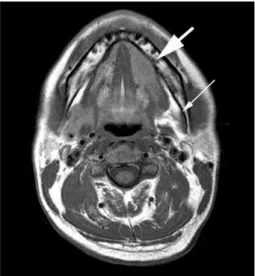
On subsequent magnetic resonance imaging (MRI), the left submandibular gland was absent and there was ipsilateral sublingual gland hypertrophy. The left sub- mandibular space was replaced with fatty tissue (Fig. 2).
In addition, left SMG aplasia and TGDC were seen, with fluid enhancement in the TGDC (Fig. 3). We rec-
J Korean Soc Radiol 2010;62:519-521
─ 519 ─
Unilateral Submandibular Gland Aplasia with a Thyroglossal Duct Cyst
1Soek Ki Lee, M.D., Ph.D., Eui-Cheol Nam, M.D., Ph.D., Sam Soo Kim, MD, Ph.D.2
1Department of Otolaryngology, Kangwon National University Hospital, School of Medicine, Kangwon National University, Korea
2Department of Radiology, Kangwon National University Hospital, School of Medicine, Kangwon National University, Korea
Received November 23, 2009 ; Accepted February 21, 2010
Address reprint requests to : Eui-Cheol Nam, M.D., Department of Otolaryngology, Kangwon National University Hospital, School of Medicine, Kangwon National University, Chuncheon-si, Gangwon-do 200-701, Korea.
Tel. 82-33-258-2311 Fax. 82-33-255-8809 E-mail: [email protected]
The congenital absence of the submandibular gland is very uncommon, and might occur in association with other developmental abnormalities. Unilateral aplasia is re- ported more infrequently because it is usually asymptomatic, whereas the bilateral form often presents as xerostomia, dysphagia, and frequent dental caries because of decreased salivary flow. Submandibular gland aplasia with a concurrent thyroglossal duct cyst (TGDC) has not been reported. We report a case of unilateral submandibular aplasia that might be associated with a TGDC.
Index words :Thyroglossal duct cyst Submandibular gland
ommended surgical excision of the TGDC to evaluate the relationship to the SMG aplasia, but the patient re- fused any further study, including fine needle aspiration biopsy (FNAB) to diagnose salivary fluid or tissue, or surgical removal.
Discussion
Development of the submandibular salivary glands is first visible as a thickening of the epithelium next to the tongue around the prebud stage. The main duct of the salivary gland is visible as a slight dimple on the oral surface, where lumen formation has already begun. The parotid, submandibular, and sublingual glands appear during the 4th, 6th, and 9th weeks of gestation, respec- tively. The aplasia of the SMG is likely to be due to ar- rest in organogenesis.
In our patient, no accompanying anomalies were seen other than mild postprandial swelling of a TGDC. He al- so had ipsilateral compensatory sublingual hypertrophy, which is seen in many cases of unilateral SMG aplasia.
He complained only of dryness of the mouth, but had no difficulty chewing or swallowing or increased inci- dence of dental caries, which are thought to be due to the reduction in the protective effect of saliva within the oral cavity.
Salivary gland aplasia may be associated with first branchial arch defects in Treacher-Collins syndrome (mandibulofacial dysostosis) or orbital abnormalities like lacrimal hypoplasia, canalicular atresia, and ab-
sence of the lacrimal puncta (1). Anomalies of the sub- mandibular glands and ducts can appear as ranula and epidermal/dermal inclusion cysts (2). Congenital dilation of the submandibular duct can appear as a mucocele, ranula, dermoid and epidermoid cyst, TGDC, or branchial cleft cyst (BCC) (3). In all these cases, no sub- mandibular tissue is detected in the cystic lesions. That is, SMG duct dilation is seen only as cystic lesions and the dilation is located closer to the submandibular area than the common location of a TGDC or other cystic le- sions.
Based on these clues, there was little possibility of a relationship between the SMG and TGDC, especially
Soek Ki Lee, et al: Unilateral Submandibular Gland Aplasia with a Thyroglossal Duct Cyst
─ 520 ─ Fig. 1. The thyroglossal duct cyst (TGDC) is seen as a well-de- fined cystic mass (arrow) below the hyoid bone on enhanced CT (axial view). The TGDC is located above the left thyroid gland lobe and superior thyroid cartilage. There is no adhesion between the TGDC and surrounding structure.
Fig. 2. The axial T1-weighted MRI image of the mouth floor shows aplasia of the left SMG (thin arrow) and compensatory hyperplasia of the left sublingual gland (thick arrow).
Fig. 3. The coronal T2-weighted MRI image of the anterior neck shows aplasia of the left SMG (arrow) while a left TGDC manifests as an anterior cystic neck mass (circle).
without being able to conduct other examinations, in- cluding a biopsy. No cases of unilateral SMG aplasia with a TGDC have been reported.
There are two possible mechanisms for postprandial TGDC swelling in unilateral SMG aplasia. First, salivary flow from the normal SMG may enter the foramen ce- cum and pass into the TGDC, resulting in TGDC swelling after a meal. Second, postprandial saliva-pro- ducing stimulation might occur in the TGDC, resulting in TGDC swelling if it contains ectopic SMG tissue.
Therefore, we still suspected a relationship between the TGDC and ectopic SMG, although it is possible that a TGDC might be found incidentally in a case of SMG aplasia. The clue suggesting that the TGDC in our case was an ectopic SMG was the postprandial swelling, we think that the possibility of a TGDC arising from an ec- topic SMG is small. Although we did not perform surgery to identify the TGDC as an ectopic SMG, we cannot exclude the possibility of a close relationship be-
tween the TGDC and an ectopic SMG. Moreover, if a patient with ipsilateral SMG aplasia complained of post- prandial swelling of a concurrent TGDC, we would sus- pect that the TGDC might have arisen as an ectopic SMG with an abnormal path of Wharton’s duct or duct obstruction.
If a patient is seen complaining of postprandial TGDC swelling, further radiological evaluation, such as CT or MRI, with a biopsy or surgery, are necessary to identify any ectopic SMG.
References
1. Srinivasan A, Moyer JS, Mukherji SK. Unilateral submandibular gland aplasia associated with ipsilateral sublingual gland hypertro- phy. AJNR Am J Neuroradial 2006;27(10):2214-2216
2. Pal K, Abdulla AM. Congenital imperforate submandibular duct in a newborn. Indian J Pediatr 2007;74(7):687-688
3. Addante RR. Congenital cystic dilatation of the submandibular duct. Oral Surg Oral Med Oral Pathol 1984;58(6):656-658
J Korean Soc Radiol 2010;62:519-521
─ 521 ─
대한영상의학회지 2010;62:519-521
갑상설골 낭종을 동반한 편측 악하선 무형성증1
1강원대학교 의학전문대학원 이비인후과학교실
2강원대학교 의학전문대학원 영상의학교실
이석기∙남의철∙김삼수2
악하선의 선천적 무형성증은 아주 드문 질환이며 특히 다른 발생학적 이상과 동반되는 경우는 더욱 드물다. 악하 선의 양측 무형성증인 경우 타액 감소로 인한 구강 건조증, 연하 곤란 및 충치등의 증상을 보이는 반면 편측 무형성 증은 무증상인 경우가 많아 발견되는 빈도가 더욱 적다. 또한 갑상설골 낭종을 동반한 악하선의 부재는 아직 보고된 적이 없어 이에 저자들은 갑상설골 낭종을 동반한 편측 악하선 무형성증에 대한 증례를 보고하고자 한다.