© 2010 The Korean Academy of Medical Sciences.
This is an Open Access article distributed under the terms of the Creative Commons Attribution Non-Commercial License (http://creativecommons.org/licenses/by-nc/3.0) which permits unrestricted non-commercial use, distribution, and reproduction in any medium, provided the original work is properly cited.
pISSN 1011-8934 eISSN 1598-6357
Traumatic Cervical Cord Transection without Facet Dislocations- A Proposal of Combined Hyperflexion-Hyperextension
Mechanism: A Case Report
A patient is presented with a cervical spinal cord transection which occurred after a motor vehicle accident in which the air bag deployed and the seat belt was not in use. The patient had complete quadriplegia below the C5 level and his imaging study showed cervical cord transection at the level of the C5/6 disc space with C5, C6 vertebral bodies and laminar fractures. He underwent a C5 laminectomy and a C4-7 posterior fusion with lateral mass screw fixation. Previous reports have described central cord syndromes occurring in hyperextension injuries, but in adults, acute spinal cord transections have only developed after fracture-dislocations of the spine. A case involving a post-traumatic spinal cord transection without any evidence of radiologic facet dislocations is reported. Also, we propose a combined hyperflexion-hyperextension mechanism to explain this type of injury.
Key Words: Cervical Trauma; Spinal Cord Injuries Yoo-Hyun Cha, Tai-Hyoung Cho,
and Jung-Keun Suh
Department of Neurosurgery, Korea University College of Medicine, Seoul, Korea
Received: 20 August 2009 Accepted: 30 September 2009 Address for Correspondence:
Jung-Keun Suh, M.D.
Department of Neurosurgery, Korea University Anam Hospital, Korea University College of Medicine, 73 Inchon-ro, Seongbuk-gu, Seoul 136-701, Korea
Tel: +82.2-920-5729, Fax: +82.2-929-0629 E-mail: [email protected]
DOI: 10.3346/jkms.2010.25.8.1247 • J Korean Med Sci 2010; 25: 1247-1250
CASE REPORT
Neuroscience
INTRODUCTION
Traumatic spinal cord transection is uncommon. In a study of 62 patients with spinal cord injuring who underwent magnetic resonance imaging (MRI), 7 had cord transections (1). In con- trast to children in who closed spinal cord trauma may occur in the absence of skeletal injury, most cord injuries in adults are associated with major musculoskeletal injuries, such as verte- bral fractures and/or dislocations (2-6). In the subaxial cervical spine, hyperextension injuries without facet dislocations are well known as central cord syndromes, but cervical cord tran- section has not been described in the literature (7-10).
We report a patient with a cervical cord transection in the ab- sence of a vertebral dislocation secondary to air bag deployment without the use of a seat belt and discuss the mechanism of this type of injury.
CASE REPORT
A 33-yr-old male was admitted through the emergency room with neck pain, and loss of sensation and inability to move all four extremities. He had crashed his car into the post of a traffic signal, was not wearing a seat belt, and the front air bag deployed.
On neurologic examination, the patient had flaccid paralysis of all four extremities, a sensory level at C4, no sphincter control or rectal tone, an absent anal wink, no sacral sparing, and a pos- itive bulbocavernosus reflex. He was fully alert with mild hypo-
tension (systolic arterial pressure <100 mm Hg). No gross wounds were observed on close inspection of the entire body.
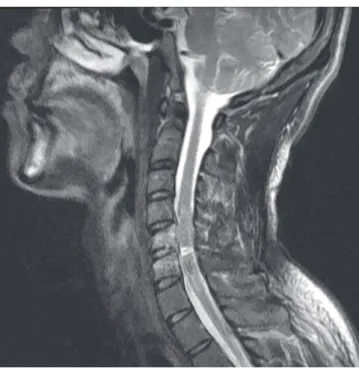
Plain radiographic evaluation of his cervical spine showed C5, C6 wedge compression fractures and minimal C5 retrolisthesis on C6 (Fig. 1). A computed tomographic (CT) scan also dem- onstrated C5, C6 vertebral body vertical fractures with laminar fractures, and a C3 spinous process fracture (Fig. 2). The frac- tured C5 lamina was depressed into the spinal canal through the lamina-facet junctions. The C5/6 facet joints were intact. A MRI revealed a linear area of abnormal signal intensity running horizontally through the spinal cord at the C5-6 disc space level, which was thought to represent a spinal cord transaction (Fig. 3).
The patient had no brain, thoracic, or abdominal abnormalities on plain films and CT scans.
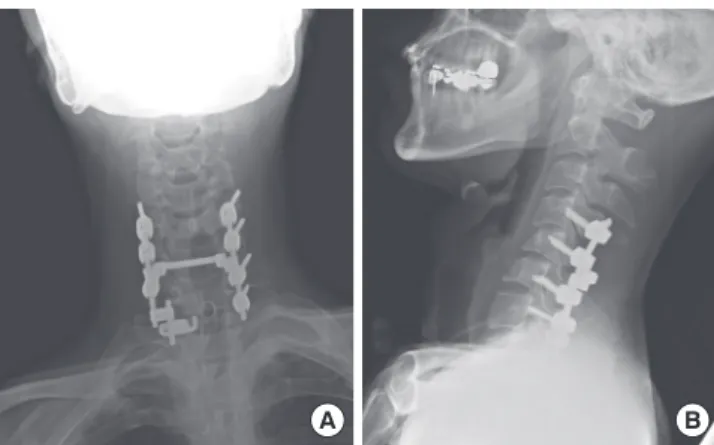
The patient underwent surgery via a posterior approach 5 days after his injury. A C5 laminectomy with a posterior fusion and lateral mass screw fixation at the C4-C7 levels was performed (Fig. 4). During this procedure, disruption of the C4-5 supraspi- nous and interspinous ligaments were noted, but the facet joint capsules were intact at the C4-C7 levels in the operative field.
He was transferred to the rehabilitation department 1 month post-operatively and no neurologic improvement had been ob- served 4 months after the injury.
DISCUSSION
There have been no reports of traumatic spinal cord transections
Cha Y-H, et al. • Cervical Cord Transection without Facet Dislocations
1248 http://jkms.org DOI: 10.3346/jkms.2010.25.8.1247
in adults other than fracture-dislocation injuries in the subaxial spine. Although Berlot et al. (11) described a delayed post-trau- matic cervical cord transection in a spinal cord injury without radiologic abnormalities (SCIWORA), the initial MRI revealed only focal swelling of the spinal cord and several patch areas of cord contusions; indeed, an initial incomplete lesion may have progressed to transection in the absence of fixation.
Our patient’s injury appeared to have occurred when his torso overrode the air bag, which resulted in acute hyperextension of
Fig. 1. C5 and C6 wedge compression fractures with minimal C5 retroli
sthesis on C6 are reveal
ed on a plain lateral cer
vical film, but there is no evidence of disloca
tion of the facet joints.
Fig. 2. Cervical spine computed tomographic (CT) scans with 3dimensional (3D) reconstruction. (A) C5 and C6 vertebral bodies show vertical fracture centrums in a coronally reconstructed image. (B) Only subtle C5 retro
listhesis on C6 is noted on a sagittally reconstructed image. A C3 spinous process fracture is also identified.
(C) The axial section of the C5 vertebra at the pedicle level shows a depressed laminar fracture. (D) The frac
ture lines of the C5 lamina are through the laminafacet junction. The C5/6 facet joints are intact. (E) 3D recon
structed image shows a C5 lamina depressed fracture through the laminafacet junction.
A
D
B
E
C Fig. 3. T2weighted magnetic resonance image reveals a horizontal line of high signal intensity in the cervical spinal cord at the C5/6 disc space level which represents spinal cord transection. Severe cord swelling around the injured level and edema of the C5, C6 vertebral bodies are also noted.
Cha Y-H, et al. • Cervical Cord Transection without Facet Dislocations
http://jkms.org 1249
DOI: 10.3346/jkms.2010.25.8.1247
the cervical spine. This potential mechanism has been shown in crash simulations using human cadavers and dummies posi- tioned opposite airbags when unbelted (12). But in such simu- lations, the velocities were between 32 and 48 km/hr. The veloc- ity in our patient was more than 60 km/hr, so a more extreme hyperextension injury may have occurred. During the episode of hyperextension, rupture of the anterior longitudinal ligament and the disc caused marked backward displacement of the C5 vertebral body against the cord (13). Also, our patient had a C5 laminar fracture, which may have exacerbated the hyperexten- sion and posterior displacement. Although there was no facet disruption, this circumstance could result in a C5/6 spinal cord transection. Because the spine returned to its normal position by the elastic recoil of the vertebral muscles when the head is in the neutral position or in flexion (14), subtle C5 retrolisthesis on C6 was just observed in post-traumatic radiologic studies.
The above mechanism of injury could explain the cord tran- section and injuries involving the posterior vertebral column.
However, C5, C6 vertebral body fractures are unresolved. Accord- ing to Allen’s classification of subaxial cervical fractures and dis- locations (15), our patent’s injury was a distractive extension stage 2 lesion. In this type of injury, however, there was no co-existing vertical fracture centrum. Therefore, we propose the hypothesis that during the initial short moment of the collision, the airbag was just in contact with the torso, but not with the face of the patient. As a result, compressive flexion force interacted at the cervical spine, resulting in C5, C6 vertebral body fractures. This hypothesized mechanism is summarized in Fig. 5.
The course of treatment in this patient is of less interest than the proposed mechanism of injury. Distractive extension stage 2 lesions must be surgically stabilized, usually with an anterior approach. However, in the presence of cord involvement by lam- inar fragments with preservation of lordotic sagittal alignment, a posterior approach is also useful (16). In this case report, the patient underwent a posterior fusion and lateral mass screw fixa- tion. Four months after the operation, no cervical instability was
A B
Fig. 4. Plain radiographic flims 4 months postoperatively. The right C7 lateral mass was cleaved during the screw insertion, so a lamina hook was used. (A) Anterior
posterior view. (B) Lateral view.
A B
Fig. 5. Summarization of the hypothesized mechanism of the injury. (A) During the initial short moment of the collision, the airbag is just in contact with the torso, but not with the face of the patient. As a result, compressive flexion force interacts at the cervical spine, resulting in C5, C6 vertebral body fractures. (B) In the late stage, the patient override the airbag, which causes him to hit his head on the roof and windshield of the vehicle, resulting in acute cervical hyperextension. The spinal cord transection occurs by posterior displacement of the C5 vertebral body against the cord in this powerful distractive extension injury.
observed while the patient ambulated in a wheelchair. Although there is a constant search for ways and means to enhance re- covery of spinal cord injury, this patient’s prognosis is very poor.
According to data of the Model Spinal Cord Injury Systems (17), 94.4% of patients with neurological complete spinal cord inju- ries remained so at the 5-yr post-injury evaluation. Neverthe- less, Kirshblum et al. reported approximately 20% showed some improvement in motor power and neurologic level of injury from year 1 to year 5 (18). Therefore medical rehabilitation service should be provided sufficiently and continuously for the sake of this patient’s recovery.
Although this report describes just a single case of spinal cord transection by motor vehicle accident, it emphasizes the impor- tance of proper use of seat belts especially in the circumstance of airbag deployment. The authors’ proposed hyperflexion-hy- perextension mechanism can result in significant neurologic deficits, but subtle radiographic abnormalities might be seen on plain films. So clinicians in emergency centers should have the possibility of cord transection in the acutely injured patient in mind because it is important for both prognostic and thera- peutic reasons.
REFERENCES
1. Kalfas I, Wilberger J, Goldberg A, Prostko ER. Magnetic resonance imag- ing in acute spinal cord trauma. Neurosurgery 1988; 23: 295-9.
2. Crenshaw AH Jr, Wood GW 2nd, Wood MW Jr, Ray MW. Fracture and dislocation of the fourth and fifth cervical vertebral bodies with transec- tion of the spinal cord. Clin Orthop Relat Res 1989: 248: 158-62.
3. Deeb ZL, Rothfus WE, Goldberg AL, Daffner RH. Absent cord sign in acute spinal trauma. Clin Imaging 1990; 14: 138-42.
4. Fasano FJ Jr, Stauffer ES. Traumatic division of the spinal cord demon- strated by magnetic resonance imaging. Report of two cases. Clin Orthop
Cha Y-H, et al. • Cervical Cord Transection without Facet Dislocations
1250 http://jkms.org DOI: 10.3346/jkms.2010.25.8.1247
Relat Res 1988; 233: 168-70.
5. Mendelsohn DB, Zollars L, Weatherall PT, Girson M. MR of cord tran- section. J Comput Assist Tomogr 1990; 14: 909-11.
6. Chieregato A. High cervical spinal cord complete transection. Arch Neu- rol 2008; 65: 1126.
7. Aarabi B, Koltz M, Ibrahimi D. Hyperextension cervical spine injuries and traumatic central cord syndrome. Neurosurg Focus 2008; 25: E9.
8. Bicknell JM, Fielder K. Unrecognized incomplete cervical spinal cord in- jury: review of nine new and 28 previously reported cases. Am J Emerg Med 1992; 10: 336-43.
9. Epstein N, Epstein JA, Benjamin V, Ransohoff J. Traumatic myelopathy in patients with cervical spinal stenosis without fracture or dislocation:
methods of diagnosis, management, and prognosis. Spine (Phila Pa 1976) 1980; 5: 489-96.
10. Schneider RC, Cherry G, Pantek H. The syndrome of acute central cervi- cal spinal cord injury; with special reference to the mechanisms involved in hyperextension injuries of cervical spine. J Neurosurg 1954; 11: 546-77.
11. Berlot G, Viviani M, Gullo A, Magnaldi S. Delayed traumatic cervical cord transection. Am J Emerg Med 1995; 13: 101-3.
12. Crandall JR, Kuhlmann TP, Pilkey WD. Air and knee bolster restraint
system: laboratory sled tests with human cadavers and the Hybrid III dummy. J Trauma 1995; 38: 517-20.
13. Pang D, Pollack IF. Spinal cord injury without radiographic abnormality in children--the SCIWORA syndrome. J Trauma 1989; 29: 654-64.
14. Taylor AR. The mechanism of injury to the spinal cord in the neck with- out damage to vertebral column. J Bone Joint Surg Br 1951; 33-B: 543-7.
15. Allen BL Jr, Ferguson RL, Lehmann TR, O’Brien RP. A mechanistic clas- sification of closed, indirect fractures and dislocations of the lower cervi- cal spine. Spine (Phila Pa 1976) 1982; 7: 1-27.
16. Dvorak MF, Fisher CG, Fehlings MG, Rampersaud YR, Oner FC, Aarabi B, Vaccaro AR. The surgical approach to subaxial cervical spine injuries:
an evidence-based algorithm based on the SLIC classification system.
Spine (Phila Pa 1976) 2007; 32: 2620-9.
17. Lim PA, Tow AM. Recovery and regeneration after spinal cord injury: a review and summary of recent literature. Ann Acad Med Singapore 2007;
36 (1): 49-57.
18. Kirshblum S, Millis S, McKinley W, Tulsky D. Late neurologic recovery after traumatic spinal cord injury. Arch Phys Med Rehabil 2004; 85:
1811-7.