481
총 설
©The Korean Society of Food Science and Technology
Toll-like receptors
신호전달체계 조절을 통한
resveratrol,
(-)-epigallocatechin-3-gallate, curcumin
의 항염증 효과
윤 형 선*
순천향대학교 의료과학대학 임상병리학과
Anti-inflammatory Effects of Resveratrol, (-)-Epigallocatechin-3-gallate and
Curcumin by the Modulation of Toll-like Receptor Signaling Pathways
Hyung-Sun Youn*
Department of Biomedical Laboratory Science, College of Medical Sciences, Soonchunhyang University
Abstract
Toll-like receptors (TLRs) induce innate immune responses that are essential for host defenses against invading
microbial pathogens, thus leading to the activation of adaptive immune responses. In general, TLRs have two major
downstream signaling pathways: the MyD88- and TRIF-dependent pathways, which lead to the activation of NF-
κB and
IRF3. Numerous studies have demonstrated that certain phytochemicals possessing anti-inflammatory effects inhibit NF-
κB
activation induced by pro-inflammatory stimuli, including lipopolysaccharides and TNF
α. However, the direct molecular
targets for such anti-inflammatory phytochemicals have not been fully identified. Identifying the direct targets of
phytochemicals within the TLR pathways is important because the activation of TLRs by pro-inflammatory stimuli can induce
inflammatory responses that are the key etiological conditions in the development of many chronic inflammatory diseases. In
this paper, we discuss the molecular targets of resveratrol, (-)-epigallocatechin-3-gallate (EGCG), and curcumin in the TLR
signaling pathways. Resveratrol specifically inhibited the TRIF pathway in TLR3 and TLR4 signaling, by targetting TBK1
and RIP1 in the TRIF complex. Furthermore, EGCG suppressed the activation of IRF3 by targetting TBK1 in the
TRIF-dependent signaling pathways. In contrast, the molecular target of curcumin within the TLR signaling pathways is the receptor
itself, in addition to IKK
β. Together, certain dietary phytochemicals can modulate TLR-derived signaling and inflammatory
target gene expression, and in turn, alter susceptibility to microbial infection and chronic inflammatory diseases.
Key words:
innate immunity, Toll-like receptors, phytochemicals, resveratrol, (-)-epigallocatechin-3-gallate, curcumin, MyD88,
TRIF
서
론
선천성면역(innate immunity) 반응은식물로부터 사람에이르 기까지거의 모든생물체 안에존재하는 숙주의방어 체계이다 (1-3). 선천성면역반응은무척추 동물에있어서는병원균에 대 항하기 위한숙주의 유일한방어 체계이지만, 고등동물에 있어서 는병원균에 대항하기위한 숙주의최초방어체계라 할수있 다. 선천성 면역 반응이 활성화되기 위해서는 다음의 조건들이 만족되어야만 한다. 첫째, 선천성 면역 체계에의해서 인식되어 지는 molecular pattern들은어떤병원균하나만이특별히가지고 있는 구조가아니라 여러병원균들이 공통으로 가지고있는 구 조이어야 한다. 둘째, 이러한 molecular pattern들은 병원체의 생 명을 유지하거나병원성(pathogenicity)을유지하기위해서 필수적 인물질인 만큼변형되어서는 안된다. 셋째, 병원체의 molecularpattern들은숙주의 self antigen들로부터 구별되어야 한다. 즉 선
천성 면역반응을 유도하기 위해서는 숙주가 self antigen들부터
병원체의 nonself antigen들을구별할수있어야만 한다(3). 이러한병원균들이가지고있는 molecular pattern들은 pathogen
associated molecular patterns(PAMPs)라고불리운다(4,5). 선천성면 역반응을 유도하는 PAMPs의 흔한 구조들로는
lipopolysaccha-ride(LPS), peptidoglycan(PGN), lipoteichoic acid(LTA), double stranded RNA(dsRNA), flagellin, unmethylated CpG(cytosine phosphate guanine) DNA 등이있다(4-8). 병원균들의 PAMPs는숙 주안에 있는 pattern recognition receptors(PRR)에의해서 인식되
어지는데, 선천성면역반응을위해서중요한 역할을하는
Toll-like receptors(TLRs)가 PRR역할을 하게된다(4,9,10). Abbreviations: TLRs, Toll-like receptors; PAMP, pathogen
associ-ated molecular patterns; PRR, pattern recognition receptor; LPS, lipopolysaccharide; PGN, peptidoglycan; LTA, lipoteichoic acid; MALP-2, macrophage-activating lipopeptide 2-kDa; Poly[I:C], polyr-iboinosinic polyribocytidylic acid; CpG DNA, cytosine phosphate guanine DNA; MyD88, myeloid differential factor 88; TRIF, TIR domain-containing adapter inducing IFNβ; IFN, interferon; IκB,
inhibitor of kappa B; IKK, IκB kinase; IRAK, IL-1 receptor-associate
kinase; TBK1, TANK-binding kinase 1; RIP1, receptor interacting protein 1; IRF3, IFN-regulatory factor 3; NF-κB, nuclear factor κB;
AP-1, activator protein 1; EGCG, (-)-epigallocatechin-3-gallate; COX-2, cyclooxygenase-2; iNOS, inducible nitric oxide synthase.
*Corresponding author: Hyung-Sun Youn, Department of Biomedical Laboratory Science, College of Medical Sciences, Soonchunhyang Uni-versity, 646 Eupnae-ri, Shinchang-myun, Asan-si, Chungnam 336-745, Korea
Tel: 82-41-530-3086 Fax: 82-41-530-3085 E-mail: [email protected]
러한포유동물이가지고있는 Toll을초파리 Toll과구별하기위하 여 Toll-like receptor라명명하게되었다. 현재까지 13개의 TLRs가 포유동물안에서발견되었으며, 각각의 TLRs은미생물들이가지 고있는서로다른구조를인식하는것으로알려져있다(Fig. 1). TLRs은 광범위하게 MyD88-과 TRIF-dependent 신호전달 체 계를 가지고 있다. TLRs은여러병원균들에의한첫번째반응으로서 dimerization 을 형성하는 것으로 알려져 있다(5). TLR4는 다른 TLR4와 homodimerization을형성해서 LPS를인식하고(16), TLR2는 TLR1 이나 TLR6와 heterodimerization을형성해서각각 tri-acyl 또는
di-acyl lipopeptides를인식하는 것으로알려져 있다(17). 하지만그 이외의 TLRs는아직어떤 TLRs와 dimerization을형성하는지정 확히 알려져 있지 않다. Agonists에 의해서 유도된 receptor의 dimerization은 TLRs에의해서 유도되는신호 전달체계의 활성 화와뒤이어 발생하는선천성 그리고 후천성면역반응을 유도 하게 된다. TLRs는 광범위하게 두 개의 신호 전달 체계인
MyD88(myeloid differential factor 88)과 TRIF(Toll/IL-1R
domain-containing adaptor inducing IFN-b) dependent 신호전달체계를가 지고있다(Fig. 1)(10). MyD88은 TLR3를 제외한모든 포유동물 에서발견되는 TLRs의 TIR(Toll/IL-1R) 도메인에붙는 즉각적인 어댑터(adaptor) 분자이다(10). MyD88은 IRAK-4(IL-1
receptor-associate kinase 4)를유도하고, IRAK-4는 IRAK-1을인산화시키 며, 인산화된 IRAK-1은스스로분해된다. 또한인산화된
IRAK-1은 TRAF6(TNF receptor-associated factor 6)를유도하며, TRAF6 는 IκB kinase(inhibitor of kappa B kinase, IKK)를 활성화시켜, 전사요소 NF-κB(nuclear factor-κB)의활성화를유도한다. MyD88
신호전달 체계를 통한 NF-κB 활성화는 결국 cytokine이나
cyclooxygenase-2(COX-2)와 같은 inflammatory gene products 유
도하여여러질병을유발하게된다(18).
TLR3와 TLR4는 MyD88 대신에 adaptor molecule인 TRIF를 통하여 interferon(IFN)이나 IFN에의해서유도되는유전체들을이 끄는신호전달 체계를활성화시킨다(Fig. 1)(19). TRIF는 TBK1
(TANK-binding kinase 1)과 IRF3(IFN regulatory factor 3)를통하 여 IFNβ나 IFN에의해서 유도되는 유전체들을 유도한다. 또한
TRIF의 C-말단부분은 RIP1(receptor interacting protein 1)과반응 하여 delayed된 NF-κB 활성화를 유도한다(20). 그래서 TRIF는 IRF3 활성화를 위해서 TBK1을사용하고, NF-κB 활성화를위해 서 RIP1을사용한다(19,21). NF-κB는 인간의 면역반응을 위해 중요한 역할을 하는 전사 요소(transcription factor)이다. NF-κB는거의모든알려져있는세포에서발견되는중요한전
사요소(transcription factor)이다(22). NF-κB는발달(development), 염증(inflammation), 면역(immunity)을위해서 중요한역할을 하는 것으로 알려져있다. 많은종류의 박테리아나바이러스가 NF-κB 를활성화시키며, 그렇게활성화된 NF-κB는 cytokine과 chemokine 을포함한 immune/inflammatory에관여하는여러 종류의타깃 유 전자의발현을조절하는것으로알려져있다(22). NF-κB는주로 heterodimerization의 형태로 NF-κB 억제제 IκBα (inhibitor of
kappa B alpha)와결합하여세포질(cytoplasm) 안에존재한다(23). 여러 병원체들에의해활성화된신호들은 IκBα를인산화시키며, 인산화된 IκBα는 26S proteasome에 의해서 분해되어 NF-κB를 자유롭게만든다. 자유롭게된 NF-κB는핵안으로 translocation되 어 DNA에결합하여타깃유전자의발현을자극해암이나질병 을유발하게된다(22,23). 병원균들이숙주안에들어왔다면, TLRs 가병원균들을인식해서, 신호를아래로보내 NF-κB를활성화시 켜 cytokine 등 inflammatory gene products를유도한다. 일반적으 로 inflammatory gene products는 후천성 면역 반응을 유도해서 Fig. 1. Toll-like receptor(TLR) signaling pathways and their agonists. TLRs have two major downstream signaling pathways;
MyD88- and TRIF-dependent pathways leading to the activation of NF-κB and IRF3. TLR2 dimerized with TLR1 or TLR6 recognizes
triacyl or diacyl lipopeptides of Gram-positive bacteria. TLR4 recognizes bacterial LPS. TLR5 recognizes bacterial flagellin. TLR3 recognizes double-stranded RNA (dsRNA). TLR7 recognizes imidazoquinolines and single-stranded viral RNA (ssRNA). TLR9 recognizes both viral and bacterial CpG DNA motifs. LPS, lipopolysaccharide; CpG DNA, cytosine phosphate guanine DNA; MyD88, myeloid differential factor 88; TRIF, TIR domain-containing adapter inducing IFNβ; IFN, interferon; TIRAP, TIR
domain-containing adapter protein; TRAM, TRIF-related adapter molecule; IκBα, inhibitor of kappa B alpha; IKK, IκB kinase;
IRAK, IL-1 receptor-associate kinase; TBK1, TANK-binding kinase 1; RIP1, receptor interacting protein 1; IRF3, IFN-regulatory factor 3; NF-κB, nuclear factor κB.
병원균들에 의해서 유도되는 여러 질병으로부터 숙주를 보호하 여준다. 하지만계속된병원균의자극에의해숙주의 면역시스 템에과부하가걸렸을 때에는 inflammatory gene products는오히
려염증을 유발해암이나 여러질병을 유발하게 된다. Fig. 2는
여러병원균들이 TLRs와 NF-κB 활성화를통해어떻게여러질 병을유발하는지, 또한 phytochemicals 등이 NF-κB 활성화를억 제하여 어떻게 anti-cancer, anti-inflammatory effects를가지고 있 는지를보여주고있다. 그러므로, 병원균들에의해유도된 NF-κB
활성화를 억제시킬 수있다면, NF-κB 활성화에 의해 유도되는
inflammatory gene products의 양을 감소시켜, 그 결과로 암이나 질병들을예방할수있게 되는것이다. 본논문에서는 TLRs 신 호전달체계안에서 molecular targets이밝혀진 phytochemicals에 대해서기술하고자 한다. 그중에서도포도껍질에 주로포함되어 있는 resveratrol(24), 녹차에 포함되어 있는 (-)-epigallocatechin-3-gallate(EGCG)(25), 그리고카레의 주성분인 curcumin에(26) 대해 소개하고자 한다. 이러한 설명에 의해서 앞으로 기능성 식품에 대해연구하고자하는연구자들에게 TLRs에의해서조절되어지 는염증반응이나 또는뒤이어 발생하는만성적인질병들이, 우리 가흔히 먹는식품이나 약초들에 포함되어 있는 phytochemicals 에의해서어떻게조절되는지를이해하는데실질적인도움이되 었으면한다.
Phytochemicals
많은phytochemical
들은 병원균들에 의해서 유도된NF-
κB
활성화를 억제시킨다.
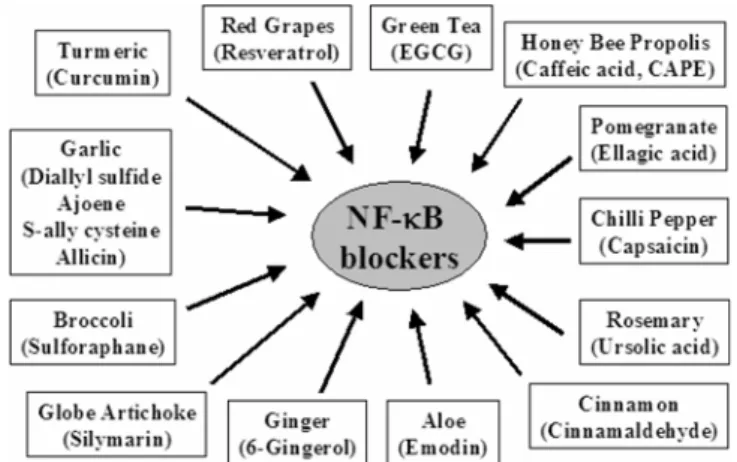
우리가흔히 먹는여러식품중에는많은 phytochemical들이포 함되어 있다. 이러한 phytochemical들은 TNFα, LPS, H2O2와같 은여러 pro-inflammatory 자극에의해서유도된 NF-κB 활성화를 억제시킨다(Fig. 3)(24,26-28). 또한선천성면역반응을조절하기 위해서중요한역할을하는 TLRs을통한 NF-κB 활성화는현재 매우 체계적으로 잘 알려진 신호전달 체계이다. 그래서 NF-κB 활성화 억제효과가 있다고알려져 있으며식품이나 약초에 많 이 포함되어 있는 phytochemical들이 어떻게 TLRs 신호전달 체 계를조절하여 항암, 항염증효과를 가지고있는지를 설명하고자 한다.Resveratrol
Resveratrol(3,4',5-trihydroxy-trans-stilbene)은포도의껍질이나적
포도주와 같이포도로 만든것에서주로발견되는 polyphenol이 다(Fig. 4). Resveratrol은 포도가 외부의 손상이나 곰팡이, 세균, 바이러스, 자외선조사, 화학물질들의자극에대항하기위해서 식 물체 스스로가 분비하는 phytoalexins 중의 하나로 알려져 있다 (29,30). 포유동물안에서 resveratrol은항염증효과와 chemopreven-tive 효과를가지고있는것으로알려져있다. Resveratrol은전립 선(prostate), 유방(breast), 결장(colon) 암세포를포함한여러암세 포의성장과발암성을억제시키는것으로알려져있으며(31), 특 히 “French Paradox”를설명하는 물질로밝혀졌다(32). 프랑스 사 람들은육류나기름진음식을많이섭취하면서도 심장병으로인 한사망률이주변국가들에 비해서낮았다. 그래서 그이유를 찾 아보았더니 바로적포도주 때문이라는것이 밝혀졌다. 이와같이 프랑스인들에게서나타나는기이한현상을 “French Paradox”라고 부르게 되었다. 또한 최근의 연구에 의하면 resveratrol은 sirtuin 유전자를 조절하여 효모의 생명을 연장시키는 물질로 알려졌다
(33). Resveratrol은 TPA, LPS, H2O2와 같은 여러
pro-inflamma-tory 자극제에의해서유도된 NF-κB 활성화를억제시켜, 염증을 유발하는 물질인 cytokines, COX-2, iNOS의 발현을 억제시키는 것으로알려져있다(34-39). 그러나 resveratrol의정확한 molecular
target은우리가선천성 면역반응을위해서중요한역할을하는
TLRs 신호전달체계 안에서 찾기전까지는 잘알려져 있지 않
았다(24).
Resveratrol은 LPS(TLR4 agonist) 또는 Poly[I:C](polyriboinosinic
polyribocytidylic acid, TLR3 agonist)에의해서유도된 NF-κB 활
성화와 COX-2 발현을 억제시킨다고 알려져 있다(24). 하지만
resveratrol은 MALP-2(Macrophage-activating lipopeptide 2-kDa,
TLR2 agonist) 또는 unmethylated CpG DNA(TLR9 agonist)에 의해서유도된 NF-κB 활성화와 COX-2 발현을억제시키지못한
Fig. 2. Several diseases caused by the NF-
κB activation mediated
through Toll-like receptors.
Pathogen-associated molecular patterns (PAMPs) induce NF-kB activation mediated through TLRs. NF-kB activation induces inflammation and then many inflammatory diseases. Resveratrol, (-)-epigallocatechin-3-gallate and curcumin, which have anti-cancer and anti-inflammatory effects, inhibit NF-kB activation induced by PAMPs.다고알려져있다(24). 또한 resveratrol은대식세포(RAW264.7) 안 에서 TLRs 신호전달체계의 downstream molecules인 MyD88 또 는 IKΚβ의 과발현에 의해서유도된 NF-κB 활성화를 억제시키 지못한다고알려져있다(24). TLR4는 MyD88-과 TRIF-dependent 양쪽신호전달체계를 통하여 NF-κB 활성화를 유도할수있다. 하지만 TLR2와 TLR9은 MyD88-dependent 신호전달체계만을통 하여, TLR3은 TRIF-dependent 신호전달체계만을통하여 NF-κB 활성화를유도한다. Murakami 등(40)은 resveratrol이 LPS와 IFNγ 에의해서 유도된 IκBα의분해를 억제시키지못한다고보고하였 다. 또한 Manna 등(41)은 resveratrol이 TNF에 의해서 유도된
IκBα의인산화와분해를억제시키지 못한다고보고하였다. 그러 므로모든 결과에의해서 resveratrol의 molecular target은
MyD88-dependent 신호전달 체계가아니라, TRIF-dependent 신호전달 체 계안에놓여있다는것이밝혀졌다.
Resveratrol은 TRIF-dependent 신호전달체계를사용하는 TLR3 와 TLR4의 agonists에의해서유도된 IFNβ의발현을억제시키며, 또한 TRIF-dependent pathway의 signaling molecules인 TRIF 또
는 TBK1의과발현에의해서유도된 IFNβ의발현을억제시킨다
고알려져 있다(24). 하지만 resveratrol은 IRF3의과발현에 의해 서유도된 IFNβ의 발현을억제시키지 못한다(24). 이러한결과는
resveratrol의 molecular target이 IRF3의 upstream, 즉 TBK1이
resveratrol의 molecular target이라는것을제기하였고, 그래서 TBK1
kinase assay에의해서 TBK1이 resveratrol의분자학적인타깃이라 는것이 확인되었다(24). 또한 resveratrol은 downstream molecules 인 TRIF 또는 RIP1의과발현에의해서유도된 NF-κB 활성화를 억제시킨다(24). 이러한모든결과에 의해서 resveratrol의분자학 적인타깃이 TBK1과 RIP1을포함한 TRIF complex라는사실이 밝혀졌다(Fig. 5)(24).
EGCG
우리가즐겨마시는녹차에는 항염증, chemopreventive 효과를 가지고있는여러종류의플라보노이드(flavonoids)가포함되어있 다. Catechin, (-)-epicatechin, (-)-epigallocatechin,
(-)-epicatechin-3-gallate, (-)-epigallocatechin-3-gallate(EGCG) 등이주로포함되어있 다(25,42). 이중에서도 EGCG(Fig. 4)가가장강한 anti-oxidative,
chemopreventive 효과를가지고 있는것으로알려져 있다. EGCG
의 galloyl group이 항염증 효과를 위해서 중요한 역할을 한다
(43,44). EGCG는 UV, LPS, IL-β 같은 pro-inflammatory 자극제에 의해서유도된전사요소 NF-κB와 AP-1(activator protein 1)의활
성화를 억제시킨다(45-47). 그 결과 lipoxygenase(48),
COX-2(49,50), iNOS(51,52), TNFα를(46) 포함한 inflammatory gene
products의발현을 억제시킨다. EGCG는 IKKβ를분자학적인 타 깃으로 삼아서 pro-inflammatory 자극제에의해서유도된 NF-κB 활성화를 억제시킨다(53,54). 즉 EGCG는 key kinase인 IKKβ의 조절을통하여 MyD88 dependent 신호전달체계를조절한다.
EGCG는 LPS(TLR4 agonist) 또는 Poly[I:C](TLR3 agonist)에 의해서유도된 IFNβ의발현과 IRF3 인산화를억제시킨다(25). 또 한 EGCG는 TRIF와 TBK1의과발현에의해서유도된 IFNβ의발 현을 억제시킨다(25). 하지만 EGCG는 IRF3의과발현에 의해서 유도된 IFNβ의 발현을 억제시키지 못한다. 이러한 결과 또한
EGCG의 분자학적인 타깃이 TBK1이될 거라는것을 제기하였 고, TBK1 kinase assay에 의해서 EGCG의 분자학적인 타깃이
TBK1이라는것이확인되었다(25). 그래서 EGCG는 IKKβ와 TBK1 을 molecular target으로하여각각 MyD88-과 TRIF-dependent 신 호전달체계를조절하는 것이밝혀졌다(Fig. 5)(25).
Curcumin
Curcumin은 Curcuma longa안에서발견되는노란색을띄고있 는 phytochemicals 중의하나이다. Curcumin은 고체 상태에서는
keto형으로, 액체안에서는 enol form으로존재한다(Fig. 4) (55,56).
Ketone group의 산소와 hydroxy group의 수소가 서로 hydrogen
bond를형성해서 보다 안정된상태로 존재 할수 있기때문에,
curcumin이 액체 상태에서는 enol형으로 존재하는 것이다.
Cur-cumin은 IKKβ를분자학적인타깃으로하여여러 pro-inflammatory
3-gallate and curcumin.
Fig. 5. The molecular targets of resveratrol,
(-)-epigallocatechin-3-gallate and curcumin in TLR signaling pathways.
TBK1 is the molecular target of resveratrol and EGCG. IKKβ is the moleculartarget of curcumin and EGCG. Curcumin also inhibits the dimerization of TLR4 induced by lipopolysaccharide. EGCG, (-)-epigallocatechin-3-gallate; RES, resveratrol; CUR, curcumin.
자극제에 의해서 유도된 NF-κB 활성화를 억제 시킨다(57-60).
Curcumin 또한 key kinase인 IKKβ의 조절을 통하여 MyD88
dependent 신호전달체계를조절한다(26).
Curcumin은 LPS(TLR4 agonist)에의해서 유도된 IFNβ의발현 을억제시키지만, TRIF나 TBK1의과발현에의해서유도된 IFNβ 의발현을억제시키지 못한다고알려져있다(26). 이러한결과는
curcumin의 molecular target이 TRIF 위에놓여있으며, 수용체자 체가 curcumin의 molecular target이라는것을제기한다. 수용체의
dimerization은 TLRs에의해서 유도되는신호 전달체계의 활성 화와뒤이어 발생하는선천성 그리고 후천성면역반응을 유도 하기위해서최초로일어나는반응중 하나로알려져있다. 또한 TLR4는 ligand에독립적으로 homodimerization을형성해서 NF-κB 활성화를 유도한다(15,18,61). Curcumin은 LPS 또는 ligand에독 립적으로유도된 TLR4의 homodimerization을억제시킨다(26). 또 한 curcumin은 LPS에의해서 유도된 IRAK-1 분해를 억제시킨 다(26). 이러한 결과에 의해서 curcumin의 분자학적인 타깃이 IKKβ에부가적으로 IRAK-1위에놓여 있다는 것이밝혀졌으며, curcumin이최초의방어체계라할수있는수용체의 dimerization 을억제하여 NF-κB 활성화를억제시키는것이밝혀졌다(26). 이 와 같은 결과는 phytochemical이 신호전달 체계 안에서 중간에
존재하는어떤 signaling 단백질만을 molecular target으로 하는것
이아니라, 수용체 level을타깃으로할수있다는것을보여주는
결과이다.
많은식물들에는 병원균들에 의해서유도된 NF-κB의 활성화
를억제하는효과를가지고있는 phytochemical들이포함되어있
다(24,26-28,62). 이러한 phytochemicals 중에서 Michael addition에 의해서 cysteine 잔기의 sulfhydryl 그룹에 반응할수있는구조를 가지고있는 polyphenol이나 sesquiterpene lactone 등이많이있다
(63-66). α,β-Unsaturated carbonyl group을가지고 있는 curcumin 은 IKKβ에있는 cysteine의 sulfhydryl(-SH) 그룹에붙어서 IKKβ 인산화효소의효과를억제시킨다(57,67). Sesquiterpene lactone 중 의 하나인 helenalin은 p65/NF-κB 안에 있는 두 개의
cys-teine(Cys38, Cys120)에 붙어서 NF-κB의 DNA 결합을 억제시킨 다(63,66). 그외에도많은연구에의하면 α,β-unsaturated carbonyl
group을가지고 있는 phytochemical들은 Michael addition에의해 서 cysteine의 sulfhydryl 그룹에 붙어단백질의 활성을 억제시킨 다고알려져 있다(64,65). TLRs는세포막의 바깥쪽에 여러개의 leucine이반복적으로나타나고, cysteine이풍부한지역이있으며, 또한 세포막 안쪽에는 TIR(Toll/IL-1R homologous) 지역을 가지 고있는세포막을 통과하는 Type I 단백질이다. 그러므로 TLRs 는세포막의 안과밖으로 여러개의 cysteine 잔기를 가지고있 다. 이러한 cysteine 잔기는아마도두개의 TLRs가결합하기위 하여이황화물(disulfide) 결합을 형성할것으로 알려져있다(68). 그러므로 curcumin과같이 Michael addition 반응을 유도할수있 는구조를가진 phytochemicals은 TLRs의 cysteine 잔기에결합을 해서 TLRs의 dimerization을억제시켜 항염증효과를 가지고있 다는것이밝혀졌다.
결
론
선천성 면역반응을 조절하는데 있어서 중요한 역할을 하는 TLRs 신호전달 체계는, 최근 세계 각국에서 최소한 매주 한편 이상의논문이발표될정도로많은연구가활발하게진행되고있 는분야이다. 또한 TLRs를통한 NF-κB 활성화는 현재매우체 계적으로잘정리된신호전달체계이다. 우리가흔히먹는여러 식품 중에는 phytochemicals이라고 불리 우는여러 기능성소재 들이포함되어 있다. 특히 phytochemicals 중에서항염증효과가 있다고 널리알려져 있는 resveratrol, EGCG, curcumin의분자학적인 타깃이 TLRs 신호전달체계안에서밝혀졌다. 기존의논문 들은 phytochemical들이암이나 염증을 억제시킨다는 결과를 관 찰하는데 중점을두었지만, 본논문에서는 phytochemical들이어 느곳을 molecular target으로하여어떻게항염증효과를가지고 있는지를 서술하는데중점을 두었다. 기능성 식품의 주된 목적 은, 일반적인 약들과다르게질병을치료하는데 중점을두는것 이아니라, 질병을예방하는것이주된목적이기때문에, 선천성 면역반응을 위해서필수적인 역할을 하는 TLRs 신호전달 체계 안에서 phytochemical들의 molecular targets의 발견은 기능성 식 품의주된목적을잘설명해주는것이라할수있겠다.
문
헌
1. Ulevitch RJ. Molecular mechanisms of innate immunity. Immu-nol. Res. 21: 49-54 (2000)
2. Ulevitch RJ. Therapeutics targeting the innate immune system. Nat. Rev. Immunol. 4: 512-520 (2004)
3. Hoebe K, Janssen E, Beutler B. The interface between innate and adaptive immunity. Nat. Immunol. 5: 971-974 (2004)
4. Akira S, Hemmi H. Recognition of pathogen-associated molecular patterns by TLR family. Immunol. Lett. 85: 85-95 (2003)
5. Liew FY, Xu D, Brint EK, O'Neill LA. Negative regulation of Toll-like receptor-mediated immune responses. Nat. Rev. Immu-nol. 5: 446-458 (2005)
6. Poltorak A, He X, Smirnova I, Liu MY, Van Huffel C, Du X, Birdwell D, Alejos E, Silva M, Galanos C, Freudenberg M, Ric-ciardi-Castagnoli P, Layton B, Beutler B. Defective LPS signaling in C3H/HeJ and C57BL/10ScCr mice: Mutations in Tlr4 gene. Science 282: 2085-2088 (1998)
7. Underhill DM, Ozinsky A, Hajjar AM, Stevens A, Wilson CB, Bassetti M, Aderem A. The Toll-like receptor 2 is recruited to macrophage phagosomes and discriminates between pathogens. Nature 401: 811-815 (1999)
8. Rezaei N. Therapeutic targeting of pattern-recognition receptors. Int. Immunopharmacol. 6: 863-869 (2006)
9. Beutler B, Hoebe K, Du X, Ulevitch RJ. How we detect microbes and respond to them: The Toll-like receptors and their transducers. J. Leukocyte Biol. 74: 479-485 (2003)
10. Takeda K, Akira S. Toll-like receptors in innate immunity. Int. Immunol. 17: 1-14 (2005)
11. Beutler B, Jiang Z, Georgel P, Crozat K, Croker B, Rutschmann S, Du X, Hoebe K. Genetic analysis of host resistance: Toll-like receptor signaling and immunity at large. Annu. Rev. Immunol. 24: 353-389 (2006)
12. Medzhitov R. Toll-like receptors and innate immunity. Nat. Rev. Immunol. 1: 135-145 (2001)
13. O'Neill LA. TLRs: Professor Mechnikov, sit on your hat. Trends Immunol. 25: 687-693 (2004)
14. Vogel SN, Fitzgerald KA, Fenton MJ. TLRs: Differential adapter utilization by Toll-like receptors mediates TLR-specific patterns of gene expression. Mol. Interv. 3: 466-477 (2003)
15. Medzhitov R, Preston-Hurlburt P, Janeway CA Jr. A human homologue of the Drosophila Toll protein signals activation of
adaptive immunity. Nature 388: 394-397 (1997)
16. Miyake K. Innate recognition of lipopolysaccharide by Toll-like receptor 4-MD-2. Trends Microbiol. 12: 186-92 (2004)
17. Hajjar AM, O'Mahony DS, Ozinsky A, Underhill DM, Aderem A, Klebanoff SJ, Wilson CB. Cutting edge: Functional interac-tions between Toll-like receptor (TLR) 2 and TLR1 or TLR6 in response to phenol-soluble modulin. J. Immunol. 166: 15-19 (2001)
18. Rhee SH, Hwang D. Murine Toll-like receptor 4 confers lipopolysaccharide responsiveness as determined by activation of NF kappa B and expression of the inducible cyclooxygenase. J.
22. Pahl HL. Activators and target genes of Rel/NF-kappaB transcrip-tion factors. Oncogene 18: 6853-6866 (1999)
23. Ghosh S, Karin M. Missing pieces in the NF-kappaB puzzle. Cell 109: S81-S96 (2002)
24. Youn HS, Lee JY, Fitzgerald KA, Young HA, Akira S, Hwang DH. Specific inhibition of MyD88-independent signaling path-ways of TLR3 and TLR4 by resveratrol: Molecular targets are TBK1 and RIP1 in TRIF complex. J. Immunol. 175: 3339-3346 (2005)
25. Youn HS, Lee JY, Saitoh SI, Miyake K, Kang KW, Choi YJ, Hwang DH. Suppression of MyD88- and TRIF-dependent signal-ing pathways of Toll-like receptor by (-)-epigallocatechin-3-gal-late, a polyphenol component of green tea. Biochem. Pharmacol. 72: 850-859 (2006)
26. Youn HS, Saitoh SI, Miyake K, Hwang DH. Inhibition of homodimerization of Toll-like receptor 4 by curcumin. Biochem. Pharmacol. 72: 62-69 (2006)
27. Surh YJ. Cancer chemoprevention with dietary phytochemicals. Nat. Rev. Cancer 3: 768-780 (2003)
28. Zingarelli B, Sheehan M, Wong HR. Nuclear factor-kappaB as a therapeutic target in critical care medicine. Crit. Care Med. 31: S105-S111 (2003)
29. Hain R, Bieseler B, Kindl H, Schroder G, Stocker R. Expression of a stilbene synthase gene in Nicotiana tabacum results in syn-thesis of the phytoalexin resveratrol. Plant Mol. Biol. 15: 325-335 (1990)
30. Hain R, Reif HJ, Krause E, Langebartels R, Kindl H, Vornam B, Wiese W, Schmelzer E, Schreier PH, Stocker RH, Stenzel K. Disease resistance results from foreign phytoalexin expression in a novel plant. Nature 361: 153-156 (1993)
31. Pervaiz S. Resveratrol: From grapevines to mammalian biology. FASEB J. 17: 1975-1985 (2003)
32. Kopp P. Resveratrol, a phytoestrogen found in red wine. A possi-ble explanation for the conundrum of the 'French paradox'? Eur. J. Endocrinol. 138: 619-620 (1998)
33. Howitz KT, Bitterman KJ, Cohen HY, Lamming DW, Lavu S, Wood JG, Zipkin RE, Chung P, Kisielewski A, Zhang LL, Scherer B, Sinclair DA. Small molecule activators of sirtuins extend Saccharomyces cerevisiae lifespan. Nature 425: 191-196 (2003)
34. Bhat KP, Pezzuto JM. Cancer chemopreventive activity of resver-atrol. Ann. NY Acad. Sci. 957: 210-229 (2002)
35. Martinez J, Moreno JJ. Effect of resveratrol, a natural polyphe-nolic compound, on reactive oxygen species and prostaglandin production. Biochem. Pharmacol. 59: 865-870 (2000)
36. Subbaramaiah K, Chung WJ, Michaluart P, Telang N, Tanabe T, Inoue H, Jang M, Pezzuto JM, Dannenberg AJ. Resveratrol inhibits cyclooxygenase-2 transcription and activity in phorbol ester-treated human mammary epithelial cells. J. Biol. Chem. 273: 21875-1882 (1998)
37. Tsai SH, Lin-Shiau SY, Lin JK. Suppression of nitric oxide syn-thase and the down-regulation of the activation of NFkappaB in macrophages by resveratrol. Brit. J. Pharmacol. 126: 673-680 (1999)
38. Wadsworth TL, Koop DR. Effects of the wine polyphenolics quercetin and resveratrol on pro-inflammatory cytokine expression
42. Fujiki H. Green tea: Health benefits as cancer preventive for humans. Chem. Rec. 5: 119-132 (2005)
43. Ikeda I, Tsuda K, Suzuki Y, Kobayashi M, Unno T, Tomoyori H, Goto H, Kawata Y, Imaizumi K, Nozawa A, Kakuda T. Tea cat-echins with a galloyl moiety suppress postprandial hypertriacylg-lycerolemia by delaying lymphatic transport of dietary fat in rats. J. Nutr. 135: 155-159 (2005)
44. Wang X, Song KS, Guo QX, Tian WX. The galloyl moiety of green tea catechins is the critical structural feature to inhibit fatty-acid synthase. Biochem. Pharmacol. 66: 2039-2047 (2003) 45. Barthelman M, Bair WB 3rd, Stickland KK, Chen W,
Timmer-mann BN, Valcic S, Dong Z, Bowden GT. (-)-Epigallocatechin-3-gallate inhibition of ultraviolet B-induced AP-1 activity. Carcino-genesis 19: 2201-2204 (1998)
46. Yang F, de Villiers WJ, McClain CJ, Varilek GW. Green tea polyphenols block endotoxin-induced tumor necrosis factor-pro-duction and lethality in a murine model. J. Nutr. 128: 2334-2340 (1998)
47. Wheeler DS, Catravas JD, Odoms K, Denenberg A, Malhotra V, Wong HR. Epigallocatechin-3-gallate, a green tea-derived polyphe-nol, inhibits IL-1 beta-dependent proinflammatory signal transduc-tion in cultured respiratory epithelial cells. J. Nutr. 134: 1039-1044 (2004)
48. Yang TT, Koo MW. Inhibitory effect of Chinese green tea on endothelial cell-induced LDL oxidation. Atherosclerosis 148: 67-73 (2000)
49. Metz N, Lobstein A, Schneider Y, Gosse F, Schleiffer R, Anton R, Raul F. Suppression of azoxymethane-induced preneoplastic lesions and inhibition of cyclooxygenase-2 activity in the colonic mucosa of rats drinking a crude green tea extract. Nutr. Cancer 38: 60-64 (2000)
50. Soriani M, Rice-Evans C, Tyrrell RM. Modulation of the UVA activation of haem oxygenase, collagenase and cyclooxygenase gene expression by epigallocatechin in human skin cells. FEBS Lett. 439: 253-257 (1998)
51. Chan MM, Fong D, Ho CT, Huang HI. Inhibition of inducible nitric oxide synthase gene expression and enzyme activity by epi-gallocatechin gallate, a natural product from green tea. Biochem. Pharmacol. 54: 1281-1286 (1997)
52. Lin YL, Lin JK. (-)-Epigallocatechin-3-gallate blocks the induc-tion of nitric oxide synthase by down-regulating lipopolysaccha-ride-induced activity of transcription factor nuclear factor-kappaB. Mol. Pharmacol. 52: 465-472 (1997)
53. Pan MH, Lin-Shiau SY, Ho CT, Lin JH, Lin JK. Suppression of lipopolysaccharide-induced nuclear factor-kappaB activity by theaflavin-3,3'-digallate from black tea and other polyphenols through down-regulation of IkappaB kinase activity in macroph-ages. Biochem. Pharmacol. 59: 357-367 (2000)
54. Yang F, Oz HS, Barve S, de Villiers WJ, McClain CJ, Varilek GW. The green tea polyphenol (-)-epigallocatechin-3-gallate blocks nuclear factor-kappa B activation by inhibiting I kappa B kinase activity in the intestinal epithelial cell line IEC-6. Mol. Pharmacol. 60: 528-533 (2001)
55. Payton F, Sandusky P, Alworth WL. NMR study of the solution structure of curcumin. J. Nat. Prod. 70: 143-146 (2007)
far. Eur. J. Cancer 41: 1955-1968 (2005)
57. Pan MH, Lin-Shiau SY, Lin JK. Comparative studies on the sup-pression of nitric oxide synthase by curcumin and its hydroge-nated metabolites through down-regulation of IkappaB kinase and NFkappaB activation in macrophages. Biochem. Pharmacol. 60: 1665-1676 (2000)
58. Jobin C, Bradham CA, Russo MP, Juma B, Narula AS, Brenner DA, Sartor RB. Curcumin blocks cytokine-mediated NF-kappa B activation and proinflammatory gene expression by inhibiting inhibitory factor I-kappa B kinase activity. J. Immunol. 163: 3474-3483 (1999)
59. Brouet I, Ohshima H. Curcumin, an anti-tumour promoter and anti-inflammatory agent, inhibits induction of nitric oxide syn-thase in activated macrophages. Biochem Bioph. Res. Co. 206: 533-540 (1995)
60. Kang G, Kong PJ, Yuh YJ, Lim SY, Yim SV, Chun W, Kim SS. Curcumin suppresses lipopolysaccharide-induced cyclooxygenase-2 expression by inhibiting activator protein 1 and nuclear factor
κB bindings in BV2 microglial cells. J. Pharmacol. Sci. 94:
325-328 (2004)
61. Zhang H, Tay PN, Cao W, Li W, Lu J. Integrin-nucleated Toll-like receptor (TLR) dimerization reveals subcellular targeting of TLRs and distinct mechanisms of TLR4 activation and signaling. FEBS Lett. 532: 171-176 (2002)
62. Jeong WS, Kim IW, Hu R, Kong AN. Modulatory properties of various natural chemopreventive agents on the activation of
NF-kappaB signaling pathway. Pharm. Res. 21: 661-670 (2004) 63. Rungeler P, Castro V, Mora G, Goren N, Vichnewski W, Pahl
HL, Merfort I, Schmidt TJ. Inhibition of transcription factor NF-kappaB by sesquiterpene lactones: A proposed molecular mecha-nism of action. Bioorg. Med. Chem. 7: 2343-2352 (1999)
64. Dinkova-Kostova AT, Massiah MA, Bozak RE, Hicks RJ, Talalay P. Potency of Michael reaction acceptors as inducers of enzymes that protect against carcinogenesis depends on their reactivity with sulfhydryl groups. P. Natl. Acad. Sci. USA 98: 3404-3409 (2001)
65. Siedle B, Garcia-Pineres AJ, Murillo R, Schulte-Monting J, Cas-tro V, Rungeler P, Klaas CA, Da Costa FB, Kisiel W, Merfort I. Quantitative structure-activity relationship of sesquiterpene lac-tones as inhibitors of the transcription factor NF-kappaB. J. Med. Chem. 47: 6042-6054 (2004)
66. Garcia-Pineres AJ, Castro V, Mora G, Schmidt TJ, Strunck E, Pahl HL, Merfort I. Cysteine 38 in p65/NF-kappaB plays a cru-cial role in DNA binding inhibition by sesquiterpene lactones. J. Biol. Chem. 276: 39713-39720 (2001)
67. Singh S, Aggarwal BB. Activation of transcription factor NF-kappa B is suppressed by curcumin (diferuloylmethane). J. Biol. Chem. 270: 24995-25000 (1995)
68. Tao X, Xu Y, Zheng Y, Beg AA, Tong L. An extensively associ-ated dimer in the structure of the C713S mutant of the TIR domain of human TLR2. Biochem. Bioph. Res. Co. 299: 216-221 (2002)