Effect of Passivation on the Sintering Behavior of Submicron Nickel Powder Compacts for MLCC Application
Gi-Young Jo, Kwi-Jong Lee
a, and Suk-Joong L. Kang *
Materials Interface Laboratory, Department of Materials Science and Engineering, Korea Advanced Institute of Science and Technology, 373-1, Guseong-dong, Yuseong-gu, Daejeon, 305-701, Republic of Korea
aLCR Division, Samsung Electro-Mechanics, Suwon 443-743, Korea (Received December 5, 2013; Accepted December 18, 2013)
···
Abstract During sintering of Ni-electrode multi-layer ceramic capacitors (MLCCs), the Ni electrode often becomes discontinuous because of its lower sintering temperature relative to that of BaTiO3. In an attempt to retard the sintering of Ni, we introduced passivation of the Ni powder. To find the optimal passivation conditions, a thermogravimetric anal- ysis (TGA) was conducted in air. After passivation at 250oC for 11 h in air, a nickel oxide shell with a thickness of 4- 5 nm was formed on nickel nanoparticles of 180 nm size. As anticipated, densification of the compacts of the passi- vated Ni/NiO core-shell powder was retarded: the starting temperature of densification increased from ~400oC to
~600oC in a 97N2-3H2 (vol %) atmosphere. Grain growth was also retarded during sintering at temperatures of 750 and 1000oC. When the sintering atmosphere was changed from wet 99.93N2-0.07H2 to wet 99.98N2-0.02H2, the average grain size decreased at the same sintering temperature. The conductivity of the passivated powder sample sintered at 1150oC for 8 h in wet 99.93N2-0.07H2 was measured to be 3.9 × 10⁴ S/cm, which is comparable with that, 4.6 × 10⁴ S/
cm, of the Ni powder compact without passivation. These results demonstrate that passivation of Ni is a viable means of retarding sintering of a Ni electrode and hence improving its continuity in the fabrication of BaTiO3-based multi-layer ceramic capacitors.
Keywords: Nickel, passivation, densification · grain growth, MLCC
···
1 . Introduction
Nickel is widely used as an electrode of multi-layer ceramic capacitors (MLCCs). With miniaturization and increased performance demand of MLCCs, the thick- nesses of the BaTiO3 dielectric layer and the Ni elec- trode layer are respectively now on a submicron scale [1,2]. A critical issue that arises with this trend is discon- tinuity of the Ni electrode layer [3-5]. The reported causes of the electrode discontinuity are the difference in sintering temperature between BaTiO3 and Ni [4], the difference in the thermal expansion coefficient between the two materials [6], and thermal grooving of the bound- aries [7]. As the electrode discontinuity can induce dis- charge, and also reduces the dielectric capacitance and reliability [8-10], several attempts have been made to
suppress densification and grain growth in nano-sized Ni for MLCC applications. Polotai et al. [11] investigated the effects of Cr addition. While the continuity of the Ni electrode was improved, the concentration of oxygen vacancies increased and the leakage current also increased, resulting in deterioration of the dielectric performance.
An attempt at modifying the firing rate [12] also yielded similar effects. Lee et al. [13] and Zhang et al. [14] stud- ied the effects of a ceramic coating on Ni particles.
Although the sintering of Ni powder was retarded with application of the ceramic coating, the conductivity was reduced. Furthermore, insufficient elimination of the organic binder used in the process could also cause dete- rioration of the electrode properties. As outlined above, the attempts thus far to retard sintering and improve the continuity of Ni electrodes without substantial deteriora-
*Corresponding Author : Suk-Joong L. Kang, TEL: +82-42-350-4113, FAX: +82-42-350-8920, E-mail: [email protected]
<PM리뷰>
vation, the negative effects that arise with ceramic coat- ing of other oxides on Ni powder can be avoided.
A Ni/NiO core/shell structured powder was prepared via a simple surface oxidation of Ni powder in air. The sintering behavior of the passivated powder was observed and the electrical conductivity of the powder compacts was measured. It was found that the passivation of Ni powder is a simple and effective means of retarding den- sification and grain growth of nano-sized Ni powder. The present results will be applicable to the fabrication of MLCCs with better Ni electrode continuity.
2. Experimental Procedure
Samples were prepared from Ni powder of 180 nm size (NFP 201X, JFE Mineral Ltd., Tokyo, Japan). Optimal passivation conditions, which yield a thin and uniform oxide layer on Ni particles, were determined after a ther- mogravimetric analysis. When the powder heated to 250oC and held at the temperature for 11 hours in air, a uniform and thin NiO layer was formed on Ni particles.
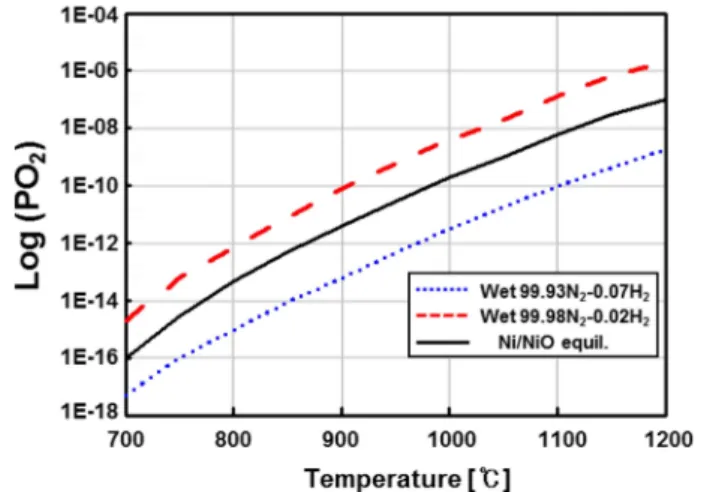
The passivated powder was observed under a scanning electron microscope (SEM) and a transmission electron microscope (TEM). For TEM observation, the particles were cut into halves using a focused ion beam (FIB) sys- tem. The particle size distributions of the non-passivated and the passivated powders were measured using a parti- cle size analyzer (LS 230, Beckman Coulter Co., U.S.A.) in an ethanol medium. The two kinds of powders were lightly pressed in a steel die of 9 mm diameter and then cold isostatically compressed at 200 MPa to make pel- lets of 8 mm diameter and 2.5 mm thickness. The pellets were sintered at two different temperatures, 750 and 1000oC, for various times in two different atmospheres, wet 99.93N2-0.07H2 and wet 99.98N2-0.02H2. Fig. 1 plots the variation of the oxygen partial pressure with tempera-
ture in different atmospheres together with the variation of the equilibrium oxygen partial pressure of Ni/NiO.
Wet 99.93N2-0.07H2 is a lightly reducing atmosphere while wet 99.98N2-0.02H2 is a lightly oxidizing atmo- sphere. The flow rate of the mixed gas was 150 cc/min.
The heating rate was 30oC/min. The microstructures of the sintered samples were observed under an SEM after polishing the samples to a 1 µm finish and chemical etching in a 60CH3COOH-30HNO3-10H2O (vol.%) solu- tion for 2-5 seconds. The average grain size was mea- sured using an image analysis program (Matrox Inspector 2.1). At least 300 grains were examined for the measure- ment. The electrical conductivity was measured by using a 4-point probe station (11862B, Keithley, U.S.A.).
3. Results and Discussion
Fig. 2(a) plots a thermogravimetric curve of nickel powder at a heating rate of 5oC/min in air. It is seen that the weight gain starts at about 250oC and increases sharply from about 300oC. Fig. 2(b) plots the weight gains with annealing time at three different temperatures, 250, 300, and 350oC. The weight gain is slow and mod- erate at 250oC and becomes rapid at 300oC, suggesting that the passivation at 250oC can be well controlled.
Table 1 lists the measured weight changes during passi- vation at 250oC and estimated shell thicknesses. The slower kinetics of passivation in a box furnace compared with that obtained in the thermogravimetric analysis is due to the absence of air flow. To ensure uniform forma- tion of the NiO layer, we passivated the powder for 11 h.
Fig. 1. Variation of the estimated oxygen partial pressure with temperature in different atmospheres.
After the passivation, the average size and size distribu- tion of the powder were nearly the same, as shown in Figs. 3(a) and 3(b). An x-ray analysis, which is not shown here, revealed the presence of oxide in the passi- vated powder. Indeed, a thin and quite uniform oxide layer of 4-5 nm thickness formed at the surface of each particle, as shown in the HRTEM micrograph in Fig. 4.
Fig. 2. (a) Thermogravimetric curve of nickel powder at a heating rate of 4oC/min in air. (b) Weight change of nickel powder with annealing time at 250, 300 and 350oC in air.
Fig. 3. Size distributions and SEM micrographs of (a) pure nickel powder and (b) passivated nickel powder.
Table 1. Measured weight gain and estimated nickel oxide weight percent and shell thickness of Ni powder passivated at 250oC for various times in air
Passivation time 2 hr 4 hr 8 hr 11 hr
Weight gain [%] 0.18 0.65 0.75 1.1
NiO [wt%] 0.81 3.0 3.46 5.04
Shell thickness [nm] 0.73 2.71 3.12 4.57
Fig. 4. (a) HRTEM micrograph of nickel powder passivated at 250oC for 11 hours in air. (b) EDS spectra of region 1 and 2 in (a).
sion of atoms in the passivated oxide layer. When the Ni/
NiO powder compact was heated to 950oC at 10oC/min, the shrinkage is less than 9%, while it is ~14% for the pure Ni powder compact. This suppressing effect of the oxide layer is comparable to that of a coated layer of other oxides on Ni [14], thus indicating that the intro- duced passivation step is a simple and effective means of suppressing densification of the Ni electrode layer dur- ing the production of MLCCs.
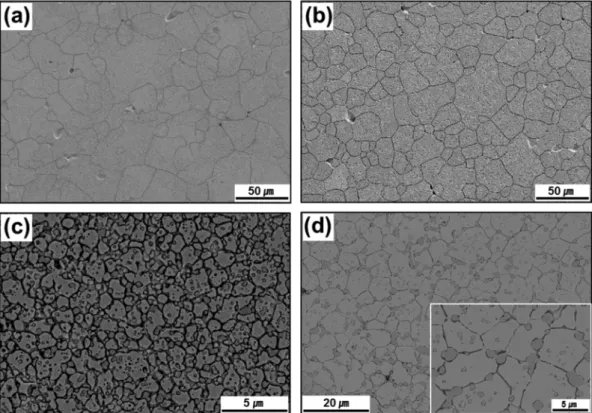
Fig. 6 shows SEM micrographs of pure Ni and Ni/NiO powder compacts sintered at two temperatures, 750 and 1000oC, for 1 h in wet 99.93N2-0.07H2. At both 750 and 1000oC, the grain size of the pure Ni powder compact is approximately 20-30 µm, as shown in Figs. 6(a) and Fig. 5. Shrinkage curves of pure Ni and Ni/NiO compacts as
a function of sintering temperature at a heating rate of 10oC/
min.
Fig. 6. SEM micrographs of pure nickel ((a) and (b)) and Ni/NiO ((c) and (d)) powder compacts sintered at 750oC ((a) and (c)) and 1000oC ((b) and (d)) for 1 hour in wet 99.93N2-0.07H2. The back-scattered SEM image in the inset in (d) reveals the presence of NiO particles (dark regions) in Ni matrix (grey regions).
6(b). Considering the initial powder size of 180 nm, the grain growth during sintering of Ni is dramatic. Accord- ing to a previous study [16], the coarse microstructure of 20-30 µm grain size is a result of the formation and the impingement of abnormal grains that occur at low tem- perature. In contrast, grain growth in a compact of passi- vated powder was significantly suppressed, as shown in Figs. 6(c) and 6(d).
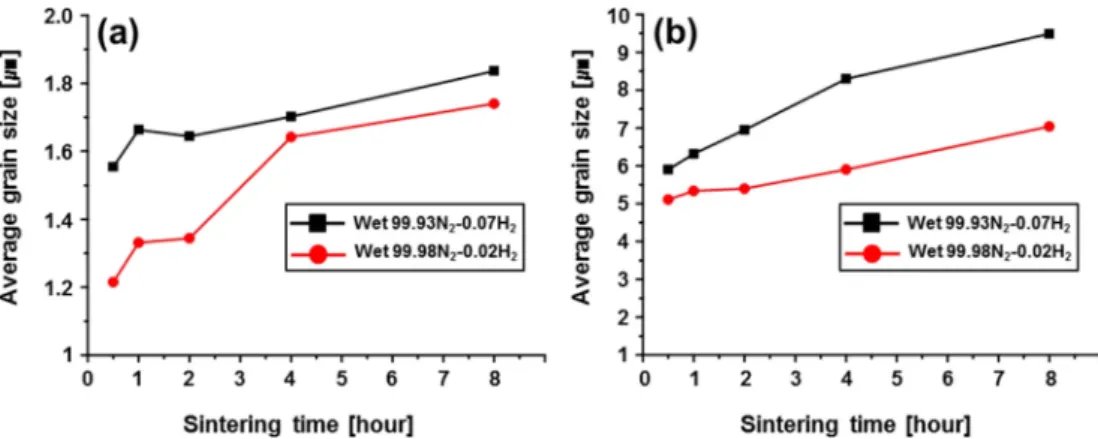
Fig. 7 plots the variation of the average grain size of Ni in Ni/NiO powder compacts with sintering time at 750 and 1000oC in slightly oxidizing (wet 99.98N2-0.02H2) and the slightly reducing (wet 99.93N2-0.07H2) atmo- spheres, respectively. In general, the average grain size in wet 99.98N2-0.02H2 is smaller than that in wet 99.93N2- 0.07H2. In both cases, however, the average grain sizes of 1-2 µm at 750oC and of 5-7 µm at 1000oC for sintering time of 1 h are much smaller than that of ~30 µm for pure Ni powder compacts. This remarkable suppression of grain growth in the Ni/NiO powder compact is attrib- uted to the suppression of sintering and also the drag of NiO particles against the boundary movement [17]. It seems that NiO particles formed with agglomeration of unreduced NiO, which was remained due to insufficient reduction in a slightly reducing atmosphere.
Table 2 lists the electrical conductivity measured by the four-point probe technique at room temperature for pure
Ni and Ni/NiO powder compacts after sintering at 1000 and 1150oC for 8 h in wet 99.93N2-0.07H2. Although NiO particles remained at the grain boundaries in the sin- tered Ni/NiO samples, the electrical conductivity of the Ni/NiO compacts is comparable to that of the pure Ni powder compact. According to a previous study [14], the electrical conductivity (2.2 × 10⁶/Ω/m) of sintered com- pacts of Ni powder coated with other oxides is substan- tially inferior to that (4.9 × 10⁶/Ω/m) of sintered pure Ni compacts. The good conductivity of our passivated Ni powder compacts is due to reduction of the oxidized layer and spherodization of remaining oxides during sin- tering. It is therefore concluded that the passivation of nickel powder is a good solution to reduce the sinterabil- ity of Ni for application of Ni electrodes in MLCCs.
4. Conclusions
In fabricating MLCCs, retardation of sintering of the Ni electrode is critical in order to improve the continuity of the electrode layer. As the sintering temperature of NiO is higher than that of Ni, Ni powder was passivated in an attempt to suppress its sintering in the present study. Ni powder with an oxide layer of 4-5 nm thick- ness was prepared after conducting a thermogravimetric analysis. Densification of the passivated Ni powder was retarded and grain growth was also suppressed. The elec- trical conductivity of the passivated and sintered Ni pow- der was comparable with that of the unpassivated and sintered Ni powder. It is concluded that the passivation of Ni powder is a simple and useful way of retarding sinter- ing and hence improving the continuity of Ni electrodes without significant reduction of their electrical conductiv- Fig. 7. Average grain size of Ni/NiO samples with sintering time at (a) 750 and (b) 1000oC in two different atmospheres.
Table 2. Electrical conductivity of pure Ni and Ni/NiO compacts sintered for 8 hours in wet 99.93N2-0.07H2
Sintering temperature 1000oC 1150oC
Pure Ni 4.2 4.6
Ni/NiO 3.1 3.9
[×104 Scm−1]
References
[1] H. Kishi, Y. Mizuno and H. Chazono: Jpn. J. Appl. Phys., 42 (2003) 1.
[2] C. A. Randall: J. Ceram. Soc. Jpn., 109 (2001) S2.
[3] B. Y. Yu and W. C. J. Wei: J. Am. Ceram. Soc., 88 (2005) 2328.
[4] A. V. Polotai, G. Y. Yang, E. C. Dickey and C. A. Randall: J.
Am. Ceram. Soc., 90 (2007) 3811.
[5] Z. Yan, O. Guillon, S. Wang, C. L. Martin, C. S. Lee and D. Bouvard: Appl. Phys. Lett., 100 (2012)263107.
18 (2007) 261.
[12] M. M. Samantaray, K. Kaneda, W. Qu, E. C. Dickey and C. A. Randall: J. Am. Ceram. Soc., 95 (2012) 992.
[13] J. Y. Lee, J. H. Lee, S. H. Hong, Y. K. Lee and J. Y. Choi:
Adv. Mater., 15 (2003) 1655.
[14] Y. Zhang, X. Wang, J. Y. Kim, J. R. Kim, K. H. Hur and L. Li: J. Am. Ceram. Soc., 96 (2013) 2163.
[15] I. Yoshio: J. Am. Ceram. Soc., 41 (1958) 397.
[16] S. H. Jung, D. Y. Yoon and S.-J. L. Kang: Acta Mater., 61 (2013) 5685.
[17] S.-J. L. Kang: Sintering : Densification, Grain Growth &
Microstructure, Elsevier, Oxford (2005) 95.