서 론
한반도의 기후는 대부분의 강우가 여름에 집중되는 몬
순성 기후이다
.
하지만,
최근 들어 기후변화로 인해 강우 의 시기,
빈도,
강우량을 예측할 수 없게 되었으며(Mini- stry of Construction and Transportation, 2005),
한 지역 에 강우가 집중되는 현상을 보이고 있다.
집중 강우는 빠─
─ 289 ─ ─
북한강 상류수계인 조양강의 DAIpo 와 TDI 를 이용한 생물학적 수질평가
김헌년∙박혜경1∙박상정1∙이옥민*
(경기대학교 생명과학과, 1국립환경과학원 물환경연구부)
Biological Water Quality Assessment of Joyang-river Located at the Upper Region of North Han-river Using DAIpo and TDI. Kim, Hun-nyun, Hea-Kyung Park
1, Sang-Jung Park1and Ok- min Lee* (Department of Life Science, College of Natural Science, Kyonggi University, Suwon 443-760, Korea; 1Water Environment Research Department, The National Institute of Environmental Research, Incheon 404-170, Korea)A biological assessment of water quality was made at 9 sites of the Joyang-river and inflow streams located in Jeongseon-gun Gangwon-do, from June 2008 to September 2010. The investigation consisted of physico-chemical factors, biomass, and standing crops of epilithic diatoms. In addition, the community structure of epilithic diatoms was analyzed, and the water quality was assessed using DAIpo and TDI. The pH varied from 7.4~ ~10.2 which is attributed to the Joyang-river area consisting of limestone. A total of 117 taxonomic groups of epilithic diatoms, including: 2 orders, 6 families, 23 genera, 95 species, 15 varieties, 2 forms, and 5 unidentified species, were found in the Joyang-river. 11 taxa, including Achnanthes laterostrata and Cymbella
delicatula which live in neutral to alkali pH, were found. An indicator species ofalkali waters, Cymbella delicatula, was routinely observed to have a relative frequ- ency of over 10% in I3 and I4. In the result of the biological assessment using DAIpo, the Joyang-river was rated class A, with an average of 77.03 and inflow streams were rated class B with an average of 65.84. As for the results of TDI analysis, the Joyang- river was rated class A~ ~B, and inflow streams were rated class A~ ~D. Accordingly, the water quality of the Joyang-river was determined to be superior to that of inflow streams. Although the main stream showed low water quality at sites J2 and J3, cor- relating with a reduction in the quality of inflow stream, I1 in September 2009.
Key words : biological assessment, joyang-river, epilithic diatoms, DAIpo, TDI
* Corresponding author: Tel: 031) 249-9643, Fax: 031) 241-0860, E-mail: [email protected]
ⓒ The Korean Society of Limnology. All rights reserved.
This is an open-access article distributed under the terms of the Creative Commons Attribution Non-Commercial License (http://creativecommons.org/licenses/by-nc/3.0/), which permits unrestricted non-commercial use, distribution, and reproduction in any medium, provide the original work is properly cited.
른 시간 내에 하천으로 유입되어 영양염의 빠른 수송과 탁수로 하천을 교란시킨다
(Ford, 1990; Horne and Gold- man, 1994).
하천으로의 탁수 유입은 빛의 투과량 감소와 용존산소 감소로 인해 하천에 서식하는 생물들에게 직접 적,
간접적으로 영향을 준다.
집중강우와 같은 교란에 영향을 받은 생물의 반응은 수환경의 변화를 유추하는 좋은 자료가 된다
.
특히,
하천 에 서식하는 부착조류는 수생태계의1
차 생산자로서 먹 이망에 기본이 되며(Hotzel and Croome, 1999),
짧은 생 활사와 생식주기를 가짐으로 인해 인위적 영향에 대해 빠른 반응을 볼 수 있다(Domingues and Galvao, 2007;
Cabecinha et al., 2009).
이러한 특성으로 인해 부착조류,
특히 부착규조류는 생물학적 수질평가에 활용되고 있다(Watanabe et al., 1986, 1990, 2005; Kelly and Whitton, 1995; Ponader and Charles, 2008; Feio et al., 2009).
부착규조류를 이용하는 생물학적 수질평가로는
DAIpo (Watanabe et al., 1990, 2005)
와TDI (Kelly and Whitton, 1995)
가 대표적이며,
이를 이용한 연구로는 일본(Tuji, 2003),
중국 (Yuazao et al., 1998; Tang et al. 2006),
영국(Kelly and Whitton, 1995; Kelly, 1998, 2001, 2002, 2003;
Kelly and Wilson, 2004; Kelly et al., 2008)
등이 있다.
국 내에서는 복하천과 달천의 연구(Kim et al., 2003),
남대 천,
연곡천과 사천천의 연구(Kim and Lee, 2011),
낙동강 의 연구(Lee, 1998),
동화습지의 연구(Kim et al., 2010)
와 충청남도 일대 저수지의 연구(Song et al., 2011)
등이 있 다.
강원도 정선군에 위치한 조양강에 대한 연구로는 저서 성무척추동물 연구
(Bae et al., 2002a),
육상곤충 연구(Bae et al., 2002b),
동강의 조류상(Cho and Choi, 2002),
어류군집의 연구(Jeon et al., 2002)
등이 있으며,
수질에 대한 평가나 부착규조류에 대한 연구는 미비하다.
본 연구에서는 조양강과 유입천의 이화학적 환경요인 을 조사하고
,
부착규조류의 종분포 및 군집구조를 분석하 였다.
이를 통하여 생물학적 수질 평가방법인DAIpo
와TDI
를 산출하여 적용함으로써 북한강 상류수역인 조양 강의 수질을 생물학적으로 평가하고자 하였다.
방 법
1.
조사지점 및 조사기간본 연구에서는 강원도 정선군에 위치한 조양강 및 유 입천을 대상으로 총
9
개의 정점을 선정하고, 2008
년6
월부터
2010
년9
월에 걸쳐 총6
회를 조사하였다.
조양강은 삼척군에서 발원한 골지천이 평창군 발왕산 에서 시원하는 송천과 정선군 여량리에서 합류하여 흐르 다가 다시 나전리에서 오대천과 합류하여 조양강을 이룬 다
.
이후 정선군을 흐르며 어천 등과 합류하고 정선군 내 를 통과하여 동강을 이루는 한강의 최상류 지류이다(Kang, 1998).
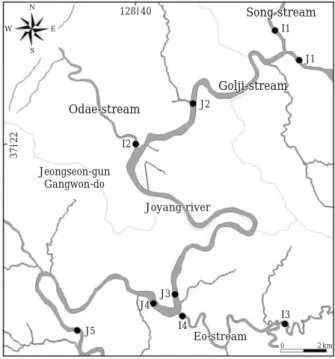
본 연구에서는 조양강 본류5
개 정점과 유입천4
개 정점을 선정하였으며 위치는 다음과 같다(Fig. 1).
조 양강 본류5
개 정점은 강원도 정선군 북면 여량리에 위 치한 여량1
교(J1),
북평면 장열리 장열교(J2),
정선읍 봉 양리 정선제2
교(J3),
봉양리 정선대교(J4),
광하리 광하 대교(J5)
이다.
그리고 유입천4
개 정점은 북면 유천리 송 천교(I1),
북평면 나전리 나전교(I2),
정선읍 덕우리 덕산3
교(I3),
정선읍 애산리 애산교(I4)
이다.
2.
채집 및 분석방법수온
, pH,
용존산소(DO),
전기전도도(Conductivity)
는Horiba D-55, Orion 5-star
를 이용하여 현장에서 측정하 였으며,
탁도는 현장에서 채수한 시료를 실험실로 운반하 여 탁도계(WTW, Turb550)
를 이용하여 측정하였다.
총질 소,
총인, BOD
는 수질측정망을 이용하였다(Water Infor- mation System, 2008~2010).
Fig. 1. Map showing the 9 sampling sites of the Joyang- river and inflow streams from Jun. 2008 to Sep.
2010.
128�40′ Song-stream
Golji-stream Odae-stream
Joyang-river
Eo-stream
N
W E
S
Jeongseon-gun Gangwon-do
I1
J1
J2
I2
J3 J4 J5
I3
0
I4
2 km
37�22′
Table 1. Physico-chemical properties determined at 9 sampling sites of the Joyang-river and inflow streams from Jun.
2008 to Sep. 2010.
Date Site WT
pH DO Cond. Turb. Chl-a AFDM BOD T-N T-P
(�C) (mg L-1) (μS cm-1) (NTU) (μg cm-2) (mg cm-2) (mg L-1) (mg L-1) (μg L-1) J1 27.6 9.3 11.8 197.1 2.6 16.8 4.2 0.6 1.724 15
I1 24.5 9.1 8.2 178.0 4.1 3.3 0.8 0.4 1.791 11
J2 25.5 9.1 9.2 188.0 13.4 9.7 2.5 1.1 1.606 26 I2 25.7 9.1 8.9 106.5 17.2 3.2 2.0 1.0 2.330 69 Jun. 2008 J3 29.0 9.4 10.0 166.2 14.4 1.6 0.7 0.7 2.188 59
I3 21.6 8.3 8.5 311.4 0.5 2.7 1.1 - - -
I4 25.2 8.9 12.4 287.8 1.3 90.8 12.5 0.3 2.567 2 J4 26.9 9.4 10.4 184.4 10.3 16.0 3.2 0.8 2.140 41 J5 25.2 9.5 11.1 217.9 7.0 2.1 0.6 1.8 1.466 16 J1 23.8 9.7 16.2 176.0 0.7 51.0 9.0 0.5 1.965 16
I1 22.5 9.6 12.1 155.5 1.7 9.6 1.2 0.7 2.700 40
J2 22.5 9.7 10.6 154.8 1.5 9.0 2.0 0.7 2.279 24
I2 23.4 10.0 12.8 132.0 1.5 3.8 1.1 0.6 2.866 30
Sep. 2008 J3 21.8 9.4 12.8 154.4 1.8 30.2 2.3 0.7 2.596 49
I3 20.1 8.8 11.2 272.8 0.4 10.1 2.3 - - -
I4 20.4 8.8 13.2 302.0 1.1 6.8 4.3 0.4 3.035 8 J4 22.7 9.3 15.8 214.3 1.2 17.2 4.1 0.7 2.615 16 J5 22.7 9.3 12.9 174.3 1.4 9.3 1.9 0.9 2.202 67 J1 14.4 9.3 5.7 146.0 2.7 10.1 1.7 0.9 2.486 09 I1 16.3 9.4 10.9 191.0 2.1 15.7 3.2 0.7 3.798 17 J2 13.9 9.3 5.6 169.8 2.2 12.9 3.1 0.7 2.326 12
I2 15.0 9.8 6.4 113.8 3.1 5.7 1.3 0.7 2.535 30
Apr. 2009 J3 18.4 10.1 9.3 162.0 4.2 12.6 2.9 0.4 4.560 17
I3 15.9 9.3 6.8 282.4 0.9 3.5 1.5 - - -
I4 17.0 9.2 7.8 333.0 2.1 4.1 1.5 0.3 3.188 13
J4 18.1 9.8 8.3 192.1 1.9 7.9 3.1 1.0 2.860 11
J5 17.0 9.7 7.9 186.5 1.8 5.6 1.8 0.6 2.592 16
J1 23.4 9.3 8.1 211.3 0.5 4.7 2.0 0.7 2.979 14
I1 22.6 9.8 6.2 142.8 0.7 10.8 2.0 0.4 2.396 21 J2 21.4 9.3 6.2 197.1 0.6 21.6 2.4 0.9 2.331 16
I2 23.9 10.2 8.4 156.5 0.4 9.8 2.8 0.8 3.518 17
Sep. 2009 J3 23.5 9.5 7.2 184.8 1.5 5.4 1.7 0.4 2.999 40
I3 21.9 8.9 7.5 274.5 0.4 2.8 1.6 - - -
I4 23.6 8.9 8.0 310.0 1.1 3.1 1.5 0.4 3.101 23
J4 26.1 9.3 10.4 215.2 0.8 9.9 2.2 0.8 3.995 60
J5 23.9 9.2 8.1 211.9 0.7 1.3 0.7 0.4 2.730 15
J1 21.1 8.3 12.8 186.8 1.5 9.5 5.1 0.4 2.646 20
I1 19.0 8.4 11.9 110.9 2.8 1.9 0.8 1.2 2.399 53
J2 16.4 7.9 9.4 129.4 2.1 0.7 0.4 1.2 1.612 15
I2 18.9 8.4 12.3 91.0 2.9 5.0 1.6 0.8 1.820 17 May 2010 J3 16.5 8.6 11.2 133.1 3.9 5.1 2.0 0.5 2.522 19
I3 20.0 7.9 10.6 286.6 0.4 3.0 1.2 - - -
I4 16.6 8.1 12.1 310.0 1.9 5.3 4.2 0.3 3.418 13
J4 17.3 8.6 12.2 226.0 2.2 4.0 2.0 0.4 2.828 13
J5 20.2 8.5 13.1 166.5 2.3 1.7 0.8 0.6 2.267 13 J1 16.2 7.5 13.0 204.2 1.7 0.7 0.8 0.3 2.778 20 I1 14.5 7.3 13.0 108.5 31.8 1.7 0.6 0.3 2.515 46 J2 12.4 7.5 11.8 155.5 15.1 1.0 0.7 0.7 2.574 76
I2 15.0 7.5 14.5 143.9 0.8 2.5 0.7 0.4 2.950 43
Sep. 2010 J3 15.2 7.4 12.2 160.0 10.9 1.6 1.0 0.4 2.299 29
I3 12.9 7.6 11.6 314.0 0.2 0.1 0.4 - - -
I4 13.4 7.6 12.3 340.0 0.6 0.1 0.3 0.4 4.188 11 J4 14.6 7.6 14.7 259.0 4.9 3.0 1.1 0.6 2.385 29
J5 15.4 7.4 12.4 185.1 7.3 0.4 0.5 0.4 2.569 22
부착규조류의 채집은 기질의
25 cm
2를 부드러운 솔로 정량 채집하였고(Ministry of Environment, 2007), 1%
의 포르말린으로 고정하였다.
부착규조류의 분석은U.S. EPA (1995)
에 따라 시료를 세정 및 봉입 후 영구표본을 제작 하여 광학현미경(Olympus BX47, Japan)
을 사용하여1000
배 하에서 수행하였다.
동정에Chung (1993)
등을 참 고하였고, Simonsen
의 분류체계(Ettl et al., 1986, 1988, 1991a, b)
에 따라 정리하였다.
엽록소a
와AFDM (Ash- free dry matter)
은Standard methods (APHA, 1998)
에 준하여 분석하였다.
부착규조류를 이용한 생물학적 수질평가를 하기 위해서
DAIpo (Watanabe et al., 1990, 2005)
와TDI (Kelly and Whitton, 1995)
를 이용하였다.
결과 및 고찰
1. 이화학적 환경요인
조양강 및 유입천의
9
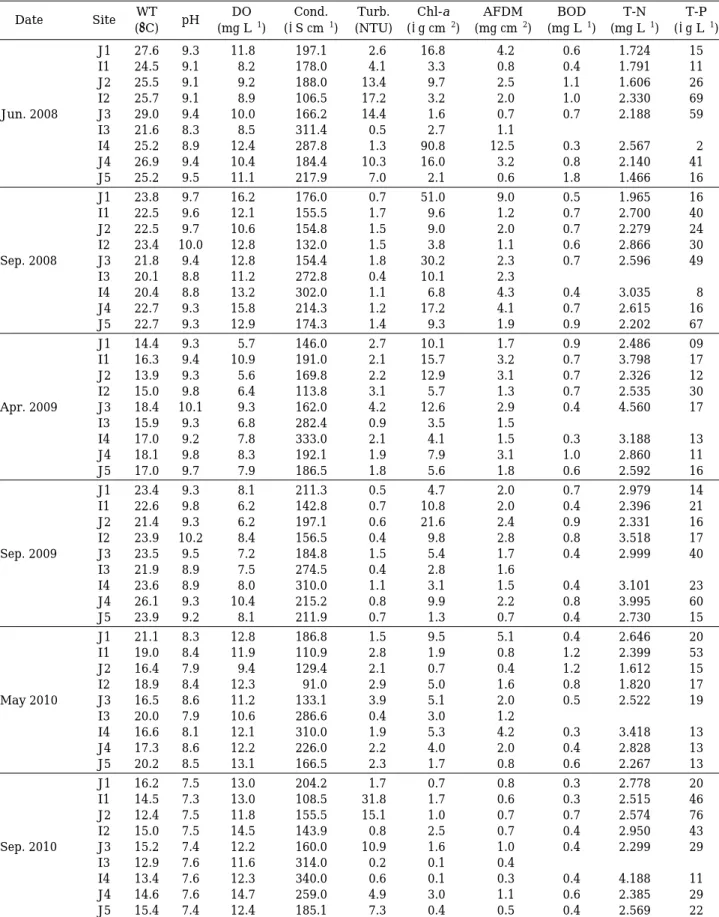
개 정점에서 조사된 이화학적 환경요인은 다음과 같다
(Table 1).
수온은12.4~29.0
�C
이 고, pH
는7.4~10.2
의 범위로 중성~
알칼리성을 나타냈 다.
이는 조양강 일대가 석회암으로 이루어져 있기 때문 인 것으로 사료된다(Kang, 1998).
탁도는0.4~17.2 NTU
로 대부분5
이하로 조사되었지만, 2008
년6
월과2010
년9
월의 경우 높은 값을 나타냈다.
이는 강우에 의한 일시 적인 탁도 증가로 사료된다(Water Information System, 2008~2010). BOD
는0.3~1.8 mg L
-1로I~II
등급으로 나타났다.
총질소는1.466~4.560 mg L
-1,
총인은2~76 μg L
-1로 본류에 비해 유입천의 총질소와 총인의 농도가 높았으나,
유입천의 유량이 상대적으로 적기 때문에 본류 에 미치는 영향은 미비하였다(Wu et al., 2012).
2. 생물량 및 유기물량
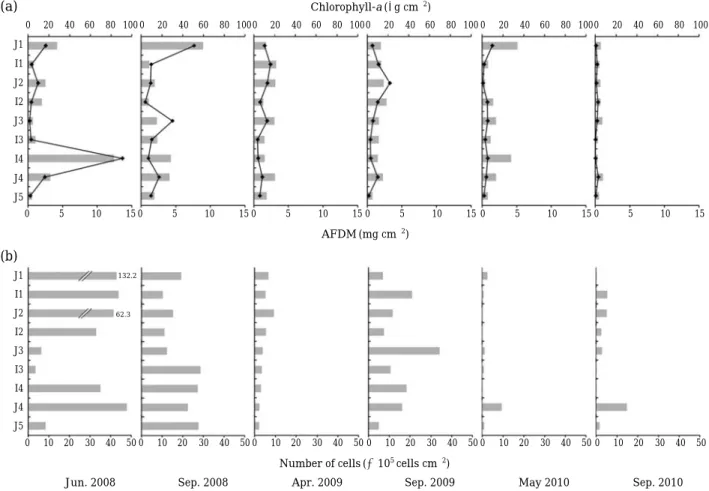
엽록소
a
는0.2~90.8 μg cm
-2로 큰 변동을 보였고, AFDM
은0.3~12.5 mg cm
-2의 범위를 보였다(Fig. 2a).
특히
2008
년6
월의I4
정점에서 엽록소a
와AFDM
이 최 대치를 기록한 것에 비해 총인의 농도는2 μg L
-1로 나타Fig. 2. Chlorophyll-a (a: line), AFDM (a: bar) and Number of cells (b) at the Joyang-river and inflow streams from Jun.
2008 to Sep. 2010.
0 20 40 60 80 100
0 5 10 15
0 10 20 30 40 50 0 10 20 30 40 50 0 10 20 30 40 50 0 10 20 30 40 50 0 10 20 30 40 50 0 10 20 30 40 50 AFDM (mg cm-2)
132.2
62.3
Number of cells (×105 cells cm-2)
Jun. 2008 Sep. 2008 Apr. 2009 Sep. 2009 May 2010 Sep. 2010
Chlorophyll-a (μg cm-2)
0 5 10 15 0 5 10 15 0 5 10 15 0 5 10 15 0 5 10 15
J1 I1 J2 I2 J3 I3 I4 J4 J5
J1 I1 J2 I2 J3 I3 I4 J4 J5
(a)
(b)
0 20 40 60 80 100 0 20 40 60 80 100 0 20 40 60 80 100 0 20 40 60 80 1000 20 40 60 80 100
났는데
,
이는 조류 성장에 의한 인의 소비와6
월에 집중 된 강우에 의해 인이 희석되어 낮은 농도를 보인 것으로 사료된다(Water Information System, 2008~2010).
부착규조류의 생물량은
0.05~132.20
×10
5cells cm
-2 의 범위로 시기 및 정점에 따라 큰 변동을 나타냈다(Fig.
2b). 2008
년6
월J1
정점에서132.20
×10
5cells cm
-2로 가장 높은 값을 나타냈고, 2010
년4
월I4
정점에서0.05
×
10
5cells cm
-2로 가장 낮은 값을 보였다.
2008
년6
월의I4
정점에서 엽록소a
와AFDM
의 값이 큰 수치를 나타냈으나 부착규조류의 현존량이 다른 지점 과 유사한 것으로 볼 때 이 시기 및 정점에서는 규조강(Bacillariophyceae)
이 아닌 남조강(Cyanophyceae)
이나 녹조강(Chlorophyceae)
이 급격하게 늘어난 것으로 판단 된다(Cho et al., 2010).
반면에2008
년6
월J1, I1, J2, I2
정점에서는 부착규조류의 현존량에 비해 엽록소a
와AFDM
의 값이 상대적으로 낮았다.
이는 세포의 크기와 종에 따라 엽록소a
양이 다르기 때문인 것으로 사료된다(Jiménez et al., 1987; Odete and Yanada, 1993).
3. 출현종 및 우점종
조양강 및 유입천에서 출현한 부착규조류는
2
목6
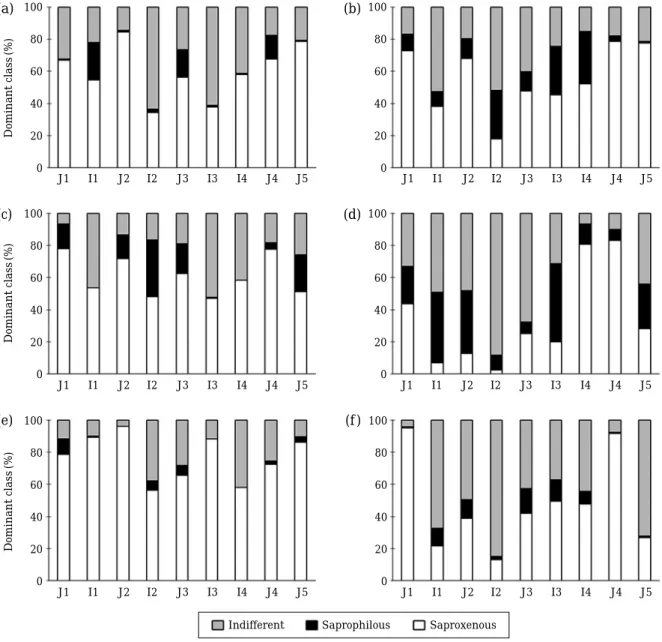
과Fig. 3. Changes of dominant class at 9 sampling sites of the Joyang-river and inflow streams from Jun. 2008 to Sep. 2010 (a: Jun. 2008, b: Sep. 2008, c: Apr. 2009, d: Sep. 2009, e: May 2010, f: Sep. 2010).
Indifferent Saprophilous Saproxenous 100
80
60
40
20
0
100
80
60
40
20
0
100
80
60
40
20
0
100
80
60
40
20
0 100
80
60
40
20
0 100
80
60
40
20
0
J1 I1 J2 I2 J3 I3 I4 J4 J5
J1 I1 J2 I2 J3 I3 I4 J4 J5
J1 I1 J2 I2 J3 I3 I4 J4 J5 J1 I1 J2 I2 J3 I3 I4 J4 J5
J1 I1 J2 I2 J3 I3 I4 J4 J5
J1 I1 J2 I2 J3 I3 I4 J4 J5
Dominant class(%)Dominant class(%)Dominant class(%)
(a) (b)
(c) (d)
(e) (f )
23
속95
종15
변종2
품종5
미동정종으로 총117
분류군 이 출현하였다. 2009
년4
월I4
정점에서7
분류군으로 가 장 적게 출현하였고, 2008
년6
월과2009
년9
월,
그리고2010
년9
월J3
정점에서28
분류군으로 가장 많이 출현 하였다(Appendix).
본 연구에서 출현한 분류군은 주로 중성수역과 알칼리 성 수역에 분포하는 분류군으로 구성되어 있었다
.
그 중Achnanthes laterostrata, Fragilaria capucina, Synedra acus
는 중성수역에서 분포하는 것으로 알려져 있으며, A.
lanceolata, Cocconeis placentula var. euglypta, C. pla- centula var. lineata
는 중성~
알칼리성 수역에 분포하는 분류군이다.
또한A. hungarica, Cymbella affinis, C. tu- mida
는 알칼리성의 수역에 분포하며, C. delicatula, F.
capucina var. mesolepta
는 석회성분이 풍부한 하천에 분 포하는 것으로 보고되었다(Chung, 1993).
또한 산성수역 의 출현종은 나타나지 않았다.
특히C. delicatula
는 조사기간 중
I3
과I4
정점에서 대부분10%
이상의 상대출현 빈도를 나타냈다.
Watanabe et al. (2005)
의 기준에 따라 출현종을 구분 하면 평균적으로 호청수성종이55.70%,
호오염성종이11.58%,
그리고 광적응성종이32.72%
의 출현빈도를 보 여 상대적으로 호청수성종이 많이 출현하는 것으로 나타 났다. J1
정점에서 높게 출현한 호청수성종은J3
정점으 로 갈수록 점차 줄어들었으며, J5
정점으로 갈수록 다시 증가하는 경향성을 보였다(Fig. 3). 2009
년9
월의 경우 호오염성종과 광적응성종의 출현빈도가 증가하였다.
이 는 갈수기 유량 감소에 의해 영양염이 축적되어 수질이 악화되었기 때문이다(Table 1).
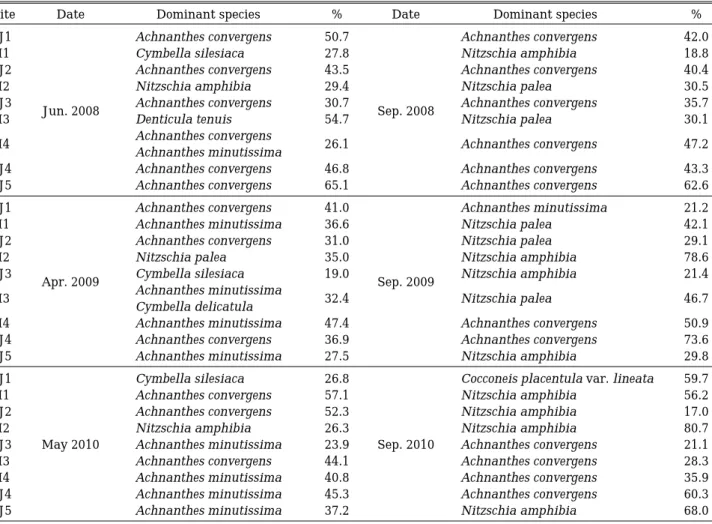
부착규조류 중 우점종은
Achnanthes convergens, A.
minutissima, Cocconeis placentula var. lineata, Cymbella delicatula, C. silesiaca, Nitzschia amphibia, N. palea
로7
분류군 이었다(Table 2).
본류인J1~J5
정점은2008
년Table 2. The percentages of dominant species at 9 sampling sites of the Joyang-river and inflow streams from Jun. 2008 to Sep. 2010.
Site Date Dominant species % Date Dominant species %
J1 Achnanthes convergens 50.7 Achnanthes convergens 42.0
I1 Cymbella silesiaca 27.8 Nitzschia amphibia 18.8
J2 Achnanthes convergens 43.5 Achnanthes convergens 40.4
I2 Nitzschia amphibia 29.4 Nitzschia palea 30.5
J3 Jun. 2008 Achnanthes convergens 30.7
Sep. 2008 Achnanthes convergens 35.7
I3 Denticula tenuis 54.7 Nitzschia palea 30.1
I4 Achnanthes convergens
Achnanthes minutissima 26.1 Achnanthes convergens 47.2
J4 Achnanthes convergens 46.8 Achnanthes convergens 43.3
J5 Achnanthes convergens 65.1 Achnanthes convergens 62.6
J1 Achnanthes convergens 41.0 Achnanthes minutissima 21.2
I1 Achnanthes minutissima 36.6 Nitzschia palea 42.1
J2 Achnanthes convergens 31.0 Nitzschia palea 29.1
I2 Nitzschia palea 35.0 Nitzschia amphibia 78.6
J3 Apr. 2009 Cymbella silesiaca 19.0
Sep. 2009 Nitzschia amphibia 21.4
I3 Achnanthes minutissima
Cymbella delicatula 32.4 Nitzschia palea 46.7
I4 Achnanthes minutissima 47.4 Achnanthes convergens 50.9
J4 Achnanthes convergens 36.9 Achnanthes convergens 73.6
J5 Achnanthes minutissima 27.5 Nitzschia amphibia 29.8
J1 Cymbella silesiaca 26.8 Cocconeis placentula var. lineata 59.7
I1 Achnanthes convergens 57.1 Nitzschia amphibia 56.2
J2 Achnanthes convergens 52.3 Nitzschia amphibia 17.0
I2 Nitzschia amphibia 26.3 Nitzschia amphibia 80.7
J3 May 2010 Achnanthes minutissima 23.9 Sep. 2010 Achnanthes convergens 21.1
I3 Achnanthes convergens 44.1 Achnanthes convergens 28.3
I4 Achnanthes minutissima 40.8 Achnanthes convergens 35.9
J4 Achnanthes minutissima 45.3 Achnanthes convergens 60.3
J5 Achnanthes minutissima 37.2 Nitzschia amphibia 68.0
에 모두 호청수성 종인
Achnanthes convergens
가 우점 하였으나, 2009
년9
월에 호오염성종인Nitzschia amphi- bia
와N. palea
가J2
정점을 포함한3
개 정점에서 우점하 였다(Table 2).
유입천인I1~I4
정점에서는 대체로 호오 염성종인Nitzschia amphibia, N. palea
가 우점하는 경향 을 보였다.
이는 유량에 비해 높은 영양염과 일시적으로 증가한 탁도로 인해 수질이 악화되었기 때문인 것으로 사료된다(Table 1).
4. 생물학적 수질평가
DAIpo
와TDI
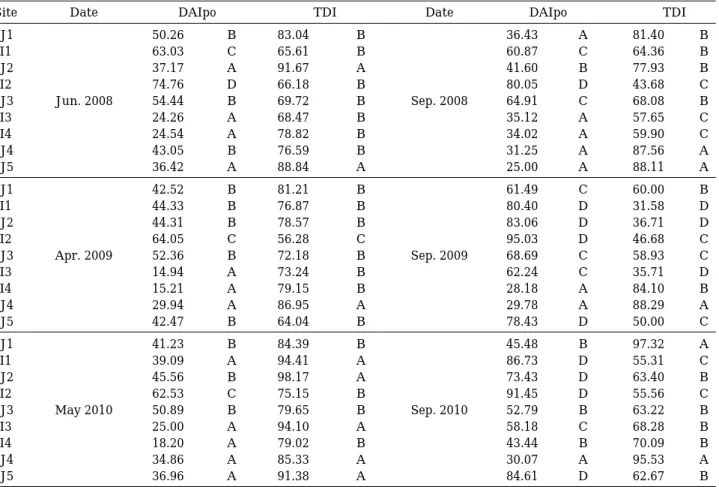
를 이용한 생물학적 수질평가 결과, DAIpo
지수는18.20~95.03
으로 넓은 범위를 보였고, TDI
지수 는31.58~98.17
로, A~D
등급을 나타났다(Ministry of Environment, 2007) (Table 3).
DAIpo
의 경우 본류와 유입천 모두A~D
등급에 걸쳐 나타났으나,
비교적 유입천의 등급이 낮은 편이다. TDI
의 경우 본류인J1~J5
정점은2009
년9
월을 제외하면 모 두A~B
등급으로 수질이 양호하였고,
유입천인I1~I4
정점은
A~D
등급에 걸쳐 나타났으며,
본류에 비해 등급 이 낮게 나타났다.
생물학적 수질평가 시 대체로TDI
가DAIpo
에 비해 높은 오염 등급을 나타내는 것으로 보고 되었으나(Hwang et al., 2006; Kim et al., 2009),
조양강 및 유입천에서는DAIpo
가TDI
보다 높은 오염 등급을 나타냈다.
이는 조양강 및 유입천의 수질은 유기오염에 의한 영향이 더 큰 것으로 사료된다.
일반적으로 하류로 갈수록 오염도가 증가하는 경향을 보이지만
(Kim et al., 2009),
본 연구에서는 하류보다는 유 입천이 본류에 비해 생물학적 수질평가가 낮았다.
이는 유 입천 유역에 존재하는 점오염원이 유입천의 유량에 비해 많기 때문인 것으로 사료된다(Wu et al., 2012).
유입천은 본류의 유량에 의해 희석되고,
조류군집의 소비로 인해 영 양염의 농도가 줄어들기 때문에 본류의 수질에 미치는 영 향은 크지 않다(Aponasenkoa et al., 2010).
그러나2009
년9
월의 경우I1
정점에서 시작된 낮은 등급이J3
정점 까지 이어지는 것으로 볼 때 조양강 일대 유입천의 수질 관리가 필요한 것으로 판단된다.
Table 3. Water quality assessment using diatom indices at 9 sampling sites of the Joyang-river and inflow streams from Jun. 2008 to Sep. 2010.
Site Date DAIpo TDI Date DAIpo TDI
J1 50.26 B 83.04 B 36.43 A 81.40 B
I1 63.03 C 65.61 B 60.87 C 64.36 B
J2 37.17 A 91.67 A 41.60 B 77.93 B
I2 74.76 D 66.18 B 80.05 D 43.68 C
J3 Jun. 2008 54.44 B 69.72 B Sep. 2008 64.91 C 68.08 B
I3 24.26 A 68.47 B 35.12 A 57.65 C
I4 24.54 A 78.82 B 34.02 A 59.90 C
J4 43.05 B 76.59 B 31.25 A 87.56 A
J5 36.42 A 88.84 A 25.00 A 88.11 A
J1 42.52 B 81.21 B 61.49 C 60.00 B
I1 44.33 B 76.87 B 80.40 D 31.58 D
J2 44.31 B 78.57 B 83.06 D 36.71 D
I2 64.05 C 56.28 C 95.03 D 46.68 C
J3 Apr. 2009 52.36 B 72.18 B Sep. 2009 68.69 C 58.93 C
I3 14.94 A 73.24 B 62.24 C 35.71 D
I4 15.21 A 79.15 B 28.18 A 84.10 B
J4 29.94 A 86.95 A 29.78 A 88.29 A
J5 42.47 B 64.04 B 78.43 D 50.00 C
J1 41.23 B 84.39 B 45.48 B 97.32 A
I1 39.09 A 94.41 A 86.73 D 55.31 C
J2 45.56 B 98.17 A 73.43 D 63.40 B
I2 62.53 C 75.15 B 91.45 D 55.56 C
J3 May 2010 50.89 B 79.65 B Sep. 2010 52.79 B 63.22 B
I3 25.00 A 94.10 A 58.18 C 68.28 B
I4 18.20 A 79.02 B 43.44 B 70.09 B
J4 34.86 A 85.33 A 30.07 A 95.53 A
J5 36.96 A 91.38 A 84.61 D 62.67 B
적 요
본 연구는 강원도 정선군에 위치한 조양강 및 유입천 을 대상으로 총
9
개 정점을 선정하고2008
년6
월부터2010
년9
월까지 총6
회에 걸쳐 이화학적 환경요인과 생 물량 및 부착규조류의 현존량을 조사하였다.
또한 부착규 조류의 군집구조를 분석하고 생물학적 평가를 통해 수질 을 평가하였다.
1.
조양강 일대는 석회암으로 구성되어pH
가7.4~10.2
로 중성~
알칼리성의 범위를 보였다.
2.
조양강 수계에서 출현한 부착규조류는2
목6
과23
속95
종15
변종2
품종5
미동정종으로 총117
분류군이 출 현하였고,
산성수역의 지표종은 출현하지 않았으며 중성~
알칼리성의pH
에서 생육하는Achnanthes laterostrata, Cymbella delicatula
등11
분류군이 출현하였다.
3.
특히 알칼리성 수역의 지표종인Cymbella delicatula
는I3
과I4
정점의 일부 시기를 제외하고10%
이상의 상 대출현빈도를 나타냈다.
4.
조양강 및 유입천에DAIpo
를 적용한 결과 조양강은 평균77.03
로A
등급을 나타냈으며,
유입천은 평균65.84
로B
등급으로 나타났다. TDI
를 이용한 생물학적 평가 시 조양강은A~B
등급을 나타냈으며,
유입천은A~D
등 급에 걸쳐 나타남으로써,
조양강 본류가 유입천보다 수질 이 양호한 것으로 나타났다.
5.
본 연구에서 유입천의 수질이 조양강에 미치는 영향 은 낮은 것으로 나타났으나, 2009
년9
월의 경우에는 본 류인J2
와J3
정점이 유입천I1
정점의 영향으로 수질이 저하되었다.
사 사
본 연구는 한국연구재단 기초연구사업
(2011-0005974)
과「수생태 건강성 조사 및 평가」에 의해 지원되었습니다
.
인 용 문 헌
APHA. 1998. Standard methods, For the examination of wa- ter and wastewater, 20th, New York, pp. 1220.
Aponasenkoa, A.D., V.V. Dryukkerb, L.M. Sorokovikovab and L.A. Shchura. 2010. The effect of tributaries on the environmental conditions in the enisei river. Water Re-
sources37(6): 817-824.
Bae, K.S., J.D. Yeo and C.I. Choi. 2002a. Distribution and variation of the terrestrial insects in the Choyang and Dong river, Korea. Korean Journal of Limnology 35(5):
259-371.
Bae, K.S., J.D. Yeo and C.I. Choi. 2002b. Characteristic of Benthic Macroinvertebrate Communities in the Choyang and Dong River, Korea. Korean Journal of Limnology 35(5): 372-387.
Cabecinha, E., R. Cortes, J. Cabral, T. Ferreira, M. Lourenço and M. Pardal. 2009. Multiscale approach using phyto- plankton as a first step towards the definition of the ecological status of reservoirs. Ecological Indicators 9(2):
240-255.
Cho, H.K., M.H. Jung, G.M. Kim, S.S. Shim and H.Y. Lee.
2010. Dynamics of phytoplankton and periphyton in Gwangju stream. Korean Journal of Environmental Biology 28(2): 69-78.
Cho, S.R. and C.I. Choi. 2002. Ecological studies en avifauna of Dong river, Korea. Korean Journal of Limnology 35(5): 337-343.
Chung, J. 1993. Illustration of the Freshwater Algae of Korea.
Academy Book, Seoul. pp. 496.
Domingues, R. and H. Galvao. 2007. Phytoplankton and environmental variability in a dam regulated temperate estuary. Hydrobiologia 586(1): 117-134.
Ettl, H., G. Gartner, J. Gerloff, H. Heynig and D. Mollen- hauer. 1991b. Süßwasserflora von Mitteleuropa. Band 2/4. Bacillariophyceae, Gustav Fischer Verlag, Stuttgart.
Ettl, H., J. Gerloff, H. Heynig and D. Mollenhauer. 1986.
Süßwasserflora von Mitteleuropa. Band 2/1. Bacillario- phyceae, Gustav Fischer Verlag, Stuttgart.
Ettl, H., J. Gerloff, H. Heynig and D. Mollenhauer. 1988.
Süßwasserflora von Mitteleuropa. Band 2/2. Bacillario- phyceae, Spektrum Akademischer Verlag, Berlin.
Ettl, H., J. Gerloff, H. Heynig and D. Mollenhauer. 1991a.
Süßwasserflora von Mitteleuropa. Band 2/3. Bacillario- phyceae, Spektrum Akademischer Verlag, Berlin.
Feio, M.J., S.F.P. Almeida, S.C. Craveiro and A.J. Calado.
2009. A comparison between biotic indices and predictive models in stream water quality assessment based on benthic diatom communities. Ecological Indicators 9(3):
497-507.
Ford, D.E. 1990. Reservoir Transport Peocess. In: Thorn- ton, K.W. B.L. Kimmel and F.E. Payne (eds.), Reservoir Limnology-Ecological Perspectives. John Wiley and Sons, Inc.
Horne, A.J. and C.R. Goldman. 1994. Limnology, 2nd ed.
Mcgraw-Hill, Inc.
Hotzel, G. and R. Croome. 1999. A Phytoplankton Methods Manual for Australian Freshwaters. LWRRDC Occasio- nal Paper 22/99.
Hwang, S.J., N.Y. Kim, D.H. Won, K.K. An, J.K. Lee and C.S. Kim. 2006. Biological assessment of water quality by using epilithic diatoms in major river systems (Geum, Youngsan, Seomjin River), Korea. Journal of Korean Society on Water Quality 22(5): 784-795.
Jeon, S.R., H.K. Choi and C.I. Choi. 2002. Ecological study on the fish community in the Dong river, Korea. Korean Journal of Limnology 35(5): 350-358.
Jiménez F.J., R.B. Bautista and V. Rodriguez. 1987. Rela- tions between chlorophyll, phytoplankton cell abundance and biovolume during a winter bloom in Mediterranean costal water. Journal of Experimental Marine Biology and Ecology 105(2-3): 161-173.
Kang, Y.P. 1998. Morphologie Karstiquednas le bassin de drainage fleure Dong (Joyang) en Coree. Journal of the Geomorphological Association of Korea 5(2): 131-142.
Kelly, M.G. 1998. Use of the trophic diatom index to monitor eutrophication in rivers. Water Research 32(1):236-242.
Kelly, M.G. 2001. Use similarity measures for quality con- trol of benthic diatom samples. Water Research 35(11):
2784-2788.
Kelly, M.G. 2002. Role of benthic diatoms in the implemen- tation of the urban wastewater treatment directive in the river wear, North-East England. Journal of Applied Phycology 14(1): 9-18.
Kelly, M.G. 2003. Short term dynamics of diatoms in an upland stream and implications for monitoring eutrophi- cation. Environmental Pollution 125(2): 117-122.
Kelly, M.G., S. Juggins, R. Guthrie, S. Pritchard, J. Jamie- son, B. Rippey, H. Hisrst and M. Yallop. 2008. Assess- ment of ecological status in U.K. rivers using diatoms.
Freshwater Biology 53(1): 403-422.
Kelly, M.G. and B.A. Whitton. 1995. The trophic diatom in- dex: a new index for monitoring eutrophication in rivers.
Journal of Applied Phycology 7(1): 433-444.
Kelly, M.G. and S. Wilson. 2004. Effect of phosphorus stri- pping on water chemistry and diatom ecology in an eas- tern lowland river. Water Research 38(6): 1599-1567.
Kim, B.H., Y.S. Park and Y.J. Kim. 2010. Periphytic diatom communities and water environment in the Donghwa constructed wetlands. Korean Journal of Limnology 43(1): 91-102.
Kim, Y.J. and O.M. Lee. 2011. The Phytoplankton commu- nity of Namdae-stream, Yeongok-stream and of Sacheon- stream in Gangwon-do. Journal of Korean Society of Environmental Impact Assessment 20(3): 281-297.
Kim, Y.J., K.A. Sin and O.M. Lee. 2009. Water quality asse- ssed by DAIpo and TDI of Bokha stream and Dal stream in South-han river. Korean Journal of Environmental Biology 27(4): 414-424.
Lee, J.H. 1988. Epilithic diatoms in the Naktong river and its value of the diatom assemblage index of organic water pollution (DAIpo). Korean Journal of Limnology 31(1): 38-44.
Ministry of Construction and Transportation. 2005. Standard for River Installation.
Ministry of environment. 2007. Ecowater health research and assessment guidelines. pp. 163.
Odete, T. and M. Yanada. 1993. Phytoplankton carbon bio- mass estimated from the size fractionated Chl-a concen- tration and cell density in the Northern Costal Wasters from Spring bloom to summer. Bulletin of the Plankton Society of Japan 39(2): 127-144.
Ponader, K.C., D.F. Charles, T.J. Belton and D.M. Winter.
2008. Total phosphorus inference models and indices for coastal plain streams based on bentic diatom assem- blages from artificial substrates. Hydrobiologia 610(1):
139-152.
Song, M.A., J.W. Kim, H.N. Kim, D.S. Kong and O.M. Lee.
2011. Water quality assessment using trophic status index and attached diatom index in 10 reservoirs inclu- ding Ye-dang reservoir of Chungcheongnam-do. Korean Journal of Limnology 44(2): 155-171.
Tang, T., Q. Cai and J. Liu. 2006. Using epilithic diatom communities to assess ecological condition of Xiangxi river system. Environmental Monitoring and Assessment 112(1-3): 347-361.
Tuji, A. 2003. Freshwater diatom flora in the bottom sedi- ments of lake Biwa: Part 2: Gomphonema sensulato.
Bulletin of the National Science Museum Series B (Bot- any) 29: 97-107.
U.S. EPA. 1995. Generic quality assurance project plan gui- dance for programs using community-level biological assessment in stream and wadeable rivers. U.S. Envi- ronmental protection Agency, Office of water, Washing- ton, D.C.EPA 841-B-95-004.
Watanabe, T., K. Asai and A. Houki. 1990. Numerical sim- ulation of organic pollution in flowing water. Hazardous Waste Containment and Treatment 4: 251-281.
Watanabe, T., K. Asai, A. Houki, S. Tanaka and T. Hizka.
1986. Saprophilous and eurysaprobic diatom taxa to organic water pollution and diatom assemblage index (DAIpo). Diatom 2: 23-73.
Watanabe, T., T. Ohtzsuka, A. Tuji and A. Houki. 2005. Pic- ture book and ecology of the freshwater diatoms. Uchida
rokako, Tokyo.
Water Information System. 2008~2010. Ministry of environ- ment. http://water.nier.go.kr.
Wu, N., B. Schmalz and N. Fohrer. 2012. Development and testing of a phytoplankton index of biotic integrity (P- IBI) for a German lowland river. Ecological Indicators 13(1): 158-167.
Yoon, S.A., N.Y. Kim, B.H. Kim and S.J. Hwang. 2010.
Effects of an inflowing urban stream (Wonju stream) on epilithic diatom assemblages in the lower SeomRiver.
Korean Journal of Limnology 43(2): 232-241.
Yuazao, Q., H. Weijian, L. Yumin and W. Liying. 1998.
Evaluation of water quality of the pearl river by using diatom assemblage index (DAIpo) and river pollution index (RPId). Journal Tropical and Subtropical Botany 6: 329-335.
(Manuscript received 13 April 2012, Revised 21 May 2012
Revision accepted 28 June 2012)
Appendix.Epilithic diatoms at 9 sampling sites of the Joyang-river and inflow streams from Jun. 2008 to Sep. 2010. DateJun. 2008Sep. 2008Apr. 2009Sep. 2009May 2010Sep. 2010 SpeciesJ1I1J2I2J3I3I4J4J5J1I1J2I2J3I3I4J4J5J1I1 Phylum CHRYSOPHYTA Cl. BACILLARIOPHYCEAE Ord. Centrales Subord. Coscinodiscineae Fam. Thalassiosiraceae Cyclotella comta++ C. meneghiniana+ C. radiosa C. stelligera++ Cyclotellasp.+ Stephanodiscus hantzschii+ Thalassiosira bramaputrae Melosira varians+++++++++ Ord. Pennales Subord. Coscinodiscineae Fam. Fragilariaceae Diatoma mesodon D. vulgaris++++ Fragilaria arcus+ F. arcusvar. recta+ F. capitata F. capitellata F. capucina++++++ F. capucinavar. capitellata+++++++++++ F. capucinavar. mesolepta+ F. construensf. binodis F. construensf. venter F. crotonensis+ F. rumpensvar. familiaris++ F. vaucheriaevar. capitellata+ Hannaea arcus Meridion circulare M. circularevar. constrictum Synedra acus++++ S. acusvar. angustissima++ S. acusvar. ostenfoldii+ S. inaequalis+++++ S. ulna+++++ Tabellaria fenestrata+ Subord. Coscinodiscineae Fam. Achnanthaceae Achnanthes convergens++++++++++++++++++++
J2I2J3I3I4J4J5J1I1J2I2J3I3I4J4J5J1I1J2I2 ++++ +++ + + + ++++++++++ +++++++++ +++++ ++++ ++++ + ++ ++ + + + +++++++ ++++++++ +++++++++++++++++
J3I3I4J4J5J1I1J2I2J3I3I4J4J5 ++ +++++ + + + ++++++ ++ + ++ ++ ++ + ++++++++++++++
Achnanthes crenulata+ A. delicatula+ A. hungarica A. japonica A. lanceolata+++ A. laterostrata A. minutissima+++++++++++++++++++ A. subhudsonis++++ A. subhudsonisvar. kraeuselii++ Cocconeis pediculus++ C. placentulavar. euglypta+ C. placentulavar. lineata+++++++++++++++++ Cocconeissp. Fam. Naviculaceae Amphora copulata++ A. inariensis+++++ A. montana+ A. pediculus Caloneis silicula Cymbella affinis+++++++++++++++ C. delicatula++++++++ C. japonica C. lacustris+++++ C. minuta+++++++++ C. prostrata++ C. silesiaca++++++++++++ C. sinuata++++++++ C. subaequalis+ C. tumida+++ C. turgidula+ C. turgidulavar. nipponica Cymbellasp.++ Didymosphenia geminata++++ D. siberica+ Gomphonema acuminatum+ G. angustum+ G. augurvar. gautieri G. clevei G. globiferum G. gracile G. minutum+++ G. parvulum+++++
+ +++++ ++++++++++++++++++++ ++++++++ ++ + ++++++++++++++ + + ++++++++++ ++++++ ++ ++++ ++++++ +++++++++++ ++++++++++++ ++ ++++++++ ++ + ++ + + ++++
+ + + +++++++++++++ + ++ +++++++++++++ ++ ++ ++++++++++++ ++++++ ++ +++++ ++++++++++ +++++ ++++++++++++ ++++ + ++++++ ++ +++++
Appendix.Continued. DateJun. 2008Sep. 2008Apr. 2009Sep. 2009May 2010Sep. 2010 SpeciesJ1I1J2I2J3I3I4J4J5J1I1J2I2J3I3I4J4J5J1I1J2I2J3I3I4J4J5J1I1J2I2J3I3I4J4J5J1I1J2I2J3I3I4J4J5J1I1J2I2J3I3I4J4J5
Gomphonema pseudosphaerophorum+ G. quadripunctatum G. truncatum++ Gomphonemasp.+ Navicula americana+ N. bacillum++ N. capitatoradiata++++ N. cincta N. cryptocephala+++++ N. lanceolata N. menisculus+++ N. minima N. nipponica+ N. pseudolanceolata+ N. pupula++ N. saprophila N. seminulum++ N. subalpina N. subminuscula+++ N. trivialis+ N. viridulavar. rostellata+++++++++ Rhoicosphenia abbreviata+ Fam. Bacillariaceae Denticula fenais D. tenuis++++++ Nitzschia acicularis++ N. amphibia+++++++++++++++++ N. dissipata++++ N. frustulum++++ N. inconspicua N. linearis++++ N. palea+++++++++++++++++ N. sinuatevar. tabellaria+++++++++++++++ N. umbonata+ Nitzschiasp.+ Fam. Surirellaceae Cymatopleura solea+ Surirella angusta+ S. minuta+ S. ovalis+ S. tenera+
++ ++ + ++++++++ + ++++ + + +++ + + + ++++++++ + ++++++ ++++++++++++++++ ++ +++ +++++++++++++++++ ++++++++++++ +++
++ + ++ +++++++ +++ +++++++ ++++ + ++++++++ +++++++++++++ + + +++++++++ ++++++++ +
Appendix.Continued. DateJun. 2008Sep. 2008Apr. 2009Sep. 2009May 2010Sep. 2010 SpeciesJ1I1J2I2J3I3I4J4J5J1I1J2I2J3I3I4J4J5J1I1J2I2J3I3I4J4J5J1I1J2I2J3I3I4J4J5J1I1J2I2J3I3I4J4J5J1I1J2I2J3I3I4J4J5