468
Copyright © 2019 The Korean Society of Fisheries and Aquatic Science pISSN:0374-8111, eISSN:2287-8815
서 론
어류에있어사료섭취는성장속도와사료이용성에영향을 미치는중요한요소중하나이다
.
영양적으로균형잡힌사료 의공급은어류의생산성을향상시키고질병발생을감소시키 는데중요하다.
그러나충분치못한사료의공급은어류의성 장과생존율을감소시키며반대로과도한사료의공급은사료 의낭비와수질저하를초래하기때문에사료이용성에악영향 을미칠수있다(Biswas et al., 2006).
따라서적절한사료공급 전략은어류의생산성향상을위해필수적이다.
일반적으로양식대상어종에대한적정사료공급횟수를결정하는데있어어 류의크기와성장단계
(Lee et al., 2000a; Kikuchi et al., 2006),
사료섭취량과소화기관내사료통과시간(Booth et al., 2008)
및환경조건(Biwas et al., 2006; Wang et al., 2009)
과같은다 양한요인들이영향을미치는것으로알려져있다.
특히국내주 요양식어종인넙치(Paralichthys olivaceus)
치어(1.5-4 g)
사 육에있어적정상업용사료공급량은1
일3
회이며(Lee et al., 1999),
배합사료내에너지함량에따른넙치치어(3.5-15 g)
의 적정사료공급량은1
일2
회또는1
일3
회인것으로보고된바 있다(Lee et al., 2000b).
또한육성기넙치(280 g
이상)
의사육시판용 침강 및 부상 배합사료 공급횟수가 미성어기 강도다리(Platichthys stellatus)의 성장, 사료이용성 및 체조성에 미치는 영향
변순규·최진·임현정·정민환
1·김경덕
2·김희성
3*
국립수산과학원 동해수산연구소, 1국립수산과학원 제주수산연구소, 2국립수산과학원 양식관리과, 3경상대학교 해양식품생명의학과
Effect of Feeding Frequency of Commercial Floating and Sinking Pellet Diets on the Growth Performance, Feed Utilization and Body
Composition of Sub-adult Starry Flounder Platichthys stellatus
Soon-Gyu Byun, Jin Choi, Hyun Jeong Lim, Min Hwan Jeong1, Kyoung-Duck Kim2 and Hee Sung Kim3*
Aquaculture Industry Research Division, East Sea Fisheries Research Institute, National Institute of Fisheries Science, Gangneung 25435, Korea
1Jeju Fisheries Research Institute, National Institute of Fisheries Science, Jeju 63068, Korea
2Aquaculture Management Division, National Institute of Fisheries Science, Busan 46083, Korea
3Department of Marine Seafood and Aquaculture Science, Gyeongsang National University, Tongyeong 53064, Korea
A 2×4 factorial feeding trial was conducted to examine the effect of feed type and feeding frequency on the per- formance of sub-adult starry flounder Platichthys stellatus . Two feed types, sinking pellets (SP) and floating pellets (FP), were given to 480 fish housed in tanks. Triplicate groups of fish were fed each feed type at one of four feeding frequencies (one meal every two days, one meal per day, two meals per day, and three meals per day) for nine weeks.
Weight gain (WG) and specific growth rate (SGR) of fish were affected by feeding frequency. However, WG and SGR were the same in fish fed SP at two and three meals per day; similarly, there was no difference in WG or SGR of fish fed FP at one meal, two meals, or three meals per day. Feed utilization of fish was affected by both feed type and feeding frequency. These findings suggest that two meals per day of the SP or one meal per day of FP are sufficient for optimum growth performance of sub-adult starry flounder.
Key words: Starry Flounder, Feeding frequency, Sinking pellet, Floating pellet, Performance
*Corresponding author: Tel: +82. 55. 772. 9154 Fax: +82. 55. 772. 9159 E-mail address: [email protected]
This is an Open Access article distributed under the terms of the Creative Commons Attribution Non-Commercial Licens (http://creativecommons.org/licenses/by-nc/3.0/) which permits unrestricted non-commercial use, distribution, and reproduction in any medium, provided the original work is properly cited.
Received 9 September 2019; Revised 4 October 2019; Accepted 10 October 2019 저자 직위: 변순규(연구관), 최진(연구사), 임현정(과장), 정민환(연구사), 김경 덕(연구사), 김희성(조교수)
https://doi.org/10.5657/KFAS.2019.0468
Korean J Fish Aquat Sci 52(5), 468-473, October 2019
에있어적정사료공급횟수는
1
일1
회로알려진바있다(Seo et
al., 2005).
강도다리는최근한국과중국에서새로운주요양식대상어종으로여겨져양식생산이활발히이루어지고있으 며
,
높은상업적가치때문에양식생산규모가점차확대되고 있는실정이다(An et al., 2011).
이에따라강도다리의배합사 료내지방산요구량(Lee et al., 2003),
적정단백질과지질함량 비(Wang et al., 2017),
어분대체원료개발(Song et al., 2014)
및사료첨가제개발(Park et al., 2016; Schmidt et al., 2017)
등 과같은연구가이루어진바있다.
그러나공급률또는공급횟수 에관한연구는강도다리치어(10-20 g)
에대한배합사료(crude protein, CP 50%)
의적정사료공급횟수(Kim et al., 2019)
가보 고된바있으나,
미성어기강도다리(180 g
내외)
의배합사료의 적정사료공급횟수에대한연구는보고된바없다.
따라서본 연구에서는상업용시판부상및침강배합사료의공급횟수가 미성어기강도다리의성장,
사료이용성및체조성에미치는영 향을조사하였다.
재료 및 방법
실험어 및 사육 조건
실험어는 경상북도 울진에위치한강도다리 양어장에서구
입하여국립수산과학원동해수산연구소로운송하였으며
, 2
주 간 예비사육을통해사육실험 환경에적응시켰다.
마리당평 균180.5±0.2 g
의강도다리를24
개의500 L
원형수조(
수량, 300 L)
에각각20
마리씩수용하였다.
사육시험기간동안의평 균사육수온은18.3±2.9°C,
염분은32.9±0.4 psu,
용존산소 는7.2±0.1 mg/L
였으며,
광주기는 형광등을이용하여12 L (light):12 D (dark)
조건으로유지하였다.
실험사료 및 실험디자인
실험사료는시중에서판매하고있는양어용부상사료
(
수분8.0%,
조단백질48.9%,
조지질5.8%,
조회분9.2%)
와침강사 료(
수분7.3%,
조단백질47.9%,
조지질6.3%,
조회분10.3%)
를사용하였다.
실험구는2
일1
회(0.5
회/
일), 1
일1
회(1
회/
일), 1
일2
회(2
회/
일)
및1
일3
회(3
회/
일)
로총4
개의실험구를설정하 여3
반복구를두었다.
사료공급시간은0.5
회/
일과1
회/
일공급 구는9:00
시, 2
회/
일공급구는9:00
와17:00
시및3
회/
일공급구 는09:00, 13:00
및17:00
시로설정하였다.
총사육시험기간은9
주였으며,
각설정된시간에실험어가사료를섭취하지않을때까지만복으로공급하였다
. 어체측정 및 성분분석
사육실험 종료시어체측정은 측정전일
24
시간절식한 후,
Table 1. Weight gain (g/fish) and specific growth rate (SGR) of sub-adult starry flounder Platichthys stellatus fed the different feed types and feeding frequencies for 9 weeks
Feed type Feeding frequency Initial weight (g/fish) Final weight (g/fish) Weight gain (g/fish) SGR1 (%/day)
SP2 One meal/2 days 180.5±0.20 243.4±2.33 62.9±2.12 0.47±0.013
One meal/day 180.7±0.10 278.8±1.37 98.1±1.42 0.69±0.008
Two meals/day 180.5±0.17 288.8±2.73 108.3±2.61 0.75±0.014
Three meals/day 180.5±0.19 295.7±5.33 115.2±5.59 0.78±0.030
FP3 One meal/2 days 180.1±0.20 231.0±0.90 50.9±1.10 0.40±0.008
One meal/day 180.3±0.20 276.5±2.06 96.2±2.04 0.68±0.012
Two meals/day 180.5±0.20 283.2±4.76 102.7±4.80 0.71±0.027
Three meals/day 180.6±0.20 284.0±0.61 103.4±0.56 0.72±0.003
Two-way ANOVA
Feed type P>0.8 P>0.8 P>0.7
SP 276.7±6.24 9.61±6.23 0.67±0.037
FP 268.7±6.71 88.3±6.66 0.63±0.041
Feeding frequency P<0.0001 P<0.0001 P<0.0001
One meal/2 days 237.2±2.99a 56.9±2.88a 0.43±0.019a
One meal/day 277.6±1.22b 97.1±1.19b 0.68±0.007b
Two meals/day 286.0±2.75c 105.5±2.75c 0.73±0.015c
Three meals/day 289.8±3.61c 109.3±3.64c 0.75±0.020c
Interaction P>0.4 P>0.4 P>0.2
Values (means of triplicate±SE) in the same column sharing a common superscript are not significantly different (P>0.05). 1SGR (%/day)
=(Ln final weight of fish-Ln initial weight of fish)×100/days of feeding trial. 2Sinking pellet. 3Floating pellet.
2-phenoxyethanol
용액(150 mg/L)
으로마취시켜각수조에수 용된모든실험어의개체별최종무게를측정하였다.
측정후5
마리의강도다리를무작위로선택하여성분분석용시료로이용 하였다.
실험사료와실험어의일반성분분석은AOAC (1990)
표준분석방법에따라수분은105°C dry oven
에서24
시간건 조후 측정하였으며,
조단백질은auto kjeldahl system (Ger- hardt VAP50OT/TT125, KG, Germany)
을사용하여분석하였 다.
조지질은조지질추출기(Velp SER 148, Usmate, Italy)
를사 용하여ether
로추출한후측정하였으며,
조회분은550°C
회화 로에서4
시간회화후측정하였다.
통계 분석
Two-way ANOVA-test
와Duncan’s multiple range test (Duncan, 1955)
로서SPSS program (SPSS Inc., Chicago, IL, USA)
을이용하여각실험구평균간의유의성을검정하였다.
결과 및 고찰
부상및침강사료에대한공급횟수를달리한
9
주간사육시미 성어기강도다리의어체중증가및일일성장률을Table 1
에나타내었다
.
사육기간동안모든실험구의생존율은100%
로실험구간에 유의차가없었다
(P>0.05).
어체중증가와일일성장률은사료형태
(
부상및침강)
에영향을받지않는것으로나타 났으나(P>0.05),
사료공급횟수에는유의한영향을받은것으 로나타났으며(P<0.001),
사료공급횟수가늘어날수록어체중 증가와일일성장률이증가되는것으로나타났다.
어체중증가 및일일성장율은사료공급횟수에있어침강사료를2
회/
일공 급한 실험구가0.5
회/
일 공급구와1
회/
일 공급구보다유의적 으로높게나타났으나(P<0.05), 3
회/
일공급구와는유의한차 이가나타나지않았다(P>0.05).
부상사료를2
회/
일공급구는0.5
회/
일공급구보다유의적으로높게나타났지만(P<0.05), 1
회/
일공급구와3
회/
일공급구와는유의적인차이가나타나지 않았다(P>0.05).
이러한결과는사료형태또는사료공급횟수 가어류의성장에영향을미친다는많은연구결과와유사하 게나타났다(Ruohonen et al., 1998; Lee et al., 2000a; Dwyer et al., 2002; Riche et al., 2004; Sun et al., 2006; Tucker et al., 2006; Silva et al., 2007; Wang et al., 2007; Booth et al., 2008;
Lee and Pham, 2010). Ruohonen et al. (1998)
은1
년산무지 개송어(Oncorhynchus mykiss)
의최대성장을위한적정사료 공급횟수는3
회/
일이며,
사료내영양소구성함량에따라적정 공급횟수가달라지는것으로보고하였으며,
육성기yellowtail
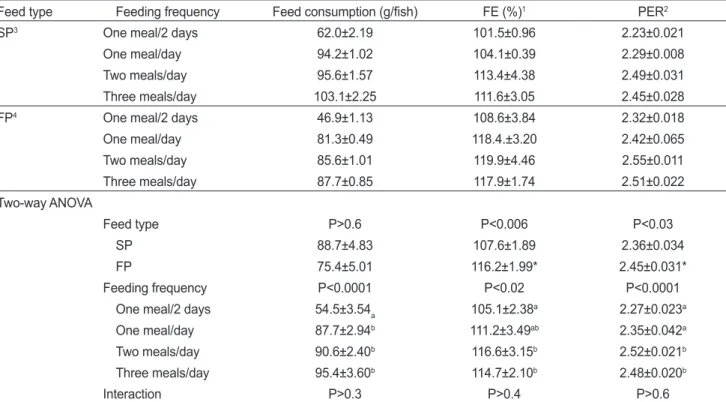
Table 2. Feed consumption (g/fish), feed efficiency (FE, %) and protein efficiency ratio (PER) of starry flounder Platichthys stellatus fed the different feed types and feeding frequencies for 9 weeks
Feed type Feeding frequency Feed consumption (g/fish) FE (%)1 PER2
SP3 One meal/2 days 62.0±2.19 101.5±0.96 2.23±0.021
One meal/day 94.2±1.02 104.1±0.39 2.29±0.008
Two meals/day 95.6±1.57 113.4±4.38 2.49±0.031
Three meals/day 103.1±2.25 111.6±3.05 2.45±0.028
FP4 One meal/2 days 46.9±1.13 108.6±3.84 2.32±0.018
One meal/day 81.3±0.49 118.4.±3.20 2.42±0.065
Two meals/day 85.6±1.01 119.9±4.46 2.55±0.011
Three meals/day 87.7±0.85 117.9±1.74 2.51±0.022
Two-way ANOVA
Feed type P>0.6 P<0.006 P<0.03
SP 88.7±4.83 107.6±1.89 2.36±0.034
FP 75.4±5.01 116.2±1.99* 2.45±0.031*
Feeding frequency P<0.0001 P<0.02 P<0.0001
One meal/2 days 54.5±3.54a 105.1±2.38a 2.27±0.023a
One meal/day 87.7±2.94b 111.2±3.49ab 2.35±0.042a
Two meals/day 90.6±2.40b 116.6±3.15b 2.52±0.021b
Three meals/day 95.4±3.60b 114.7±2.10b 2.48±0.020b
Interaction P>0.3 P>0.4 P>0.6
Values (means of triplicate±SE) in the same column sharing a common superscript are not significantly different (P>0.05). 1Feed efficiency (FE, %)=Weight gain of fish×100/feed consumed. 2Protein efficiency ratio (PER)=Weight gain of fish/protein consumed. 3Sinking pellet.
4Floating pellet.
flounder Limanda ferruginea
의최대성장을위한적정사료공 급횟수는2
회/
일만복공급이며(Dwyer et al., 2002),
틸라피아(Oreochromis niloticus)
의생산성효율상승을위한적정사 료공급은4
시간간격으로공급이효과적인것으로나타났다(Riche et al., 2004).
또한넙치(Paralichthys olivaceus)
치어에 있어서어체중증가와체조성은사료내에너지함량과사료공 급횟수에따라영향을받는것으로나타났다(Lee et al., 2000b).
이와같이어류의최대성장을위한적정사료공급횟수는어종
,
발달단계,
환경조건및사료내영양소와에너지함량등과같 은다양한요인에따라달라지는것으로판단된다.
9
주간의사육실험종료시미성어기강도다리의사료섭취량,
사료효율(feed efficiency, FE)
과 단백질전환효율(protein ef- ficiency ratio, PER)
은Table 2
에나타내었다.
사료섭취량은 사료형태에따른유의한영향을받지않는것으로나타났지만(P>0.05),
사료공급횟수가증가함에따라사료섭취량이증가하는경향이나타났다
(P<0.05).
이와유사하게넙치치어에있어 사료형태(
부상,
침강및생사료)
는일일사료섭취량(daily feed
intake)
에영향을미치지않았으나,
사료공급횟수가늘어남에따라증가하는경향을보였다
(Lee and Pham, 2010).
또한yel- lowtail flounder
치어사육시사료공급횟수에따라사료섭취 량에유의한영향을미치는것으로나타났으나(Dwyer et al.,
2002),
무지개송어는사료공급횟수와사료형태둘모두에유의한영향을받는것으로나타났다
(Ruohonen et al., 1998).
본 연구에서또한미성어기강도다리에있어사료효율은사료형 태(P<0.006)
와사료공급횟수(P<0.02)
에유의한영향을받는 것으로나타났으며,
사료공급횟수보다사료형태에많은영향 을받는것으로나타났다.
또한침강사료공급구보다부상사료 공급구의사료효율이유의하게높게나타났고,
사료공급횟수 가2
회/
일까지는증가하였으나, 3
회이상/
일공급시감소하였 다.
단백질전환효율은침강사료를공급한실험구보다부상사 료를공급한실험구가유의적으로높게나타났다.
이와같이동 일한사료공급횟수로사료를공급시침강사료보다부상사료의 공급이미성어기강도다리의사료이용성이보다우수하게나타 난것으로판단된다.
이와유사하게넙치치어에있어서동일한 사료공급횟수로부상사료,
생사료및침강사료를공급시부상 사료에대한사료이용성이우수하다는결과가보고된바있으 며(Lee and Pham, 2010),
이는부상사료제조시압출성형후 영양소와에너지에대한소화이용성의증가때문으로보고하였 다(Podoskina et al., 1997; Hernot et al., 2008).
그러나본연구 에서는시판용사료를이용하여연구를수행하여침강및부상 사료제조시이용된사료원에대한정보를알지못하므로추후 동일한사료원을이용한강도다리미성어기용침강및부상사 료제조를통한공급량및공급횟수에대한추가적인연구가필 요한것으로사료된다.
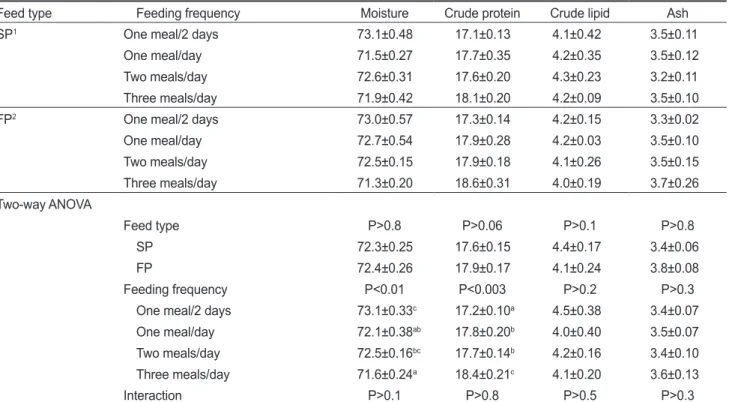
Table 3. Proximate composition (%, wet weight basis) of the whole body of starry flounder Platichthys stellatus fed the different feed types and feeding frequencies for 9 weeks
Feed type Feeding frequency Moisture Crude protein Crude lipid Ash
SP1 One meal/2 days 73.1±0.48 17.1±0.13 4.1±0.42 3.5±0.11
One meal/day 71.5±0.27 17.7±0.35 4.2±0.35 3.5±0.12
Two meals/day 72.6±0.31 17.6±0.20 4.3±0.23 3.2±0.11
Three meals/day 71.9±0.42 18.1±0.20 4.2±0.09 3.5±0.10
FP2 One meal/2 days 73.0±0.57 17.3±0.14 4.2±0.15 3.3±0.02
One meal/day 72.7±0.54 17.9±0.28 4.2±0.03 3.5±0.10
Two meals/day 72.5±0.15 17.9±0.18 4.1±0.26 3.5±0.15
Three meals/day 71.3±0.20 18.6±0.31 4.0±0.19 3.7±0.26
Two-way ANOVA
Feed type P>0.8 P>0.06 P>0.1 P>0.8
SP 72.3±0.25 17.6±0.15 4.4±0.17 3.4±0.06
FP 72.4±0.26 17.9±0.17 4.1±0.24 3.8±0.08
Feeding frequency P<0.01 P<0.003 P>0.2 P>0.3
One meal/2 days 73.1±0.33c 17.2±0.10a 4.5±0.38 3.4±0.07
One meal/day 72.1±0.38ab 17.8±0.20b 4.0±0.40 3.5±0.07
Two meals/day 72.5±0.16bc 17.7±0.14b 4.2±0.16 3.4±0.10
Three meals/day 71.6±0.24a 18.4±0.21c 4.1±0.20 3.6±0.13
Interaction P>0.1 P>0.8 P>0.5 P>0.3
Values (means of triplicate±SE) in the same column sharing a common superscript are not significantly different (P>0.05). 1Sinking pellet.
2Floating pellet.
9
주간사육실험종료시강도다리전어체의일반성분조성은Table 3
에나타내었다.
전어체의수분과조단백질함량은사료형태에는영향을받지않았으나
(P>0.05),
사료공급횟수에는유의한영향을받는것으로나타났다
(P<0.05).
이전의대다수 의사료공급횟수연구에서는사료공급횟수를늘림에따라어 체의조지질함량이증가하는 것으로나타났으나(Lee et al., 2000a, 2000b; Lee and Pham, 2010; Okomoda et al., 2019),
본연구에서는전어체의조지질함량이사료공급횟수에영향 을받지않는것으로나타났다. Mizanur and Bai (2014)
연구에 서는사료공급횟수를늘릴수록성장기조피볼락전어체의조 지질함량이감소하였으며,
이는어체크기별소화능력과관련 있다고보고하였다.
이상의결과에서미성어기강도다리의성장
(
어체중증가와일 일성장률)
과사료이용성(
사료효율과단백질전환효율)
향상을 위해서는해산어용시판침강사료(CP, 47.9%)
는1
일2
회이 상,
부상사료(CP, 48.9%)
는1
일1
회이상공급하는것이적절 한것으로판단된다.
그러나경제적인강도다리양식을위한사 육관리방안을제시하기위해서는국내양식장의사육환경조 건에따른배합사료공급량및공급횟수를세분화하여연구할 필요가있으며,
특히양식현장적용을위한미성어기강도다리 의배합사료연구는장기간(
저수온및고수온)
사육기간에따 른공급횟수차이에대한연구가추후필요할것으로사료된다.
사 사
이논문은
2019
년도국립수산과학원수산과학연구사업동해특산품종양식기술개발
(R2019010)
의지원으로수행된연구입니다
.
References
An HS, Byun SG, Kim YC, Lee JW and Myeong JI. 2011. Wild and hatchery populations of Korean starry flounder (Platich-
thys stellatus) compared using microsatellite DNA mark-
ers. Int J Mol Sci 12, 9189-9202. https://doi.org/10.3390/ijms12129189.
AOAC (Association of Official Analytical chemists). 1990. Of- ficial methods of analysis. association of official analytical chemists Inc, Arlington, VA, U.S.A.
Biswas G, Jena JK, Singh SK, Patmajhi P and Muduli HK.
2006. Effect of feeding frequency on growth, survival and feed utilization in mrigal, Cirrhinusn mrigala, and rohu,
Labeo rohita, during nursery rearing. Aquaculture 254, 211-
218. https://doi.org/10.1016/j.aquaculture.2005.08.001.Booth MA, Tucker BJ, Allan GL and Fielder DS. 2008. Effect of feeding regime and fish size on weight gain, feed intake and gastric evacuation in juvenile Australian snapper Pagrus au-
ratus. Aquaculture 282, 104-110. https://doi.org/10.1016/j.
aquaculture.2008.06.027.
Duncan DB. 1955. Multiple range and multiple F tests. Biomet- rics 11, 1-42.
Dwyer KS, Brown JA, Parrish C and Lall SP. 2002. Feeding frequency affects food consumption, feeding pattern and growth of juvenile yellowtail flounder (Limanda ferru-
ginea). Aquaculture 213, 279-292. https://doi.org/10.1016/
S00448486(02)00224-7.
Hernot DC, Boileau TW, Baufer LL, Sawnson KS and Fahey GC Jr. 2008. In vitro digestion characteristics of unprocessed and processed whole grains and their components. J Ag- ric Food Chem 56, 10721-10726. https://doi.org/10.1021/
jf801944a.
Kim HS, Choi J, Lim HJ, Jeong MH, Lee CS and Byun S. 2019.
Effect of feeding frequency on the growth of juvenile starry flounder Platichthys stellatus. Korean J Fish Aquat Sci 52, 87-91. https://doi.org/10.5657/KFAS.2019.0087.
Kikuchi K, Iwata N, Kawabata T and Yanagawa. 2006. Ef- fect of feeding frequency, water temperature, and stocking density on the growth of tiger puffer, Takifugu rubripes. J World Aquac Soc 37, 12-20. https://doi.org/10.1111/j.1749- 7345.2006.00002.x.
Lee S and Pham MA. 2010. Effects of feeding frequency and feed type on the growth, feed utilization and body compo- sition of juvenile olive flounder, Paralichthys olivaceus.
Aquacult Res 41, e166-e171. https://doi.org/10.1111/j.1365- 2109.2010.02491.x.
Lee SM, Seo CH and Cho YS. 1999. Growth of the juvenile olive flounder (Paralichthys olivaceus) fed the diets at dif- ferent feeding frequencies. J Kor Fish Soc 32, 18-21.
Lee S, Hwang U and Cho SH. 2000a. Effects of feeding fre- quency and dietary moisture content on growth, body com- position and gastric evacuation of juvenile Korean rockfish
Sebastes schlegeli. Aquaculture 187, 399-409. https://doi.
org/ 10.1016/S0044-8486(00)00318-5.
Lee SM, Cho SH and Kim DJ. 2000b. Effects of feeding fre- quency and dietary energy level on growth and body com- position of juvenile flounder, Paralichthys olivaceus Tem- minck & Schlegel. Aquacult Res 31, 917-921. https://doi.
org/10.1046/j.1365-2109.2000.00505.x.
Lee S, Lee JH and Kim K. 2003. Effect of dietary essential fatty acids on growth, body composition and blood chem- istry of juvenile starry flounder (Platichthys stellatus).
Aquaculture 225, 269-281. https://doi.org/10.1016/S0044- 8486(03)00295-3.
Mizanur RM and Bai SC. 2014. The optimum feeding frequency in growing Korean rockfish (Sebastes schlegeli) rearing at the temperature of 15°C and 19°C. Asian-Australas J Anim Sci 27, 1319-1327. https://doi.org/10.5713/ajas.2014.14193.
Okomoda VT, Aminem W, Hassan A, Martins CO. 2019. Ef- fects of feeding frequency on fry and fingerlings of African catfish Clarias gariepinus. Aquaculture 511, 734232. https://
doi.org/10.1016/j.aquaculture.2019.734232.
Park Y, Moniruzzaman M, Lee S, Hong J, Won S, Lee JM, Yun H, Kim K, Ko D and Bai SC. 2016. Comparison of the ef- fects of dietary single and multi-probiotics on growth, non- specific immune responses and disease resistance in starry flounder, Platichthys stellatus. Fish Shellfish Immunol 59, 351-357. https://doi.org/10.1016/j.fsi.2016.11.006.
Podoskina TA, Podoskin AG and Bekina EN. 1997. Efficiency of utilization of some potato starch modifications by rain- bow trout (Oncorhynchus mykiss). Aquaculture 152, 235- 248. https://doi.org/10.1016/S0044-8486(96)01515-3.
Riche MD, Haley I, Oetker M, Garbrecht S and Garling DL.
2004. Effect of feeding requency on gastric evacuation and the return of appetite in tilapia reochromis niloticus (L.).
Aquaculture 234, 657-673. https://doi.org/10.1016/j.aqua- culture.2003.12.012.
Ruohonen K, Vielma J and Grove DJ. 1998. Effects of feeding frequency on growth and food utilization of rainbow trout (Oncorhynchus mykiss) fed low-fat herring or dry pellets.
Aquaculture 165, 111-121. https://doi.org/10.1016/S0044- 8486(98)00235-X.
Schmidt J, Bischoff A, Weiss M, Kim SK, Frickenhaus S, Slater M and Buck B. 2017. Effect of beta-1-3-glucan and man- nans on growth and fitness of Starry flounder (Platichthys
Stellatus): A potential new candidate for aquaculture in tem-
perate regions. J Fishscicom 11, 17-25.Seo J, Choi K, Choi J and Lee S. 2005. Effect of feeding fre- quency of extruded diet containing different macro-nutrient levels on apparent nutrient digestibility in grower flounder
Paralichthys olivaceus. J Aquaculture 18, 160-166.
Silva CR, Gomes LC and Brandao FR. 2007. Effect of feed- ing rate and frequency on tambaqui (Colossoma macropo-
mum) growth, production and feeding costs during the first
growth phase in cages. Aquaculture 264, 135-139. https://doi.org/10.1016/j.aquaculture.2006.12.007.
Song Z, Li H, Wang J, Li P, Sun Y and Zhang L. 2014. Effects of fishmeal replacement with soy protein hydrolysates on growth performance, blood biochemistry, gastrointestinal digestion and muscle composition of juvenile starry floun- der (Platichthys stellatus). Aquaculture 426, 96-104. https://
doi.org/10.1016/j.aquaculture.2014.01.002.
Sun LH, Chen HR, Huang LM and Wang ZD. 2006. Growth, feacal production, nitrogenous excretion and energy budget in juvenile cobia (Rachycentron canadum) relative to feed types and ratio level. Aquaculture 259, 211-221. https://doi.
org/10.1016/j.aquaculture.2006.05.024.
Tucker BJ, Booth MA, Allan GL, Booth D and Fielder DS.
2006. Effects of photoperiod and feeding frequency on per- formance of newly weaned Australian snapper Pagrus au-
ratus. Aquaculture 258, 514-520. https://doi.org/10.1016/j.
aquaculture.2006.03.033.
Wang N, Xu X and Kestemont P. 2009. Effect of tempera- ture and feeding frequency on growth performances, feed
efficiency and body composition of pikeperch juvenile (Sander lucioperca). Aquaculture 289, 70-73. https://doi.
org/10.1016/j.aquaculture.2009.01.002.
Wang Y, Kong L, Li K and Bureau DP. 2007. Effects of feeding frequency and ration level on growth, feed utilization and nitrogen waste output of cuneate drum (Nibea miichthiodes) reared in net pens. Aquaculture 271, 350-356. https://doi.
org/10.1016/j.aquaculture.2007.03.022.
Wang J, Li B, Ma J, Wang S, Huang B, Sun Y and Zhang L.
2017. Optimum dietary protein to lipid ratio for starry floun- der Platichthys stellatus. Aquacult Res 48, 189-201. https://
doi.org/10.1111/are.12873.