Kor J Fish Aquat Sci 47(5),630-636,2014
한수지 47(5), 630-636, 2014Original Article
630
Copyright © 2014 The Korean Society of Fisheries and Aquatic Science pISSN:0374-8111, eISSN:2287-8815
서 론
잡종은무척추동물
,
어류,
조류및포유류의많은종에서발생 하며(Rhymer and Simberloff, 1996),
특히대부분의경골어류 가체외수정을하고유사한번식습성을가지기때문에다른척 추동물과비교해서잡종의발생률이높다(Leary et al., 1995).
이러한어류의특성때문에
,
잡종연구에서어류는중요한실 험재료로써사용되어져왔다(Verspoor and Hammer, 1991).
어류에서잡종은지리적으로분리분포하고있는두집단간의 분류학적위치를검토하고
(Kim and Kim, 1993),
외래종(intro- duced species)
의유입에의한토착종(native species)
의유전 적오염정도를파악하기위해서연구되어져왔다(Rubidge et
al., 2001).
인위적으로어류잡종을생산하는데있어서초기발생및성숙가능여부등의많은변수가존재하고있지만
(Varadi
et al., 1995),
최근에는양식업이발전하면서두종의장점을가진새로운양식대상종을개발하기위한연구가진행되고있다
(Kim et al., 1995; Chevassus, 1998; Nam et al., 2008).
이러한 연구가진행되고있는것은잡종1
세대에서발현되는어떤형 질이친어로사용되는두종의형질보다더우수하게되는잡종 강세(heterosis)
로설명될수있다(Glamuzina et al., 2001).
하 지만잡종강세는모든형질에서나타나는현상이아니기때문 에우수한형질을가진잡종을생산하기위해다양한어종간의 잡종연구가계속해서이루어지고있다.
넙치
(Paralichthys olivaceus)
는가자미목(Order Pleuronecti- formes)
넙치과(Family Paralichthyidae)
에속하는저서성어류 로우리나라전연안과일본,
쿠릴열도,
동중국해등에분포하고 있으며,
성장이빨라우리나라양식어류중에서가장많은양이 생산되고 있는중요한양식대상종으로2012
년에39,341
톤이 생산되었다(KOSIS, 2013).
하지만온수성어종으로동절기에 성장이느려지고비브리오나바이러스등의여러가지질병에넙치(Paralichthys olivaceus) 암컷과 강도다리(Platichthys stellatus) 수컷 잡종에서 수정란의 수온별 발생속도 및 자어 성장
도용현·민병화·최명렬
1·임한규
2*국립수산과학원 양식관리과, 경상남도 수산기술사업소1, 목포대학교 해양수산자원학과2
Developmental Speed of Hybrid Fertilized Egg Between Olive Flounder Paralichthys olivaceus Female and Starry Flounder Platichthys stellatus
Male at Different Water Temperatures and Larval Growth
Yong Hyun Do, Byung Hwa Min, Myeoung Lyeoul Choi
1
and Han Gyu Lim2*
Aquaculture Management Division, National Fisheries Research and Development Institute, Busan 619-705, Korea
1
Gyeongnam Provincial Government Fisheries Development Division, Masan 631-709, Korea
2
Department of Marine and Fisheries Resources, Mokpo National University, Muan 534-729, Korea
To investigate the characteristics of hybrid eggs and larva produced by olive flounder Paralichthys olivaceus females and starry flounder Platichthys stellatus males, we examined the developmental speed of hybrid eggs at different water temperatures. The developmental speed of hybrid eggs tended to increase with increasing water temperature.
Specifically, the hatching times were 91 hrs, 62 hrs and 43 hrs at 10℃, 15℃and 20℃, respectively. The mean bio- logical minimum temperature of the hybrid was 1.3℃, which is in between that of the olive flounder and the starry flounder. In high water temperatureseasons, slower growth was observed in hybrids of the starry flounder which is a coldwater fish.
Key words: Hybrid, Biological minimum temperature, Growth
This is an Open Access article distributed under the terms of the Creative Commons Attribution Non-Commercial Licens (http://creativecommons.org/licenses/by-nc/3.0/)which permits unrestricted non-commercial use, distribution, and reproduction in any medium, provided the original work is properly cited.
http://dx.doi.org/10.5657/KFAS.2014.0630 Kor J Fish Aquat Sci 47(5) 630-636, October 2014
Received 16 July 2014; Revised 29 September 2014; Accepted 14 October 2014
*Corresponding author: Tel: +82. 61. 450. 2395 Fax: +82. 61. 452. 8875
E-mail address: [email protected]
대한문제점이있다
.
강도다리(Platichthys stellatus)
는가자미 목가자미과(Family Pleuronectidae)
에속하는저서성어류로 우리나라동해안과일본,
오호츠크해등에분포하고있다.
강도다리는성장이느리고
, 22℃
이상의수온에서섭식활동이감소하고폐사개체가나타나는냉수성어종이며
(Byun et al., 2008),
담수및기수역에서도서식하는염분내성이강한광염성어종이 다(Lim et al., 2007).
이두종간의교배를통해환경변화에강 하고성장이빠른품종을개발하기위한잡종이생산되어형태 학적연구(Nam et al., 2008)
와microsatellite maker
를이용한 가계분석(Kang et al., 2011)
에대한연구가진행되었지만기초 연구는미비한실정이다.
따라서본연구에서는넙치
,
강도다리및두종간잡종수정란 의수온별발생속도및생물학적영도를조사하고,
넙치및잡 종부화자어의성장도를조사하여생물학적기초자료를제공 하고자한다.
재료 및 방법
실험어 및 인공수정
실험에사용된강도다리정액은강도다리의방정과넙치의산 란시기가다른것을고려하여
, 2012
년2
월약1
달동안부산광 역시기장군국립수산과학원양식관리과에서사육중인강도다 리의정액을채취하여Lim et al. (2007)
의결과에따라희석액 을제조하였으며,
동해방지제인10% DMSO (dimethyl sulf- oxide)
를사용하여-196℃
액체질소에냉동보존하였다.
2012
년2
월28
일에냉동보존한강도다리정액을전라남도여 수시에위치한종묘배양장의강도다리암컷중에서성숙한어미 를선발하여복부압박법으로얻은알과건식법으로인공수정 시켜강도다리수정란을생산하였다.
2012
년3
월30
일에냉동보존한강도다리정액을경상남도거 제시의국립수산과학원육종연구센터에서사육중인넙치암컷 에서동일한방법으로얻은알과건식법으로수정시켜잡종(
넙 치♀×
강도다리♂)
을생산하였고,
동일하게사육중인넙치암 컷과수컷에서알과정액을채취하여넙치수정란을생산하였 다.
생산된수정란은국립수산과학원양식관리과로수송후에 수온별난발생속도를관찰하였다.
수온별 난발생
넙치
,
강도다리및잡종수정란의수온별난발생속도를조사 하기위하여,
아크릴재질의사각수조(53×33×18 cm)
에자동 온도조절기와수중히터를이용하여5, 10, 15, 20, 25
및30℃
를실험구로설정하고수온을유지하였다
.
각수정란은마이크 로필터(∅ 50 μm)
와자외선살균기로여과ㆍ
살균한34 psu
해수를담은
1 L
비이커에수용하여수온이유지되고있는사각수조에두고
3
반복으로실험을진행하였다.
수정란의발생단계는광 학현미경(Axioskop 2 plus; Carl Zeiss, Jena, Germany)
를이용 하여30
분마다관찰하였다.
수온별난발생속도차이를조사하 기위해강도다리는포배기,
낭배기,
쿠퍼씨포(Kuffer's vesicle)
출현기,
꼬리지느러미형성기를기준으로하였고,
넙치와잡종 는포배기,
낭배기,
쿠퍼씨포출현기,
부화직후자어기를기준Fig. 1. Each embryonic development stages and hatching larva of hybrid between olive flounder Paralichthys olivaceus female and starry flounder Platichthys stellatus male. a, blastula; b, gastrula; c, kuffer's vesicle; d, hatching larva. Scale bar 500 μm.
도용현
ㆍ
민병화ㆍ
최명렬ㆍ
임한규632
으로하였다
(Fig. 1).
발생단계는각단계에도달한수정란의비율이
50%
가될때를그발생단계의소요시간으로산정하였다.
또한강도다리,
넙치및잡종수정란의부화율을조사하기위해15℃
에서각수정란의부화율을3
반복으로조사하였다. 자어 성장 및 통계분석
부화한넙치및잡종자어를
1.2
톤FRP
수조에서초기먹이 생물인rotifer
와Artemia
부화유생을공급하면서종묘생산을 하였다.
부화후24
일까지는rotifer
만공급하면서지수식으로 수온15℃,
자연광주기를유지하였으며,
그이후로Artemia
와rotifer
를혼합급이하면서유량을조금씩늘려유수식으로전환하였다
.
유수식으로전환후에는배합사료를공급하면서자 연수온으로사육을하였으며, 4
월부터8
월까지사육중2
주간 격으로전장(total length)
을측정하였다.
넙치및잡종의성장 도평균±
표준오차로나타냈으며,
유의차는SPSS
통계프로그 램(Ver. 18.0)
을사용하여Independent t-Test
로유의차를분석 하였다.
결 과
수온별 발생속도
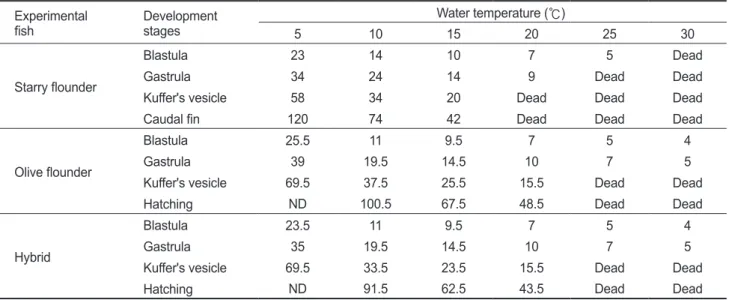
강도다리수정란에서낭배기까지의소요시간은
5℃
에서34
시간, 10℃
에서24
시간, 15℃
에서14
시간30
분, 20℃
에서9
시 간이소요되었다.
쿠퍼씨포형성기까지소요시간은5℃
에서58
시간, 10℃
에서34
시간, 15℃
에서20
시간이소요되었다. 25℃
와
30℃
에서는낭배기까지발생도중모두폐사하였으며, 20℃
는쿠퍼씨포형성기까지발생도중폐사하였다
.
본연구에서강도다리수정란의발생수온
(WT)
과발생단계 별소요시간(h)
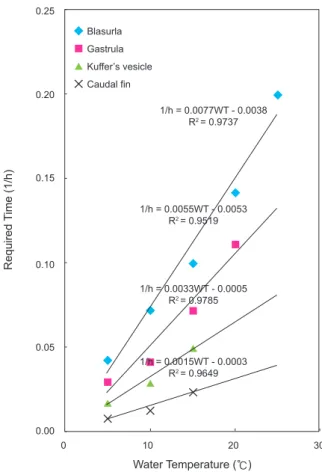
의관계식은다음과같다(Fig. 2).
포배기
: 1/h=0.0077WT-0.0038 (R
2=0.9737)
낭배기: 1/h=0.0055WT-0.0053 (R
2=0.9519)
쿠퍼씨포형성기
: 1/h=0.0033WT-0.0005 (R
2=0.9785)
꼬리지느러미형성기: 1/h=0.0015WT-0.0003 (R
2=0.9649)
이들관계식을기초로강도다리수정란의초기발생에있어서 난발생이진행되지 않는생물학적영도
(biological minimum temperature)
를산정한결과0.5℃
로나타났다.
넙치수정란에서낭배기까지의소요시간은
5℃
에서39
시간, 10℃
에서19
시간30
분, 15℃
에서14
시간30
분, 20℃
에서10
시 간, 25℃
에서7
시간, 30℃
에서5
시간이소요되었다.
쿠퍼씨포 형성기까지는5℃
에서69
시간30
분, 10℃
에서37
시간30
분, 15℃
에서25
시간30
분, 20℃
에서15
시간30
분이소요되었다. 25℃
와30℃
는낭배기까지발생하였으나모두폐사하였으며,
부화에도달한실험수온은10, 15
및20℃
였다.
넙치수정란의발생에서수온과발달단계별소요시간의관계
식은다음과같다
(Fig. 3).
포배기
: 1/h=0.0081WT-0.0038 (R
2=0.9761)
낭배기: 1/h=0.0067WT-0.0196 (R
2=0.9578)
쿠퍼씨포형성기
: 1/h=0.0033WT-0.0045 (R
2=0.9636)
부화: 1/h=0.0011WT-0.0009 (R
2=0.9974)
이들관계식을기초로넙치수정란의생물학적영도를산정한 결과
1.8℃
로나타났다잡종수정란에서낭배기까지의소요시간은
5℃
에서35
시간, 10℃
에서19
시간30
분, 15℃
에서14
시간30
분, 20℃
에서10
시간, 25℃
에서7
시간, 30℃
에서5
시간이소요되었다.
쿠퍼씨 포형성기까지는5℃
에서69
시간30
분, 10℃
에서33
시간30
분, 15℃
에서23
시간30
분, 20℃
에서15
시간30
분이소요되 었다.
넙치수정란에서의결과와같이25℃
와30℃
는낭배기 까지발생후모두폐사하였고,
부화까지도달한실험구는10, 15, 20℃
였다.
잡종수정란의발생에서수온과발달단계별소요시간의관계 식은다음과같다
(Fig. 4).
Fig. 2. Relationship between water temperature and required time to each development stages after fertilization of starry flounder Platichthys stellatus.
Water Temperature (℃)
1/h = 0.0077WT - 0.0038R2 = 0.9737
1/h = 0.0055WT - 0.0053 R2 = 0.9519
1/h = 0.0033WT - 0.0005 R2 = 0.9785
0.00
0 10 20 30
0.05 0.10 0.15 0.20 0.25
Blasurla Gastrula Kuffer’s vesicle Caudal fin
Water Temperature (℃)
0.000 10 20 30 40
0.05 0.10 0.15 0.20 0.3
0.25
Blasurla Gastrula Kuffer’s vesicle Hatching
Required T ime (1/h) Required T ime (1/Hour) Required T ime (1/Hour)
Water Temperature (℃)
0.000 10 20 30 40
0.05 0.10 0.15 0.20 0.3
0.25
Blasurla Gastrula Kuffer’s vesicle Hatching
1/h = 0.0015WT - 0.0003 R2 = 0.9649
1/h = 0.0081WT - 0.0038 R2 = 0.9761
1/h = 0.0067WT - 0.0196 R2 = 0.9578
1/h = 0.0033WT - 0.0045 R2 = 0.9636
1/h = 0.0011WT - 0.0009 R2 = 0.9974
1/h = 0.008WT - 0.0016 R2 = 0.9748
1/h = 0.0066WT - 0.0177 R2 = 0.9534
1/h = 0.0033WT - 0.0029 R2 = 0.9858
1/h = 0.0012WT - 0.0015 R2 = 0.9916
0.0 20.0 40.0 60.0 80.0 100.0 120.0 140.0
Olive Flounder
Hybrid (Olive Flounder♀×Starry Flounder♂)
Apr. May Jun. Jul. Aug.
Month
Total Length (mm)
넙치와 강도다리 잡종 난발생속도 및 자어 성장
633
포배기
: 1/h=0.008WT-0.0016 (R
2=0.9761)
낭배기: 1/h=0.0066WT-0.0177 (R
2=0.9578)
쿠퍼씨포형성기
: 1/h=0.0033WT-0.0029 (R
2=0.9636)
부화: 1/h=0.0012WT-0.0009 (R
2=0.9974)
이들관계식을기초로잡종수정란의생물학적영도를산정한 결과
1.3℃
로나타났다.
넙치
,
강도다리및잡종수정란의난발생이진행되는수온별 소요시간은모든실험구에서수온이높아질수록짧아지는경 향을보였다.
부화율은강도다리가
63.5%,
넙치가75.8%
로나타났으며,
잡 종은20.0%
로나타났다.
자어 성장
넙치및잡종자어의성장은
Fig. 5
와같다.
넙치자어는4
월 에3.7±0.1 mm
에서6
월19.8±1.9 mm, 8
월126.6±3.5 mm
까지성장하였다.
잡종자어는4
월에4.0±0.1 mm
에서6
월21.1±1.6 mm, 8
월에95.2±2.4 mm
로성장하였다. 6
월까지 는넙치및잡종자어의성장에서유의한차이가없었지만, 7
월과
8
월에는넙치가잡종보다더빨리성장하는것을관찰할 수있었다.
Fig. 4. Relationship between water temperature and required time to each development stage after fertilization of hybrid between olive flounder Paralichthys olivaceus female and starry flounder Platichthys stellatus male.
Water Temperature (℃)
1/h = 0.0077WT - 0.0038R2 = 0.9737
1/h = 0.0055WT - 0.0053 R2 = 0.9519
1/h = 0.0033WT - 0.0005 R2 = 0.9785
0.00
0 10 20 30
0.05 0.10 0.15 0.20 0.25
Blasurla Gastrula Kuffer’s vesicle Caudal fin
Water Temperature (℃)
0.000 10 20 30 40
0.05 0.10 0.15 0.20 0.3
0.25
Blasurla Gastrula Kuffer’s vesicle Hatching
Required T ime (1/h) Required T ime (1/Hour) Required T ime (1/Hour)
Water Temperature (℃)
0.000 10 20 30 40
0.05 0.10 0.15 0.20 0.3
0.25
Blasurla Gastrula Kuffer’s vesicle Hatching
1/h = 0.0015WT - 0.0003 R2 = 0.9649
1/h = 0.0081WT - 0.0038 R2 = 0.9761
1/h = 0.0067WT - 0.0196 R2 = 0.9578
1/h = 0.0033WT - 0.0045 R2 = 0.9636
1/h = 0.0011WT - 0.0009 R2 = 0.9974
1/h = 0.008WT - 0.0016 R2 = 0.9748
1/h = 0.0066WT - 0.0177 R2 = 0.9534
1/h = 0.0033WT - 0.0029 R2 = 0.9858
1/h = 0.0012WT - 0.0015 R2 = 0.9916
0.0 20.0 40.0 60.0 80.0 100.0 120.0 140.0
Olive Flounder
Hybrid (Olive Flounder♀×Starry Flounder♂)
Apr. May Jun. Jul. Aug.
Month
Total Length (mm)
Fig. 3. Relationship between water temperature and required time to each development stage after fertilization of olive flounder Para- lichthys olivaceus.
Water Temperature (℃)
1/h = 0.0077WT - 0.0038R2 = 0.9737
1/h = 0.0055WT - 0.0053 R2 = 0.9519
1/h = 0.0033WT - 0.0005 R2 = 0.9785
0.00
0 10 20 30
0.05 0.10 0.15 0.20 0.25
Blasurla Gastrula Kuffer’s vesicle Caudal fin
Water Temperature (℃)
0.000 10 20 30 40
0.05 0.10 0.15 0.20 0.3
0.25
Blasurla Gastrula Kuffer’s vesicle Hatching
Required T ime (1/h) Required T ime (1/Hour) Required T ime (1/Hour)
Water Temperature (℃)
0.000 10 20 30 40
0.05 0.10 0.15 0.20 0.3
0.25
Blasurla Gastrula Kuffer’s vesicle Hatching
1/h = 0.0015WT - 0.0003 R2 = 0.9649
1/h = 0.0081WT - 0.0038 R2 = 0.9761
1/h = 0.0067WT - 0.0196 R2 = 0.9578
1/h = 0.0033WT - 0.0045 R2 = 0.9636
1/h = 0.0011WT - 0.0009 R2 = 0.9974
1/h = 0.008WT - 0.0016 R2 = 0.9748
1/h = 0.0066WT - 0.0177 R2 = 0.9534
1/h = 0.0033WT - 0.0029 R2 = 0.9858
1/h = 0.0012WT - 0.0015 R2 = 0.9916
0.0 20.0 40.0 60.0 80.0 100.0 120.0 140.0
Olive Flounder
Hybrid (Olive Flounder♀×Starry Flounder♂)
Apr. May Jun. Jul. Aug.
Month
Total Length (mm)
Water Temperature (℃)
1/h = 0.0077WT - 0.0038R2 = 0.9737
1/h = 0.0055WT - 0.0053 R2 = 0.9519
1/h = 0.0033WT - 0.0005 R2 = 0.9785
0.00
0 10 20 30
0.05 0.10 0.15 0.20
Kuffer’s vesicle Caudal fin
Water Temperature (℃)
0.000 10 20 30 40
0.05 0.10 0.15 0.20 0.3
0.25
Blasurla Gastrula Kuffer’s vesicle Hatching
Required T ime (1/h) Required T ime (1/Hour) Required T ime (1/Hour)
Water Temperature (℃)
0.000 10 20 30 40
0.05 0.10 0.15 0.20 0.3
0.25
Blasurla Gastrula Kuffer’s vesicle Hatching
1/h = 0.0015WT - 0.0003 R2 = 0.9649
1/h = 0.0081WT - 0.0038 R2 = 0.9761
1/h = 0.0067WT - 0.0196 R2 = 0.9578
1/h = 0.0033WT - 0.0045 R2 = 0.9636
1/h = 0.0011WT - 0.0009 R2 = 0.9974
1/h = 0.008WT - 0.0016 R2 = 0.9748
1/h = 0.0066WT - 0.0177 R2 = 0.9534
1/h = 0.0033WT - 0.0029 R2 = 0.9858
1/h = 0.0012WT - 0.0015 R2 = 0.9916
0.0 20.0 40.0 60.0 80.0 100.0 120.0 140.0
Olive Flounder
Hybrid (Olive Flounder♀×Starry Flounder♂)
Apr. May Jun. Jul. Aug.
Month
Total Length (mm)
Fig. 5. Variation of total length of olive flounder Paralichthys oli- vaceus and hybrid between oliveflounder female and starry floun- der Platichthys stellatus male from April to August.
도용현
ㆍ
민병화ㆍ
최명렬ㆍ
임한규634
고 찰
수온은어류에서수정란의발생과자
ㆍ
치어에서의성장및생 존에가장중요한요인중하나이다(Kamler, 2002).
일반적으 로수정란의발생과자·
치어의성장은낮은수온에서는지연되 고높은수온에서는더빨라지는경향을가지며,
각어종에따른 특유의생활사와생태적인특징에따라서정상적인발생을위 한적정수온범위를가지게된다(Rana, 1990).
본연구에서도 잡종수정란의부화까지소요시간은10℃
에서91.5
시간, 15℃
에서
62.5
시간, 20℃
에서43.5
시간이소요되어수온이상승할 수록부화시간도단축되는경향을보였으며,
넙치및강도다리 수정란의수온별발생속도에서도같은경향을보였다.
이결과 는고등어(Scomber japonicus) (Hwang et al., 2008),
뱅에돔(Girella punctata)
및긴꼬리뱅에돔(Girella melanichthys) (Oh et al., 2010),
참가자미(Pseudopleuronectes herzensteini) (Lee et al., 1997)
등의다른어류에서보고된결과와도일치한다.
어류양식에서수온에대한이해는성장과생존에관련된적 정수온을통해양식시스템을개선시키는데매우중요하며
,
더 나아가수정란의수온별발생속도는그종이서식하는자연환 경을유추할수도있다(Hyojin et al., 2012).
또한부화최적수 온은대체로자연산란시기의수온과일치한다고알려져있다(Jun et al., 2002).
본 연구에서 생물학적 영도는 강도다리가
0.5℃,
잡종이1.3℃,
넙치가1.8℃
로나타났다.
이결과는가자미목에속하 는돌가자미(Kareius bicoloratus) 1.3℃,
참가자미2.6℃,
찰가 자미(Microstomus achne) 0.4℃
와유사하게나타났다(Jun et al., 2002; Lee et al., 1997; Byun et al., 2009).
하지만같은가자 미목에속하는저서성어류에서도생물학적영도가조금씩다른것은산란시기의자연수온과관련된종간의생태적인특성 차이때문인것으로여겨진다
(Jun et al., 2002).
이종들의산란 시기는돌가자미가12~3
월,
참가자미4~6
월,
찰가자미3~4
월 이며,
본실험에사용된넙치는3~5
월,
강도다리가2~3
월이다.
최근바리과(Family Serranidae)
에서생산성이뛰어난잡종 을 생산하기위한연구가활발히진행되고 있으며,
동남아시 아를중심으로산업적으로도이용되고있다.
이들바리과에서 이러한연구들이활발히이루어지고성공적인잡종이생산되 는것은각종들의유전적인관계가매우밀접하기 때문이다(Kiriyakit et al., 2011).
가자미목에속하는넙치와범가자미(Verasper variegatus)
의잡종유도에서도두종이과(Family)
가다르지만부화자어의초기생존율및기형율에있어서양친 과차이가없는성공적인잡종이생산되어넙치와범가자미가 진화학적으로매우가까운유연관계라고보고된바있다(Kim et al., 1995).
본실험에사용된넙치및강도다리도가자미목에 속하는어류이며이들종간잡종의결과로두종이진화학적으 로매우가까운관계라고판단할수있다.
잡종형질에서일부는친어로사용된두종중에서한쪽을따 르지만대부분의형질은친어로사용된두종의중간을나타내 는것으로보고된바있다
(Kim et al., 1995).
본실험에서생물 학적영도는잡종이넙치와강도다리의중간으로친어로사용된 두종의중간형질을나타내었다.
하지만넙치와강도다리잡종 의형태학적인특징에서는수컷으로사용된강도다리에조금 더가깝다는보고가있었으며(Nam et al., 2008),
본연구에서5
개월간성장을지켜본결과에서도잡종의체형및지느러미모 양등이넙치보다강도다리와유사하게나타났다.
또한자연수 온에서의넙치및잡종의성장이4~6
월까지는유의차를보이지 않았으며,
강도다리의경우도Byun et al. (2007)
의결과에서평Table 1. Elapsed time (hour) after fertilization of olive flounder Paralichthys olivaceus, starry flounder Platichthys stellatus and hybrid be- tween olive flounder female and starry flounder male to distinctive development stages at different water temperature
Experimental
fish Development
stages Water temperature (℃)
5 10 15 20 25 30
Starry flounder
Blastula 23 14 10 7 5 Dead
Gastrula 34 24 14 9 Dead Dead
Kuffer's vesicle 58 34 20 Dead Dead Dead
Caudal fin 120 74 42 Dead Dead Dead
Olive flounder
Blastula 25.5 11 9.5 7 5 4
Gastrula 39 19.5 14.5 10 7 5
Kuffer's vesicle 69.5 37.5 25.5 15.5 Dead Dead
Hatching ND 100.5 67.5 48.5 Dead Dead
Hybrid
Blastula 23.5 11 9.5 7 5 4
Gastrula 35 19.5 14.5 10 7 5
Kuffer's vesicle 69.5 33.5 23.5 15.5 Dead Dead
Hatching ND 91.5 62.5 43.5 Dead Dead
ND, no more developed.
균수온이
14℃
일때부화후52
일째의성장이13.5±1.7 mm
로 넙치및잡종자어의성장과차이를보이지않았다.
하지만수온 이상승하기시작하는7
월과8
월에넙치의성장이더빨라지는 것을관찰할수있었다.
이결과는잡종의수온에대한내성이 강도다리와마찬가지로고수온기에사료섭식율이낮아지고성 장이느려지는냉수성어종의특징임을나타내었다.
잡종초기생활사에대한이해는종묘생산기술향상과양식 을위한새로운종의선정으로이어질수있다
(Kiriyakit et al.,
2011).
본연구에서잡종의종묘생산시넙치및강도다리의종묘생산방법과동일하게
rotifer, Artemia
와같은먹이생물과배 합사료를공급하여성장하는것을관찰할수있었다.
이것은넙 치와강도다리잡종의부화및변태등의초기생활사가친어로 사용된두종과유사하다고판단할수있다.
본연구는넙치와강도다리잡종의수온별난발생속도
,
생물 학적영도및성장도를나타내었다.
잡종의형질은생물학적영 도에서는친어로사용된두종의중간정도를보였으며,
성장 도는수컷으로사용된강도다리와유사한특징을보였다.
잡종 의생리학적인특징은친어로사용된어류의종류나암ㆍ
수차 이에의해서도달라진다.
본연구는넙치암컷과강도다리수 컷사이의잡종을생산하는데있어서기초자료로활용될것으 로기대되며,
잡종특징을파악하기위해서더많은연구가진 행될필요성이있다.
사 사
본연구는국립수산과학원
"
양식어장피해저감연구"
과제(RP-2014-AQ-121)
의연구비지원에의해수행되었습니다.
References
Byun SG, Lee BI, Lee JH, Ku HD, Park SU, Yun SM, Hwang SY, Kim YC and Lim HG. 2007. Egg development and morphological change of larvae and juveniles of the starry flounder, Platichthys stellatus. Korean J Ichthyol 19, 350- Byun SG, Jeong MH, Lee JH, Lee BI, Ku HD, Park SU, Kim 359.
YC and Chang YJ. 2008. Diel rhythm of oxygen consump- tion of the starry flounder Platichthys stellatus by water tem- perature. J Kor Fish Soc 41, 113-118.
Byun SG, Lee SH, Hwang JH, Han KH, Yeon IH, Kim JD, Lee JH and Lee BI. 2009. Effect of water temperature on the em- bryonic development of slime flounder Microstomus achne.
Dev Reprod 13, 265-270.
Chevassus B. 1983. Hybridization in fish. Aquaculture 33, 245- Glamuzina B, Glavic N, Skaramuca B, Kozul V and Tutman P. 262.
2001. Early development of the hybrid Epinephelus costae
♀ × E. marginatus ♂. Aquaculture 198, 55-61.
Hwang HG, Kim DH, Park MW, Yoon SJ and Lee YH. 2008.
Effect of water temperature and salinity on the egg and lar- val of club Mackerel Scomber japonicus. J Aquaculture 21, 234-238.
Hyojin A, Yoshiaki Y, Akihiro O, Noriyuki H, Naomi M, Satoru T and Katsumi T. 2012. Effect of water temperature on em- bryonic development and hatching time of the japanese eel
Anguilla japonica. Aquaculture 330-333, 100-105.
Jun JC, Kim CH, Chung EY, Lee CH and Kim BG. 2002. Influ- ence of water temperature and salinity on early development of the stone flounder Kareius bicoloratus from West Sea of Korea. Korean J Ichthyol 14, 190-197.
Kamler E. 2002. Ontogeny of yolk-feeding fish: an ecological perspective. Reviews Fish Biol Fish 12, 79-103.
Kang JH, Kim YK, Park JY, An CM, Nam MM, Byun SG, Lee BI, Lee JH and Choi TJ. 2011. Microsatellite analysis as a tool for discriminating an interfamily hybrid between olive flounder and starry flounder. Genet Mol Res 10, 2786-2794.
Kim IS and Kim SY. 1993. Interspecific hybridization between
Oryzias sinensis and O. latipes from Korea. Korean J Ich-
thyol 5, 113-121.Kim KK, Bang IC, Kim Y and Kim DS. 1995. Survival and growth in larval stage of induced hybrid between olive flounder Paralichthys olivaceus and spotted flounder Ve-
rasper variegatus. J Aquacult 8, 69-76.
Kiriyakit A, Gallardo WG and Bart AN. 2011. Successful hy- bridization of groupers (Epinephelus coioides × Epineph-
elus lanceolatus) using cryopreserved sperm. Aquaculture
320, 106-112.KOSIS. 2013. Korean Statistics Information Service. Retrieved from http://kosis.kr.
Leary RF, Allendorf FW and Sage GK. 1995. Hybridization and introgression between introduced and native fish. Am Fish Soc Symp 15, 91-101.
Lee JY, Kim WK and Chang YJ. 1997. Influence of water tem- perature and salinity on egg development of flatfish Liman-
da Herzensteini. J Aquacult 10, 357-362.
Lim HG, An CM, Noh GA and Min BH. 2007. Effects of dilu- ents and cryoprotectants on sperm cryopreservation in starry flounder Platichthys stellatus. J Aquacult 20, 173-177.
Lim HG, Byun SG, Lee JH, Park SU, Kim YC, Han HK, Min BH and Lee BY. 2007. Sexual maturity and reproductive cy- cle of starry flounder Platichthys stellatus cultured in indoor tank. J Aquacult 20, 212-218.
Nam MM, Byun SG, Lee BI, LEE JH and Kim YC. 2008. Mor- phological characteristics of the hybrids of female flounder
Paralichthys olivaceus and male starry flounder Platichthys stellatus. Korean J Ichthyol 20, 285-200.
Oh BS, Choi YU, Ku HD, Kim SC, Jung MM and Park HS.
2010. The effect of water temperature on egg development stages of largescale blackfish Girella punctata and smalls- cale blackfish Girella melanichthys. Dev Reprod 14, 51-58.
Rana HJ. 1990. Influence of incubation temperature on Oreo-
도용현
ㆍ
민병화ㆍ
최명렬ㆍ
임한규636
chromis niloticus egg and fry I. gross embryology, tempera-
ture tolerance and rates of embryonic development. Aqua- culture 87, 165-181.Rhymer JM and Simberloff D. 1996. Extinction by hybridiza- tion and introgression. Annual Review Ecol Systematics 27, 83-109.
Rubidge E, Corbett P and Taylor EB. 2001. A molecular analy- sis of hybridization between native westslope cutthroat trout and introduced rainbow trout in southeastern British Colum- bia, Canada. J Fish Biol 29, 42-54.
Varadi L, Hidas A, Varkonyi E and Horvath L. 1995. Interest- ing phenomena in hybridization of carp Cyprinus carpio and rosy barb Barbus conchonius. Aquaculture 129, 211-214.
Verspoor E and Hammer J. 1991. Introgressive hybridization in fishes: the biochemical evidence. J Fish Biol 39, 309-334.