345
저수온기 및 고수온기에 있어서 배합사료를 공급한 넙치( Paralichthys olivaceus) 치어의 적정 공급율
김강웅·황남용1·손맹현·김경덕·이준호2·유 의
윤용현2·박건현2·김성삼3·이경준3·배승철2✽
국립수산과학원 사료연구센터, 1수산자원사업단 부안종묘사업소
2부경대학교 해양바이오신소재학과/사료영양연구소, 3제주대학교 해양생명과학부
Optimum Feeding Rates in Juvenile Olive Flounder Paralichthys olivaceus Fed Practical Expanded Pellet at Low
and High Water Temperatures
Kang-Woong Kim, Nam-Yong Hwang
1, Maeng-Hyun Son, Kyoung-Duck Kim, Jun-ho Lee
2, Liu-Yi
2, Yong-hyun Yun
2, Gun-Hyun Park
2, Sung-Sam Kim
3,
Kyung-Jun Lee
3and Sungchul C. Bai
✽Aquafeed Research Center, NFRDI, Pohang 791-802, Korea
1
Marin haychery, FIAR, Buan 579-851, Korea
2
Department of Marine Bio-Materials and Aquaculture / FFNRC, Pukyong National University, Busan 608-737, Korea
3
Faculty of Marine Ocean Science Jeju National University, Jeju 690-756, Korea
Two feeding trials were conducted to investigate the optimum feeding rates in juvenile olive founder
Paralichthys olivaceus
fed practical expanded pellet(EP) containing 58.1% crude protein, 10.7% crude lipid, and 10.8% ash at low and high water temperatures. In the first experiment, triplicate groups of 15 fish with average weight of 7.7 g were fed at one of seven feeding rates(0, 1, 1.5, 2, 2.25, or 2.5% of body weight/day or to satiation) for 4 weeks at low water temperature. In the second experiment, quadruplicate groups of 20 fish with average weight of 5.5 g were fed at one of eight feeding rates(0, 3, 3.5, 4, 4.25, 4.5, or 4.75% of body weight/day or to satiation) for 4 weeks at high water temperature. Based on growth performance, we estimated that the optimum feeding rates for juvenile olive flounder were 1.97-2.51% and 4.82-6.36% of body weight/day at low and high water temperatures, respectively.Key words; Olive flounder, Optimum feeding rates, Low temperature, High temperature, Extruded pellet
서 론
어류양식에 있어 총양식경영비의 50-60%가 사료비로 지출 되고 있으며(Cho et al., 2006), 이에 따른 효율적인 사료공급은 사료효율 및 어류 성장에 직접적인 영향을 미쳐 실질적으로 양 식의 경제적 성패를 좌우할 만큼 중요한 위치를 차지하고 있다 (Tsevis et al., 1992: Azzaydi et al., 2000., Lee et al, 2002).
어류의 성장은 소화, 흡수, 물질대사와 배설의 복합적인 생리 적 작용의 결과이며(Brett et al., 1979), 어류의 생리적 기능은 수 온의 영향에 의한 효소활성으로 조절된다(Pelleiter et al., 1995).
수온이 낮아지면 어류 체내의 소화효소 활성 및 대사율이 감소 하게 되어(Fauconneau et al., 1983) 먹이 섭취량이 적어지고, 수 온이 상승하게 되면 활동성 및 대사율 증가로 사료 섭취율도 증
가하기 때문에(NRC, 1993) 수온에 따른 적정 사료 공급률을 설정하는 것이 매우 중요하다. 우리나라에서 넙치(
Paralichtys olivaceus
)는 국내 주요 양식 대상어종으로서, 생산량에 있어 서 2010년에 40,922톤으로 국내 총 어류양식의 50%이상으로 매우 큰 비중을 차지하고 있다(FAO, 2009). 이러한 넙치는 수 온 19-21℃의 범위에서 성장이 잘 되는 어종이지만(Kim et al, 2005) 대부분 유수식으로 이루어지는 국내양식현장 특성상 연 안해역의 수온변화에 직접적인 영향을 받으며, 이에 따른 배합 사료 섭취량도 달라진다. 적수온에 따른 넙치 성장단계별 적 정 배합사료 공급율 연구는 체계적으로 수행된바 있다(Okorie, 2010).따라서, 본 연구에서는 수온별 성장단계에 따른 넙치 배합사료 공급프로그램 개발의 일환으로 치어기 넙치에 있어서 저수온기 및 고수온기에 실용배합사료의 적정 공급률을 확인하고자 하였다.
Corresponding author : [email protected]
재료 및 방법
실험어 및 사육관리
저수온기 실험에 사용된 실험어는 전남 완도에서 생산된 넙 치(
Paralichthys olivaceus
) 치어를 부경대학교 영양대사학 실 험실내 400 L 수조에서 실험환경에 적응할 수 있도록 2주간 예 비 사육하였다. 예비사육 후, 평균무게 7.7±0.13 g(mean±SD) 인 넙치 치어를 30 L 사각수조에 각각 실험구당 15마리씩 무작 위로 3반복 배치하였다. 고수온기 실험에 사용된 실험어는 경남 포항에서 운반된 넙치치어를 부경대학교 영양대사학 실험실내 400 L 수조에서 실험환경에 적응할 수 있도록 2주간 예비 사육 하였다. 예비사육 후, 평균무게 5.4±0.04 g(mean±SD)인 넙치 치어를 40 L 사각수조에 각각 실험구당 20마리씩 무작위로 4반 복 배치하였다. 각 실험수조는 순환 여과식으로 유수량 2-3.2 L/min으로 조절하였으며, 총 사육실험 기간은 4주간 실시하였다.
실험사료 및 실험설계
실험에 사용된 모든 실험사료는 넙치 상업용 배합사료(수협, 4호)를 사용하였으며 일반성분은 Table 1에 나타내었다. 저수온 기 실험에 있어서 일일 사료 공급량은 어체 무게당 0, 1.0, 1.5, 2.0, 2.25, 2.5% 및 만복공급(Satiation, SA)으로 총 7개 실험구 로 나누어 1일 2회(09:00 h, 16:00 h) 공급하였다. 만복공급은 매일 100 mL 플라스틱 샘플병에 50 g의 사료를 담아 사료공급 시 10분 동안 만복 공급하였으며, 남은 사료량을 환산하여 사료 공급량을 추산하였다. 사육수온은 14.8±0.3℃로 유지하였다.
고수온기 실험의 경우, 일일 사료 공급량은 어체 무게당 0, 3.0, 3.5, 4.0, 4.25, 4.5, 4.75% 및 만복공급(Satiation, SA)으로 총 8 개 실험구로 나누어 1일 2회(09:00 h, 16:00 h) 공급하였다. 사 육수온은 25.7±0.5℃로 유지하였다.
어체측정
어체 측정은 4주간의 실험종료 후, 성장률을 측정하기 위하 여 24시간 절식시키고 MS-222(100 ppm)로 마취시켜 전체무 게를 측정하였다. 실험종료 후, 증체율(weight gain, WG), 일 간성장률(specific growth rate, SGR), 단백질전환효율(protein efficiency ratio, PER), 사료효율(feed efficiency, FE), 생존율 (survival), 비만도(condition factor, CF), 중량비(hepatosomatic index, HSI) 및 내장중량비(visceralsomatic index, VSI)를 각각 측정하였다.
성분분석
일반성분은 실험사료와 각 수조별로 5마리씩 무작위로 추출 하여 분쇄한 전어체를 시료로 분석하였으며, AOAC(2000)방 법에 따라 수분은 상압가열건조법(135℃, 2시간), 조단백질은 Kjeldahl 질소정량법(N×6.25), 조회분은 직접회화법, 조지방
은 샘플을 12시간 동결 건조한 후 Soxtec system 1046(Tacator AB, Sweden)을 사용하여 soxhlet 추출법으로 각각 분석하였 다. 혈액성분 분석을 위하여 실험어를 채혈하기 전까지 약 24시 간 동안 절식시켰다. 실험어를 각 실험구당 5마리씩 무작위 추 출하여 MS-222(100 ppm)로 마취시켰다. 실험어의 미부정맥에 서 혈액을 채혈한 후 자동혈액분석기(Excell 500, USA)를 사용 하여, 전혈에 대한 적혈구용적(HCT), 혈소농도(HGB) 및 백혈 구농도(WBC)를 분석하였다. 혈청성분의 분석을 위하여 채혈 한 혈액을 항응고제가 처리되지 않은 원심분리관에 넣고 실온 에 30분간 방치한 후 3,000 rpm에서 10분간 원심분리하여 냉장 보관하면서 16시간 이내에 분석하였다. 혈청성분은 혈액분석기 CH100(대광메디텍, 한국)을 이용하여 GPT는 Kinetic방법으로, TP, glucose는 End-Point 방법을 이용하여 분석하였다.
통계분석
모든 자료의 통계처리는 J.M.P program version 9.1.3 statistical software(SAS Institute, 2004)로 One-way ANOVA test를 실시한 후, 최소유의차 검정(LSD: Least Significant Difference)으로 평균간의 유의성(
P
<0.05)을 검정하였으며, 적정 배합사료 공급율은 broken line analysis(Robbins et al., 1979)와 second-order polynomial analysis(Zeitoun et al., 1976)를 이용하여 확인하였다.결과 및 고찰
현재 세계 양식 선진국은 환경친화적이고 지속적인 양식산 업으로 나아가기 위해 생사료의 공급 체계를 벗어나 양질의 배 합사료 개발과 함께 체계적인 공급체계가 이루어지고 있는 실정 이다. 사료공급에 있어 적정 공급횟수와 공급률은 대상 어종의 크기와 사육환경에 영향을 받으며(Ng et al., 2000: Mihelakakis et al., 2002), 그 중 사육수온은 어류의 사료섭취량에 영향을 미 칠 수 있고(Brett and Higgs, 1970), 생체의 영양 대사 속도와 직 접적인 관련이 있기 때문에 어류양식 시 사육수온에 따른 공급 체계에 대한 연구는 매우 중요하다.
저수온 및 고수온기에 이루어진 4주간의 사육실험에 대한 성 장 결과는 Table 2에 나타내었다. 저수온기의 증체율(WG)과 일 간성장률(SGR)에 있어서 만복구(SA)에서 52.3%, 2.0%로 각 각 가장 높은 수치를 보였고, 2.0, 2.25, 2.5% 실험구와는 유의 한 차이가 없었으나(
P
>0.05), 절식구인 0% 실험구에 비해 유의 하게 높게 나타났다(P
<0.05). 고수온기에는 만복구에서 가장 높 은 수치가 나타났으며, 4.75% 실험구와 유의한 차이가 없었다 (P
>0.05). 증체량과 일간성장률에 있어서 제한공급구에 비해 만 복공급구으로 갈수록 높아지는 경향이 나타났으며, 이는 사료 공급률이 증가할수록 어류의 성장이 증가한다는 타 어종에 대 해 보고된 결과와 유사한 경향을 보였다(XiaoJun and Ruyung, 1992; Adebayo et al., 2000; Ng et al., 2000; Mihelakakis et al.,2002). 사료효율(FE)에 있어서 저수온기에는 실험구간에 유의 한 차이가 없었으나(
P
>0.05), 고수온기에는 3.0% 실험구에서 가장 높은 수치가 나타났으며, 4.75%, 만복구를 제외한 모든 실 험구와는 유의한 차이가 없었다(P
>0.05).일간성장율(SGR)을 이용한 Broken line analysis 통해 넙 치 치어(5-9 g) 상업용 배합사료의 적정 공급율은 저수온기에는 1.97% BW/day, 고수온기에는 4.82% BW/day로 각각 나타났 으며, Second-order polynomial analysis을 통한 적정 공급율은 저수온기에는 2.51% BW/day, 고수온기에는 6.36% BW/day로 각각 나타났다. Okorie (2010)에 의하면 적정수온에서의 상업 용 배합사료의 적정 공급율은 5 g 치어의 경우 4.83% BW/day, 10 g 치어의 경우 4.52% BW/day로 보고되었으며, 본 고수온기 에 이루어진 연구와 유사한 수준이 나타났다. 반면 넙치 치어 18 g 내외를 대상으로 한 여름철 배합사료 공급율 연구에서는 어체 중당 3.5% 내외(Choi et al., 2008), 넙치 치어 4 g에서의 배합사 료 공급율 연구에서는 어체중당 2.63-2.78%(kim et al., 2007)로 각각 나타났으며, 본 연구와는 달리 낮은 수치가 나타났다. 이는 사료원 구성, 에너지 비, 사육밀도, 사료물성 등에 따라 사료 공 급율은 달라질 수 있다고 보고되고 있다(Deng et al., 2003).
Commercial diet (Su-Hyup No.4) Ingredient
Moisture 6.7
Crude protein 58.1
Crude lipid 11.4
Crude ash 10.8
Diet Size(mm) 4.0-4.2
Table 1. Proximate analysis of the experimental diet for juvenile olive flounder
Paralichthys olivaceus
(% of dry matter basis)Table 2. Growth performance of juvenile olive flounder
Paralichthys olivaceus
fed commercial diet at the low and high water temperature11Values in each column with different superscripts are significantly different(
P
<0.05).2SA: Satiation(2.84%)
3SA: Satiation(5.02%)
4IW: Initial Weight(g/fish)
5FW: Final Weight(g/fish)
6WG: Weight Gain(%)=(final weight - initial weight)×100/initial weight
7SGR: Specific Growth Rate(%/day)=(loge final weight-loge initial weight/days
8FE: Feed Efficiency(%)=(wet weight gain/dry feed intake)/100
9PER: Protein Efficiency Ratio=wet weight gain/protein intake
10Survival(%)=number of fish at end of experiment/number of fish stocked×100
11Pooled SEM: Pooled Standard error of mean: SD/ .
Water
Temp. Feeding rate
(BW/day) IW
4FW
5WG
6SGR
7FE
8PER
9Survival
10below 15°C (low)
0 7.5 5.9 -21.5
c-1.20
c- - 40.0
c1.0 7.6 9.7 28.1
bc1.17
bc80.4 1.39 53.4
bc1.5 7.7 10.1 31.9
b1.31
b66.3 1.14 60.0
b2.0 7.7 11.0 43.1
ab1.70
ab66.9 1.16 80.0
a2.25 7.7 11.6 49.6
a1.94
a75.6 1.30 75.5
a2.5 7.8 11.8 51.7
a1.97
a69.2 1.06 60.0
bSA
27.7 11.7 52.3
a1.99
a70.0 0.92 66.7
abPooled SEM
110.13 0.44 3.61 0.21 3.55 0.06 3.61
or more 24°C (high)
0 5.5 4.3 -22.3
f-1.15
f- - 20.0
c3.0 5.6 12.9 131.7
e3.82
e138.4
a2.33
ab90.0
b3.5 5.5 14.0 150.3
cd4.22
d136.5
a2.35
a97.5
a4.0 5.5 15.0 171.2
c4.69
c137.8
a2.33
ab100
a4.25 5.5 15.9 187.4
c4.86
c135.4
ab2.24
abc100
a4.5 5.5 16.9 205.5
b5.07
b128.8
ab2.15
abc97.5
a4.75 5.5 17.4 210.3
ab5.22
ab123.0
b2.12
c100
aSA
35.5 17.9 225.6
a5.35
a109.1
c1.88
d85.0
bPooled SEM
110.04 0.44 13.13 0.35 2.32 0.05 4.62
n
단백질 전환효율(PER)에 있어서 저수온기에는 1% 실험구 에서 가장 높은 수치를 보였으나, 다른 실험구와는 유의한 차이 가 나타나지 않았다(
P
>0.05). 고수온기에는 3.5% 실험구에서 가장 높은 수치가 나타났으며, 4.75% 실험구, 만복구를 제외한 모든 실험구와는 유의한 차이가 없게 나타났다(P
>0.05). 단백 질이용율(PER) 및 사료효율(FE)은 대체로 사료 공급율이 증가 할수록 감소하는 경향이 나타났으며, 타 어종의 연구결과에서 도 이와 유사한 경향이 나타났다(Clark et al., 1990; Hung et al., 1993; Mihelakakis et al., 2002). 본 연구의 두 실험결과, 0% 실 험구인 절식구에서는 증체율 감소와 함께 높은 폐사율이 나타났 다. Weatherley and Gill (1987)에 의하면, 어류에 있어서 충분 한 사료를 섭취하지 못하였기 때문에 체내 조직의 축적 에너지 를 소모함으로써 생명현상을 유지하게 되고, 이러한 체조직 내 의 저장에너지 이용은 성장감소로 나타날 뿐만 아니라, 어류의 체조성 및 생존율에도 큰 영향을 미칠 수 있다고 보고되고 있다.어류의 건강상태, 생리적인 활성 및 체내 대사 장애를 진단하 는 수단으로 혈액성분 분석이 많이 사용되고 있으며, 같은 어종 이라도 서식환경과 먹이의 종류에 따라 혈액선상의 변화가 나타
나는 것으로 알려져 있다(Nakagawa et al., 1977). 양식어류의 전신상태 및 영양상태의 지표로서 총단백질 및 글루코스가 대표 적으로 쓰이고 있으며, 간기능 지표로서는 GPT 항목이 널리 쓰 이고 있다(Jung et al., 2006). 본 연구에서 혈액성분에 있어 결과 는 Table 3에 나타내었다. 헤모글로빈 함량은 저수온기에는 9.4- 12.2 g/dL로 나타나 일반적인 건강한 어류에서 나타는 헤모글로 빈 함량 10 g/dL(Post, 1983)과 비교하여 유사한 수치가 나타난 반면, 고수온기의 경우 4.6-5.2 g/dL로 저수온기에 비해 전체적 으로 낮은 수치를 보였다. 헤마토크리트 함량에 있어서, Sim et al (1995)에 의하며 넙치의 질병에 대한 저항력이 높았을 때 정 상어류보다 높아질 수 있다고 보고하였으며, 본 실험에서는 오 차가 발생하는 일부를 제외하고 만복구에 가까울수록 높은 수 치가 나타나는 경향이 보였다. Gordon (1968)에 의하면 GOT의 경우 생체 내에서 중요한 당, 지방, 단백질 대사에 관여하는 효 소로서 어체 상태가 좋지 않을수록 체내 GOT 수치는 증가한다 고 하였으며, 일반적으로 간의 장해에 의해서 그 수치들이 증가 한다고 보고되고 있다. 본 연구의 GOT 수치는 대체적으로 배합 사료 공급률에 있어서 절식구와 만복구로 갈수록 증가하는 경향 Table 3. Serological characteristics of juvenile oliver flounder
Paralichthys olivaceus
fed commercial diet at the low and high water temperature1Water Temp. Feeding rate (BW/day) HCT
4HGB
5WBC
6TP
7Glucose
8GOT
9below 15°C (low)
0 17.3
c9.4
b58.5
d1.1
d8.2
d84.0
b1.0 18.8
b12.2
a66.6
c1.7
c11.9
c62.3
d1.5 16.3
d11.0
ab72.4
b2.2
b12.2
c87.2
a2.0 17.5
c11.2
ab76.0
ab2.4
ab16.9
a60.6
d2.25 21.0
a12.1
a76.1
ab2.5
ab14.2
b43.2
e2.5 20.7
a12.0
a77.0
a2.6
a12.9
c45.9
eSA
217.4
c10.0
ab58.1
d2.2
b11.9
c68.1
cPooled
10SEM 0.38 0.33 2.14 0.14 0.08 4.26
24°C or more (high)
0 28.5
bc4.6
c40.0
e1.1
e8.5
g54.0
a3.0 28.8
bc5.2
b58.5
cd2.1
d16.0
e21.0
b3.5 22.7
de5.2
b53.8
d2.8
c25.0
c11.7
c4.0 20.9
e5.2
b65.8
bc3.1
b22.0
d10.5
c4.25 25.4
cd5.2
b66.2
bc3.1
b30.0
b13.0
c4.5 30.9
b5.4
a81.6
a3.1
b41.0
a8.5
d4.75 52.8
a5.3
a75.7
ab3.2
a25.0
c9.0
dSA
349.4
a5.2
b68.7
bc3.2
a13.0
f11.4
cPooled
10SEM 2.35 0.05 2.63 0.07 2.50 4.19
1Values in each column with different superscripts are significantly different(
P
<0.05).2SA: Satiation(2.84%)
3SA: Satiation(5.02%)
4HCT: Hematocrit(%)
5HGB: Hemoglobin(%)
6WBC: White Blood Cell(×106cell/ug)
7TP: Total Protein(mg/dL)
8Glucose(mg/dL)
9GOT: Glutamic oxaloacetic transaminase(IU/L)
10Pooled SEM: Pooled Standard error of mean: SD/ .
n
이 나타났다.
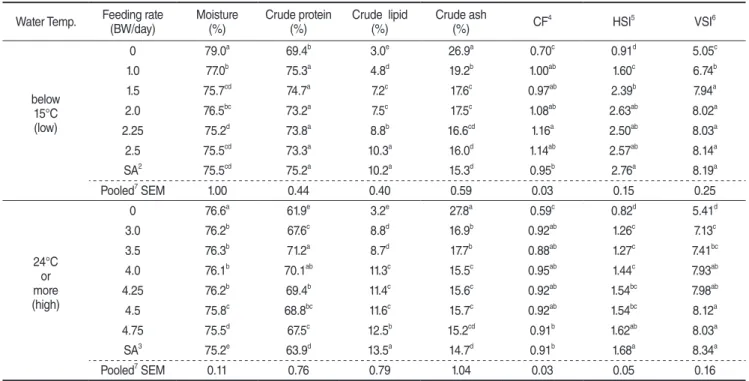
전어체 성분분석 및 형태학적 분석 결과는 Table 4에 나타냈 다. 본 연구의 전어체 성분에 있어서 조단백, 조지방 함량은 사 육수온에 관계없이 절식구에서 가장 낮은 수치로, 다른 실험구 에 비해 유의하게 낮게 나타났으며(
P
<0.05), 반면에 조회분과 수분 함량에 있어서는 가장 높은 수치로 다른 실험구에 비해 유 의하게 높게 나타났다(P
<0.05). Lee and Hur (1993)은 조피볼 락을 10주간 절식시키며 기간별로 전어체의 성분변화를 조사 한 결과, 최초 어체에 비하여 수분 함량은 절식기간이 지남에 따 라 증가한 반면, 단백질 및 지방함량은 감소하였으며, 지방의 감 소비율이 단백질에 비하여 더 높았다고 보고하였으며, Kim et al. (2007)의 연구와 본 연구에서도 이와 유사한 경향이 나타났 다. 지방함량에 있어서 고수온기보다 저수온기에 전체적으로 더 높은 수치의 경향이 나타났다. 이는 어류는 변온동물로서, 수온 이 낮아질수록 소화효소의 활성 및 대사율이 감소하게 되지만, 이와 반대로 사료 섭취율이 같을 경우에 수온이 상승한다면, 어 류의 소화효소의 활성 및 대사가 증가되지 않고 체내에 축적되 어 지방의 함량을 증대시킬 수 있다고 보고되고 있다(Fange andGrove, 1979; Fauconneau et al., 1983). 형태학적 분석 결과에 있어서는 비만도(CF)의 경우, 배합사료 공급율이 증가할수록 수치가 높아지는 경향이 나타났으나, 만복구에서는 다시 낮아지 는 경향이 나타났다. 간중량(HSI)과 내장중량지수(VSI)에 있어 서 0% 실험구인 절식구에 가까울수록 수치가 낮아지는 경향이 나타났다. 이는 먹이의 절대적 부족으로 인하여 체내의 지방 및 내장 축적지방이 에너지원으로 사용되기 때문에 함량이 낮아진 다고 보고되고 있다(Lee et al., 1996).
따라서, 본 연구를 통하여 상업용 배합사료의 적정 공급율은 겨울철 저수온기에는 1.97-2.51% BW/day, 여름철 고수온기에 는 4.83-6.36% BW/day가 될 것이며(Fig. 1 and Fig. 2), 이는 넙 치 배합사료 공급프로그램 개발에 도움을 줄 것으로 사료된다.
사 사
본 연구는 국립수산과학원(고효율 배합사료 개발 및 실용화 연구, RP-2011-AQ-061)의 지원에 의해 운영되었습니다.
Water Temp. Feeding rate
(BW/day) Moisture
(%) Crude protein
(%) Crude lipid
(%) Crude ash
(%) CF
4HSI
5VSI
6below 15°C (low)
0 79.0
a69.4
b3.0
e26.9
a0.70
c0.91
d5.05
c1.0 77.0
b75.3
a4.8
d19.2
b1.00
ab1.60
c6.74
b1.5 75.7
cd74.7
a7.2
c17.6
c0.97
ab2.39
b7.94
a2.0 76.5
bc73.2
a7.5
c17.5
c1.08
ab2.63
ab8.02
a2.25 75.2
d73.8
a8.8
b16.6
cd1.16
a2.50
ab8.03
a2.5 75.5
cd73.3
a10.3
a16.0
d1.14
ab2.57
ab8.14
aSA
275.5
cd75.2
a10.2
a15.3
d0.95
b2.76
a8.19
aPooled
7SEM 1.00 0.44 0.40 0.59 0.03 0.15 0.25
24°C or (high) more
0 76.6
a61.9
e3.2
e27.8
a0.59
c0.82
d5.41
d3.0 76.2
b67.6
c8.8
d16.9
b0.92
ab1.26
c7.13
c3.5 76.3
b71.2
a8.7
d17.7
b0.88
ab1.27
c7.41
bc4.0 76.1
b70.1
ab11.3
c15.5
c0.95
ab1.44
c7.93
ab4.25 76.2
b69.4
b11.4
c15.6
c0.92
ab1.54
bc7.98
ab4.5 75.8
c68.8
bc11.6
c15.7
c0.92
ab1.54
bc8.12
a4.75 75.5
d67.5
c12.5
b15.2
cd0.91
b1.62
ab8.03
aSA
375.2
e63.9
d13.5
a14.7
d0.91
b1.68
a8.34
aPooled
7SEM 0.11 0.76 0.79 1.04 0.03 0.05 0.16
Table 4. Whole-body proximate composition and morphological parameters of juvenile olive flounder
Paralichthys olivaceus
fed commercial diet at the low and high water temperature11Values in each column with different superscripts are significantly different(
P
<0.05).2SA: Satiation(2.84%)
3SA: Satiation(5.02%)
4CF: Condition Factor=body weight / total body length3
5HSI: Hepatosomatic Index=liver weight / body weight×100
6VSI: Visceralsomatic Index=visceral weight / body weight×100
7Pooled SEM: Pooled Standard error of mean: SD/ .
n
참고문헌
Adebayo OT, Balogun AM and Fagbenro OA. 2000. Effects of feeding rate on growth; Body composition and economic performance of juvenile clariid catfish hybrid(♀
Clarias gariepinus
× ♂Heterobranchus bidorsalis
). J Aquacult Trop 15, 109-117.AOAC (Association of Official Analytical Chemists). 2000.
Official Methods of Analysis of the Association of Official Analytical Chemists, 17th Edition. Cunniff, P ed. Association of Official Anayticial Chemists, Imc, Arlington, VA, U.S.A.
Azzaydi M, Martines FJ, Zamora S, Valzquez S and Madrid JA. 2000. The influence of nocturnal vs. diurnal feeding condition under winter condition on growth and feed conversion of European sea bass(
Dicentrachus labrax L
).Aquacult 182, 329-338.
Brett JR. 1979. Environmental factors and growth in Hoar,
W.S. Randall DJ. and Brett JR. editors, Fish Physiology.
Bioenergetics and Growth, vol. Ⅷ. Academic Press, New York, U.S.A., 599-675.
Brett JR and Higgs DA. 1970. Effects of temperature on rate of gastric digestion in fingerling sockeye salmon (
Onchorhynchus nerka
) in relation to temperature and ration size. J Fish Res Bd Can 26, 2363-2394.Clark JH, Watanabe WO and Eranst DH. 1990. Effect of feeding rate on growth and feed conversion of Florida red tilapia reared in floating marine cages. J World Aquacult Soc 21, 16-24.
Cho SH, Lee SM, Park BH and Lee SM. 2006. Effect of feeding ratio on growth and body composition of juvenile olive flounder,
Paralichthys olivaceus
fed extruded pellets during the summer season. J Aquacult 251, 78-84.Choi SM, Kim KW, Kang YJ, Park HS and Bai SC. 2008.
Optimum dietary lipid level and feeding rates of extruded pellets in juvenile flounder,
Paralichthys olivaceus
during Fig. 2. Second-order polynomial analysis of specific growth rate(SGR, %) for optimum feeding rate in juvenile olive flounder fed commercial diet at low(A) and high(B) temperature.Specific growth rate (%) Specific growth rate (%) Specific growth rate (%) Specific growth rate (%)
2.5
1.5
0.5
-0.5
-1.5
2.5 1.5 0.5 -0.5 -1.5
7.5 6 4.5 3 1.5 0
6 4.5 3 1.5 0
Feeding rate (%)
Feeding rate (%)
Feeding rate (%) y = 1.454x - 0.890
R
2= 0.890
y = 0.492x
2+ 2.467x - 1.117
R
2= 0.979 y = -0.168x
2+ 2.137x - 1.148
R
2= 0.999 y = 0.847x + 1.27
R
2= 0.998
1.97%
BW/day
(A) (B)
(A) (B)
0 1 2 3 4 2 3 4 5 6
0 1 2 3 4
2.51%
BW/day
4.82%
BW/day
6.36%
BW/day
Feeding rate (%)
2 4 6 8
Specific growth rate (%) Specific growth rate (%) Specific growth rate (%) Specific growth rate (%)
2.5
1.5
0.5
-0.5
-1.5
2.5 1.5 0.5 -0.5 -1.5
7.5 6 4.5 3 1.5 0
6 4.5 3 1.5 0
Feeding rate (%)
Feeding rate (%)
Feeding rate (%) y = 1.454x - 0.890
R
2= 0.890
y = 0.492x
2+ 2.467x - 1.117
R
2= 0.979 y = -0.168x
2+ 2.137x - 1.148
R
2= 0.999 y = 0.847x + 1.27
R
2= 0.998
1.97%
BW/day
(A) (B)
(A) (B)
0 1
2 3 4 5 6
2 3 4
0 1 2 3 4
2.51%
BW/day
4.82%
BW/day
6.36%
BW/day
Feeding rate (%)
2 4 6 8
Fig. 1. Broken-line analysis of specific growth rate(SGR, %) for optimum feeding rate in juvenile olive flounder
Paralichthys
olivaceus
fed commercial diet at low(A) and high(B) temperature.the summer season. J Aquacult 21 4, 244-251.
Deng DF, Koshio S, Yokoyama S, Bai SC, Shao Q, Cui Y and Hung SO. 2003. Effects of feeding rate on growth performance of white sturgeon,
Acipenser transmontanus
larvae. J Aquacult 217, 589-598.FAO. 2009. Fishstat plus, universal software for fishery statistical time series. Food and Aquaculture Organization, United Nations, Rome. Electronic webpage.
Fange R. and Grove D. 1979. Digestion. Fish physiology 8:
Bioenergetic and Growth Brett JR. Academic Press, New York, U.S.A., 161-260.
Fauconneau BG, Choubert D, Blanc J, Breque and Luquet P.
1983. Influence of environmental temperature on flow rate of foodstuffs through the gastointestinal tract of rainbow trout. J Aquacult 34, 27-39.
Gordon RB. 1968. Distribution of transaminase(Aminotransf- erases) in the tissues of the pacific salmon, with emphasis on the properties and diagnostic use of glutamic oxaloacet ic transaminase. J Fish Res Bd Can 25, 1247-1268.
Jung SH, Gordon RB. 1968. Distribution of transaminases (
Aminotransferases
) in the tissues of the pacific salmon (Oncorhynchus
), with emphasis on the properties and diagnostic use of emphasis on the properties and diagnostic use of glutamic osaloacetic transaminase. J Fish Res Bd Can 25, 1247-1268,Sim DS,S.H. Jung and Lee SD. 1995. Changes of blood parametersof the culture flounder(
Paralichthys olivaceus
) naturallyinfected with Staphylococcusepidermidis
. Bull Nat Fish Res Dev Age 49, 149-155.Hung SSO, Conte and Hallen EK. 1993. Effects of feeding rates on growth, body composition and nutriment metabolism in striped bass(
Morone saxatilis
) fingerlings. J Aquacult 112, 349-361.Kim YU. 2005. Policy of artifical feed supply for marine fish culture in korea, International Symposium on the present Status of Nutrition Research and the Future of Aquaculture Feed in Korea. Busan Korea, 11-16.
Kim KD., Kang YJ, Kim KW and Kim KM. 2007. Effects of feeding rate on growth and body composition of juvenile flounder,
Paralichthys olivaceus
. J World Aquacult Soc 38, 169-173.Lee SM and Hur SB. 1993. Effects of dietary n-3 highly unsaturated fatty acids on growth and biochemical changes in the Korean rockfish
Sebastes schlegeli
Ⅲ.Changes of body compositions with starvation. J Aquacult 6, 199-211.
Lee SM and Jeon IG. 1996. Evaluation of dr pellet on growth of juvenile Korean rockfish(
Sebastes schlegeli
) by comparing with moist pellet and raw fish based moist pellet. J Aquacult 9, 247-254.Lee SM, Park CS and Bang IC. 2002. Dietary protein
requirement of young Japanese flounder(
Paralichthys olivaceus
). J Aquacult. Res 31, 917-921.Mihelakakis A, Tsolkas C and Yoshimatsu T. 2002.
Optimization of feeding rate of hatchery-produced juvenile gilthead seabream
Sparus aurata
. J World Aquacult Soc 22, 169-175.Nakagawa K and Ikuta K. 1977. Electrophoretic evidence of seasonal variation of carp plasma albumin. J Fac Fish, Aim Husb Hiroshima Univ 16, 99-106.
Ng WK, Lu KS, Hashim R and Ali A. 2000. Effects of feeding rate on growth, feed utilization and body composition of a tropical bagrid catfish. J Aquacult Int 8, 19-29.
NRC(national research council). 1993. Nutrient requirement of fish. National academy Press, Washington DC, U.S.A., 114.
Okorie EO. 2010. A computer simulated feeding program proposed by the optimum feeding rate trials in olive flounder,
Paralichthys olivaceus
at the optimum temperature. Docter's Thesis. Pukyong Univ Pusan Korea.Pelletier D, Blier PU. Dutil JD and Guderley H. 1995. How should enzyme activities be used in fish growth studies?. J Exp Biol 198, 1493-1497.
Post G. 1983. Nutrition and nutritional diseases of fish In:
Textbook of fish healt. TFH. publications Inc Ltd, New Jersey, U.S.A., 199-207.
Robbins KR, Norton HW and Baker DH. 1979. Estimation of nutrient requirements from growth data. J Nut 109, 1710- 1714.
Sim DS, Jung SH and Lee SD. 1995. Changes in blood parameters of the cultured flounder,
Paralichthys olivaceus
naturally infected with Staphylococcusepidermidi
. Bull Nat Fish Res Dev Agency 49, 149-155.Tsevis N, Klaoudatos S and Condes A. 1992. Food conversion budget in sea bass
Dicentracus labrax
, fingerlings under two different feeding frequency patterns. J Aquacult 101, 293-304.Weatherley AH. and Gill HS. 1987. The biology of fish growth. 4. Protei, lipid and caloric contents. Academic press, London, U.K., 139-146
XiaoJin X and Ruyung S. 1992. The bioenergetics of the southern catfish(
Scohthalmus maximus
). J Aquacult 217, 547-558.Zeitoun IH, Ullrey DE, D.E Magae, Gill JL and Bergen WG.
1976. Quantifying nutrient requirements of fish. J Fish Rec Bd Can 33, 167-172.
2011년 5월 31일 접수 2011년 8월 16일 수정 2011년 8월 19일 수리