604 Corresponding author: [email protected]✽
제주도 넙치 양식현장에서 배합사료 성장 평가
김강웅✽・강용진1・김경덕・손맹현・최세민・배승철2・이경준3
국립수산과학원 양식관리과, 1중앙내수면연구소,
2부경대학교 양식학과, 3제주대학교 해양의생명과학부
Evaluation of extruded pellet for growth performance of olive flounder Paralichthys olivaceus in Jeju farm field
Kang-Woong Kim
✽, Yong Jin Kang
1, Kyoung-Duck Kim,
Maeng Hyun Son, Se-Min Choi, Sungchul C. Bai
2and Kyeong-Jun Lee
3Aquaculture Management Division, NFRDI, Pohang 791-802, Korea
1Inland Fisheries Research Institute, NFRDI, Gapyung 477-815, Korea
2Department of Aquaculture, Pukyong National University, Busan 608-737, Korea
3Faculty of Marine Biomedical Science, Cheju National University, Jeju 690-756, Korea
This study was conducted to evaluate extruded pellet (EP) diet compared with a raw fish moist pellet (MP) diet for flounder, Paralichthys olivaceus on field feeding experiments in Jeju area. The experimental EP diet (juvenile, growing and adult) was prepared based on the former studies on nutrient requirements and feed ingredient of flounder. Fish were distributed randomly to each aquarium as a group of 102,300 fish (initial mean weight 97 g) in field experimentⅠ and reared randomly to each aquarium as a group of 40,000 fish (initial mean weight 120 g) in field experimentⅡ. In field feeding experimentⅠ conducted in commercial flounder farm, survival, wt. gain (94-1,090 g), feed efficiency and condition factor of fish fed experimental EP were comparable to those of fish fed MP, but considerably higher protein efficiency ratio were observed in fish fed experimental EP. In field feeding experimentⅡ, no significant difference was observed in final mean weight of fish fed the experimental EP (1,234 g) and MP (1,286 g), and any noticeable problem caused by feeding the experimental EP was not found during the whole period of feeding trial. Survival of fish fed the experimental EP was lower than that of MP, and there was no significant difference in feed efficiency between the fish fed experimental EP and MP. Therefore, these results strongly suggest that diet EP could be developed to replace MP diet for the marketable size (1.3 kg) of production for flounder without adverse effects on growth performance. In particular, abdominal dropsy and reduction of condition factor, which are frequently occurred in commercial EP feeding farms, were not observed in flounder fed experimental EP.
Key words: Olive flounder, Extruded pellet, Moist pellet, Practical feed
서 론
최근 양식기술의 비약적인 발전으로 해산어 양식 생산량은 1990년 3천 톤에서 2008년 99천 톤으로 계속하여 증가하였으 며, 그 중 넙치와 조피볼락이 대부분 차지하고 있다. 넙치 양식 생산량은 농림수산식품부 자료를 토대로 1988년 10여 톤으로 처음 보고된 이래 2008년에 46천 톤으로 증가 추세에 있다. 해산어 양식 생산량과 더불어 양식사료 소비량도 606천 톤으로 증가하고 있으며, 그 중 배합사료 134천 톤 (22%)으로 생사료 472천 톤 (78%)에 비해 현저히 뒤떨어지고 있는 실정 이다. 특히 배합사료 사용량의 경우 2003년 76천 톤에서 2008 년 134천 톤으로 증가추세에 있으나, 넙치 등 핵심 어종은 증가율이 저조한 상태이다.
그 동안 넙치 연구는 완전배합사료 개발을 위하여 영양학적 기초연구들이 수행되어져 왔으며 (Kikuchi et al., 1997; Kim
et al., 2002; Alam et al., 2002; Kim et al., 2004; Kim et al., 2005a), 최근에는 실용배합사료 개발 (Extruded floating pellet, EP)에 대한 연구도 활발히 수행되어지고 있다 (Cho et al., 2005;
Seo et al., 2005; Kim et al., 2005b; Kim et al., 2006; Kim et al., 2008). 현재 배합사료가 개발되었더라도 대상어종에 부적합 하여 성장 및 사료효율 측면에서 생사료에 비해 크게 개선되어 있지 않거나 가격 면에서도 비싸기 때문에 양식 사양가로부터 외면당하고 있는 실정이다. 이러한 문제점들을 해결하기 위해 서는 양식 현장에서 신뢰할 수 있는 고품질배합사료 개발과 더불어 실제양식현장에서 습사료 와의 비교 사육실험을 통해 그 효과를 증명하고 평가하는 것이 중요하다고 볼 수 있다.
따라서, 본 연구에서는 습사료를 대체하여 사용할 수 있는 고품질의 실용배합사료를 개발하기 위하여 넙치의 영양요구 및 사료원료 이용성에 관한 기존의 연구결과들을 토대로 배합 사료를 설계, 제조하여 넙치 치어부터 상품크기까지의 제주도 양식장 현장에서의 자료를 제공하고자 수행되었다.
재료 및 방법
실험사료
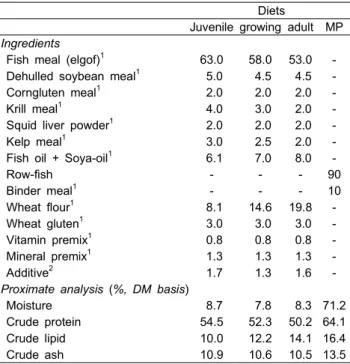
넙치 실험에 사용된 실험사료의 사료원료 및 일반성분 조성 은 Table 1에 나타내었다. 실험사료의 단백질원으로는 어분, 대두박, 콘글루텐밀, 크릴밀을 사용하였으며, 지질원으로 어 유, 대두유, 그리고 탄수화물원으로 밀가루, 밀글루텐을 사용 하였다. 기타 첨가제로서 다시마분말, 항산화제, 콜린, 효소, 레시틴 등을 사용하였다. 습사료 (MP)는 생사료 (고등어, 청 어, 조기새끼, 갈치새끼, 전갱이)와 분말사료 (binder meal)를 9:1 비율로 제조하여 냉동한 후 사용하였다. 실험사료는 기존 의 넙치의 영양소 요구량을 고려하여 성장단계별(치어기, 육 성기, 성어기)로 조단백질 50~54%, 조지방은 10~14%로 나뉘 어 사료회사에서 EP 부상사료를 제조 (5~15 mm)하였다.
실험어 및 사육관리
실험어는 실험 Ⅰ의 경우 제주도 한림읍 종묘배양장 (귀덕 수산)과 실험 Ⅱ의 경우 충남 태안군 육성용양식장 (샛별수산) 으로부터 제주시 표선읍에 위치한 삼형수산으로 운반하여 예비 사육하였으며, 실험사료에 적응시키기 위해 실험시작 전 넙치 상품사료를 2~4주간 공급하였다. 예비사육 후, 1차 실험의 경우 평균무게 97.2±1.6 g (mean±SD)인 102,300마리 (EP 52,000미, MP 50,300미)를, 2차 실험 의 경우 평균무게 120.2±0.3 g (mean±SD)인 육성어 40,000마리 (EP 20,000미, MP 20,000미)를 콘크리트수조 (8×8 m, 12×10 m, 12×13 m)에 각각 MP 및 EP 실험구로 분조하여 무작위 배치하였다. 각
Table 1. Ingredients and nutrient contents of experimental diets
Diets
Juvenile growing adult MP Ingredients
Fish meal (elgof)1 63.0 58.0 53.0 -
Dehulled soybean meal1 5.0 4.5 4.5 -
Corngluten meal1 2.0 2.0 2.0 -
Krill meal1 4.0 3.0 2.0 -
Squid liver powder1 2.0 2.0 2.0 -
Kelp meal1 3.0 2.5 2.0 -
Fish oil + Soya-oil1 6.1 7.0 8.0 -
Row-fish - - - 90
Binder meal1 - - - 10
Wheat flour1 8.1 14.6 19.8 -
Wheat gluten1 3.0 3.0 3.0 -
Vitamin premix1 0.8 0.8 0.8 -
Mineral premix1 1.3 1.3 1.3 -
Additive2 1.7 1.3 1.6 -
Proximate analysis (%, DM basis)
Moisture 8.7 7.8 8.3 71.2
Crude protein 54.5 52.3 50.2 64.1
Crude lipid 10.0 12.2 14.1 16.4
Crude ash 10.9 10.6 10.5 13.5
1Provided by Suhyup Feed Co., Kyong-Nam, Korea.
2Anti-oxidant, glucan, choline (50%), Lecthin.
실험수조는 유수식으로 유수량은 생해수와 지하해수 (30%) 를 혼합하여 시간당 20회전 되도록 하였으며, 실험기간 동안 수온은 15~23℃로 전 기간 자연수온에 의존하였다. 사료공급 량은 1일 2~3회 만복 공급하였으며, 사육기간은 실험 Ⅰ의 경우 2007년 12월 18일~2008년 11월 13일이며, 실험 Ⅱ의 경우 2007년 12월 3일~2008년 11월 3일까지 실시하였다.
어체측정 및 성분분석
어체 측정은 매월 각 수조별 수용된 실험어의 30~50마리를 수조당 2회씩 평균무게로 측정하였으며, 어류가 성장함에 따 라 수조크기 변경, 실험어 분조 및 선별을 하였다. 실험종료 후 전수측정을 실시하였으며, 총중량, 증체량, 증체율, 사료섭 취량, 사료효율, 생존율 등을 조사하였다. 실험사료와 각 수조 별로 10마리씩 무작위로 추출하여 분쇄한 전어체 및 등근육을 분석하였으며, AOAC (1984)방법에 따라 수분은 상압가열건 조법 (105℃, 6시간), 조단백질은 kjeldahl 질소정량법 (N×
6.25), 조회분은 직접회화법으로 분석하였다. 조지방은 샘플 을 12시간 동결 건조한 후, soxtec system 1046(Tacator AB, Sweden)을 사용하여 soxhlet 추출법으로 분석하였다.
통계처리
결과의 통계처리는 SPSS program을 사용하여 One-way ANOVA-test를 실시하여 Duncan’s multiple range test (Duncan, 1955)로 평균간의 유의성을 검정하였다.
결과 및 고찰
실용적인 배합사료를 개발하기 위해서는 대상 어종에 필요 한 영양소 및 영양소별 적정 요구량을 구명하는 것이 가장 먼저 선행되어야 하며 (Peres and Oliva-Teles, 1999), 아울러 상기 넙치 치어, 육성어 및 성어의 배합사료 현장적용시험에 사용된 사료설계는 성장함에 따라 단백질함량, 아미노산조성, 지방함량 등 영양소 요구량을 고려하여 최적의 건조부상사료 (EP)로 제조되었다 (Kikuchi et al., 1997; Bai et al., 2002; Kim
& Lee, 2004; Kim et al., 2004).
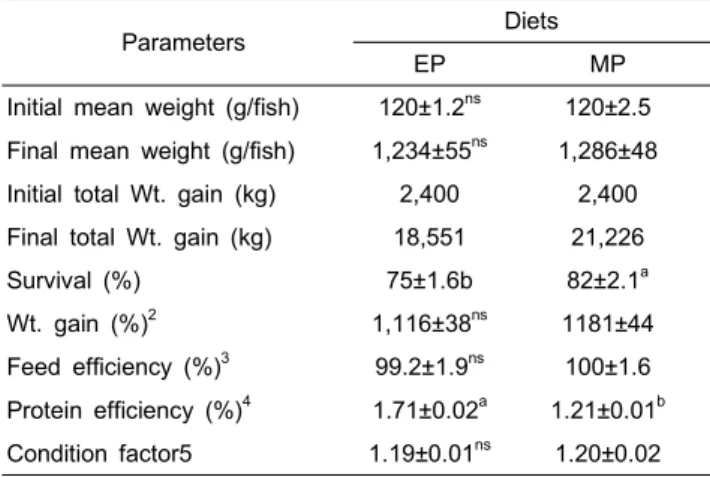
장기간 (2007. 12. 3~2008. 11. 13) 동안 제주지역 현장에서 사육한 넙치의 배합사료 (EP) 및 습사료 (MP) 실험구의 성장 결과는 Table 2~3에 나타내었다. 실험 Ⅰ의 사육실험 결과, 최초 평균체중 94~101 g이었던 것이 최종 평균체중 1,052~
1,090 g으로 상품크기까지 성장하였으며, 증체율은 EP 실험구 가 1,020%로 MP 실험구의 984%보다 높은 값을 보였으나, 두 실험구간에는 유의적인 차이를 보이지 않았다 (P>0.05).
월별 증체량에 있어서는 10~11월 사이 높은 수온 (20~22℃)으 로 먹이섭취가 원활하여 월별체중 134~224 g으로 높게 나타났 으며, 1~4월 사이 저수온 (14~16℃)에 따른 평균체중 50 g 내외의 낮은 성장을 보였다. 실험 Ⅱ의 사육실험 결과, 최초 평균체중이 120 g이었던 것이 최종 평균체중 1,234~1,286 g으 로 상품크기 이상으로 성장하였으며, 증체율은 EP 실험구가 928%로 MP 실험구의 972%보다 낮은 값을 보였으나, 두 실험 구간에 유의한 차이를 보이지 않았다 (P>0.05). 월별 증체량 (Fig. 1 및 2)에 있어서 9~11월 사이 수온 상승에 따른 월별체중
124~223 g으로 높게 나타났으며, 2~4월 사이에는 평균 100 g 이하로 낮은 성장을 보였다. 두 실험의 사육시험 종료 시, 어체의 비만도에서도 EP 실험구 (1.12~1.19)와 MP 실험구 (1.13~1.20) 간에 차이가 없었다 (P>0.05). 상기 결과는 최근에 대형수조 및 양식장 현장에서 배합사료 (EP)와 습사료 (MP)의 사육효능을 비교 평가한 연구 결과, EP의 성장이 MP보다 우수하거나 차이가 없는 것으로 나타나서 넙치 사육을 위한 EP의 MP 대체 가능성을 보고한 바와 비슷한 경향을 보였다 (Cho et al., 2005; Lee et al., 2005; Seo et al., 2005; Kim et al., 2006; Kim et al., 2008). 특히 Kim et al. (2008)은 최근 대형수조(15톤)에서 최초 체중 600 g 전후의 미성어기 넙치를 상품크기인 1 kg 이상까지 32주간 사육한 결과, EP가 MP와 비교하여 성장 및 비만도에서 유의한 차이가 없는 것으로 나타났다. 이러한 결과는 넙치 배합사료 공급 시 문제점으로 제기되어온 성어기 성장둔화로 인한 출하시기 지연, 복수증, 비만도 및 육질저하 등 해소할 수 있을 것으로 기대되며, EP의 MP 대체 가능성을 증명한 연구결과를 바탕으로 양어가들의 배합사료에 대한 불신감을 줄일 수 있어 EP를 실제 양식현장 에 적용할 수 있을 것으로 판단된다.
Fig 1. Monthly changes of Wt. gain in field feeding experimentⅠ.
Fig 2. Monthly changes of Wt. gain in field feeding experimentⅡ.
Table 2. Growth performance of flounder fed EP and MP diets in field feeding experimentⅠ1
Parameters Diets
EP MP
Initial mean weight (g/fish) 94±3.7ns 101±2.5 Final mean weight (g/fish) 1,052±49ns 1,090±66 Initial total Wt. gain (kg) 4,878 5,056 Final total Wt. gain (kg) 39,065 42,420
Survival (%) 73±2.1ns 78±1.9
Wt. gain (%)1 1,021±23ns 984±29
Feed efficiency (%)2 104±2.1ns 108±1.5 Protein efficiency (%)3 1.62±0.01a 1.02±0.01b Condition factor4 1.12±0.02nns 1.13±0.02 Values (mean±SE of ten replications) in each column with a different superscript are significantly different (P<0.05).
ns, not significant (P>0.05).
1Percent weight gain; (final wt. - initial wt.) × 100 / initial wE t.
2Fish wet weight gain × 100 / feed intake.
3Fish wet weight gain × 100 / protein intake.
4Fish weight gain × 100 / total length3.
Table 3. Growth performance of flounder fed EP and MP diets in field feeding experimentⅡ1
Parameters Diets
EP MP
Initial mean weight (g/fish) 120±1.2ns 120±2.5 Final mean weight (g/fish) 1,234±55ns 1,286±48 Initial total Wt. gain (kg) 2,400 2,400 Final total Wt. gain (kg) 18,551 21,226
Survival (%) 75±1.6b 82±2.1a
Wt. gain (%)2 1,116±38ns 1181±44
Feed efficiency (%)3 99.2±1.9ns 100±1.6 Protein efficiency (%)4 1.71±0.02a 1.21±0.01b Condition factor5 1.19±0.01ns 1.20±0.02
1Refer to Table 2.
실험어가 성장함에 따라 선별한 결과, 실험 Ⅰ의 경우 선두 그룹 (1.3kg 이상)은 배합사료 (59%)로 습사료 (64.4%)보다 낮게 나타난 반면에 중간 및 하위그룹 (1.3 kg 이하)에서는 배합사료 (41%)가 습사료 (35.6%)보다 높은 경향을 보였다.
실험 Ⅱ의 경우 선두그룹 (1.3 kg 이상)은 배합사료 (12.7%)가 습사료(22.3%)보다 다소 낮게 나타난 반면에 중간그룹 (1~1.3 kg)은 배합사료 (60.3%)가 습사료 (39.9%)보다 매우 높은 경향 을 보였으며, 하위그룹 (1 kg 이하)은 배합사료 (27%)가 습사 료(37.8%)보다 낮게 나타났다. EP 사료는 전체적으로 고른 성장을 보인 반면에 MP 사료는 상위와 하위그룹에 차이가
높은 것을 알 수 있다. 이러한 차이는 사료의 공급량, 사료의 형태 및 방법, 사료의 종류 등에 따라 달라 질수 있으며, 특히 사료내 영양소 중에서 단백질함량, 지질함량, 에너지함량 등 에 따라 크게 달라 질 수 있다 (Azzaydi et al., 2000).
사료효율은 실험 Ⅰ의 경우 EP 실험구가 104%로 MP 실험 구의 108%와 비교하여 유의적인 차이가 없었으며 (P>0.05), 실험 Ⅱ의 경우도 마찬가지로 EP 및 MP 실험구가 각각 99%, 100%로 유의적인 차이가 없었다 (P>0.05). 상기 결과는 현장 시험 양식장에서 넙치 500 g 크기까지 배합사료 공급체계에 대한 경험을 바탕으로 사양관리 기술이 원활하게 이루어 졌으 며, 아울러 MP의 경우도 사육수조에서 사료를 섭취하는 동안 수중으로 유실되는 양을 최소화 할 뿐만 아니라 사료내 첨가 제를 통해 사료효율도 높았을 것으로 판단된다. 양어사료의 사양관리 기술은 성장, 사료비용, 환경오염과 직접적인 관련 성을 가지고 있으며, 만약 사료가 과잉 공급되었을 경우 사료 비용의 증가와 사료의 유실로 인해 수질오염이 발생할 우려가 있는 반면에 사료공급이 부족할 경우 양식어의 성장저하를 초래할 수 있다 (Tsvis et al., 1992; Azzaydi et al., 2000) 이미 기존의 연구들에서는 EP 실험구에 비해 MP 실험구가 사료효 율이 낮은 것으로 보고되었는데 (Cho et al., 2005; Lee et al, 2005; Kim et al., 2007), 이는 점결력이 낮고 수분함량이 높은 MP가 사육수조에서 사료를 섭취하는 동안 수중으로 유실되 는 량이 EP사료에 비하여 많은 것으로 보고되었다 (Doughyt and Mcphall, 1995). 이와 관련하여 연어과 어류의 경우에서도 생사료의 사료 허실량이 배합사료의 3배가 된다고 보고되고 있어 수질오염을 줄이기 위한 사료의 질적 개선에 대한 지속 적인 연구가 필요하다 (Hardy et al., 1993).
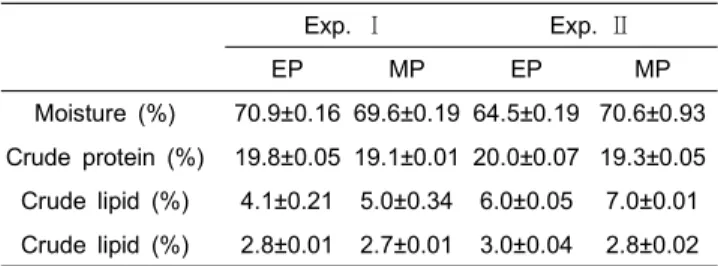
Table 4. Proximate composition of whole body of flounder for field feeding ExperimentⅠ & Ⅱ
Exp. Ⅰ Exp. Ⅱ
EP MP EP MP
Moisture (%) 70.9±0.16 69.6±0.19 64.5±0.19 70.6±0.93 Crude protein (%) 19.8±0.05 19.1±0.01 20.0±0.07 19.3±0.05 Crude lipid (%) 4.1±0.21 5.0±0.34 6.0±0.05 7.0±0.01 Crude lipid (%) 2.8±0.01 2.7±0.01 3.0±0.04 2.8±0.02 Values (mean of duplications) in each column with a different superscript are significantly different (P<0.05).
Table 5. Proximate composition of dorsal muscle of flounder for field feeding ExperimentⅠ & Ⅱ
Exp. Ⅰ Exp. Ⅱ
EP MP EP MP
Moisture (%) 75.0±0.16 75.7±0.06 74.7±0.11 75.9±0.15 Crude protein (%) 24.1±0.33 23.2±0.41 23.7±0.51 21.9±0.55 Crude lipid (%) 0.4±0.01 0.5±0.008 0.5±0.01 0.6±0.01 Values (mean of duplications) in each column with a different superscript are significantly different (P<0.05).
생존율은 실험 Ⅰ의 경우 모든 실험구 (73~78%)에서 유의 적인 차이가 없는 (P>0.05) 반면에 실험 Ⅱ의 경우 EP 실험구 (75%)가 MP 실험구 (82%)와 비교하여 유의적으로 낮게 나타 내었으며 (P<0.05), 전체적으로 MP 실험구가 EP 실험구보다 다소 높은 경향을 보였다. 이것은 실험 초기에 배합사료를 소화하는 과정에서 다소 폐사율이 발생하였으며, 또한 EP의 생리적 특징상 겨울철 (저수온기) 낮은 소화율로 인한 면역력 저하와 여름철 (고수온기)의 높은 밀도로 인한 용존산소 부족 에 기인하는 것으로 사료된다. 향후 EP 사료 제조 시, 사료물성 에 따라 성장, 영양소 이용효율, 사료 섭취율 및 체성분 등에 있어 차이가 중요한 변수가 될 것으로 판단되어 더 많은 연구 가 뒷받침되어야 한다.
사육실험 종료 후, 실험어의 전어체의 일반성분 분석 결과 를 Table 4에 각각 나타내었다. 실험 Ⅰ의 경우 전어체의 조단 백질은 EP (17.4~19.8%)와 MP 실험구 (17.5~19.1%)에서 월별 성장함에 따라 유의적인 차이가 없었으며 (P>0.05), 조지질도 마찬가지로 EP (2.0~4.1%) 및 MP 실험구 (2.5~5.0%) 모두 유의적인 차이는 없었으나, 전체적으로 MP 실험구가 높은 경향을 보였다. 이와 같은 경향은 MP 사료내 지질 함량 증가가 어체의 지질 함량을 증가시키는 결과로 사료된다. 실험 Ⅱ의 경우도 마찬가지로 전어체의 수분, 조단백질 및 조지질 함량 이 모든 실험구간에서 유의적인 차이를 보이지 않았다 (P>0.05). 실험 Ⅰ & Ⅱ의 등근육 (dorsal muscle)의 일반성분 결과는 Table 5에 나타내었으며, 모든 실험구간에 유의적인 차이를 보이지 않았다 (P>0.05).
따라서, 상기 넙치 제주지역 현장시험을 통해 EP 사료의 성장 및 사료효율, 비만도 등 사육 성적에 대한 평가가 MP 사료와 견줄만한 성장 결과를 도출하는 것으로 확인하였으며, 배합사료만으로도 충분한 성장이 가능하여 산업화 보급에 전혀 손색이 없을 것으로 판단된다. 이번 시험사업 결과를 통해 양식 넙치용 배합사료에 대한 어업인의 새로운 인식 전환의 계기로 삼아 향후 친환경 배합사료의 사용 확대 및 정부 차원에서 추진 중인 배합사료 직불제의 활성화 도모에 크게 기여할 것이다.
사 사
본 연구는 국립수산과학원 (고효율 배합사료 개발 및 실용 화 연구, RP-2008-AQ-162)의 지원에 의해 운영되었습니다.
참고문헌
Alam MS, Teshima SI, Kosiho S and Ishikawa M.
2002. Arginine requirement of juvenile Japanese flounder, Paralichthys olivaceus estimated by growth and biochemical parameters. Aquaculture 205, 127-140.
Azzaydi M, Martines FJ, Zamora S, Sanchez- Valzquez and Madrid JA, 2000. The influence of nocturnal vs. diurnal feeding condition under winter condition on growth and feed conversion
of European sea bass (Dicentrarchus labrax L.).
Aquaculture, 182, 329-338.
Cho SH, Lee SM and Lee JH. 2005. Effects of the extruded pellets and raw fish-based moist pellet on growth and body composition of flounder, Parlichthys olivaceus for 10 months. J Aquaculture 18, 60-65.
Doughty CR and Mcphall CD. 1995. Monitoring the environmental impacts and consent compliance of freshwater fish farms. Aquaculture Research 26, 557-565.
Hardy RW, Fairgrieve WT and Scott TW. 1993.
Periodic feeding of low-phosphorus diet and phos- phorus retention in rainbow trout. In: Kaushik S J & Luquet P (eds.). Fish Nutrition in Practice.
pp. 403-412. INRA Press, Paris.
Kikuchi K, Furuta T and Honda H. 1997. Use of Meat and Bone Meal as a protein source in the diet of juvenile japanese flounder. Fisheries Science 63, 29-32.
Kim KD and Lee M. 2004. Requirement of dietary n-3 highly unsaturated fatty acids for juvenile flounder Paralichthys olivaceus. Aquaculture 229, 315-323.
Kim KW, Wang XJ and Bai SC. 2002. Reevaluation of the Dietary Protein Requirement of Japanese Flounder Paralichthys olivaceus. Aquaculture research 33, 673-679.
Kim KW, Kang YJ, Kim KM, Lee HY, Kim KD and Bai SC. 2005b. Long-term evaluation of extruded pellet diets compared to raw fish moist pellet diet for growing flounder, Paralichthys olivaceus. J Aquaculture 18, 225-230.
Kim KW, Kang YJ, Choi SM, Wang XJ, Choi YH, Bai SC, Jo JY and Lee JY. 2005a. Optimum
dietary protein levels and protein to energy ratios in olive flounder, Paralichthys olivaceus. J World Aquaculture Research 36, 165-178
Kim KW, Kang YJ, Lee HY, Kim KD, Choi SM, Bai SC and Park HS. 2006. Commercial scale evaluation of practical extruded pellet feed for the olive flounder (Paralichthys olivaceus). J Korean Fish Soc 39, 100-105.
Kim KD, Kang YJ, Lee JY, Nam MM, Kim KW, Jang MS and Lee SM. 2008. Evalution of extruded pellets and raw fish-based moist pellet for growth of sub-adult flounder Paralichthys olivaceus. J Aquaculture 21, 102-106.
Lee SM, Seo JY, Lee YW, Kim KD, Lee JH and Jang HS. 2005. Evaluation of experimental extruded pellet, commercial pellet and raw fish-based moist pellet for growing flounder, Paralichthys olivaceus.
J Aquaculture 18, 287-292.
Peres H and Oliva-Teles A. 1999. Effect of dietary lipid level on growth performance and feed utilization by European sea bass juvenile (Dicentrarchus labrax). Aquaculture 179, 325-334.
Seo JY, Lee JH, Kim GU and Lee SM. 2005. Effect of extruded and moist pellets at different feeding rate on growth and body composition of juvenile flounder, Paralichthys olivaceus. J Aquaculture 18, 26-30.
Tsevis N, Klaoudatos S and Conides A. 1992. Food conversion budget in sea bass Dicentrarchus labrax, fingerlings under two different feeding frequency patterns. Aquaculture 101, 293-304.
2009년 10월 5일 접수 2009년 11월 10일 수정 2009년 12월 12일 수리