First record of Cyrtomium laetevirens and Dryopteris simasakii var.
paleacea (Dryopteridaceae) from Korea Chang Shook Lee*, Kanghyup Lee1 and Youngsim Hwang
2
Dept. of Science Education, Ewha Womans University, Seoul 120-750, Korea
1Pyunggang Botanical Garden, Pocheon 487-892, Gyeonggi-do, Korea
2Geobook, Seoul 110-873, Korea
(Received 16 August 2013; Accepted 3 September 2013)
한반도 미기록 층층지네고사리와 윤쇠고비(관중과)
이창숙*·이강협1·황영심2
이화여자대학교 사범대학 과학교육과, 1평강식물원, 2지오북
ABSTRACT: Two newly recorded species, Cyrtomium laetevirens and Dryopteris simasakii var. paleacea (Dryopteri- daceae) were collected from forests in Jeonnam, Geongnam and Jeju-do, with the latter also, found addedly in Gwa- naksan, Seoul. C. laetevirens (vernacular name: ‘Yun-soe-go-bi’) was distinguished from other Korean congeners of the genus Cyrtomium by having glossy laminae, narrow lanceolate, yellow-green pinnae with minutely serrated margin and gradually narrowing shape from base to apex, along with entire, unicolor, and white grayish indusia. D. simasakii var.
paleacea (vernacular name: ‘Cheung-cheung-ji-ne-go-sa-ri’), was distinguished by shining leaves, opposite pinnae arrangement, no falcate pinnules, and densely adpressed scaly wholly along with irregular dark brown scales on stipe and rachis. Descriptions and illustrations of the two taxa and their photographs in the habitat are provided along with a key to the species of Cyrtomium and sect. Hirpedes of Dryopteris from Korea.
Keywords: Cyrtomium laetevirens, Dryopteris simasakii var. paleacea, Dryopteridaceae, first report
적 요: 관중과의 미기록 분류군 윤쇠고비(Cyrtomium laetevirens)와 층층지네고사리 (Dryopteris simasakii var.
paleacea)가 전남, 경남, 제주지역에서 두 종 모두 발견되었다. 또한 층층지네고사리는 서울 관악산에서도 발견
되었다. 윤쇠고비는 쇠고비속의 다른 분류군들에 비해서 윤기가 있는 잎몸, 좁은 피침형이고 황록색이며, 가장 자리에 작은 톱니가 있고, 끝을 향해 점차 좁아지는 우편, 단색의 회백색 포막이 있는 점이 뚜렷이 구별된다.
층층지네고사리는 다른 분류군들과 비교해 윤기가 나며, 우편은 마주나 배열되고, 소우편은 낫모양이 아니며, 불규칙하고 흑갈색인 비늘조각이 잎자루와 중축에 전체적으로 납작하게 밀집되어 있다는 점에서 뚜렷이 구 분된다. 주요형질에 대한 두 분류군의 기재 및 해부도와 서식지 식물사진 및 한국산 쇠고비속과 관중속의 홍 지네고사리절 (sect. Hirpedes) 식물에 대한 검색표를 제시하였다.
주요어: 윤쇠고비, 층층지네고사리, 관중과, 미기록
The genus Cyrtomium C. Presl (Dryopteridaceae), known as the Asiatic holly fern, contains about 40 species that are mostly
distributed in Eastern Asia as well as a few species in Africa and Hawaii (Jin and Cheng, 2003; Lu et al., 2005). This genus is characterized by short densely scaly rhizomes, ascending or erect, imparipinnate with a distinct pinnatifid apex, entire or denticulate margin of pinna, anastomosing veins with free vein, and peltate indusia (Jin and Cheng, 2003).
Some studies have attended to the delimitation of species
*Author for correspondence: [email protected] /[email protected] http://www.pltaxa.or.kr
Copyright © 2013 the Korean Society of Plant Taxonomists
and sections within this genus (Tagawa, 1934; Shing, 1965;
Iwatsuki, 1995), but interspecific relationships remain poorly understood (Lu et al., 2006). According to Shing (1965), the genus Cyrtomium is divided into two series, Falcata and Fortuneana based on frond texture and the presence or absence of serrations on leaf margins. Some taxonomists have treated Polystichum, Phaneroplebia and Cyrtogonellum as synonyms of Cyrtomium (Tryon and Tryon, 1982). Cyrtomium was reported as distinct monophyletic group and is more closely related to Polystichum than to Phaneroplebia based on phylogeny analysis of rbcL sequence data (Little and Barrington, 2003). According to Lu et al. (2005), molecular phylogeny of rbcL and trnL-F sequence data determined about 19 species of Cyrtomium, and the results confirm Cyrtomium as a paraphyletic. Phylogenetic studies to clarify the taxonomic status of the sections in subgenus Cyrtomium have been carried out recently based on molecular and morphological data (Lu et al., 2006).
The base chromosome number of Cyrtomium is n = 41 (Löve et al., 1977), but some studies have detected four cytotypes in Cyrtomium along with intraspecific ploidy differences in other species (Lu and Cheng, 2003; Lu et al., 2006). Based on spore counts obtained from herbarium specimens, Mitsuta (1986) observed that 56% of Chinese Cyrtomium species are apogamous, among which seven species display both sexual and apogamous types (Lu et al., 2006).
Korean ferns belonging to Cyrtomium have been reported as C. caryotideum var. coreanum Nakai, C. falcatum (L. f.) C.
Presl, C. devexiscapulae (Koidz.) Ching, C. fortunei J. Sm . var. fortunei, and C. fortunei J. Sm. var. clivicola (Makino) Tagawa (Lee, 2006; Kim and Sun, 2007; Park et al., 2008;
Youn, 2012). Studies on one, two or three taxa of Cyrtomium from Korea have been carried out based on morphology (Oh et al., 1993), chromosome of C. falcatum (Sun et al., 2002), prothallus morphogenesis of C. falcatum and C. caryotideum (Jeong and Lee, 2006), and recently chloroplast DNA, trnL- trnF, trnH-psbA, rps4-trnS of C. falcatum, C. devexiscapulae and C. fortunei (Youn, 2012).
The genus Dryopteris Adans. is the largest genera of Dryopteridaceae (Fraser-Jenkins, 1986; Sessa et al., 2012;
Zhang et al., 2012). Fraser-Jenkins (1986) prevousely carried out a global classification that divided Dryopteris into four subgenera [subgen. Pycnopteris (T. Moore) Ching, subgen.
Dryopteris, subgen. Erythrovariae (H. Itô) Fraser-Jenk., and subgen. Nephrocystis (H. Itô) Fraser-Jenk.]. Among these, three sections of the subgenus Erythrovariae (H. Itô) Fraser-Jenk.
(section Erythrovarie, section Politae Fraser-Jenk., and section Variae Fraser-Jenk.), the section Erythrovariae showed the
following characters: asymmetrical pinnae and pinnules, pinnules always with a cuneate base and non caudate apices, rounded lobes, and mostly bullate scales below costae and costules (Fraser-Jenkins, 1986; Liou and Wang, 2013). The section Erythrovariae was reported as a distinct monophyletic group based on phylogenetic sequence analysis of four plastid loci (rbcL gene, rps4-trnS spacer, trnL intron, trnL-F spacer) (Zhang et al., 2012). The base chromosome number of Dryopteris is n = 41 (Liu et al., 2007), although polyploidy is common, and Dryopteris is considered to be extremely prone to hybridization (Manton, 1950). The potential roles of reticulate evolution and polyploidy in the genus have long been recognized (Stein et al., 2010). Many taxa of sect.
Erythrovariae that have been reported as apogamous are diploidy or triploidy (n = 82 or 123) (Hirabayashi, 1969; Gibby, 1985; Iwatsuki, 1995)
Korean ferns belonging to sect. Erythrovariae have been reported as Dryopteris decipiens, D. fuscipes, D. medioxima, D. championii, D. kinkiensis, D. erythrosora, D. caudipinna, D. nipponensis, and D. hondoensis (Lee, 2006; Kim and Sun, 2007; Park et al., 2008).
In the present study, C. laetevirens (Hiyama) Nakaike is reported as a newly recorded taxa from Korea, and it was collected from a forest in Mudeungsan in Jeonnam, Iphwasan in Ulsan-si, Gaoje-do, Mireuk-do, and Jeju-do. The local name was designated as ‘Yun-soe-go-bi’ based on the polished upper laminae. This taxon is distinguished based on dark brown scale in base of stipe, narrow falcate-lanceolate, green and glossy pinnae, minutely serrated margin of lateral pinnae, and white grayish indusia (Hiyama, 1953; Nakaike, 1992; Matsumoto, 2003). D. simasakii var. paleacea (H. Itô) Sa. Kurata is reported as newly recorded taxa from Korea, and it was collected from a forest in Mudeungsan, Ulsan-si, Gaoje-do, Mireuk-do, Jeju- do, and even Gwanaksan in Seoul. This taxon is distinguished based on shinning laminae, dense scales in stipe and rachis, and less irregular toothed scales in stipe. The local name was given as ‘Cheung-cheung-ji-ne-go-sa-ri’ based on the shape of pinnae of lamina.
We compared and analyzed morphological characters between C. laetevirens and similar taxa of Cyrtomium, as well as between the other new recorded taxon, D. simasakii var.
paleacea and similar taxa of sect. Erythrovariae of Dryopteris in order to elucidate their taxonomic relationship. The morphological characters, and illustrations of C. laetevirens and D. simasakii var. paleacea, along with photographs of the habitat, are newly reported with a taxonomic key to the species of Cyrtomium, and sect. Erythrovariae of Dryopteris from Korea.
Materials and Methods
Two unrecorded taxa (Cyrtomium laetevirens and Dryopteris simasakii var. paleacea) (Figs. 1-4) were collected firstly in Korea, and the voucher specimens were deposited in the National Institute of Biological Resources (NIBR) and Ewha Womans University Herbarium (EWH). To reveal the taxonomic positions of C. laetevirens and D. simasakii var.
paleacea, 15 and 18 morphological characters respectively (Tables 1, 2), based on observed morphological data and the reported data of the flora and illustrated books (Tagawa, 1934;
Kurata and Nakaike, 1979; Nakaike, 1992; Iwatsuki, 1992, 1995; Liou & Wang, 2013). The former was compared for seven taxa with two taxa distributed in Japan as having more similar characters to this species of Cyrtomium (Table 1). And the latter was compared for six taxa with three taxa distributed in Japan and Taiwan as having more similar characters to this species of Dryopteris (Table 2).
Description and Discussion
Cyrtomium laetevirens (Hiyama) Nakaike, New Fl. Japan, Pterid.: 840 (1992).
C. fortunei f. laetevirens Hiyama, Journal of Japanese Botany 28: 218 (1953).
Korean name: Yun-soe-go-bi 윤쇠고비
Winter green herb, height 60-100 cm. Rhizomes short, thick, ascending or erect, scaly; scales ovate lanceolate, serrate margin, shinning blackish brown, 5-20 mm length, 0.2-6.0 mm width. Stipes 25-35 cm length, 2-3 mm width, commonly scaly at base; scales lanceolate to linear lanceolate, mimute lacerate at margin, suddenly caudate at apex, blackish brown, 1.5-1.6 mm length, 0.2-4.5 mm width. Laminae once pinnate, 18-25 lateral pinnae pairs, narrow lanceolate, gradually narrowing towards acuminate apex, lower pinnae a little shortened, papyraceous, 35-60 cm length, 14-20 cm width, lateral pinnae deflexed a little; rachis greenish colored, with smaller scales than stipe; scales lanceolate, brown, 2-7 mm length, 0.1-2.0 mm, with brown or blackish brown hairs;
lateral pinnae falcate-linear lanceolate, narrowing continuously from base, 6-10 cm length, 18-30 mm width, a little auricled, round at base, short-stalked about 2 mm length, minutely serrate margin, yellowish green; veinlets reticulate with free vein. Sori dispersed somewhat throughout, attached at end or middle part of free vein in reticulate vein; indusial peltate, entire, uni-color, grayish white, about 1.2 mm width.
Spores monolete.
Distribution: Korea and Japan, in mountain areas.
Specimens examined: Mudeungsan, Gwangju-jikhalsi, 24 Oct. 2012, C.S. Lee & G.H. Lee 1210001-2 (EWH); Oesong, Geoje-do, 3 Nov. 2012, C.S. Lee & G.H. Lee 121115 (EWH);
Hyodoncheon, Seogwipo-si, Jeju-do, 3 Mar. 2013, C.S. Lee &
G.H. Lee 1303001-2 (EWH); Iphwasan, Ulsan-si, 8 June, 2013, C.S. Lee & G.H. Lee 1306100-6 (NIBR, EWH)
The new local name ‘Yun-soe-go-bi’ was given based on polished upper laminae. It was found widely in the forest from Mudeungsan, Gwangju-jikhalsi to Seogwipo-si as southern part of Korea with D. fuscipes, D. uniformis, D. erythrosora, Polygonatum inflatum, Arisaema amurense var. serratum, Quercus myrsinaefolia, Camellia japonica, and Hedera rhombea.
C. laetevirens can be distinguished from the similar taxa of the genus Cyrtomium in Korea as follows:
1. Pinnae coriaceous or thick papyraceous, without tooth in apex of pinna
2. Pinna base round; central part of indusium blackish brown ··· C. falcatum 도깨비쇠고비 2. Pinna base cuneate; throughout part of indusium
blackish brown
··· C. devexiscapulae 긴잎도깨비쇠고비 1. Pinnae papyraceous, with serrulate apex of pinna
3. Pinnae narrow lanceolate, gradually narrowing to apex, shinning ··· C. laetevirens 윤쇠고비 3. Pinnae ovate lanceolate, suddenly narrowing to apex,
without shinning
4. Adaxial surface of lamina yellowish green, about 15 lateral pinnae pairs ··· C. fortunei var. clivicola 산쇠고비 4. Adaxial surface of lamina deep green, about 30 lateral pinnae pairs ··· C. fortunei var. fortunei 쇠고비
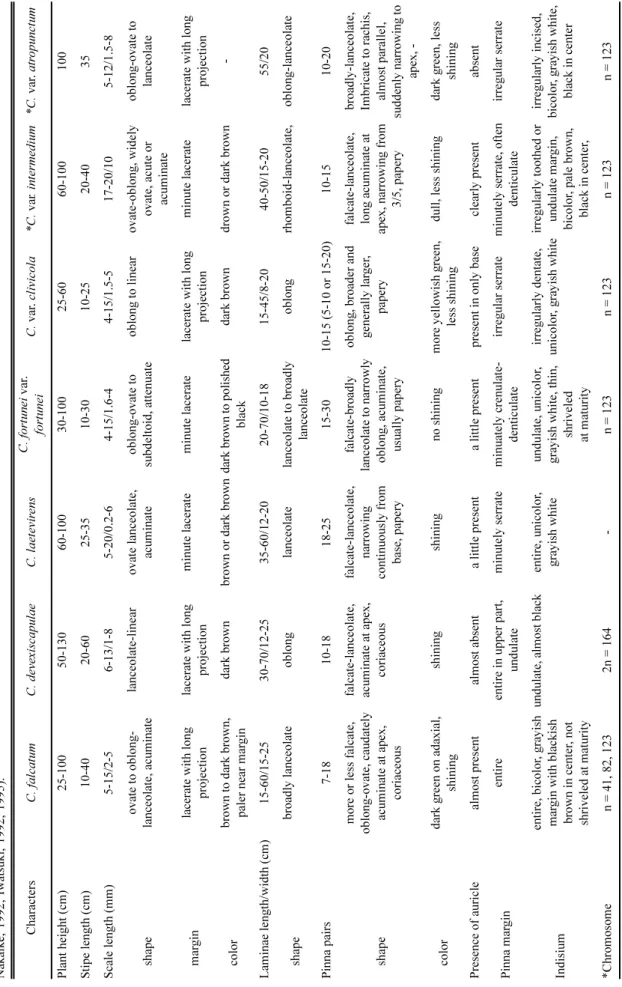
The new reported taxon in Korea, C. laetevirens (Hiyama) Nakaike has been classified as a form of C. fortunei by Hiyama (1953), or an independent species by Nakaike (1992). Iwashina et al. (2006) supported Nakaike (1992) based on flavonoid analysis that C. laetevirens has C-methylflavanones as homologues character, which was isolated from the other species with four flavonol glycosides and some C- glycosylflavones. Comparative analysis of morphological characters with the related taxa was supported Nakaike (1992) and Iwashina et al. (2006) that C. laetevirens is independent species, based on shining and lanceolate laminae, narrowing continuously pinnae from base to apex, minutely serrate pinna margin, along with entire unicolor, and grayish white indusia (Table 1, Figs. 1, 2).
C. falcatum (L. f.) C. Presl has been identified three cytotypes, sexual diploid, apogamous triploid, and sexual tetraploid (Manton, 1950; Lovis, 1977). Triploid plant (2n = 123) of C. falcatum (L.
f.) C. Presl in Dok-do was reported by Sun et al. (2002). It has prominent distinguished morphological characters as broadly lanceolate laminae, oblong ovate pinnae, caudately acuminate pinnae at apex, entire pinnae margin, along with entire, bicolor, and grayish margin with blackish brown in center (Table 1).
C. devexiscapulae (Koidz.) Ching was known to distribute in Jeju-do (Tagawa, 1934; Lee, 2006; Park et al., 2008). It has been treated as a variety of C. falcatum by Tagawa (1934), while as two independent species by Kung (2001) and Matsumoto (2003). Lu et al. (2005) supported that C. falcatum was likely the female parent of C. devexiscapulae as tetraploid plant based on molecular study, distribution, and distinct morphological difference. There are ovate to oblong-lanceolate scales, ovate and falcate pinnae with prominent auricles, and bicolored indusia having grayish margin along with blackish brown in center of C. falcatum, while C. devexiscapulae has lanceolate-linear scales, lanceolate pinnae without auricles, along with unicolor and black indusia (Table 1).
C. fortunei J. Sm. has been treated as sensu lato or as sensu stricto, which was known 4 varieties, C. fortunei var. fortunei, var. clivicola (Makino) Tagawa, var. intermidium Tagawa, and var. atropunctatum (Sa. Kurata) K. Iwatsuki in Japan (Tagawa, 1935; Iwatsuki et al., 1995). Among them, C. fortune var.
intermidium and var. atropunctatum have been treated as independent species, C. yamamotoi Tagawa and C. atropunctatum Kurata, respectively. They are all reported to be apogamous triploids (Ootsuki et al, 2012). Although they show the continuous morphological variation, they are distinguished from some different morphological characters based on scale shape, laminae shape, pinnae shape and color, presence of auricle, pinna margin, along with indusial margin and color (Table 1).
C. caryotideum var. coreanum Nakai was known based on prominent auricle in pinnae, sharp teeth of margin of pinnae, and serrate margin of indusia (Park, 1975; Lee, 1980; Lee, 2006;
Park et al., 2008). But we could not illustrate the existence or specimens of this taxon at any place of our country. We need to investigate about the status of this taxon with related taxa.
Fig. 2. Illustrations of Cyrtomium laetevirens (Hiyama) Nakaike.
A. Habit. B. Scales on stipe. C. Scales on rachis. D. Reticulate vein with free vein, sori and indusia of abaxial surface of pinna. E.
Cross section of stipe.
Fig. 1. Photographs of Cyrtomium laetevirens (Hiyama) Nakaike, taken in Oesong, Geoje-do on 3 Nov. 2012 (A) and Iphwasan, Ullsan-si on 8 June 2013 (B-E). A. Habit. B. Rachis and abaxial surface with sori and indusia. C. Scales in stipe. D. Glossy leaf blade. E. Reticulate vein with free vein, sori and indusia.
Table 1. Comparative morphological characters between C. laetevirens and related taxa distributed in Korea with two taxa in Japan of Cyrtomium (*Tagawa, 1934; Kurata and Nakaike, 1979; Nakaike, 1992; Iwatsuki, 1992, 1995). CharactersC. falcatumC. devexiscapulaeC. laetevirensC. fortunei var. fortuneiC. var. clivicola*C. var. intermedium*C. var. atropunctum Plant height (cm)25-10050-13060-10030-10025-6060-100100 Stipe length (cm)10-4020-6025-3510-3010-2520-4035 Scale length (mm)5-15/2-56-13/1-85-20/0.2-64-15/1.6-44-15/1.5-517-20/105-12/1.5-8 shapeovate to oblong- lanceolate, acuminatelanceolate-linearovate lanceolate, acuminate oblong-ovate to subdeltoid, attenuate oblong to linearovate-oblong, widely ovate, acute or acuminate
oblong-ovate to lanceolate marginlacerate with long projectionlacerate with long projectionminute lacerateminute laceratelacerate with long projectionminute laceratelacerate with long projection colorbrown to dark brown, paler near margindark brownbrown or dark browndark brown to polished blackdark browndrown or dark brown - Laminae length/width (cm)15-60/15-2530-70/12-2535-60/12-2020-70/10-1815-45/8-2040-50/15-2055/20 shapebroadly lanceolateoblonglanceolatelanceolate to broadly lanceolateoblongrhomboid-lanceolate, oblong-lanceolate Pinna pairs7-1810-1818-2515-3010-15 (5-10 or 15-20)10-1510-20 shape
more or less falcate, oblong-ovate, caudately acuminate at apex, coriaceous falcate-lanceolate, acuminate at apex, coriaceous falcate-lanceolate, narrowing continuously from base, papery falcate-broadly lanceolate to narrowly oblong, acuminate, usually papery oblong, broader and generally larger, papery falcate-lanceolate, long acuminate at apex, narrowing from 3/5, papery
broadly-lanceolate, Imbricate to rachis, almost parallel, suddenly narrowing to apex, - colordark green on adaxial, shiningshiningshiningno shiningmore yellowish green, less shiningdull, less shiningdark green, less shining Presence of auriclealmost presentalmost absenta little presenta little present present in only baseclearly presentabsent Pinna marginentireentire in upper part, undulateminutely serrateminuately crenulate- denticulateirregular serrateminutely serrate, often denticulateirregular serrate Indisium
entire, bicolor, grayish margin with blackish brown in center, not shriveled at maturity undulate, almost black entire, unicolor, grayish whiteundulate, unicolor, grayish white, thin, shriveled at maturity irregularly dentate, unicolor, grayish whiteirregularly toothed or undulate margin, bicolor, pale brown, black in center, irregularly incised, bicolor, grayish white, black in center *Chromosomen = 41, 82, 1232n = 164-n = 123n = 123n = 123n = 123
Dryopteris simasakii var. paleacea (H. Itô) Sa. Kurata, J.
Geobot. 18: 5 (1970).
D. indusiata var. paleaceae H. Itô, Journal of Japanese Botany 9 (1): 57-58, f. 7 (1933).
Korean name: Cheung-cheung-ji-ne-go-sa-ri 층층지네고사리
Winter green herb, height 60-100 cm. Rhizomes short, massive, ascending, densely scaly; scales broadly lanceolate, gradually narrowing near apex, margin with irregular projection, dark brown to brown, 10-13 mm length, 2-3 mm width. Stipes 30-50 cm length, 3-4 mm width, greenish straw, adpressed densely scaly throughout; many scales linear lanceolate to ovate, almost entire or with a little irregular projections at margin, filamentous caudate at apex, shining blackish brown, 3-12 mm length, 0.2-2.0 mm width. Laminae twice pinnate, 16-20 lateral pinnae pairs, widest at base part, ovate to ovate oblong, gradually narrowing towards acute apex, lower second pinnae longer, brilliant, texture herbaceous, 40-60 cm length, 35-52 cm width, lateral pinnae curved up; rachis deep green,
copiously, and clothed in bullate scales; pinnae linear lanceolate, gradually narrowing towards acute apex, 18-25 cm length, 4.5-6 cm width, rounded at base, short-stalked about 3 mm length, pinnated, lowest pinnules of lowest pinna longest; pinnules entire or a little toothed margin, becoming almost serrate at the base of the lowest pinnule, deep green, paler beneath; veinlets simple. Sori medial to costal pinnule; indusia round-renifom, grayish white, subentire.
Distribution: Korea and Japan, in the mountain area.
Specimens examined: Minoreum, Jeju-do, 7 Sept. 2012, C.S. Lee & G.H. Lee 1209001-3 (NIBR); Gwanaksan, Seoul, 15 Sept. 2012, C.S. Lee, G.H. Lee & M.S. Kim 12091011-2 (EWH); Mireuk-do, Tongyeong-si, 4 Nov. 2012, C.S. Lee &
G.H. Lee 121101 (EWH); Oesong, Geoje-do, 3 Nov. 2012, C.S.
Lee & G.H. Lee 121105 (EWH)
The new local name ‘Cheung-cheung-ji-ne-go-sa-ri’ was given based on the opposite pinna arrangement shape. It was found widely in a forest nationally from Jeju-do to Seoul with D.
fuscipes, D. uniformis, D. bissetiana, D. erythrosora, Cyrtomium fortunei, Cryptomeria japonica, and Trachelospermum asiaticum.
Fig. 3. Photographs of Dryopteris simasakii var. paleacea (H. Itô) Sa. Kurata, taken in Mireuk-do, Tongyeong-si on 4 Nov. 2012. A.
Habit. B, C. Scales on stipe. D. Young shoot. E. Abaxial surface with sori and indusia.
Fig. 4. Illustrations of Dryopteris simasakii var. paleacea (H. Itô) Sa. Kurata. A. Habit. B. Pinnule. C. Scales on stipe. D. Scales on rachis. E. Cross section of stipe.
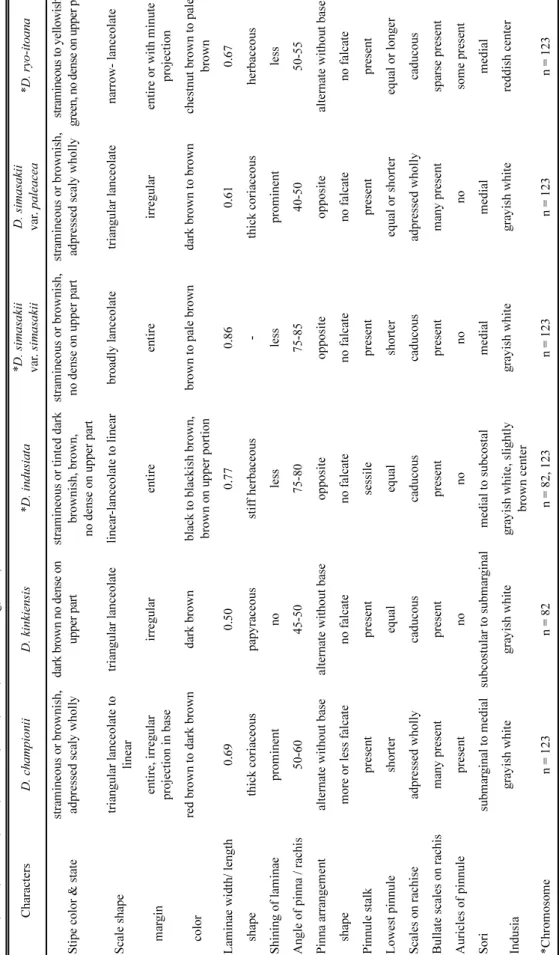
Table 2. Comparative morphological characters between D. simasakii var. paleacea and related taxa distributed in Korea with tree taxa in Japan and Taiwan of Dryopteris (*Kurata and Nakaike, 1979; Nakaike, 1992; Iwatsuki, 1992, 1995; Liou & Wang, 2013). CharactersD. championiiD. kinkiensis*D. indusiata*D. simasakii var. simasakiiD. simasakii var. paleacea*D. ryo-itoana Stipe color & statestramineous or brownish, adpressed scaly whollydark brown no dense on upper partstramineous or tinted dark brownish, brown, no dense on upper part
stramineous or brownish, no dense on upper part stramineous or brownish, adpressed scaly whollystramineous to yellowish- green, no dense on upper part Scale shapetriangular lanceolate to lineartriangular lanceolatelinear-lanceolate to linearbroadly lanceolatetriangular lanceolatenarrow- lanceolate marginentire, irregular projection in baseirregularentireentireirregularentire or with minute projection colorred brown to dark browndark brownblack to blackish brown, brown on upper portionbrown to pale browndark brown to brownchestnut brown to pale brown Laminae width/ length0.690.500.770.860.610.67 shapethick coriaceouspapyraceousstiff herbaceous-thick coriaceousherbaceous Shining of laminaeprominentnolesslessprominentless Angle of pinna / rachis50-6045-5075-8075-8540-5050-55 Pinna arrangementalternate without base alternate without base oppositeoppositeoppositealternate without base shape more or less falcate no falcate no falcate no falcateno falcateno falcate Pinnule stalk presentpresentsessilepresentpresentpresent Lowest pinnule shorterequalequalshorterequal or shorterequal or longer Scales on rachiseadpressed whollycaducouscaducous caducousadpressed whollycaducous Bullate scales on rachismany presentpresentpresentpresentmany presentsparse present Auricles of pinnulepresentnonononosome present Sorisubmarginal to medialsubcostular to submarginalmedial to subcostalmedialmedialmedial Indusiagrayish whitegrayish whitegrayish white, slightly brown centergrayish whitegrayish whitereddish center *Chromosome n = 123n = 82n = 82, 123n = 123n = 123n = 123
D. simasakii var. paleacea can be distinguished from the similar taxa of sect. Hirtipedes in the genus Dryopteris in Korea as follows:
1. Laminae unipinnate; pinnae nearly entire to dentate at margin, or pinnatifid ···· D. decipiens 애기지네고사리 1. Laminae bipinnate to tripinnate
2. Scales on stipes irregular margin, dense, and triangular lanceolate
3. Laminae shinning; pinnules shallowly dentate; sori medial to submarginal; scales dense on rachis 4. Pinnae alternate arrangement except base, more or less
falcate; sori submarginal to medial
··· D. championii 제주지네고사리 4. Pinnae nearly opposite, no falcate; sori medial
··· D. simasakii var. paleacea 층층지네고사리 3. Laminae no shining; pinnules deeply dissected; sori subcostal or medial to submarginal; scales not dense on rachis ··· D. kinkiensis 엷은지네고사리 2. Scales on stipes entire or rarely with projections margin,
caducous, and narrow lanceolate 5. Pinnules obtuse to acuminate at apex
6. Scales on stipe red-brown; pinnules obtuse or round at apex ··· D. fuscipes 큰지네고사리 6. Scales on stipe dark-brown; pinnules acuminate at apex ··· D. medioxima 반들지네고사리 5. Pinnules almost acute apex
7. Basal first pinnules very shorter than adjacent ones, basal pinnules dentate to crenate margin
··· D. erythrosora 홍지네고사리 7. Basal first pinnules equal or a little shorter than adjacent ones, basal pinnules halfway to midribs or pinnatifid
8. Upper pinnae gradually smaller upwardly 9. Pinnules linear or linear lanceolate; indusia nearly
red ··· D. caudipinna 가는홍지네고사리 9. Pinnules oblong lanceolate or oblong; indusia
nearly grayish white
··· D. hondoensis 큰홍지네고사리 8. Upper pinnae suddenly shortened
··· D. nipponensis 참지네고사리
The other new recorded taxon, Dryopteris simasakii var.
paleacea (H. Itô) Sa. Kurata was asymmetrical pinnae and pinnules, pinnules always with a cuneate base and non caudate apices, rounded lobes, and mostly bullate scales below the costae and costules. These characters correspond with the characters of sect. Erythrovariae Fraser-Jenkins, as devised by
Fraser-Jenkins (1986). In a phylogenetic studies on the genus Dryopteris based on molecular data (Zhang et al., 2012), it was suggested that 11 taxa with D. simasakii of sect.
Erythrovariae form a monophyletic clade. These results suggest that D. simasakii could be treated within sect.
Erythrovariae.
Six taxa of sect. Erythrovariae in Dryopteris, including one new recorded taxon, were compared in Table 2 in order to determine the taxonomic status of this taxon. D. simasakii var. paleacea (H. Itô) Sa. Kurata known as an endemic species in Japan, is distinguished with D. simasakii var.
simasakii based on adpressed densely scales on stipe and rachis, irregular scale margin, thick coriaceous and shinning laminae, opposite arrangement pinnae, and curved pinnae upwardly as 40-50oC in angle of pinna and rachis (Table 2, Figs. 3, 4).
D. simasakii var. paleacea (H. Itô) Sa. Kurata has inter- mediate characters between D. championii and D. indusiata without no hybrid name (Iwatsuki, 1995). It is similar with D.
championii based on dense and adpressed scales wholly on stipe and rachis, thick coriaceous and prominent shining laminae, stalked pinnules, and it is also similar with D. indusiata based on opposite pinnae arrangement and no falcate pinnae (Table 2, Figs. 3, 4).
D. simasakii var. paleacea (H. Itô) Sa. Kurata is similar to D. kinkiensis Koidzumi et Tagawa which was reported with a photo or illustration in Gwangju, Korea by Lee (2006), and Park et al. (2008), based on triangular lanceolate scales, irregular scales margin, no falcate and stalked pinnules, although the former differs with the latter based on adpressed densely scales on stipe and rachis, shining laminae, and sori medial (Table 2).
D. ryo-itoana Sa. Kurata known as an endemic species in Japan is also reported growing in mid-elevation of northern Taiwan (Liou and Wang, 2013). It is similar to D. indusiata based on narrow lanceolate scales on stipe, less shining lamellae, no falcate pinnae, and caducous scales on rachis, but it is different based on chestnut brown or pale brown scales, and alternate pinnae arrangement (Table 2).
Acknowledgement
This search was supported by grants from "The Survey of new and unrecorded taxa in vascular plants (NIBR No. 2013- 02-001)" founded by the Ministry of Environment of the Korean Government. Thanks to Myeong Soo Kim at Gwanaksan, Dong Un Kim at Iphwasan, Yang Hoon Cho at Mudeungsan, and Sun Yeul Ko at Jeju-do for guiding.
Literature Cited
Fraser-Jenkins, C. R. 1986. A classification of the genus Dryopt- eris (Pteridophyta: Dryopteridaceae). Bulletin of the British Musium (Natural History), Botany 14: 183-218.
Gibby, M. 1985. Cytological observations on Indian subcontinent and Chinese Dryopteris and Polystichum (Pteridophyta: Dry- opteridaceae). Bulletin of the British Musium (Natural His- tory), Botany 14: 1-42.
Hirabayashi, H. 1969. Chromosome numbers in Japanese species of Dryopteris (3). Journal of Japanese Botany 44: 85-96.
Hiyama, K. 1953. On some Japanese plants. Journal of Japanese Botany 28: 218.
Iwashina, T., J. Kitajima and S. Matsumoto. 2006. Flavonoids in the species of Cyrtomium (Dyopteridaceae) and related gen- era. Biochemical Systematics and Ecology 34: 14-24.
Iwatsuki, K. 1992. Ferns and Fern Allies of Japan. Heibonsha Ltd., Tokyo. Pp. 182-201. (in Japanese)
Iwatsuki, K. 1995. Dryopteridaceae. In Flora of Japan I. Edited by Iwatsuki, K., T. Yamazaki, D. E. Boufford and H. Ohba.
Kodansha Ltd., Tokyo. Pp. 145-167.
Jeong, J. -A. and C. H. Lee. 2006. Prothallus Morphogenesis of Cyrtomium falcatum (L.) Presl and caryotideum var. core- anum Nakai in vitro Culture. Korean Journal of Plant Resources 19: 360-364. (in Korean)
Jin, M. -L. and X. Cheng, 2003. Distributional study of the genus Cyrtomium C. Presl (Dryoteridaceae). In Pteridology in the New Millenium. Chandra, S. and M. Srivastava (eds.). Klu- wer Academic Publishers. Pp. 133-141.
Kim, C. H. and B. -Y. Sun. 2007. Dryopteridaceae. In The flora of vascular plants of Korea. Flora of Korea EdItôrial Committee (eds.). Academy Publishing Co., Seoul. (in Korean) Kung, H. S. 2001. Dryopteridaceae (2). In Florae Reipublicae Pop-
ularis Sinicae Tomus 5: Science Press, Beijing. (in Chinese) Kurata, S. and T. Nakaike. 1979. Illustrations of Pteridophytes of
Japan. Vol. 1, 4. Univ. of Tokyo press, Tokyo. (in Japanese) Lee, T. B. 1980. Aspidiaceae. In Illustrated flora of Korea. Hyang
Mun-sa, Seoul. (in Korean)
Lee, Y. N. 2006. New flora of Korea. Kyohaksa Publ. Co., Seoul.
(in Korean)
Little, D. P. and D. S. Barrington. 2003. Major evolutionary events in the origin and diversification of the fern genus Polystichum (Dryopteirdaceae). American Journal of Botany 90: 508-514.
Liu, H. M., X. C. Zhang, W. Wang, Y. L. Qiu and Z. D. Chen.
2007. Molecular phylogeny of the fern family Dryopteri- daceae inferred from chloroplast rbcL and atpB Genes. Inter- national Journal of Plant Sciences 168: 1311-1323.
Liou, W. -T. and J. -C. Wang. 2013. Dryopteris ryo-itoana Kurata
(Dryopteridaceae) : a Newly Recorded Species in Taiwan. Tai- wan Journal of Forest Science 28 (1): 43-49.
Löve, A., D. Löve and R. E. G. Pichi Sermolli. 1977. Cytotaxo- nomical Atlas of the Pteridophyta. J. Cramer, Vaduz.
Lovis, J. D. 1977. Evolutionary patterns and processes in ferns.
Advances in Botanical Research 4: 229-415.
Lu, J. -M. and X. Cheng. 2003. Chromosome Numbers of 10 Spe- cies of Cyrtomium (Dryopteridaceae). Acta Botanica Yunnan- ica 25: 663-670.
Lu, J. -M., D. -Z., Li, L. M. Gao and X. Cheng. 2005. Paraphyly of Cyrtomium (Dryopteridaceae): evidence from rbcL and trnL-F sequence data. Journal of Plant Research 118: 129-135.
Lu, J. -M., X. Cheng, D. Wu and D. Z. Li. 2006. Chromosome study of the fern genus Cyrtomium (Dryopteridaceae). Botan- ical Journal of the Linnean Society 150: 221-228.
Manton, I. 1950. Problems of cytology and evolution in the Pteri- dophyta. Cambridge University Press, Cambridge, UK. Pp. 1- 316.
Matsumoto, S. 2003. Species ecological study on reproductive systems amd speciation of Cyrtomium falcatum complex (Dryopteridaceae) in Japanese archipelago. Annals of Tsukuba Botanical Garden 22: 1-141.
Mitsuta, S. 1986. A preliminary report on reproductive type of Cyrtomium (Dryopteidaceae) Acta phytotaxonomica et geobo- tanica 37: 117-122. (in Japanese)
Nakaike, T. 1992. New Flora of Japan Pteridophyta Revised and Enlarged. Shibundo Co., Tokyo. Pp. 401-433. (in Japanese) Oh, Y. C., C. S. Lee and S. M. Kim. 1993. A taxonomic study of
Korea Dryopteridaceae. Journal of Basic Science 10: 21-42.
(in Korean)
Ootsuki, R., H. Sato, N. Nakato and N. Murakami. 2012. Evi- dence of genetic segregation in the apogamous fern species Cyrtomium fortunei (Dryopteridaceae). Journal of Plant Research 125: 605-612.
Park, M. K. 1975. Illustrated Encyclopedia of Fauna and Flora of Korea. vol. 16. Pteridophyta. Ministry of Education, Seoul.
Pp. 90-94. (in Korean)
Park, S. H., Y. M. Lee, J. C. Yang, D. G. Cho, G. H. Lee, C. S.
Jang, H. J. Lee, H. J. Choi, S. S. Jung and J. H. Choi. 2008.
Illustrated Pteridophytes of Korea. Korea National Arbore- tum, Pocheon. Pp. 294-320. (in Korean)
Sessa, E. B., E. A. Zimmer and T. J. Givnish. 2012. Phylogeny, Divergence times, and Historical Biogeography of New world Dryopteris (Dryopteridaceae). American Journal of Botany 99: 730-750.
Shieh, W. -C., C. E. Devol and C. -M. Kuo. 1994. Dryopteri- daceae. In Flora of Taiwan. Vol. 1. Pteridophyta, Gymnosper- mae. EdItôrial Committee of the Flora of Taiwan, Taipei. Pp.
316-326.
Shing, K. H. 1965. A taxonomic study of the genus Cyrtomium Pr.
Acta Phytotaxonomica Sinica 1: 1-48. (in Chinese)
Stein, D. B., C. Hutton, D. S. Conant, C. H. Haufler and C. R.
Werth. 2010. Reconstructing Dryopteris “ semicristata ” (Dry- opteridaceae): Molecular profiles of tetraploids verify their undiscovered diploid ancestor. American Journal of Botany 97: 998-1004.
Sun, B. -Y., M. R. Sul, J. A. Im, C. H. Kim and T. J. Kim. 2002.
Evolution of endemic vascular plants of Ulleungdo and Dokdo in Korea - floristic and cytotaxomic characteristics of vascular flora of Dokdo. Korean Journal of Plant Taxonomy 32: 143- 158.
Tagawa, M. 1934. A review of the genus Cyrtomium of Japan.
Acta phytotaxonomica et geobotanica 3: 57-67.
Tagawa, M. 1935. Two varieties of Cyrtomiun fortunei J. Smith.
Journal of Japanese Botany 4: 38-39.
Tryon, M. R. and A. F. Tryon. 1982. Ferns and allied plant: with special reference to tropical America. Springer, Berlin Heidel- berg, New York.
Youn, J. S. 2012. Phylogeny of Korean Cyrtomium (Dryopteri- daceae) based on chloroplast DNA sequence. A thesis of Graduate School of Kyungpook Natinal Univ., Daegu.
Zhang, L. -B., L. Zhang, S. -Y. Dong, E. B. Sessa, X. -F. Gao and A. Ebihara. 2012. Molecular circumscription and major evo- lutionary lineages of the fern genus Dryopteris (Dryopteri- daceae). BMC Evolutionary Biology 12: 180 (2-15).