• 검색 결과가 없습니다.

Predicting stock price direction by using data mining methods : Emphasis on comparing single classifiers and ensemble classifiers

N/A
N/A
Protected

Academic year: 2021

Share "Predicting stock price direction by using data mining methods : Emphasis on comparing single classifiers and ensemble classifiers"

Copied!
6
0
0

로드 중.... (전체 텍스트 보기)

전체 글

(1)

Predicting stock price direction by using data mining methods : Emphasis on comparing single classifiers and ensemble classifiers

1)

Kyun Sun Eo*, Kun Chang Lee**

Abstract

This paper proposes a data mining approach to predicting stock price direction. Stock market fluctuates due to many factors. Therefore, predicting stock price direction has become an important issue in the field of stock market analysis. However, in literature, there are few studies applying data mining approaches to predicting the stock price direction. To contribute to literature, this paper proposes comparing single classifiers and ensemble classifiers. Single classifiers include logistic regression, decision tree, neural network, and support vector machine. Ensemble classifiers we consider are adaboost, random forest, bagging, stacking, and vote. For the sake of experiments, we garnered dataset from Korea Stock Exchange (KRX) ranging from 2008 to 2015. Data mining experiments using WEKA revealed that random forest, one of ensemble classifiers, shows best results in terms of metrics such as AUC (area under the ROC curve) and accuracy.

▸Keyword: Stock price direction prediction, Data Mining, Feature selection, Single classifiers, Ensemble classifiers

I. Introduction

본 연구는 기업의 재무자료와 주식가격정보를 활용하여 미 래의 주가방향을 예측한다. 주가방향 예측 (Stock price direction prediction)이란 주가가 전년도 대비 일정 비율 이상 오를지 또는 내릴지를 예측하는 것이다. 본 연구는 데이터마이 닝 기법(Data mining)을 통하여 주가에 영향을 미치는 특성 (Features)을 확인하고, 이를 바탕으로 주가방향 예측을 위한 적정 데이터마이닝 분류기(Classifier)를 제시하고자 한다.

금융업계에서 주가방향을 예측하는 것은 중요한 주제이다 [1-3]. 주가방향 예측에 관한 선행연구의 대부분은 데이터마이 닝 기법을 이용하고 있다[4-6]. 해당 연구에서는 다양한 분류 기의 주가방향 예측 성능을 비교하고 또한 특성추출의 성과를 비교하고 있다[7-8].

반면 본 연구에서는 특성추출을 실행하고 앙상블 분류기를 포함한 다양한 분류기 간의 성능을 비교하고자 한다. 본 연구에

서 사용하는 분류기는 다음과 같다. 첫째, 단일분류기(Single classifier)로서 인공신경망(Neural Network: NN), 의사결정 트리(Decision Tree: DT), 서포트 벡터 머신(Support Vector Machine: SVM)과 로지스틱 회귀 (Logistic Regression: LR) 를 이용한다. 둘째, 앙상블 분류기(Ensemble Classifier)로서 아다부스트(Adaboost: AB), 랜덤포레스트(Random Forest:

RF), 배깅(Bagging: BA), 그리고 스태킹(Stacking: ST)을 적 용하였다.

본 연구의 연구질문 (RQ: Research Question)은 다음과 같다.

RQ1: 데이터 마이닝 기법을 이용하여 주가방향 예측에 필요 한 특성추출(Feature Selection, FS)을 시도한다.

RQ2: RQ1에서 추출된 특성을 이용하여 주가방향 예측을 위 한 적정 데이터마이닝 분류기를 제시한다.

∙First Author: Kyun Sun Eo, Corresponding Author: Kun Chang Lee

*Kyun Sun Eo ([email protected]), MS student in MIS, Sungkyunkwan University, Seoul 03063, Republic of Korea

**Kun Chang Lee ([email protected]), Professor at SKK Business School/SAIHST (Samsung Advanced Institute of Health Sciences & Technology), Sungkyunkwan University, Seoul 03063, Republic of Korea

∙Received: 2017. 03. 19, Revised: 2017. 05. 19, Accepted: 2017. 08. 09.

(2)

Authors Year Feature Selection Single classifier Ensemble classifier

DT LR NN SVM RF AB BA ST

P. N. Rodriguez & A. Rodriguez. [4] 2004 √ √ √ √ √

M. Kumar & M. Thenmozhi. [5] 2006 √ √ √ √

Y. Kara et al. [10] 2011 √ √

L. P. Ni et al. [8] 2011

Information Gain, S y m m e t r i c a l uncertainty,

ReliefF, Cfs, OneR,

Improved Fractal

J. Patel et al. [7] 2015 √ √ √

M. Ballings et al. [6] 2015 √ √ √ √ √

Y. Shynkevich et al. [11] 2016

Chi-square

B i - n o r m a l Separation

√ √

This study Cfs √ √ √ √ √ √ √ √

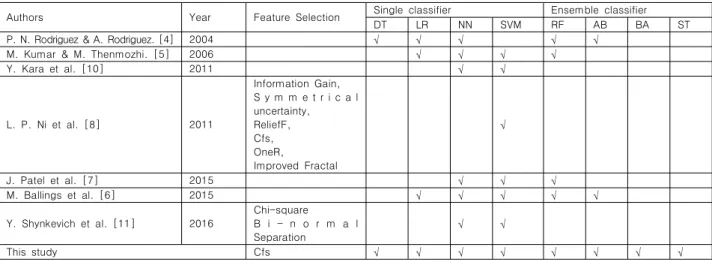
Table 1. Classifiers for stock price direction prediction used in literature.

본 연구의 구성은 다음과 같다. 2장에서는 주가방향 예측에 관한 선행연구를 간략하게 소개하고, 데이터마이닝 기법 중 특 성추출과 분류기에 대해 설명했다. 3장에서는 본 연구에 사용 된 데이터와 연구 방법을 설명했다. 4장에서는 주가방향 예측 에 필요한 특성과 적정 데이터마이닝 분류기의 성과를 비교했 다. 마지막으로 5장에서는 본 연구의 시사점과 향후 연구방향 에 대해 설명했다.

II. Preliminaries

2.1 Previous Studies

효율적 시장가설(EMH)[9]은 모든 정보가 즉각 공유되어 금 융자산의 가격이 충분히 반영되는 시장을 말한다. 투자자가 가 진 정보는 이미 주가에 반영이 되기 때문에 투자자가 가진 정 보로는 초과 수익을 얻을 수 없다. 하지만 선행연구는 데이터마 이닝 방법을 이용해 과거의 데이터를 분석해 예측 하고 있다.

연구자들은 복잡하고 비선형(non-linear)인 주식 시장을 분석 해 더 나은 결과를 만들기 위해 노력하고 있고, 이에 필요한 기 술을 고안하기 위해 연구 하고 있다[10-11].

주가방향을 예측 하는 방법은 대표적으로 3가지가 있다. 첫 째 기술적 분석, 둘째 시계열 예측, 그리고 데이터 마이닝 방법 [12] 등이 있는데 예측 방법은 다음과 같다. (1)기술적 분석방 법은 차트를 이용한 도구로써 분석가들이 구매 또는 판매에 관 한 결정을 할 때 사용된다. (2)시계열 예측 방법은 과거의 주가 를 분석하여 미래의 주가를 예측하는 것이다. 시계열 예측방법 으로는 자기회귀모형(autoregressive method), 이동평균법 (moving average model), 자기회귀-이동평균 (autoregressive-moving average model) 등이 있다. (3)데이 터마이닝 방법은 복잡하고 대용량의 데이터에서 가치 있는 정

보를 추출하는 것이다[13]. 주가방향을 예측할 때 생기는 문제 점 중 하나는 방대한 양의 데이터를 처리하는 것이다. 데이터마 이닝 방법을 사용하지 않고 대용량의 데이터를 분석하는 것은 데이터의 양이 매우 많기 때문에 데이터의 숨은 정보를 정확히 파악할 수 없다.

주가방향 예측에 대한 선행연구는 Table 1과 같다. 선행연 구는 로지스틱 회귀분석, 인공신경망과 서포트 벡터머신을 이 용해 주가방향을 예측 했고, 앙상블 분류기인 랜덤포레스트, 아 다부스트 등을 사용했다[6]. 선행연구는 서포트 벡터 머신과 랜덤포레스트가 높은 성능을 보인다고 제시했다[5][7]. 그리고 아다부스트는 랜덤포레스트 만큼 높은 예측력을 가지고 있다 [4]. 본 연구는 WEKA를 이용하여 Table 1에 표시한 단일분류 기와 앙상블 분류기를 이용해 분석을 진행했다.

2.2 Feature Selection

Feature Selection은 특성추출을 의미한다. 이는 분류기법 을 실행하기 전에 불필요한 특성을 배제하고 실제 타겟 변수에 영향을 주는 특성들을 추출하는 것이다. 특성추출을 통해 분류 기의 정확도를 향상시키고 데이터의 본질적인 특징을 파악할 수 있다[5]. 특성추출은 필터기반 추출 방법(Filter-based method)과 래퍼방법(Wrapper-based method)이 주로 사용된 다[13]. 래퍼방법은 성능이 좋은 방법 중 하나이기 때문에 인 기 있는 방법이다[14]. 본 연구에서는 유통업의 주가방향 예측 에 필요한 특성을 파악하고자 다음과 같은 특성추출 방법을 사 용했다.

본 연구는 상관관계 기반에 의한 특성추출(Correlation based Feature Selection) 방법과 특성추출을 위한 검색기능 인 Best-first 방법을 사용했다.

2.3 Data Mining

2.3.1 Single Classifier Decision tree

의사결정트리는 복잡하고 대용량의 자료를 처리할 때 특성

의 성질이나 특성 간의 관계를 쉽게 판별할 수 있는 장점을 가

(3)

No  feature 1 Total assets growth

2 Tangible assets growth 3 Current assets growth 4 Inventories growth 5 Shareholder's equity growth 6 Net sales growth

7 Operating income growth

8 Income before income tax expense growth 9 Net income growth

10 No. of employee growth 11 Operating income to total assets

12 Income before income tax expense to total assets 13 Net income to total assets

14 Income before income tax expense

15 Net income before financial expenses to avg. total assets 16 Operating income to operating capital

17 Income before income tax expense to equity 18 Net income to shareholder's equity

19 Income before income tax expense to capital stock 20 Net income to capital stock

21 Income before income tax expense to net sale 22 Net income to net sales

23 Gross profits to net sales 24 Operating income to net sales 25 Total expenses to total revenue 26 COGS to net sales

27 Depreciation ratio 28 Depreciation/total cost 29 Personnel expenses/total cost 30 Taxes / Income before income taxes 31 Taxes / total cost

32 Financial expenses / total liabilities 33 Financial expenses / total borrowings 34 Financial expenses / total expenses 35 Financial expenses / net sales

36 Times interest earned-operating act. basis 37 Times interest earned-operating income basis 38 Times interest earned-ordinary income basis

39 Times interest earned-income before income taxes basis 40 Dividend ratio

41 Dividend to net income 42 Coverage ratio 43 Debt coverage ratio 44 Loan efficiency ratio 45 EBIT/net sales 46 EBITDA/net sales

47 EBITDA/financial expenses 48 Equity to total assets 49 Current ratio 50 Quick ratio 51 Cash ratio

52 Non current assets ratio

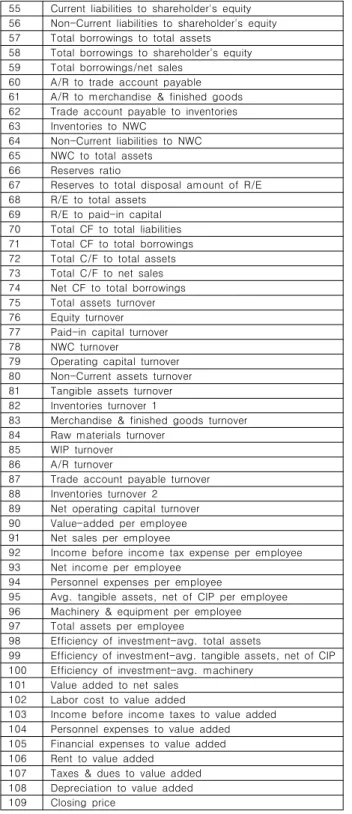
53 Non current assets to equity & LT liabilities 54 Total liabilities to shareholder's equity Table 2. Description of Features

지고 있다. 의사결정트리는 좋은 성능을 가지기 때문에 인기 있 는 분류기 중의 하나이다[15-16]. 본 연구는 WEKA에서 제공 하는 J4.8분류기를 사용 했다. WEKA에서 사용하고 있는 J4.8 분류기은 C4.5분류기를 기반으로 개발된 분류기이다[17].

Neural Network

인공신경망 방법은 인간 뇌의 기본구조를 이루는 뉴런 (neuron)의 모형을 기반으로 만든 모델이다. 인공신경망은 복 잡한 비선형 함수(non-linear function)를 구축할 수 있다[15].

인공신경망은 입력층, 은닉층, 출력층으로 이루어져 있으며 은 닉층에 존재하는 각각의 노드들은 의사결정트리의 잎 노드와 동일한 역할을 한다[16]. 인공신경망은 신경망 구조가 주어졌 을 때 역전파 알고리즘(Back-propagation)을 통해 가중치를 결정 한다.

Logistic Regression

로지스틱 회귀분석은 종속변수가 이항형(Binominal) 또는 다항형(Multinominal)일 때 사용하는 회귀분석 방법이다[18].

본 연구는 종속변수가 범주형 데이터이기 때문에 분류 기법이 다.

Support Vector Machine

서포트 벡터 머신은 선형 모형과 인스턴스가 기반인 학습 알 고리즘이 합쳐진 지도 학습 모형이다[14]. 서포트 벡터 머신은 데이터를 선형이나 비선형으로 구분하는데 효과적인 분류기이 다. 비선형 분류인 경우에는 비선형 커널 함수를 이용하여 입력 값을 초평면으로 변환시킨다[6]. 본 연구는 다항커널함수를 이 용하였다.

2.3.2 Ensemble Classifier

앙상블 분류기는 여러 개의 분류기를 조합해 더 나은 성능을 내는 분류기이다.[6]. 앙상블 분류기는 동일한 타입의 분류기 를 재구성하는 배깅, 부스팅 방법이 있고, 다양한 분류기를 통 해 구성된 모델에 적용하는 스태킹이 있다.

III. The Proposed Scheme

3.1 Data and Variables

본 연구의 데이터는 NICE 펑가 정보(주)에서 제공하는 KIS-value에서 수집했다. 2008년부터 2015년도 까지 근속된 기 업으로 KOSPI에 상장된 유통업이다. 본 연구에서 사용한 데이터는 다음과 같다. 독립변수 개수는 109개이며, 변수의 내용은 Table 2와 같다. 레코드 개수는 1184개, 회사의 수는 37개이다. 2008년부 터 2015년까지 분기별 재무자료와 주식종가로 구성하였다.

본 연구의 목적을 위해서 타겟 변수를 다음과 같이 설정했 다. 타겟 변수는 월별 주식종가를 분기별 평균으로 구성한 다음

에 2007년도의 주식종가와 다음연도인 2008년도를 비교했다.

2009년도도 2008년도와 같이 전년도인 2008년도와 비교하여

2015년도 까지 비교했다. 그리고 전 년도 대비 주식종가의 성

장률을 임계점(Threshold)을 지정해 비교했다. 타겟 변수별 임

계점은 다음과 같다. TH1은 25%, TH2는 35%, 15%, TH3은

35%, 25% 15%, TH4는 35%, 25%, 15%, 5%이다.

(4)

55 Current liabilities to shareholder's equity 56 Non-Current liabilities to shareholder's equity 57 Total borrowings to total assets

58 Total borrowings to shareholder's equity 59 Total borrowings/net sales

60 A/R to trade account payable 61 A/R to merchandise & finished goods 62 Trade account payable to inventories 63 Inventories to NWC

64 Non-Current liabilities to NWC 65 NWC to total assets 66 Reserves ratio

67 Reserves to total disposal amount of R/E 68 R/E to total assets

69 R/E to paid-in capital 70 Total CF to total liabilities 71 Total CF to total borrowings 72 Total C/F to total assets 73 Total C/F to net sales 74 Net CF to total borrowings 75 Total assets turnover 76 Equity turnover 77 Paid-in capital turnover 78 NWC turnover

79 Operating capital turnover 80 Non-Current assets turnover 81 Tangible assets turnover 82 Inventories turnover 1

83 Merchandise & finished goods turnover 84 Raw materials turnover

85 WIP turnover 86 A/R turnover

87 Trade account payable turnover 88 Inventories turnover 2

89 Net operating capital turnover 90 Value-added per employee 91 Net sales per employee

92 Income before income tax expense per employee 93 Net income per employee

94 Personnel expenses per employee

95 Avg. tangible assets, net of CIP per employee 96 Machinery & equipment per employee 97 Total assets per employee

98 Efficiency of investment-avg. total assets

99 Efficiency of investment-avg. tangible assets, net of CIP 100 Efficiency of investment-avg. machinery

101 Value added to net sales 102 Labor cost to value added

103 Income before income taxes to value added 104 Personnel expenses to value added 105 Financial expenses to value added 106 Rent to value added

107 Taxes & dues to value added 108 Depreciation to value added 109 Closing price

3.2 Method

3.2.1 Feature Selection (FS)

특성추출은 분류기법을 실행하기 전에 불필요한 특성을 배 제하고 실제 분류 성능에 영향을 주는 특성들을 추출하는 것이 다. 특성추출은 분류기의 정확도를 향상시키고 데이터의 본질 적인 특징을 파악할 수 있다[5].

3.2.2 Model Evaluation Criteria

본 연구는 AUC(Area under the Receiver operating Characteristics)를 적용했다[19]. AUC는 신호탐지 이론에서 적중확률(X축, True Positives, Sensitivity), 오경보확률(Y축, False Positive, 1-Specificity)을 나타내는 그래프이다. AUC 는 0.5부터 1까지 예측확률을 나타내고 1에 가까울수록 높은 예측확률을 가진다. TP는 True Positives, TN은 True Negatives, P는 positives(event), N은 Negatives(non-event )이다.

3.2.3 Cross validation

본 연구는 cross validation을 이용하여 데이터마이닝 분류기 를 검증했다[20]. 본 연구에서는 10-fold cross validation 방법 을 이용했다. 10-fold cross validation방법은 데이터를 10개의 폴더로 나눈 후 9개 폴더는 분류기를 학습하기 위해 사용되고 남은 1개 폴더는 검증하기 위해 사용하는 하는 검증방법이다.

IV. Results

4.1 Results for RQ1

본 연구에서는 데이터마이닝 기법을 이용하여 주가방향 예 측에 필요한 특성을 추출했다. 109개의 변수 중에서 특성추출 을 통해 추출한 변수는 Table 3과 같다. TH1은 23개, TH2는 26개, TH3은 20개, TH4는 19개로 대폭 감소했다.

4.2 Results for RQ2

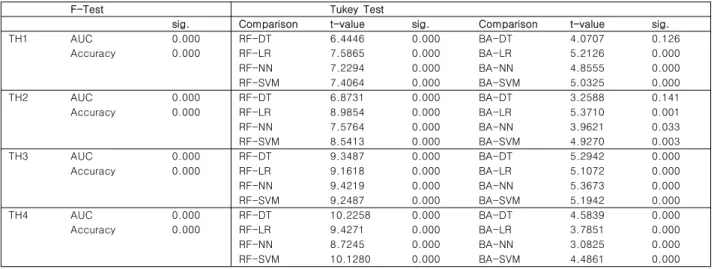
TH 별로 분류기의 AUC는 Table 4와 같다. AUC가 가장 높은 분류기는 랜덤포레스트이고 그다음으로 높은 것은 배깅으 로 확인했다. TH별로 분류기의 정확도를 검증한 결과는 Table 5와 같다. 랜덤포레스트가 가장 높은 예측력을 보였고, 다음으로 배깅의 예측력이 높았다. 본 연구를 통해 분류기의 성 능을 비교해본 결과 단일분류기보다 앙상블 분류기가 더 높은 성능을 가지는 것으로 확인했다. 위 결과를 바탕으로 TH별로 AUC와 Accuracy의 F-Test를 실시하였고, 랜덤포레스트와 배 깅을 단일분류기의 차이를 검증하기 위해 Tukey 검정을 실시 했다. 결과는 Table 6과 같다.

Feature

TH1 2, 4, 5, 6, 11, 14, 16, 17, 18, 19, 20, 35, 39, 42, 45, 52, 56, 57, 59, 66, 68, 76, 109

TH2 2, 4, 11, 12, 14, 16, 17, 18, 19, 20, 35, 37, 39, 45, 52, 55, 56, 57, 58, 59, 65, 66, 68, 69, 95, 109 TH3 4, 11, 12, 16, 17, 19, 20, 35, 37, 38, 49, 52,

56, 57, 59, 66, 68, 69, 95, 109

TH4 11, 16, 17, 18, 19, 20, 21, 32, 35, 37, 39, 47, 57, 59, 66, 68, 69, 93, 109

Table 3. Features selected by FS

(5)

F-Test Tukey Test

sig. Comparison t-value sig. Comparison t-value sig.

TH1 AUC 0.000 RF-DT 6.4446 0.000 BA-DT 4.0707 0.126

Accuracy 0.000 RF-LR 7.5865 0.000 BA-LR 5.2126 0.000

RF-NN 7.2294 0.000 BA-NN 4.8555 0.000

RF-SVM 7.4064 0.000 BA-SVM 5.0325 0.000

TH2 AUC 0.000 RF-DT 6.8731 0.000 BA-DT 3.2588 0.141

Accuracy 0.000 RF-LR 8.9854 0.000 BA-LR 5.3710 0.001

RF-NN 7.5764 0.000 BA-NN 3.9621 0.033

RF-SVM 8.5413 0.000 BA-SVM 4.9270 0.003

TH3 AUC 0.000 RF-DT 9.3487 0.000 BA-DT 5.2942 0.000

Accuracy 0.000 RF-LR 9.1618 0.000 BA-LR 5.1072 0.000

RF-NN 9.4219 0.000 BA-NN 5.3673 0.000

RF-SVM 9.2487 0.000 BA-SVM 5.1942 0.000

TH4 AUC 0.000 RF-DT 10.2258 0.000 BA-DT 4.5839 0.000

Accuracy 0.000 RF-LR 9.4271 0.000 BA-LR 3.7851 0.000

RF-NN 8.7245 0.000 BA-NN 3.0825 0.000

RF-SVM 10.1280 0.000 BA-SVM 4.4861 0.000

Table 6. Result of F-Test & Tukey Test

DT LR NN SVM RF AB BA ST

TH1 0.69 0.65 0.59 0.50 0.81 0.60 0.75 0.50 TH2 0.72 0.65 0.67 0.50 0.81 0.53 0.75 0.50 TH3 0.68 0.61 0.65 0.50 0.81 0.55 0.74 0.50 TH4 0.71 0.63 0.65 0.50 0.81 0.54 0.74 0.50 Table 4. Area under ROC

# of

Features DT LR NN SVM RF AB BA ST

TH1 23 71.62 70.48 70.84 70.66 78.07 71.54 75.69 70.75

TH2 26 65.72 63.61 65.08 64.05 72.59 64.93 68.98 63.96

TH3 20 63.78 63.96 63.70 63.88 73.13 65.02 69.07 63.97

TH4 19 54.97 55.77 56.47 55.07 65.19 55.07 59.55 55.07

Table 5. Analysis Result of Accuracy

Table 6에 따르면 모든 TH에 대해 AUC와 Accuracy는 모 두 통계적으로 유의하게 나왔다. 따라서 모든 TH에서 랜덤포 레스트와 배깅의 경우 단일분류기와 비교하여 모두 통계적으로 유의함을 보였다.

V. Conclusions

본 연구는 주가방향 예측을 위해 단일분류기와 앙상블 분류 기의 성능을 비교하였다. 본 연구에서 사용한 자료는 코스피에 상장된 유통업종 기업의 재무비율 자료와 주가자료이다. 해당 자료를 분류기로 분석하기 전 상관관계에 기반한 특성추출을 하였고, 그 결과 Table 3에서와 같은 특성을 추출하였다. 추출 한 특성을 이용해 데이터마이닝 분류기의 성능을 비교한 결과, 랜덤포레스트와 배깅의 성능이 상대적으로 가장 우수하였다.

이같은 결과는 주가방향 예측시 랜덤포레스트의 성능이 우수하 다는 선행연구의 결과와 일치한다[5-7]. 본 연구에서는 특성추 출을 통해 일반 적인 업종이 아닌 특정 업종인 유통업 분석에

필요한 특성을 파악할 수 있었다. 또한 109개의 특성 중 26개

~ 19 개로 대폭 감소시킴으로서 주가방향의 예측력을 높이고 주가방향에 필요한 특성을 제시했다. 향후 연구에서는 특성추 출에 관한 새로운 방법을 개발하여 주가방향 예측을 수행할 수 있을 것이다.

REFERENCES

[1] R. Al-Hmouz, W. Pedrycz, & A. Balamash, “Description and prediction of time series: A general framework of granular computing”. Expert Systems with Applications, Vol. 42, pp. 4830–4839, 2015

[2] S. Barak, & M. Modarres, “Developing an approach to evaluate stocks by forecasting effective features with data mining methods”, Expert Systems with Applications, Vol. 42, pp. 1325–1339, 2015

[3] A. Booth, E. Gerding, & F. McGroarty, “Automated trading with performance weighted random forests and seasonality”, Expert Systems with Applications, Vol. 41, pp. 3651–3661, 2014

[4] P. N. Rodriguez, & A. Rodriguez, “Predicting stock market indices movements”, WIT Transactions on Modelling and Simulation, Vol.38, 2004.

[5] M. Kumar, & M. Thenmozhi, “Forecasting Stock index movement: A comparison of support vector machines and random forest”. SSRN Scholarly Paper. Rochester, NY:

Social Science Research Network, January 24, 2006.

[6] M. Ballings, Dirk Van den Poel, Nathalie Hespeels, Ruben Gryp. “Evaluating multiple classifiers for stock price direction prediction”, Expert Systems with Applications Vol. 42 pp. 7046–7056, 2015

[7] J. Patel, S. Shah, P. Thakkar, K. Kotecha, “Predicting

(6)

stock and stock price index movement using Trend Deterministic Data Preparation and machine learning techniques”, Expert Systems with Applications, Vol. 42, pp. 259-268, 2015

[8] L. P. Ni, Z. W. Ni, & Y. Z. Gao, “Stock trend prediction based on fractal feature selection and support vector machine”, Expert Systems with Applications, Vol. 38(5), pp. 5569-5576, 2011

[9] B. G. Malkiel, & E. F. Fama, “Efficient capital markets:

A review of theory and empirical work”, The Journal of Finance, Vol. 25(2), pp. 383–417, 1970

[10] Y. Kara, M. A. Boyacioglu, & Ö. K. Baykan, “Predicting direction of stock price index movement using artificial neural networks and support vector machines: The sample of the Istanbul Stock Exchange”, Expert systems with Applications, Vol. 38(5), pp. 5311-5319, 2011 [11] Y. Shynkevich, T. M. McGinnity, S. A. Coleman, & A.

Belatreche, “Forecasting movements of health-care stock prices based on different categories of news articles using multiple kernel learning”, Decision Support Systems, Vol. 85, pp. 74-83, 2016.

[12] T. Hellström, K. Holmströmm, “Predictable Patterns in Stock Returns”. Technical Report Series IMa-TOM-1997-09, (August 9, 1998)

[13] Z. Li, W. Xu, L. Zhang, & R. Y. Lau, “An ontology-based Web mining method for unemployment rate prediction”.

Decision Support Systems, Vol. 66, pp. 114-122, 2014.

[14] R. Kohavi, & G. H. John, “Wrappers for feature subset selection”. Artificial Intelligence, Vol. 97 , pp. 273–324 , 1997

[15] D. L. Olson, D. Delen, & Y. Meng, “Comparative analysis of data mining methods for bankruptcy prediction”, Decision Support Systems, Vol. 52, No. 2, pp. 464-473, 2012.

[16] E. C. Bae, & K. C. Lee, “Predicting Stock Liquidity by Using Ensemble Data Mining Methods”, Journal of The Korea Society of computer and Information, Vol. 21, No. 6, pp. 9-19, 2016.

[17] R. Quinlan, “C4.5: Programs for machine learning”. San Mateo: Morgan Kaufmann Publishers, 1993

[18] A. Dag, A. Oztekin, A. Yucel, S. Bulur, F. M. Megahed,

“Predicting heart transplantation outcomes through data analytics”, Decision Support Systems Vol. 94 pp. 42–52, 2017

[19] F. Provost, T. Fawcett, & R. Kohavi, “The case against accuracy estimation for comparing induction algorithms”, In Proceedings of the fifteenth international conference on machine learning (pp. 45–453), Morgan Kaufmann, 1997

[20] S. Arlot, & A. Celisse, “A survey of cross-validation

procedures for model selection”, Statistics Surveys, Vol.

4, pp. 40–79, 2010

Authors

Kyunsun Eo is a MS student in Business Administration at Sungky unkwan University, Korea. He is interested in data mining, machine learning, and artificial intelligence.

Kun Chang Lee is a full professor of

MIS in SKK Business School at

Sungkyunkwan University. He is now

in charge of Creativity Science

Research Institute (CSRI) and Health

Mining Research Center (HMRC) as

well, Sungkyunkwan University. His recent research

interested in data mining, health informatics,

creativity science, Human-Robot Interaction (HRI),

and artificial intelligence techniques in decision

making analysis.

수치

Table  1.  Classifiers  for  stock  price  direction  prediction  used  in  literature.
Table  3.  Features  selected  by  FS
Table  6.  Result  of  F-Test  &  Tukey  Test

참조

관련 문서

This study investigates relationship between macroeconomic variables and stock returns using ARMA-GARCH model. Also the stability of serial data and the

Voting rights of existing shareholders of publicly traded common stock registered under Section 12 of the Exchange Act cannot be disparately reduced or

The results reveal that the market condition and the revision ratio of offer price are useful public information, which affects IPO stock performance in

8) Voting rights of existing shareholders of publicly traded common stock registered under Section 12 of the Exchange Act cannot be disparately reduced or restricted

Shiller, Comparing Welfare Effects: The Stock Market Versus the Housing Market, NBER Working

"Beyond Computation: Information Technology, Organizational Transformation and Business Practices” shows the relationship between IT stock and productivity for a large sample

1 John Owen, Justification by Faith Alone, in The Works of John Owen, ed. John Bolt, trans. Scott Clark, "Do This and Live: Christ's Active Obedience as the

Direction of a flux vector: direction of contaminant transport, normal to the frame Magnitude of a flux vector: net rate of contaminant transport per unit area of the