http://dx.doi.org/10.5090/kjtcs.2012.45.5.301 ISSN: 2233-601X (Print) ISSN: 2093-6516 (Online)
Department of Thoracic and Cardiovascular Surgery,
1Inje University Sanggye Paik Hospital, Inje University College of Medicine,
2Seoul National University Bundang Hospital, Seoul National University College of Medicine,
3Eulji University Hospital, Eulji University School of Medicine
Received: January 21, 2012, Revised: July 10, 2012, Accepted: July 15, 2012
Corresponding author: Kay-Hyun Park, Department of Thoracic and Cardiovascular Surgery, Seoul National University Bundang Hospital, Seoul National University College of Medicine, 82 Gumi-ro 173beon-gil, Bundang-gu, Seongnam 463-707, Korea
(Tel) 82-31-787-7140 (Fax) 82-31-787-4050 (E-mail) [email protected]
C
The Korean Society for Thoracic and Cardiovascular Surgery. 2012. All right reserved.
CC
This is an open access article distributed under the terms of the Creative Commons Attribution Non-Commercial License (http://creative- commons.org/licenses/by-nc/3.0) which permits unrestricted non-commercial use, distribution, and reproduction in any medium, provided the original work is properly cited.
Risk Factors of Red Blood Cell Transfusion in Isolate off Pump Coronary Artery Bypass Surgery
Eui Suk Chung, M.D.
1, Kay-Hyun Park, M.D.
2, Cheong Lim, M.D.
2, Jinho Choi, M.D.
3Background: Perioperative transfusion of red blood cell (RBC) may cause adverse effects. Bloodless-cardiac sur- gery has been spotlighted to avoid those problems. Off pump coronary artery bypass (OPCAB) surgery can de- crease the transfusion. However, the risk factors of transfusions in OPCAB have not been investigated properly.
Materials and Methods: One hundred and thirteen patients (male:female=35:78, mean age=66.7±9.9 years) who received isolated OPCAB were retrospectively analyzed from March 2006 to September 2007. The threshold of RBC transfusion was 28.0% of hematocrit. Bilateral internal thoracic arteries graft were used for 99 patients (87.6%). One hundred and three (91.1%) and 35 patients (31.5%) took aspirin and clopidogrel just before surgery.
Results: Sixty-five patients (47.5%) received the RBC transfusion (mean 2.2±3.2 units). Mortality and major compli- cations were not different between transfusion and no-transfusion group. But, ventilator support time, intensive care unit stay and hospitalization period had been reduced in no-transfusion group (p<0.05). In multivariate analysis, patients risk factors for RBC transfusion were preoperative low hematocrit (<37.5%) and clopidogrel medication.
Surgical risk factors were longer graft harvesting time (>75 minutes) and total operation time (>5.5 hours, p
<0.05). Conclusion: We performed the transfusion according to transfusion guideline; over 40% cases could con- duct the OPCAB without transfusion. There were no differences in major clinical results between transfusion and non-transfusion group. In addition, when used together with accurate understanding of transfusion risk factors, it is expected to increase the proportion of patients that do not undergo transfusions.
Key words: 1. Blood transfusion 2. Coronary artery bypass 3. Cardiopulmonary bypass
INTRODUCTION
Perioperative red blood cell (RBC) transfusion may in- crease the adverse effect such as acute hypersensitive re- actions, coagulopathy, acute respiratory problems, and in- fections [1]. Particularly the increase of intraoperative blood transfusions in cardiac surgery can makes chances to meet the
problems like postoperative renal failure, arrhythmia, and death [2-5]. In addition, lack of blood and the spread of reli- gious and social hostility towards blood transfusions are lead- ing to demands to minimize transfusions during cardiac sur- gery and active research is being conducted [5,6].
Off pump coronary artery bypass (OPCAB) can reduced
the postoperative bleeding because there is no surgical in-
cision in the heart, a small amount of heparin is used and there is little dilution of the coagulation factors. In addition, there is no diuretic effect and hemolysis that can be an ad- verse effect of cardiopulmonary bypass (CPB) [7-9]. We aim to analyze the clinical result of OPCAB between transfusion and non-transfusion group and the risk factors of RBC transfusions.
MATERIALS AND METHODS
Out of 127 OPCAB from March 2006 to September 2007, 113 patients, excluding the 14 patients who received other additional surgeries, were selected. The medical records of the 113 patients were reviewed in retrospect (male:fe- male=78:35, mean age=66.7±9.9 years). The patients were divided into transfusion group and non-transfusion group ac- cording to whether they received RBC transfusions, and clin- ical result differences and changes of hematocrit were evaluated. The risk factors of RBC transfusions were ana- lyzed, divided into patient factors and surgical factors.
RBC transfusions were only conducted in one of the followings. Hematocrit in the blood was under 28.0%
(hemoglobin of 8.5 gm/dL) during or after surgery, hema- tocrit was under 30.0% (hemoglobin of 9.0 gm/dL) with chest tube drainage was 500 mL/hr or above after surgery, when changes in symptoms such as hypotension, tachycardia decrease urine output, due to bleeding. Fresh frozen plasma platelet concentration was used only in the abnormal results in coagulation test.
Analysis of clinical results, RBC transfusions risk factors was conducted using univariate analysis through two by two or two by Pearson’s chi-square test, and multivariate study using logistic regression analysis. Changes in hematocrit of the two groups before and after surgery were compared using average comparison through t-test analyzed. Statistical sig- nificance was defined as p-value of 0.05 or less. The soft- ware used for analysis was SPSS ver. 18.0 (SPSS Inc., Chicago, IL, USA).
RESULTS 1) Clinical results
The mean weight was 57.10±3.52 kg, mean body mass in- dex (BMI) was 24.52±30.01. The average hematocrit before surgery was 38.10±5.47%. Sixty cases (50.1%) were emer- gency operation. The both internal thoracic artery (ITA) was used for the bypass graft in 99 cases (87.6%), left ITA was used in 9 cases (8.0%). The other vessels were used in 5 cas- es (4.4%) (Table 1). It took 90.45±35.06 minutes for mean graft harvesting, and the average number of distal anasto- mosis was 3.20±1.11. The mean operation time was 259.30±65.16 minutes other patients profile were listed in Table 1.
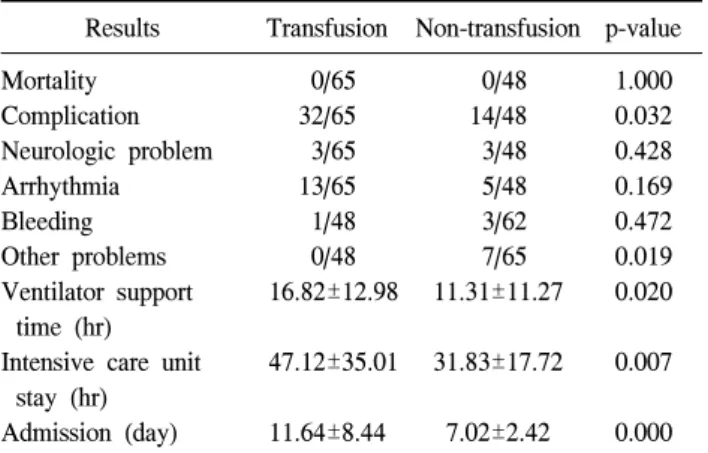
There were no deaths in any of the 113 cases included in this study. There were 46 cases of complications related to surgery (40.7%). Twenty-three of those cases (20.4%) were arrhythmia, 6 cases (5.3%) were neurological problems, and 4 cases (3.5%) were reoperation due to bleeding. There were 8 cases (7.1%) with other complications (cardiac arrest 2, respi- ratory problem 3, acute renal failure 2, and cholecystitis 1).
But there were a higher proportion of overall complications in the transfusion group. The transfusion group also had sig- nificantly longer ventilator support time, intensive care unit admission duration, and hospitalization after surgery (p
<0.05), but there were no differences between the two groups in mortality and major complications such as neuro- logical problem, arrhythmia, or reoperations due to bleeding (p>0.05) (Table 2).
2) Red blood cell transfusions
Sixty-five cases of RBC transfusions (57.5%, mean 2.2±3.2 units) were conducted during the hospitalization. There were 27 cases of intraoperative transfusion (mean 0.52±1.23 units) and 55 cases of postoperative transfusion (mean 1.74±2.8 units). Seventeen (15.0%) of these cases transfused RBC both during and after surgery. There were only 18 cases (15.9%) of fresh frozen plasma and platelet transfusions.
Hematocrit increased with time for both groups after sur- gery (p=0.00), and there was no significant difference be- tween the two groups from three days after surgery (p=0.17).
The results of laboratory test when the patients visited the
Table 1. Patients profile
Profile Results
Patient
Mean age (yr) Sex (male:female) BMI (kg/m
2)
a)Diabetes mellitus Hypertension Renal failure
b)PCI history
Acute coronary syndrome
c)3 Vessel disease
Left main disease Atrial fibrillation
Left ventricle dysfunction
d)Aspirin
Clopidogrel Hematocrit Operation
Intra-aortic balloon pump Emergent, urgent operation Graft
LITA+RITA LITA+RITA+SVG LITA+other vessel LITA only SVG only Etc.
Anastomosis number Harvesting time (min) Operation time (min)
Intra-operation fluid intake (mL)
66.7±9.9 78:35 24.52±30.01
55/113 (48.6) 83/113 (73.5) 16/113 (14.2) 11/113 (9.7) 84/113 (74.3) 95/113 (84.1) 30/113 (26.54)
1/113 (0.8) 1 (9.7) 103 (91.1) 35 (31.0) 38.10±5.47
9 (8.0) 60 (53.1)
75 (66.4) 24 (21.2) 6 (5.3) 3 (2.7) 3 (2.7) 2 (1.7) 3.2±1.1 90.5±35.1 259.3±65.2 3.2±1.4 Values are presented as mean±standard deviation or number (%).
BMI, body mass index; PCI, percutaneous coronary inter- vention; LITA, left internal thoracic artery; RITA, right internal thoracic artery; SVG, saphenous vein graft.
a)
Weight in kilograms by the square of their height in meters.
b)
Chronic renal failure or increase creatinine over 50% of nor- mal range.
c)
Acute myocardial infarction+unstable angina.
d)
Ejection fraction <40%.
Table 2. Clinical results
Results Transfusion Non-transfusion p-value Mortality
Complication Neurologic problem Arrhythmia Bleeding Other problems Ventilator support
time (hr) Intensive care unit
stay (hr) Admission (day)
0/65 32/65 3/65 13/65 1/48 0/48 16.82±12.98
47.12±35.01
11.64±8.44
0/48 14/48 3/48 5/48 3/62 7/65 11.31±11.27
31.83±17.72
7.02±2.42
1.000 0.032 0.428 0.169 0.472 0.019 0.020
0.007
0.000
Table 3. Postoperative hematocrit change
Time Hematocrit (%)
p-value No transfusion Transfusion
Pre Op.
Post Op. #0 Post Op. #1 Post Op. #3 Post Op. #5 1st Opd. visit
39.93±5.25 30.75±4.02 30.25±4.29 30.97±4.77 32.32±4.25 35.40±4.18
36.76±5.28 27.54±4.06 28.07±3.90 29.87±3.76 32.72±3.94 34.56±4.06
0.002 0.000 0.006 0.190 0.607 0.290 Values are presented as mean±standard deviation.
Op, operation; Opd, out patients department.
first outpatient department showed that the both groups main- tained a high hematocrit concentration around 35% (p<0.05) (Table 3).
3) Analysis of risk factors of red blood cell transfusions
In order to find out the risk factors of increased RBC
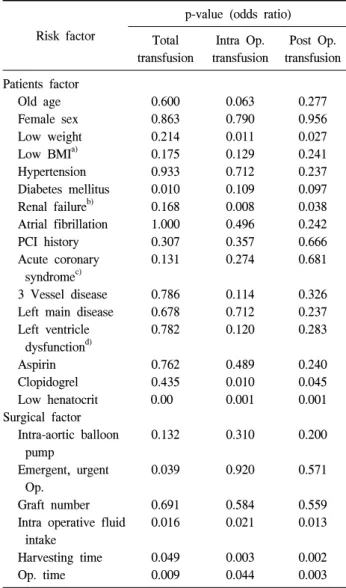
transfusions, the factors were divided into patient factors and surgical factors, and univariate and multivariate analyses were conducted.
(1) Analysis of patient factors: Patient factors related to
increase of intraoperative, postoperative and total RBC trans-
fusions during hospitalization were analyzed. Increased intra-
operative RBC transfusions were found to be related to dia-
betes and low hematocrit before surgery in both univariate
and multivariate studies (p<0.05) (Tables 4, 5). Postoperative
RBC transfusions significantly increased the patient taking
clopidogrel, low hematocrit before surgery and renal failure
in both univariate and multivariate studies too (p<0.05)
(Tables 4, 5). Taking clopidogrel, low hematocrit before sur-
gery, light weight, and renal failure were found to be related
total transfusion through univariate analysis (p<0.05). But re-
sults of the multivariate analysis only found that taking clopi-
dogrel and low hematocrit before surgery were related to in-
creased total RBC transfusions (p<0.05) (Tables 4, 5).
Table 4. Univariate analysis of risk factors of red cell transfusion Risk factor
p-value (odds ratio) Total
transfusion
Intra Op.
transfusion
Post Op.
transfusion Patients factor
Old age Female sex Low weight Low BMI
a)Hypertension Diabetes mellitus Renal failure
b)Atrial fibrillation PCI history Acute coronary
syndrome
c)3 Vessel disease Left main disease Left ventricle
dysfunction
d)Aspirin Clopidogrel Low henatocrit Surgical factor
Intra-aortic balloon pump
Emergent, urgent Op.
Graft number Intra operative fluid
intake Harvesting time Op. time
0.600 0.863 0.214 0.175 0.933 0.010 0.168 1.000 0.307 0.131
0.786 0.678 0.782
0.762 0.435 0.00
0.132
0.039
0.691 0.016
0.049 0.009
0.063 0.790 0.011 0.129 0.712 0.109 0.008 0.496 0.357 0.274
0.114 0.712 0.120
0.489 0.010 0.001
0.310
0.920
0.584 0.021
0.003 0.044
0.277 0.956 0.027 0.241 0.237 0.097 0.038 0.242 0.666 0.681
0.326 0.237 0.283
0.240 0.045 0.001
0.200
0.571
0.559 0.013
0.002 0.003 Op, operation; BMI, body mass index; PCI, percutaneous cor- onary intervention.
a)
Weight in kilograms by the square of their height in meters.
b)
Chronic renal failure or increase creatinine over 50% of nor- mal range.
c)
Acute myocardial infarction+unstable angina.
d)
Ejection fraction<40%.
Table 5. Multivariate analysis of risk factors of red cell trans- fusion
Risk factor
Intraoperative transfusion
Postoperative transfusion
Total transfusion p-value (odds ratio)
Patient factor Diabetes mellitus Renal failure
a)Clopidogrel Hematocrit (%)
>43.0 37.5−43.5 31.5−37.5
≤31.5 Weight (kg)
>75.0 60.0−75.0 45.0−60.0
≤45.0 Surgical factor
Emergent, urgent operation
0.012 (5.97) 0.968 0.551
0.001 0.454 0.107 0.002 (94.07)
0.382 0.199 0.376 0.847
0.009 (7.89) 0.627 0.050 (5.38) 0.002 (5.87)
0.109 0.257 0.039 (6.26) 0.034 (7.75)
0.260 0.105 0.046 0.999
0.835
0.704 0.074 0.007 (5.61)
0.003 0.195 0.003 (28.12) 0.001 (43.05)
0.463 0.133 0.116 0.999
0.355
Intra operation fluid intake (mL)
≤2,500 2,500−3,500 3,500−4,500
>4,500
0.773 0.700 0.439 0.319
0.347 0.671 0.295 0.353
0.868 0.739 0.117 0.873 Graft harvesting time (min)
≤75 75−105
>105
0.080 0.034 (7.63) 0.049 (8.3)
0.068 0.053 0.036 (4.26)
0.016 0.011 (6.40) 0.014 (6.83) Total operation time (hr)
≤3.5 3.5−5.5
>5.5
0.200 0.235 0.076
0.248 0.154 0.107
0.045 0.055 0.012 (59.40)
a)