http://www.j-circ.or.jp
ased on the clear ischemic benefits, dual antiplatelet therapy (DAPT) with aspirin and clopidogrel has become the cornerstone of the management of coro-nary artery disease.1–3 Due to the potential risk of bleeding-related complications, it was recommended that clopidogrel be discontinued at least 5 days prior to cardiac surgery with cardiopulmonary bypass (CPB).3–6 By avoiding CPB, off-pump coronary artery bypass surgery (OPCAB) is associated with less deterioration in coagulation and has been suggested as an alternative surgical technique to CPB in patients exposed to recent antiplatelet therapy, mitigating perioperative blood loss while maximizing ischemic benefit.7–10
Colloids are often used in cardiac surgery because colloids are more efficient than crystalloids in maintaining intravascular volume and osmotic pressure, and improving microperfu-sion.11–16 Hydroxyethyl starch (HES) solutions, however, the most widely used synthetic colloids, cause adverse effects on coagulation that are mainly attributable to the mean molecular weight and degree of substitution. The recently developed HES 130/0.4 (Voluven®; Fresenius Kabi, Bad Homburg, Germany)
has a lower molecular weight and lower molar substitution ratios than its congeners, and has been reported not to increase postoperative blood loss significantly in patients undergoing cardiac surgery.17,18 When considering the use of HES 130/0.4
Received April 13, 2011; revised manuscript received May 26, 2011; accepted June 13, 2011; released online August 2, 2011 Time for primary review: 25 days
Department of Anesthesiology and Pain Medicine (J.S.L., J.W.S., J.K.S., Y.L.K.), Department of Thoracic and Cardiovascular Surgery (K.-J.Y.), Anesthesia and Pain Research Institute (J.K.S., Y.L.K.), Cardiovascular Research Institute (J.K.S., K.-J.Y., Y.L.K.), Severance Biomedical Science Institute (Y.L.K.), Yonsei University College of Medicine, Seoul; and Department of Anesthesiology and Pain Medicine, Kwangdong University College of Medicine, Goyang (S.W.A.), Republic of Korea
The first two authors contributed equally (J.S.L., S.W.A.). Name of grant: No fund supported.
Mailing address: Young Lan Kwak, MD, PhD, Department of Anesthesiology and Pain Medicine and Anesthesia and Pain Research Institute, Yonsei University Health System, 250 Seongsanno, Seodaemun-gu, Seoul 120-752, Republic of Korea. E-mail: [email protected] ISSN-1346-9843 doi: 10.1253/circj.CJ-11-0404
All rights are reserved to the Japanese Circulation Society. For permissions, please e-mail: [email protected]
Effect of Hydroxyethyl Starch 130/0.4 on Blood Loss
and Coagulation in Patients With Recent Exposure
to Dual Antiplatelet Therapy Undergoing Off-Pump
Coronary Artery Bypass Graft Surgery
Jeong Soo Lee, MD; So Woon Ahn, MD; Jong Wook Song, MD;
Jae Kwang Shim, MD, PhD; Kyung-Jong Yoo, MD, PhD; Young Lan Kwak, MD, PhD
Background: Hydroxyethyl starch (HES) solutions are often used for maintaining intravascular volume and improv-ing microperfusion, while a large amount of HES can cause adverse effects on coagulation. As the indications for clopidogrel expand, an increasing number of patients undergoing off-pump coronary artery bypass surgery (OPCAB) are also undergoing dual antiplatelet therapy (DAPT), with its higher risk of bleeding complications. The aim of the present study was to determine whether a moderate dose of 6% HES 130/0.4 significantly increases perioperative blood loss in patients with continued DAPT within 5 days of OPCAB.
Methods and Results: Patients who received clopidogrel and aspirin within 5 days of OPCAB were randomly
allocated to receive HES 130/0.4 (≤30 ml/kg) followed by crystalloid infusion (HES group, n=53), or crystalloid only (crystalloid group, n=53) perioperatively. The amount of perioperative blood loss (sum of bleeding during the intra-operative and postoperative 24-h period), transfusion requirements, modified thromboelastography and coagulation variables, hemodynamic parameters, and fluid balance were recorded. Perioperative blood loss and coagulation profiles were similar between the groups, but the postoperative hemoglobin level was higher in the crystalloid group.
Conclusions: Up to 30 ml · kg–1 · day–1 of 6% HES 130/0.4 did not increase the perioperative blood loss compared to
crystalloid in patients with recent exposure to DAPT undergoing OPCAB. HES 130/0.4 caused a similar degree and duration of coagulation impairment as observed when only crystalloid was given. (Circ J 2011; 75: 2397 – 2402) Key Words: Aspirin; Clopidogrel; Coagulation; 6% Hydroxyethyl; Hydroxyethyl starch 130/0.4; Off-pump coronary
artery bypass surgery
B
in patients with recent exposure to DAPT undergoing OPCAB, however, the additional risk of increased bleeding to inherent hemodilution by HES could affect perioperative blood loss and coagulation, even with a limited amount of HES,19 yet no com-prehensive data exist.
The aim of the present study was therefore to investigate the effect of a moderate dose of 6% HES 130/0.4 on perioperative blood loss and coagulation, including modified thromboelas-tography (TEG) parameters, in patients with continued DAPT within 5 days of OPCAB in a prospective and randomized trial.
Methods
With approval of the Institutional Review Board and informed consent from all patients, 106 patients scheduled for OPCAB who received clopidogrel and aspirin within 5 days of surgery were randomly allocated into the following 2 groups: HES 130/0.4 group (n=53, maximal dose, 30 ml · kg–1 · day–1); and
crystalloid group (n=53). This was an open-label trial in which the endpoints were assessed blindly. The exclusion criteria included emergency surgery, myocardial infarction (MI), his-tory of previous cardiac surgery, hishis-tory of bleeding diathesis or hepatic dysfunction, left ventricular ejection fraction <40%, hemoglobin <12 g/dl, platelet count <100,000 mm3, abnormal
prothrombin time (international normalization ratio [INR]) and activated partial thromboplastin time (aPTT), creatinine >1.4 mg/dl, and use of glycoprotein IIb/IIIa inhibitors.
Patients were managed perioperatively according to institu-tional standards by a single team of anesthesiologists and car-diothoracic surgeons. The standard monitoring devices included a pulmonary artery catheter (Swan-Ganz CCOmbo® CCO/SvO2;
Edwards Lifesciences LLC, CA, USA), which was inserted via the right internal jugular vein under local anesthesia for con-tinuous measurement of the cardiac index (CI), mixed venous oxygen saturation (SvO2), right ventricular ejection fraction,
and right ventricular end-diastolic volume index (RVEDVI). The HES 130/0.4 or crystalloid (Plasma solution A; CJ, Seoul, Korea) was infused to maintain the CI >2.2 L · min–1 · m–2,
SvO2 >60%, and urinary output >0.5 ml · kg–1 · h–1. In the HES
130/0.4 group, the maximal dose of HES 130/0.4 was 30 ml ·
kg–1 · day–1, after which crystalloid, a balanced multiple
elec-trolyte-containing isotonic solution, was infused. Norepineph-rine or sodium nitroprusside was infused to maintain the mean arterial blood pressure (MAP) between 60 and 80 mmHg, and vasopressin (0.1 unit) was given when the norepinephrine requirement exceeded >0.5 μg · kg–1 · min–1. Vasopressin was
infused (2–4 units/h) when the patient needed repeated boluses of vasopressin.
All surgical procedures were performed by 1 surgeon through a median sternotomy and the heart was displaced using a posterior pericardial stitch, large gauze swabs (12×70 cm), and a tissue stabilizer (Octopus Tissue Stabilization System®;
Medtronic, Minneapolis, MN, USA). Systemic heparinization during anastomoses was achieved with 100 U/kg of porcine heparin with additional doses to reach the target activated clot-ting time (ACT; >250 s). On completion of the anastomoses, heparin activity was neutralized with protamine sulfate (0.5 mg/ 150 U of heparin). A cell salvage device was used during the surgery in all cases and salvaged blood was re-infused into the patient before the end of the surgery. None of the patients received aprotinin or anti-fibrinolytics through the study period. All patients were transferred to the intensive care unit (ICU) after surgery.
Allogeneic packed red blood cells (pRBCs) were transfused when the hemoglobin level was <8 g/dl throughout the study
period. Fresh frozen plasma (FFP) was transfused when the postoperative INR was >1.5 with excessive bleeding (>200 ml/h) for 2 consecutive hours. The criteria for transfusion of platelets were a postoperative platelet count <50,000/mm3 with
exces-sive bleeding (>200 ml/h) for 2 consecutive hours. Surgical re-exploration was indicated when chest tube drainage was >200 ml/h for 6 consecutive hours or >400 ml during the first hour postoperatively, despite a normal ACT and global coagu-lation status. Transfusions in the operating room and ICU were decided by the anesthesiologist and cardiothoracic surgeons, respectively, who were not involved in the current study.
Hemodynamic variables, including heart rate, MAP, CI, cen-tral venous pressure, mean pulmonary artery pressure, RVEDVI, and SvO2, were recorded after 15 min of induction of anesthesia
(T1), during grafting of the obtuse marginal (OM) branch of the left circumflex coronary artery (T2), and after sternum closure (T3).
The hemoglobin level, prothrombin time INR, aPTT, and platelet count were recorded 1 day before and after surgery. Modified TEG was performed 15 min after the induction of anesthesia, 15 min after sternum closure, and 5 h after surgery.
The primary endpoint of the present study was to compare the difference in perioperative blood loss, which was the sum of blood loss during the intraoperative and postoperative 24-h period. Re-transfusion of blood using a cell salvage device was regarded as intraoperative bleeding. The blood that drained from the chest tube during 24 h in the ICU was regarded as postoperative blood loss. Total infused fluid volume, urine output, and transfusion requirements intraoperatively and 24 h postoperatively were also recorded.
The major morbidity endpoints were defined as permanent stroke, renal dysfunction, any cardiac surgery re-operation, prolonged ventilation >48 h, and deep sternal wound infec-tions.20,21 For clarification, renal dysfunction was defined as acute postoperative renal injury resulting in one or more of the following: increase in serum creatinine to >2.0 mg/dl; ≥50% decrease in the estimated glomerular filtration rates compared to the baseline preoperative value; and a new requirement for dialysis.21,22 Postoperative MI was defined as the occurrence of an increase in troponin-T ≥0.8 ng/ml and/or development of new pathologic Q wave on electrocardiogram.23 Troponin-T was evaluated 1 day prior to surgery and at 12, 24, and 48 h after surgery. The length of stay in the ICU and general ward was also recorded. All aforementioned parameters were assessed and recorded by the clinicians who were blinded the patient’s group and who were not involved the study.
The sample size calculation was performed based on the data of a previous study;24 specifically, we considered a 150-ml dif-ference in perioperative blood loss to be statistically significant. Based on the results of OPCAB during 2008 in Yonsei Univer-sity Hospital,25 the SD of perioperative blood loss was 250 ml. This calculation generated an estimate of 45 patients in each group with 80% power and an α level of 0.05. Considering a 15% estimated dropout, we included 53 patients in each group. All data were expressed as the number of patients or mean ± SD. Data were examined for a normal distribution of variance with ANOVA and expressed as the mean ± SD. For an abnormal distribution of variance, data were assessed using a Kruskal– Wallis test and measured median (interquartile range). Discrete variables between the groups were compared using a chi-square test or Fisher’s exact test, and P<0.05 was considered to be statistically significant. Statistical analyses were performed using SPSS 15.0 for Windows (SPSS, Chicago, IL, USA).
Results
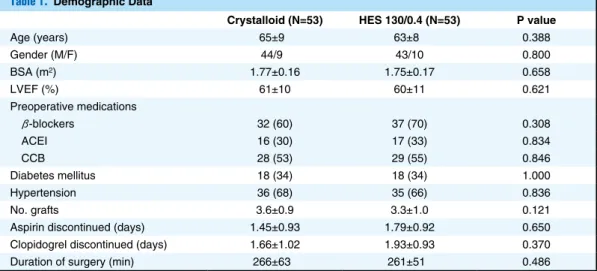
There were no significant differences in the demographic data, preoperative medications, number of grafts, and duration of surgery between the 2 groups (Table 1). No patients required emergency conversion to CPB due to intraoperative hemody-namic instability.
There was no significant difference in the amount of periop-erative blood loss between the groups. The pRBC and FFP transfusion requirements, and the number of patients transfused were also not different between the groups. The total volume of fluids infused and urine output intraoperatively and 24 h postoperatively were similar between the groups (Table 2).
The changes in hemodynamic variables after 15 min of induc-tion of anesthesia (T1), during grafting of the OM branch of the left circumflex coronary artery (T2), and after sternum closure (T3) were similar between the groups (Table 3).
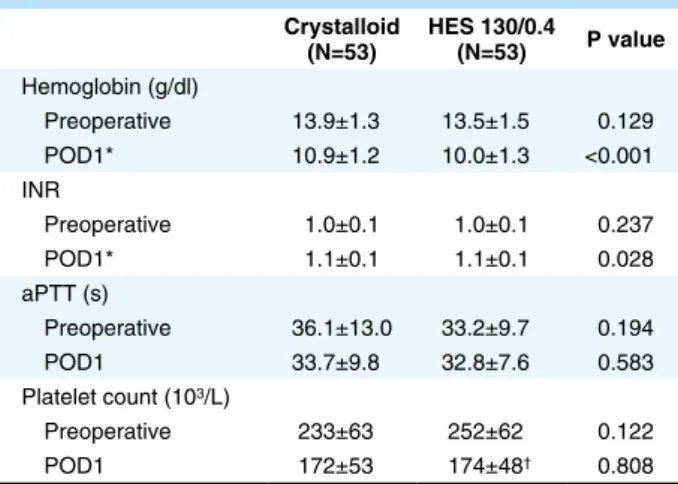
The hemoglobin level was significantly higher in the
crys-talloid group than in the HES 130/0.4 group postoperatively, although the hemoglobin levels were similar in the 2 groups preoperatively. The postoperative INR was significantly lower in the crystalloid group than the HES 130/0.4 group (1.09±0.07 and 1.12±0.09 in the crystalloid and HES 130/0.4 groups, respectively, P=0.028), while the INRs were similar in the 2 groups preoperatively (0.98±0.76 and 0.96±0.69 in the crystal-loid and HES 130/0.4 groups, respectively, P=0.237). The remaining hematologic parameters were similar between the groups before and after the operation (Table 4).
Based on TEG analysis, there were no significant differ-ences between the groups. Both groups demonstrated sig-nificant changes in r, k, maximum amplitude (MA), and the α-angle at T2 compared to the corresponding baseline values
at T1, which returned to baseline at T3 (Table 5).
The number of patients requiring vasopressors was not dif-ferent between the groups (n=44 and n=43 in the crystalloid and HES 130/0.4 groups, respectively, P>0.999), and the mean dose
Table 1. Demographic Data
Crystalloid (N=53) HES 130/0.4 (N=53) P value
Age (years) 65±9 63±8 0.388 Gender (M/F) 44/9 43/10 0.800 BSA (m2) 1.77±0.16 1.75±0.17 0.658 LVEF (%) 61±10 60±11 0.621 Preoperative medications β-blockers 32 (60) 37 (70) 0.308 ACEI 16 (30) 17 (33) 0.834 CCB 28 (53) 29 (55) 0.846 Diabetes mellitus 18 (34) 18 (34) 1.000 Hypertension 36 (68) 35 (66) 0.836 No. grafts 3.6±0.9 3.3±1.0 0.121 Aspirin discontinued (days) 1.45±0.93 1.79±0.92 0.650 Clopidogrel discontinued (days) 1.66±1.02 1.93±0.93 0.370 Duration of surgery (min) 266±63 261±51 0.486 Data given as mean ± SD or n (%). HES, hydroxyethyl starch; BSA, body surface area; LVEF, preoperative left ventricular ejection fraction; ACEI, angio-tensin-converting enzyme inhibitors; CCB, calcium channel blockers.
Table 2. Fluid Balance and Transfusion During the Perioperative Period
Crystalloid (N=53) HES 130/0.4 (N=53) P value
Perioperative blood loss† 1,028±389 978±347 0.483 OR 218±161 232±159 0.637 ICU24 810±322 753±313 0.353 Transfused pRBC (units) 1.6±1.2 2.1±1.6 0.316 During operation 0.7±0.8 1.5±1.6 0.115 ICU24 0.9±1.0 0.6±1.1 0.508 Transfused FFP (units) 2.2±0.5 2.6±1.2 0.552 During operation 0.6±1.3 0.4±0.9 0.796 ICU24 1.6±0.9 2.1±1.4 0.470 Patients receiving pRBC† 12 (23) 14 (27) 0.652 Patients receiving FFP† 5 (9) 8 (15) 0.379 Crystalloid infused† 8,342±1,794 6,694±1,882 <0.001 Colloid infused† 0 1,458±465 <0.001 Urine output† 4,073±1,498 3,772±921 0.219 Data given as mean ± SD or n (%). †Intraoperatively and during the first 24 h in the intensive care unit postoperatively. ICU24, during the first 24 h in the intensive care unit postoperatively; pRBC, packed red blood cells; FFP, fresh frozen plasma.
of infused norepinephrine and injected vasopressin was also similar between the groups. The frequency of vasopressin infu-sion for severe hypoteninfu-sion was also not different (4 and 5 in the crystalloid and HES 130/0.4 groups, respectively, P>0.999).
Acute renal failure developed in 1 and 0 patients in the HES 130/0.4 and crystalloid groups, respectively (P=0.315), and the patient who developed renal failure in the HES 130/0.4 group
required hemodialysis. The length of stay in the ICU (2.7±1.1 days and 2.7±0.8 days in the crystalloid and HES 130/0.4 groups, respectively, P=0.916) and in the hospital (10.3±3.7 days and 10.9±5.7 days in the crystalloid and HES 130/0.4 groups, respectively, P=0.484) postoperatively, and the inci-dence of other adverse events postoperatively were not differ-ent between the groups.
Discussion
In the present prospective, randomized trial addressing the safety of a moderate dose of 6% HES 130/0.4 compared to crystalloid solution in patients undergoing OPCAB with recent exposure to DAPT, no differences were observed in terms of perioperative blood loss. Transfusion requirements and coag-ulation variables (including TEG parameters) were also not different, although the postoperative hemoglobin level was lower and the INR was higher in the HES 130/0.4 group.
The HES solutions have been reported to induce a type I von Willebrand-like syndrome with decreased factor VIII coagulant activity and decreased von Willebrand factor anti-gen and VIII-related ristocetin cofactor levels.26 These effects manifest as an increase in r (time-to-initial fibrin formation) and k (rapidity of fibrin cross-linking), and a decrease in MA (clot strength, and activities of fibrin and platelets) and α-angle (speed of clot formation) on TEG that are associated with an actual increase in blood loss during cardiac surgery.27 Account-ing for the important role of molecular weight and degree of substitution ratio on hemostasis, HES 130/0.4 was developed with a lower molecular weight and lower C2/C6 ratio, result-ing in rapid total body clearance. Accordresult-ingly, HES 130/0.4 was found to retain the significant plasma volume expansion effect with a minimal influence on coagulation. Indeed, while HES 200/0.5 disturbed blood coagulation and increased bleed-ing at a maximum dose (33 ml/kg), HES 130/0.4 had less of an effect on blood coagulation and bleeding at loading doses up to 50 ml/kg.18,21 In a study addressing the safety in cardiac surgery under CPB when used as a component of a priming
Table 4. Changes in Hematologic Parameters and Coagulation Profiles Crystalloid (N=53) HES 130/0.4 (N=53) P value Hemoglobin (g/dl) Preoperative 13.9±1.3 13.5±1.5 0.129 POD1* 10.9±1.2 10.0±1.3 <0.001 INR Preoperative 1.0±0.1 1.0±0.1 0.237 POD1* 1.1±0.1 1.1±0.1 0.028 aPTT (s) Preoperative 36.1±13.0 33.2±9.7 0.194 POD1 33.7±9.8 32.8±7.6 0.583 Platelet count (103/L) Preoperative 233±63 252±62 0.122 POD1 172±53 174±48† 0.808 Data given as mean ± SD. *P<0.05 crystalloid vs. HES 130/0.4. HES, hydroxyethyl starch; INR, international ratio of prothrombin time; aPTT, activated partial thromboplastin time; POD1, postop-erative day 1.
Table 5. Changes in Thromboelastography Variables
T0 T1 T2 Reference value R (min) Crystalloid 20.1±7.6 22.6±15.6 22.2±11.6 12–27 HES 130/0.4 23.0±10.3 28.4±19.8 19.7±7.1 P value 0.156 0.163 0.329 K (min) Crystalloid 9.9±4.8 13.7±10.4 11.4±5.7 3–13 HES 130/0.4 12.4±7.4 17.1±10.7 12.2±5.8 P value 0.074 0.169 0.575 MA Crystalloid 47.4±8.5 43.6±10.4 46.4±10.5 42–63 HES 130/0.4 46.6±9.3 40.0±10.8 44.5±7.2 P value 0.711 0.147 0.430 α-angle (°) Crystalloid 24.4±9.3 22.7±11.6 24.3±14.6 14–46 HES 130/0.4 22.5±11.1 18.5±11.8 21.9±12.7 P value 0.413 0.125 0.499 Data given as mean ± SD. T0, baseline before induction of anesthesia; T1, 15 min after sternum closure; T2, 5 h after arrival in the ICU; R, reaction time; HES, hy-droxyethyl starch; K, kinetic time; MA, maximum amplitude.
Table 3. Intraoperative Hemodynamic Changes
Group T1 T2 T3 Heart rate (beats/min) Crystalloid 61±10 65±10 66±9 HES 130/0.4 61±11 67±10 68±9* MAP (mmHg) Crystalloid 72±8 73±8 73±12 HES 130/0.4 71±9 72±7 73±10 CI (L · min–1 · m–2) Crystalloid 2.6±0.5 1.9±0.4 2.4±0.5 HES 130/0.4 2.6±0.7 2.0±0.5 2.5±0.5 CVP (mmHg) Crystalloid 8±2 10±3 9±2 HES 130/0.4 8±2 10±2 8±2 MPAP (mmHg) Crystalloid 13±3 14±3 13±3 HES 130/0.4 12±4 14±4 12±3 RVEDVI (ml/m2) Crystalloid 128±33 113±28 123±30 HES 130/0.4 143±39 122±32 138±49 SvO2 (%) Crystalloid 76±12 66±9 72±9* HES 130/0.4 80±6 66±9 73±6 Data given as mean ± SD. T1, after induction of anesthesia; T2, during graft of obtuse mar-ginal branch; T3, during closure of sternum; HES, hydroxyethyl starch; MAP, mean arterial pressure; CI, cardiac index; CVP, central venous pressure; MPAP, mean pulmonary artery pres-sure; RVEDVI, right ventricular end diastolic volume index; SvO2,
solution, dose-dependent alterations in coagulation without an actual increase in blood loss were observed.28
With increased clinical application of DAPT (aspirin and clopidogrel), concerns for potential hemorrhagic complica-tions arising from the use of these agents in proximity to coro-nary artery bypass grafts (CABG) have become an important issue. In these patients, OPCAB has been proposed as an alternative surgical revascularization technique because the major deteriorating effect on the coagulation system (CPB) is avoided.7–9 Indeed, OPCAB has been safely performed with-out an increased risk of transfusion requirement in patients with recent exposure to clopidogrel.25 Thus, an increased num-ber of patients has continued antiplatelet agent therapy before OPCAB, notwithstanding the guideline recommending dis-continuation of antiplatelet agents at least 5 days before sur-gery.4 Although the pharmacokinetic properties of HES 130/0.4 produced minimal disturbances in hemostasis, hemo-dilution per se causes lower platelet availability, which may pose the additional risk of increased bleeding in patients in need of continued antiplatelet therapy perioperatively. This assumption, however, has not been validated heretofore.
In the current study 6% HES 130/0.4 solution at a maxi-mum dose of 30 ml · kg–1 · day–1 did not increase the amount of
perioperative blood loss and transfusion requirements com-pared to a balanced crystalloid solution. Indeed, based on the coagulation profile, 6% HES 130/0.4 produced similar changes in aPTT and TEG parameters as a balanced crystalloid solu-tion. Although the prothrombin time INR was higher in the HES 130/0.4 group than the crystalloid group, the difference was small and not likely to be clinically significant. Both groups demonstrated an increase in r and k time, and a decrease in α-angle and MA indicative of hemodilution, which returned to baseline 5 h postoperatively. These changes are in agree-ment with the TEG findings following OPCAB when only normal saline was used,27 and may be attributable to the favor-able pharmacokinetic property of rapid total body clearance, considering that most of the HES 130/0.4 was given intraop-eratively. The present results clearly demonstrate the safety of an infusion of HES 130/0/4 with regard to perioperative bleed-ing and coagulation when used at 30 ml · kg–1 · day–1, even in
patients with recent exposure to DAPT.
Although the present study was not designed to address the following, we did not observe any differences in the postop-erative outcome variables, including postoppostop-erative Cr levels and the incidence of acute renal failure between the groups. Concerns have been raised previously regarding the negative influence of HES on possible renal impairment.29–31 Limited use of HES 130/0.4 at 30 ml · kg–1 · day–1, however, as in the
current study, does not appear to influence renal function. The limitations of the present study were as follows. We did not measure occult intraoperative blood loss by comparing the weights of soaked tapes and gauzes to the dry counterparts, which may have confounded the result regarding the hemoglo-bin level. The observed difference in the postoperative hemo-globin level, however, may more likely be attributable to the following reason. Unexpectedly, the total amount of infused volume to achieve the pre-defined hemodynamic goals was not significantly greater in the crystalloid group. The only finding reflecting the more efficient volume expansion capa-bility of HES was the significantly lower postoperative hemo-globin levels in the HES 130/0.4 group despite a similar amount of blood loss and transfusion requirements, which is in agreement with previous studies.28,32 A recent goal-directed resuscitation study involving critically ill patients found that a volume ratio of crystalloid-to-HES achieved an equivalent
plasma volume in the range of only 1:1.6.33,34 Therefore, based on the amount of total infused volume and vasopressors we cannot conclude whether or not HES 130/0.4 was superior in terms of expanding plasma volume and improving microper-fusion, which had already been confirmed in a number of previous studies.11–16 Second, the SD of perioperative blood loss in the current study was 370 ml, whereas the present sample size calculation was based on an SD of 250 ml. There-fore, the present study may have been underpowered to detect 150-ml difference in perioperative blood loss between the groups. Third, although the discontinuation date of the anti-platelet agents was similar between the groups, substantial interindividual variability exists in platelet response to clopi-dogrel.35,36 There is currently no generally accepted platelet function assay, however, that has been demonstrated to cor-relate well with post-surgical blood loss. Therefore, the influ-ence of individual platelet responsiveness to clopidogrel on the present trial remains inconclusive.
In conclusion, 6% HES 130/0.4 (≤30 ml · kg–1 · day–1) was
not associated with an increased amount of perioperative blood loss or transfusion requirements compared to crystalloid solu-tions in patients with recent exposure to DAPT undergoing OPCAB. HES 130/0.4 also caused a similar degree and dura-tion of coaguladura-tion impairment to that observed when only crystalloid solution was given during OPCAB.
References
1. Mehta SR, Yusuf S. The Clopidogrel in Unstable angina to prevent Recurrent Events (CURE) trial programme; rationale, design and baseline characteristics including a meta-analysis of the effects of thienopyridines in vascular disease. Eur Heart J 2000; 21: 2033 – 2041.
2. Fox KA, Mehta SR, Peters R, Zhao F, Lakkis N, Gersh BJ, et al. Benefits and risks of the combination of clopidogrel and aspirin in patients undergoing surgical revascularization for non-ST-elevation acute coronary syndrome: The Clopidogrel in Unstable angina to prevent Recurrent ischemic Events (CURE) Trial. Circulation 2004;
110: 1202 – 1208.
3. Peters RJ, Mehta SR, Fox KA, Zhao F, Lewis BS, Kopecky SL, et al. Effects of aspirin dose when used alone or in combination with clopidogrel in patients with acute coronary syndromes: Observations from the Clopidogrel in Unstable angina to prevent Recurrent Events (CURE) study. Circulation 2003; 108: 1682 – 1687.
4. Dunning J, Versteegh M, Fabbri A, Pavie A, Kolh P, Lockowandt U, et al. Guideline on antiplatelet and anticoagulation management in cardiac surgery. Eur J Cardiothorac Surg 2008; 34: 73 – 92. 5. Chu MW, Wilson SR, Novick RJ, Stitt LW, Quantz MA. Does
clopidogrel increase blood loss following coronary artery bypass surgery? Ann Thorac Surg 2004; 78: 1536 – 1541.
6. Kapetanakis EI, Medlam DA, Petro KR, Haile E, Hill PC, Dullum MK, et al. Effect of clopidogrel premedication in off-pump cardiac surgery: Are we forfeiting the benefits of reduced hemorrhagic sequelae? Circulation 2006; 113: 1667 – 1674.
7. Ishida M, Kobayashi J, Tagusari O, Bando K, Niwaya K, Nakajima H, et al. Perioperative advantages of off-pump coronary artery bypass grafting. Circ J 2002; 66: 795 – 799.
8. Chassot PG, van der Linden P, Zaugg M, Mueller XM, Spahn DR. Off-pump coronary artery bypass surgery: Physiology and anaesthetic management. Br J Anaesth 2004; 92: 400 – 413.
9. Rastan AJ, Eckenstein JI, Hentschel B, Funkat AK, Gummert JF, Doll N, et al. Emergency coronary artery bypass graft surgery for acute coronary syndrome: Beating heart versus conventional cardio-plegic cardiac arrest strategies. Circulation 2006; 114: I477 – I485. 10. Song SW, Youn YN, Yi G, Lee S, Yoo KJ. Effects of continuous
administration of clopidogrel before off-pump coronary artery bypass grafting in patients with acute coronary syndrome. Circ J 2008; 72: 626 – 632.
11. Gallandat Huet RC, Siemons AW, Baus D, van Rooyen-Butijn WT, Haagenaars JA, van Oeveren W, et al. A novel hydroxyethyl starch (Voluven) for effective perioperative plasma volume substitution in cardiac surgery. Can J Anaesth 2000; 47: 1207 – 1215.
12. Haljamae H. Volume substitution in shock. Acta Anaesthesiol Scand
13. Funk W, Baldinger V. Microcirculatory perfusion during volume therapy: A comparative study using crystalloid or colloid in awake animals. Anesthesiology 1995; 82: 975 – 982.
14. Wang P, Hauptman JG, Chaudry IH. Hemorrhage produces depres-sion in microvascular blood flow which persists despite fluid resusci-tation. Circ Shock 1990; 32: 307 – 318.
15. Kjellgren P, Gupta A, Sjoberg F. Volume replacement during cardiac surgery-influence on microcirculation. Acta Anaesthesiol Scand 1995;
39: 709 – 710.
16. Standl T, Burmeister MA, Schroeder F, Currlin E, Schulte am Esch J, Freitag M. Hydroxyethyl starch (HES) 130/0.4 provides larger and faster increases in tissue oxygen tension in comparison with prehemo-dilution values than HES 70/0.5 or HES 200/0.5 in volunteers under-going acute normovolemic hemodilution. Anesth Analg 2003; 96: 936 – 943.
17. Entholzner EK, Mielke LL, Calatzis AN, Feyh J, Hipp R, Hargasser SR. Coagulation effects of a recently developed hydroxyethyl starch (HES 130/0.4) compared to hydroxyethyl starches with higher molec-ular weight. Acta Anaesthesiol Scand 2000; 44: 1116 – 1121. 18. Kasper SM, Meinert P, Kampe S, Gorg C, Geisen C, Mehlhorn U, et
al. Large-dose hydroxyethyl starch 130/0.4 does not increase blood loss and transfusion requirements in coronary artery bypass surgery compared with hydroxyethyl starch 200/0.5 at recommended doses.
Anesthesiology 2003; 99: 42 – 47.
19. Cabrales P, Tsai AG, Intaglietta M. Resuscitation from hemorrhagic shock with hydroxyethyl starch and coagulation changes. Shock 2007;
28: 461 – 467.
20. Shroyer AL, Coombs LP, Peterson ED, Eiken MC, DeLong ER, Chen A, et al. The Society of Thoracic Surgeons: 30-day operative mortality and morbidity risk models. Ann Thorac Surg 2003; 75: 1856 – 1865. 21. Van der Linden PJ, De Hert SG, Deraedt D, Cromheecke S, De Decker
K, De Paep R, et al. Hydroxyethyl starch 130/0.4 versus modified fluid gelatin for volume expansion in cardiac surgery patients: The effects on perioperative bleeding and transfusion needs. Anesth Analg 2005;
101: 629 – 634.
22. Bellomo R, Ronco C, Kellum JA, Mehta RL, Palevsky P. Acute renal failure – definition, outcome measures, animal models, fluid therapy and information technology needs: The Second International Con-sensus Conference of the Acute Dialysis Quality Initiative (ADQI) Group. Crit Care 2004; 8: R204 – R212.
23. Nesher N, Alghamdi AA, Singh SK, Sever JY, Christakis GT, Goldman BS, et al. Troponin after cardiac surgery: A predictor or a phenomenon? Ann Thorac Surg 2008; 85: 1348 – 1354.
24. Hecht-Dolnik M, Barkan H, Taharka A, Loftus J. Hetastarch increases the risk of bleeding complications in patients after off-pump coronary
bypass surgery: A randomized clinical trial. J Thorac Cardiovasc
Surg 2009; 138: 703 – 711.
25. Shim JK, Choi YS, Oh YJ, Bang SO, Yoo KJ, Kwak YL. Effects of preoperative aspirin and clopidogrel therapy on perioperative blood loss and blood transfusion requirements in patients undergoing off-pump coronary artery bypass graft surgery. J Thorac Cardiovasc Surg 2007; 134: 59 – 64.
26. Hillman K, Bishop G, Bristow P. The crystalloid versus colloid con-troversy: Present status. Baillière Clin Anaesthesiol 1997; 11: 1 – 13. 27. Yen TS, Chan KC, Cheng YJ. Intraoperative coagulation was more
interfered by HES 200/0.5 than normal saline in off-pump coronary artery bypass surgery. J Cardiovasc Surg (Torino) 2008; 49: 679 – 684.
28. Schramko A, Suojaranta-Ylinen R, Kuitunen A, Raivio P, Kukkonen S, Niemi T. Hydroxyethylstarch and gelatin solutions impair blood coagulation after cardiac surgery: A prospective randomized trial.
Br J Anaesth 2010; 104: 691 – 697.
29. Cittanova ML, Mavre J, Riou B, Coriat P. Long-term follow-up of transplanted kidneys according to plasma volume expander of kid-ney donors. Intensive Care Med 2001; 27: 1830.
30. Winkelmayer WC, Glynn RJ, Levin R, Avorn J. Hydroxyethyl starch and change in renal function in patients undergoing coronary artery bypass graft surgery. Kidney Int 2003; 64: 1046 – 1049.
31. Hartog C, Reinhart K. CONTRA: Hydroxyethyl starch solutions are unsafe in critically ill patients. Intensive Care Med 2009; 35: 1337 – 1342.
32. Nielsen VG. Hemodilution modulates the time of onset and rate of fibrinolysis in human and rabbit plasma. J Heart Lung Transplant 2006; 25: 1344 – 1352.
33. Verheij J, van Lingen A, Raijmakers PG, Rijnsburger ER, Veerman DP, Wisselink W, et al. Effect of fluid loading with saline or colloids on pulmonary permeability, oedema and lung injury score after car-diac and major vascular surgery. Br J Anaesth 2006; 96: 21 – 30. 34. Brunkhorst FM, Engel C, Bloos F, Meier-Hellmann A, Ragaller M,
Weiler N, et al. Intensive insulin therapy and pentastarch resuscita-tion in severe sepsis. N Engl J Med 2008; 358: 125 – 139.
35. Ikeda T, Taniguchi R, Watanabe S, Kawato M, Kondo H, Shirakawa R, et al. Characterization of the antiplatelet effect of aspirin at en-rollment and after 2-year follow-up in a real clinical setting in Japan.
Circ J 2010; 74: 1227 – 1235.
36. Jinnai T, Horiuchi H, Makiyama T, Tazaki J, Tada T, Akao M, et al. Impact of CYP2C19 polymorphisms on the antiplatelet effect of clop-idogrel in an actual clinical setting in Japan. Circ J 2009; 73: 1498 – 1503.