저작자표시-비영리-동일조건변경허락 2.0 대한민국 이용자는 아래의 조건을 따르는 경우에 한하여 자유롭게 l 이 저작물을 복제, 배포, 전송, 전시, 공연 및 방송할 수 있습니다. l 이차적 저작물을 작성할 수 있습니다. 다음과 같은 조건을 따라야 합니다: l 귀하는, 이 저작물의 재이용이나 배포의 경우, 이 저작물에 적용된 이용허락조건 을 명확하게 나타내어야 합니다. l 저작권자로부터 별도의 허가를 받으면 이러한 조건들은 적용되지 않습니다. 저작권법에 따른 이용자의 권리는 위의 내용에 의하여 영향을 받지 않습니다. 이것은 이용허락규약(Legal Code)을 이해하기 쉽게 요약한 것입니다. Disclaimer 저작자표시. 귀하는 원저작자를 표시하여야 합니다. 비영리. 귀하는 이 저작물을 영리 목적으로 이용할 수 없습니다. 동일조건변경허락. 귀하가 이 저작물을 개작, 변형 또는 가공했을 경우 에는, 이 저작물과 동일한 이용허락조건하에서만 배포할 수 있습니다.
The Effect of Tranexamic Acid on Transfusion
Requirement in Dual Antiplatelet-Treated Anemic
Patients Undergoing Off-Pump Coronary Artery
Bypass Graft Surgery
by
SoWoon Ahn
Major in Medicine
Department of Medical Sciences
The Graduate School, Ajou University
The Effect of Tranexamic Acid on Transfusion
Requirement in Dual Antiplatelet-Treated Anemic
Patients Undergoing Off-Pump Coronary Artery
Bypass Graft Surgery
by
SoWoon Ahn
A Dissertation Submitted to The Graduate School of
Ajou University in Partial Fulfillment of the
Requirements for the Degree of Ph.D. in Medicine
Supervised by
Jin Soo Kim, M.D., Ph.D.
Major in Medicine
Department of Medical Sciences
The Graduate School, Ajou University
This certifies that the dissertation
of SoWoon Ahn is approved.
SUPERVISORY COMMITTEE
Jin Soo Kim
Yong Woo Hong
You Sun Hong
Young Lan Kwak
SungYong Park
The Graduate School, Ajou University
December 20th, 2011
i
– ABSTRACT–
The Effect of Tranexamic Acid on Transfusion Requirement in Dual
Antiplatelet-Treated Anemic Patients Undergoing Off-Pump
Coronary Artery Bypass Graft Surgery
Background: Anemia is not rare in patients presenting for coronary artery bypass graft
surgery (CABG). As these patients are frequently on dual antiplatelet therapy, the two coexisting conditions could potentially increase the risk of bleeding and transfusion. The aim of this study was to evaluate the effect of tranexamic acid (TA) on blood loss and transfusion in preoperatively anemic patients who continued their dual antiplatelet therapy until within 5 days of off-pump CABG (OPCAB).
Methods and Results: Seventy-six anemic patients were randomized into two groups: a TA
group receiving TA (1 g bolus followed by infusion at 200 mg h-1) and a Control group receiving the same volume of saline. The amount of blood loss at 4h and 24h after operation were measured. And transfusion requirement during operation, 4h and 24 h after the operation were assessed. Patients’ characteristics and operative data were similar between the groups. During the perioperative period combining the intraoperative and postoperative 24 h, TA group received significantly less amounts of packed red blood cells and fresh frozen plasma. The blood loss during the postoperative 4 h was significantly less in the TA group.
Conclusions: TA infusion could reduce the amount of transfusion during perioperative
period in patients with preoperative anemia who continued their dual antiplatelet therapy until within 5 days of OPCAB.
Keywords: Dual Antiplatelet Therapy, anemia, tranexamic acid, off-pump coronary artery
ii
TABLE OF CONTENTS
ABSTRACT ... i
TABLE OF CONTENTS ... ii
LIST OF FIGURES ... iii
LIST OF TABLES ... iv
Ⅰ. INTRODUCTION ... 1
Ⅱ. MATERIALS AND METHODS ... 3
Ⅲ. RESULTS ... 5
Ⅳ. DISCUSSION ... 10
Ⅴ. CONCLUSION ... 13
REFERENCES ... 14
iii
LIST OF FIGURES
iv
LIST OF TABLES
Table 1. Patient characteristics ... 6
Table 2. Operative data ... 7
Table 3. Blood loss and transfusion requirement ... 8
- 1 -
Ⅰ
. INTRODUCTION
Increased bleeding and subsequent transfusion of allogeneic blood products are undoubtedly associated with adverse outcome in cardiac surgical patients.(Hajjar et al., 2010) Among many risk factors, preoperative anemia is one of the strongest predictors of transfusion.(Scott et al., 2003) In coronary patients presenting for coronary artery bypass graft surgery (CABG), mild preoperative anemia is not rare, upon which surgery often cannot be delayed, especially in patients with acute coronary syndrome.(Salisbury et al., 2010) Moreover, the need for dual antiplatelet therapy consisting of aspirin and clopidogrel would further complicate the perioperative course of these patients in terms of blood loss and transfusion requirement.(Kapetanakis et al., 2006; Angiolillo et al., 2010; Sellke et al., 2010)
In order to maximize the ischemic benefit and minimize the bleeding risk in patients receiving dual antiplatelet therapy until shortly before surgery, off-pump CABG (OPCAB) has been proposed as an alternative technique of surgical revascularization.(Chassot et al., 2004; Song et al., 2008) However, patients with preoperative anemia have reduced red blood cell reserve that is likely to be depleted by operative intervention, even without the use of cardiopulmonary bypass (CPB). In addition, anemia per se has been demonstrated to be associated with reversible platelet dysfunction.(Valeri et al., 2001) Therefore, coexistence of anemia and continued dual antiplatelet therapy may potentially result in increased risk of bleeding and transfusion requirement mandating the need for an effective blood conservation strategy.
Tranexamic acid (TA) is a synthetic antifibrinolytic agent that binds to the lysine-binding sites of plasminogen.(Verstraete, 1985) TA reduced postoperative blood loss and transfusion requirement in cardiac surgery with and without CPB.(Wei et al., 2006) TA improved platelet function in chronic renal failure patients(Mezzano et al., 1999) and reduced postoperative blood loss in patients treated with antiplatelet therapy undergoing CABG.(Senay et al., 2010; Weber et al., 2011) Also, a recent study demonstrated that TA actually increased platelet aggregation in patients treated with aspirin and clopidogrel undergoing CABG.(Weber et al., 2011) Therefore, coronary patients with preoperative anemia who are on continued dual antiplatelet therapy until shortly before OPCAB could benefit from TA infusion in terms of
- 2 -
blood conservation, yet no comprehensive data exist in that regard.
The aim of this randomized, double-blinded, placebo-controlled study was to evaluate the effect of TA on transfusion requirement and blood loss in preoperatively anemic patients who have been exposed to dual antiplatelet therapy until within 5 days of OPCAB.
- 3 -
Ⅱ
. MATERIALS AND METHODS
After obtaining approval of the institutional ethics board and informed written consent
from all patients, 76 preoperatively anemic patients (hemoglobin [Hb] £130 g l-1 for male and £120 g l-1 for female)treated with aspirin and clopidogrel until within 5 days of OPCAB were randomized into two groups. The envelope method with random numbers was used for randomization. Patients in the TA group (n = 38) received 1 g of TA (Shinpoong, Seoul, Korea) for 20 min before skin incision with subsequent continuous infusion at 200 mg h-1 during the operation.(Vanek et al., 2005) Patients in the Control group (n = 38) received the equivalent amount of saline solution at the same infusion rate. Infusion syringe was prepared by an anesthetic nurse who was not involved in the study. Patients with impaired renal function (serum creatinine [sCr] >20 mg l-1), hepatic dysfunction, neurologic dysfunction, and hematologic disorders were excluded.
The same previously described anesthetic technique was used for all patients.(Shim et al., 2007) Systemic heparinization during anastomosis was achieved with 100 U kg-1 of porcine heparin to reach a target activated clotting time (ACT) of greater than 250 seconds. ACT was checked at a 30-minute interval until the completion of anastomosis. Then, heparin was neutralized with protamine sulfate (0.5 mg 100 U-1 of heparin). The amount of heparin injected and protamine for reversal of heparinization during operation, baseline ACT value before anastomosis, highest ACT value during anastomosis, and ACT value after protamine reversal were recorded. All patients were transferred to ICU after operation.
Allogeneic packed red blood cells (pRBC) were transfused when the Hb level was less than 85 g l-1 throughout the study period. Fresh frozen plasma (FFP) was transfused when the postoperative international normalized ratio was greater than 1.5 with excessive bleeding greater than 200 ml h-1 for 2 consecutive hours. The criteria for transfusion of platelets concentrates were postoperative platelet count less than 50,000 mm-3 with excessive bleeding greater than 200 ml h-1 for 2 consecutive hours. Surgical re-exploration was indicated when chest tube drainage was greater than 200 ml h-1 for 4 consecutive hours or greater than 400 ml during the first hour despite normalized ACT and global coagulation status. Hb levels and platelet counts were measured preoperatively, at the end of operation, and 24 h after
- 4 -
operation. Lowest Hb level during the postoperative period was also recorded. Prothrombin time (PT), and activated partial thromboplastin time (aPTT) were measured preoperatively and 24 h after operation. During the intraoperative period, fluid balance, amount of pRBC transfusion, and number of patients transfused were recorded. Postoperative blood loss was recorded as the volume of chest tube drainage measured at 4 h and 24 h after operation, and the drained blood was not reinfused. The amount of transfused pRBC, FFP, platelet concentrates and numbers of patients requiring pRBC transfusion during 4 h and 24 h after operation were recorded. During hospitalization, possible thromboembolic complications as a result of TA treatment, including myocardial infarction (MI, increase in Tn-T > 0.8 ng ml-1 and/or development of pathologic Q wave on ECG),(Nesher et al., 2008) acute renal insufficiency (sCr of ≥3 mg l-1 or 50 to 200% from baseline using modified RIFLE classification),(Molitoris et al., 2007) major neurologic dysfunction (transient ischemic attack or stroke), pulmonary embolism, and deep vein thrombosis were recorded.
Primary endpoint of this study was to compare perioperative (combined period of intraoperative and postoperative 24 h) transfusion requirement between the groups. Secondary endpoint of this study was to compare the amount of perioperative blood loss between the groups.
Statistical analyses were performed with SPSS 15.0 (SPSS Inc, Chicago, IL). A difference of 1 unit transfusion of pRBC between the groups was taken as clinically significant to reduce. Based on the OPCAB results of our hospital in patients who continued clopidogrel until within 5 days of surgery, the standard deviations of the amounts of perioperative pRBC transfusion was 1.5 unit.(Shim et al., 2007) This calculation generated an estimate of 36 patients in each group with 80% power and an alpha level of 0.05. All data were expressed as the number of patients (percentage) or the mean ± SD. The normality of distribution was assessed with a q–q plot and the Shapiro–Wilk test. Data between the groups were compared by the χ2 test, Fisher’s exact test, or independent t-test with post hoc comparison using the Bonferroni test as appropriate. A P value < .05 was considered significant.
- 5 -
Ⅲ
. RESULTS
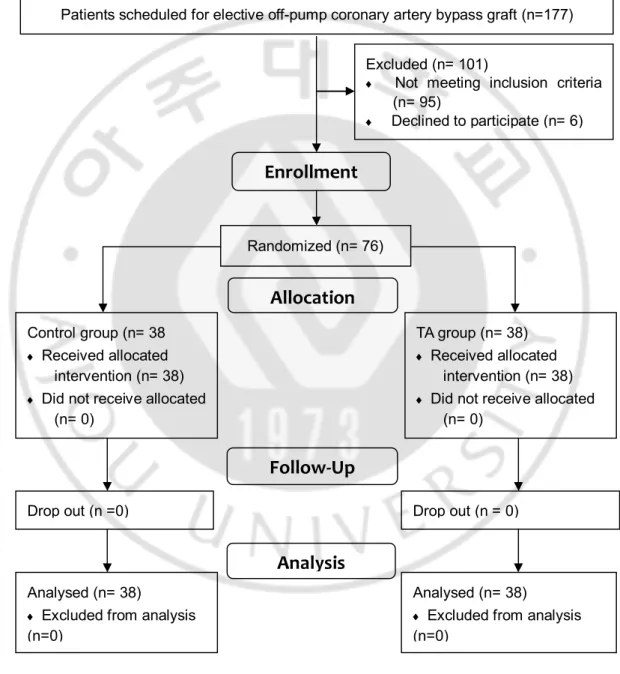
OPCAB was successfully performed in all patients without requiring emergent conversion to on-pump procedure. Thus, data of all 76 patients were analyzed. None of the patients underwent reoperation due to bleeding (Fig. 1).
Fig. 1. Flow diagram
Analysed (n= 38)
¨ Excluded from analysis
(n=0)
Drop out (n =0) Drop out (n = 0)
Analysed (n= 38)
¨ Excluded from analysis
(n=0)
Analysis
Patients scheduled for elective off-pump coronary artery bypass graft (n=177)
Excluded (n= 101)
¨ Not meeting inclusion criteria (n= 95)
¨ Declined to participate (n= 6)
Control group (n= 38
¨ Received allocated
intervention (n= 38)
¨ Did not receive allocated
(n= 0)
Allocation
Follow-Up
Randomized (n= 76)Enrollment
TA group (n= 38) ¨ Received allocated intervention (n= 38)¨ Did not receive allocated
- 6 -
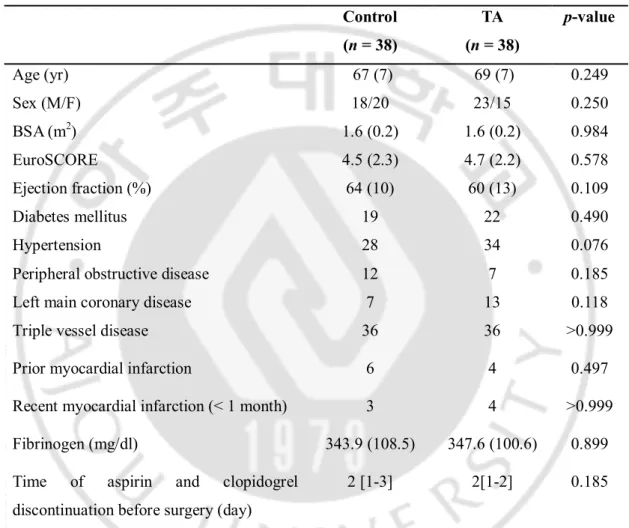
Patient characteristics and the preoperative fibrinogen level were all statistically not different between the groups (Table 1).
Table 1. Patient characteristics
Control (n = 38) TA (n = 38) p-value Age (yr) 67 (7) 69 (7) 0.249 Sex (M/F) 18/20 23/15 0.250 BSA (m2) 1.6 (0.2) 1.6 (0.2) 0.984 EuroSCORE 4.5 (2.3) 4.7 (2.2) 0.578 Ejection fraction (%) 64 (10) 60 (13) 0.109 Diabetes mellitus 19 22 0.490 Hypertension 28 34 0.076
Peripheral obstructive disease 12 7 0.185
Left main coronary disease 7 13 0.118
Triple vessel disease 36 36 >0.999
Prior myocardial infarction 6 4 0.497
Recent myocardial infarction (< 1 month) 3 4 >0.999
Fibrinogen (mg/dl) 343.9 (108.5) 347.6 (100.6) 0.899
Time of aspirin and clopidogrel discontinuation before surgery (day)
2 [1-3] 2[1-2] 0.185
Values are mean (SD), median [interquartile range] or number of patients. TA; tranexamic acid, BSA: body surface area.
- 7 -
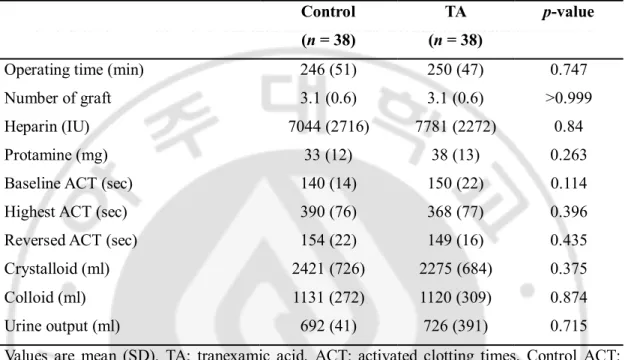
Operative data including the number of grafts performed were also similar between the groups (Table 2).
Table 2. Operative data
Control (n = 38)
TA (n = 38)
p-value
Operating time (min) 246 (51) 250 (47) 0.747
Number of graft 3.1 (0.6) 3.1 (0.6) >0.999
Heparin (IU) 7044 (2716) 7781 (2272) 0.84
Protamine (mg) 33 (12) 38 (13) 0.263
Baseline ACT (sec) 140 (14) 150 (22) 0.114
Highest ACT (sec) 390 (76) 368 (77) 0.396
Reversed ACT (sec) 154 (22) 149 (16) 0.435
Crystalloid (ml) 2421 (726) 2275 (684) 0.375
Colloid (ml) 1131 (272) 1120 (309) 0.874
Urine output (ml) 692 (41) 726 (391) 0.715
Values are mean (SD). TA; tranexamic acid, ACT: activated clotting times, Control ACT: initial level of ACT during operative period, Highest ACT: ACT which is highest level of ACT during operative period, Reversed ACT: ACT after reversal with protamine.
- 8 -
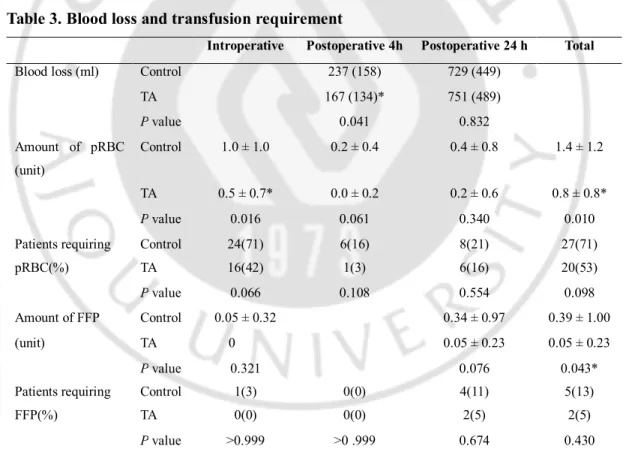
The amounts of postoperative blood loss and perioperative transfusion requirement are listed in Table 3.
Overall, during the perioperative period combining the intraoperative and 24 h postoperative period, patients in the TA group received a significantly less amount of pRBC transfusion. Also, the number of patients requiring pRBC transfusion during the perioperative period trended to be lower in the TA group (20 vs. 27, p = 0.098). In detail, during the operation, patients in the TA group received significantly less amount of pRBC transfusion. Also, a less number of patients required pRBC transfusion in the TA group without statistical significance (p = 0.066). For the first 4 h after operation, the TA group lost a significantly less amount of blood and required lower amount of pRBC transfusion. The amount of FFP transfusion during the perioperative period was significantly less in the TA group. None of the patients was transfused with platelet concentrates during the study period.
Table 3. Blood loss and transfusion requirement
Introperative Postoperative 4h Postoperative 24 h Total
Blood loss (ml) Control 237 (158) 729 (449)
TA 167 (134)* 751 (489) P value 0.041 0.832 Amount of pRBC (unit) Control 1.0 ± 1.0 0.2 ± 0.4 0.4 ± 0.8 1.4 ± 1.2 TA 0.5 ± 0.7* 0.0 ± 0.2 0.2 ± 0.6 0.8 ± 0.8* P value 0.016 0.061 0.340 0.010
Patients requiring Control 24(71) 6(16) 8(21) 27(71)
pRBC(%) TA 16(42) 1(3) 6(16) 20(53)
P value 0.066 0.108 0.554 0.098
Amount of FFP Control 0.05 ± 0.32 0.34 ± 0.97 0.39 ± 1.00
(unit) TA 0 0.05 ± 0.23 0.05 ± 0.23
P value 0.321 0.076 0.043*
Patients requiring Control 1(3) 0(0) 4(11) 5(13)
FFP(%) TA 0(0) 0(0) 2(5) 2(5)
P value >0.999 >0 .999 0.674 0.430 Values are mean (SD) or number of patients. TA; tranexamic acid, pRBC; packed red blood cell, FFP; fresh frozen plasma, Total; combining data of intraoperative and postoperative 24 h, *: p < .05 compared to the Control group.
- 9 -
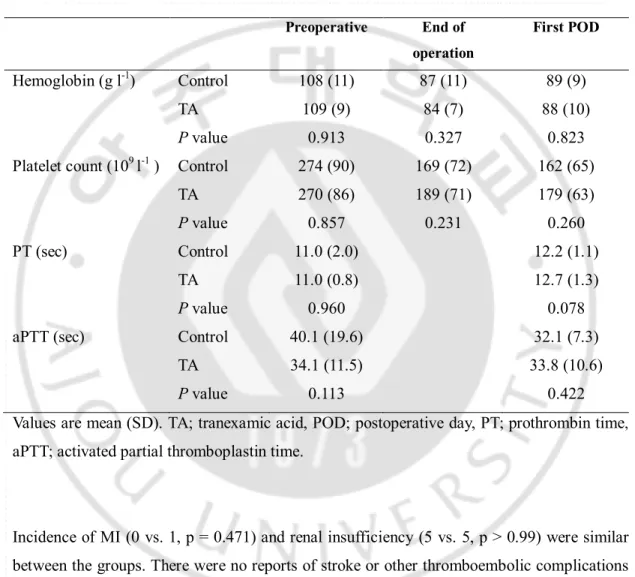
Baseline and postoperative hematologic variables were all comparable between the groups. The lowest Hb level during the perioperative period were 76 ± 9 g/l in the control group and 75 ± 9 g/l in TA group (P = 0.823) (Table 4).
Table 4. Hematologic data
Values are mean (SD). TA; tranexamic acid, POD; postoperative day, PT; prothrombin time,
aPTT; activated partial thromboplastin time.
Incidence of MI (0 vs. 1, p = 0.471) and renal insufficiency (5 vs. 5, p > 0.99) were similar between the groups. There were no reports of stroke or other thromboembolic complications in both groups. Preoperative End of operation First POD Hemoglobin (g l-1) Control 108 (11) 87 (11) 89 (9) TA 109 (9) 84 (7) 88 (10) P value 0.913 0.327 0.823
Platelet count (109 l-1 ) Control 274 (90) 169 (72) 162 (65)
TA 270 (86) 189 (71) 179 (63)
P value 0.857 0.231 0.260
PT (sec) Control 11.0 (2.0) 12.2 (1.1)
TA 11.0 (0.8) 12.7 (1.3)
P value 0.960 0.078
aPTT (sec) Control 40.1 (19.6) 32.1 (7.3)
TA 34.1 (11.5) 33.8 (10.6)
- 10 -
Ⅳ
. DISCUSSION
In this prospective randomized study, we observed significantly less amounts of pRBC and FFP transfusion in the TA group during the perioperative study period in patients with preoperative anemia who continued their dual antiplatelet therapy until within 5 days of OPCAB, although the differences in the number of patients requring pRBC transfusion between the groups did not reach statistical significance.
Platelet plays a pivotal role in hemostasis, and platelet dysfunction is regarded as a major pathophysiologic cause of nonsurgical postoperative bleeding.(Woodman and Harker, 1990) In cardiac surgery using CPB, CPB mainly contributed to a decrease in platelet number and function through hemodilution, adhesion, activation, and mechanical destruction.(Hartmann et al., 2006) Not surprisingly, a considerable number of coronary patients presenting for CABG are at high risk of bleeding and hemorrhagic complications if they are receiving dual antiplatelet therapy consisting of aspirin and clopidogrel, and such patients are recommended to discontinue the drugs 5 days prior to surgery.(Dunning et al., 2008) However, an increasing number of studies alarm the adverse consequences of discontinuation of these agents, especially in patients with previous stent implantation or acute coronary syndrome.(Burger et al., 2005) Altogether, recent literature on antiplatelet agents implicate that there may be an ischemic or even a mortality benefit with some degree of platelet inhibition at the time of CABG despite a possible risk of excessive bleeding.(Mehta and Yusuf, 2000) In the context of maximizing the ischemic benefit while minimizing the bleeding and transfusion risk conveyed by dual antiplatelet therapy, OPCAB has been proposed as an alternative surgical revascularization technique.(Chassot et al., 2004)
Transfusion of allogeneic blood products carries risks far beyond the risk of disease transmission affecting patients’ outcome after cardiac surgery.(Hajjar et al., 2010) Despite efforts to reduce allogeneic blood transfusion, blood transfusion is still common in patients undergoing cardiac surgery including OPCAB. Among many risk factors of transfusion, preoperative anemia is not uncommon in patients undergoing CABG partly due to preoperative percutaneous coronary angiography or interventions.(Bertrand et al., 2010) Mild preoperative anemia (Hct <35%) was also demonstrated to be an independent risk
- 11 -
factor of transfusion in patients undergoing OPCAB.(Scott et al., 2003) Furthermore, reduction of hematocrit (Hct) produces a reversible platelet dysfunction manifested by an increase in bleeding time and shed blood loss at the bleeding site.(Valeri et al., 2001) In most cases, however, CABG is usually not delayed based on the presence of mild preoperative anemia and these patients are frequently on dual antiplatelet therapy. Thus, for preoperatively anemic patients who received dual antiplatelet therapy in proximity to CABG, a strategy is essential to reduce perioperative blood loss and transfusion.
Plasmin has been demonstrated to exert platelet dysfunction by activating complelement cascade, and inducing proteolytic degradation and redistribution of platelet glycoprotein receptors.(de Haan and van Oeveren, 1998) TA reduces the plasma concentration of plasmin by blocking the lysine-binding sites of plasminogen, thus blocking the interaction with specific lysine residues of fibrin hindering the conversion of plasminogen to plasmin.(Verstraete, 1985) TA infusion has already been demonstrated to reduce postoperative blood loss and transfusion requirements in various cardiac surgeries including OPCAB.(Wei et al., 2006) Indeed, although the efficacy of TA on CPB related platelet dysfunction was less than that of aprotinin, TA partially reversed platelet aggregation dysfunction associated with antiplatelet therapy in an in vitro analysis.(Weber et al., 2011) Still, controversial results of TA had been reported in clinical studies of on-pump CABG involving patients treated with antiplatelet agent. In a retrospective review of patients undergoing on-pump CABG, the beneficial effect of TA on perioperative blood loss and transfusion requirement was less prominent in patients preoperatively treated with clopidogrel.(Senay et al., 2010) On the contrary, in a prospective study, a single dose of intraoperative TA reduced postoperative bleeding in patients treated with aspirin until the day of on-pump CABG. However, there have been no studies addressing the influence of TA on patients with preoperatively treated with dual antiplatelet agent undergoing OPCAB.
In the current trial, TA produced beneficial influence on the amount of pRBC transfusion during the study period. In addition, although it did not reach statistical significance, a less number of TA group patients required transfusion.
TA’s beneficial influence on blood loss and transfusion requirement was more prominent during the intraoperative period and for the first 4 h after surgery, while it did not exert any effects over postoperative 24 h. This is not surprising considering that TA’s half-life is 2-4 h
- 12 -
and that it was infused only during the operation, which is in agreement with the results of a recent meta-analysis demonstrating no beneficial influence of TA on midperiod (4-24 hr) blood loss.(Adler Ma et al., 2011) Most critical decisions regarding the transfusion of coagulation factors and/or hemostatic re-exploration are decided within the first 4 h after surgery.(Kirklin and Barratt-Boyes, 1986) Thus, the findings that TA conveyed beneficial influence especially during the intraoperative and the first 4 h after surgery, even with concomitant use of intraoperative cell salvage device, implicate its potential role as a blood conservation strategy in this subset of patients.
The use of antifibrinolytic agents carries the risk of various thromboembolic events as well as increases the early graft occlusion rate in patients undergoing CABG.(Karski et al., 2005) TA does not increase the risk of thromboembolic complications or compromises early venous graft patency rate in various studies on both on-pump CABG and OPCAB.(Karski et al., 2005) In the current study, any complications related with thromboembolic events and increase in the rate of perioperative MI were not observed. However, the cumulative warm ischemia-reperfusion injury and systemic inflammatory response elicited by multivessel OPCAB was demonstrated to be associated with a postoperative hypercoagulable state with increase in coagulation and fibrinolysis mimicking consumptive coagulopathy.(Kon et al., 2008) Thus, we limited the duration of TA infusion to the intraoperative period, although more definite effects of TA on transfusion requirement could have been observed by prolonged infusion of TA extended to the postoperative period.
Another limitation is that we did not assess individual platelet responsiveness, which might have confounded the results of the current trial. However, there is currently no generally accepted platelet function assay assessing the responsiveness to antiplatelet agents which correlates well with blood loss and having enough clinical evidence to support its influence.
- 13 -
Ⅴ
. CONCLUSION
In conclusion, intraoperative TA infusion could be safely used as a blood conservation strategy in preoperatively anemic patients who continued their dual antiplatelet therapy until within 5 days of OPCAB. Its beneficial influence on blood loss and transfusion requirement was mostly confined to the intraoperative and the first 4 h after operation in relation to the duration of TA infusion and its pharmacokinetics, even with routine use of cell salvage during the operation.
14
REFERENCES
1. Adler Ma SC, Brindle W, Burton G, Gallacher S, Hong FC, Manelius I, Smith A, Ho W, Alston RP, Bhattacharya K: Tranexamic acid is associated with less blood transfusion in off-pump coronary artery bypass graft surgery: a systematic review and meta-analysis. J Cardiothorac Vasc Anesth 25: 26-35, 2011
2. Angiolillo DJ, Ueno M, Goto S: Basic principles of platelet biology and clinical implications. Circ J 74: 597-607, 2010
3. Bertrand OF, Larose E, Rodes-Cabau J, Rinfret S, Dery JP, Bagur R, Gleeton O, Nguyen CM, Proulx G, De Larochelliere R, Poirier P, Costerousse O, Roy L: Incidence, range, and clinical effect of hemoglobin changes within 24 hours after transradial coronary stenting. Am J Cardiol 106: 155-161, 2010
4. Burger W, Chemnitius JM, Kneissl GD, Rucker G: Low-dose aspirin for secondary cardiovascular prevention - cardiovascular risks after its perioperative withdrawal versus bleeding risks with its continuation - review and meta-analysis. J Intern Med 257: 399-414, 2005
5. Chassot PG, van der Linden P, Zaugg M, Mueller XM, Spahn DR: Off-pump coronary artery bypass surgery: physiology and anaesthetic management. Br J Anaesth 92: 400-413, 2004
6. de Haan J, van Oeveren W: Platelets and soluble fibrin promote plasminogen activation causing downregulation of platelet glycoprotein Ib/IX complexes: protection by aprotinin. Thromb Res 92: 171-179, 1998
7. Dunning J, Versteegh M, Fabbri A, Pavie A, Kolh P, Lockowandt U, Nashef SA: Guideline on antiplatelet and anticoagulation management in cardiac surgery. Eur J Cardiothorac Surg 34: 73-92, 2008
8. Hajjar LA, Vincent JL, Galas FR, Nakamura RE, Silva CM, Santos MH, Fukushima J, Kalil Filho R, Sierra DB, Lopes NH, Mauad T, Roquim AC, Sundin MR, Leao WC, Almeida JP, Pomerantzeff PM, Dallan LO, Jatene FB, Stolf NA, Auler JO, Jr.: Transfusion requirements after cardiac surgery: the TRACS randomized controlled trial. JAMA 304: 1559-1567, 2010
15
cardiac surgery on hemostasis. Transfus Med Rev 20: 230-241, 2006
10. Kapetanakis EI, Medlam DA, Petro KR, Haile E, Hill PC, Dullum MK, Bafi AS, Boyce SW, Corso PJ: Effect of clopidogrel premedication in off-pump cardiac surgery: are we forfeiting the benefits of reduced hemorrhagic sequelae? Circulation 113: 1667-1674, 2006
11. Karski J, Djaiani G, Carroll J, Iwanochko M, Seneviratne P, Liu P, Kucharczyk W, Fedorko L, David T, Cheng D: Tranexamic acid and early saphenous vein graft patency in conventional coronary artery bypass graft surgery: a prospective randomized controlled clinical trial. J Thorac Cardiovasc Surg 130: 309-314, 2005 12. Kirklin J, Barratt-Boyes B: Cardiac surgery. New York, Churchill Livingstone, 1986 13. Kon ZN, Brown EN, Grant MC, Ozeki T, Burris NS, Collins MJ, Kwon MH, Poston
RS: Warm ischemia provokes inflammation and regional hypercoagulability within the heart during off-pump coronary artery bypass: a possible target for serine protease inhibition. Eur J Cardiothorac Surg 33: 215-221, 2008
14. Mehta SR, Yusuf S: The Clopidogrel in Unstable angina to prevent Recurrent Events (CURE) trial programme; rationale, design and baseline characteristics including a meta-analysis of the effects of thienopyridines in vascular disease. Eur Heart J 21: 2033-2041, 2000
15. Mezzano D, Panes O, Munoz B, Pais E, Tagle R, Gonzalez F, Mezzano S, Barriga F, Pereira J: Tranexamic acid inhibits fibrinolysis, shortens the bleeding time and improves platelet function in patients with chronic renal failure. Thromb Haemost 82: 1250-1254, 1999
16. Molitoris BA, Levin A, Warnock DG, Joannidis M, Mehta RL, Kellum JA, Ronco C, Shah S: Improving outcomes from acute kidney injury. J Am Soc Nephrol 18: 1992-1994, 2007
17. Nesher N, Alghamdi AA, Singh SK, Sever JY, Christakis GT, Goldman BS, Cohen GN, Moussa F, Fremes SE: Troponin after cardiac surgery: a predictor or a phenomenon? Ann Thorac Surg 85: 1348-1354, 2008
18. Salisbury AC, Alexander KP, Reid KJ, Masoudi FA, Rathore SS, Wang TY, Bach RG, Marso SP, Spertus JA, Kosiborod M: Incidence, correlates, and outcomes of acute, hospital-acquired anemia in patients with acute myocardial infarction. Circ
16
Cardiovasc Qual Outcomes 3: 337-346, 2010
19. Scott BH, Seifert FC, Glass PS, Grimson R: Blood use in patients undergoing coronary artery bypass surgery: impact of cardiopulmonary bypass pump, hematocrit, gender, age, and body weight. Anesth Analg 97: 958-963, 2003
20. Sellke FW, Chu LM, Cohn WE: Current state of surgical myocardial revascularization. Circ J 74: 1031-1037, 2010
21. Senay S, Toraman F, Karabulut H, Alhan C: Efficiency of preoperative tranexamic Acid in coronary bypass surgery: an analysis correlated with preoperative clopidogrel use. Heart Surg Forum 13: E149-154, 2010
22. Shim JK, Choi YS, Oh YJ, Bang SO, Yoo KJ, Kwak YL: Effects of preoperative aspirin and clopidogrel therapy on perioperative blood loss and blood transfusion requirements in patients undergoing off-pump coronary artery bypass graft surgery. J Thorac Cardiovasc Surg 134: 59-64, 2007
23. Song SW, Youn YN, Yi G, Lee S, Yoo KJ: Effects of continuous administration of clopidogrel before off-pump coronary artery bypass grafting in patients with acute coronary syndrome. Circ J 72: 626-632, 2008
24. Valeri CR, Cassidy G, Pivacek LE, Ragno G, Lieberthal W, Crowley JP, Khuri SF, Loscalzo J: Anemia-induced increase in the bleeding time: implications for treatment of nonsurgical blood loss. Transfusion 41: 977-983, 2001
25. Vanek T, Jares M, Fajt R, Straka Z, Jirasek K, Kolesar M, Brucek P, Maly M: Fibrinolytic inhibitors in off-pump coronary surgery: a prospective, randomized, double-blind TAP study (tranexamic acid, aprotinin, placebo). Eur J Cardiothorac Surg 28: 563-568, 2005
26. Verstraete M: Clinical application of inhibitors of fibrinolysis. Drugs 29: 236-261, 1985
27. Weber CF, Gorlinger K, Byhahn C, Moritz A, Hanke AA, Zacharowski K, Meininger D: Tranexamic acid partially improves platelet function in patients treated with dual antiplatelet therapy. Eur J Anaesthesiol 28: 57-62, 2011
28. Wei M, Jian K, Guo Z, Wang L, Jiang D, Zhang L, Tarkka M: Tranexamic acid reduces postoperative bleeding in off-pump coronary artery bypass grafting. Scand Cardiovasc J 40: 105-109, 2006
17
29. Woodman RC, Harker LA: Bleeding complications associated with cardiopulmonary bypass. Blood 76: 1680-1697, 1990
18 -국문요약-
수술 전 5일 이내까지 이중항혈소판 요법을 시행받은, 빈혈이 동반된
무체외순환관상동맥우회술을 시행 받는 환자에서 Tranexamic Acid가
출혈과 수혈량에 미치는 영향
아주대학교 대학원 의학과 안 소 운 (지도교수: 김 진 수) 관상동맥우회술을 받는 환자에서 빈혈은 드문 일이 아니다. 이러한 환자들이 이중항혈소판제제 요법을 시행 받고 있는 경우가 많으므로, 이로 인한 출혈과 수혈의 위험 또한 높아진다. 이 연구에서는, 수술 전 5일 이내까지 이중항혈소판제제 요법을 시행한 빈혈환자가 무체외순환관상동맥우회술을 시행 받을 때 tranexamic acid(TA)가 출혈과 수혈에 미치는 영향을 알아보고자 하였다. 수술 전 이중항혈소판제제요법을 받은 76명의 빈혈환자를 무작위로 생리식염수를 투여하는 대조군(n=38)과 TA를 투여하는 실험군(n=38)으로 나누어, 실험군은 TA 1 g을 투여하고 수술 중 200 mg/hr을 점적주입하였으며, 대조군은 동량의 생리식염수를 같은 방법으로 투여하였다. 수술 후 4시간과 24시간 동안의 출혈량과 수혈량을 측정하였다. 두 군의 환자 특성과 수술 기록은 비슷하였다. 수술 중과 수술 후 24시간 까지의 농축적혈구와 신선동결혈장의 총수혈량은 실험군에서 유의하게 적었다. 또한 수술 후 4시간까지의 출혈량도 실험군이 대조군에 비하여 통계적으로 유의하게 적은 양을 보였다. 그러므로 수술 중 TA의 투여는 수술 전 5일 이내까지 이중항혈소판제제 요법을 시행한 빈혈환자가 무체외순환관상동맥우회술을 시행 받는 경우 주술기19
수혈량을 감소시킬 수 있고 수술 후 4 시간까지의 출혈량을 줄일 수 있다.
핵심어: 이중항혈소판제제 요법, 빈혈, tranexamic acid,