• 검색 결과가 없습니다.

Impact of High-Dose Statin Pretreatment in Patients with Stable Angina during Off-Pump Coronary Artery Bypass

N/A
N/A
Protected

Academic year: 2021

Share "Impact of High-Dose Statin Pretreatment in Patients with Stable Angina during Off-Pump Coronary Artery Bypass"

Copied!
7
0
0

로드 중.... (전체 텍스트 보기)

전체 글

(1)

DOI:10.5090/kjtcs.2011.44.3.208 ISSN: 2233-601X (Print) ISSN: 2093-6516 (Online)

*Division of Cardiovascular Surgery, Yonsei Cardiovascular Hospital, Yonsei University College of Medicine, Yonsei University Health System

†This work was supported by the Korea Research Foundation Grant, funded by the Korean Government (MOEHRD, Basic Research Promotion Fund) (KRF-2008-331-E00198).

Received: February 17, 2011, Revised: March 12, 2011, Accepted: May 19, 2011

Corresponding author: Kyung-Jong Yoo, Division of Cardiovascular Surgery, Yonsei Cardiovascular Hospital, Yonsei University College of Medicine, Yonsei University Health System, 134, Shinchon-dong, Seodaemun-gu, Seoul 120-752, Korea

(Tel) 82-2-2228-8485 (Fax) 82-2-313-2992 (E-mail) [email protected]

C

The Korean Society for Thoracic and Cardiovascular Surgery. 2011. All right reserved.

CC

This is an open access article distributed under the terms of the Creative Commons Attribution Non-Commercial License (http://creative- commons.org/licenses/by-nc/3.0) which permits unrestricted non-commercial use, distribution, and reproduction in any medium, provided the original work is properly cited.

Impact of High-Dose Statin Pretreatment in Patients with Stable Angina during Off-Pump Coronary Artery Bypass

Young-Nam Youn, M.D.*, Seong-Yong Park, M.D.*, Yoohwa Hwang, M.D.*, Huyn-Chul Joo, M.D.*, Kyung-Jong Yoo, M.D.*

Background: Periprocedural treatment with high-dose statins is known to have cardioprotective and pleiotropic ef- fects, such as anti-thrombotic and anti-inflammatory actions. We aimed to assess the efficacy of high-dose rosuvas- tatin loading in patients with stable angina undergoing off-pump coronary artery bypass grafting (OPCAB). Materials and Methods: A total of 142 patients with stable angina who were scheduled to undergo surgical myocardial re- vascularization were randomized to receive either pre-treatment with 60-mg rosuvastatin (rosuvastatin group, n=71) or no pre-treatment (control group, n=71) before OPCAB. The primary endpoint was the 30-day incidence of major adverse cardiac events (MACEs). The secondary endpoint was the change in the degree of myocardial ischemia as evaluated with creatine kinase-myocardial band (CK-MB) and troponin T (TnT). Results: There were no sig- nificant intergroup differences in preoperative risk factors or operative strategy. MACEs within 30 days after OPCAB occurred in one patient (1.4%) in the rosuvastatin group and four patients (5.6%) in the control group, respectively (p=0.37). Preoperative CK-MB and TnT were not different between the groups. After OPCAB, the mean maximum CK-MB was significantly higher in the control group (rosuvastatin group 10.7±9.75 ng/mL, control group 14.6±12.9 ng/mL, p=0.04). Furthermore, the mean levels of maximum TnT were significantly higher in the control group (rosuvastatin group 0.18±0.16 ng/mL, control group 0.39±0.70 ng/mL, p=0.02). Conclusion: Our findings suggest that high-dose rosuvastatin loading before OPCAB surgery did not result in a significant reduction of 30-day MACEs. However, high-dose rosuvastatin reduced myocardial ischemia after OPCAB.

Key words: 1. Off-pump

2. Coronary artery bypass 3. Statin

INTRODUCTION

Reduction of plasma cholesterol, particularly cholesterol transported in low-density lipoproteins (LDL), lowers the risk of primary and secondary cardiovascular events. 3-hy- droxy-3-methylglutaryl (HMG)-CoA reductase inhibitors, com-

monly known as statins, can produce significant reductions in

cholesterol. It is well known that the beneficial effect of sta-

tins on coronary events is related to their hypocholesterolemic

properties. However, the immediate product of HMG-CoA re-

ductase, mevalonic acid, is not only a substrate for cholester-

ol synthesis but also a precursor of isoprenoids and other me-

(2)

tabolites involved in different cellular pathways of athero- genesis and thrombosis [1]. As a consequence, statins may result in pleiotropic effects that are independent of cholesterol reduction, which may explain many of the direct anti-athero- sclerotic and anti-thrombotic properties of these compounds [1-6].

The ARMYDA (Atorvastatin for Reduction of Myocardial Damage During Angioplasty) trial [7] has shown that a 7-day pretreatment with atorvastatin is associated with an 81% re- duction in the risk of periprocedural myocardial infarction in patients with stable angina undergoing elective percutaneous coronary intervention (PCI). Attenuation of endothelial activa- tion may explain this protective role at least in part [8], and preprocedural loading with atorvastatin may even improve outcomes in patients with acute coronary syndrome under- going early invasive intervention [9].

Recently, statins were shown to be independently asso- ciated with a reduced risk of postoperative mortality in pa- tients undergoing major, noncardiac vascular surgery [10].

Furthermore, preoperative statin therapy has been in- dependently associated with a significant reduction in the risk of all-cause mortality in patients undergoing coronary artery bypass grafting (CABG) surgery [11-13]. However, patients were treated with different types of statins and variable doses, and the duration of previous treatment was unknown.

Additionally, these findings have not been validated in a randomized trial, and most patients in these studies underwent CABG using cardiopulmonary bypass.

Avoiding the systemic inflammatory response that may re- sult from cardiopulmonary bypass, off-pump coronary bypass grafting (OPCAB) is known to have benefits in high-risk patients. The anti-inflammatory and pleiotropic effects of sta- tins and their effects on clinical outcomes for patients who undergo the OPCAB procedure have not been described. The aim of the current study was to determine whether pre- operative rosuvastatin loading is independently associated with reduced myocardial ischemia and clinical outcomes in patients with stable angina undergoing isolated OPCAB.

MATERIALS AND METHODS 1) Study population and design

This trial was a single-center, randomized, prospective trial performed at our hospital. Inclusion criteria were the presence of stable angina, age between 18 and 80 years, and a need for isolated surgical myocardial revascularization. Exclusion criteria were evidence of recent myocardial infarction and un- stable angina, emergent or urgent operation, history of prior cardiac surgery, any increase in liver enzymes, renal failure with serum creatinine >3 mg/dL, left ventricular ejection fraction <35%, and history of liver or muscle disease. From October 2007 to December 2008, a total of 214 patients who met the inclusion criteria were initially evaluated; 7 patients were excluded because of previous cardiac surgery, 15 for in- creased liver enzymes, 16 for renal failure with creatinine >3 mg/dL, 19 for low ejection fraction, 5 for history of liver dis- ease, and 10 for refusal to participate in the study. Eligible patients (n=142) were randomized to receive rosuvastatin (40 mg loading dose 12 hours before surgery and a second 20 mg dose 2 hours before surgery) or no pretreatment (control group). Patients were assigned in a 1 : 1 ratio using a com- puter-generated randomization sequence. This study protocol was approved by the Institutional Review Board of Yonsei University College of Medicine and individual patient consent was obtained.

2) Operative technique

We have previously described the operative technique and graft strategy [14,15]. The operation was performed through a full sternotomy incision or minimal incision through the left fifth intercostal space, and the left internal mammary artery was harvested in a semi-skeletonized fashion. The second choice of graft was the radial artery, which was harvested with a harmonic scalpel (Ethicon Endosurgery Inc., Cincinna- ti, OH). The right internal mammary artery, saphenous vein, or right gastroepiploic artery was also harvested if necessary.

Heparin (0.7∼1.0 mg/kg) was administered to achieve a tar-

get activated clotting time (≥300 seconds) before ligation of

the distal internal mammary artery. Target arteries were stabi-

lized with a tissue stabilizer and heart positioner. During

anastomosis, blood was removed from the arteriotomy sites

(3)

Table 1. Demographics and baseline clinical characteristics

  Rosuvastatin

group

Control

group p-value Female

Age, yrs Smoker

Diabetes mellitus Hypertension Dyslipidemia

Chronic statin treatment Chronic renal failure CVA history PAOD Previous PTCA Preoperative medication Beta blocker ACE inhibitor IV Nitrate ARB

Old myocardial infarction Three vessel disease Left main disease Ejection fraction (%) EuroSCORE

14 (19.7) 65.9±8.6 34 (47.9) 28 (39.4) 52 (73.2) 20 (28.2) 39 (54.9) 9 (12.7) 9 (12.7) 8 (11.3) 10 (14.1)

51 (71.8) 7 (9.9) 22 (31) 21 (29.6) 21 (29.6) 58 (81.7) 24 (33.8) 59.6±13.8 3.1±2.2

18 (25.4) 66.6±7.6

39 (54.9) 31 (43.7) 54 (76.1) 20 (28.2) 39 (54.9) 6 (8.5) 4 (5.6) 2 (2.8) 9 (12.7)

48 (67.6) 9 (12.7) 17 (23.9) 22 (31) 23 (32.4) 63 (88.7) 21 (29.6) 59.5±16.0 3.3±2.1

0.42 0.62 0.40 0.61 0.70 1.00 1.00 0.41 0.24 0.10 0.81

0.58 0.60 0.35 0.86 0.72 0.43 0.59 0.95 0.53 CVA=Cerebrovascular accident; PAOD=Peripheral artery obstr- uctive disease; PTCA=Percutaneous transluminal coronary angi- oplasty; ACE=Angiotensin converting enzyme; IV=Intravenous;

ARB=Angiotensin II receptor blocker; EuroSCORE=European system for cardiac operative risk evaluation.

with a misted carbon dioxide blower and irrigation with warm saline. After surgery, patients were transferred to the intensive care unit and managed as usual.

3) Cardiac enzyme assay

In all patients, blood samples were collected before OPCAB and at 24, 48, and 72 hours after OPCAB to de- termine the levels of creatine kinase-myocardial band (CK-MB) isoenzyme and troponin-T. Normal limits of CK-MB and troponin T were defined as ≤5 ng/mL and

<0.1 μg/L, respectively.

4) Data collection and definition of terms

Preoperative, intraoperative, and postoperative data were collected prospectively from the registry database, medical notes, and medical charts. Detailed data were collected on the admission when cardiac surgery was performed. Complete re- vascularization was defined as the placement of at least one graft onto each of the three major vascular regions that ex- hibited stenosis of more than 50% of diameter [16,17].

Perioperative MI was defined as an increase in biomarkers greater than 5 times the 99th percentile of the upper reference limit (URL) plus one of the following: either new patho- logical Q waves or new LBBB, angiographically documented new graft or native coronary artery occlusion, or imaging evi- dence of new loss of viable myocardium [18]. Other variables were defined according to the Society of Thoracic Surgeons Adult Cardiac Database Definition of Terms version 2.61 (http://www.sts.org/documents/pdf/AdultCVDataSpecifications2.

61.pdf).

5) Endpoints

The primary endpoint was the occurrence of major adverse cardiac events (MACEs), which included the following: death from all causes, non-fatal myocardial infarction (MI), and re- peat revascularization by percutaneous intervention or bypass surgery within 30 days after the operation. The secondary endpoint was the difference in the degree of myocardial is- chemia between the two groups after OPCAB. The degree of myocardial ischemia was measured by the highest level of cardiac enzymes after OPCAB.

6) Statistical analysis

Categorical variables were expressed as mean±standard de- viation (SD). Categorical variables were compared by χ

2

test or Fisher’s exact test. A Student’s t-test was used to compare continuous variables for normal distribution; otherwise, the Mann-Whitney U test was used. Data were analyzed using SPSS for Windows, version 15.0 (SPSS, Inc, Chicago, IL).

p-values equal to or less than 0.05 indicated a significant dif- ference, and all p-values were two-tailed.

RESULTS

Seventy-one patients were allocated to each group. Patient

demographics and baseline clinical characteristics are dis-

played in Table 1. The two groups were similar in regards to

the following: age; prevalence of females; smoking status;

(4)

Table 2. Operative data

  Rosuvastatin

group

Control

group p-value Operation time (min)

Distal anastomosis Total arterial grafting Use of LITA

Complete revasculazation

235.3±39.9 3.2±0.8 37 (52.1) 70 (98.6) 71 (100)

240.5±39.6 3.1±0.8 44 (62.0) 69 (97.2) 69 (97.2)

0.34 0.4 0.24 1.00 0.5 LITA=Left internal thoracic artery.

Table 3. Incidence of the primary endpoint

  Rosuvastatin

group

Control

group p-value 30-day MACEs

Death Nonfatal MI Target vessel revascularization

1 (1.4) 0 0 1 (1.4)

4 (5.6) 1 (1.4) 3 (4.2)

0

0.37 1 0.25

1

MACEs=Major adverse cardiac events; MI=Myocardial infarc- tion.

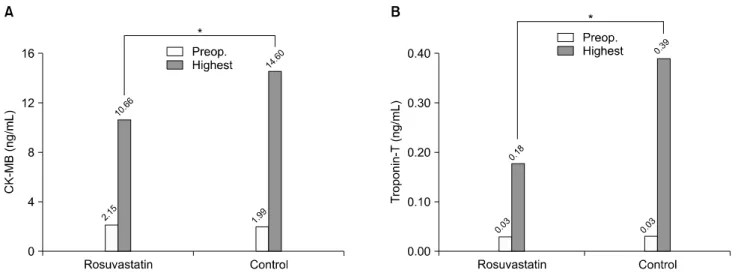
Fig. 1. Changes in cardiac enzymes after operation. (A) Change in the level of CK-MB. (B) Change in the level of troponin T.

Preop=Preoperative level (white bar); Highest=Highest level at postoperative period (gray bar). *=p-value<0.05.

prevalence of diabetes mellitus, hypertension, dyslipidemia chronic renal failure, and peripheral arterial obstructive dis- ease; chronic statin treatment for more than one month; his- tory of cerebrovascular accidents and percutaneous trans- luminal coronary angioplasty; medication use; degree of coro- nary artery disease; and left ventricular ejection fraction.

Preoperative risk, as assessed by EuroSCORE, was not sig- nificantly different between the groups (rosuvastatin group 3.1±2.2, control group 3.3±2.1, p=0.53). There were no sig- nificant differences in the duration of the operation, number of distal anastomosis, total arterial grafting, or complete re- vascularization (Table 2).

The primary endpoint was evaluated at 30 days (Table 3).

The composite primary endpoint of death, myocardial in- farction, and target vessel revascularization occurred in 3.5%

of patients (5 of 142), one patient (1.4%) in the rosuvastatin

group and four patients (5.6%) in the control group. No sig- nificant difference was found between groups in overall (p=0.37) or individual cardiac events. One patient with chron- ic renal failure died in the control group due to the ag- gravation of renal and respiratory failure.

Changes in cardiac enzymes are displayed in Fig. 1.

Preoperative CK-MB and troponin T were not different be-

tween groups (CK-MB, rosuvastatin group 2.15±0.85 ng/mL,

control group 1.99±0.76 ng/mL, p=0.24; troponin T, rosuvas-

tatin group 0.03±0.07 ng/mL, control group 0.03±0.09

ng/mL, p=0.52). After OPCAB, the mean maximum CK-MB

was significantly higher in the control group (rosuvastatin

group 10.7±9.75 ng/mL, control group 14.6±12.9 ng/mL,

p=0.04). Furthermore, the levels of the mean maximum tropo-

nin T were significantly higher in the control group

(rosuvastatin group 0.18±0.16 ng/mL, control group

(5)

0.39±0.70 ng/mL, p=0.02). In the rosuvastatin group, CK-MB decreased by 26.7% and troponin T decreased by 53.8%

compared to the control group.

DISCUSSION

This study is the first single-center randomized trial to evaluate the efficacy of high-dose rosuvastatin loading (60 mg) before OPCAB in patients with stable angina. At the 1-month clinical follow-up assessment, the occurrence of ma- jor cardiac events was not significantly different between the control and 60-mg rosuvastatin pretreatment groups. However, our study suggests that high-dose rosuvastatin loading before OPCAB may decrease myocardial ischemia as determined by CK-MB and troponin T after OPCAB.

The benefit of periprocedural treatment with statins in on-pump CABG is well established. In the Multicenter Study of Perioperative Ischemia (McSPI) Epidemiology II Study [13], the authors reported that preoperative statin therapy was independently associated with a significant reduction in the risk of early cardiac death after elective on-pump CABG, but was not associated with a reduced risk of postoperative non- fatal, in-hospital MI. Powell et al. [19] evaluated the influ- ence of lipid-lowering therapy for 30 days before CABG. In this observational study with 4,739 patients, in-hospital mor- tality was significantly lower in the lipid-lowering therapy group than in the nonlipid-lowering therapy group (1.4% vs.

2.2%, odds ratio 0.62, 95% CI 0.40∼0.96, p=0.03). Even though the multivariable model demonstrated a loss of stat- istical significance for the effect of lipid-lowering therapy on in-hospital mortality, they suggested that patient risk factors and the use of other cardioprotective medications associated with the use of preoperative lipid-lowering therapy appeared to explain the association with improved survival. Several prospective trials have been conducted to validate these find- ings of statin pre-treatment in PCI and CABG settings. In the ARMYDA-ACS trial [9], short-term atorvastatin loading con- ferred an 88% risk reduction in 30-day MACEs in patients with acute coronary syndrome before PCI. Mannacio et al.

evaluated the effect of 20 mg/d rosuvastatin pretreatment for 1 week before on-pump CABG. Troponin I, myoglobin, and CK-MB mass values were assessed, and all biological mark-

ers were significantly lower in the rosuvastatin pretreatment group. However, few studies have evaluated statin pretreat- ment in OPCAB patients. Song et al. [20] reported that pre- operative loading with atorvastatin for 3 days before OPCAB significantly reduced the occurrence of postoperative atrial fibrillation.

A total of 60 mg rosuvastatin was loaded before OPCAB in this study. According to a well-reviewed paper [21] about pre-procedural statin therapy, the loading dosages of various statins before PCI or CABG were mostly determined by researchers. In our preliminary study, 40 mg rosuvastatin loading 12 hours before OPCAB did not result in significant decreases of cardiac enzymes and inflammatory markers. 20 mg of rosuvastatin were added 2 hours before OPCAB, and no serious side effects of 60 mg rosuvastatin loading were found.

This study found no significant reduction in 30-day MACEs. The effects of high-dose rosuvastatin loading in this study could not be determined because the incidence of clin- ical events was low in both patient groups. However, there was a tendency toward a lower number of MACEs in the ro- suvastatin loading group and further study with more patients is warranted.

In this study, statin loading before OPCAB significantly lowered the degree of myocardial ischemia as assessed by cardiac enzymes. Although these beneficial effects of statin loading on myocardial protection cannot be completely ex- plained, this early protective effect of statins is unlikely to be the result of its effect on cholesterol. Instead, statins exert pleiotropic effects that may be initiated before its lipid-low- ering effects [22]. Previous studies show the improvement of myocardial ischemia after OPCAB that we observed in this study. Protection from aggravation of myocardial ischemia may result from the pleiotropic effects of statins, such as the improvement of endothelial function, dilatation of coronary microvessels, anti-thrombotic effects, and anti-inflammatory action [23,24].

Our study had several limitations. First, two surgeons from

a single center conducted the trial. Second, myocardial ische-

mia was only assessed by CK-MB and troponin T, which

may have lower specificity in certain conditions, such as re-

nal dysfunction. Third, sample size was relatively small with

(6)

low clinical morbidity and mortality, and accordingly, a stat- istical difference may not have been detected. These factors should be addressed using larger cohorts in multicenter trials that evaluate the effects of statin loading before OPCAB surgery.

CONCLUSION

Our findings suggest that high-dose rosuvastatin loading before OPCAB surgery did not result in a significant reduc- tion of 30-day MACEs. However, high-dose rosuvastatin re- duced myocardial ischemia after OPCAB.

REFERENCES

1. Goldstein JL, Brown MS. Regulation of the mevalonate pathway. Nature 1990;343:425-30.

2. Bernini F, Didoni G, Bonfadini G, Bellosta S, Fumagalli R.

Requirement for mevalonate in acetylated LDL induction of cholesterol esterification in macrophages. Atherosclerosis 1993;104:19-26.

3. Corsini A, Mazzotti M, Raiteri M, et al. Relationship be- tween mevalonate pathway and arterial myocyte pro- liferation: in vitro studies with inhibitors of HMG-CoA reductase. Atherosclerosis 1993;101:117-25.

4. Grunler J, Ericsson J, Dallner G. Branch-point reactions in the biosynthesis of cholesterol, dolichol, ubiquinone and pre- nylated proteins. Biochimica et Biophysica Acta 1994;1212:

259-77.

5. Corsini A, Raiteri M, Soma MR, Bernini F, Fumagalli R, Paoletti R. Pathogenesis of atherosclerosis and the role of 3-hydroxy-3-methylglutaryl coenzyme A reductase inhibitors.

Am J Cardiol 1995;76:21A-8A.

6. Bellosta S, Ferri N, Arnaboldi L, Bernini F, Paoletti R, Corsini A. Pleiotropic effects of statins in atherosclerosis and diabetes. Diabetes Care 2000;23(Suppl 2):B72-8.

7. Pasceri V, Patti G, Nusca A, Pristipino C, Richichi G, Di Sciascio G. Randomized trial of atorvastatin for reduction of myocardial damage during coronary intervention: results from the ARMYDA (Atorvastatin for Reduction of MYocardial Damage during Angioplasty) study. Circulation 2004;110:674-8.

8. Patti G, Chello M, Pasceri V, et al. Protection from proce- dural myocardial injury by atorvastatin is associated with lower levels of adhesion molecules after percutaneous coro- nary intervention: results from the ARMYDA-CAMs (Atorvastatin for Reduction of MYocardial Damage during Angioplasty-Cell Adhesion Molecules) substudy. J Am Coll Cardiol 2006;48:1560-6.

9. Patti G, Pasceri V, Colonna G, et al. Atorvastatin pretreat- ment improves outcomes in patients with acute coronary syn- dromes undergoing early percutaneous coronary inter- vention: results of the ARMYDA-ACS randomized trial. J Am Coll Cardiol 2007;49:1272-8.

10. Poldermans D, Bax JJ, Kertai MD, et al. Statins are asso- ciated with a reduced incidence of perioperative mortality in patients undergoing major noncardiac vascular surgery.

Circulation 2003;107:1848-51.

11. Pan W, Pintar T, Anton J, Lee VV, Vaughn WK, Collard CD. Statins are associated with a reduced incidence of peri- operative mortality after coronary artery bypass graft surgery. Circulation 2004;110:II45-9.

12. Clark LL, Ikonomidis JS, Crawford FA Jr, et al. Preoper- ative statin treatment is associated with reduced post- operative mortality and morbidity in patients undergoing cardiac surgery: an 8-year retrospective cohort study. J Thorac Cardiovasc Surg 2006;131:679-85.

13. Collard CD, Body SC, Shernan SK, Wang S, Mangano DT.

Preoperative statin therapy is associated with reduced car- diac mortality after coronary artery bypass graft surgery. J Thorac Cardiovasc Surg 2006;132:392-400.

14. Youn YN, Kwak YL, Yoo KJ. Can the EuroSCORE predict the early and mid-term mortality after off-pump coronary ar- tery bypass grafting? Ann Thorac Surg 2007;83:2111-7.

15. Yang H, Youn YN, Yoo KJ. Correlation of akinesia with graft patency and cardiac enzyme after off-pump coronary artery bypass graft surgery. Circ J 2010;74:1564-9.

16. Vander Salm TJ, Kip KE, Jones RH, et al. What constitutes optimal surgical revascularization? Answers from the Bypass Angioplasty Revascularization Investigation (BARI). J Am Coll Cardiol 2002;39:565-72.

17. Sabik JF, Blackstone EH, Lytle BW, Houghtaling PL, Gillinov AM, Cosgrove DM. Equivalent midterm outcomes after off-pump and on-pump coronary surgery. J Thorac Cardiovasc Surg 2004;127:142-8.

18. Thygesen K, Alpert JS, White HD. Universal definition of myocardial infarction. J Am Coll Cardiol 2007;50:2173-95.

19. Powell BD, Bybee KA, Valeti U, et al. Influence of pre- operative lipid-lowering therapy on postoperative outcome in patients undergoing coronary artery bypass grafting. Am J Cardiol 2007;99:785-9.

20. Song YB, On YK, Kim JH, et al. The effects of atorvastatin on the occurrence of postoperative atrial fibrillation after off-pump coronary artery bypass grafting surgery. Am Heart J 2008;156:373.e9-16.

21. Winchester DE, Wen X, Xie L, Bavry AA. Evidence of pre-procedural statin therapy a meta-analysis of randomized trials. J Am Coll Cardiol 2010;56:1099-109.

22. Wassmann S, Faul A, Hennen B, Scheller B, Bohm M,

Nickenig G. Rapid effect of 3-hydroxy-3-methylglutaryl coen-

zyme a reductase inhibition on coronary endothelial function.

(7)

Circ Res 2003;93:e98-103.

23. Hinoi T, Matsuo S, Tadehara F, Tsujiyama S, Yamakido M.

Acute effect of atorvastatin on coronary circulation measured by transthoracic Doppler echocardiography in patients with- out coronary artery disease by angiography. Am J Cardiol

2005;96:89-91.

24. Ray KK, Cannon CP. Early time to benefit with intensive

statin treatment: could it be the pleiotropic effects? Am J

Cardiol 2005;96:54F-60F.

수치

Table 1. Demographics and baseline clinical characteristics   Rosuvastatin  group Control group p-value Female  Age,  yrs  Smoker  Diabetes  mellitus  Hypertension  Dyslipidemia
Fig. 1. Changes in cardiac enzymes after operation. (A) Change in the level of CK-MB. (B) Change in the level of troponin T

참조

관련 문서

(2017) Effects of preoperative aspirin on perioperative platelet activation and dysfunction in patients undergoing off-pump coronary artery bypass graft surgery:

Purpose: The aim of this study was to find an optimal range of activated clotting time (ACT) during off-pump coronary artery bypass surgery (OPCAB) yielding ischemic

Materian and Method: From April, 2005 to September, 2005, 12 patients were underwent awake coronary artery bypass grafting using high thoracic epidural anesthesia.. Off pump

Combined percutaneous transluminal coronary angioplasty and minimally invasive coronary arterial bypass grafting (Hybrid CABG).. artery bypass with complete avoidance

The Recovery of Left Ventricular Function after Coronary Artery Bypass Grafting in Patients with Severe Ischemic Left Ventricular Dysfunction: Off-pump Versus On-pump.. Jae Hyun

Coronary artery bypass grafting in elderly patients: comparative results in a consecutive series of 469 patients older than 75 years. Favorable results of

Compared with conventional coronary artery bypass graft (CABG), off-pump coronary artery bypass (OPCAB) has ad- vantages for performing transfusion-free surgery,

In this case, combined bilateral lung transplantation and coronary artery bypass grafting was performed in a p atient who had a single vessel disease with