ISSN: 2233-601X (Print) ISSN: 2093-6516 (Online)
Received: November 2, 2016, Revised: December 30, 2016, Accepted: December 30, 2016, Published online: October 5, 2017
Corresponding author: Jung Hee Bang, Department of Thoracic and Cardiovascular Surgery, Dong-A University Hospital, 26 Daesin- gongwon-ro, Seo-gu, Busan 49201, Korea
(Tel) 82-51-240-5195 (Fax) 82-51-247-8753 (E-mail) [email protected]
© The Korean Society for Thoracic and Cardiovascular Surgery. 2017. All right reserved.
This is an open access article distributed under the terms of the Creative Commons Attribution Non-Commercial License (http://creativecommons.org/
licenses/by-nc/4.0) which permits unrestricted non-commercial use, distribution, and reproduction in any medium, provided the original work is properly cited.
Risk Factors of On-Pump Conversion during Off-Pump Coronary Artery Bypass Graft
Sung Sil Yoon, M.D. 1 , Jung Hee Bang, M.D. 1 , Sang Seok Jeong, M.D. 1 , Jae Hwa Jeong, M.D. 1 , Jong Soo Woo, M.D. 2
1
Department of Thoracic and Cardiovascular Surgery, Dong-A University College of Medicine,
2
Department of Thoracic and Cardiovascular Surgery, BHS Hanseo Hospital
Background: Off-pump coronary artery bypass grafting (OPCABG) procedures can avoid the complications of an on-pump bypass. However, some cases unexpectedly require conversion to cardiopulmonary bypass during OPCABG. The risk factors associated with a sudden need for cardiopulmonary bypass were analyzed. Methods:
This retrospective study included 283 subjects scheduled for OPCABG from 2001 to 2010. These were div- ided into an OPCABG group and an on-pump conversion group. Preoperative, operative, and postoperative variables were compared between the 2 groups. Results: Of the 283 patients scheduled for OPCABG, 47 (16%) were switched to on-pump coronary artery bypass grafting (CABG). The mortality of the both the OPCABG and on-pump conversion groups was not significantly different. The major risk factors for conversion to on-pump CABG were congestive heart failure (CHF) (odds ratio [OR], 3.5; p=0.029), ejection fraction (EF)
<35% (OR, 4.4; p=0.012), and preoperative beta-blocker (BB) administration (OR, 0.3; p=0.007). The use of intraoperative (p=0.007) and postoperative (p=0.021) inotropics was significantly higher in the conversion group. The amount of postoperative drainage (p<0.001) and transfusion (p<0.001) also was significantly higher in the conversion group. There were no significant differences in stroke or cardiovascular complica- tions between the groups over the course of short-term and long-term follow-up. Conclusion: Patients who undergo OPCABG and have CHF or a lower EF (<35%) are more likely to undergo on-pump conversion, while preoperative BB administration could help prevent conversions from OPCABG to on-pump CABG.
Key words: 1. Off-pump coronary artery bypass grafting 2. Coronary artery bypass
3. Myocardial ischemia 4. Hemodynamic instability 5. On pump conversion
Introduction
Performing coronary artery bypass grafting (CABG) procedures without cardiopulmonary bypass (CPB) can reduce unwanted complications, such as my- ocardial ischemia (MI), inflammatory responses, and
neurological complications in elderly and high-risk patients. Following the successful clinical application of off-pump CABG (OPCABG) by Borst et al. [1] in 1996, revascularization was initially limited to the vessels of the anterior wall. However, complete re- vascularization of the left lateral and inferior wall of
https://doi.org/10.5090/kjtcs.2017.50.5.355
the heart is now possible with the development of cardioplegic technology and improved hemodynamic understanding of the heart vasculature. There are considerable difficulties in performing coronary per- fusion without CPB in patients with poor left ven- tricular (LV) function, evolving MI, severe congestive heart failure (CHF), or very small epicardial vessels.
In these cases, the emergent use of CPB may result in complications and an adverse outcome. Deterioration of cardiac function due to manipulation of the heart during an operation can result in the obstruction of the right ventricular outflow tract and a change in LV pumping action. These changes have been shown to lead to decreased cardiac output, cardiac insuffi- ciency, and hypotension [2]. Thus, if the probability of needing CPB can be accurately predicted pre- operatively, then unwanted risk can be reduced with an elective on-pump CABG. In this study, we retro- spectively analyzed patients who were switched from OPCABG to on-pump CABG in order to develop safer surgical procedures.
Methods
Of 451 patients scheduled for isolated OPCABG be- tween March 2001 and December 2010, 283 were selected for possible outpatient follow-up in this study to analyze long-term complications and surviv- al rates. Out of these 283 patients, 47 (16%) were switched to on-pump CABG (the on-pump conversion group); these were compared to the remaining 236 (84%) in the OPCABG group. Patients with unstable vital signs secondary to cardiogenic shock who re- quired an intraaortic balloon pump (IABP) preopera- tively and patients with a history of valve repair, aortic graft replacement surgery, or revision surgery were excluded from this study.
Of the 283 patients in the study, 163 (58%) were taking beta-blockers (BBs) until the day before sur- gery (carvediolol, 6.25 mg twice a day). Data on car- diomegaly, ejection fraction (EF), recent MI, presence or absence of CHF, number of diseased coronary ar- teries, comorbid diseases, and renal function were recorded. Comorbid diseases included hypertension, chronic obstructive pulmonary disease, hyperlipidemia, and diabetes mellitus. Hypertensive patients were identified as those taking at least one antihyper- tensive drug, and patients with diabetes mellitus
were identified as those taking insulin therapy either orally or by injection. Patients with a recent MI were identified by a cardiologist, based on reported symp- toms, elevated cardiac enzymes, or the results of an electrocardiogram (ECG) taken within 3 months be- fore surgery. Patients with cardiomegaly were identi- fied as those with an elevated cardiothoracic ratio (above 0.5). The Framingham criteria were used to identify patients with CHF.
Postoperative MI was defined as a new onset Q-wave after operation on an ECG or significant car- diac enzyme elevation accompanied by symptoms.
Postoperative stroke was defined as a new focal neu- rologic deficit and a persistent postoperative change in mental status. Renal failure was defined as a 50%
increase in postoperative serum creatinine level com- pared to baseline serum creatinine levels. Postoperative atrial arrhythmia was defined as the occurrence of new atrial arrhythmia in the absence of preoperative persistent or paroxysmal atrial arrhythmias over 24 hours.
Conversion from OPCABG to on-pump CABG took place when, despite corrective measures, including the loosening of deep pericardial sutures and admin- istering myocardial stabilizers, administering in- otropics and plasma, and changing the patient’s posi- tion, a patient had (1) a systolic blood pressure that has fallen to 70 mm Hg; (2) a persistent ventricular arrhythmia; (3) a persistent change in ST segments;
and (4) left ventricle distension with bradycardia.
When these conditions were met, CPB was applied promptly.
1) Surgical method
All patients were kept normothermic and in the
supine position. OPCABG was attempted with CPB on
standby. For patients with a low EF, the right femo-
ral artery site was reserved for an IABP, in case it
was necessary, and a Swan-Ganz catheter was placed
in 35% of the patients. A median sternotomy was
performed to harvest the internal thoracic artery
graft. If needed, radial artery and great saphenous
vein grafts also were harvested. Prior to ligation of
the internal thoracic artery, 8,000–10, 000 units of
heparin were administered, and the activated clotting
time during the operation was maintained between
200 and 300 seconds. After the pericardial incision
was made, a right pleurotomy and a deep vertical
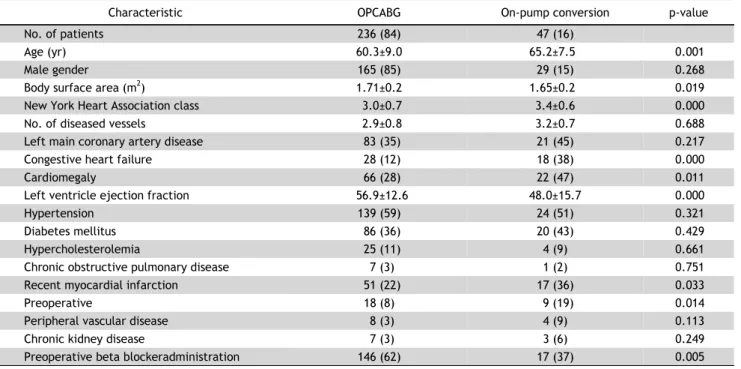
Table 1. Characteristics of the 283 patients in the OPCABG group and on-pump conversion groups
Characteristic OPCABG On-pump conversion p-value
No. of patients 236 (84) 47 (16)
Age (yr) 60.3±9.0 65.2±7.5 0.001
Male gender 165 (85) 29 (15) 0.268
Body surface area (m
2) 1.71±0.2 1.65±0.2 0.019
New York Heart Association class 3.0±0.7 3.4±0.6 0.000
No. of diseased vessels 2.9±0.8 3.2±0.7 0.688
Left main coronary artery disease 83 (35) 21 (45) 0.217
Congestive heart failure 28 (12) 18 (38) 0.000
Cardiomegaly 66 (28) 22 (47) 0.011
Left ventricle ejection fraction 56.9±12.6 48.0±15.7 0.000
Hypertension 139 (59) 24 (51) 0.321
Diabetes mellitus 86 (36) 20 (43) 0.429
Hypercholesterolemia 25 (11) 4 (9) 0.661
Chronic obstructive pulmonary disease 7 (3) 1 (2) 0.751
Recent myocardial infarction 51 (22) 17 (36) 0.033
Preoperative 18 (8) 9 (19) 0.014
Peripheral vascular disease 8 (3) 4 (9) 0.113
Chronic kidney disease 7 (3) 3 (6) 0.249
Preoperative beta blockeradministration 146 (62) 17 (37) 0.005
Values are presented as number (%) or mean±standard deviation.
OPCABG, on-pump coronary artery bypass grafting.
pericardiotomy were performed to secure a space for entering the heart from the right thoracic cavity. One or 2 deep pericardial sutures were placed between the upper left pulmonary vein and the inferior vena cava, and then the heart was elevated. Either a pres- sure-type myocardial stabilizer (Guidant Axius Vacuum 2 Stabilizer System; Guidant Corp., Santa Clara, CA, USA) or a vacuum-type myocardial stabilizer (Guidant Axius XposeTM Device 3, Guidant Corp.) was used to secure the area of anastomosis, and then the coro- nary artery was exposed. Prior to dissection of the artery, pressure was applied with a 5-0 polypropylene suture if there was incomplete occlusion of the sur- rounding area of anastomosis. After dissection, a cor- onary arterial shunt (intracoronary shunt, Flo-Thru, internal diameter 1.5–2.0 mm; Bio-Vascular Inc., St.
Paul, MN, USA) was inserted to maintain distal perfu- sion during surgery. Carbon dioxide spray (Guidant Axius Blower/minister, flow rate <5 L/min; Guidant Corp.) was used to secure visibility of the anastomosis.
For any evidence of hemodynamic instability, addi- tional intravenous heparin was administered (with an activated clotting time of 400 seconds), and the pro- cedure was converted to CPB, using a venous cathe- ter without cardioplegia. All anastomoses were per-
formed on a beating heart.
The left ascending artery was always bypassed first. Second, any vessel with a more-critical stenosis was bypassed and an anastomosis was performed. A proximal anastomosis was completed before begin- ning the anastomosis of the next stenosed vessel.
The guiding principle was that more cardiac displace- ment was better tolerated with increasingly complete revascularization. The order of the anastomosis of the different vessels was decided for individual pa- tients depending on various factors, particularly he- modynamic status after heart manipulation. Continuous suturing with 8-0 polypropylene was used for arterial grafts, and 7-0 polypropylene was used for venous grafts. In cases where proximal aortic anastomosis was necessary, suturing with 6-0 polypropylene was performed after side-clamping. After all anastomoses were completed, blood flow (mL/min) within the vessel graft was measured with Doppler ultrasound and protamine neutralization was performed.
2) Statistics
Data were expressed as mean±standard deviation.
Statistical analysis was performed using IBM SPSS
ver. 20.0 (IBM Corp., Armonk, NY, USA). Univariate
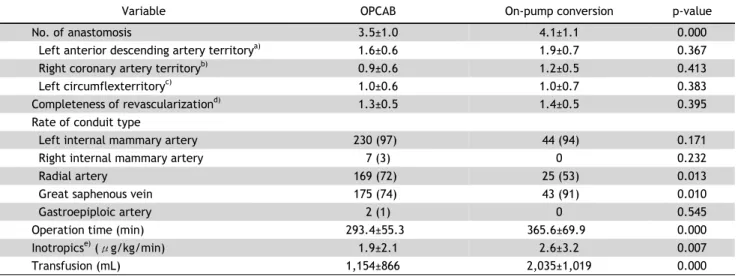
Table 2. The intraoperative data of 283 patients with OPCAB group and on-pump conversion group
Variable OPCAB On-pump conversion p-value
No. of anastomosis 3.5±1.0 4.1±1.1 0.000
Left anterior descending artery territory
a)1.6±0.6 1.9±0.7 0.367
Right coronary artery territory
b)0.9±0.6 1.2±0.5 0.413
Left circumflexterritory
c)1.0±0.6 1.0±0.7 0.383
Completeness of revascularization
d)1.3±0.5 1.4±0.5 0.395
Rate of conduit type
Left internal mammary artery 230 (97) 44 (94) 0.171
Right internal mammary artery 7 (3) 0 0.232
Radial artery 169 (72) 25 (53) 0.013
Great saphenous vein 175 (74) 43 (91) 0.010
Gastroepiploic artery 2 (1) 0 0.545
Operation time (min) 293.4±55.3 365.6±69.9 0.000
Inotropics
e)( μg/kg/min) 1.9±2.1 2.6±3.2 0.007
Transfusion (mL) 1,154±866 2,035±1,019 0.000
Values are presented as mean±standard deviation or number (%).
OPCAB, off-pump coronary artery bypass graft.
a)
Including left anterior descending artery, diagonal artery, and ramus intermedius.
b)Including posterior descending artery and postero- lateral branches.
c)Obtuse marginal branches.
d)As measured by the mean number of distal anastomoses divided by the mean number of diseased vessel system.
e)Average dose of dobutamine which is the first choice of the inotropic agent intraoperatively.
analyses were performed to assess factors associated with study outcomes. The chi-square test or the Fisher exact test was used to compare categorical variables.
The Student t-test was used to compare continuous variables. We constructed a multivariate logistic re- gression model for risk factors. The stepwise elimi- nation method was used, including the variables CHF, recent MI, cardiomegaly, EF<35%, stroke, and pre- operative use of a BB. The odds ratios (ORs) and 95% confidence intervals were also calculated. All re- sults with a p-value less than 0.05 were considered statistically significant.
Results
In the 283 patients scheduled for an isolated OPCABG, 47 (16%) were converted to an on-pump CABG. The risk-factor analyses of the 29 males (15%) in the on-pump conversion group and 165 males (85%) in the OPCABG group indicated there was no significant difference between the groups based on gender (p=0.268) (Table 1). The analyses also indica- ted that the on-pump conversion group patients had a higher frequency of CHF (p=0.000), cardiomegaly (p=0.011), recent MI (p=0.033), and previous stroke (p=0.014). Low cardiac function was also present in the on-pump conversion group, which had, for exam-
ple, significantly more low left ventricle EFs (p=
0.000) and were in higher New York Heart Association (NYHA) classes (p=0.000).
The patients in the on-pump conversion group un- derwent conversion for the following reasons: LV dysfunction from pressure created by heart manipu- lation (40 cases), electrical disturbances such as bra- dycardia and ST-segment elevation from heart manip- ulation for the anastomosis of inferior wall vessels (5 cases), and anatomically narrow or curving target vessels that prevented insertion of a shunt into the vessel incision (2 cases).
During the operation, the on-pump conversion group had significantly larger packed red blood cell trans- fusion volumes than the OPCABG group (p=0.000).
The on-pump conversion group also used a signifi- cantly larger average amount of dobutamine (p=0.007) and had significantly more surgical anastomosis sites (p=0.000) than the OPCABG group (Table 2).
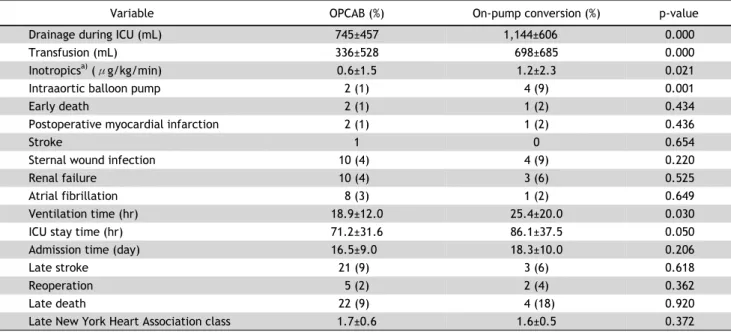
An IABP was used postoperatively in 6 patients, with significantly more in the on-pump conversion group (4, 9%) than the OPCABG group (2, 1%) (p=
0.001). The use of the IABPs was deferred for up to
44 hours without difficulty. The chest tube drainage
(p=0.000) and transfusion (p=0.000) volumes were
significantly different between the 2 groups. On
Pump conversion group was more large. Three early
Table 3. The postoperative and follow-up data of patients with OPCAB group and on-pump conversion group
Variable OPCAB (%) On-pump conversion (%) p-value
Drainage during ICU (mL) 745±457 1,144±606 0.000
Transfusion (mL) 336±528 698±685 0.000
Inotropics
a)( μg/kg/min) 0.6±1.5 1.2±2.3 0.021
Intraaortic balloon pump 2 (1) 4 (9) 0.001
Early death 2 (1) 1 (2) 0.434
Postoperative myocardial infarction 2 (1) 1 (2) 0.436
Stroke 1 0 0.654
Sternal wound infection 10 (4) 4 (9) 0.220
Renal failure 10 (4) 3 (6) 0.525
Atrial fibrillation 8 (3) 1 (2) 0.649
Ventilation time (hr) 18.9±12.0 25.4±20.0 0.030
ICU stay time (hr) 71.2±31.6 86.1±37.5 0.050
Admission time (day) 16.5±9.0 18.3±10.0 0.206
Late stroke 21 (9) 3 (6) 0.618
Reoperation 5 (2) 2 (4) 0.362
Late death 22 (9) 4 (18) 0.920
Late New York Heart Association class 1.7±0.6 1.6±0.5 0.372
Values are presented as mean±standard deviation or number (%).
OPCAB, off-pump coronary artery bypass graft; ICU, intensive care unit.
a)