This is an Open Access article distributed under the terms of the Creative Commons Attribution Non-Commercial License (http://creativecommons.org/
licenses/by-nc/3.0) which permits unrestricted non-commercial use, distribution, and reproduction in any medium, provided the original work is properly cited.
The Antimicrobial Activity of the Crude Extracts from Cichorium intybus L. (Chicory) against Bacillus cereus in Various Dairy Foods
†
Dana Jeong
1,
†Dong-Hyeon Kim
1,
†Jung-Whan Chon
1,2,
†Hyunsook Kim
3, Hong-Seok Kim
1,
*Kwang-Young Song
1, Il-Byung Kang
1, Young-Ji Kim
1, Jin-Hyeong Park
1, Ho-Seok Chang
1and
†Kun-Ho Seo
11Center for One Health, College of Veterinary Medicine, Konkuk University, Seoul, Korea
2National Center for Toxicological Research, US Food and Drug Administration, Jefferson, USA
3Dept. of Food & Nutrition, College of Human Ecology, Hanyang University, Seoul, Korea
Abstract
The roots of
Cichorium intybus
L. (chicory) have many nutritional qualities and also have been used for health promotion as traditional medicine. The antimicrobial activity ofCichorium intybus
L.’s (chicory) ethanol extract onBacillus cereus
ATCC 10876 were investigated using spot on lawn method in this study. Ethanol extract exhibited antimicrobial activities againstBacillus cereus
ATCC 10876 with significance. Also, the results produced the larger zones of inhibition againstBacillus cereus
ATCC 10876 tested, with increasing concentration ofCichorium intybus
L.’s (chicory) ethanol extracts,. Hence,Cichorium intybus
L. (chicory) could be served for keeping the safety of various dairy products as natural antimicrobial agents.Keywords
chicory (
Cichorium intybus
),Bacillus cereus
, antimicrobial activity.Received: November 28, 2016 Revised: December 20, 2016 Accepted: December 24, 2016
†These authors contributed equally to this study.
*Corresponding author : Kwang-Young Song, Center for One Health, College of Veterinary Medicine, Konkuk University, Seoul, Korea.
Tel : +82-2-450-4121, Fax : +82-2-3436-4128, E-mail : [email protected]
Introduction
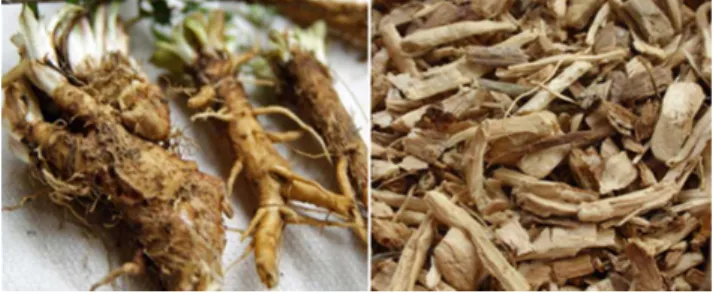
Until now, numerous medicinal plants have been used for centuries and many cultures still rely on indigenous medicinal plants to meet their significant health care needs (Street et al., 2013; Jeong et al., 2016). Cichorium intybus L., commonly known as chicory, is a medicinally important plant in Asia and Eurasia including Africa. In general, Cichorium intybus L. (chicory) is an erect fairly woody perennial herb, about 1 m in height with a fleshy taproot of over 75 cm in length and large basal leaves (Bais and Ravishankar, 2001) (Fig. 1).
All parts of Cichorium intybus L. (chicory) have many important medicinal components
such as alkaloids, inulin, sesquiterpene lactones, coumarins, vitamins, chlorophyll pigments,
unsaturated sterols, flavonoids, saponins, tannins, and so on (Nandagopal and Kumari,
2007; Muthusamy et al., 2008; Atta et al., 2010). Furthermore, fresh chicory generally
includes about 68% inulin, 14% sucrose, 5% cellulose, 6% protein, 4% ash, and 3% other
Fig. 1. Cichorium intybus L. (chicory) belongs to the family
Asteraceae which is a small aromatic biennial or perennial herb (Left, unprocessed roots; right, processed roots with cleaning, cutting into slices, and drying)
compounds, on the other hand dried chicory has roughly 98% inulin and 2% other compounds (Meehye and Shin, 1996).
Although important phytochemicals are distributed through- out the plant, the main components are present in the root of Cichorium intybus L. (chicory) contained over 40%
inulin (Bais and Ravishankar, 2001; Judzentiene and Budiene, 2008). To date, Cichorium intybus L. (chicory) is grown for the production of inulin on an industrial scale (van Arkel et al., 2012).
Also, there is a little investigated the bioavailability of Cichorium intybus L. (chicory) in terms of phytochemistry and pharmacology. In fact, up to 100 individual compounds have been isolated and identified from the roots of Cichorium intybus L. (chicory) (Street et al., 2013). Most of the pharmacological studies on Cichorium intybus L.
(chicory) have been performed the testing of aqueous and/or alcoholic extracts only (Street et al., 2013).
Among various food-borne pathogenic bacteria, Bacillus cereus is a spore-forming bacterium which occurs naturally in many kinds of foods and also could cause illness in humans (Jaquette and Beuchat, 1998; Agata et al., 2002).
It could form spores which are resistant to heating and dehydration and therefore could survive cooking and dry storage (Paananen et al., 2002; Clavel et al., 2004). When foods containing Bacillus cereus spores are in the
‘temperature danger zone’ the spores may germinate, and also the bacteria may grow, produce toxins, and make people sick (Ehling-Schulz, 2004). Such illness is frequently
linked with starchy foods of plant origin such as rice, pasta, potatoes, pastry and noodles. Bacillus cereus could cause vomiting or diarrhoea and, in some cases, both (Guinebretière et al., 2008). Enterotoxins produced by B. cereus (diarrhoeal toxin) result in the diarrhoeal form of the disease and most often follow ingestion of contaminated food, local bacterial growth and subsequent toxin production in the intestines of the host (Berthold-Pluta et al., 2015).
Emetic toxin produced by B. cereus (cereulide) can result in the vomiting form of the disease following ingestion of food containing pre-formed toxin (Rajkovic, 2014). Generally, diarrhoeal illness is often associated with meat products, soups, vegetables, sauces and milk/milk products. Especially, dairy products may spoil through the growth of spores (including the spores of psychrotrophs) that survive pasteuri- zation (Rajkovic et al., 2008).
So far, there was no report on the inhibition against Bacillus cereus as food-borne pathogenic bacteria using the crude extracts from Cichorium intybus L. (chicory).
Therefore, this study was aimed at investigating the antimicrobial activity of Cichorium intybus L. (chicory) as natural additives against Bacillus cereus for guaranteeing the quality and safety of various dairy products.
Materials and Methods
1. Materials and extraction
Cichorium intybus L. (chicory) were donated from Center for One Health, Konkuk Univeristy in Seoul, Korea. The roots of Cichorium intybus L. (chicory) were cleaning, cutting into slices, and drying. Then the dried roots were macerated in 95% ethanol for 48 hours with occasionally stirring at 25±2℃. And hence, the soluble ingredients were concentrated by rotary evaporator (Rotavapor® R-100, BUCHI Corp., USA) at 50±1℃ until dryness. The yield obtained was obtained for ethanol extraction type. These stock solutions were filtrated through 0.2 mm millipore and stored at -20℃ before use.
2. Bacterial strains and culture condition
Bacillus cereus ATCC 10876 was obtained from Department
of Public Health, College of Veterinary, Konkuk University in Seoul, Korea. Cells were grown on nutrient agar (NA;
Oxoid, UK) overnight. According to the instruction of the manufacturer, colonies were transferred into tubes con- taining cryopreservation fluid (Original Microbiology Bead Storage System, STS, Technical Service Consultants Limited, UK). Until use, the beads were stored at -70±5℃.
3. Antimicrobial activity testing
Antimicrobial activity of Cichorium intybus L. (chicory) was detected by the spot on lawn method with some modifications (Cadirci and Citak, 2005). All test bacteria were cultured on Mueller-Hinton broth (MHB; Difco) and incubated at 37℃ for 24 h. The culture broth was diluted using MHB to 0.5 McF and spread onto Mueller-Hinton agar (MHA; Difco) using sterilized cotton swabs. A total of 10 μL, 20 μL, and 30 μL of chicory extract was directly dropped onto the surface of the MHA, respectively. The plates were incubated for 24 h at 37±1℃, and the inhibition zone was observed.
4. Statistical analysis
All experiments were carried out independently in triplicate experiments. The inhibition of various concentration of Cichorium intybus L.’s (chicory) ethanol extracts against Bacillus cereus ATCC 10876 were evaluated by one way analysis of variance (ANOVA).Statistical significance was accepted at the P = 0.05 level.
Results and Discussion
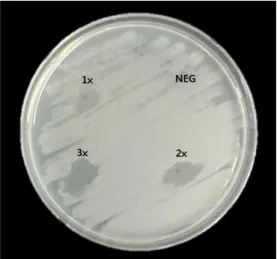
In this study, the ethanol extract of Cichorium intybus L.
(chicory) showed various levels of antimicrobial activity when tested by spot on lawn method (Fig. 2). This results obtained showed that ethanol extract exhibited anti- microbial activities against Bacillus cereus ATCC 10876.
With increasing concentration of Cichorium intybus L.’s (chicory) ethanol extracts, the results produced the larger zones of inhibition against the bacteria tested (P<0.05) (Fig. 2).
Until now, many natural materials including Cichorium
Fig. 2. The antimicrobial activity on various concentration of Cichorium intybus L. (chicory) ethanol extracts against Bacillus cereus ATCC 10876 tested by spot on lawn methods.