171
PCR 방법을 이용한 우유 및 유제품에서 발생하는 식중독 균의 신속 검출법
곽혜림․한선경․김이슬․홍연․김해영*
경희대학교 생명자원과학연구원
Rapid Detection Methods for Food-Borne Pathogens in Dairy Products by Polymerase Chain Reaction
Hyelim Kwak, Seonkyeong Han, Eiseul Kim, Yeun Hong and Haeyeong Kim*
Institute of Life Sciences and Resources, Kyung Hee University, Yongin 446-701, Korea
Abstract
The dairy industry has consistently grown via the expansion of dairy-based food categories. Dairy product consumption is stable since the nutrient composition in dairy products is ideal for human health. However, dairy products are highly susceptible to food-borne pathogens. Controlling the safety of dairy products is thus important when considering the nutrient- rich matrix of this food category. Currently, immunoassays or molecular biology techniques have been used to evaluate the safety of dairy products in Korea. These methods are based on the detection of proteins and thus have low reproducibility and sensitivity. Recent techniques to detect food-borne pathogens have focused on genetic analyses. Rapid detection methods for food-borne pathogens in milk and dairy products using polymerase chain reaction (PCR) techniques, such as conventional PCR, real-time PCR, repetitive sequence-based (rep)-PCR, PCR-denaturing gradient gel electrophoresis (DGGE), and digital PCR, are reviewed in this article. The aim of this review was to contribute knowledge of the relationship between microflora and the quality of dairy products. This study will also assist in the immediate monitoring of food-borne pathogens in milk and dairy products when an outbreak related to this food category occurs.
Keywords: Rapid detection, PCR, dairy product, milk, food-borne pathogen
* Corresponding author: Haeyeong Kim, Institute of Life Sciences and Resources, Kyung Hee University, Yongin 446-701, Korea. Tel:
82-31-201-2660, Fax: 82-31-205-6091, E-mail: [email protected]
서 론
최근 식중독 사고가 증가하면서 먹을거리의 안전성이 중 요한 문제로 강조되고 있다. 미생물에 의해 발생한 위해는 인체 건강에 즉각적으로 반응을 일으키며, 때로는 심각한 영향을 미치기도 한다. 식품유래 미생물에 의한 질병은 전 세계의 관심을 차지하고 있다(Kim et al., 2011a).
특히 유제품은 단백질 함량도 높고 고영양원으로 미생물
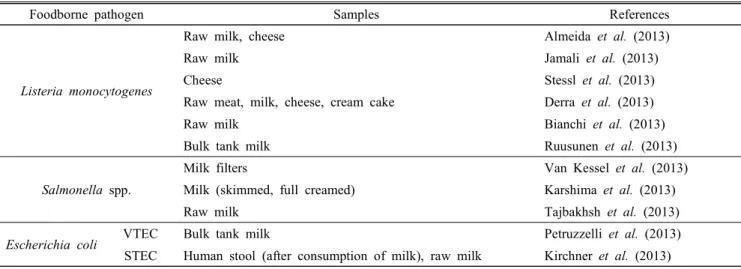
이 쉽게 자랄 수 있는 환경이기 때문에, 생산으로부터 운반, 판매 등 전 과정에서 부패되거나 변질되기 쉽다. 따라서 안 전성에 대한 각별한 주의가 요구된다(Kim et al., 2009). 살 균된 우유일지라도 식중독 균 중 Staphylococcus aureus의 경우, 포자를 형성하여 살균과정에서도 살아남을 수 있다 는 위험이 있다. 더 나아가 식중독 균에 감염이 되어 있는 우유를 사용하여 유제품을 만든다면 낙농업에 큰 피해가 올 수도 있기 때문에, 우유나 유제품 속 식중독의 신속 검 출법 개발이 시급하다. 실제로 우유나 유제품에서 식중독 균 분리가 된다는 사실은 다음의 표를 통해 확인할 수 있다 (Table 1). 한편, 각종 균들의 생육 조절을 통해 축산가공품
의 맛과 품질에도 많은 영향을 끼칠 수 있기 때문에 유제품 중 미생물에 대한 다양한 연구가 진행되고 있다.
우유 및 유제품은 섭취하는 소비자층이 두텁고 가공식품 에 활용범위가 넓기 때문에, 식중독 사고 발생 시 많은 피 해를 일으킬 수 있다. 식중독 사고 발생 시 빠르게 확산되 는 것을 막는 것이 중요하기 때문에, 즉시 사용할 수 있는 효과적인 검출법이 요구되는데, 유제품 검출에 있어서 가 장 큰 문제점들은 여러 물질들과 섞여 있는 식중독 균을 농 축하여 추출할 수 없기 때문에 식품 중에 미량으로 존재하 는 식중독 균의 검출이 힘들다는 점이다. 따라서 식품 중의 식중독 균 검출법은 소량의 균이 존재하더라도 정확하게 판별을 할 수 있는 방법이어야 한다.
식품 중 식중독 균의 신속하고 간편한 검출 기법이 많이 개발되고 있지만, 아직까지는 전통적인 검출방법 중 하나 인 배지법을 널리 사용하고 있다. 배지법은 균을 직접 확인 하면서 식품 속 미량의 균을 증균하면서 각 균에 맞는 조건 을 사용하며, 시간과 노동력이 많이 필요하고, 신속하게 균 을 검출하기에는 큰 어려움이 있다. 현장에서 바로 사용할 수 있다는 장점을 가진 면역학적인 방법으로 단백질을 이 용한 검출법이 사용되고 있지만, 민감도가 떨어지고, 재현 성이 낮으며, 각종 저해제에 의해 제약이 많은 편이다.
현재 우리나라에서는 우유나 유제품에서 살모넬라(Salmonella spp.), 황색포도상구균(Staphylococcus aureus), 장염비브리 오(Vibrio parahaemolyticus), 클로스트리디움 퍼프리젠스 (Clostridium perfringens), 리스테리아 모노사이토제네스 (Listeria monocytogenes), 대장균 O157:H7(Escherichia coli O157:H7) 등의 식중독 균이 검출되지 않아야 하고, 검사는
‘축산물의 가공기준 및 성분규격’의 축산물시험법과 ‘식품 공전’의 미생물 시험법을 기준으로 실시하고 있다(Kim et al., 2011b). 또한, 식중독 균 검출방법으로 API kit, VITEK,
Table 1. 우유 및 유제품에서 Listeria monocytogenes, Salmonella spp., E. coli(VTEC, STEC)의 검출 사례
Foodborne pathogen Samples References
Listeria monocytogenes
Raw milk, cheese Almeida et al. (2013)
Raw milk Jamali et al. (2013)
Cheese Stessl et al. (2013)
Raw meat, milk, cheese, cream cake Derra et al. (2013)
Raw milk Bianchi et al. (2013)
Bulk tank milk Ruusunen et al. (2013)
Salmonella spp.
Milk filters Van Kessel et al. (2013)
Milk (skimmed, full creamed) Karshima et al. (2013)
Raw milk Tajbakhsh et al. (2013)
Escherichia coli VTEC Bulk tank milk Petruzzelli et al. (2013)
STEC Human stool (after consumption of milk), raw milk Kirchner et al. (2013)
VIDAS, 면역학적 방법들이 사용되고 있고, 그 외 PFGE나 HPLC 방법도 알려져 있다(Kim et al., 2010). 그러나 면역 학적 방법이나 전기영동방법은 여러 물질이 들어 있는 식 품 중에서 식중독 균을 검출할 때 민감도가 떨어진다는 단 점이 있다. 최근에는 유전학적 방법인 PCR 방법이 식품 분 석 분야에서 활용사례가 증가하고 있는 추세이다. 미생물 의 DNA의 일부를 증폭하는 PCR 기법은 식품에 오염된 식 중독 균을 확인하는데 가장 우수한 방법으로 인정되고 있 다. ISO에서는 미생물학적 또는 생화학적 방법을 규정하였 으나, 2005년에 식중독 균 검출 방법으로 PCR 방법을 도입 하였다. 본고에서는 식품공전에 등재되어 있는 식중독 균 들을 중심으로 여러 PCR 방법들을 이용하여 우유와 유제 품에 존재하는 식중독 원인균을 신속하게 검출하는 방법에 대해 알아보고자 한다.
본 론
1. Conventional PCR
중합효소연쇄반응(Polymerase Chain Reaction; PCR)은 식중독 균의 DNA 중 특정 부위를 증폭하여 식품으로부터 식중독 원인 미생물을 신속 검출하기 위한 유전학적인 기 법 중 가장 편리한 방법이다. 식품으로부터 추출된 DNA를 주형으로 하여 증폭하고자 하는 DNA 부분에 특이적으로 결합하는 프라이머를 제작하고, 합성 효소(Taq polymerase) 를 사용하여 DNA를 증폭시킨다. PCR 과정은 크게 두 가 닥의 DNA가 단일 DNA로 풀리는 변성단계(denaturation step), 프라이머가 주형 DNA에 결합하는 결합단계(annealing step), 합성효소(Taq polymerase)의 활성으로 DNA가 증폭 되는 연장단계(extension step)로 나뉘게 된다.
PCR은 사용하는 프라이머 쌍의 개수에 따라 single-PCR,
multiplex-PCR로 나뉘는데, 이때 multiplex PCR은 한번의 PCR 반응으로 하나의 튜브 내에서 2개 이상의 프라이머를 사용하여 2개 이상의 부분의 DNA를 증폭시키는 방법을 말 한다. Multiplex PCR은 single PCR과 기본 원리는 같고, 여 러 개의 프라이머 쌍을 사용하기 때문에 프라이머들 간의 경쟁성을 고려하여 최적 농도를 결정해 주어야 하며, 프라 이머들 간의 잘못된 조합으로 원치 않는 증폭산물이 얻어 지지 않도록 주의하여야 한다. 식품의약품안전처는 2013년 식중독 원인조사 검사지침에서 13종의 식중독 균에 대한 single-PCR 검출법과 함께 5종(Staphylococcus aureus, Listeria monocytogenes, Shigella species, Vibrio cholera, Vibrio vulnificus)의 식중독 균에 대한 multiplex PCR 검출법 또한 제시하였다(Jo et al., 2007). 식중독 균 multiplex PCR 중 EHEC(Enterohaemorrhagic E. coli)를 검출하는 것이 유용하 게 사용되는데, 이 PCR은 1회의 PCR 수행으로 모든 EHEC 균을 검출함으로써 한 종류의 균에 속하는 여러 가지 다른 독소나 병원성 인자를 동시에 검출할 수 있다.
이러한 PCR 기법을 사용해서 우유 및 유제품으로부터 식중 독 균을 검출하는 연구도 많이 이루어졌다. 그 중 listeriolysin O gene을 target으로 하는 프라이머를 사용하여 우유에 접 종된 Listeria monocytogenes를 PCR을 통해 검출한 연구가 보고되었다. 이를 통하여 우유 및 유제품에서 PCR을 통해 Listeria monocytogenes가 검출된다는 것이 입증되었다(Rodrigues et al., 2003). 또한 multiplex PCR 기법으로 우유로부터 Staphylococcus aureus와 Yersinia enterocolitica를 동시 검 출한 보고가 있으며(Aminul et al., 2006), 이 밖에도 우유 및 유제품으로부터 PCR을 통한 식중독 균 검출법 연구 활 동은 활발히 진행되고 있다.
2. Real-time PCR
Real-time PCR 기법은 여러 진단기법 중 정량을 할 수 있 는 시험법으로 최근 널리 사용되고 있다. 일반적인 PCR처 럼 프라이머를 사용한다는 점에서 동일하지만, 형광물질을 가지고 있는 프로브를 사용한다는 점에서 차이가 있다. 형 광 프로브는 PCR 과정에서 프라이머와 같이 DNA에 상보적 으로 결합하면서 증폭을 하게 된다. 프로브 종류 중 많이 사 용되고 있는 Taqman 프로브의 경우, 양 끝에 리포터(reporter) 와 퀜처(quencher)가 있어 증폭이 진행됨에 따라 둘 사이의 거리가 늘어나면서 리포터의 형광을 감지하게 되는 원리를 가지고 있다. Real-time PCR은 반응의 마지막 부분에서 증 폭산물을 확인하던 기존의 PCR 방법과는 다르게 프로브의 존재로 인해 분석과 증폭을 한 번에 하여 실시간으로 확인 할 수 있으며, 각 반응 단계마다 증폭되는 DNA양을 모니 터링할 수 있을 뿐만 아니라, 형광 리포터를 이용하여 별도
의 전기영동이 필요 없다는 장점을 가지고 있는 기술이다.
Real-time PCR은 식중독 균 검출 시 신속하게 양성 유무 를 판별하기도 하고, 선택 배지 실험 결과, 의심 집락을 대 상으로 PCR을 하여 식중독 균의 확인에 적용할 수 있다. 기 존 PCR법을 사용하면 최소 7일 경과 후에 결과가 나오는 반면, real-time PCR 법을 사용하면 Bacillus cereus, Listeria monocytogenes, Salmonella spp.가 짧게는 2일 내에 검출될 수 있다(Oliwa-Stasiak et al., 2011; Aparecida de Oliveira et al., 2010; Ahn et al., 2010). 황색포도상구균(Staphylococcus aureus)의 몇 가지 특정 유전자를 표적으로 하여 real-time PCR 법으로 검출하는 것도 가능하다. Real-time PCR 방법 과 선택 배지법으로 확인된 colony를 확인 및 동정하는 방 법, colony PCR 방법의 3가지 실험법을 비교하였을 때, 배 지법보다는 낮은 검출율을 보였지만 colony PCR 확인 시험 법보다 높은 검출률을 보여 기존의 배지법을 대체할 수 있는 신속한 검출법이라는 것을 알 수 있다(Lee et al., 2010). Lopez- Enriquez 등(2007)은 real-time PCR 법을 통해 우유 속 Clostridium tyrobutyricum을 검출하였다. Clostridium tyrobutyricum은 치즈 제조 시 late blowing 현상을 일으켜 치즈 변패로 상품의 질 을 떨어뜨리기 때문에 조절이 필요한 균이다. 이처럼 식중 독 균뿐만 아니라, 식품의 품질이나 맛을 유지하기 위해 품 질 변화의 원인균의 추적에 사용되기도 한다.
그러나 real-time PCR은 보이는 세포 중 죽은 세포의 비 율을 알 수 없고, 시료 식품의 matrix가 혼입되면 결과에 영 향을 미칠 수 있으며, 형광을 띄게 해주는 프로브 가격 또한 고가이기 때문에, 많은 양의 시료를 측정하기에는 보완할 단 점이 많다. 저해제가 존재하는 경우 International Amplification Control(IAC)를 통해 결과 값의 정확성을 높여주는 등 real- time PCR을 통한 검출법은 계속해서 발전해 나가고 있는 추세이다.
3. Rep-PCR(Repetitive Extragenic Palindromic-PCR) Rep-PCR은 원핵세포 유전체 내에 존재하는 35~40 bp의 반복적인 염기서열을 PCR로 증폭하는 방법으로 전기영동을 함으로써 DNA fingerprinting pattern을 기준으로 종(species) 내 계통(strain) 간에도 구분을 해내는 방법이다. 이에 사용 되는 세균의 DNA 중의 반복적인 염기서열은 rep(repetitive extragenic palindromic) 이외에도 eric(enterobacterial repetitive intergenic consensus), box 등이 있다. 이 중에서도 rep 시퀀 스는 124~127 bp인 eric 시퀀스에 비해 염기서열이 짧고, 미 생물의 염색체에 존재하는 rep 시퀀스의 수가 eric 시퀀스 의 수보다 현저히 많은 것으로 알려져 있다. 이 방법은 같 은 종이라도 보유하고 있는 rep 시퀀스의 위치가 다르기 때 문에, 각기 다른 DNA fingerprinting pattern이 얻어질 수 있
어 샘플로부터 분리된 다양한 종류의 균주를 동정하고, 유 전적 상관성 및 유사성을 분석하는 데 이용되고 있다. Nucera 등(2013)은 rep-PCR의 신속ㆍ정확성을 알아보기 위하여 고 르곤졸라 치즈 생산 공장에서 채취한 치즈와 환경 샘플에 서 분리된 Listeria monocytogenes 균주를 PFGE 방법으로 subtyping한 후 rep-PCR을 통하여 재확인하였다. 그 결과, rep-PCR은 높은 재현성을 보여주었고, 효율적이고 신속한 subtyping 방법으로 평가되었다. 또한 Pasanene 등(2011)은 rep-PCR 방법을 이용하여 임상 분리균주에서 Clostridium difficile 감염의 원인이 되는 Clostridium difficile PCR ribotype 027과 078을 검출하였다. Pogacic 등(2013)은 생우유를 원 료로 자연적인 종균배양으로 경질치즈를 만들어 숙성기간 에 따라 유산균을 측정하였고, rep-PCR를 통해 유산균 계 통 간의 다양성을 연구하였다.
4. PCR-DGGE(PCR-Denaturing Gradient Gel Electrophoresis) PCR-DGGE 법은 배양 비의존적(culture-independent) 방 법으로 샘플에서 추출한 전체 DNA를 GC-clamp가 붙어 있 는 프라이머를 사용하여 16S rDNA를 증폭시킨 후 urea나 formamide와 같은 DNA 변성제로 농도 구배가 되어 있는 겔에 PCR 증폭산물을 55~65℃ 사이의 일정한 온도에서 전 기영동 한다. 증폭된 DNA가 겔 상에서 변성되어 단일 가 닥이 되면 한쪽 끝에 GC-clamp가 붙어있어 겔 상에 밴드로 나타나게 되는데, 이 때, 각각의 미생물의 염기서열에 따라 Tm값이 다르기 때문에 핵산의 이동속도 또한 달라지게 되 어서 샘플 내에 미생물의 개체수가 다양할수록 밴드의 수 는 늘어나게 된다. 또한 DGGE 패턴 상의 각각의 밴드를 잘라내어 겔에서 DNA를 회수하여 분석할 수 있다는 장점 이 있다. 이처럼 Tm값에 따른 DNA의 분리는 약간의 염기 차이로도 분리가 가능하기 때문에, 샘플에서의 미생물군집 의 다양성을 더 정확하게 확인할 수 있는 방법이다. 이러한 PCR-DGGE 방법은 샘플에 분포하는 전체 미생물 종의 수 를 하나의 겔 상에서 관찰할 수 있기 때문에 식품 및 환경 샘플에서 PCR-DGGE 방법을 이용하여 미생물을 검출한 연구가 많이 보고되었다.
우유 및 유제품에 존재하는 미생물을 검출한 연구들로 Delgado 등(2013)은 PCR-DGGE 방법을 통해 우유와 살균 처리된 우유에 존재하는 Streptococcus thermophilus 등 다 양한 호열성 세균을 검출하였고, Gori 등(2013)은 덴마크 치즈와 상업용 치즈의 표면과 내부에서 Lactobacillus 속, Corynebacterium 속, Lactococcus lactis subsp. lactis 등을 검출하였다. 또한 Alegria 등(2012)은 PCR-DGGE를 통하여 폴란드의 전통 치즈인 Oscypek으로부터 Lactococcus 속, Leuconostoc 속, Streptococcus 속 등의 세균뿐만 아니라, 다
양한 효모까지도 분리하여 폴란드 전통치즈에 분포하는 미 생물을 연구하였고, Leite 등(2012)은 발효유의 종균으로 사용되는 티벳 버섯(kefir grain)의 미생물 분포를 연구하여 Lactobacillus 등을 검출하였다. Deperrois-Lafarge와 Meheut (2013)는 우유와 유제품에서 유해세균을 동정하는 방법으 로 V3 유전자 대신에 rpoB 유전자를 target으로 새로운 PCR- DGGE 방법을 제시하였다. Bao 등(2012)은 중국의 전통 우 유인 야크 우유와 야크 유제품에서 분리된 염기서열의 유 사성이 높은 분리균주들을 PCR-DGGE 법으로 V3 region 을 비교함으로써 보다 정확하게 구별하였다.
5. Digital PCR
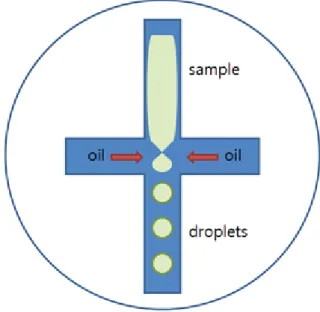
Digital PCR은 일반적인 PCR 방법처럼 증폭 주기 횟수 에 의존하지 않고, 처음 시료의 양에 의해 결정되기 때문에 중간에 의도되지 않은 값들이 없어져 좀 더 정확한 절대 정 량이 가능하다. 또한 예비 증폭단계가 필요 없기 때문에, 신속하고 정확한 결과 값을 기대할 수 있다. DNA, cDNA, RNA까지 증폭이 가능하며, 적은 양의 시료에도 정확한 절대 정량을 할 수 있다는 사실 때문에 real-time PCR보다 더 진 화된 실험법이라고 할 수 있다. Digital PCR은 chamber digital PCR(cdPCR)과 droplet digital PCR(ddPCR)이 존재 하는데, cdPCR은 수천 개의 microfluidic chamber가 주형 DNA와 반응을 하는 것이고, ddPCR은 microfluidic chamber 대신 유중수적형(water-in-oil) 에멀션 안에 있는 수 천 개 나 노 입자 크기의 작은 방울(droplet)을 이용하는 것으로, PCR 반응을 한 DNA 분자가 들어간 작은 방울의 개수를 세어 절대 정량을 할 수 있다. Fig. 1에 ddPCR에서 에멀션을 이
Fig. 1. Droplet digital PCR 원리
용하여 작은 방울과 시료가 반응하는 모습을 나타내었다.
Digital PCR은 real-time PCR보다 저해제에 의한 영향이 적 고, 시료 당 가격도 저렴하며, 더 많은 수의 시료를 단시간 에 검출할 수 있다는 장점이 있다. 비교적 최근에 나온 PCR 기법으로 아직 민감도, 정확도, 재현성 등 단독 실험을 진행 하기엔 표본이 부족하다는 것이 단점이지만, 계속해서 digital PCR을 활용한 논문이 활발하게 나오는 추세이다(Hindson et al., 2013).
Digital PCR은 식품 분야에서는 GMO 검출법에 많이 적 용이 되고 있고(Morisset et al., 2013), 의학 분야에서는 바 이러스를 검출한 사례가 있는데, 레트로바이러스성인 HIV 와 간염바이러스(Hepatitis C)의 정량을 실시하였다(Shen et al., 2011).
결 론
본고에서 제시한 유전자를 이용한 PCR 분석법들은 검사 결과가 안정적이고, 식중독의 원인 분석에 빠르게 대처할 수 있으며, 민감도가 높기 때문에 소량의 식중독 균이 들어 있더라도 검출이 가능하다. 최근 droplet digital PCR와 같 은 새로운 검출방법에 대한 연구가 활발하게 일어나고 있 기 때문에, 검출하려는 식중독 균에 대한 정보나 각 검출방 법에 따른 민감도 등 기초 자료와 비교할 수 있는 자료들이 계속해서 많이 수집되어야 한다. 그 자료를 바탕으로 개발 된 방법을 유제품에 적용시켜 유제품 속 균의 분포를 파악 하고, 식중독 사고가 발생했을 때 빠르고 정확하게 검출할 수 있어야 한다.
감사의 글
본 논문은 농촌진흥청 공동연구사업(과제번호: PJ009237) 의 지원에 의해 이루어 진 것입니다.
참고문헌
1. Ahn, Y. C., Cho, M. H., Yoon, I. K., Jung, D. H., Lee, E. Y., Kim, J. H. and Jang, W. C. 2010. Detection of Salmonella using the loop mediated isothermal amplification and real-time PCR. J. Korean Chem. Soc. 54:215-221.
2. Alegría, A., Szczesny, P., Mayo, B., Bardowski, J. and Kowalczyk, M. 2012. Biodiversity in Oscypek, a tradi- tional polish cheese, determined by culture-dependent and independent approaches. Appl. Environ. Microbiol. 78:1890- 1898.
3. Almeida, G., Magalhães, R., Carneiro, L., Santos, I., Silva, J., Ferreira, V., Hogg, T. and Teixeira, P. 2013. Foci of contamination of Listeria monocytogenes in different cheese processing plants. J. Food Microbiol. 167:303-309.
4. Aminul, I. M., Heuvelink, A. E., Talukder, K. A. and Boer, E. D. 2006. Immunoconcentration of shiga toxin- producing Escherichia coli O157 from animal faces and raw meats by using Dynabeads anti-E. coli O157 and the VIDAS system. Int. J. Food Microbiol. 109:151-156.
5. Aparecida de Oliveira, M., Abeid Ribeiro, E. G., Morato Bergamini, A. M. and Pereira De Martinis, E. C. 2010.
Quantification of Listeria monocytogenes in minimally processed leafy vegetables using a combined method based on enrichment and 16S rRNA real-time PCR. Food Microbial.
27:19-23.
6. Bao, Q. H., Liu, W. J., Yu, J., Wang, W. H., Qing, M.
J., Chen, X., Wang, F., Zhang, J. C., Zhang, W. Y., Qiao, J. M., Sun, T. S. and Zhang, H. P. 2012. Isolation and identification of cultivable lactic acid bacteria in traditional yak milk products of Gansu province in China.
J. Gen. Appl. Microbiol. 58:95-105.
7. Bianchi, D. M., Barbaro, A., Gallina, S., Vitale, N., Chiavacci, L., Caramelli, M. and Decastelli, L. 2013. Monitoring of foodborne pathogenic bacteria in vending machine raw milk in Piedmont, Italy. Food Control 32:435-439.
8. Delgado, S., Rachid, C. T. C. C., Fernandez, E., Rychlik, T., Alegria, A., Peixoto, R. S. and Mayo, B. 2013. Diversity of thermophilic bacteria in raw, pasteurized and selectively- cultured milk, as assessed by culturing, PCR-DGGE and pyrosequencing. Food Microbiol. 36:103-111.
9. Deperrois-Lafarge, V. and Meheut, T. 2012. Use of the rpoB gene as an alternative to the V3 gene for the identifi- cation of spoilage and pathogenic bacteria species in milk and milk products. Appl. Microbiol. 55:99-108.
10. Derra, F. A., Karlsmose, S., Monga, D. P., Mache, A., Svendsen, C. A., Félix, B., Granier, S. A., Geyid, A., Taye, G. and Hendriksen, R. S. 2013. Occurrence of Listeria spp. in retail meat and dairy products in the area of Addis Ababa, Ethiopia. Foodborne Pathog. Dis.
10:577-579.
11. Gori, K., Ryssel, M., Arneborg, N., and Jespersen, L.
2013. Isolation and identification of the microbiota of danish farmhouse and industrially produced surface-ripened cheeses. Microb. Ecol. 65:602-615.
12. Hindson, C. M., Chevillet, J. R., Briggs, H. A., Gallichotte, E. N., Ruf, I. K., Hindson, B. J., Vessella, R. L. and Tewari, M. 2013. Absolute quantification by droplet digital PCR versus analog real-time PCR. Nature Methods 10:1003- 1005.
13. Jamali, H., Radmehr, B. and Thong, K. L. 2013. Prevalence, characterisation, and antimicrobial resistance of Listeria species and Listeria monocytogenes isolates from raw milk in farm bulk tanks. Food Control. 34:121-125.
14. Jo, C., Kim, H. J., Kim, D. H., Lee, W. K., Ham, J. S.
and Byun, M. W. 2007. Radiation sensitivity of selected pathogens in ice cream. Food Control 18:859-865.
15. Karshima, N. S., Pam, V. A., Bata, S. I., Dung, P. A. and Paman, N. D. 2013. Isolation of Salmonella species from milk and locally processed milk products traded for human consumption and associated risk factors in Kanam, Plateau state, Nigeria. J. Anim. Prod. Adv. 3:69-74.
16. Kim, H. J., Kim, Y. S., Chung, M. S., Oh, D. H., Bahk, G. J., Chun, H. S. and Ha, S. D. 2010. Trends in rapid detection methods for food-borne pathogenic microorganisms by using new technologies. J. Food Hyg. Safety 25:
376-387.
17. Kim, H. W., Han, K. S., Park, B. Y., Jeong, S. G., Kim, H. S. and Oh, M. H. 2011. Microbiological risk assessment for milk and dairy products in Korea. Korean J. Dairy Sci. Technol. 29:69-73.
18. Kim, H. W., Paik, H. -D., Hong, W. S. and Lee, J. Y. 2009.
Overview of the management characteristics of food (livestock products) transportation systems on international- and national-level HACCP application. Korean J. Food Sci. Ani. Resour. 29:513-522.
19. Kim, H. W., Seol, K. H., Ham, J. S., Jang, A., Kim, D.
H. and Oh, M. H. 2011. Standard methods for the detection and assessment of safety in milk and dairy pro- ducts in Korea. Korean J. Dairy Sci. Technol. 29:59-68.
20. Kirchner, M., Dildei, C., Runge, M., Brix, A., Claussen, K., Weiss, U., Fruth, A., Praqer, R., Mellmann, A., Beutin, L., Miko, A., Schauer, H. W., Pulz, M. and Dreesman, J. 2013. Outbreak of non-sorbitol-fermenting shiga toxin- producing E. coli 0157:H7 infections among school children associated with raw milk consumption in Germany. Arch.
Lebensmittelhyg. 64:68-74.
21. Lee, J. H., Song, K. Y., Hyeon, J. Y., Hwang, I. G., Kwak, H. S., Han, J. A., Chung, Y. H. and Seo, K. H.
2010. Comparison of standard culture method and real- time PCR assay for detection of Staphylococcus aureus in processed and unprocessed foods. Korean J. Food Sci. Ani. Resour. 30:410-418.
22. Leite, A. M., Mayo, B., Rachid, C. T., Peixoto, R. S., Silva, J. T., Paschoalin, V. M. and Delgado, S. 2012.
Assessment of the microbial diversity of Brazilian kefir grains by PCR-DGGE and pyrosequencing analysis. Food Microbiol. 31:215-221.
23. Lopez-Enriquez, L., Rodriguez-Lazaro, D. and Hernandez, M. 2007. Quantitative detection of Clostridium tyrobutyricum in milk by real-time PCR. Appl. Environ. Microbiol. 73:
3747-3751.
24. Morisset, D., Stebih, D., Milavec, M., Gruden, K. and Zel, J. 2013. Quantitative analysis of food and feed samples with droplet digital PCR. Plos One 8:1-8.
25. Nucera, D. M., Lomonaco, S., Costa, A., Morra, P. and Grassi, M. A. 2013. Diagnostic performance of rep-PCR as a rapid subtyping method for Listeria monocytogenes.
Food Anal. Methods. 6:868-871.
26. Oliwa-Stasiak, K., Kolaj-Robin, O. and Adley, C. C. 2011.
Development of real-time PCR Assays for detection and quantification of Bacillus cereus group species; differen- tiation of B. weihenstephanensis and Rhizoid B. pseudo- mycoides isolates from milk. Appl. Environ. Microbiol.
77:80-88.
27. Pasanene, T., Kotila, S. M., Horsma, J., Virolainen, A., Jalava, J., Ibrahem, S., Antikainen, J., Mero, S., Tarkka, E., Vaara, M. and Tissari, P. 2011. Comparison of repetitive extragenic palindromic sequence-based PCR with PCR ribotyping and pulsed-field gel electrophoresis in studying the clonality of Clostridium difficile. Clin. Microbiol.
Infect. 17:166-175.
28. Petruzzelli, A., Amagliani, G., Micci, E., Foglini, M., Renzo, E. D., Brandi, G. and Tonucci, F. 2013. Pre- valence assessment of Coxiella burnetii and verocytotoxin- producing Escherichia coli in bovine raw milk through molecular identification. Food Control 32:532-536.
29. Pogacic, T., Mancini, A., Santarelli, M., Bottari, B., Lazzi, C., Neviani, E. and Gatti, M. 2013. Diversity and dynamic of lactic acid bacteria strains during aging of a long ripened hard cheese produced from raw milk and un- defined natural starter. Food Microbiol. 36:207-215.
30. Rodrigues, M. J., Ho, P., Lopez-Caballero, M. E., Vaz-
Pires, P. and Nunes, M. L. 2003. Characterization and identification of microflora from soaked cod and respective salted raw materials. Food Microbiol. 20:471-481.
31. Ruusunen, M., Salonen, M., Pulkkinen, H., Huuskonen, M., Hellstrom, S., Revez, J., Hanninen, M. L., Ahomaa, M.
F. and Lindstrom, M. 2013. Pathogenic bacteria in Finnish bulk tank milk. Foodborne Pathog. Dis. 10:99- 106.
32. Shen, F., Sun, B., Kreutz, J. E., Davydova, E. K., Du, W., Reddy, P. L., Joseph, L. J. and Ismagilov, R. F.
2011. Multiplexed quantification of nucleic acids with large dynamic range using multivolume digital RT-PCR on a rotational SlipChip tested with HIV and Hepatitis C viral load. J. Am. Chem. Soc. 133:17705-17712.
33. Stessl, B., Fricker, M., Fox, E., Karpiskova, R., Demnerova, K., Jordan, K., Schulz, M. E. and Wagner, M. 2013.
Collaborative survey on the colonization of different types of cheese-processing facilities with Listeria mono- cytogenes. Foodborne Pathog. Dis. (in press).
34. Tajbakhsh, F., Tajbakhsh, E., Rahimi, E. and Momenii, M. 2013. Determination of antibiotic resistance in Sal- monella spp. isolated from raw cow, sheep and goat’s milk in Chaharmahal Va Bakhtiyari provience, Iran.
Glob. Vet. 10:681-685.
35. Van Kessel, J. A. S., Karns, J. S., Wolfgang, D. R. and Hovingh, E. 2013. Regional distribution of two dairy- associated Salmonella enterica Serotypes. Foodborne Pathog. Dis. 10:448-452.
36. 식품의약품안전처. 2013. 식중독예방과 식중독 원인조 사 검사지침.
(Received: November 5, 2013 / Accepted: November 25, 2013)