• 검색 결과가 없습니다.

Dembo polymerase chain reaction technique for detection of bovine abortion, diarrhea, and respiratory disease complex infectious agents in potential vectors and reservoirs JVS

N/A
N/A
Protected

Academic year: 2022

Share "Dembo polymerase chain reaction technique for detection of bovine abortion, diarrhea, and respiratory disease complex infectious agents in potential vectors and reservoirs JVS"

Copied!
10
0
0

로드 중.... (전체 텍스트 보기)

전체 글

(1)

J Vet Sci 2018, 19(3), 350-357ㆍhttps://doi.org/10.4142/jvs.2018.19.3.350 JVS

Received 30 Oct. 2017, Revised 12 Dec. 2017, Accepted 26 Dec. 2017

*Corresponding author: Tel: +81-42-367-5749; Fax: +81-42-367-5742; E-mail: [email protected]

The first two authors contributed equally to this work.

Supplementary data is available at http://www.vetsci.org only.

Journal of Veterinary Scienceㆍⓒ 2018 The Korean Society of Veterinary Science. All Rights Reserved.

This is an Open Access article distributed under the terms of the Creative Commons Attribution Non-Commercial License (http://creativecommons.org/licenses/

pISSN 1229-845X eISSN 1976-555X

Dembo polymerase chain reaction technique for detection of bovine abortion, diarrhea, and respiratory disease complex infectious agents in potential vectors and reservoirs

Sayed Samim Rahpaya

1,2,9,†

, Shinobu Tsuchiaka

1,2,†

, Mai Kishimoto

1

, Mami Oba

1

, Yukie Katayama

1

, Yuka Nunomura

1

, Saki Kokawa

1

, Takashi Kimura

3

, Atsushi Kobayashi

3

, Yumi Kirino

4

, Tamaki Okabayashi

4

, Nariaki Nonaka

4

, Hirohisa Mekata

4

, Hiroshi Aoki

5

, Mai Shiokawa

5

, Moeko Umetsu

5

, Tatsushi Morita

5

, Ayako Hasebe

6

, Keiko Otsu

6

, Tetsuo Asai

2,6

,

Tomohiro Yamaguchi

7

, Shinji Makino

8

, Yoshiteru Murata

1

, Ahmad Jan Abi

9

, Tsutomu Omatsu

1,2

, Tetsuya Mizutani

1,2,

*

1

Research and Education Center for Prevention of Global Infectious Diseases of Animals, Faculty of Agriculture, Tokyo University of Agriculture and Technology, Tokyo 183-0045, Japan

2

United Graduate School of Veterinary Science, and

6

Education and Research Center for Food Animal Health (GeFAH), Gifu University, Gifu 501-1193, Japan

3

Laboratory of Comparative Pathology, Department of Clinical Science, Faculty of Veterinary Medicine, Hokkaido University, Sapporo 060-0808, Japan

4

Center for Animal Disease Control, University of Miyazaki, Miyazaki 889-2192, Japan

5

Faculty of Veterinary Science, Nippon Veterinary and Life Science University, Tokyo 180-8602, Japan

7

Canine-Lab. Inc., Tokyo 184-0012, Japan

8

Department of Microbiology and Immunology, University of Texas Medical Branch at Galveston, TX 77555-1019, USA

9

Faculty of Veterinary Science, Paraclinic Department, Kabul University, Kabul 1006, Afghanistan

Bovine abortion, diarrhea, and respiratory disease complexes, caused by infectious agents, result in high and significant economic losses for the cattle industry. These pathogens are likely transmitted by various vectors and reservoirs including insects, birds, and rodents. However, experimental data supporting this possibility are scarce. We collected 117 samples and screened them for 44 bovine abortive, diarrheal, and respiratory disease complex pathogens by using Dembo polymerase chain reaction (PCR), which is based on TaqMan real-time PCR.

Fifty-seven samples were positive for at least one pathogen, including bovine viral diarrhea virus, bovine enterovirus, Salmonella enterica ser. Dublin, Salmonella enterica ser. Typhimurium, and Neospora caninum; some samples were positive for multiple pathogens. Bovine viral diarrhea virus and bovine enterovirus were the most frequently detected pathogens, especially in flies, suggesting an important role of flies in the transmission of these viruses. Additionally, we detected the N. caninum genome from a cockroach sample for the first time. Our data suggest that insects (particularly flies), birds, and rodents are potential vectors and reservoirs of abortion, diarrhea, and respiratory infectious agents, and that they may transmit more than one pathogen at the same time.

Keywords: Dembo polymerase chain reaction, cattle, disease reservoirs, disease vectors, virulence factors

Introduction

Abortion, diarrhea, and respiratory infectious agents cause a broad spectrum of diseases, resulting in significant economic losses in the cattle industry [6,9,19]. In the USA, it has been estimated that late-term cattle abortions cost between US dollar (USD) 500 and USD 900 per case and that the cattle respiratory disease complex causes 70% to 80% of all feedlot cattle

morbidity and 40% to 50% of all cattle mortality, resulting in major economic losses amounting to more than USD 500 million per year [10,19]. Diarrhea in cattle decreases fertility and productivity, including reductions in milk production and weight gain [9,11]. According to the United States Department of Agriculture’s reports, 57% of deaths of weaning calves in the USA were due to diarrhea [31].

Various vectors and reservoirs have important roles in the

(2)

transmission of pathogens [4,22,27]. Vector-borne diseases are transmitted by insects, such as mosquitoes, flies, ticks, fleas, and lice [22,27]. Vectors may be divided into two types:

biological and mechanical. Biological vectors carry infectious agents or pathogens within their bodies, where the infectious agents undergo multiplication and/or development, consequently transmitting the infectious agents to the host through bites.

Mosquitoes are a biological vector of many pathogens.

Mechanical vectors transfer pathogens from an infected host or a contaminated substrate to a susceptible host without multiplying and/or developing of the pathogens within the vector. Many insects can serve as mechanical vectors [27].

Reservoirs are one or more epidemiologically connected populations or environments, in which the infectious agent can be permanently maintained, and from which infection is transmitted to the defined target population [8]. Mammals, such as rodents and carnivores, are examples of most commonly known disease reservoirs [8].

Several studies have shown that vectors and reservoirs play a critical role in the transmission of a broad spectrum of pathogens, including bovine viral diarrhea virus (BVDV), bovine enterovirus (BEV), Salmonella enterica ser. Typhimurium, Escherichia coli, and Campylobacter spp. [3,7,22,27].

Previously, we developed detection systems for 19 bovine diarrheal agents and 16 bovine respiratory disease complexes by using a detection system of microbes for bovine (Dembo) diarrheal diseases via real-time polymerase chain reaction (Dembo diarrhea-PCR) and a similar system for bovine respiratory disease complex via real-time PCR (Dembo respiratory-PCR), respectively; both detection systems are based on TaqMan real-time PCR [13,31]. The Dembo-PCR method exhibits high sensitivity, high specificity, rapidity, and a capacity to simultaneously detect all targeted infectious agents.

In the present study, we developed a real-time PCR-based system for detection of 24 bovine abortive agents (Dembo abortion-PCR). Subsequently, by using Dembo-PCR, we evaluated whether infectious agents causing diseases in cattle could be transferred by vectors and reservoirs such as insects, rodents, and birds.

Materials and Methods

Primer and probe design

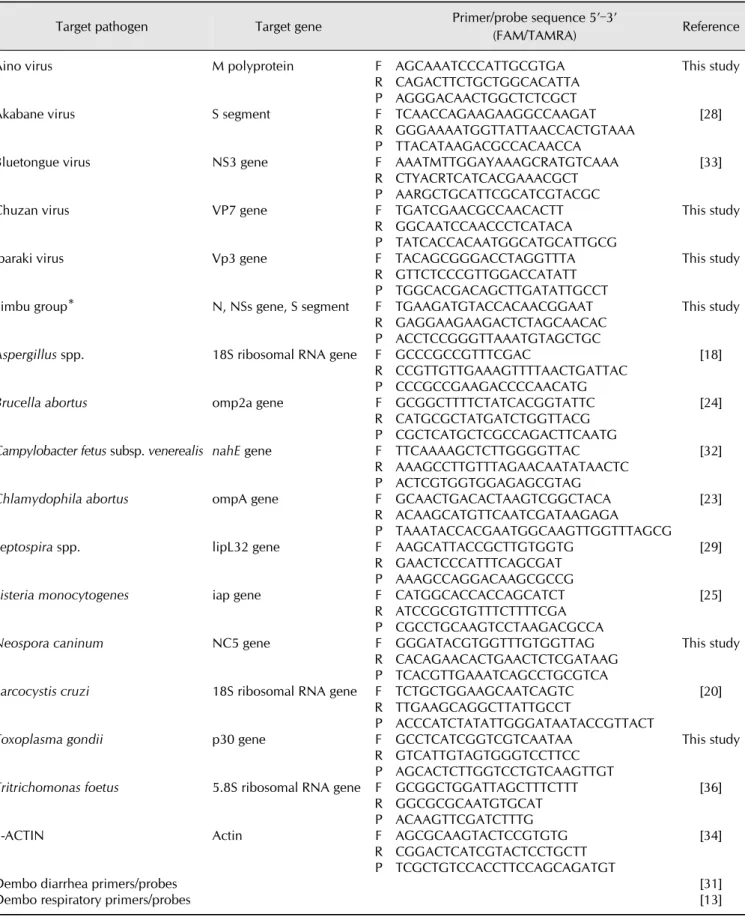
We selected 24 pathogens as bovine abortive agents. To detect 15 of those pathogens, we used previously reported primers and probes [18,20,23-25,28,29,31-33,36]. We used newly designed primers and probes for the remaining 9 pathogens: Schmallenberg virus, Chuzan virus, Sathuperi virus, Shamonda virus, Douglas virus, Ibaraki virus, Aino virus, Toxoplasma gondii, and Neospora caninum. The multiple nucleotide sequences for each of these 9 pathogens were obtained from the National Center for

Biotechnology Information database (Supplementary Table 1), and new sets of primers and probes were designed by using PrimerQuest tool (Integrated DNA Technologies, USA) based upon a consensus sequence acquired by multiple alignments of the obtained sequences obtained via the BioEdit software 7.0.5 (Ibis Therapeutics, USA). Bovine -actin was used as the internal control for the extraction of nucleic acids [13,31,34].

All probes at the 5´ end were indicated by the dye FAM (6-carboxyfluorescein) and by the fluorescent dye TAMRA (6-carboxytetramethylrhodamine) at the 3´ end. All primers and probes were purchased from Sigma-Aldrich (USA) or Integrated DNA Technologies. Table 1 lists the primers and probes used in this study.

Extraction of nucleic acids

Viral nucleic acids were extracted by using High Pure Viral Nucleic Acid Kit (Roche Diagnostics, Germany). The QIAamp Fast DNA Stool Mini Kit (Qiagen, Germany) was used according to the manufacturer’s instructions to obtain bacterial, protozoal, and fungal DNA. The extracted DNA and RNA were stored at −80

o

C until use.

Real-time PCR amplification

All TaqMan real-time PCR assays were performed under the same reaction conditions used for Dembo diarrhea-PCR and Dembo respiratory-PCR [13,31]. A One Step PrimeScript RT-PCR Kit (Perfect Real Time; TaKaRa Bio, Japan) was used to detect viral RNA, and Premix Ex Taq (Perfect Real Time) was used to detect the viral, protozoal, fungal, and bacterial DNAs. The real-time PCR assay was performed with the Applied Biosystems 7300 Real-Time PCR System (ABI 7300;

Applied Biosystems, USA) for screening and with the LightCycler Nano (Roche Diagnostics) for validation of positive samples detected during screening. To analyze the fluorescence data, the automatic quantification algorithm was used in LightCycler Nano Software 1.1 and Applied Biosystems 7300 Real-Time PCR software. The parameters of analysis were as follows:

Exclude early cycle = 7, minimum relative amplifications = 0, and minimum amplification quality = 5.

Validation of the Dembo abortion-PCR

To evaluate the sensitivity of the Dembo abortion-PCR, the

synthetic DNA (including target genome regions) of all target

pathogens was used to determine the limit of detection (LOD),

correlation coefficient (R

2

), and PCR efficiency (E). The synthetic

DNA was fabricated at Integrated DNA Technologies. After

creation of standard curves, LOD, R

2

, and E were calculated as

described previously [13,31]. To validate the specificity of the

Dembo abortion-PCR, 22 cattle blood samples and 14 cattle

aborted fetus spinal cord samples were collected and subjected

to Dembo abortion-PCR. All samples were negative for the

presence of target pathogens; no positive or false positive

(3)

Table 1. Information on all primers and probes used in current study

Target pathogen Target gene Primer/probe sequence 5’–3’

(FAM/TAMRA) Reference

Aino virus M polyprotein F AGCAAATCCCATTGCGTGA This study

R CAGACTTCTGCTGGCACATTA P AGGGACAACTGGCTCTCGCT

Akabane virus S segment F TCAACCAGAAGAAGGCCAAGAT [28]

R GGGAAAATGGTTATTAACCACTGTAAA P TTACATAAGACGCCACAACCA

Bluetongue virus NS3 gene F AAATMTTGGAYAAAGCRATGTCAAA [33]

R CTYACRTCATCACGAAACGCT P AARGCTGCATTCGCATCGTACGC

Chuzan virus VP7 gene F TGATCGAACGCCAACACTT This study

R GGCAATCCAACCCTCATACA P TATCACCACAATGGCATGCATTGCG

Ibaraki virus Vp3 gene F TACAGCGGGACCTAGGTTTA This study

R GTTCTCCCGTTGGACCATATT P TGGCACGACAGCTTGATATTGCCT

Simbu group* N, NSs gene, S segment F TGAAGATGTACCACAACGGAAT This study R GAGGAAGAAGACTCTAGCAACAC

P ACCTCCGGGTTAAATGTAGCTGC

Aspergillus spp. 18S ribosomal RNA gene F GCCCGCCGTTTCGAC [18]

R CCGTTGTTGAAAGTTTTAACTGATTAC P CCCGCCGAAGACCCCAACATG

Brucella abortus omp2a gene F GCGGCTTTTCTATCACGGTATTC [24]

R CATGCGCTATGATCTGGTTACG P CGCTCATGCTCGCCAGACTTCAATG

Campylobacter fetus subsp. venerealis nahE gene F TTCAAAAGCTCTTGGGGTTAC [32]

R AAAGCCTTGTTTAGAACAATATAACTC P ACTCGTGGTGGAGAGCGTAG

Chlamydophila abortus ompA gene F GCAACTGACACTAAGTCGGCTACA [23]

R ACAAGCATGTTCAATCGATAAGAGA

P TAAATACCACGAATGGCAAGTTGGTTTAGCG

Leptospira spp. lipL32 gene F AAGCATTACCGCTTGTGGTG [29]

R GAACTCCCATTTCAGCGAT P AAAGCCAGGACAAGCGCCG

Listeria monocytogenes iap gene F CATGGCACCACCAGCATCT [25]

R ATCCGCGTGTTTCTTTTCGA P CGCCTGCAAGTCCTAAGACGCCA

Neospora caninum NC5 gene F GGGATACGTGGTTTGTGGTTAG This study

R CACAGAACACTGAACTCTCGATAAG P TCACGTTGAAATCAGCCTGCGTCA

Sarcocystis cruzi 18S ribosomal RNA gene F TCTGCTGGAAGCAATCAGTC [20]

R TTGAAGCAGGCTTATTGCCT

P ACCCATCTATATTGGGATAATACCGTTACT

Toxoplasma gondii p30 gene F GCCTCATCGGTCGTCAATAA This study

R GTCATTGTAGTGGGTCCTTCC P AGCACTCTTGGTCCTGTCAAGTTGT

Tritrichomonas foetus 5.8S ribosomal RNA gene F GCGGCTGGATTAGCTTTCTTT [36]

R GGCGCGCAATGTGCAT P ACAAGTTCGATCTTTG

-ACTIN Actin F AGCGCAAGTACTCCGTGTG [34]

R CGGACTCATCGTACTCCTGCTT P TCGCTGTCCACCTTCCAGCAGATGT

Dembo diarrhea primers/probes [31]

Dembo respiratory primers/probes [13]

F, forward primer; R, reverse primer; P, probe. *Simbu group: Douglas virus, Sathuperi virus, Shamonda virus, Schmallenberg virus.

(4)

Table 3. Results of sensitivity tests for bovine abortive pathogens obtained by using the LightCycler Nano (Roche Diagnostics)

Target pathogen LOD (copies/reaction) E R

2

1 2 1 2 1 2

Sarcocystis cruzi 1 1 2.026 1.884 0.9827 0.9981

Toxoplasma gondii 10 10 2.048 2.235 0.9984 0.9814

Tritrichomonas fetus 10 10 1.992 1.838 0.9981 0.9738

Neospora caninum 10 100 1.954 1.972 0.9998 0.9679

Campylobacter fetus 10 100 1.909 2.120 0.9991 0.9634

Chlamydophila abortus 1 10 2.031 1.883 0.9582 0.9999

Listeria monocytogenes 10 10 1.941 1.940 0.9994 0.9997

Leptospira spp. 100 10 1.932 1.935 0.9950 0.9996

Brucella abortus 1 10 1.957 2.017 0.9994 0.9998

Bluetongue virus 1 10 2.076 1.987 1 0.9993

Akabane virus 100 100 1.891 1.858 0.9976 0.9993

Aino virus 10 10 1.975 1.878 0.9989 0.9971

Chuzan virus 10 10 1.938 1.944 0.9986 0.9998

Bovine herpes virus-1 100 10 2.159 1.930 0.6052 0.9948

Bovine viral diarrhea virus 100 100 1.930 2.007 0.9927 0.9897

Simbu group* 10 10 1.842 1.863 0.9981 0.9998

Ibaraki virus 10 10 1.921 1.944 0.9993 0.9980

Aspergillus spp. 1 1 2.130 2.080 0.9170 0.9900

Salmonella Enteritidis 10 10 1.962 2.159 0.9980 0.9550

Salmonella Typhimurium 100 100 2.192 2.173 0.9950 0.9960

Salmonella Dublin 10 10 1.958 1.930 0.9850 0.9910

LOD, limit of detection; E, polymerase chain reaction efficiency; R

2

, coefficient of determination; 1, first reaction; 2, second reaction. *Simbu group:

Douglas virus, Sathuperi virus, Shamonda virus, Schmallenberg virus.

Table 2. Pooling method used for the extracted nucleic acids obtained from vectors samples

Type of sample Samples Pool 1 Pool 2 Pool 3 Pool 4 Pool 5 Pool 6 Pool 7 Pool 8 Pool 9 Pool 10

Fly 64 9 9 9 9 9 9 9 9 9 10

Gadfly 18 9 9

Feces of rodent 14 7 7

Feces of birds 14 7 7

Insects 7 7

Data are presented as number of samples.

results were obtained.

Analysis of field samples

A total of 117 vector and reservoir samples, including 63 flies, 18 gadflies, 7 insects, 14 fecal and intestinal contents from rodents, and 14 fecal samples from birds were collected from inside and outside of 4 dairy cattle farms and 17 beef cattle farms between 2014 to 2016 in Japan (Supplementary Table 2).

Nucleic acids were extracted from each sample. To identify bovine diarrheal pathogens, all 117 samples were screened individually. To detect bovine abortive and respiratory disease

complex pathogens, extracted nucleic acid samples were pooled

as shown in Table 2. After sample pooling, RNAs in each

pooled sample were reverse transcribed into complementary

DNA (cDNA) by using SuperScript III Reverse Transcriptase

(Invitrogen, USA), and then, the cDNA and genomic DNA

were amplified by using GenomiPhi V2 DNA Amplification

Kit (GE Healthcare, UK). The extracted nucleic acids were

evaluated in triplicate by targeting abortive, diarrheal, and

respiratory disease complex pathogens in a single run of

Dembo-PCR [31]. When the Cq values were calculated by

algorithm described above in more than two out of three runs,

(5)

Table 4. Results for the LOD of bovine abortive and respiratory disease complex pathogens obtained by using the Applied Biosystems 7300 Real-Time PCR System (Applied Biosystems)

Target pathogen LOD

(copies/reaction) Bovine viral diarrheal virus 100

Bovine coronavirus 100

Mammalian orthoreovirus 100

Bovine herpes virus-1 100

Salmonella Dublin 100

Salmonella Enteritidis 100

Salmonella Typhimurium 100

Bovine adenovirus 3 100

Bovine parainfluenza virus 3 100 Bovine respiratory syncytial virus 100

Influenza D virus 100

Bovine rhinitis A virus 100

Bovine rhinitis B virus 100

Bovine adenovirus 7 100

Mannheimia haemolytica 100

Pasteurella multocida 250

Histophillus somni 250

Trueperella pyogenes 250

Mycoplasma bovis 250

Ureaplasma diversum 250

Bluetongue virus  100

Akabane virus 100

Chuzan virus 100

Aino virus 100

Ibaraki virus 100

Simbu group* 100

Chlamydophila abortus 100

Neospora caninum 100

Campylobacter fetus subsp. venerealis 100

Toxoplasma gondii 100

Sarcocystis cruzi 100

Brucella abortus 100

Tritrichomonas foetus 100

Listeria monocytogenes 100

Aspergillus spp. 100

Leptospira spp. 100

LOD, limit of detection; PCR, polymerase chain reaction. *Simbu group:

Douglas virus, Sathuperi virus, Shamonda virus, Schmallenberg virus.

the samples were considered positive.

Results

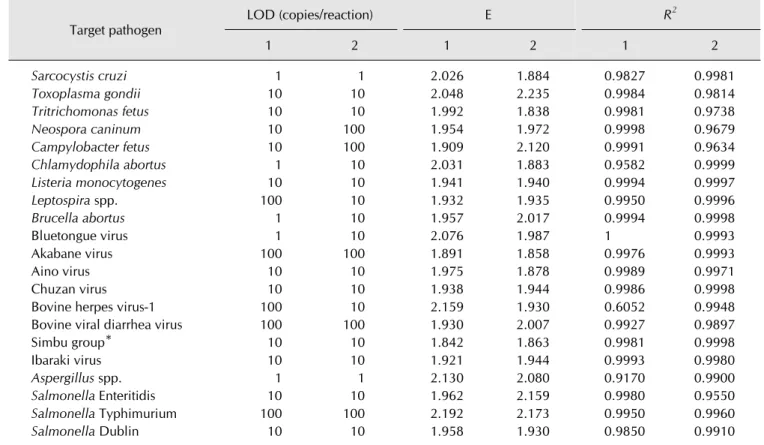
Sensitivity and specificity of the Dembo abortion-PCR Table 3 shows the LOD, R

2

, and E value of the Dembo abortion-PCR results from the LightCycler Nano instrument.

The LOD, according to the DNA copy number of all pathogens, was between 1 and 100 copies per reaction. The coverage of the calibration curves for each assay was within a linear dynamic range of more than five orders of magnitude, and R

2

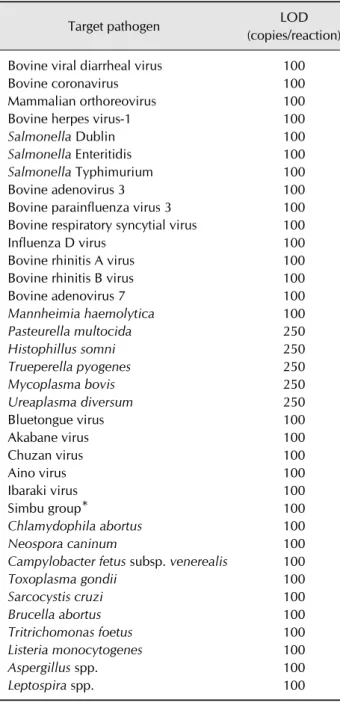
values were at least 0.9582. The E values were in the range of 92.1% to 106%. When using the ABI 7300 instrument, the LODs of the Dembo respiratory- and abortion-PCR assays were evaluated with 100 copies per reaction. When the sensitivity was lower than 100 copies per reaction, lower diluents were used to evaluate the LOD. All sets of primers and probes, except for 5, showed sensitivities of 100 copies per reaction (Table 4).

Analysis of field samples via Dembo-PCR

Field samples were analyzed via two different approaches. To detect diarrheal pathogens, all 117 samples were individually screened via Dembo-PCR using the LightCycler Nano instrument. Fifty-seven of the 117 samples were positive for at least one diarrheal pathogen; 34 of the 63 flies (53.97%), 8 of the 14 fecal and intestinal contents from rodents (57.14%), 8 of the 18 gadflies (44.44%), 5 of the 14 fecal samples from birds (35.71%), and 2 of the 7 insects (28.57%) were positive for at least one pathogen including BVDV, BEV, S. enterica ser.

Dublin, and S. enterica ser. Typhimurium. To detect abortive and respiratory disease complex pathogens, 15 pooled samples were screened via Dembo-PCR using the ABI 7300 instrument.

N. caninum was detected only in an insect pooled sample, which consisted of 7 different insect samples including 2 cockroaches, 2 spiders, and 3 unidentified insects. All other pathogen results were negative in all of the pooled samples. To determine which insects were positive for N. caninum, each of the 7 insect samples was analyzed using the LightCycler Nano instrument, resulting in the cockroach sample testing positive exclusively.

Table 5 summarizes the numbers of positive samples from each vector and reservoir.

Discussion

This is the first study that simultaneously evaluated the presence of a wide range of bovine abortion pathogens in potential vectors and reservoirs by using the Dembo abortion- PCR, a highly sensitive and rapid pathogen detection system.

The Dembo abortion-PCR was performed by using the same reaction conditions as those reported for Dembo diarrhea-PCR and Dembo respiratory-PCR [13,31]. We first used the Dembo abortion-PCR to detect 24 cattle abortive agents including 11

viruses, 8 bacteria, 4 protozoa, and 1 fungus. Subsequently, 44

bovine abortive, diarrheal, and respiratory disease complex

pathogens, including 23 viruses, 12 bacteria, 6 protozoa, 2

mycoplasmas, and 1 fungus, were targeted in a single run by

Dembo-PCR. For the Dembo abortion-PCR, additional primers

and probes were designed to detect the Schmallenberg virus,

Sathuperi virus, Douglas virus, and Shamonda virus [35]. These

(6)

Table 5. Positive results obtained from clinical samples by using Dembo-PCR assay Type of sample BVDV BEV S. Dublin BVDV +

S. Dublin

BVDV + BEV

BVDV + S. Typhimurium

BEV + S. Dublin

BEV + N. caninum*

Fly 5 23 1 0 3 0 2 0

Feces of rodent 3 0 1 1 0 1 0 0

Contents in intestine of rodent 0 1 1 0 0 0 0 0

Feces of bird 3 1 0 0 0 0 1 0

Gadfly 1 1 4 1 1 0 0 0

Unidentified insect 1 0 0 0 0 0 0 0

Cockroach 0 0 0 0 0 0 0 1

PCR, polymerase chain reaction; BVDV, bovine viral diarrhea; BEV, bovine enterovirus; S. Dublin, Salmonella enterica ser. Dublin; S. Typhimurium, Salmonella enterica ser. Typhimurium; N. caninum, Neospora caninum. *N. caninum was confirmed by nested PCR (data not shown).

viruses belong to the Simbu group, which includes important viruses causing abortion in cattle [35].

BVDV was one of the most frequently detected pathogens from the wide spectrum of examined vectors and reservoirs, including flies, gadflies, and rodent and bird fecal matter. It should be noted that in addition to diarrhea, BVDV causes abortion and respiratory diseases [13,17,31]. Out of the 117 vector and reservoir samples, 20 tested positive for BVDV, and 8 flies that were positive for BVDV formed the largest group among the examined vectors and reservoirs. Our results are consistent with those in a previous study that reported flies as a potential source of BVDV transmission in cattle [3]. We also detected BVDV in rodent and avian fecal matter; in contrast, no previous study has reported the presence of BVDV in rodents and birds. The results of these studies (both current and past [13,31]) imply that BVDV is one of the most important infectious agents in cattle-related diseases and that BVDV could be transmitted by flies, rodents, and birds.

BEV was positive in 34 samples, including 28 flies, 2 gadflies, 1 rodent fecal matter sample, 2 avian fecal matter samples, and 1 cockroach. BEV, a common virus in the environment, is very stable under a broad range of environmental conditions such as pH, temperature, and salinity. These physiological properties of BEV facilitate easy transmission of BEV to cattle [15]. Although BEV was detected from diarrheal samples in this study, it also has the potential to cause abortion in cattle [31]. While previous studies have mentioned that BEV could be spread in the environment and contaminate water and food, our present study represents the first detection of BEV in vectors and reservoirs [12].

Both S. enterica ser. Dublin and S. enterica ser. Typhimurium were detected in flies, gadflies, and fecal samples of rodents and birds, suggesting that those animals serve as reservoirs [1,21,22,27]. In cattle, these two serovars of Salmonella cause diarrhea and may also cause abortion and respiratory disease [2,13,31]. In this study, we did not demonstrate whether cattle

inside the farms were infected with these pathogens. Further study is needed to isolate these bacteria from potential vectors and reservoirs because we detected only the bacterial genomes in this study; additionally, there is a need to investigate transmission from these pests to cattle.

N. caninum and BEV were simultaneously detected in one cockroach sample. N. caninum is an obligate intracellular coccidian parasite that is globally distributed and is one of the major pathogens causing abortion in cattle [16,30]. A broad spectrum of wild and domestic animals can be infected by N.

caninum with dogs, coyotes, and gray wolves (Canis lupus) considered to be final hosts of N. caninum. However, mammals and birds, including cattle, sheep, goat, water buffalo, horse, donkey, bison, white-tailed deer, red fox, chicken, pigeon, sparrow, feral swine, capybara, and rabbit can also serve as potential natural intermediate hosts for this pathogen. Although N. caninum has been detected in several mammals and birds, further investigation into the lifecycle and hosts of this pathogen is required [5,16,26,30]. Cockroaches are vectors or potential transmitters of protozoans such as T. gondii, Sarcocystis oocysts, and others [14,27,37]. Our study detected the N.

caninum genome in a cockroach sample for the first time, implying that cockroaches may play a role in its life cycle.

Alternatively, cockroaches may serve as a potential vector of N.

caninum.

Our results have shown that insects and rodents, while acting as potential vectors and reservoirs of cattle pathogens, can carry more than one pathogen at the same time. This is the first demonstration of vectors and reservoirs acting in tandem to transmit more than one infectious agent.

Acknowledgments

This research was supported by the MONITSUKURI grant.

(7)

Conflict of Interest

The authors declare no conflicts of interest.

References

1. Alley MR, Connolly JH, Fenwick SG, Mackereth GF, Leyland MJ, Rogers LE, Haycock M, Nicol C, Reed CE. An epidemic of salmonellosis caused by Salmonella Typhimurium DT160 in wild birds and humans in New Zealand. N Z Vet J 2002, 50, 170-176.

2. Barkallah M, Gharbi Y, Hassena AB, Slima AB, Mallek Z, Gautier M, Greub G, Gdoura R, Fendri I. Survey of infectious etiologies of bovine abortion during mid- to late gestation in dairy herds. PLoS One 2014, 9, e91549.

3. Chamorro MF, Passler T, Givens MD, Edmondson MA, Wolfe DF, Walz PH. Evaluation of transmission of bovine viral diarrhea virus (BVDV) between persistently infected and naive cattle by the horn fly (Haematobia irritans). Vet Res Commun 2011, 35, 123-129.

4. Desquesnes M, Biteau-Coroller F, Bouyer J, Dia ML, Foil L.

Development of a mathematical model for mechanical transmission of trypanosomes and other pathogens of cattle transmitted by tabanids. Int J Parasitol 2009, 39, 333-346.

5. Feng Y, Lu Y, Wang Y, Liu J, Zhang L, Yang Y. Toxoplasma gondii and Neospora caninum in free-range chickens in Henan Province of China. Biomed Res Int 2016, 2016, 8290536.

6. Givens MD. A clinical, evidence-based approach to infectious causes of infertility in beef cattle. Theriogenology 2006, 66, 648-654.

7. Glawischnig W, Lazar J, Wallner A, Kornschober C.

Cattle-derived Salmonella enterica serovar Dublin infections in red foxes (Vulpes vulpes) in Tyrol, Austria. J Wildl Dis 2017, 53, 361-363.

8. Haydon DT, Cleaveland S, Taylor LH, Laurenson MK.

Identifying reservoirs of infection: a conceptual and practical challenge. Emerg Infect Dis 2002, 8, 1468-1473.

9. Heuer C, Healy A, Zerbini C. Economic effects of exposure to bovine viral diarrhea virus on dairy herds in New Zealand.

J Dairy Sci 2007, 90, 5428-5438.

10. Hilton WM. BRD in 2014: where have we been, where are we now, and where do we want to go? Anim Health Res Rev 2014, 15, 120-122.

11. Hovingh E. Abortions in Dairy Cattle I: Common Causes of Abortions. pp. 288-404, Virginia Polytechnic Institute and State University, Blacksburg, 2009.

12. Jiménez-Clavero MA, Escribano-Romero E, Mansilla C, Gómez N, Córdoba L, Roblas N, Ponz F, Ley V, Sáiz JC.

Survey of bovine enterovirus in biological and environmental samples by a highly sensitive real-time reverse transcription- PCR. Appl Environ Microbiol 2005, 71, 3536-3543.

13. Kishimoto M, Tsuchiaka S, Rahpaya SS, Hasebe A, Otsu K, Sugimura S, Kobayashi S, Komatsu N, Nagai M, Omatsu T, Naoi Y, Sano K, Okazaki-Terashima S, Oba M, Katayama Y, Sato R, Asai T, Mizutani T. Development of a one-run real-time PCR detection system for pathogens associated with bovine respiratory disease complex. J Vet Med Sci

2017, 79, 517-523.

14. Kopanic RJ Jr, Sheldon BW, Wright CG. Cockroaches as vectors of Salmonella: laboratory and field trials. J Food Prot 1994, 57, 125-135.

15. Ley V, Higgins J, Fayer R. Bovine enteroviruses as indicators of fecal contamination. Appl Environ Microbiol 2002, 68, 3455-3461.

16. Li J, He P, Yu Y, Du L, Gong P, Zhang G, Zhang X. Detection of Neospora caninum-DNA in feces collected from dogs in Shenyang (China) and ITS1 phylogenetic analysis. Vet Parasitol 2014, 205, 361-364.

17. Lucchese L, Benkirane A, Hakimi I, El Idrissi A, Natale A.

Seroprevalence study of the main causes of abortion in dairy cattle in Morocco. Vet Ital 2016, 52, 13-19.

18. Luong ML, Clancy CJ, Vadnerkar A, Kwak EJ, Silveira FP, Wissel MC, Grantham KJ, Shields RK, Crespo M, Pilewski J, Toyoda Y, Kleiboeker SB, Pakstis D, Reddy SK, Walsh TJ, Nguyen MH. Comparison of an Aspergillus real-time polymerase chain reaction assay with galactomannan testing of bronchoalvelolar lavage fluid for the diagnosis of invasive pulmonary aspergillosis in lung transplant recipients. Clin Infect Dis 2011, 52, 1218-1226.

19. Miles DG. Overview of the North American beef cattle industry and the incidence of bovine respiratory disease (BRD). Anim Health Res Rev 2009, 10, 101-103.

20. Moré G, Schares S, Maksimov A, Conraths FJ, Venturini MC, Schares G. Development of a multiplex real time PCR to differentiate Sarcocystis spp. affecting cattle. Vet Parasitol 2013, 197, 85-94.

21. Olsen AR. Regulatory action criteria for filth and other extraneous materials. III. Review of flies and foodborne enteric disease. Regul Toxicol Pharmacol 1998, 28, 199- 211.

22. Olsen AR, Hammack TS. Isolation of Salmonella spp. from the housefly, Musca domestica L., and the dump fly, Hydrotaea aenescens (Wiedemann) (Diptera: Muscidae), at caged-layer houses. J Food Prot 2000, 63, 958-960.

23. Pantchev A, Sting R, Bauerfeind R, Tyczka J, Sachse K.

New real-time PCR tests for species-specific detection of Chlamydophila psittaci and Chlamydophila abortus from tissue samples. Vet J 2009, 181, 145-150.

24. Probert WS, Schrader KN, Khuong NY, Bystrom SL, Graves MH. Real-time multiplex PCR assay for detection of Brucella spp., B. abortus, and B. melitensis. J Clin Microbiol 2004, 42, 1290-1293.

25. Rodríguez-Lázaro D, Hernández M, Scortti M, Esteve T, Vázquez-Boland JA, Pla M. Quantitative detection of Listeria monocytogenes and Listeria innocua by real-time PCR: assessment of hly, iap, and lin02483 targets and AmpliFluor technology. Appl Environ Microbiol 2004, 70, 1366-1377.

26. Salman D, Oohashi E, Mohamed AE, Abd El-Mottelib Ael-R, Okada T, Igarashi M. Seroprevalences of Toxoplasma gondii and Neospora caninum in pet rabbits in Japan. J Vet Med Sci 2014, 76, 855-862.

27. Sarwar M. Insect vectors involving in mechanical transmission of human pathogens for serious diseases. Int J Bioinform Biomed Eng 2015, 1, 300-306.

28. Shirafuji H, Yazaki R, Shuto Y, Yanase T, Kato T, Ishikura Y,

(8)

Sakaguchi Z, Suzuki M, Yamakawa M. Broad-range detection of arboviruses belonging to Simbu serogroup lineage 1 and specific detection of Akabane, Aino and Peaton viruses by newly developed multiple TaqMan assays. J Virol Methods 2015, 225, 9-15.

29. Stoddard RA, Gee JE, Wilkins PP, McCaustland K, Hoffmaster AR. Detection of pathogenic Leptospira spp.

through TaqMan polymerase chain reaction targeting the LipL32 gene. Diagn Microbiol Infect Dis 2009, 64, 247-255.

30. Truppel JH, Montiani-Ferreira F, Lange RR, Vilani RG, Reifur L, Boerger W, da Costa-Ribeiro MC, Thomaz-Soccol V. Detection of Neospora caninum DNA in capybaras and phylogenetic analysis. Parasitol Int 2010, 59, 376-379.

31. Tsuchiaka S, Masuda T, Sugimura S, Kobayashi S, Komatsu N, Nagai M, Omatsu T, Furuya T, Oba M, Katayama Y, Kanda S, Yokoyama T, Mizutani T. Development of a novel detection system for microbes from bovine diarrhea by real-time PCR. J Vet Med Sci 2016, 78, 383-389.

32. van der Graaf-van Bloois L, van Bergen MA, van der Wal FJ, de Boer AG, Duim B, Schmidt T, Wagenaar JA. Evaluation of molecular assays for identification Campylobacter fetus species and subspecies and development of a C. fetus

specific real-time PCR assay. J Microbiol Methods 2013, 95, 93-97.

33. Wernike K, Hoffmann B, Beer M. Simultaneous detection of five notifiable viral diseases of cattle by single-tube multiplex real-time RT-PCR. J Virol Methods 2015, 217, 28-35.

34. Wong K, Xagoraraki I. Quantitative PCR assays to survey the bovine adenovirus levels in environmental samples. J Appl Microbiol 2010, 109, 605-612.

35. Yanase T, Kato T, Aizawa M, Shuto Y, Shirafuji H, Yamakawa M, Tsuda T. Genetic reassortment between Sathuperi and Shamonda viruses of the genus Orthobunyavirus in nature: implications for their genetic relationship to Schmallenberg virus. Arch Virol 2012, 157, 1611-1616.

36. Yao C. Diagnosis of Tritrichomonas foetus-infected bulls, an ultimate approach to eradicate bovine trichomoniasis in US cattle? J Med Microbiol 2013, 62, 1-9.

37. Zurek L, Schal C. Evaluation of the German cockroach

(Blattella germanica) as a vector for verotoxigenic Escherichia

coli F18 in confined swine production. Vet Microbiol 2004,

101, 263-267.

(9)

J Vet Sci 2018, 19(3), 350-357 JVS

Supplementary Table 1. GenBank accession numbers for the reference sequences used for primer and probe design

Pathogen name GenBank accession No.

Aino virus HE795088, AB542973, AB542972, AB542971, AB542970, AB542969, AB542978, AB542967, AB542966, AB100695

Chuzan virus NC005988, AB014727, AY078469, AY078470

Ibaraki virus AB107801, AB106908, AB106907, AB106903, AB106902, AB106901, AB106900 Simbu group* KC108864, NC018464, NC018462, HE795092

Toxoplasma gondii S63900, DQ872518, GQ253080, GQ253086, DQ872517, AK317969, GQ253075, GQ253073, X14080, AY187278, JX045363, JX045390, JX045394, HM776940, JX045356, XM002368164, S73634, AY217784, AY661791

Neospora caninum KX683874, KX683873, KU253799, KR106184, KR106181, KP715562, KP715561, KP715560, KP715559, KF649845, KF649845, KF649846, KF649847, HM031965

*Simbu group: Douglas virus, Sathuperi virus, Shamonda virus, Schmallenberg virus.

(10)

A Dairy Outside Gadfly 6

Inside Spider 1

Inside Mosquito 3

Inside Fly 14

Outside Feces of Bird 7

Inside Intestine contents of rodent 1

B Dairy Inside Fly 14

Inside Cockroach 1

Outside Gadfly 2

Inside Gadfly 2

Inside Feces of Bird 5

Outside Feces of Bird 2

Inside Intestine contents of rodent 1

C Dairy Inside Fly 2

D Dairy Inside Fly 1

E Meat Inside Fly 2

Inside Spider 1

Inside Unidentified insect 1

Outside Gadfly 2

Outside Feces of rodent 2

Inside Feces of rodent 2

F Meat Inside Fly 2

Outside Gadfly 2

Outside Fly 2

G Meat Inside Fly 1

Outside Fly 1

Inside Feces of rodent 1

No information Feces of rodent 1

H Meat Inside Fly 1

Outside Fly 1

Outside Gadfly 3

I Meat Inside Fly 1

Outside Fly 1

J Meat Inside Fly 2

Outside Fly 1

K Meat Inside Fly 1

Outside Fly 1

L Meat Inside Fly 1

M Meat Inside Fly 2

Inside Feces of rodent 1

Outside Feces of rodent 2

Inside Gadfly 1

N Meat Inside Fly 1

O Meat Inside Fly 1

P Meat Inside Fly 1

Outside Fly 1

Q Meat Inside Fly 2

R Meat Inside Fly 1

Outside Fly 1

No information Feces of rodent 2

S Meat Inside Fly 1

T Meat Inside Fly 1

Outside Fly 1

U Meat Inside Fly 1

Outside Fly 1

Inside Feces of rodent 1

수치

Table 1. Information on all primers and probes used in current study
Table 2. Pooling method used for the extracted nucleic acids obtained from vectors samples
Table 4. Results for the LOD of bovine abortive and respiratory  disease complex pathogens obtained by using the Applied  Biosystems 7300 Real-Time PCR System (Applied Biosystems)
Table 5. Positive results obtained from clinical samples by using Dembo-PCR assay Type of sample BVDV BEV S

참조

관련 문서

Polymerase chain reaction - restriction fragment length polymorphism (PCR-RFLP) assay was used to detect and identify four fish viruses, fish iridovirus, viral hemorrhagic

gypseum, by using the restriction fragment length polymorphism (RFLP) analysis and polymerase chain reaction (PCR) to detect polymorphisms in the metallopro- teinase-1 gene

Key Words : Mycobacterium tuberculosis, In-house polymerase chain reaction (PCR) assay, Acid-fast stain... 산균을 구별하지 못하는

1 noted that “Real-time PCR from selective bronchoscopic aspirates enhances the diagnostic yield much more when added to sputum examina- tion.” In fact, polymerase

Key words : Porcine reproductive and respiratory syndrome virus (PRRSV), Single-tube nested reverse transcription-polymerase chain reaction (snRT-PCR), Uracil DNA

In this study, the HLA-B genotypes were determined in twenty students unrelated koreans using the PCR-SSP (polymerase chain reaction-sequence specific primer) technique.. This

In this study, the HLA-DRB1 genotypes were determined in twenty students using the PCR-SSP (polymerase chain reaction-sequence specific primer) technique. Two specific primer pairs

In this sutdy, the HLA-A genotypes were determined in twenty students unrelated koreans using the PCR-SSP (Polymerase Chain Reaction-Sequence Specific Primer) technique.. This