INTRODUCTION
Epithelial ovarian carcinoma (EOC) accounts for the highest cancer-related mortality among gynecologic malignancies. In
2011, it was estimated that 225,500 women were diagnosed with EOC, and that 140,200 died of the disease worldwide [1]. Despite the fact that complete clinical remission can be achieved in approximately 80% of these patients, owing to cytoreductive surgery followed by systematic front- line chemotherapy, the majority of these clinical complete responders eventually develop recurrent disease [2]. Most women who relapse will be offered further chemotherapy, with the likelihood of benefit and improved survival related in part to the initial response to chemotherapy, and to the dura- tion of the response [3]. Although monotherapy can improve
Survival benefit of taxane plus platinum in recurrent
ovarian cancer with non-clear cell, non-mucinous histology
Hiroaki Kajiyama1, Kiyosumi Shibata1, Mika Mizuno1, Tomokazu Umezu1, Shiro Suzuki1, Ryuichiro Sekiya1, Kaoru Niimi1, Hiroko Mitsui1, Eiko Yamamoto1, Michiyasu Kawai2, Tetsuro Nagasaka3, Fumitaka Kikkawa1
1Department of Obstetrics and Gynecology, Nagoya University Graduate School of Medicine, Nagoya; 2Department of Obstetrics and Gynecology, Toyohashi Municipal Hospital, Toyohashi; 3Department of Medical Laboratory Sciences, Nagoya University Graduate School of Medicine, School of Health Science, Nagoya, Japan
Received May 15, 2013, Revised Sep 5, 2013, Accepted Sep 6, 2013 Correspondence to Hiroaki Kajiyama
Department of Obstetrics and Gynecology, Nagoya University Graduate School of Medicine, Tsuruma-cho 65, Showa-ku, Nagoya 466-8550, Japan.
E-mail: [email protected]
Objective: This study was conducted to examine the effects of front-line chemotherapy on overall survival (OS) and postrecurrence survival (PRS) of patients with recurrent ovarian cancer, when stratifying the histologic type.
Methods: Five hundred and seventy-four patients with recurrent ovarian cancer with sufficient clinical information, including front-line chemotherapy, were analyzed. The pathologic slides were evaluated by central pathologic review. The patients were divided into two groups: group A (n=261), who underwent taxane plus platinum, and group B (n=313), who underwent conventional platinum-based chemotherapy without taxanes.
Results: The median age was 54 years (range, 14 to 89 years). Group A had significantly better median OS (45.0 months vs.
30.3 months, p<0.001) and PRS (23.0 months vs. 13.0 months, p<0.001) compared to group B. The OS and PRS were similar between the groups in patients with clear cell or mucinous histology. In contrast, among patients with non-clear cell, non- mucinous histologies, the OS and PRS of group A were significantly better than those of group B (OS, p<0.001; PRS, p<0.001).
Multivariable analyses revealed that, among patients with non-clear cell, non-mucinous histologies, chemotherapy including taxane and platinum was an independent predictor of favorable survival outcomes. Conversely, in patients with clear cell or mucinous histology, taxane-including platinum-based combination chemotherapy did not improve the OS and PRS compared to a conventional platinum-based regimen which did not include taxanes.
Conclusion: Since the emergence of taxane plus platinum, the prognosis of patients with recurrent ovarian cancer has improved. However, we here demonstrate that this improvement is limited to patients with non-clear cell, non-mucinous histologies.
Keywords: Chemotherapy, Histologic type, Overall survival, Postrecurrence survival, Recurrent ovarian cancer
pISSN 2005-0380·eISSN 2005-0399
progression-free survival even in patients with platinum- resistant disease [4], patients with recurrent ovarian cancer are essentially incurable. Once patients experience recurrence, they will have to endure long-term treatment with toxic side effects, anxiety, fear for their life, and various tumor-related symptoms. Accordingly, the goals of recurrent ovarian cancer treatment are to prolong survival, delay the time to progres- sion, control disease-related symptoms, minimize treatment- related symptoms, and maintain or improve the quality of life (QoL) [5]. Hence, it is crucial to consider postrecurrence survival (PRS) as another indicator related to both the QoL and length of life, even though overall and progression-free survival rates have previously been used in most clinical studies. Indeed, a variety of systematic treatments, including salvage chemo- therapy and/or secondary cytoreductive surgery, have been conducted to improve the overall survival (OS) and PRS [6- 12]. However, to our knowledge, there are only a few reports regarding PRS specifically.
Patients with recurrent ovarian cancer show a wide variety of clinical outcomes that depend on many factors related to chemotherapy, such as the response to the initial treatment, duration of the response, and the number of cycles/regimen [3]. Our group has previously reported that when stratifying by the treatment period, the PRS has been prolonged over the last decade (≥2000) compared with prior to this period (≤1999) [13]. Taxane plus platinum has been widely used worldwide as first-line chemotherapy since the latter half of the 1990s.
Particularly, in a platinum-sensitive setting, taxane-including salvage chemotherapy may contribute to the improvement of OS and PRS in recurrent ovarian cancer. Thus, we questioned whether the first-line chemotherapy influences the prognosis of patients with recurrent ovarian cancer, especially the PRS.
In the present study, we evaluated the survival outcomes of recurrent ovarian cancer according to the first-line chemo- therapy regimen (taxane plus platinum or platinum-based regimen excluding taxane). It is well-known that EOC tumors with a clear cell or mucinous histology are some of the most aggressive and malignant tumors, because of their potential resistance to conventional platinum-based chemotherapy [14-16]. Thus, we also focused on the difference in survival outcomes of patients with recurrent ovarian cancer according to the histologic types (clear cell or mucinous vs. non-clear cell and non-mucinous histologies).
MATERIALS AND METHODS 1. Patients
Between 1986 and 2008, more than 1,500 cases of EOC were
registered and analyzed by the Tokai Ovarian Tumor Study Group, consisting of Nagoya University Hospital and affiliated hospitals. This group has accumulated regional clinical data on malignant ovarian tumors under the central pathologic re- view system as a population-based study. Data were collected from medical records and clinical follow-up visits. Patients were eligible if they fulfilled the following criteria: (1) Primary laparotomy was conducted to facilitate assessment of the abdominal contents; (2) Histologic slides were reviewed under a central pathologic review system by several adequately experienced pathologists who specialize in gynecologic pathology, with no knowledge of the patients’ clinical data;
(3) Recurrence or progression was diagnosed by radiologic and/or physical findings and/or an increasing CA-125 level (>35 U/mL) suggestive of disease; (4) Patients had sufficient clinicopathological data regarding recurrence, including the date of recurrence; and if (5) Patients had sufficient clinical in- formation on first-line chemotherapy. Patients were excluded from this study if follow-up was not possible immediately after surgery. Finally, 574 patients with recurrent ovarian cancer were enrolled in the current study. The study was approved by the ethics committee of Nagoya University. The histologic cell types were assigned according to the criteria of the World Health Organization.
2. Treatment
In principle, standard primary surgical treatment consisted of hysterectomy, bilateral salpingo-oophorectomy, infracolic omentectomy, peritoneal washing, retroperitoneal lymph- adenectomy, or sampling. In patients deemed too old, or in patients with severe complications, retroperitoneal lymph- adenectomy was not performed. If residual tumor remained, maximal cytoreductive surgery was performed. When retro- peritoneal lymphadenectomy was omitted in patients without residual tumor, the absence of enlarged lymph nodes >1 cm in diameter was confirmed by a preoperative computed tomography (CT) scan; if present, palpable nodes were ap- propriately sampled. All patients were treated postoperatively with at least three cycles of platinum-based chemotherapy as a first-line treatment. We divided all patients into two groups: group A (n=261); patients who underwent taxane plus platinum, and group B (n=313); patients who underwent conventional platinum-based chemotherapy without taxanes.
Details of the chemotherapy regimens in each time period have been previously described [17]. Briefly, patients received first-line chemotherapy as follows: CAP (cyclophosphamide, 300 mg/m2; adriamycin, 30 mg/m2; and cisplatin, 70 mg/m2), 1986-1989; CAP or PVB (cisplatin, 70 mg/m2; vinblastine, 6 mg/m2; and bleomycin, 12 mg/m2), 1989-1991; PVB or PP (car-
boplatin, 300 mg/m2 and cisplatin, 70 mg/m2), 1992-2000; TC (paclitaxel, 180 mg/m2 and carboplatin, area under the curve [AUC] 5), 2000-2002; and TC or DC (docetaxel, 70 mg/m2 and carboplatin, AUC 5), 2003 and onwards. The standard treat- ment for the first relapse was mainly based on intravenous salvage chemotherapy.
3. Follow-up and analysis
At the end of treatment, all patients underwent a strict follow-up, consisting of clinical checkups including pelvic ex- aminations, ultrasonographic scans, CA-125 evaluations, and periodic radiologic images. Radiologic recurrence was defined as tumor recurrence based on CT, magnetic resonance imag- ing, positron emission tomography, and/or ultrasound, and clinical recurrence was defined as the development of ascites, elevated CA-125, or a clinically palpable mass according to the Gynecologic Cancer InterGroup criteria in principle [18].
OS was defined as the time between the date of surgery and the last date of follow-up or death from any cause. PRS was defined as the time interval between the date of recurrence and the last date of follow-up or death from any cause. The
survival curves were created using the Kaplan-Meier method, and compared using Log-rank tests. Multivariable analysis was carried out using the Cox proportional hazard model to evalu- ate independent factors affecting survival. A p-value <0.05 was considered significant.
RESULTS
1. Patients’ characteristics
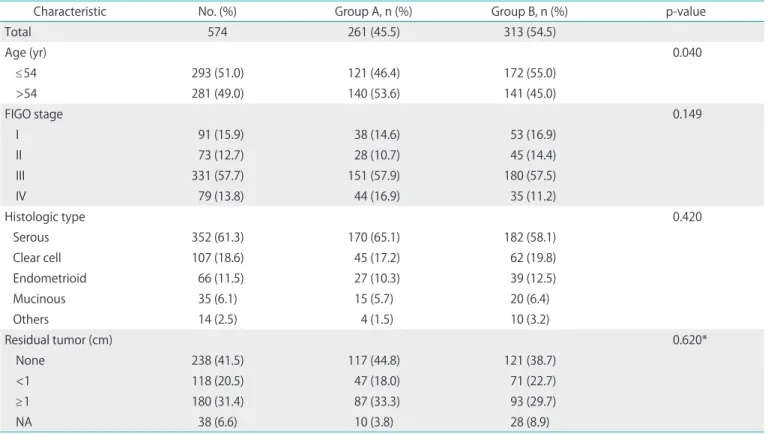
The patients’ characteristics are summarized in Table 1.
The median age was 54 years (range, 14 to 84 years). The median follow-up for all patients was 30.9 months (range 2.1 to 250.2 months). Three hundred and thirteen patients (54.5%) received conventional platinum-based chemotherapy without taxanes, and 261 patients (45.5%) received taxane plus platinum chemotherapy. Patients in group A were older than those in group B (p=0.040). However, distributions of the International Federation of Gynecology and Obstetrics (FIGO) stage, histologic type, and extent of residual tumors, did not significantly differ between the two chemotherapy groups.
Table 1. Patient characteristics
Characteristic No. (%) Group A, n (%) Group B, n (%) p-value
Total 574 261 (45.5) 313 (54.5)
Age (yr) 0.040
≤54 293 (51.0) 121 (46.4) 172 (55.0)
>54 281 (49.0) 140 (53.6) 141 (45.0)
FIGO stage 0.149
I 91 (15.9) 38 (14.6) 53 (16.9)
II 73 (12.7) 28 (10.7) 45 (14.4)
III 331 (57.7) 151 (57.9) 180 (57.5)
IV 79 (13.8) 44 (16.9) 35 (11.2)
Histologic type 0.420
Serous 352 (61.3) 170 (65.1) 182 (58.1)
Clear cell 107 (18.6) 45 (17.2) 62 (19.8)
Endometrioid 66 (11.5) 27 (10.3) 39 (12.5)
Mucinous 35 (6.1) 15 (5.7) 20 (6.4)
Others 14 (2.5) 4 (1.5) 10 (3.2)
Residual tumor (cm) 0.620*
None 238 (41.5) 117 (44.8) 121 (38.7)
<1 118 (20.5) 47 (18.0) 71 (22.7)
≥1 180 (31.4) 87 (33.3) 93 (29.7)
NA 38 (6.6) 10 (3.8) 28 (8.9)
FIGO, International Federation of Gynecology and Obstetrics; NA, data not available.
*Comparison between none or <1 cm (optimal) vs. ≥ 1 cm (suboptimal).
2. The survival of patients with recurrent ovarian cancer As shown in Fig. 1, the 3-, 5-, and 7-year OS rates of all patients with recurrent ovarian cancer were 49.9, 30.4, and 21.7%, respectively. The 5-year OS rates of patients in groups A and B were 37.4 and 25.4%, respectively. The median OS rates for group A and B were 45.0 months and 30.3 months, respectively, and the patients in group B had a significantly poorer prognosis than those in group A (p<0.001) (Fig. 1).
Similarly, the 3- and 5-year PRS rates of all 574 patients were 24.8% and 16.4%, respectively. Fig. 2 shows PRS curves stratified by each group. Median PRS rates for the two groups were as follows: group A, 23.0 months; group B, 13.0 months.
The rate of PRS was significantly lower in group B compared to group A (5-year PRS; 13.2% vs. 18.4%, respectively, p<0.001;
Fig. 2).
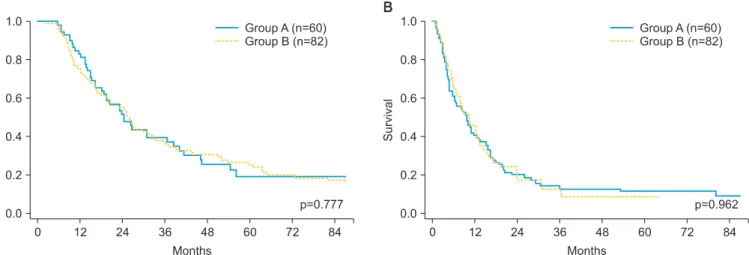
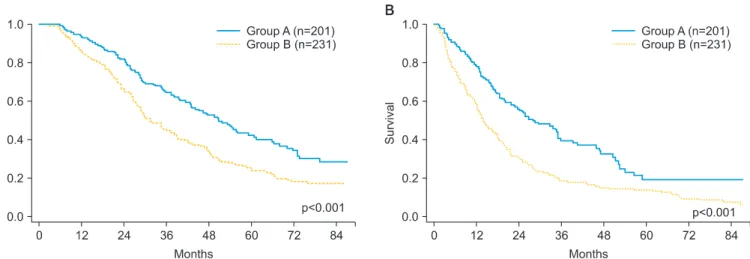
We subsequently examined whether the prognosis of patients with recurrent ovarian cancer could be stratified by the histologic features and type of chemotherapy. In patients with clear cell or mucinous histology, the OS and PRS did not significantly differ, regardless of the type of chemotherapy (OS, p=0.777; PRS, p=0.962) (Fig. 3). In contrast, as shown in Fig. 4, among patients with serous, endometrioid, and other histologies, the OS and PRS of group A were significantly better compared to group B (OS, p<0.001; PRS, p<0.001). We additionally performed univariate analyses in relation to other clinicopathological factors such as age (≤54 vs. >54), FIGO stage (I-II vs. III-IV), and surgery based on the residual tumor (complete [residual tumor=0] or optimal [residual tumor <1
Fig. 1. Kaplan-Meier estimated overall survival of all 574 patients with recurrent ovarian cancer according to the type of first-line chemo- therapy. Group A, taxane plus platinum; Group B, conventional platinum-based.
Fig. 2. Kaplan-Meier estimated postrecurrence survival of all 574 patients with recurrent ovarian cancer according to the type of first-line chemotherapy. Group A, taxane plus platinum; Group B, conventional platinum-based.
Fig. 3. Kaplan-Meier estimated overall survival (A) and postrecurrence survival (B) of the patients with clear cell or mucinous histology according to the type of first-line chemotherapy. Group A, taxane plus platinum; Group B, conventional platinum-based.
cm] vs. suboptimal [residual tumor ≥1 cm] vs. unknown). In patients with clear cell or mucinous histology, there were no significant differences observed in OS and PRS between the age and FIGO stage categories. In contrast, patients who underwent complete or optimal surgery showed significantly poorer OS and PRS than those who received suboptimal surgery (data not shown). Moreover, in patients with non-clear cell and non-mucinous histologies (serous/endometrioid/
others), the OS and PRS did not significantly differ between the two age categories. On the other hand, for both OS and
PRS, a significantly poorer prognosis was noted in patients with complete/optimal surgery or FIGO stage III-IV tumors, compared to those with suboptimal surgery or FIGO stage I-II tumors (data not shown).
3. Multivariable analyses
Lastly, we performed multivariable analyses to examine whether these factors were also independent prognostic factors for the OS and PRS of the patients (Table 2). In patients with each histologic type (clear cell/mucinous and Fig. 4. Kaplan-Meier estimated overall survival (A) and postrecurrence survival (B) of patients with serous, endometrioid, and other histologies according to the type of first-line chemotherapy. Group A, taxane plus platinum; Group B, conventional platinum-based.
Table 2. Multivariable analyses of clinicopathologic parameters in relation to overall and postrecurrence survival Variable
Clear cell/mucinous Serous/endometrioid/others
OS PRS OS PRS
HR (95% CI) p-value HR (95% CI) p-value HR (95% CI) p-value HR (95% CI) p-value Age (yr)
≤54 1 1 1 1
>54 1.245 (0.856-1.811) 0.251 1.272 (0.879-1.842) 0.203 1.163 (0.923-1.465) 0.201 1.031 (0.820-1.297) 0.792 FIGO stage
I and II 1 1 1 1
III and IV 1.232 (0.806-1.884) 0.335 1.015 (0.665-1.550) 0.943 1.659 (1.181-2.330) 0.004 1.623 (1.154-2.281) 0.005 Residual tumor (cm)
<1 1 1 1 1
≥1 1.949 (1.123-3.382) 0.018 1.948 (1.103-3.438) 0.022 1.302 (1.014-1.671) 0.038 1.334 (1.039-1.714) 0.024 Unknown 1.357 (0.486-3.788) 0.560 1.110 (0.398-3.094) 0.842 1.107 (0.723-1.694) 0.641 1.331 (0.876-2.021) 0.180 Chemotherapy
Group A 1 1 1 1
Group B 0.867 (0.578-1.302) 0.492 0.979 (0.659-1.456) 0.918 1.798 (1.412-2.290) <0.001 1.976 (1.553-2.514) <0.001 CI, confidense interval; FIGO, International Federation of Gynecology and Obstetrics; HR, hazard ratio; OS, overall survival; PRS, postrecurrence survival.
serous/endometrioid/others), the four aforementioned clinicopathological factors were individually entered into the Cox proportional hazard analysis. In patients with clear cell or mucinous histology, none of the factors, excluding the type of surgery (complete/optimal vs. suboptimal), significantly influ- enced the OS and PRS. On the other hand, among those with a non-clear cell or non-mucinous histology, the stage, surgery, and type of chemotherapy were all significant independent predictors of a poorer OS and PRS (FIGO, I-II vs. III-IV: hazard ratio [HR] 1.623, 95% confidence interval [CI] 1.154 to 2.281, p=0.005; surgery, complete/optimal vs. suboptimal: HR 1.334, 95% CI 1.039 to 1.714, p=0.024; chemotherapy, group A vs. B:
HR 1.976, 95% CI 1.553 to 2,514, p<0.001).
DISCUSSION
In this study of 574 patients with recurrent ovarian cancer, we observed similar prognostic tendencies using both OS and PRS. Considering the importance of the QoL and length of life in these patients, it might be better to utilize an indicator of PRS more frequently. We showed here that, when stratifying to the front-line chemotherapy, the OS and PRS of patients with recurrent ovarian cancer who received taxane plus platinum were longer than those of patients treated with the conventional platinum-based regimen. This was consistent with the fact that retreatment with a taxane-including regimen resulted in a survival benefit compared to taxane-excluding treatment in some patients with recurrent ovarian cancer.
Based on an ICON4/AGO-OVAR-2.2 randomized trial including 802 patients with platinum-sensitive recurrent ovarian cancer, paclitaxel plus platinum chemotherapy seems to improve the overall and progression-free survival compared with conventional platinum-based chemotherapy [19]. This longer survival may be attributable to the direct power of front- line chemotherapy per se, and its retreatment. However, we believe that the development of systematic treatment played a greater role in the improvement of the outcome, along with chemotherapy itself. Namely, in the treatment of recurrent ovarian cancer, a variety of cytotoxic agents, such as taxanes, liposomal doxorubicin, gemcitabine, and topotecan, are utilized with appropriate surgical management and improved palliative supportive care. Moreover, management using the treatment-free interval has been suggested for the selection of subsequent chemotherapeutic agents after recurrence.
Patients who are considered to have a “platinum-sensitive”
tumor are suitable targets for retreatment with the same platinum-based regimen.
Indeed, according to our recent report examining the long-
term clinical outcomes of patients with recurrent ovarian cancer, on stratifying by the histologic types and treatment periods, the prognosis of patients with recurrent ovarian cancer was significantly improved compared to before 2000 in terms of both OS and PRS [13]. Nevertheless, the biological characteristics, including the sensitivity to a chemotherapeutic agent, are known to differ between histologic subtypes. In practice, we showed that the benefit in OS and PRS in all patients with recurrent ovarian cancer who underwent taxane plus platinum as a front-line chemotherapy was attributable to the improvement of survival in those with a non-clear cell or non-mucinous histology. On the other hand, in those with a clear cell or mucinous histology, the OS and PRS were not improved regardless of the type of chemotherapy. Further- more, the current multivariable analysis revealed that the type of chemotherapy was a significant independent predictor of a poorer PRS for patients with a non-clear cell or non-mucinous histology, but not for patients with a clear cell or mucinous histology, and these results indicate that there was no prognostic progress in patients with these histologies. In fact, based on our previous investigation, the PRS of patients with clear cell or mucinous histology did not significantly differ regardless of the treatment period [13].
In most clinical trials in recurrent ovarian cancer, the majority of patients enrolled had a serous tumor, whereas tumors with a clear cell or mucinous histology were uncommon. Indeed, several studies have previously reported the inconsistent association between the oncologic outcome and prognosis in patients with less common histologies [16,20-23]. Patients with clear cell or mucinous histologies have historically been treated similarly to those with other histologies, due to a lack of promising therapies for these malignancies. Nevertheless, according to recent reports from Takano et al. [24], less than a 10% treatment response was demonstrated in patients with recurrent ovarian clear cell carcinoma involving either a platinum-sensitive or platinum-resistant tumor. Thus, the con- cept of treatment free intervals per se may not be applicable for patients with this histology. On the other hand, according to previous reports, an earlier introduction of palliative care can lead to significant improvements in the QoL [25,26].
Therefore, in these patients, we also consider palliative care as an essential approach to cancer care that, along with symp- tom control, focuses on aspects of life important to patients and their families, in an attempt to protect against, and relieve suffering.
The current study has limitations associated with all retrospective investigations. Although our study includes a comparatively large series, the non-prospective approach contains weaknesses with respect to the treatment hetero-
geneity, selection-bias, and a possibility of type I and II errors.
In particular, the absence of a significant difference between the two chemotherapy groups in patients with a clear cell or mucinous histology may merely reflect a lack of power as a type II error. Moreover, since the current cohort underwent a multi-institutional study over a long period, the salvage chemotherapy was diverse and information on secondary cytoreductive surgery was unfortunately deficient. Complete cytoreductive surgery in patients with recurrent ovarian can- cer may particularly have a survival benefit [27]. In this context, our examination is still preliminary and hypothesis-generating.
In contrast, one of the strengths of this analysis was that all slides were reviewed from a central pathologic perspective, leading to reduced intra-observer variability in determining the histologic type, and chemotherapeutic treatments were generally carried out with the same protocol.
In conclusion, we provide an overview of, and highlight the possible association between the prognosis of patients with recurrent ovarian cancer, and representative histologic groups, stratified by the type of chemotherapy. After the emergence of taxane plus platinum, prognostic progress has been observed in patients with recurrent ovarian cancer.
However, in this study, we show that the improvement was attributable only to patients with non-clear cell or non- mucinous histologies. However, while these results are still preliminary, we have presented a novel view of PRS as well as OS in a recurrent ovarian cancer cohort of 574 patients.
The findings of this investigation substantiate many practical issues, and provide a strong motivation to resolve how to best confront recurrent ovarian cancer, particularly with a less common histology such as clear cell or mucinous carcinomas.
CONFLICT OF INTEREST
No potential conflict of interest relevant to this article was reported.
ACKNOWLEDGMENTS
We sincerely thank Drs. Y. Kinoshita (Ogaki Municipal Hospital), K. Sakakibara (Okazaki Municipal Hospital), A. Takeda (Gifu Prefectural Tajimi Hospital), N. Kamiya (Nagoya Memorial Hospital), O. Yamamuro (Japanese Red Cross Nagoya Second Hospital), T. Nakanishi (Aichi Cancer Center Hospital), K.
Mizuno (Japanese Red Cross Nagoya first Hospital), H. Oguchi (Toyota Memorial Hospital), and K. Matsuzawa (Anjyo Kosei Hospital) who collaborated in data collection.
REFERENCES
1. Jemal A, Bray F, Center MM, Ferlay J, Ward E, Forman D. Global cancer statistics. CA Cancer J Clin 2011;61:69-90.
2. Eisenkop SM, Friedman RL, Wang HJ. Complete cytoreductive surgery is feasible and maximizes survival in patients with ad- vanced epithelial ovarian cancer: a prospective study. Gynecol Oncol 1998;69:103-8.
3. Friedlander M, Butow P, Stockler M, Gainford C, Martyn J, Oza A, et al. Symptom control in patients with recurrent ovarian cancer:
measuring the benefit of palliative chemotherapy in women with platinum refractory/resistant ovarian cancer. Int J Gynecol Cancer 2009;19 Suppl 2:S44-8.
4. Meier W, du Bois A, Reuss A, Kuhn W, Olbricht S, Gropp M, et al.
Topotecan versus treosulfan, an alkylating agent, in patients with epithelial ovarian cancer and relapse within 12 months following 1st-line platinum/paclitaxel chemotherapy: a prospectively rando- mized phase III trial by the Arbeitsgemeinschaft Gynae kologische Onkologie Ovarian Cancer Study Group (AGO-OVAR). Gynecol Oncol 2009;114:199-205.
5. Hizli D, Boran N, Yılmaz S, Turan T, Altınbaş SK, Celik B, et al. Best predictors of survival outcome after tertiary cytoreduction in patients with recurrent platinum-sensitive epithelial ovarian cancer. Eur J Obstet Gynecol Reprod Biol 2012;163:71-5.
6. Oksefjell H, Sandstad B, Trope C. The role of secondary cytoreduction in the management of the first relapse in epithelial ovarian cancer. Ann Oncol 2009;20:286-93.
7. Zang RY, Zhang ZY, Li ZT, Chen J, Tang MQ, Liu Q, et al. Effect of cytoreductive surgery on survival of patients with recurrent epithelial ovarian cancer. J Surg Oncol 2000;75:24-30.
8. Zang RY, Li ZT, Tang J, Cheng X, Cai SM, Zhang ZY, et al. Secondary cytoreductive surgery for patients with relapsed epithelial ovarian carcinoma: who benefits? Cancer 2004;100:1152-61.
9. Benedetti Panici P, De Vivo A, Bellati F, Manci N, Perniola G, Basile S, et al. Secondary cytoreductive surgery in patients with platinum-sensitive recurrent ovarian cancer. Ann Surg Oncol 2007;14:1136-42.
10. Salani R, Santillan A, Zahurak ML, Giuntoli RL 2nd, Gardner GJ, Armstrong DK, et al. Secondary cytoreductive surgery for localized, recurrent epithelial ovarian cancer: analysis of prognostic factors and survival outcome. Cancer 2007;109:685-91.
11. Dizon DS, Hensley ML, Poynor EA, Sabbatini P, Aghajanian C, Hummer A, et al. Retrospective analysis of carboplatin and paclitaxel as initial second-line therapy for recurrent epithelial ovarian carcinoma: application toward a dynamic disease state model of ovarian cancer. J Clin Oncol 2002;20:1238-47.
12. Christian J, Thomas H. Ovarian cancer chemotherapy. Cancer Treat Rev 2001;27:99-109.
13. Kajiyama H, Shibata K, Mizuno M, Umezu T, Suzuki S, Yamamoto E, et al. Long-term clinical outcome of patients with recurrent epithelial ovarian carcinoma: is it the same for each histological type? Int J Gynecol Cancer 2012;22:394-9.
14. Goff BA, Sainz de la Cuesta R, Muntz HG, Fleischhacker D, Ek
M, Rice LW, et al. Clear cell carcinoma of the ovary: a distinct histologic type with poor prognosis and resistance to platinum- based chemotherapy in stage III disease. Gynecol Oncol 1996;60:412-7.
15. Pectasides D, Fountzilas G, Aravantinos G, Kalofonos C, Efstathiou H, Farmakis D, et al. Advanced stage clear-cell epithelial ovarian cancer: the Hellenic Cooperative Oncology Group experience.
Gynecol Oncol 2006;102:285-91.
16. Hess V, A'Hern R, Nasiri N, King DM, Blake PR, Barton DP, et al.
Mucinous epithelial ovarian cancer: a separate entity requiring specific treatment. J Clin Oncol 2004;22:1040-4.
17. Suzuki S, Kajiyama H, Shibata K, Ino K, Nawa A, Sakakibara K, et al. Is there any association between retroperitoneal lymphadenectomy and survival benefit in ovarian clear cell carcinoma patients? Ann Oncol 2008;19:1284-7.
18. Rustin GJ, Vergote I, Eisenhauer E, Pujade-Lauraine E, Quinn M, Thigpen T, et al. Definitions for response and progression in ovarian cancer clinical trials incorporating RECIST 1.1 and CA 125 agreed by the Gynecological Cancer Intergroup (GCIG). Int J Gynecol Cancer 2011;21:419-23.
19. Parmar MK, Ledermann JA, Colombo N, du Bois A, Delaloye JF, Kristensen GB, et al. Paclitaxel plus platinum-based chemotherapy versus conventional platinum-based chemotherapy in women with relapsed ovarian cancer: the ICON4/AGO-OVAR-2.2 trial.
Lancet 2003;361:2099-106.
20. Kommoss F, Kommoss S, Schmidt D, Trunk MJ, Pfisterer J, du Bois A, et al. Survival benefit for patients with advanced-stage transitional cell carcinomas vs. other subtypes of ovarian carcinoma after
chemotherapy with platinum and paclitaxel. Gynecol Oncol 2005;
97:195-9.
21. Omura GA, Brady MF, Homesley HD, Yordan E, Major FJ, Buchsbaum HJ, et al. Long-term follow-up and prognostic factor analysis in advanced ovarian carcinoma: the Gynecologic Oncology Group experience. J Clin Oncol 1991;9:1138-50.
22. Winter WE 3rd, Maxwell GL, Tian C, Carlson JW, Ozols RF, Rose PG, et al. Prognostic factors for stage III epithelial ovarian cancer: a Gynecologic Oncology Group Study. J Clin Oncol 2007;25:3621- 7.
23. Chaitin BA, Gershenson DM, Evans HL. Mucinous tumors of the ovary: a clinicopathologic study of 70 cases. Cancer 1985;55:
1958-62.
24. Takano M, Sugiyama T, Yaegashi N, Sakuma M, Suzuki M, Saga Y, et al. Low response rate of second-line chemotherapy for recurrent or refractory clear cell carcinoma of the ovary: a retro- spective Japan Clear Cell Carcinoma Study. Int J Gynecol Cancer 2008;18:937-42.
25. Levy MH, Back A, Benedetti C, Billings JA, Block S, Boston B, et al.
NCCN clinical practice guidelines in oncology: palliative care. J Natl Compr Canc Netw 2009;7:436-73.
26. McCartney CF, Larson DB. Quality of life in patients with gynecologic cancer. Cancer 1987;60(8 Suppl):2129-36.
27. Zang RY, Harter P, Chi DS, Sehouli J, Jiang R, Trope CG, et al.
Pre dictors of survival in patients with recurrent ovarian cancer under going secondary cytoreductive surgery based on the pooled analysis of an international collaborative cohort. Br J Cancer 2011;105:890-6.