Current Status of Intensive Care Units Registered as Critical Care Subspecialty Training Hospitals in Korea
There is a lack of information on critical care in Korea. The aim of this study was to determine the current status of Korean intensive care units (ICUs), focusing on the organization, characteristics of admitted patients, and nurse and physician staffing.
Critical care specialists in charge of all 105 critical care specialty training hospitals nationwide completed a questionnaire survey. Among the ICUs, 56.4% were located in or near the capital city. Only 38 ICUs (17.3%) had intensive care specialists with a 5-day work week. The average daytime nurse-to-patient ratio was 1:2.7. Elderly people ≥ 65 yr of age comprised 53% of the adult patients. The most common reasons for admission to adult ICUs were respiratory insufficiency and postoperative management. Nurse and physician staffing was insufficient for the appropriate critical care in many ICUs. Staffing was worse in areas outside the capital city. Much effort, including enhanced
reimbursement of critical care costs, must be made to improve the quality of critical care at the national level.
Keywords: Critical Care; Intensive Care Units; Organizations; Outcome Assessment;
Personnel Staffing; Korea Sang-Hyun Kwak,1 Cheol-Won Jeong,2
Seong-Heon Lee,1 Hyun-Jeong Lee,1 and Younsuck Koh3*
1Department of Anesthesiology and Pain Medicine, Chonnam National University Medical School,
2Department of Anesthesiology, Chonnam National University School of Dentistry, Gwangju;
3Department of Pulmonary and Critical Care Medicine, Asan Medical Center, University of Ulsan College of Medicine, Seoul, Korea
Received: 1 August 2013 Accepted: 10 December 2013 Address for Correspondence:
Younsuck Koh, MD
Department of Pulmonary and Critical Care Medicine, Asan Medical Center, University of Ulsan College of Medicine, 88 Olympic-ro 43-gil, Songpa-gu, Seoul 138-736, Korea Tel: +82.2-3010-3134, Fax: +82.2-3010-4709 E-mail: [email protected]
This study was performed under auspices of the Korean Society of Critical Care Medicine.
http://dx.doi.org/10.3346/jkms.2014.29.3.431 • J Korean Med Sci 2014; 29: 431-437
INTRODUCTION
In 1962, two university hospitals in Korea set up intensive care units (ICUs) as postoperative respiratory care units. Since then, the number of ICUs has continued to increase. When the Kore- an Society of Critical Care Medicine (KSCCM) was organized in 1980, 18 university hospitals and nine general hospitals had ICUs.
Compared with other medical fields, the quality of critical care has lagged behind that of advanced countries. Moreover, the level of critical care quality differs significantly between univer- sity hospital ICUs (1).
To analyze the problems in critical care, the first step is to know the current status of critical care at the national level. Lit- tle information is available on critical care delivery in Korea.
The purpose of this study was to clarify current problems relat- ed to ICU organization, critical care-giver staffing, and the char- acteristics of patients admitted to an ICU.
MATERIALS AND METHODS Questionnaire survey
In the autumn of 2009, a questionnaire prepared as an official document of the KSCCM was distributed to the critical care phy- sicians in all 105 critical care subspecialty training hospitals.
The collected data were specific to the individual ICU rather than the hospital, and included ICU type, number of ICU and hospital beds, any association with a medical school, and nurse and physician staffing levels. We categorized ICUs as medical, surgical, pediatric, neurologic, emergency, coronary care units (CCUs), or mixed (not classified on the basis of patient charac- teristics). A dedicated physician was defined as a medical doc- tor who worked in an ICU more than 8 hr a day as a trainee or specialist. Patient information included age, length of stay, ICU admission source, ICU admission diagnosis, receipt of mechan- ical ventilation, vasoactive or inotropic drugs, blood transfu- sion(s), invasive monitoring, and cardiopulmonary resuscita- tion (CPR). Some survey data (including number of nursing staffs on duty per day, and demographic and clinical character- istics of patients per day) were recorded for 5 days and averaged to obtain a representative value for a single day. If necessary, lo- cal site visits were performed to clarify the information in the questionnaires.
Statistical analyses
Results are expressed as mean and standard deviation, or as percentages of respondents. Data were analyzed with SAS ver- sion 6.12 statistical software (SAS Institute, Cary, NC, USA). Two- tailed Student’s t-tests, analyses of variance (ANOVA), Chi-square
test, linear by linear association Chi-square test, and logistic re- gression analysis were used to test the significance of differenc- es in responses, where appropriate. Differences were consid- ered statistically significant at a P value < 0.05.
Ethics statement
The study protocol was approved by the institutional review board of Chonnam National University Hospital (CNUH-2013- 165). Informed consent was waived.
RESULTS Response rates
The questionnaires were administered to the 105 hospitals with a critical care training program, and were endorsed by the KSC- CM. A total of 220 responses were received from the ICUs in 86 hospitals (81.9%) and critical care data were obtained from 3,197 patients.
Characteristics of the ICUs
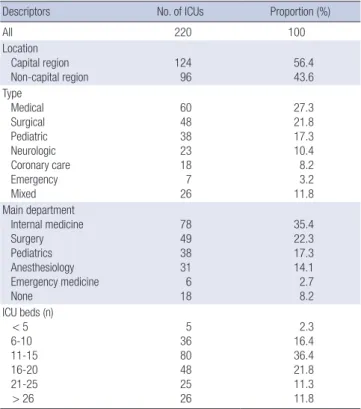
To be designated as a critical care subspecialty training hospi- tal, several requirements of the KSCCM should be met. One of the most important is having an appropriate educational envi- ronment. As a result, 82.3% of all ICUs are in teaching hospitals, either university or university affiliated hospitals. Among the 220 ICUs (41 in public and 179 in private hospitals), 56.4% were located in (35%) or near (21.4%) the capital city, Seoul. Sixty- two of the ICUs (28.2%) were in hospitals with more than 1000
patient beds; 178 (88.2%) were specialized (Table 1). All but two of the neurologic ICUs admitted neurosurgical patients. Most of the ICUs were open units and most of the specialized ICUs were managed by the relevant hospital department (e.g., a medical ICU was part of a department of internal medicine). Of all the ICUs, 35.5% were affiliated with a Department of Internal Med- icine, which was also the case for most CCUs, medical, and mixed ICUs. The next largest group was surgery (22.3%) followed by pediatrics (16.8%). All pediatric ICUs were affiliated with a pe- diatrics department. Anesthesiology was relatively infrequent as a separate department (14.1% of the total ICUs), but was evenly distributed among the various hospitals. Board certified internal medicine specialists were in charge of all the ICUs in most of the smaller hospitals: 61.1% of hospitals with ≤ 500 beds, 51.0% of hospitals with 501-1,000 beds, and 34.7% of hospitals with > 1,000 beds (P = 0.03, by linear-by-linear association Chi- square).
The number of ICU beds varied with the type of unit and the hospital size (median 15 beds, range 11-15; Table 1). The num- ber of units also varied, increasing along with hospital size (Ta- ble 2) from 1.4 (≤ 500 beds) through 2.2 (501-1,000 beds) to 6.2 (> 1,000 beds) per hospital. A single mixed or general ICU was more common in smaller hospitals and multiple, specialized ICUs were more common in larger hospitals (P < 0.001).
Physician and nurse staffing of the ICUs
Most ICUs had a director who played a major role in the admi- nistrative duties and was partly involved in management of the ICU patients. Overall, 70.9% of the ICUs were staffed by dedi- cated physicians who worked in the unit more than 8 hr a day (Table 3). The dedicated physician included medical specialists, critical care subspecialists, interns (in only 12 ICUs), and resi- dents. Only 38 ICUs (17.3%) had specialists on duty 5 days each week, and that decreased to 17 ICUs (7.7%) when the data from pediatric ICUs were excluded. Fulltime adult critical care sub- specialists were only available in 17 units in nine hospitals (Fig.
1) and 12 of the 17 units (70%) were located in Seoul. The day- Table 1. Descriptive characteristics of 220 ICUs in 86 Korean hospitals
Descriptors No. of ICUs Proportion (%)
All 220 100
Location Capital region Non-capital region
124 96
56.4 43.6 Type
Medical Surgical Pediatric Neurologic Coronary care Emergency Mixed
60 48 38 23 18 7 26
27.3 21.8 17.3 10.4 8.2 3.2 11.8 Main department
Internal medicine Surgery Pediatrics Anesthesiology Emergency medicine None
78 49 38 31 6 18
35.4 22.3 17.3 14.1 2.7 8.2 ICU beds (n)
< 5 6-10 11-15 16-20 21-25
> 26
5 36 80 48 25 26
2.3 16.4 36.4 21.8 11.3 11.8
Table 2. ICU characteristics depending on the hospital size
Level of units
Hospital size
≤ 500 beds (n = 15)
501-1,000 beds (n = 61)
> 1,000 beds
(n = 10) Total No. of units (units/hospital) 21 (1.4) 137 (2.2) 62 (6.2) 220 (100%) No. of units by teaching status
Teaching
Nonteaching 13
8 106
31 62
0 181 (82.3%) 39 (17.7%) No. of units by ICU
Specialized
General 11 (52.4)
10 (47.6) 122 (89.1)
15 (10.9) 61 (98.4)
1 (1.6) 194 (88.2%) 26 (11.8%)
*P < 0.001. ICU, intensive care unit; n, number of hospitals. There was a significant association between ICU specialization and the hospital size. P values were calculat- ed with the linear-by-linear Chi-square test.
specialization (%)*
time nurse-to-patient ratio averaged 1:2.7, and was greater in small and medium sized hospitals than in large ones (P < 0.001).
In 19 ICUs, one nurse cared for four or more patients.
Available technology in the ICUs
A picture archiving communication system was available in 98.6% of the ICUs and electronic medical records were avail- able in 49.1% (Table 4). Local arterial blood gas analysis moni- toring was available in 61.4% of the ICUs and a local patient in- formation database was available in 71.4% of the ICUs. The num- ber of ventilators and monitors per bed were 0.66 and 1.10, re- spectively.
Characteristics of ICU patients
Table 5 shows the demographic and clinical characteristics of 3,197 patients in the ICUs. The mean age of the adult patients was 60 yr. The age distribution of ICU patients differed with hos- pital size; the percentage of elderly patients over 65 yr of age was higher in smaller than in larger hospitals (Fig. 2). The most common ICU admission was from the emergency room. The most common reasons for ICU admission were respiratory in- sufficiency (20.2%) and postoperative management (12.8%) among adults, and prematurity (56.4%) followed by respiratory insufficiency (13.6%) among children (Table 6). Central venous catheterization was the most common intervention (43.4%) (Table 7). Pulmonary artery catheterization was only done in
1.2% of the units, most often in surgical and CCUs. All interven- tions were performed more frequently in larger hospitals.
The mean percentage of patients receiving CPR before or af- ter ICU admission was 4.8%, and a mean of 6.0% of patients had
“do not attempt resuscitation” orders (Table 8). These percent- ages were significantly higher in medical ICUs than in other types of ICU, and also in smaller hospitals compared to larger ones.
DISCUSSION
In 2009, there were a total of 975 ICUs and 10,446 ICU beds in Table 3. Physician and nurse staffing of ICUs
Staff
Hospital size
≤ 500 beds (n = 21)
501-1,000 beds (n = 137)
> 1,000 beds (n = 62)
Total (n = 220) No. of units having an
assigned doctor (%) Director
Dedicated physician Specialist
19 (90.5) 9 (42.9) 0 (0)
126 (92.0) 95 (69.3) 15 (10.9)
61 (98.4) 52 (83.9) 23 (37.1)
206 (93.6) 156 (70.9) 38 (17.3) Mean no. of patients per
daytime RN 2.9* 2.8* 2.3 2.7
n, number of units. *P < 0.001 compared with hospitals with more than 1,000 beds.
One-way ANOVA, Tukey HSD post-hocanalysis.
Table 4. Technologies available in the ICU
Technologies/Facilities
Public vs private hospital Public units
(n = 41) Private units
(n = 179) All units (n = 220) No. of units with technology (%)
EMR PACS Local ABGA Database
15 (36.6%) 40 (97.6%) 23 (56.1%) 34 (82.9%)
93 (52.0%) 177 (98.9%) 112 (62.6%) 123 (68.7%)
108 (49.1%) 217 (98.6%) 135 (61.4%) 157 (71.4%) Mean no. of equipments per bed (SD)
Ventilator
Monitor 0.71 (0.27)
1.02 (0.15) 0.65 (0.27)
1.11 (0.28) 0.66 (0.27) 1.10 (0.26) There was no difference between public and private hospitals.
Table 5. Demographic and clinical characteristics of 3,197 ICU patients in 86 Korean hospitals
Descriptors No. of patients Proportion (%)
All 3,197 100
Age (yr)
≤ 20 21-64 65-84
> 85
606 1,188 1,285 118
19.0 37.1 40.2 3.7 Admitting source
Emergency department
Operating room/postoperative recovery Hospital floor within hospital Another hospital Other ICU within hospital Direct admission
1,317 620 710 166 173 211
41.2 19.4 22.2 5.2 5.4 6.6 Primary admitting diagnosis
Respiratory insufficiency Postoperative management Brain hemorrhage Prematurity Neurologic dysfunction Ischemic heart disorder Others
614 365 310 301 147 146 1,314
19.2 11.4 9.7 9.4 4.6 4.6 41.1 Interventions
Mechanical ventilation Arterial blood pressure monitoring Vasoactive/inotropic drugs Central venous catheter Pulmonary artery catheter Transfusion
1,192 762 787 1,387 37 412
37.3 23.8 24.6 43.4 1.2 12.9 Resuscitation
CPR before/after admission
DNAR order 152
191 4.8
6.0 Fig. 1. Percentage of ICUs having an assigned doctor. CCU, coronary care unit.
CCU Medical Surgical
Neurologic Pedia tric
Emergenc y
Mixed 100
80 60 40 20 0
(%) SpecialistDedicated physician
Fig. 2. Percentage of elderly patients depending on the hospital size. There was a significant association between the percentage of elderly patients and the hospital size (P < 0.001). Data from pediatric ICU were excluded. P values were calculated by the linear-by-linear chi-square test.
≥ 65 yr
< 65 yr
≤ 500 beds 501-1,000 beds > 1,000 beds 100
75
50
25
0 (%)
Table 6. Primary admitting diagnosis
Adults Children
Respiratory insufficiency 20.2% Prematurity 56.4%
Postoperative management 12.8% Respiratory insufficiency 13.6%
Brain hemorrhage 11.5% Congenital abnormality 8.9%
Ischemic heart disorder 5.4% Others 21.1%
Neurologic dysfunction 5.2%
Renal insufficiency 5.1%
Others 39.8%
Table 7. ICU interventions depending on the hospital size
Interventions
Hospital size Total
(n = 3,197) ≤ 500 beds
(n = 243) 501-1,000 beds
(n = 2,019) > 1,000 beds
(n = 935) P value
Central venous catheter 1,387 (43.4) 105 (43.2) 837 (41.5) 445 (47.6) 0.012
Mechanical ventilation 1,191 (37.3) 74 (30.5) 721 (35.7) 396 (42.4) < 0.001
Vasoactive/inotropic drugs 788 (24.6) 54 (22.2) 480 (23.8) 254 (27.2) 0.033
Arterial blood pressure monitoring 762 (23.8) 24 (9.9) 383 (19.0) 355 (38.0) < 0.001
Transfusion 412 (12.9) 24 (9.9) 240 (11.9) 148 (15.8) 0.001
Pulmonary artery catheter 36 (1.1) 1 (0.4) 14 (0.7) 21 (2.2) < 0.001
There was a significant association between ICU interventions and the hospital size. P values were calculated by the linear-by-linear Chi-square test.
Table 8. Resuscitation history and do not attempt resuscitation status depending on ICU type and hospital size
Resuscitation All (n = 3,197)
No. (%) of patients and ICU type No. (%) of patients and hospital size Medical ICU
(n = 923) Other ICU
(n = 2,274) P value ≤ 500 beds
(n = 243) 501-1,000 beds
(n = 2,019) > 1,000 beds
(n = 935) P value
CPR 152 (4.8) 71 (7.7) 81 (3.6) < 0.001 17 (7.0) 105 (5.2) 30 (3.2) 0.004
DNAR 191 (6.0) 94 (10.2) 97 (4.3) < 0.001 21 (8.6) 141 (7.0) 29 (3.1) < 0.001
Korea, according to data from the National Health Insurance Corporation. The estimated 17 adult ICU beds per 100,000 pop- ulationis comparable to other advanced countries (2). Besides medical infrastructure, we are confident that our medical sci- ence and technology has grown to a level nearly the equal as that in advanced countries. However, we cannot say that the management and the outcomes in critical care units have reach- ed the same levels as in advanced countries. In a multicenter retrospective analysis of 1090 ICU patients from 18 hospitals with 500-2,200 beds, the overall mortality rate was 24% (3). Con- sidering that those were relatively large hospitals, it is apparent that our mortality rate is worse than that of advanced countries (2). It is clear that there are substantial differences among coun- tries in clinical performance, medical resources, and national spending on health-care. Nevertheless, our findings and their implications raise some serious issues, which may account for
this poor outcome.
First, the mean daytime nurse-to-patient ratio was 1:2.7 in this survey, and varied from 1:2.9 in small hospitals to 1:3.2 in mixed ICUs. One nurse provided care for more than four pa- tients in 19 of the surveyed units. This situation could become worse at night due to decreased personnel on night shifts, as of- ten occurs in the open ward setting. Moreover, because there are very few respiratory therapists in Korea, overall bedside du- ties of ICU nurses are increased, with a corresponding loss of quality of patient care. The increasing need for critical care beds, combined with decreasing budgets and nurse shortages, might lead to inadequate staffing and compromised patient safety in hospitals worldwide. Many studies have demonstrated a rela- tionship between decreased nurse staffing levels and increased adverse patient outcomes in the ICU, including mortality, in- fection, and pressure ulcers (4-8). To overcome these problems, minimum standards of nurse staffing levels adopted by of criti- cal care nurses associations (9, 10) have resulted in nurse-to- patient ratios of 1:1 or 1:2 in many advanced countries (11, 12).
Second, physician staffing is a serious problem for Korean critical care. In this survey, 70.9% of ICUs had dedicated physi- cians who worked more than 8 hr a day. That result does not seem bad, but most of the physicians were not intensivists or
specialists. Only 7.7% of adult ICUs were staffed by physician specialists for 5 days each week. The outcome of severe sepsis and compliance with the Surviving Sepsis Campaign in Korea was poor in ICUs without fulltime intensivists (1). In several studies that evaluated the association between ICU physician staffing and patient outcomes, higher staffing of intensivists was associated with lower hospital mortality and morbidity (13- 17). Furthermore, a new paradigm for 24-hr intensivist cover- age in the ICU has emerged recently because of its impact on patient outcomes (18, 19). Staffing with intensivists may also decrease resource use because specialists may be better at re- ducing inappropriate ICU admissions, preventing complica- tions that prolong length of stay, and recognizing opportunities for prompt discharge. Intensivists take primary responsibility in managing the critically ill patients in the ICUs of many advanced countries (20, 21).
Third, the deficiencies in nurse and physician staffing are re- lated to an unreasonable health insurance reimbursement sys- tem and an inappropriate medical law in Korea. Currently, the reimbursement rates are estimated to support only 30%-50% of the original critical care cost. For this reason, most Korean ICUs operate at a deficit, and hospitals tend to avoid further invest- ment in the human resources of their ICUs. Furthermore, Kore- an medical legislation mandates that neonatal ICUs, but not necessarily adult ICUs, must have dedicated specialists. Our findings show that advanced computer technologies are fre- quently adopted, with picture archiving communication sys- tem available in 98.6% of the surveyed ICUs. However, only 38 ICUs (17.3%) have specialists on duty for 5 days each week.
Korea is categorized as an aging society and is rapidly becom- ing an aged society. When data from pediatric ICUs were ex- cluded, 53% of the adult patients in this study were elderly peo- ple (≥ 65 yr of age). As the population continues to age, the bur- den of acute and chronic illness and the demand for critical care services will rise (22). This study shows that critically ill pa- tients may not be treated by the best equipped health-care pro- fessionals, even in large hospitals and teaching institutions. The situation in smaller, non-academic hospitals would be expect- ed to be worse. The quality and patient outcome in critical care will worsen over time if current critical care practices remain unchanged. In 2008, as the only organization representing all professional components of critical care in Korea, the KSCCM introduced a subspecialty system for critical care medicine after 6 yr of discussion with other medical societies including those concerned with anesthesiology, emergency medicine, internal medicine, neurology, neurosurgery, pediatrics, surgery, and thoracic surgery. We anticipate that this system will increase the supply of qualified intensivists and will improve quality, ef- ficiency, and outcomes of critical care in Korea. To implement this system, policy makers need to understand the current prob- lems and improve critical care policy, including critical care cost
and medical law.
We recognize that our study has several limitations. Our sam- ple size was small, which limited the precision of the results. In addition, the survey was targeted to critical care subspecialty training hospitals instead of using a stratified random sampling method. Thus, the results may not provide a full description of critical care delivery in Korea. However, the results do increase our understanding of the current situation and problems in Ko- rean ICUs. Second, more than half of ICUs in this study were lo- cated in the capital region, which occupies only 12% of the area of the country but houses about 50% of the Korea’s population and medical institutions. Consequently, we did not need to ad- just for these factors when analyzing the results. A third limita- tion is that we did not include mortality and complications data from each unit in the estimate of the ICUs quality of care. This study could be viewed as the first step in building a Korean crit- ical care database, with more detailed morbidity and mortality data to be collected in the future.
In conclusion, we have described the organization and staff- ing of ICUs in Korean university and teaching hospitals, and characteristics of admitted patients. The data collected in this survey indicate that staffing of nurses and physiciansis poor compared with that in advanced countries. We believe that the roles of health-care professionals are important, and much ef- fort including enhanced reimbursement of critical care costs must be made to improve the quality of critical care at the na- tional level.
ACKNOWLEDGMENTS
We thank staffs of the participating hospitals, which included The Catholic University (Univ.) of Korea Daejeon St. Mary’s Hos- pital; The Catholic Univ. of Korea Seoul St. Mary’s Hospital; The Catholic Univ. of Korea Bucheon St. Mary’s Hospital; The Cath- olic Univ. of Korea St. Paul’s Hospital; The Catholic Univ. of Ko- rea St. Vincent’s Hospital; The Catholic Univ. of Korea Uijeong- bu St. Mary’s Hospital; Gangnam Severance Hospital; Kangbuk Samsung Hospital; Kangwon National Univ. Hospital; Konkuk Univ. Hospital; Konkuk Univ. Chungju Hospital; Konyang Univ.
Hospital; Kyungpook National Univ. Hospital; Gyeongsang Na- tional Univ. Hospital; Kyunghee Univ. Medical Center; Keimy- ung Univ. Dongsan Medical Center; Korea Univ. Guro Hospital;
Korea Univ. Ansan Hospital; Korea Univ. Anam Hospital; Kosin Univ. Gospel Hospital; Kwandong Univ. Myongji Hospital; Kwang- ju Christian Hospital; National Police Hospital; National Cancer Center; National Medical Center; NHIS Ilsan Hospital; Dankook Univ. Hospital; Daegu Catholic Univ. Medical Center; Daegu Fatima Hospital; Daedong Hospital; Sun Medical Center; Dong- kang Medical Center; Dongguk Univ. Ilsan Hospital; Dongsu- won General Hospital; Samsung Changwon Hospital; Maryk- noll Medical Center; Jungang General Hospital; Pusan National
Univ. Hospital; Busan St. Mary’s Hospital; Seoul National Univ.
Bundang Hospital; Daejin Medical Center; Samsung Medical Center; Seoul National Univ. Hospital; Asan Medical Center;
SMG-SNU Boramae Medical Center; Sunlin Hospital Handong Univ.; St. Carollo Hospital; Soonchunhyang Univ. Hospital Gumi;
Soonchunhyang Univ. Hospital Bucheon; Soonchunhyang Univ.
Hospital Cheonan; Severance Hospital; Ajou Univ. Hospital;
Andong Medical Group; Wonju Severance Christian Hospital;
Yeungnam Univ. Hospital; Presbyterian Medical Center; Wal- lace Memorial Baptist Hospital; Ulsan Univ. Hospital; Wonwang Univ. Sanbon Hospital; Wonwang Univ. Hospital; Korea Insti- tute of Radiological & Medical Sciences; Eulji Medical Center;
EwhaWomans Univ. Medical Center; Inje Univ. Seoul Paik Hos- pital; Inje Univ. Busan Paik Hospital; Inje Univ. Sanggye Paik Hospital: Inje Univ. IlsanPaik Hospital; Inha Univ. Hospital; Chon- nam National Univ. Hospital; Chonbuk National Univ. Hospital;
Jeju National Univ. Hospital; With Cheju Halla General Hospi- tal; Chosun Univ. Hospital; ChungAng Univ. Hospital; Chang- won Fatima Hospital; Cheongju St. Mary’s Hospital; Chungnam National Univ. Hospital; Chungbuk National Univ. Hospital;
Bundangcha Hospital; Hallym Univ. Medical Center; Hanyang Univ. Guri Hospital; Hangyang Univ. Hospital; Kepco Medical Center; Haedong Hospital; Chonnam National Univ. Hwasun Hospital.
DISCLOSURE
No author received financial support and there are no potential conflicts of interest for any authors.
ORCID
Sang-Hyun Kwak http://orcid.org/0000-0001-6077-2086 Cheol-Won Jeong http://orcid.org/0000-0003-0167-2901 Seong-Heon Lee http://orcid.org/0000-0001-5568-6730 Hyun-Jeong Lee http://orcid.org/0000-0001-8373-4381 Younsuck Koh http://orcid.org/0000-0001-5066-2027
REFERENCES
1. Kim JH, Hong SK, Kim KC, Lee MG, Lee KM, Jung SS, Choi HS, Lee JH, Jung KS, Lee SS, et al. Influence of full-time intensivist and the nurse-to- patient ratio on the implementation of severe sepsis bundles in Korean intensive care units. J Crit Care 2012; 27: 414.e11-21.
2. Wunsch H, Angus DC, Harrison DA, Collange O, Fowler R, Hoste EA, de Keizer NF, Kersten A, Linde-Zwirble WT, Sandiumenge A, et al. Vari- ation in critical care services across North America and Western Europe.
Crit Care Med 2008; 36: 2787-93.e1-9.
3. Kang CH, Kim YI, Lee EJ, Park K, Lee JS, Kim Y. The variation in risk adjust- ed mortality of intensive care units. Korean J Anesthesiol 2009; 57: 698-703.
4. Stone PW, Mooney-Kane C, Larson EL, Horan T, Glance LG, Zwanziger J, Dick AW. Nurse working conditions and patient safety outcomes. Med
Care 2007; 45: 571-8.
5. Cho SH, Hwang JH, Kim J. Nurse staffing and patient mortality in inten- sive care units. Nurs Res 2008; 57: 322-30.
6. Sales A, Sharp N, Li YF, Lowy E, Greiner G, Liu CF, Alt-White A, Rick C, Sochalski J, Mitchell PH, et al. The association between nursing factors and patient mortality in the Veterans Health Administration: the view from the nursing unit level. Med Care 2008; 46: 938-45.
7. Blot SI, Serra ML, Koulenti D, Lisboa T, Deja M, Myrianthefs P, Manno E, Diaz E, Topeli A, Martin-Loeches I, et al. Patient to nurse ratio and risk of ventilator-associated pneumonia in critically ill patients. Am J Crit Care 2011; 20: e1-9.
8. Hugonnet S, Uckay I, Pittet D. Staffing level: a determinant of late-onset ventilator-associated pneumonia. Crit Care 2007; 11: R80.
9. Bray K, Wren I, Baldwin A, St Ledger U, Gibson V, Goodman S, Walsh D.
Standards for nurse staffing in critical care units determined by: the Brit- ish Association of Critical Care Nurses, the Critical Care Networks Na- tional Nurse Leads, Royal College of Nursing Critical Care and In-flight Forum. Nurs Crit Care 2010; 15: 109-11.
10. Hartigan RC. The Synergy Model: establishing criteria for 1:1 staffing ra- tios. Crit Care Nurse 2000; 20: 112, 114-6.
11. Sirio CA, Tajimi K, Taenaka N, Ujike Y, Okamoto K, Katsuya H. A cross- cultural comparison of critical care delivery: Japan and the United States.
Chest 2002; 121: 539-48.
12. Mallick R, Strosberg M, Lambrinos J, Groeger JS. The intensive care unit medical director as manager: impact on performance. Med Care 1995;
33: 611-24.
13. Pronovost PJ, Angus DC, Dorman T, Robinson KA, Dremsizov TT, Young TL. Physician staffing patterns and clinical outcomes in critically ill pa- tients: a systematic review. JAMA 2002; 288: 2151-62.
14. Treggiari MM, Martin DP, Yanez ND, Caldwell E, Hudson LD, Ruben- feld GD. Effect of intensive care unit organizational model and structure on outcomes in patients with acute lung injury. Am J Respir Crit Care Med 2007; 176: 685-90.
15. Dimick JB, Pronovost PJ, Heitmiller RF, Lipsett PA. Intensive care unit physician staffing is associated with decreased length of stay, hospital cost, and complications after esophageal resection. Crit Care Med 2001;
29: 753-8.
16. Pronovost PJ, Jenckes MW, Dorman T, Garrett E, Breslow MJ, Rosenfeld BA, Lipsett PA, Bass E. Organizational characteristics of intensive care units related to outcomes of abdominal aortic surgery. JAMA 1999; 281:
1310-7.
17. Suarez JI, Zaidat OO, Suri MF, Feen ES, Lynch G, Hickman J, Georgiadis A, Selman WR. Length of stay and mortality in neurocritically ill patients:
impact of a specialized neurocritical care team. Crit Care Med 2004; 32:
2311-7.
18. Gajic O, Afessa B, Hanson AC, Krpata T, Yilmaz M, Mohamed SF, Raba- tin JT, Evenson LK, Aksamit TR, Peters SG, et al. Effect of 24-hour man- datory versus on-demand critical care specialist presence on quality of care and family and provider satisfaction in the intensive care unit of a teaching hospital. Crit Care Med 2008; 36: 36-44.
19. Haupt MT, Bekes CE, Brilli RJ, Carl LC, Gray AW, Jastremski MS, Naylor DF, PharmD MR, Md AS, Wedel SK, et al. Guidelines on critical care ser- vices and personnel: recommendations based on a system of categoriza- tion of three levels of care. Crit Care Med 2003; 31: 2677-83.
20. Judson JA, Fisher MM. Intensive care in Australia and New Zealand. Crit
Care Clin 2006; 22: 407-23.
21. Offenstadt G, Moreno R, Palomar M, Gullo A. Intensive care medicine in Europe. Crit Care Clin 2006; 22: 425-32.
22. Angus DC, Kelley MA, Schmitz RJ, White A, Popovich J Jr; Committee on Manpower for Pulmonary and Critical Care Societies (COMPACCS).
Caring for the critically ill patient: current and projected workforce re- quirements for care of the critically ill and patients with pulmonary dis- ease: can we meet the requirements of an aging population? JAMA 2000;
284: 2762-70.