A Prospective Multicenter Trial of the Efficacy and Tolerability of Neoadjuvant Sunitinib for Inoperable Metastatic Renal Cell
Carcinoma
This study aimed to evaluate the efficacy, safety, and tolerability of 2-cycled neoadjuvant sunitinib therapy (NST) in patients with inoperable metastatic renal cell carcinoma (mRCC).
Between 2009 and 2012, 14 patients with inoperable mRCC from 5 Korean academic centers were prospectively enrolled after collecting their clinicopathological data and completing health-related questionnaires. The best overall response (BOR), safety profile, and changes in quality of life during NST were assessed using the RECIST criteria (version 1.0), CTCAE criteria (version 4.0), and the Cancer Quality of Life Questionnaire (QLQ-C30).
Among the 14 patients, 9 patients (64.3%) experienced partial response or stable disease state, and 5 patients (35.7%) did not complete treatment, with 1 case of disease
progression (7.1%), 3 grade 3 adverse events (21.4%), and 1 voluntary withdrawal (7.1%).
Four patients (28.6%) were successfully converted to an operable state and underwent surgery after NST. The BOR for the primary renal lesions was 22.2%, with a median 1.3-cm diameter reduction (range: 0-2.8 cm) from a baseline diameter of 10.3 cm (range: 6.6- 15.8 cm). The other 18 measurable metastatic lesions exhibited a BOR of 55.6%. The QLQ-C30 questionnaire results revealed significant improvements in the quality of life domain, although we observed significant increases in the scores for fatigue, nausea and vomiting, and the financial effects of NST (P < 0.05). Two-cycle NST provided limited efficacy for resectability of inoperable mRCC, despite mild improvements in the BOR of the primary lesion and quality of life (Clinical Trial Registry 1041140-1).
Keywords: Targeted Molecular Therapy; Neoadjuvant Therapy; Carcinoma, Renal Cell;
Metastasis; Neoplasm Sung Han Kim,1 Seong Il Seo,2
Hyun Moo Lee,2 Han-Yong Choi,2 Seung Hyun Jeon,3 Hyung-Lae Lee,3 Tae Gyun Kwon,4 Yong-June Kim,5 Wun-Jae Kim,5 and Jinsoo Chung1*
1Department of Urology, Center for Prostate Cancer, Research Institute and Hospital of National Cancer Center, Goyang, Korea; 2Department of Urology, Samsung Medical Center, Sungkyunkwan University, School of Medicine, Seoul, Korea; 3Department of Urology, Kyung Hee University Hospital, Seoul, Korea; 4Department of Urology, Kyungpook National University Hospital, Deagu, Korea; 5Department of Urology, Chungbuk National University Hospital, Cheongju, Korea
Received: 15 April 2016 Accepted: 22 August 2016 Address for Correspondence:
Jinsoo Chung, MD
Department of Urology, Center for Prostate Cancer, Research Institute and Hospital of National Cancer Center, 323, Ilsan-ro, Ilsandong-gu, Goyang 10408, Republic of Korea
E-mail: [email protected]
Funding: This multi-center study was supported by a grant from Pfizer (Korea), the Korean Urological Oncology Society (2010-0112), and the National Cancer Center (NCC 1041140-1).
https://doi.org/10.3346/jkms.2016.31.12.1983 • J Korean Med Sci 2016; 31: 1983-1988
INTRODUCTION
Approximately one-third of patients with newly-diagnosed re- nal cell carcinoma (RCC) have an advanced disease state, and a significant proportion of these patients are inoperable, which results in a dismal prognosis, as surgical removal of the renal tumor is the only proven therapy for complete remission (1).
However, the emergence of new antiangiogenic therapies has improved the prognosis of patients with metastatic RCC (mRCC), and targeted therapies (TT) can now be integrated with surgical treatment to optimize outcomes for patients with inoperable advanced RCC (1). The potential tumor shrinkage may also permit easier surgical resection. Neoadjuvant therapy (NT), which refers to presurgical treatment for unresectable cancer, may be useful for decreasing the tumor’s volume to increase re- sectability. Furthermore, NT may improve outcomes in patients with renal cancer by reducing the risk of postoperative recur- rence, eradicating micrometastatic disease, increasing the like-
lihood of curative therapy, maximizing nephron sparing and renal function, and enhancing the molecular effects of TT to overcome drug resistance (2,3).
The concept of NT was not prominent in the era of cytokine- based systemic therapy for mRCC. Furthermore, these treat- ment regimens are relatively ineffective for managing metasta- ses as long as the primary tumor remains in situ, and the cyto- kine-based therapies did not provide a significant reduction in the primary tumor’s size (4). However, during the current era of TT, NT strategies have regained the attention of oncologists, and several trials of NT for RCC and mRCC have recently been completed or are ongoing (5-7). Some trials have established the safety and response rates of NT with several agents, but there is no consensus in the literature regarding the effective- ness, safety, and clinical utility of NT (8). Therefore, the possible or conceivable indications for neoadjuvant TT now include the treatment of 1) large unresectable advanced tumors to facilitate surgery, 2) imperative indications to enable a nephron-sparing Urology
procedure, and 3) high-level vena cava thrombi involvement to achieve downsizing and facilitate the use of simpler surgical techniques that are associated with lower morbidity rates. How- ever, there are no consensus indications for NT in RCC.
In the present study, we prospectively enrolled 14 patients with mRCC from 5 academic hospitals to evaluate the response of the inoperable primary tumor to 2-cycle neoadjuvant suni- tinib therapy (NST). The objective for this study was to evaluate the treatment’s efficacy, safety, and tolerability (including chang- es in quality of life [QoL]). Sunitinib was chosen as the targeted agent because it is the most extensively investigated TT agent, and is likely the most suitable agent for NT, given its ability to shrink the primary tumor (6,9).
MATERIALS AND METHODS
Between June 2009 and September 2012, 14 patients with inop-
erable clear cell mRCC were enrolled from 5 Korean academic hospitals (National Cancer Center, Seoul Samsung Medical Cen- ter, Kyung Hee University Hospital at Gangdong, Kyungpook National University Hospital, and Chungbuk National Univer- sity Hospital). These patients all received 2-cycle sunitinib (50 mg/day for 4 weeks, followed by a 2-week hiatus) as neoadju- vant TT. The decision to administer NST was made on an indi- vidual basis at the discretion of the treating urologist, and was not prospectively specified at the participating institutions. The patients’ baseline clinical data were prospectively collected (Table 1), and included the Memorial Sloan Kettering Cancer Center (MSKCC) risk stratification (10), pathological data with the 2010 TNM stage (11) after percutaneous biopsy, and ad- verse events based on version 4.0 of the NCI Common Termi- nology Criteria for Adverse Events (CTCAE) (12). Quality of life was evaluated before and after the NST according to the specif- ic domains of the European Organization for the Research and
ECOG = Eastern Cooperative Oncology Group, MSKCC = Memorial Sloane Kettering Cancer Center, BUN = blood urea nitrogen, AST = aspartate aminotransferase, ALT = alanine aminotransferase, TNM = tumor-node-metastasis, RECIST = Response Evaluation Criteria In Solid Tumors.
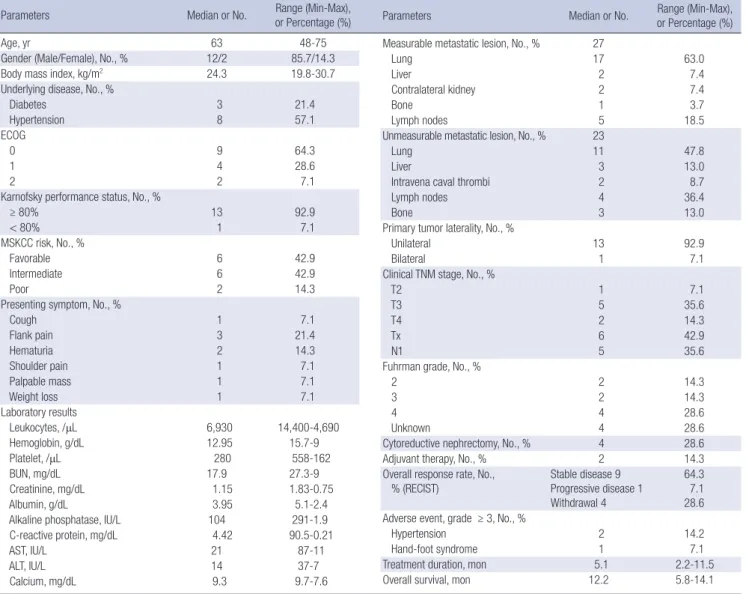
Table 1. Baseline demographics (n = 14)
Parameters Median or No. Range (Min-Max),
or Percentage (%)
Age, yr 63 48-75
Gender (Male/Female), No., % 12/2 85.7/14.3
Body mass index, kg/m2 24.3 19.8-30.7
Underlying disease, No., %
Diabetes 3 21.4
Hypertension 8 57.1
ECOG
0 9 64.3
1 4 28.6
2 2 7.1
Karnofsky performance status, No., %
≥ 80% 13 92.9
< 80% 1 7.1
MSKCC risk, No., %
Favorable 6 42.9
Intermediate 6 42.9
Poor 2 14.3
Presenting symptom, No., %
Cough 1 7.1
Flank pain 3 21.4
Hematuria 2 14.3
Shoulder pain 1 7.1
Palpable mass 1 7.1
Weight loss 1 7.1
Laboratory results
Leukocytes, /μL 6,930 14,400-4,690
Hemoglobin, g/dL 12.95 15.7-9
Platelet, /μL 280 558-162
BUN, mg/dL 17.9 27.3-9
Creatinine, mg/dL 1.15 1.83-0.75
Albumin, g/dL 3.95 5.1-2.4
Alkaline phosphatase, IU/L 104 291-1.9
C-reactive protein, mg/dL 4.42 90.5-0.21
AST, IU/L 21 87-11
ALT, IU/L 14 37-7
Calcium, mg/dL 9.3 9.7-7.6
Parameters Median or No. Range (Min-Max),
or Percentage (%) Measurable metastatic lesion, No., % 27
Lung 17 63.0
Liver 2 7.4
Contralateral kidney 2 7.4
Bone 1 3.7
Lymph nodes 5 18.5
Unmeasurable metastatic lesion, No., % 23
Lung 11 47.8
Liver 3 13.0
Intravena caval thrombi 2 8.7
Lymph nodes 4 36.4
Bone 3 13.0
Primary tumor laterality, No., %
Unilateral 13 92.9
Bilateral 1 7.1
Clinical TNM stage, No., %
T2 1 7.1
T3 5 35.6
T4 2 14.3
Tx 6 42.9
N1 5 35.6
Fuhrman grade, No., %
2 2 14.3
3 2 14.3
4 4 28.6
Unknown 4 28.6
Cytoreductive nephrectomy, No., % 4 28.6
Adjuvant therapy, No., % 2 14.3
Overall response rate, No.,
% (RECIST) Stable disease 9
Progressive disease 1 Withdrawal 4
64.3 7.1 28.6 Adverse event, grade ≥ 3, No., %
Hypertension 2 14.2
Hand-foot syndrome 1 7.1
Treatment duration, mon 5.1 2.2-11.5
Overall survival, mon 12.2 5.8-14.1
Treatment of Cancer (EORTC) Quality of Life Questionnaire (QLQ)-C30 (a 30-item questionnaire that is available at: http://
groups.eortc.be/qol/eortc-qlq-c30) (13).
All subsequent imaging results underwent a central review at each institution to detect any change in the size of the primary tumor. The tumor thrombus level was defined according to No- vick’s classification (14). The objective clinical response of the primary tumor and the overall disease response were assessed according to the Response Evaluation Criteria In Solid Tumors criteria (RECIST version 1.0) by the treating physician and the central review, using findings from computed tomography (CT), magnetic resonance imaging, or 18-fluoro-2-deoxyglucose pos- itron emission tomography/CT. The follow-up protocol was the same for all participating institutions, and included a physical examination, blood analyses, and abdominal imaging using ul- trasonography, CT, and whole-body positron emission tomog- raphy/CT at the end of each cycle.
The median times to disease progression or death were as- sessed from the diagnosis date to the date of disease progres- sion, or to the date of cancer-specific death or last follow-up, re- spectively. A Wilcoxon signed rank test was used to compare the summary scores from before and after NST. All analyses were performed using Stata software (version 9.2; StataCorp, College Station, TX, USA), and a P value of < 0.05 was consid- ered statistically significant.
Ethics statement
This study’s design was approved by each institution’s ethical review board, and by the ethical review board of the Research Institute and Hospital National Cancer Center (IRB No. NCCTS C09414, Clinical trial registry 1041140-1). All patients provided their voluntary written consent to participate in this study, and their records/information were anonymized and de-identified prior to the analysis. All study protocols complied with the ethi- cal guidelines of the Declaration of Helsinki.
RESULTS
The patients’ characteristics and adverse events are described in Table 1. Among the 14 patients, 5 patients (35.7%) did not complete the treatment due to disease progression (n = 1, 7.1%;
death occurred at 2.2 months after enrollment), voluntary with- drawal (n = 1, 7.1%), or grade 3 adverse events (n = 3, 21.4%), which included 2 cases of hypertension and 1 case of hand-foot syndrome (Table 1).
The 9 patients (64.3%) who completed treatment exhibited 2 partial responses (22.2%) and 7 stable overall diseases (77.8%), based on the RECIST criteria. These patients were considered inoperable at enrollment due to the presence of stage II or III intra-vena cava thrombi with either a large tumor burden or in- vasion of the neighboring vital organs. At the end of the study, 7 patients (77.8%) were converted to an operable status, and 4 of these patients (28.6%) ultimately underwent surgery, including 2 patients who underwent successful partial nephrectomy.
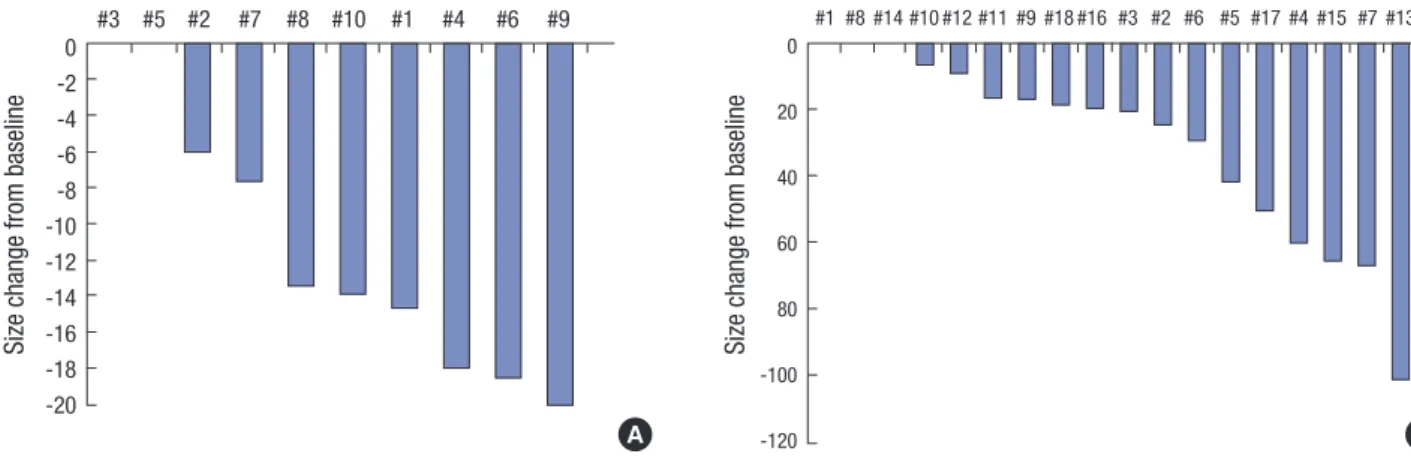
The median baseline primary tumor diameter was 10.3 cm (range: 6.6-15.8 cm), and the median reduction was -13.5%
(range: -20% to 0%). The baseline CT images revealed 18 mea- surable metastatic lesions and 15 unmeasurable lesions. The 18 measurable lesions included 2 unresponsive lesions and exhib- ited a median reduction of -20.2% (range: -101% to 0%), and the 15 unmeasurable lesions decreased or disappeared (Fig. 1, Ta- ble 2).
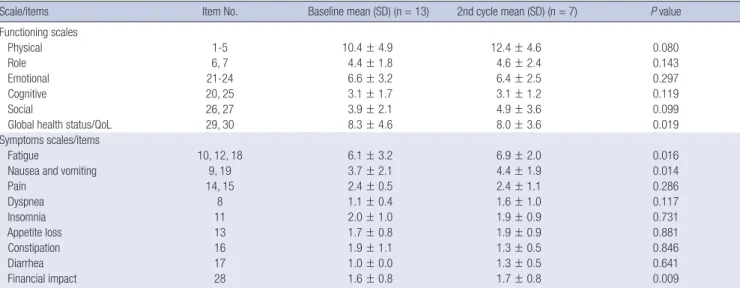
For the QoL assessment, only 7 patients (77.8%) completed the questionnaires after the NST, and their composite QoL scores are presented according to the specific domains in Table 2. The mean baseline global QoL score for the cohort was 8.3 ± 4.6, which significantly decreased to 8.0 after the NST (P = 0.019), although significant increases were observed for fatigue, nau- sea and vomiting, and the financial effect of NST (all, P < 0.05).
Fig. 1. Waterfall plot for size changes (%) in (A) the primary lesion and (B) the metastatic lesions.
Size change from baseline
#3 #5 #2 #7 #8 #10 #1 #4 #6 #9 0
-2 -4 -6 -8 -10 -12 -14 -16 -18 -20
Size change from baseline
#1 #8 #14 #10 #12 #11 #9 #18 #16 #3 #2 #6 #5 #17 #4 #15 #7 #13 0
20 40 60 80 -100
A -120 B
DISCUSSION
Cytoreductive nephrectomy or metastasectomy, as either prima- ry therapy for a limited metastatic burden or as part of a surgical consolidation strategy after a partial response to systemic NT, is associated with an improved prognosis (15). However, the surgi- cal benefits after NT in mRCC have generally been observed during the immunotherapy era. While the use of preoperative TT in the setting of locally advanced or metastatic RCC (mRCC) re- mains in its preliminary stages, with only a few retrospective studies and case reports (2,16-18), there is a growing body of evi- dence that may support its role in a select group of patients (8).
Therefore, the present study is significant because few studies have evaluated neoadjuvant TT in Asian populations (19), and, to the best of our knowledge, this is the first and only study of NT using a targeted agent in Korean patients with mRCC.
Previous reports of successful TT as NT have confirmed its efficacy in RCC and other malignancies, such as colorectal, pan- creatic, and urothelial cancers (6,9,20). Although it is clear that both surgery and NT have a role in the management of mRCC, the optimal integration of these 2 modalities remains unclear (especially when TTs are used as NT). Nevertheless, recent stud- ies of NT have provided evidence that it can provide real-time clinical feedback regarding the patient’s responsiveness (e.g.,
overall tumor burden) to a specific TT before performing surgi- cal procedures that may be associated with a high risk of mor- bidity or mortality. Thus, NT could be useful to downstage the primary tumor, reduce the complexity and risk of surgical re- moval, eliminate micrometastatic disease, and ultimately re- duce the postoperative risk of metastatic progression (9,21).
In the present study, 2-cycle sunitinib therapy was selected to evaluate the tolerability and efficacy of NT (3,16,17). No cases of perioperative morbidity or major intraoperative complica- tions were observed during this study. However, this treatment was unsatisfactory, based on a tolerability of 64.2% (n = 9) dur- ing the NST and a drop-out rate of 28.6% (n = 4) because of dis- ease progression and adverse events. Furthermore, 21.4% of the overall adverse events during the NST were grade 3 hyperten- sion or grade 3 hand-foot syndrome, which resolved after suni- tinib discontinuation and adequate medical treatment.
The RECIST criteria are most suitable grading system for a global assessment of the best overall response in tumor burden, especially for primary renal tumors, which tend to be large and exhibit a relatively small decrease in size after treatment, com- pared to the responses of metastases (3,22,23). In the present study, NST provided an unsatisfactory partial response rate of 22.2%, despite the disease control rate of 64.3% among the 9 patients who completed treatment. For the primary tumor, we observed a median diameter reduction of 1.3 cm (range: 0.1-2.8 cm) and a burden reduction of 13.5%, as well as diameter re- ductions of 0.2-0.8 cm and burden reductions of 20.2% for the metastatic lesions. These results are similar to the findings of previous studies, which revealed a limited overall response rate (7%-30%), a progression rate of 11%-27.3%, and that only 10%- 57.9% of cases exhibited a reduction in the primary tumor’s size (6,23-25). In addition, 7 patients (50.0%) from the present study were considered operable after the NST, although only 4 pati- ents (28.6%) underwent successful nephrectomy. This finding is consistent with the surgical success rates of 10%-57.9% from previous series (6).
We observed median overall survival times of 12.2 months from treatment initiation (range: 5.8-21.3 months) and 6.2 months from treatment completion (range: 0.7-16.2 months) (Table 1 and data not shown). At the end of the study, 5 of the 9 patients (55.6%) who completed the treatment remained alive, although there were no significant differences in the survival outcomes for patients who underwent nephrectomy (n = 4) or who did not undergo nephrectomy (n = 5) (11.7 months [range: 1.7-13.9 months] vs. 5.9 months [range: 0.7-16.2 months], respectively;
P = 0.082). Nevertheless, this trend towards an increased sur- vival after nephrectomy has also been reported by Wood and Margalis (31.1 months vs. 27.7 months, respectively; P = 0.697) (21). Furthermore, 2 of the 4 patients who underwent nephrec- tomy subsequently received adjuvant sunitinib therapy (7.4 months and 5.5. months), which resulted in a median progres- Table 2. Tumor responses after sunitinib therapy (n = 9)
Parameters Before therapy Tumor response
rate after therapy (RECIST criteria) Primary renal tumor lesion, median (range)
Baseline tumor size, mm
Primary tumor (n = 9) 10.3 (6.6-15.8) Secondary tumor (n = 7) 1.8 (0.5-6.5) Tertiary tumor (n = 5) 1.5 (1-2.7) Quaternary tumor (n = 3) 2.2 (0.8-5.5) Tumor size reduction, mm
Primary tumor (n = 9) 1.3 (0-2.8) PR 2, SD 7
Secondary tumor (n = 7) 0.8 (0-1.9) PR 3. SD 4 Tertiary tumor (n = 5) 0.2 (0-0.7) PR 1, SD 4 Quaternary tumor (n = 3) 0.4 (0.4-1.5) PR 2, SD 1 Percentage (%) of tumor reduction -13.5 (-20-0)
Metastatic tumor lesion, No. (%)
Measurable metastatic lesion 18
Lung 11 (61.1) PR 9, SD 2
Lymph node 3 (16.7) PR 0, SD 3
Pararenal tissue 2 (11.1) PR 2
Contralateral kidney 2 (11.1) PR 1 SD 1
Percentage (%) of tumor reduction -20.2 (-101.0-0) Unmeasurable metastatic lesion 15
Lung 6 (40.0) CR 3, PR 1, SD 2,
Lymph node 3 (20.0) CR 1, SD 2
Bone 2 (13.3) CR 1, PR 1
Liver 2 (13.3) PR 1, SD 1
Intravena caval thrombi 2 (13.3) PR 2
PR = partial response, SD = stable disease, CR = complete response, RECIST = Res- ponse Evaluation Criteria In Solid Tumors.
sion-free survival of 12.2 months (range: 5.8-21.3 months) until the end of the study.
The effect on tumor thrombi in 2 patients exhibited a good response, with safe resectability after undergoing NST in this study. These patients successfully underwent inferior vena cava thrombectomy, although the changes in the dimensions of the thrombi were not calculated. Nevertheless, it is intriguing to consider the use of TT to achieve operable tumor status or to promote the regression of regionally advanced tumor thrombi.
A previous study of 25 patients who received NT reported a 44%
reduction in thrombi height above the renal vein after NT, as well as a 48% reduction in the primary thrombus mass (24). How- ever, the median decrease in the thrombus diameter was < 1 cm, and downstaging of the thrombus was only achieved in 3 patients (12%). Furthermore, previous studies have reported progression of a local tumor or tumor thrombus in approximate- ly 20%-25% of patients during NT, which would indicate that NT should only be considered in exceptional cases or in patients who are deemed absolutely inoperable (6).
The current study also evaluated patients’ quality of life using the EORTC QoL-questionnaire, which is used for a variety of malignancies and incorporates several distinct domains regard- ing symptoms (nausea, vomiting, pain, and fatigue) and func- tional status (physical, social, emotional, and cognitive func- tioning) (13). The questionnaire results revealed that the pati- ents’ general health status improved significantly (P = 0.019), although fatigue, nausea and vomiting, and the financial effect of NST were the most significant detrimental factors that affect- ed patients’ QoL during 2-cycle NST (Table 3, all, P < 0.05).
This study contains several limitations that warrant consider- ation. First, we only evaluated a small number of patients, and our results should not be extrapolated to other patients and populations. Second, we observed a limited completion rate
(64.3%), which limits our ability to draw positive conclusions regarding the efficacy of NST, as cytoreductive nephrectomy was infrequently performed despite the conversion to operable status after NST. Third, it is possible that our findings were in- fluenced by subjective policies when the physicians evaluated the tumors’ operability at the participating institutions.
Conclusively in this study, two-cycle NST provided disappoint- ing efficacy and tolerability, with limited clinical benefits, for select patients with inoperable mRCC. However, a small subset of patients experienced conversion to an operable status, with- out disease progression and with few side effects and satisfac- tory safety. It is important to consider perioperative morbidity when selecting patients with mRCC for NST.
DISCLOSURE
The corresponding author (Dr. Jinsoo Chung) has acted as a consultant for Pfizer. The other authors did not receive funding from Pfizer and have no conflicts of interests regarding this man- uscript. In addition, Pfizer had no involvement in the collec- tion, analysis, and interpretation of data for this manuscript, the writing of this manuscript, or the decision to submit it for publi- cation. All the data collection and analysis for this study were performed based on an academic objectivity.
AUTHOR CONTRIBUTION
Manuscript conception and preparation: Seo SI, Lee HM, Choi HY, Jeon SH, Lee HL, Kwon TG, Kim WJ, Chung J. Data collec- tion and analysis: Seo SI, Lee HM, Choi HY, Jeon SH, Lee HL, Kwon TG, Kim YJ, Kim WJ, Chung J. Writing of the manuscript:
Kim YJ. Internal review for draft: Kim SH, Chung J. Manuscript approval: all authors.
Table 3. Changes in quality of life during therapy, as assessed using the Korean version of the EORTC QLQ-C30 questionnaire (n = 13)
Scale/items Item No. Baseline mean (SD) (n = 13) 2nd cycle mean (SD) (n = 7) P value
Functioning scales
Physical 1-5 10.4 ± 4.9 12.4 ± 4.6 0.080
Role 6, 7 4.4 ± 1.8 4.6 ± 2.4 0.143
Emotional 21-24 6.6 ± 3.2 6.4 ± 2.5 0.297
Cognitive 20, 25 3.1 ± 1.7 3.1 ± 1.2 0.119
Social 26, 27 3.9 ± 2.1 4.9 ± 3.6 0.099
Global health status/QoL 29, 30 8.3 ± 4.6 8.0 ± 3.6 0.019
Symptoms scales/items
Fatigue 10, 12, 18 6.1 ± 3.2 6.9 ± 2.0 0.016
Nausea and vomiting 9, 19 3.7 ± 2.1 4.4 ± 1.9 0.014
Pain 14, 15 2.4 ± 0.5 2.4 ± 1.1 0.286
Dyspnea 8 1.1 ± 0.4 1.6 ± 1.0 0.117
Insomnia 11 2.0 ± 1.0 1.9 ± 0.9 0.731
Appetite loss 13 1.7 ± 0.8 1.9 ± 0.9 0.881
Constipation 16 1.9 ± 1.1 1.3 ± 0.5 0.846
Diarrhea 17 1.0 ± 0.0 1.3 ± 0.5 0.641
Financial impact 28 1.6 ± 0.8 1.7 ± 0.8 0.009
Scores range from 1 to 4, with a higher score representing a higher level of functioning and symptoms.
EORTC = European Organization for the Research and Treatment of Cancer, QLQ = quality of life questionnaire.
ORCID
Sung Han Kim http://orcid.org/0000-0002-1689-5203 Seong Il Seo http://orcid.org/0000-0002-9792-7798 Hyun Moo Lee http://orcid.org/0000-0003-3969-4540 Han-Yong Choi http://orcid.org/0000-0002-1980-4899 Seung Hyun Jeon http://orcid.org/ 0000-0003-0915-8106 Hyung-Lae Lee http://orcid.org/0000-0002-4338-7423 Tae Gyun Kwon http://orcid.org/0000-0002-4390-0952 Yong-June Kim http://orcid.org/0000-0002-7021-2450 Wun-Jae Kim http://orcid.org/0000-0002-8060-8926 Jinsoo Chung http://orcid.org/0000-0003-2251-5331
REFERENCES
1. Motzer RJ. New perspectives on the treatment of metastatic renal cell car- cinoma: an introduction and historical overview. Oncologist 2011; 16 Suppl 2: 1-3.
2. Cowey CL, Amin C, Pruthi RS, Wallen EM, Nielsen ME, Grigson G, Wat- kins C, Nance KV, Crane J, Jalkut M, et al. Neoadjuvant clinical trial with sorafenib for patients with stage II or higher renal cell carcinoma. J Clin Oncol 2010; 28: 1502-7.
3. Thomas AA, Rini BI, Lane BR, Garcia J, Dreicer R, Klein EA, Novick AC, Campbell SC. Response of the primary tumor to neoadjuvant sunitinib in patients with advanced renal cell carcinoma. J Urol 2009; 181: 518-23.
4. Flanigan RC, Mickisch G, Sylvester R, Tangen C, Van Poppel H, Crawford ED. Cytoreductive nephrectomy in patients with metastatic renal cancer:
a combined analysis. J Urol 2004; 171: 1071-6.
5. Mizutani Y. Recent advances in molecular targeted therapy for metastatic renal cell carcinoma. Int J Urol 2009; 16: 444-8.
6. Schrader AJ, Steffens S, Schnoeller TJ, Schrader M, Kuczyk MA. Neoadju- vant therapy of renal cell carcinoma: a novel treatment option in the era of targeted therapy? Int J Urol 2012; 19: 903-7.
7. Shuch B, Riggs SB, LaRochelle JC, Kabbinavar FF, Avakian R, Pantuck AJ, Patard JJ, Belldegrun AS. Neoadjuvant targeted therapy and advanced kidney cancer: observations and implications for a new treatment para- digm. BJU Int 2008; 102: 692-6.
8. Borregales LD, Adibi M, Thomas AZ, Wood CG, Karam JA. The role of neo- adjuvant therapy in the management of locally advanced renal cell carci- noma. Ther Adv Urol 2016; 8: 130-41.
9. Ho D, Kim HL. The potential role for neoadjuvant therapy in renal cell carcinoma. Clin Adv Hematol Oncol 2013; 11: 777-82.
10. Motzer RJ, Bacik J, Murphy BA, Russo P, Mazumdar M. Interferon-alfa as a comparative treatment for clinical trials of new therapies against ad- vanced renal cell carcinoma. J Clin Oncol 2002; 20: 289-96.
11. Sobin LH, Gospodarowicz MK, Wittekind C. TNM Classification of Ma- lignant Tumors. 7th ed. New York, NY: Wiley-Blackwell, 2009.
12. National Cancer Institute (US). Common terminology criteria for adverse events v.3.0 and v.4.0 (CTCAE) [Internet]. Available at http://ctep.cancer.
gov/protocolDevelopment/electronic_applications/ctc.htm [accessed on 14 June 2016].
13. Aaronson NK, Ahmedzai S, Bergman B, Bullinger M, Cull A, Duez NJ, Fi- liberti A, Flechtner H, Fleishman SB, de Haes JC, et al. The European Or- ganization for Research and Treatment of Cancer QLQ-C30: a quality-of- life instrument for use in international clinical trials in oncology. J Natl Cancer Inst 1993; 85: 365-76.
14. Novick AC, Streem SB, Pontes JE, Stewart BH. Stewart’s Operative Urolo- gy. 2nd ed. Baltimore, MD: Williams & Wilkins, 1989.
15. Vogl UM, Zehetgruber H, Dominkus M, Hejna M, Zielinski CC, Haitel A, Schmidinger M. Prognostic factors in metastatic renal cell carcinoma:
metastasectomy as independent prognostic variable. Br J Cancer 2006;
95: 691-8.
16. Ueda K, Noguchi M, Suekane S, Moriya F, Nagayoshi R, Ejima K, Momo- zono K, Matsuoka K. Successful treatment of T4 renal cell carcinoma af- ter a neoadjuvant targeted therapy using sunitinib: report of a case. Ku- rume Med J 2011; 58: 95-8.
17. Peters I, Winkler M, Jüttner B, Teebken OE, Herrmann TR, von Klot C, Kramer M, Reichelt A, Abbas M, Kuczyk MA, et al. Neoadjuvant targeted therapy in a primary metastasized renal cell cancer patient leads to down- staging of inferior vena cava thrombus (IVC) enabling a cardiopulmo- nary bypass-free tumor nephrectomy: a case report. World J Urol 2014;
32: 245-8.
18. Cost NG, Krabbe LM, Bagrodia A, Margulis V. The use of preoperative tar- geted molecular therapy to allow nephron sparing for T1b tumors. Curr Opin Urol 2013; 23: 411-7.
19. Yuki H, Kamai T, Kubota K, Abe H, Nishihara D, Mizuno T, Masuda A, Betsunoh H, Yashi M, Fukabori Y, et al. Axitinib for preoperative down- staging of renal cell carcinoma with sarcomatoid differentiation and di- rect invasion of the duodenum and inferior vena cava: a case report. Onco Targets Ther 2014; 7: 289-95.
20. Wood CG. Multimodal approaches in the management of locally advanc- ed and metastatic renal cell carcinoma: combining surgery and systemic therapies to improve patient outcome. Clin Cancer Res 2007; 13: 697s- 702s.
21. Wood CG, Margulis V. Neoadjuvant (presurgical) therapy for renal cell carcinoma: a new treatment paradigm for locally advanced and meta- static disease. Cancer 2009; 115: 2355-60.
22. Thiam R, Fournier LS, Trinquart L, Medioni J, Chatellier G, Balvay D, Es- cudier B, Dromain C, Cuenod CA, Oudard S. Optimizing the size varia- tion threshold for the CT evaluation of response in metastatic renal cell carcinoma treated with sunitinib. Ann Oncol 2010; 21: 936-41.
23. van der Veldt AA, Meijerink MR, van den Eertwegh AJ, Bex A, de Gast G, Haanen JB, Boven E. Sunitinib for treatment of advanced renal cell can- cer: primary tumor response. Clin Cancer Res 2008; 14: 2431-6.
24. Cost NG, Delacroix SE Jr, Sleeper JP, Smith PJ, Youssef RF, Chapin BF, Karam JA, Culp S, Abel EJ, Brugarolas J, et al. The impact of targeted molecular therapies on the level of renal cell carcinoma vena caval tumor throm- bus. Eur Urol 2011; 59: 912-8.
25. Powles T, Blank C, Chowdhury S, Horenblas S, Peters J, Shamash J, Sar- war N, Boleti E, Sahdev A, O’Brien T, et al. The outcome of patients treat- ed with sunitinib prior to planned nephrectomy in metastatic clear cell renal cancer. Eur Urol 2011; 60: 448-54.