Introduction
Gross anatomy is considered as an important field of study in medical college. A majority of the residency programs re- port that gross anatomy is either extremely important or very important to mastery of their discipline and rank it as the most important basic science [1]. The ability to conceptualize and visualize the structure in three-dimensional (3D) space, which is developed in the gross anatomy curriculum, is also
important in the clinical setting when operating or perform- ing invasive medical tests [2]. Traditional learning methods in gross anatomy are lecture-based learning, problem-based learning, and dissection [3, 4]. However, students who have low-spatial ability have difficulties in understanding the struc- tures in 3D space and finding muscles, nerves, and organs during dissection.
As interactive multimedia and tablets are developed, 3D atlas applications are invented as new learning materials for the study of gross anatomy. 3D atlas applications are tablet- based software that enables medical students to touch and rotate virtual bodies and understand the spatial relationships.
Nowadays, there are students who utilize 3D atlas applications as well as two-dimensional (2D) atlas apps, such as Netter’s atlas of human anatomy and Grant’s atlas of anatomy. There is the possibility of utilizing 3D atlas applications as effective learning materials for the study of gross anatomy.
Corresponding author:
Jung-A Shin
Department of Anatomy, Ewha Womans University College of Medicine, 1071 Anyangcheon-ro, Yangcheon-gu, Seoul 07985, Korea
Tel: +82-2-2650-2645, Fax: +82-2-2650-5711, E-mail: [email protected]
*These authors contributed equally to this work.
The impacts of three-dimensional anatomical atlas on learning anatomy
Sohyun Park
1,*, Yumin Kim
1,*, Sohyeon Park
1,*, Jung-A Shin
21College of Medicine, Ewha Womans University, Seoul, 2Department of Anatomy, Ewha Womans University College of Medicine, Seoul, Korea
Abstract: Gross anatomy has traditionally been the foundation of medical education. Medical students have learned the structure of the human body through dissection, lecture, and textbooks. As tablets and three-dimensional (3D) applications are developed, 3D atlas applications are utilized in learning anatomy by medical students. The purpose of this research is to investigate the impacts of 3D atlas applications on students’ understanding of gross anatomy. This research was targeted at medical students taking the Anatomy and Embryology class in 2017 and 2018, at Ewha Womans University. The correlation between use of 3D atlas and student's results on the Anatomy and Embryology test was analyzed. An open-book anatomy quiz was also carried out to analyze the correlation between the type of atlas each student refers to and the results of the quiz. Independent t test between groups did not show statistically significant difference in the results of the Anatomy and Embryology test. However, the group referring to 3D atlas showed significantly higher results on the simple questions of the open-book anatomy quiz (P<0.05). In conclusion, 3D atlas is not very helpful in acquiring deep anatomical knowledge or memorizing the location of anatomical structures, but it can simply aid in the rapid identification of anatomical structures.
Additionally, the 3D atlas will show good synergy with the two-dimensional atlas if used properly in anatomy education, because most students think it is useful to use the 3D atlas.
Key words: 3D atlas, Application, Anatomy, Medical education, Learning
Received September 19, 2018; Revised November 8, 2018; Accepted November 16, 2018
One study showed that 3D anatomy models were effective instructional multimedia material tools in teaching human anatomy [5]. But another study showed that a computer- based anatomy model has several disadvantages compared to traditional teaching [6]. According to the review which iden- tified studies exploring 3D anatomy models and their impact on learning, there was no solid evidence that the use of 3D models is superior to traditional teaching, and more studies are needed to examine the impacts of 3D models on learning using valid and appropriate tools [7]. 3D models which were utilized in previous research were 3D computer-based, web- based, and physical models [7]. Majority of the 3D models were 3D computer-based models, but they were of a quite different modality from the 3D atlas applications and dealt with only specific parts of the body such as the ear [8], larynx [9], or liver [10]. In contrast, 3D atlas applications deal with entire body structures including muscles, nerves, vessels, and organs. As the application manuals are easy to understand and the contents specific, they can be helpful in the learning of gross anatomy. The aim of this research is to investigate the impacts of 3D atlas applications on the students’ understand- ing of gross anatomy and the possibility of incorporating it into the gross anatomy curriculum. 3D atlas applications such as Complete Anatomy (3D4Medial.com), Human Anatomy Atlas (Visible body), and Essential Anatomy (3D4Medical.
com) were utilized by medical students in the research.
Materials and Methods
This research was carried out at Ewha Womans University School of Medicine. The target of this research was first-year medical students taking the Anatomy and Embryology I, II, and III courses in 2017 and 2018. The numbers of students were 77 students and 78 students each in year 2017 and 2018.
All the students gave prior consent before joining the re- search.
Anatomy and Embryology I, II, and III consist of lectures and cadaveric dissection mainly on macroscopic anatomy.
Students taking the courses were encouraged to study inde- pendently using any anatomy atlas of their preference to pre- pare for exam. Six exams including written tests and cadaveric tests were conducted to evaluate each student’s understanding of human anatomy.
Interview questions posed to target students included which kind of anatomy atlas each student prefers during in- dividual study, the reason for preference, how they utilize 3D
atlas, and their thoughts on the effectiveness of 3D atlas. The interview questions are shown in the Appendix 1.
First-year students in 2018 were also asked to participate in an extra open-book quiz on anatomy, on June 11, 2018, when most of the anatomy classes are over. Students were allowed to choose and refer to any atlas they were familiar with (between 2D and 3D atlas) during the quiz. Questions for the quiz were set by professor Jung-A Shin of the Department of Anatomy, Ewha Womans University School of Medicine. The questions consisted of nine simple questions, which could be solved by referring to a single page of an anatomy atlas, and six complex questions, which required reference to several pages of an anatomy atlas to be solved. Sample questions are shown in the Appendix 1.
An analysis of the correlation between use of 3D atlas and student’s results on the Anatomy and Embryology I, II, and III tests was performed. How the type of atlas each student refers to affects the result of the open-book anatomy quiz was also analyzed. Statistical analysis of this research was performed by IBM SPSS Statistics version 25.0 (IBM Corp., Armonk, NY, USA). Statistical significance was defined as <5%.
Results
Of the 155 students who joined the research, 120 students used 3D atlas for individual study (77.42%) and 35 students did not (22.58%). Sixty-seven students used Complete Anat- omy (3d4Medical), 37 used Human Anatomy Atlas (Visible Body), and 19 used Essential Anatomy (3d4Medical). Some used more than one kind of 3D atlas. Reasons for not using 3D atlas were absence of electronic equipment for the 3D atlas (n=10), not finding it necessary (n=5), functional inconve- nience (n=5), high costs (n=3), and others.
Among the 120 students who used 3D atlas, 99 students (82.5%) found 3D atlas to be easier to use than 2D atlas when searching for unfamiliar structures of the human body. Stu- dents who found 3D atlas to be more helpful than 2D atlas when understanding 3D structures of the human body were 108 (90%). Eighty-seven students (72.5%) answered that 3D atlas was convenient to use overall. However, only 51 students (42.5%) agreed that 3D atlas would be able to substitute 2D atlas entirely in next 10 years.
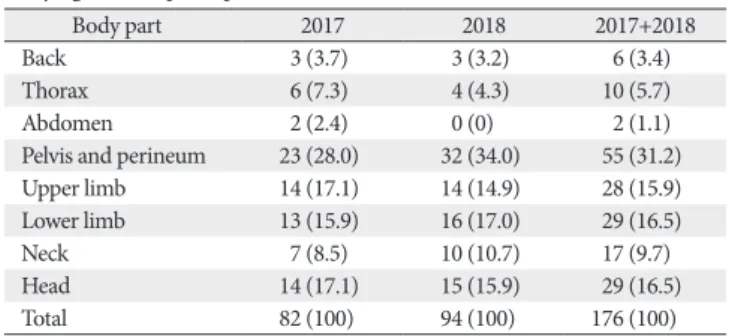
The 120 students who used 3D atlas were asked to choose the body parts they found useful studying about with 3D atlas. Multiple answers were allowed. As Table 1 shows, the most frequent answers were “the pelvis and perineum” (n=55),
followed by “the lower limb” (n=29), “the head” (n=29), and
“the upper limb” (n=28) respectively.
The 120 students who used 3D atlas were also asked to choose the body systems they found useful studying about with 3D atlas. Multiple answers were allowed. The most fre- quent answer was “the muscular system” (n=76), respectively followed by “the circulatory system” (n=44) and “the nervous system” (n=43) as shown in Table 2.
The average difference in the results of the Anatomy and Embryology I, II, and III tests between the group that used 3D atlas and the group that did not was analyzed by indepen-
dent t test. Homogeneity was tested by Levene’s test. Among the 155 students who joined the research, five did not provide their test results for the research. Therefore, 150 cases were analyzed. The group that used 3D atlas showed lower average results (by 5.018 points) than the group that did not. To be specific, the average result of the written tests was lower by 1.509 points and the average result of the cadaveric tests was lower by 3.510 points. However, the difference was not statis- tically significant (Tables 3, 4).
The average difference between the group that referred to 3D atlas and the group that referred to 2D atlas in the open- book human anatomy quiz was analyzed by independent t test. Homogeneity was tested by Levene’s test. Seventy-six stu- dents participated in the quiz; 62 used 3D atlas and 14 used 2D atlas. The group that used 3D atlas showed higher average results (by 0.878) than the group that used 2D atlas. The dif- ference was not statistically significant. However, the average result of the simple questions by the group that used 3D atlas was higher by 0.853 points, which is a statistically significant difference (P<0.05) (Tables 5, 6).
Table 1. Students’ answer on which body parts 3D atlas was most useful while studying in (multiple responses allowed)
Body part 2017 2018 2017+2018
Back 3 (3.7) 3 (3.2) 6 (3.4)
Thorax 6 (7.3) 4 (4.3) 10 (5.7)
Abdomen 2 (2.4) 0 (0) 2 (1.1)
Pelvis and perineum 23 (28.0) 32 (34.0) 55 (31.2)
Upper limb 14 (17.1) 14 (14.9) 28 (15.9)
Lower limb 13 (15.9) 16 (17.0) 29 (16.5)
Neck 7 (8.5) 10 (10.7) 17 (9.7)
Head 14 (17.1) 15 (15.9) 29 (16.5)
Total 82 (100) 94 (100) 176 (100)
Values are presented as number (%). 3D, three-dimensional.
Table 2. Students’ answer on which body systems 3D atlas was most useful while studying in (multiple responses allowed)
Body system 2017 2018 2017+2018
Skeletal 9 (11.3) 4 (3.6) 13 (6.8)
Joint 4 (5.0) 1 (0.9) 5 (2.6)
Muscular 34 (42.5) 42 (35.7) 76 (39.6)
Nervous 15 (18.8) 28 (25.0) 43 (22.4)
Circulatory 11 (13.8) 33 (29.5) 44 (22.9)
Digestive 3 (3.8) 1 (0.9) 4 (2.1)
Respiratory 0 (0) 0 (0) 0 (0)
Urinary 2 (2.5) 2 (1.8) 4 (2.1)
Reproductive 0 (0) 1 (0.9) 1 (0.5)
Endocrine 0 (0) 0 (0) 0 (0)
Integumentary 2 (2.5) 0 (0) 2 (1.0)
Total 80 (100) 112 (100) 192 (100)
Values are presented as number (%). 3D, three-dimensional.
Table 3. Statistics for results in embryology and anatomy tests
Results in test No. Mean±SD SEM
Written test (3D atlas) 116 260.84±28.87 2.68
Written test (2D atlas) 34 262.35±32.52 5.58
Cadaveric test (3D atlas) 116 67.16±11.80 1.10
Cadaveric test (2D atlas) 34 70.67±13.01 2.23
Total (3D atlas) 116 328.0±37.71 3.50
Total (2D atlas) 34 333.02±42.43 7.28
SD, standard deviation; SEM, standard error of mean; 3D, three-dimensional;
2D, two-dimensional.
Table 4. Comparison of 2D and 3D test results using independent t test
Test type Mean difference SEM t P-value
Written test 1.509 5.797 0.260 0.795
Cadaveric test 3.510 2.356 1.490 0.138
Total 5.018 7.569 0.663 0.508
2D, two-dimensional; 3D, three-dimensional; SEM, standard error of mean; t, t-statistics.
Table 5. Statistics for results in open-book human anatomy quiz
Results in quiz No. Mean±SD SEM
Simple questions (3D atlas) 62 7.71±1.43 0.18
Simple questions (2D atlas) 14 6.86±0.95 0.25
Complex questions (3D atlas) 62 3.56±1.41 0.18
Complex questions (2D atlas) 14 3.57±1.34 0.36
Total (3D atlas) 62 11.31±2.42 0.31
Total (2D atlas) 14 10.43±1.95 0.52
SD, standard deviation; SEM, standard error of mean; 3D, three-dimensional;
2D, two-dimensional.
Table 6. Independent t test results comparing results in open-book human anatomy quiz
Question type Mean difference SEM t P-value
Simple questions 0.853 0.402 2.121 0.037
Complex questions –0.007 0.414 –0.017 0.987
Total 0.878 0.694 1.266 0.210
SEM, standard error of mean; t, t-statistics.
Discussion
Traditionally, anatomy is considered as the foundation of medicine [1] but many students find it difficult owing to the complex 3D anatomical structure and low-spatial ability, which have led to many studies in anatomy education [11, 12]. Along with the development of a variety of smart devices, 3D anatomy applications such as Complete Anatomy, Hu- man anatomy atlas, and Essential Anatomy have appeared.
Previous studies that investigated the impacts of 3D anatomi- cal models on learning have mainly used 3D computer and mobile-based models, and there are only few reports on the impacts of 3D atlas on the learning of gross anatomy [7]. The purpose of this study was to investigate whether the use of 3D atlas improves academic achievement and to examine the in- fluences of 3D atlas applications on future anatomy curricula.
In this study, researchers asked the first-year students in year 2017 and 2018 at a single medical school through ques- tionnaires about their use of 3D atlas, frequency of use, reason for use, etc., and compared their grades on the anatomy test, which consisted of both written and practical tests.
The students who responded that they used 3D atlas con- stituted 77.42% of the total number of respondents. Most of the students who used the 3D atlas apps responded that it was helpful in understanding anatomical structures and conve- nient to use. However, only 42.5% of the students who used 3D atlas agreed that it would be able to substitute 2D atlas entirely in next 10 years. This result is consistent with the findings of Tam et al. (2009) [13] who have already reported that there is insufficient evidence to show that computer resources can truly replace traditional methods of teaching anatomy. The results indicate that students have a positive at- titude towards 3D atlas, but it is hard for the 3D atlas apps to completely replace the 2D ones. Based on the above results, rather than using only 3D atlas, the appropriate use of the 3D atlas as an adjunct to the 2D will make it easier for students to approach anatomy.
The result of comparing and analyzing the grades on the anatomy test showed that the average value of the group that used the 3D atlas apps was lower than that of the group that did not in both the written and cadaveric tests. Nevertheless, the difference was not statistically significant. In addition, there was no significant relationship between the frequency of 3D atlas use and grade (data not shown). In the anatomy open book test conducted in the first year in 2018, the average result of the group that used 3D atlas was higher only in the
simple questions, and the result was statistically significant.
Our results did show that on the simple questions of the open book test, the mean score of the 3D atlas user group was significantly higher than that of the 2D atlas user group. From the results above, it can be concluded that 3D atlas can aid in the quick identification of anatomical structures, although it is not as powerful as 2D atlas in acquiring deep anatomi- cal knowledge or memorizing the location of anatomical structures. In other words, it would be difficult for 3D atlas to completely replace 2D atlas in the next 10 years, though 3D atlas is thought to be of additional benefit in finding anatomi- cal structures when there is a fundamental understanding of anatomy. Taking together the results of this article that 82.5%
of the students thought the use of 3D atlas is easier to find un- known structures than 2D atlas, 90% of the students thought 3D atlas is more helpful when understanding the 3D structure of the human body than 2D atlas, and 72.5% of the students reported that 3D atlas was convenient to use overall, research- ers can assume that 3D atlas will have a good synergy with 2D atlas if used properly in anatomy education. Besides, with the study by Murakami et al. (2014) [14] who found that using 3D models yielded strongly positive student perspectives and significant improvements in radiology skills in later clinical courses, it is thought that 3D atlas may be helpful for read- ing various radiological data by quickly matching anatomical structures in the medical field, especially when the use of magnetic resonance imaging and computed tomography is more important.
As highlighted in this study, the majority of students are positive about 3D atlas, and 3D atlas is more useful than 2D atlas for matching simple anatomical structures. In addition, as highlighted in the article by Lewis et al. (2014) [15], 3D at- las has a number of advantages such as portability and acces- sibility. Although these are merits, there are entry barriers to the additional use of 3D atlas in anatomy education. Students who did not use 3D atlas said that the reason for not using it was mainly the absence of a smart device, functional incon- venience, and the high price of software applications. If there is adequate guidance on how to use 3D atlas, the functional inconvenience will be easily resolved. What really matters are that the initial cost of purchasing anatomical applications and smart devices is so expensive that many students can- not afford to buy them. Therefore, in order that 3D atlas can be effectively used for anatomy training, these infrastructure problems must be resolved by affiliating schools with applica- tion or device providers and providing the needed devices to
students.
This study has the following limitations. First, students were not randomly assigned to the 3D atlas user group and the 2D atlas user group. The students who used 3D atlas were relatively more than those who used 2D atlas, and the study did not take into account the students' individual abilities.
Second, it is assumed that students who used 3D atlas would have also used some 2D traditional books, considering the results of Lujan and Dicarlo (2006) [16] who found that first year medical students prefer multiple learning styles. Even if they did not actually use the book, most of the lecture notes are made up of drawings taken from the 2D atlas, so it is hard to say that students who used 3D atlas used it exclusively.
Third, this study was conducted on two grades of a single school, so the number of research subjects is admittedly small, and the observation period is short. Therefore, further research needs to be carried out with a bigger and more ran- domized sample of participants.
Acknowledgements
The work was supported by the Ewha Womans Univer- sity Research Grant of 2018, and the Basic Science Research Program through the National Research Foundation of Korea (NRF-2017R1C1B1011306).
References
1. Cottam WW. Adequacy of medical school gross anatomy educa- tion as perceived by certain postgraduate residency programs and anatomy course directors. Clin Anat 1999;12:55-65.
2. Atlasi MA, Moravveji A, Nikzad H, Mehrabadi V, Naderian H.
Learning styles and strategies preferences of Iranian medical students in gross anatomy courses and their correlations with gender. Anat Cell Biol 2017;50:255-60.
3. Azer SA, Eizenberg N. Do we need dissection in an integrated problem-based learning medical course? Perceptions of first- and second-year students. Surg Radiol Anat 2007;29:173-80.
4. Sugand K, Abrahams P, Khurana A. The anatomy of anatomy: a review for its modernization. Anat Sci Educ 2010;3:83-93.
5. Hoyek N, Collet C, Di Rienzo F, De Almeida M, Guillot A. Ef- fectiveness of three-dimensional digital animation in teaching human anatomy in an authentic classroom context. Anat Sci Educ 2014;7:430-7.
6. Khot Z, Quinlan K, Norman GR, Wainman B. The relative effec- tiveness of computer-based and traditional resources for educa- tion in anatomy. Anat Sci Educ 2013;6:211-5.
7. Azer SA, Azer S. 3D anatomy models and impact on learning: a review of the quality of the literature. Health Prof Educ 2016;2:
80-98.
8. Nicholson DT, Chalk C, Funnell WR, Daniel SJ. Can virtual reality improve anatomy education? A randomised controlled study of a computer-generated three-dimensional anatomical ear model. Med Educ 2006;40:1081-7.
9. Hu A, Wilson T, Ladak H, Haase P, Doyle P, Fung K. Evalua- tion of a three-dimensional educational computer model of the larynx: voicing a new direction. J Otolaryngol Head Neck Surg 2010;39:315-22.
10. Beermann J, Tetzlaff R, Bruckner T, Schöebinger M, Müller- Stich BP, Gutt CN, Meinzer HP, Kadmon M, Fischer L. Three- dimensional visualisation improves understanding of surgical liver anatomy. Med Educ 2010;44:936-40.
11. Hosapatna M, Ankolekar VH, Kotian SR, Souza AD, Souza AS.
Impact of overall teaching program of anatomy in learning: a students perspective. Adv Sci Lett 2017;23:1826-9.
12. Sawant SP, Rizvi S. Teaching anatomy to undergraduate students.
Int J Anat Res 2015;3:1212-5.
13. Tam MD, Hart AR, Williams S, Heylings D, Leinster S. Is learn- ing anatomy facilitated by computer-aided learning? A review of the literature. Med Teach 2009;31:e393-6.
14. Murakami T, Tajika Y, Ueno H, Awata S, Hirasawa S, Sugimoto M, Kominato Y, Tsushima Y, Endo K, Yorifuji H. An integrated teaching method of gross anatomy and computed tomography radiology. Anat Sci Educ 2014;7:438-49.
15. Lewis TL, Burnett B, Tunstall RG, Abrahams PH. Complement- ing anatomy education using three-dimensional anatomy mobile software applications on tablet computers. Clin Anat 2014;27:
313-20.
16. Lujan HL, DiCarlo SE. First-year medical students prefer mul- tiple learning styles. Adv Physiol Educ 2006;30:13-6.
Appendix 1. Interview questions and sample questions.
1. Questions from interview on target students
1. Did you use 3D anatomy atlas program or application for macroscopic anatomy study?
(1) Yes (2) No
1-1. If you answered no, what is the reason for not using it?
1-2. If you answered yes, which program did you mostly use for study?
(1) Complete Anatomy (2) Human Anatomy Atlas (Visible Body) (3) Essential Anatomy (4) Others
2. Did you find 3D atlas to be easier to use than 2D atlas when searching for unfamiliar structure of human body?
(1) Strongly agree (2) Somewhat agree (3) Neither agree nor disagree (4) Somewhat disagree (5) Strongly disagree
3. Did you find 3D atlas more helpful than 2D atlas when understanding 3D structure of human body?
(1) Strongly agree (2) Somewhat agree (3) Neither agree nor disagree (4) Somewhat disagree (5) Strongly disagree
4. Did you find 3D atlas convenient to use overall?
(1) Strongly agree (2) Somewhat agree (3) Neither agree nor disagree (4) Somewhat disagree (5) Strongly disagree
5. Do you expect 3D atlas to be able to substitute 2D atlas entirely in next 10 years?
(1) Strongly agree (2) Somewhat agree (3) Neither agree nor disagree (4) Somewhat disagree (5) Strongly disagree
6. In which body parts 3D atlas was most useful while studying?
(1) Back (2) Thorax (3) Abdomen (4) Pelvis and perineum (5) Upper limb (6) Lower limb (7) Neck (8) Head
7. In which body systems 3D atlas was most useful while studying?
(1) Skeletal system (2) Joint system (3) Muscular system (4) Nervous system (5) Circulatory system (6) Digestive system (7) Respiratory system (8) Urinary system (9) Reproductive system (10) Endocrine system (11) Integumentary system
2. Sample questions from human anatomy open-book quiz
<Simple question>
Which of the following is insertion of brachialis?
(1) Ulnar tuberosity (2) Radial tuberosity (3) Humeral tuberosity (4) Radial head
<Complex question>
Which of the following is wrong about lungs?
(1) Rt. superior lobar bronchus is located anterior to Rt. pulmonary a.
(2) Lt. main bronchus is located inferior to lt. pulmonary a. at the hilum.
(3) Groove for aortic arch can be seen from medial side of lt. lung.
(4) Rt. Bronchus is shorter and thicker than lt. bronchus.