Diaphragmatic hernia following liver resection:
case series and review of the literature
Francesco Esposito1, Chetana Lim1, Chady Salloum1, Michael Osseis1, Eylon Lahat1, Philippe Compagnon1,2, and Daniel Azoulay1,2
1Department of Hepatobiliary and Pancreatic Surgery and Liver Transplantation, Henri Mondor Hospital, Créteil,
2INSERM, U955, Créteil, France
Backgrounds/Aims: Postoperative diaphragmatic hernia, following liver resection, is a rare complication. Methods:Data of patients who underwent major hepatectomy for liver tumors, between 2011 and 2015 were retrospectively reviewed.
The literature was searched for studies reporting the occurrence of diaphragmatic hernia following liver resection.
Results: Diaphragmatic hernia developed in 2.3% of patients (3/131) with a median delay of 14 months (4-31 months).
One patient underwent emergency laparotomy for bowel obstruction and two patients underwent elective diaphragmatic hernia repair. At last follow-up, no recurrences were observed. Fourteen studies including 28 patients were identified in the literature search (donor hepatectomy, n=11: hepatectomy for liver tumors, n=17). Diaphragmatic hernia was re- paired emergently in 42.9% of cases and digestive resection was necessary in 28.5% of the cases. One patient died 3 months after hepatectomy, secondary to sepsis, from a segment of small bowel that perforated into the diaphragmatic hernia. Conclusions: Although rare, diaphragmatic hernia should be considered as an important complication, especially in living donor liver transplant patients. Diaphragmatic hernia should be repaired surgically, even for asymptomatic patients. (Ann Hepatobiliary Pancreat Surg 2017;21:114-121)
Key Words: Diaphragmatic hernia; Liver resection; Repair; Systematic review
Received: March 21, 2017; Revised: May 30, 2017; Accepted: June 4, 2017 Corresponding author: Daniel Azoulay
Department of Hepatobiliary and Pancreatic Surgery and Liver Transplantation, Henri Mondor Hospital, 51 Avenue de Lattre de Tassigny, 94010 Créteil, France
Tel: +33 1 49 81 25 48, Fax: +33 1 49 81 24 32, E-mail: [email protected]
Copyright Ⓒ 2017 by The Korean Association of Hepato-Biliary-Pancreatic Surgery
This is an Open Access article distributed under the terms of the Creative Commons Attribution Non-Commercial License (http://creativecommons.org/
licenses/by-nc/4.0) which permits unrestricted non-commercial use, distribution, and reproduction in any medium, provided the original work is properly cited.
Annals of Hepato-Biliary-Pancreatic Surgery ∙ pISSN: 2508-5778ㆍeISSN: 2508-5859
INTRODUCTION
Right-sided major liver resection (LR) is considered a technically complex liver resection.1,2 The right liver mo- bilization from the diaphragm may be cumbersome partic- ularly, for tumors with invasion or severe adhesion of the diaphragm. This may lead to en-bloc resection of the dia- phragm or diaphragm opening, when technical difficulty is encountered during right liver mobilization.
Diaphragmatic hernia (DH) is a rare complication fol- lowing LR. After right-sided major LR, the large surface area of the right diaphragm previously covered by the right liver allows the right colon and small bowel to mi- grate into the infra-diaphragmatic fossa. Traumatic dia- phragmatic defect and diaphragm resection have been de- scribed as risk factors for DH.3,4 DH are classified as con- genital and acquired. Congenital DH results from abnor-
mal development of the diaphragm during embryogenesis and is symptomatic, during the first day of life.5 Acquired DH is often traumatic in origin (blunt or penetrating in- jury), with an incidence ranging from 2.6% to 3.7%.3 DH has been rarely reported after LR. The literature review revealed 18 cases and 10 cases of DH following LR, for liver tumors and in the setting of living liver donor, respectively.4,6-18
The aim of this study was to report our experience, to review the literature, and to explore the underlying poten- tial mechanisms of DH in the setting of LR for tumors.
MATERIALS AND METHODS
Henri Mondor experience
Patients: From January 2011 to February 2015, 131 elective major right-sided LRs were performed for benign
and malignant tumors at Henri Mondor Hospital (Créteil, France). Of the cases identified from a maintained data- base, 3 (2.3%) patients developed postoperative DH, fol- lowing LR. We reviewed the patient demographics, oper- ative details, circumstances, and delay of DH.
Surgical procedure: Hepatic resections were per- formed using an open or laparoscopic approach in 117 and 14 cases, respectively.19,20 A conventional approach or an anterior approach was used, according to the local- ization of the tumor and the preference of the surgeons.
The conventional approach consists of performing full mobilization of the right liver before parenchyma transection. The anterior approach consists of performing liver parenchyma transection before the full mobilization of the right liver.21 Mobilization of the right liver includes a sectioning of the right triangular ligament and right dia- phragmatic attachments to the right liver. This step was performed using either a monopolar cautery or scissors.
Hemostasis of the right diaphragm was done using the bi- polar sealer, bipolar coagulation, or monopolar cautery.
Hemostasis and biliostasis were achieved by bipolar co- agulation, a bipolar irrigated sealer (AquamantysⓇ) since 2013, sutures and metallic clips. At the end of transection plane, an observation of 20 minutes was performed to be sure that hemostasis was achieved. At least one abdominal drain was placed close to the transected surface in all patients.
After discharge, all patients were followed with a clas- sic screening protocol including a thoracic and abdominal computed tomography, routine biological tests, and tumor markers every 3 months during the first 24 months, and then every 6 months during the following years.
Systematic review of the literature
A literature search was performed with the following databases: MEDLINE (through PubMed) and Google Scholar. A specific research equation was formulated us- ing the following keywords and/or MeSH terms:
“diaphragmatic hernia,” “hepatectomy,” “living donor,”
and “liver resection.” In addition, reference lists from eli- gible studies and relevant review articles were cross- checked to identify additional studies.
The Preferred Reporting Items for Systematic Reviews and Meta-Analyses (PRISMA) statement checklist for re-
porting a systematic review was applied.22 The selection criteria included the following: (i) all types of original ar- ticles (including case reports, letters to the editors, and conference abstracts). No time limitation was applied, (ii) adults’ patients affected by DH after LR for benign and malignant tumors and in cases of living donation. All studies written in English were retrieved and checked for eligibility. All studies reporting DH after liver-related non-surgical procedures and pediatric diaphragmatic her- nias were considered ineligible. All studies that met the inclusion criteria were retrieved and included in this sys- tematic review.
RESULTS
Incidence, circumstances, and delay of DH after LR
During the study period, the incidence of DH following right-sided major LR was 2.3% (3/131). There were 2 women, 1 man, and the median age was 55 years (43-65 years). All patients underwent open right hepatectomy.
Two patients underwent LR for hepatocellular carcinoma and 1 patient underwent LR for mucinous cystadenoma.
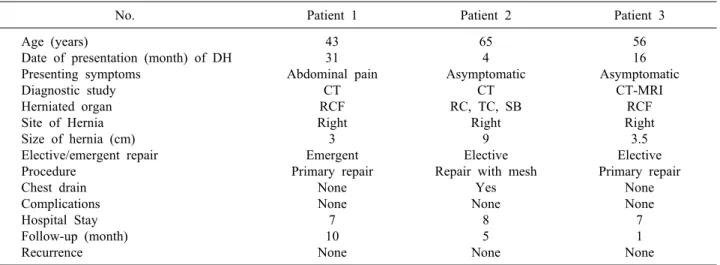
None of these patients required diaphragm resection. One patient had a 2.2 cm tumor, located in the deep aspect of the right liver, and 2 patients were operated for huge tumors (≥10 cm in diameter) located on the right liver in the vicinity of the right diaphragm. The median tumor size was 9 cm (2.2-15 cm). Neither diaphragm injury nor opening was observed peroperatively. The LR post- operative course was uneventful (Table 1).
DH was diagnosed in 3 (2.3%) patients with a median delay of 14 months (4-31 months), from the hepatectomy (Fig. 1). One patient underwent emergency laparotomy for bowel obstruction and 2 patients underwent elective DH repair, using an open approach (Fig. 2). As for the dia- phragm repair technique, an interrupted suture without mesh was performed in 2 cases and a composite prosthetic mesh (SymbotexTM Composite Mesh, Covidien, USA) was used in 1 case. At last follow-up (1, 5, and 10 months), no recurrence was seen upon cross imaging.
Literature review
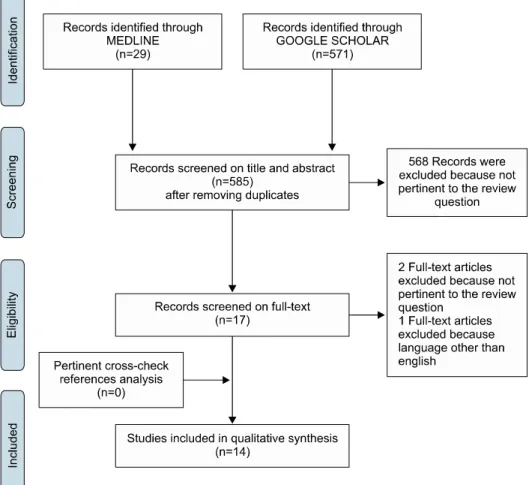
The flow chart of studies identification and in- clusion/exclusion process is shown in Fig. 3. A total of
Table 1. Characteristics of patients with diaphragmatic hernia
No. Patient 1 Patient 2 Patient 3
Age (years)
Date of presentation (month) of DH Presenting symptoms
Diagnostic study Herniated organ Site of Hernia Size of hernia (cm) Elective/emergent repair Procedure
Chest drain Complications Hospital Stay Follow-up (month) Recurrence
43 31 Abdominal pain
CT RCF Right 3 Emergent Primary repair
None None
7 10 None
65 4 Asymptomatic
CT RC, TC, SB
Right 9 Elective Repair with mesh
Yes None
8 5 None
56 16 Asymptomatic
CT-MRI RCF Right 3.5 Elective Primary repair
None None 7 1 None
CT indicates computed tomography; MRI, magnetic resonance imaging; RCF, right colonic flexure; RC, right colon; TC, trans- verse colon; SB, small bowel
Fig. 1. Preoperative computed tomography showing the dia- phragmatic hernia.
Fig. 2. Intraoperative view of the diaphragmatic hernia. (A) A white arrow shows the right colon flexure incarcerated in the hernia. (B) A white star shows the site of the hernia. (C) Primary closure of the hernia.
Fig. 3. Flow diagram showing the selection of studies report- ing diaphragmatic hernia, fol- lowing liver resection for sys- tematic review.
14 articles were found eligible for this systematic review.4,6-18
Indications of LR: The selected studies included 6 case reports,6,9,11,14,16,17 4 retrospective case series,4,7,8,12 2 letters to the editor,10,15 and 2 original articles13,18 (Table 2).4,6-18 Overall, 28 cases of DH after LR have been de- scribed (excluding our 3 cases). The most common in- dication of LR were as follows: living donor liver pro- curement in 11 cases (39.4%), liver metastases in 6 cases (21.4%), HCC in 2 cases (7.1%), adenoma in 2 cases (7.1%), focal nodular hyperplasia in one case (3.6%), and others in 6 cases (21.4%). In the case of living donor liver procurement (11/28), all but one patient underwent right hepatectomy. In the setting of LR for tumors (17/28), open right hepatectomy was performed in 10 cases, lapa- roscopic left hepatectomy in 3 cases (10.7%), and open left hepatectomy in 1 case. The procedure was not men- tioned for 3 cases.18
DH management: The mean time between LR and DH was 19 months (1-72 months). The most frequent symptoms were as follows: abdominal pain (50%; 14/28), respiratory symptoms (14.3%; 4/28), and abdominal pain plus respiratory symptoms (14.3%; 4/28). Three (10.7%) patients were asymptomatic. The most commonly herni- ated organ was the colon (42.8%; 12/28). The hernia re- pair was performed electively in 46.4% of the cases and emergently in 42.9% of the cases.
Open, laparoscopic, and thoracotomy approaches were used in 67.9% (19/28), 3.5% (1/28), and 17.8% (5/28) of patients, respectively. Data regarding DH repair was not available for 3 cases.
Digestive resection was performed in 8 (28.5%) cases including small bowel resection in 3 cases (10.7%), colon resection in 3 cases (10.7%), appendix resection in 1 case (3.6%), and gastric resection in 1 case (3.6%). As for the diaphragm repair technique, an interrupted suture without mesh was performed in 71.4% (20/28) of the cases. In 17.8% (5/28) of the cases, DH was repaired using a mesh.
Of these 5 patients, 2 patients (7.1%) had a non-absorb-
Table 2. Review of literature of diaphragmatic hernia following liver resection in adult patients Year,1st authors N. of patient - N. of hepatectomyEtiologyTumor size (cm)ProcedureDate of presentation (months)
Presenting symptomsHerniated organType of reparation Elective/ emergent repair
Surgical approachComplications/ Recurrences Hepatectomy for Liver Donation 2006, A.M. Hawxby61-n/aNot applicableNot appli- cableRH36Abdominal pain + Respiratory symptoms
TCPrimary repairElectiveThoracotomyNone 2011, L. Kousoulas72-87 (2.3%)Not applicableNot appli- cableRH(2)n/an/an/an/a(2) + Colon re- section(1)n/an/an/a 2011, R.A. Dieter82-n/aNot applicableNot appli- cableRH(2)36-n/aAbdominal pain + Respiratory symptoms(2) RC+TC+ SB(1), RC+SB(1) Repair with mesh(2)Emergent(1), n/a(1)Thoracotomy(2)None 2012, S. Vernadakis91-164 (0.6%)Not applicableNot appli- cableRH30Abdominal painSBPrimary repair + Small bowel re- section
EmergentLaparotomyNone 2012, P. Tabrizian4 *1-993 (0.1%)Not applicableNot appli- cableRH24Abdominal painCOPrimary repairElectiveLaparotomyNone 2014, S. Mizuno101-n/aNot applicableNot appli- cableLH34Abdominal painSTPrimary repair + Gastric resectionEmergentLaparotomyNone 2015, K.S. Jeng111-n/aNot applicableNot appli- cableRH1Abdominal painSBPrimary repairEmergentLaparotomyNone 2016, S.M. Livingstone122-151 (1.3%)Not applicableNot appli- cableRH(2)60-19Abdominal pain(2) + Respiratory symptoms(1)
RC(1), CO+SB(1)Primary repair(2) + Small bowel resection(1)
Emergent(2)Laparotomy(2)None Hepatectomy for Tumors 2002, A.W. Hemming131-16 (6.2%)Metastasisn/aRH- Resecated diaphragm
3n/aSBn/aEmergentn/aDeath 2003, M. Sugita141-n/aFNHn/aLLH8Abdominal painSTPrimary repairElectiveLaparotomyNone 2009, D. Matz151-n/aMetastasisn/aRH36Abdominal painRCPrimary repair + Colon resectionEmergentLaparotomyNone 2010, E. Schellhaas161-n/aHemangioman/aRH72Respiratory symptomsSB+RCPrimary repair+ AppendectomyEmergentLaparotomyNone 2012, P. Tabrizian4 *9-993 (0.9%)Metastasis(3), HCC(2), Adenoma(2), Others(2)
11,10, 14,6,5, 3,16,5,13
RH(7), LLH(1), LH(1)
15Abdominal pain (7), Asymptomatic (2)
SB(2), CO(3), ST(1), n/a(3)
Primary repair(6) + bowel resection(1), Repair with mesh(3) Elective(7), Emergent(2)Laparotomy(7), Laparoscopy(1), Thoracotomy(1) None(8), Recurrence(1)
able mesh. In the remaining 3 cases, data was not avail- able regarding the type of mesh applied. One patient ex- perienced a DH recurrence, which was treated with a mesh using a thoracic approach.
DISCUSSION
The aim of this study was to provide an overview of the incidence as well as to suggest potential mechanisms of DH after right-sided major LR. Two results should be emphasized.
First, in our experience, the incidence of postoperative DH following right-sided major LR was 2.3%. Second, DH may occur even after right hepatectomy, which does not require diaphragm resection or opening, and in pa- tients with uneventful postoperative course.
This study confirmed that the incidence of this compli- cation is low (2.3%), which is consistent with that of the literature in the setting of LR for tumors (1.1%-6.2%) and in living donor hepatectomy (0.6%-2.3%). In our experi- ence, this complication was not associated with mortality.
However, in the literature review (Table 1),4,6-18 one pa- tient died 3 months after hepatectomy, secondary to sepsis from a segment of small bowel that perforated into the DH.13 This suggests that even though this complication is rare, it should be repaired surgically, even for asympto- matic patients.
This study showed that DH occurred with a median de- lay of 14 months. This was earlier than reported in the literature (19 months). Despite the screening protocol in- cluding computed tomography scans every 3 months dur- ing the first 24 months, and every 6 months for the fol- lowing years, the diagnosis of the diaphragmatic hernia was delayed. In three cases, the hernia was evident on imaging, only at that specific time.
In the case of diaphragmatic repair, several surgical techniques are available using an abdominal or thoracic approach. Abdominal DH repair without mesh represents the most commonly used technique reported in the liter- ature (71.4%; 20/28). In the case of DH repair with a mesh, a polypropylene, composite, or biological mesh can be used. The former represents the most commonly used materials. The latter, although more expensive, is pre- ferred due to their low infection rates. Further studies are needed to validate this data.23
Table 2. Continued Year,1st authors N. of patient - N. of hepatectomyEtiologyTumor size (cm)ProcedureDate of presentation (months)
Presenting symptomsHerniated organType of reparation Elective/ emergent repair
Surgical approachComplications/ Recurrences 2015, J.V. Lodhia171-n/aMetastasisn/aLLH8AsymptomaticOMPrimary repairElectiveThoracotomyNone 2016, A. Patrizi183-51 (5.6%)n/a(3)n/an/a(3)n/a(2), 18(1)Respiratory symp- toms (3)n/a(2), RC(1)Primary repair(3) + colon resection(1)Elective(2) Emergent(1)Laparotomy(3)None 2016, F. Esposito3-131 (2.3%)HCC(2), Cystadenome (1)
15,10, 2.2RH(3)31-15-16Abdominal pain(1), Asymptomatic(2)RC(2), RC+TC+ SB(1) Primary repair(1), Repair with mesh(2) Elective(2), Emergent(1)Laparotomy(3)None Total31 ----19 (1-72)--Primary repair(21), Repair with mesh(7), n/a(3)
Elective(15), Emergent (13), n/a(3) Thoracotomy(5), Laparotomy(22), Laparoscopy(1) n/a(3)
Death (1), Recurrences(1) *including one case of living donor FNH, focal nodular hyperplasia; RH, right hepatectomy; LLH, laparoscopic left lateral hepatectomy; LH, left hepatectomy; ST, stomach; SB, small bowel; TC, transverse colon; RC, right colon; CO, colon; OM, Omentum; HCC, hepatocellular carcinoma; n/a, not available
Potential intraoperative risk factors of DH following hepatic resection for liver tumors, such as diaphragm re- section or opening have been reported.4 Large tumors have not been reported as risk factor by themselves. In a study by Tabrizian et al., half of the patients who had DH were previously operated for huge tumors (≥10 cm).4 This may be explained by the fact that due to the in- creased intra-abdominal pressure, large tumors are likely to weaken the diaphragm musculature, may predispose pa- tients to DH as the diaphragm is thin and extensively dis- sected during liver mobilization. Another potential risk factor may be the cautery-related thermal injury to the diaphragm. Electrocautery is routinely used to mobilize the liver from the diaphragm. The routine use of new de- vices such as bipolar irrigated sealer (AquamantysⓇ) on hemostasis may increase cautery-related diaphragm injuries.18 In our experience, this bipolar irrigated sealer was used for hemostasis of the diaphragmatic attachments of the right triangular ligament in the last 2 cases.
However, studies with more patients are needed to con- firm this assumption.
Abdominal (laparoscopic or laparotomy), thoracic, or a combined approach may be used, depending upon the preference of the surgeon, the anatomic location of the de- fect, and the degree of infra-diaphragmatic adhesions. A thoracic approach might be easier to treat recurrent dia- phragmatic hernia, following previous abdominal repair.
In conclusion, despite the increasing technical complex- ity of LR and new surgical devices used for hemostasis, DH remains a rare complication, following right-sided major resection for liver tumors with an incidence of less than 3%. Tumor burden (size and diaphragm invasion) and technical difficulties (severe adhesion of the right dia- phragm, extensive mobilization of the right liver, dia- phragm resection, opening or injury) might represent po- tential causes for DH. Also, thermal surgical devices should be used with caution, when performing right liver mobilization and hemostasis of the diaphragm. A careful follow-up including thoracic and abdominal computed to- mography every 3 months, during the first 24 months is advised.
REFERENCES
1. Lee MK 4th, Gao F, Strasberg SM. Perceived complexity of var-
ious liver resections: results of a survey of experts with develop- ment of a complexity score and classification. J Am Coll Surg 2015;220:64-69.
2. Zimmitti G, Roses RE, Andreou A, Shindoh J, Curley SA, Aloia TA, et al. Greater complexity of liver surgery is not associated with an increased incidence of liver-related complications except for bile leak: an experience with 2,628 consecutive resections.
J Gastrointest Surg 2013;17:57-64; discussion p.64-65.
3. Rubikas R. Diaphragmatic injuries. Eur J Cardiothorac Surg 2001;20:53-57.
4. Tabrizian P, Jibara G, Shrager B, Elsabbagh AM, Roayaie S, Schwartz ME. Diaphragmatic hernia after hepatic resection: case series at a single Western institution. J Gastrointest Surg 2012;
16:1910-1914.
5. Willemse P, Schütte PR, Plaisier PW. Thoracoscopic repair of a Bochdalek hernia in an adult. Surg Endosc 2003;17:162.
6. Hawxby AM, Mason DP, Klein AS. Diaphragmatic hernia after right donor and hepatectomy: a rare donor complication of parti- al hepatectomy for transplantation. Hepatobiliary Pancreat Dis Int 2006;5:459-461.
7. Kousoulas L, Becker T, Richter N, Emmanouilidis N, Schrem H, Barg-Hock H, et al. Living donor liver transplantation: effect of the type of liver graft donation on donor mortality and morbidity. Transpl Int 2011;24:251-258.
8. Dieter RA Jr, Spitz J, Kuzycz G. Incarcerated diaphragmatic her- nia with intrathoracic bowel obstruction after right liver donation. Int Surg 2011;96:239-244.
9. Vernadakis S, Paul A, Kykalos S, Fouzas I, Kaiser GM, Sotiropoulos GC. Incarcerated diaphragmatic hernia after right hepatectomy for living donor liver transplantation: case report of an extremely rare late donor complication. Transplant Proc 2012;44:2770-2772.
10. Mizuno S, Tanemura A, Isaji S. Incarcerated left diaphragmatic hernia following left hepatectomy for living donor liver transplantation. Transpl Int 2014;27:e65-e67.
11. Jeng KS, Huang CC, Lin CK, Lin CC, Wu JM, Chen KH, et al. Early incarcerated diaphragmatic hernia following right donor hepatectomy: a case report. Transplant Proc 2015;47:815-816.
12. Livingstone SM, Andres A, Shapiro AM, Kneteman NN, Bigam DL. Diaphragmatic hernia after living donor right hepatectomy:
proposal for a screening protocol. Transplant Direct 2016;2:e84.
13. Hemming AW, Reed AI, Langham MR, Fujita S, van der Werf WJ, Howard RJ. Hepatic vein reconstruction for resection of hepatic tumors. Ann Surg 2002;235:850-858.
14. Sugita M, Nagahori K, Kudo T, Yamanaka K, Obi Y, Shizawa R, et al. Diaphragmatic hernia resulting from injury during mi- crowave-assisted laparoscopic hepatectomy. Surg Endosc 2003;17:1849-1850.
15. Matz D, Kirchhoff P, Kocher TM, Heizmann O. Consecutive ce- cum perforation due to incarcerated diaphragmatic hernia after liver surgery. Int J Colorectal Dis 2009;24:1353-1354.
16. Schellhaas E, Döbler O, Kroesen AJ, Buhr HJ, Hotz HG.
Gangrenous intrathoracic appendicitis, a rare cause of right-sided chest pain: report of a case. Surg Today 2010;40:874-877.
17. Lodhia JV, Appiah S, Tcherveniakov P, Krysiak P.
Diaphragmatic hernia masquerading as a pulmonary metastasis.
Ann R Coll Surg Engl 2015;97:e27-e29.
18. Patrizi A, Jezequel C, Sulpice L, Meunier B, Rayar M, Boudjema K. Disposable bipolar irrigated sealer (Aquamantys(Ⓡ)) for liver resection: use with caution. Updates Surg 2016;68:171-177.
19. Lim C, Compagnon P, Sebagh M, Salloum C, Calderaro J, Luciani A, et al. Hepatectomy for hepatocellular carcinoma larg- er than 10 cm: preoperative risk stratification to prevent futile surgery. HPB (Oxford) 2015;17:611-623.
20. Memeo R, de'Angelis N, Compagnon P, Salloum C, Cherqui D, Laurent A, et al. Laparoscopic vs. open liver resection for hep- atocellular carcinoma of cirrhotic liver: a case-control study.
World J Surg 2014;38:2919-2926.
21. Azoulay D, Marin-Hargreaves G, Castaing D, Adam R, Savier E, Bismuth H. The anterior approach: the right way for right massive hepatectomy. J Am Coll Surg 2001;192:412-417.
22. Moher D, Liberati A, Tetzlaff J, Altman DG; PRISMA Group.
Preferred reporting items for systematic reviews and meta-analy- ses: the PRISMA Statement. Open Med 2009;3:e123-e130.
23. Al-Nouri O, Hartman B, Freedman R, Thomas C, Esposito T.
Diaphragmatic rupture: Is management with biological mesh fea- sible? Int J Surg Case Rep 2012;3:349-353.