Received: November 8, 2016 Revised: January 19, 2017 Accepted: May 31, 2017.
Corresponding author: Yon Chul Park
Department of Family Medicine, Yonsei University Wonju College of Medicine, 20 Ilsan-ro, Wonju 26426, Korea Tel: +82-33-741-1416, Fax: +82-33-741-1780, E-mail: [email protected]
Copyright Ⓒ 2017 The Korean Academy of Clinical Geriatrics
This is an open access article distributed under the term s of the Creative Com m ons Attribution Non-Com m ercial License (http://creativecom m ons.org/ licenses/by-nc/4.0) which
perm its unrestricted non-com m ercial use, distribution, and reproduction in any m edium , provided the original work is properly cited.
Relationship between High Serum Cadmium Level and Low Muscle Mass in Korean National Health and Nutrition Examination Survey
Jai Soon Kim, Tae Sic Lee, Jong-Koo Kim, Yoo Jung Hwang, Yon Chul Park
Department of Family Medicine, Yonsei University Wonju College of Medicine, Wonju, Korea
Background: Sarcopenia is a syndrome defined as progressive loss of skeletal muscle mass, strength and function, asso- ciated with mobility disorders, increased risk of falls, loss of independence and mortality. Cadmium is a non-essential heavy metal with an accumulative polluting effect and seems to have toxicity to kidneys, lungs, and bones. The present study aimed to examine the associations between the prevalence of sarcopenia and serum cadmium levels using Korean National Health and Nutrition Examination Survey (2010) data.
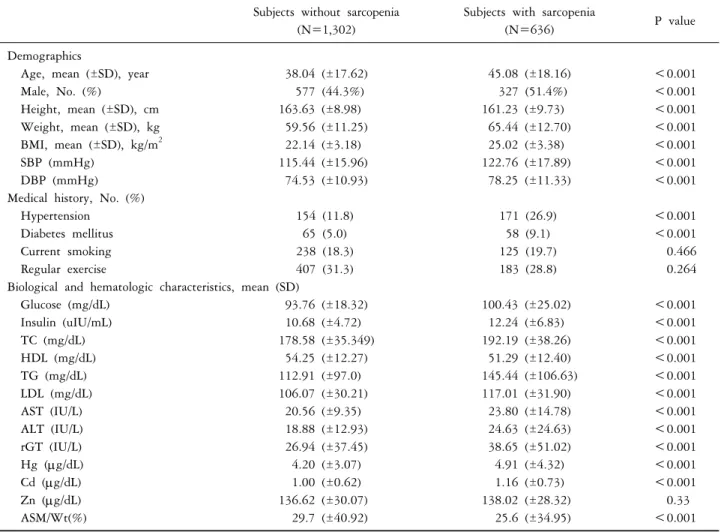
Methods: The total number of study subjects was 1,938 and these included 904 males and 1,038 females aged 10 years or older. Subject were allocated to two groups; a sarcopenia group (n=636) or a normal group (n=1,302). Sarcopenia was defined as an appendicular skeletal mass to body weight ratio of one SD less than the mean ratio of a young (20∼39 years), sex specific, and reference group.
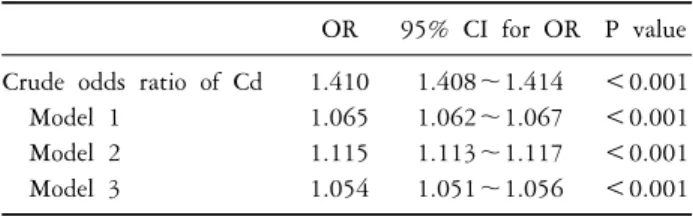
Results: Serum cadmium (Cd) levels were higher in the sarcopenia group than in the normal group [1.16 (SD, ±0.73) μg/dL in the sarcopenia group and 1.00 (SD, ±0.62) μg/dL in the normal group]. Members of the sarcopenia group had a significantly higher mean serum cadmium level (OR 1.410, 95% CI 1.408∼1.414, P=0.018). After adjusting for compounding factors, the prevalence of sarcopenia increased by 5.4% (Odd ratio=1.054, 95% confidence interval (CI)=1.051∼1.056) for every 1 μg/dL increase in Cd level.
Conclusion: Sarcopenia was associated with elevated serum cadmium in the Korean population.
Key Words: Cadmium, Sarcopenia, Skeletal muscle, Korean population
INTRODUCTION
Sarcopenia is a syndrome that involves progressive loss of skeletal muscle mass, strength, and function during the ag- ing process.
1) Muscle loss is associated with mobility dis- orders, increased risk of falls, reduced ability to performed daily activities, and loss of independence.
2) Szulc et al.
3) re-
ported that loss of muscle mass is a strong predictor of mortality in later life. Furthermore, sarcopenia is also related to metabolic disease, and since skeletal muscles are primary sites for glucose uptake and deposition, sarcopenia increases insulin resistance, thereby progressively increases the risks of diabetes and metabolic syndrome.
4)
Cadmium (Cd) is a non-essential heavy metal and has cu-