732 https://doi.org/10.9713/kcer.2018.56.5.732
PISSN 0304-128X, EISSN 2233-9558
Phase Equilibrium of Binary Mixture for the (Carbon Dioxide + 1-Phenyl-2-Pyrrolidone) System at High Pressure
Ho Lee, Jong-Dae Jeong and Hun-Soo Byun†
Department of Chemical and Biomolecular Engineering, Chonnam National University, 50, Daehak-ro, Yeosu-si, Jeollanam-do, 59626, Korea (Received 13 August 2018; Received in revised form 1 September 2018; accepted 7 September)
Abstract − Experimental data of phase equilibria are reported for the binary mixture of 1-phenyl-2-pyrrolidone in supercritical carbon dioxide. Phase behavior data was measured in a synthetic method at a temperature ranging from 333.2 to 393.2 K and at pressures up to 97.14 MPa. The solubility of 1-phenyl-2-pyrrolidone in the carbon dioxide+ 1- phenyl-2-pyrrolidone system increased as temperature increased at a constant pressure and it exhibited the type-I phase behavior. The experimental data for the binary mixture were correlated with the Peng-Robinson equation of state using mixing rule and the critical properties of 1-phenyl-2-pyrrolidone were predicted with the Joback and Lyderson method.
Key words: 1-Phenyl-2-pyrrolidone, Carbon dioxide, Phase behavior, P-x isotherm, Phase equilibrium
1. Introduction
Among the derivatives of 2-pyrrolidone, 1-phenyl-2-pyrrolidone is an organic compound consisting of a five-membered lactam. It is a colorless liquid used in industrial applications as a high-boiling non- corrosive polar solvent for a wide variety of applications. It is misci- ble with a wide variety of other solvents including water, ethanol, diethyl ether, ethyl acetate, and carbon disulfide [1].
Understanding two-component and three-component mixtures of the acrylate group containing supercritical solvents plays an import- ant role in the chemical processes, separation technology, polymer- ization and chemical applications [2-6]. As a matter of fact, we have measured the phase behavior (bubble-point, dew-point and critical- point) for two-component mixtures with supercritical carbon diox- ide [7,8]. Carbon dioxide is widely used as a process-friendly sol- vent because it is cheap, nonflammable, nontoxic and a good solvent with nonpolar molecules. Therefore, a knowledge for the phase equi- libria of carbon dioxide and solute binary mixtures is required for practical uses.
Phase behavior data for some of carbon dioxide + solute systems were reported by our group [9-12], Kim et al. [13] and Rebelatto et al. [14]. We [9-12] reported the high-pressure phase behavior for the binary system of 3-phenyl propionitrile, triethylene glycol diacry- late, tetrahydrofurfuryl acrylate and 3-(trimethoxysilyl)propyl meth- acrylate in supercritical carbon dioxide at temperatures ranging from 313.2 to 393.2 K and several different pressures. Kim et al. [13] pre- sented the carbon dioxide + methyl methoxyacetate and carbon diox- ide + methyl trans-3-methoxyacrylate systems at pressures from 5 to
20 MPa and at five varying temperatures. Rebelatto et al. [14] mea- sured the experimental phase equilibria data for a pseudo-binary sys- tem involving of carbon dioxide + ω-pentadecalactone and for a pseudo-ternary system involving carbon dioxide + ω-pentadecalac- tone + chloroform at the temperatures from 313 to 343 K, and at pressures between 5.4 MPa and 26.1 MPa.
This work was to measure the high-pressure phase equilibria data for the carbon dioxide + 1-phenyl-2-pyrrolidone system by investi- gating mixtures of carbon dioxide with a component. The experi- mental data obtained in this work were correlated with the Peng- Robinson equation of state (P-R EOS) [15] using mixing rule includ- ing binary interaction parameters. The critical properties such as crit- ical pressure, critical temperature and acentric factor of 1-phenyl-2- pyrrolidone were estimated by the Joback and Lydersen method with group contributions [16].
2. Experimental Section
2-1. Apparatus and Procedure
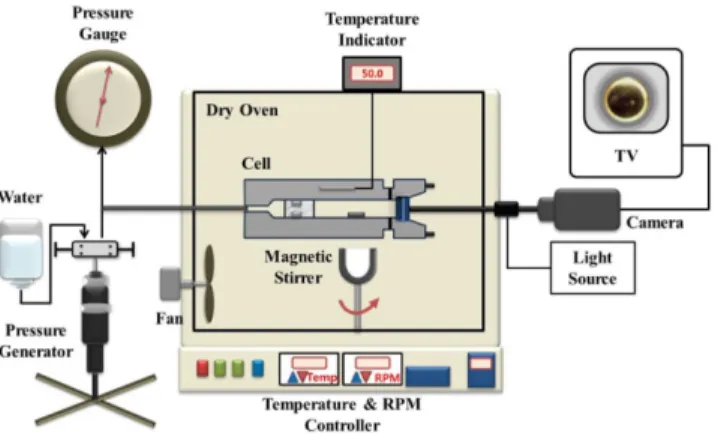
Fig. 1 shows a schematic diagram of the apparatus measuring high-pressure phase behavior view cell used for the phase equilibria measurement [17,18]. A high-pressure view cell of 6.2 cm outer diameter and 1.59 cm inner diameter, an operating volume of ~28 cm3 was used, and it is capable of operating up to pressure of 150.0 MPa.
The front part of the cell was fitted with a 1.9 cm thick and 1.9 cm diameter a sapphire window (GT Advanced Technology, USA), which enabled observation of the phases inside the cell. The solution mix- ture in the cell was compressed to the desired pressure by moving a piston located within the cell. A 2.54 cm long piston was moved using water pressurized by a high pressure generator (HIP, model 37- 5.75-60). The pressure of mixture was measured with a Heise gauge (Dresser Ind., model CM-124914, 0 to 136.0 MPa, standard uncer- tainty: 0.14 MPa). The temperature of the cell, typically maintained
†To whom correspondence should be addressed.
E-mail: [email protected]
This is an Open-Access article distributed under the terms of the Creative Com- mons Attribution Non-Commercial License (http://creativecommons.org/licenses/by- nc/3.0) which permits unrestricted non-commercial use, distribution, and reproduc- tion in any medium, provided the original work is properly cited.
Korean Chem. Eng. Res., Vol. 56, No. 5, October, 2018 constant within a narrow range of ±0.12 K, as measured using a plat-
inum-resistance thermometer (Thermometrics Corp., Class A) and a digital multimeter (Yokogawa, model 7563, accurate to ±0.005 %).
The mixture inside the cell was viewed on a video monitor using a camera coupled to a borescope (Olympus Corp., model F100-038- 000-50) placed against the outside of the sapphire window. Typically, supercritical carbon dioxide is added to the cell very accurately to a target amount within a minimal range of ±0.002 g using a high pres- sure cylinder. The monomer is loaded into the cell to a target value within a short range of ±0.001 g using a syringe as well.
2-1-1. Materials
1-Phenyl-2-pyrrolidone (> 0.99 mass fraction purity, CAS RN 4641-57-0, C10H11NO) used in this work was purchased from Scien- tific Polymer Products, Inc. A component was used without further purification in the experiments. Carbon dioxide (> 0.999 mass frac- tion purity) obtained from Daesung Industrial Gases Co. was used as received. The specifications of all the chemicals used in this work are summarized in Table 1 and the chemical structure of 1-phenyl-2-pyr- rolidone is represented in Fig. 2.
3. Results and discussion
High-pressure phase behavior data for the 1-phenyl-2-pyrrolidone in supercritical carbon dioxide were measured, and the experimental uncertainty was estimated to be 0.20 MPa and 0.2 K for a given load- ing of the cell [19,20]; the standard uncertainty for the mole fraction of 1-phenyl-2-pyrrolidone was 0.003 [19].
Fig. 3 and Table 2 show the experimental pressure-composition (P - x) isotherms at T = (333.2, 353.2, 373.2 and 393.2) K, and pres- sures from (6.26 to 97.14) MPa for the (carbon dioxide + 1-phenyl- 2-pyrrolidone) system. First, three phases were not observed at all
temperatures, and the P-x isotherms (see Fig. 3) were consistent with those expected for the type-I system [21,22]. Then, the solubility pressures increased as the temperatures increased at the mole frac- tion of 1-phenyl-2-pyrrolidone > 0.394, while it decreased with the temperature in increase at the mole fraction < 0.394.
In this work, the experimental phase behavior data were correlated with the P-R EOS. The P-R EOS [15] is expressed as follows:
(1)
(2)
(3)
(4) (5) where Tc, pc, Tr and ω are the critical temperature, critical pres- sure, reduced temperature (T/Tc) and acentric factor of the pure component, respectively. The P-R EOS was used for the mixture
P RT
V b–
--- a T( ) V V b( + ) b V b+ ( – ) --- –
=
a T( ) 0.457235α T( )R2Tc2 pc ---
=
b 0.077796RTc pc ---
=
α T( )=[1+κ 1 T( – r0.5)]2
κ 0.37464 1.54226ω 0.26992ω= + – 2 Fig. 1. Schematic diagram of high-pressure apparatus.
Table 1. Specifications of the chemicals used in this work
Chemical name Mass fraction purity Source CAS RN
CO2 >0.999 Daesung Ind. Gases Co. 124-38-9
1-phenyl-2-pyrrolidone >0.990 Scientific Polymer Products, Inc. 84170-74-1
Fig. 2. Schematic diagram of 1-phenyl-2-pyrrolidone.
Fig. 3. Plot of the pressure against the mole fraction, comparing the experimental data (symbols) of the (carbon dioxide + 1- phenyl-2-pyrrolidone) system. , 333.2 K; , 353.2 K; , 373.2 K; , 393.2 K.
with the following mixing rules:
(6)
(7) (8)
(9) where kij and hij were i and j interaction parameters determined by fitting (P-x) isotherms curves, and aii and bii were pure com- ponent parameters as defined by Peng and Robinson [15]. The objective function (OBF) and root mean squared relative deviation (RMSD) percent of this calculation are defined by
(10)
(11)
Table 3 lists properties of pure components; critical temperatures (Tc), critical pressures (Pc), and the acentric factors (ω) for carbon dioxide [16], 1-phenyl-2-pyrrolidone[16] used in the P-R EOS. The boiling points were obtained from the literature [23]. The properties of 1-phenyl-2-pyrrolidone were then calculated by the Joback group- contribution method [16].
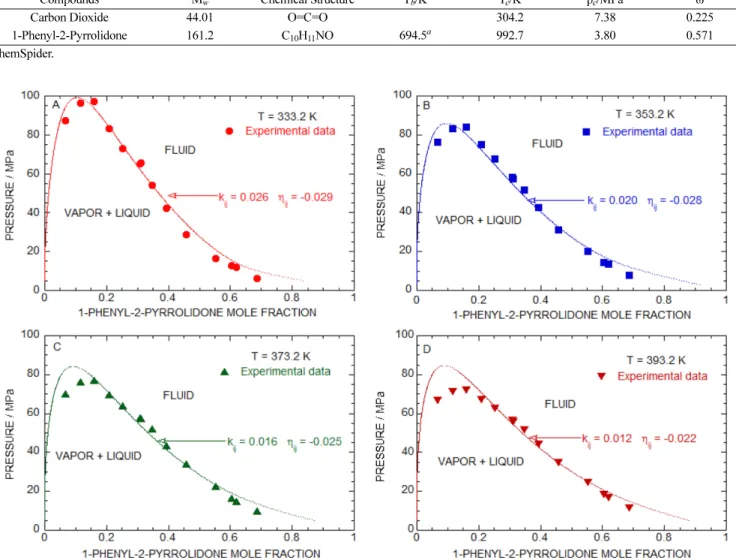
Fig. 4 plots the pressure against the mole fraction, comparing the experimental data (symbols) of the carbon dioxide + 1-phenyl-2-pyr- rolidone system with calculations obtained from the P-R EOS with kij and ηij set equal to zero (red solid lines), and kij = 0.020, ηij = -0.028 (blue solid lines) at 353.2 K. With the optimized parameters of the P-R EOS for the carbon dioxide + 1-phenyl-2-pyrrolidone system at T = 353.2 K, the comparison shows an error as low as 7.91%.
The experimental data with calculated (P-x) isotherms at tempera- tures of 333.2, 353.2, 373.2 and 393.2 K for the carbon dioxide + 1-
amix xixjaij
∑
j∑
i=
aij=(aiiajj)1/2(1 k– ij) bmix xixjbij
∑
j∑
i=
bij=0.5 b( ii+bjj) 1 η( – ij)
OBF Pexp–Pcal Pexp ---
⎝ ⎠
⎛ ⎞2
i
∑
N=
RMSD %( ) OBF --- 100ND×
=
Fig. 4. Plot of the pressure against the mole fraction, comparing the experimental data (symbols) of the (carbon dioxide + 1-phe- nyl-2-pyrrolidone) system with calculations obtained from the Peng-Robinson equation of state with kij and ηij set equal to zero (red solid lines), and kij= 0.020, ηij= -0.028 (carbon dioxide + 1-phenyl-2-pyrrolidone) (blue solid lines) at 353.2 K.
Table 2. Experimental data for the (carbon dioxide + 1-phenyl-2- pyrrolidone) system. BP is a bubble-point, CP is a critical-point and DP is a dew-point
1-Phenyl-2-Pyrrolidone
Mole Fraction pa/MPa Transitionb
Ta / K = 333.2 K
0.066 87.21 DP
0.115 96.12 DP
0.161 97.14 BP
0.209 83.28 BP
0.252 72.93 BP
0.308 65.34 BP
0.310 65.62 BP
0.348 54.14 BP
0.394 42.31 BP
0.458 28.86 BP
0.553 16.59 BP
0.604 12.66 BP
0.619 11.97 BP
0.685 6.24 BP
T / K = 353.2 K
0.066 76.24 DP
0.115 83.21 DP
0.161 84.17 CP
0.209 74.93 BP
0.252 67.48 BP
0.308 58.31 BP
0.310 57.48 BP
0.348 51.59 BP
0.394 42.79 BP
0.458 31.00 BP
0.553 20.10 BP
0.604 14.35 BP
0.619 13.62 BP
0.685 7.90 BP
T / K = 373.2 K
0.066 70.10 DP
0.115 76.17 DP
0.161 77.07 BP
0.209 69.83 BP
0.252 64.17 BP
0.308 57.76 BP
0.310 57.21 BP
0.348 52.03 BP
0.394 43.28 BP
0.458 33.97 BP
0.553 22.66 BP
0.604 16.62 BP
0.619 14.64 BP
0.685 9.69 BP
T / K = 393.2 K
0.066 66.93 DP
0.115 71.48 DP
0.161 72.10 BP
0.209 67.21 BP
0.252 62.66 BP
0.308 56.66 BP
0.310 55.83 BP
0.348 51.48 BP
0.394 44.24 BP
0.458 34.86 BP
0.553 24.79 BP
0.604 18.55 BP
0.619 16.66 BP
0.685 11.35 BP
aStandard uncertainties are u(T) = 0.2 K and u(p) = 0.05 MPa
bBP: Bubble-point, CP: Critical-point, DP: Dew-point
Korean Chem. Eng. Res., Vol. 56, No. 5, October, 2018 phenyl-2-pyrrolidone system using the optimized kij and hij values
determined at the each temperature were compared Fig. 5(a~d). RMSD
for the system at temperatures of 333.2, 353.2, 373.2 and 393.2 K was 13.1%, 7.91%, 7.88% and 9.66%, respectively, and experimen- tal data point at each temperature was 14. In comparison of Fig. 5(a~d), the experimental data and calculated curve show a good agreement at four temperatures for high pressures.
Fig. 6 plots kij and hij parameters against the temperature for the (carbon dioxide + 1-phenyl-2-pyrrolidone) system with the P-R EOS.
The parameter equations of the fitting line were kij = -0.00023T + 0.10204 and ηij = 0.00012T - 0.06958 (333.2 K ≤ T ≤ 393.2 K) deter- mined by the P-R EOS.
4. Conclusions
The P-x isotherm for the (carbon dioxide + 1-phenyl-2-pyrroli- done) system was studied using a variable-volume view cell with a static-type apparatus. The (carbon dioxide + 1-phenyl-2-pyrrolidone) mixtures did not exhibit three phases at all four selected tempera- tures. The Peng-Robinson equation of state is properly capable of Table 3. The properties of pure components of carbon dioxide and 1-phenyl-2-pyrrolidone
Compounds Mw Chemical Structure Tb/K Tc/K pc/MPa ω
Carbon Dioxide 44.01 O=C=O 304.2 7.38 0.225
1-Phenyl-2-Pyrrolidone 161.2 C10H11NO 694.5a 992.7 3.80 0.571
aChemSpider.
Fig. 5. Plot of the pressure against the mole fraction, comparing the experimental data (symbols) of the (carbon dioxide + 1-phenyl-2-pyrrolidone) system with calculations (solid lines) obtained with the Peng-Robinson equation of state using optimized kij and ηij at each temperature: , 333.2 K; , 353.2 K; 373.2 K; , 393.2 K.
Fig. 6. Plot of kij and hij parameters against the temperature for the (carbon dioxide + 1-phenyl-2-pyrrolidone) {(1 -x) CO2+x C10H11NO} system with the Peng-Robinson equation of state.
The equations of the fitting line for the (carbon dioxide + 1- phenyl-2-pyrrolidone) are kij = -0.00023T + 0.10204 and hij= 0.00012T - 0.06958 (333.2 K ≤ T ≤ 393.2 K).
predicting the phase behavior of mixtures using two temperature- independent mixture interaction parameters. The agreement between calculated and experimental mixture curves was reasonably good by using two optimized parameters obtained at each temperature with the Peng-Robinson equation of state. RMSD for the (carbon dioxide + 1-phenyl-2-pyrrolidone) system was calculated by 8.82%, a mean for four selected temperatures.
Acknowledgments
This research was supported by Basic Science Research Program through the National Research Foundation of Korea (NRF) funded by the Ministry of Education (Grant No. NRF-2016R1D1A1B04931921).
Nomenclatures
a, b : Parameter in the Peng-Robinson equation of state
k : Binary interaction parameter in the Peng-Robinson equation of state
P : Pressure, MPa T : Temperature, K R : Universal gas constant x : Mole fraction of liquid V : Molar volume, cm3/mol
Greek letters
α : Parameter in the Peng-Robinson equation of state κ : Parameter in the Peng-Robinson equation of state
η : Binary interaction parameter in the Peng-Robinson equation of state
ω : Acentric factor
Subscrpits
i, j : Component identifiers c : Critical property r : Reduced property mix : Mixture
exp : Experiment cal : Calculation
References
1. Parshikov, A., Terent’ev, P. B., Piskunkova, N. F., Gracheva, R.
A. and Bulakhov, G. A., “Microbiological Transformation of Deriv- atives of 4-Phenyl-2-Pyrrolidone by Mycelial Fungi,” Chem. Hetero- cycl. Compd, 33(5), 523-526(1997).
2. Kendall, J. L., Canelas, D. A., Young, J. L. and DeSimone, J.
M., “Polymerizations in Supercritical Carbon Dioxide,” Chem.
Rev., 99(2), 543-563(1999).
3. Yeo, S. D. and Kiran, E., “Formation of Polymer Particles with Supercritical Fluids: A Review,” J. Supercrit. Fluids, 34(3), 287- 308(2005).
4. McHugh, M. A. and Krukonis, V. J., Supercritical Fluid Extraction, 2nd ed., Butterworth-Heinemann, Stoneham, Boston, 1994.
5. Lee, J. C., Kim, C. R. and Byun, H. S., “Synthesis and Adsorp- tion Properties of Carbamazepine Imprinted Polymer by Disper- sion Polymerization in Supercritical Carbon Dioxide,” Korean J.
Chem. Eng., 31(12), 2266-2273(2014).
6. Jang, Y. S. and Byun, H. S., “Cloud-Point and Bubble-Point Measure- ment for the Poly(2-butoxyethyl acrylate) + Cosolvent Mixture and 2-Butoxyethyl Acrylate in Supercritical Fluid Solvents,” J.
Chem. Eng. Data, 59(5), 1391-1399(2014).
7. Jang, Y. S., Kim, S. H., Yoo, K. P. and Byun, H. S., “Phase Behavior Measurement for the Binary Mixture of CO2+ Neopentyl Glycol Diacrylate and CO2+ Neopentyl Glycol Dimethacrylate Systems at High Pressure,” Fluid Phase Equilib., 302, 234-240 (2011).
8. Yoon, Y. D. and Byun, H. S., “Experimental Measurement and Correlation of Phase Behavior for the CO2 + Heptafluorobutyl Acrylate and CO2 + Heptafluorobutyl Methacrylate Systems at High Pressure,” Korean J. Chem. Eng., 31(3), 522-527(2014) 9. Byun, H. S., “High Pressure Phase Equilibria for the Binary mixture
of CO2 + 3-Phenyl Propionitirle and CO2 + 2-Phenyl Butyroni- trile Systems,” J. Supercriti. Fluids, 120, 218-225(2017).
10. Byun, H. S. and Rhee, S. Y., “Phase Equilibria Measurement of Binary Mixtures for Triethylene Glycol Dimethacrylate and Trieth- ylene Glycol Diacrylate in Supercritical CO2,” Korean J. Chem.
Eng., 34(4), 1170-1176(2017).
11. Lee, B. S. and Byun, H. S., “Solubility on Tetrahydrofurfuryl Acry- late Effect for the Poly[tetrahydrofurfuryl acrylate] in Supercrit- ical Carbon Dioxide and Dimethyl Ether,” J. Supercriti. Fluids, 135, 211-217(2018).
12. Lee, B. S., Lee, J.-K., Bong, J.-H. and Byun, H. S., “Phase Behavior for the 2-(trimethylsilyloxy)ethyl methacrylate and 3-(trimethoxysi- lyl)propyl Methacrylate in Supercritical Carbon Dioxide,” Fluid Phase Equilib., 462, 1-5(2018).
13. Kim, S.-H., Chun, D., Yoon, S.-D. and Byun, H. S., “Phase Behav- ior for the CO2 + Methyl Methoxyacetate and CO2 + Methyl trans-3- Methoxyacrylate Systems at Pressures from (5 to 20) MPa and Various Temperatures,” J. Chem. Eng. Data, 61(3), 1101-1108(2016).
14. Rebelatto, E. A., Polloni, A. E., Andrade, K. S., Bender, J. P., Cora- zza, M. L., Lanza, M. and Oliveira, J. V., “High-Pressure Phase Equilibrium Data for Systems Containing Carbon Dioxide, ω-Penta- decalactone, Chloroform and Water,” J. Chem. Thermodyn., 122, 125-132(2018).
15. Peng, D. Y. and Robinson, D. B., “A New Two-Constant Equa- tion of State,” Ind. Eng. Chem. Fundam., 15(1), 59-63(1976).
16. Poling, B. E., Prausnitz, J. M. and O’Connell, J. P., The Proper- ties of Liquids and Gases, 5th ed., McGraw-Hill, New York, 2001.
17. Lee, B. S. and Byun, H. S., “Phase Behavior of Binary and Ternary Mixture for the Poly(TBAEMA) and TBAEMA in Supercritical Solvents,” Korean J. Chem. Eng., 34(7), 2056-2064(2017).
18. Cho, D. W., Shin, J., Bae, W., Kim, H., Lee, J. H. and Shin, M.
S., “High-pressure Phase Behavior of Tri-ethylene Glycol Dimethac- rylate and Tetra-ethylene Glycol Dimethacrylate in Supercritical Carbon Dioxide,” Fluid Phase Equilib., 319, 37-41(2012).
19. Chirico, R. D., Frenkel, M., Diky, V. V., Marsh, K. N. and Wil- hoit, R. C., “ThermoML-An XML-Based Approach for Storage and Exchange of Experimental and Critically Evaluated Ther- mophysical and Thermochemical Property Data. 2. Uncertain-
Korean Chem. Eng. Res., Vol. 56, No. 5, October, 2018 ties,” J. Chem. Eng. Data, 48(5), 1344-1359(2003).
20. Yoon, S. D. and Byun, H. S., “Phase Behaviour for the (Carbon Dioxide + 1,3-Butanediol Diacrylate) and (Carbon Dioxide + 1,3-Butanediol Dimethacrylate) Systems at Elevated Pressures and Temperatures,” J. Chem. Thermodyn., 71, 91-97(2014).
21. Scott, R. L. and van Konynenburg, P. B., “Static Properties of
Solutions — van der Waals and Related Models for Hydrocar- bon Mixtures,” Discuss. Faraday Soc., 49, 87-97(1970).
22. Rowlinson, J. S. and Swinton, F. L., Liquid and Liquid Mixtures, 3rd ed., Butterworth, Boston, 1982.
23. http://www.chemspider.com/Chemical-Structure.70744.html.
![Table 3 lists properties of pure components; critical temperatures (T c ), critical pressures (P c ), and the acentric factors (ω) for carbon dioxide [16], 1-phenyl-2-pyrrolidone[16] used in the P-R EOS](https://thumb-ap.123doks.com/thumbv2/123dokinfo/5404832.218781/3.892.66.429.168.1138/properties-components-critical-temperatures-critical-pressures-acentric-pyrrolidone.webp)