서 론
암은 2014년 남녀 사망원인 1위로 인구 10만 명당 150.9명이 암으 로 사망하였고, 암으로 인한 사망률은 지난 10년간 지속적으로 증가 하고 있다.1) 하지만 암은 다른 급성기 질환과 달리 미리 말기 예측이 가능한 질환이다. 암환자 중 말기 암환자는 적극적인 치료에도 불구 하고 근원적인 회복의 가능성이 없고 증상이 악화되어 수개월 내 사 망할 것으로 예상되는 암환자로 정의되어 삶의 마지막 시기에 환자 와 가족의 삶의 질 향상을 위해 적극적인 완화의료가 필요하다.2,3) 국
립암센터 2014년 완화의료 전문기관의 평가 자료에 따르면 완화의료 전문기관의 환자 만족도는 78%로 이전 암치료 기관의 만족도 30%에 비해 큰 차이를 보였다.4)
말기 암환자가 효과적인 호스피스 완화의료를 받기 위해서는 호 스피스 시설의 충분한 입원 기간이 필요하다. 호스피스 시설 평균 이 용 기간은 1개월 가량으로 알려져 있다. 그러나 최근 미국의 National Hospice and Palliative Care Organization의 통계 자료에 의하면 2014년 미국의 호스피스 병동 재원 기간의 중앙값(median length of service) 은 17.4일로 2013년 18.5일에 비해 감소하였고, 가장 많은 비율의 환자
Original Article
호스피스 병동 입원 후 72시간 이내 임종한 말기 암환자의 특성
윤소정, 곽정임*, 최현정, 신준섭, 남지완, 안형준
안양 샘병원 가정의학과
The Characteristics of Terminally Ill Cancer Patients Who Expired within 72 Hours after Admission to a Hospice
So Jung Yun, Jung Im Gwak*, Hyun Jung Choi, Jun Seob Shin, Ji Wan Nam, Hyung Joon An
Department of Family Medicine, Anyang SAM General Hospital, Anyang, KoreaBackground: If the length of survival in hospice is too short, terminally ill cancer patients are unable to receive sufficient end-of-life care. However, many patients in hospices die within a relatively short period after admission. The characteristics of the patients who die early in hospice have not been studied; thus, we examined the clinical symptoms and characteristics of the patients who died within 72 hours after admission to a hospice unit in Anyang.
Methods: We examined 82 terminally ill cancer patients who died within 72 hours after admission to the hospice unit, and 77 patients who survived for 21–28 days in the same unit, who served as the control group, from January 2010 to March 2015. We examined the baseline, clinical, and laboratory characteristics of the patients by performing a chi-square test for the univariate analysis and binary logistic regression for the multivariate analysis.
Results: The median length of survival was 2.11 days (standard deviation, 0.703 days). The multivariate analysis showed that the patients who died within 72 hours showed an increased prevalence of resting dyspnea (P=0.03), decreased consciousness to drowsy mentality (P=0.021), and decreased systolic blood pressure (<90 mmHg; P=0.005). Moreover, the multivariate analysis for the laboratory characteristics revealed increased serum creatinine (P<0.001) and total bilirubin (P=0.011) levels in these patients.
Conclusion: The patients who died within 72 hours following admission to the hospice showed an increased prevalence of resting dyspnea, drowsy mentality, decreased systolic blood pressure (<90 mmHg), and increased serum creatinine and total bilirubin levels.
Keywords: Hospice Care; Terminally Ill; Neoplasms; Early Death
http://dx.doi.org/10.21215/kjfp.2016.6.3.160 pISSN 2233-9019 · eISSN 2233-9116 Korean J Fam Pract. 2016;6(3):160-165KJFP
Korean Journal of Family PracticeReceived March 15, 2016 Accepted March 31, 2016 Corresponding author Jung Im Gwak
Tel: +82-31-467-9161, Fax: +82-31-449-0151 E-mail: [email protected]
Copyright © 2016 The Korean Academy of Family Medicine
This is an open-access article distributed under the terms of the Creative Commons At- tribution Non-Commercial License (http://creativecommons.org/licenses/by-nc/4.0) which permits unrestricted noncommercial use, distribution, and reproduction in any medium, provided the original work is properly cited.
윤소정 외. 호스피스 입원 72시간 이내 임종한 말기 암환자의 특성 Korean Journal of Family Practice
KJFP
Original Article
Korean Journal of Family Practice 군(35.5%)이 입원 후 7일 내 사망하거나 퇴원하는 것으로 조사되었다.5)
재원 일수가 짧을수록 효과적인 말기 환자의 돌봄이 어렵다는 사 실은 여러 논문에서 확인된 바 있다.6-9) 또한 입원 후 단기간 내 임종 할 경우 같은 병동에 입원한 타 환자에게도 부정적인 영향을 줄 수 있기 때문에 생존기간이 짧을 것으로 예측되는 환자를 파악하여 가 정 호스피스 등 다른 형태의 호스피스를 권유하는 등의 특별한 치 료 계획이 필요할 수 있다.10) 하지만 입원 후 급박하게 임종한 환자들 에 대하여 이전에 연구된 적이 없어, 본 논문은 호스피스 병동 입원 후 72시간 이내 급박한 임종을 맞은 환자의 증상과 특성을 비교 분 석하고자 한다.
방 법
1. 연구대상
2010년 1월부터 2015년 3월까지 경기도 안양 소재 일개 병원의 완 화의료 병동에 입원하여 치료를 받다가 72시간 이내에 임종한 환자 82명을 대상으로 동일 병동에 입원 후 21–28일 후 임종한 환자 77명 을 대조군으로 비교 연구하였다.
2. 연구방법
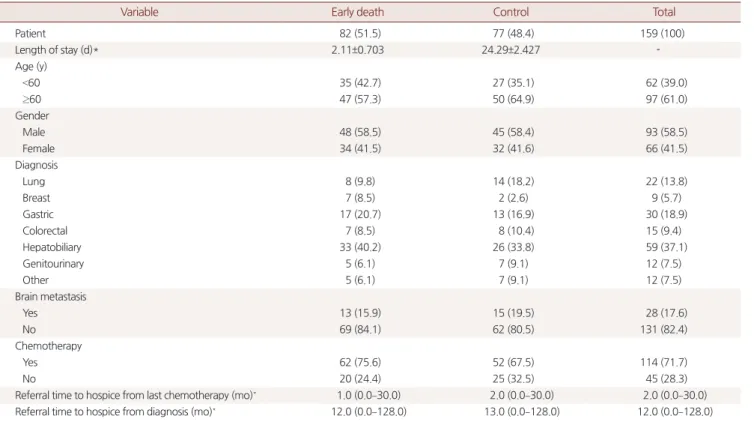
대상환자의 의무기록을 통해, 환자의 일반적 특성, 임상적 특성, 혈액 검사적 특성을 조사하였다. 환자의 일반적 특성에 대하여 나이 (<60세, ≥60세), 성별(남, 여), 원발암 병소(폐암, 유방암, 위암, 대장암, 간췌도암, 비뇨생식기암, 기타 암), 뇌전이 여부, 항암 치료력 여부, 진 단 후 호스피스 병동 입원까지의 기간, 마지막 항암 치료 이후 호스 피스 병동 입원까지의 기간을 조사하였다.
임상적 특성에 대하여 Eastern Cooperative Oncology Group Status (ECOG) performance status 기능상태 지수를 조사하였다. ECOG 기 능상태 지수는 암환자의 운동수행능력을 0에서 4까지 등급화한 것 으로, 스스로 정상적인 일상생활이 가능한 상태를 0으로, 타인의 도 움 없이 아무것도 수행할 수 없는 상태를 4로 정의하며, 3 미만과 3 이상의 두 그룹으로 나눠 조사하였다. 통증은 숫자 통증 등급(nu- merical rating scale, NRS)을 확인할 수 있는 환자에서는 NRS를 확인 하였고, NRS를 확인할 수 없는 환자는 얼굴 통증 평가 척도(face pain rating scale, FPRS)를 확인하였다. NRS와 FPRS 모두 0점을 통증 없음, 10점을 상상할 수 없을 정도의 심한 통증으로 정의하였고, 4점 미만 의 경도 통증을 나타내는 군과 4점 이상의 중등도 이상의 통증을 호 소하는 군으로 나눠 조사하였다. 심한 식욕 부진 여부(5 숟가락 미만
Table 1. Baseline patient characteristics (n=159)
Variable Early death Control Total
Patient 82 (51.5) 77 (48.4) 159 (100)
Length of stay (d)* 2.11±0.703 24.29±2.427 -
Age (y)
<60 35 (42.7) 27 (35.1) 62 (39.0)
≥60 47 (57.3) 50 (64.9) 97 (61.0)
Gender
Male 48 (58.5) 45 (58.4) 93 (58.5)
Female 34 (41.5) 32 (41.6) 66 (41.5)
Diagnosis
Lung 8 (9.8) 14 (18.2) 22 (13.8)
Breast 7 (8.5) 2 (2.6) 9 (5.7)
Gastric 17 (20.7) 13 (16.9) 30 (18.9)
Colorectal 7 (8.5) 8 (10.4) 15 (9.4)
Hepatobiliary 33 (40.2) 26 (33.8) 59 (37.1)
Genitourinary 5 (6.1) 7 (9.1) 12 (7.5)
Other 5 (6.1) 7 (9.1) 12 (7.5)
Brain metastasis
Yes 13 (15.9) 15 (19.5) 28 (17.6)
No 69 (84.1) 62 (80.5) 131 (82.4)
Chemotherapy
Yes 62 (75.6) 52 (67.5) 114 (71.7)
No 20 (24.4) 25 (32.5) 45 (28.3)
Referral time to hospice from last chemotherapy (mo)* 1.0 (0.0–30.0) 2.0 (0.0–30.0) 2.0 (0.0–30.0)
Referral time to hospice from diagnosis (mo)* 12.0 (0.0–128.0) 13.0 (0.0–128.0) 12.0 (0.0–128.0)
Values are presented as number (%), mean±standard deviation, or median (range).
*Tested by Mann-Whitney U test.
So Jung Yun, et al. Terminally Ill Cancer Patients Who Expired within 72 Hours
Korean Journal of Family Practice
KJFP
혹은 1/3 그릇 미만), 안정 시 호흡 곤란 여부, 의식 수준(alert, drowsy, stupor-coma), 수축기 혈압(<90, ≥90 mmHg), 발열(고막 체온 >37.8°C), 응급실 경유 입원 여부를 조사하였다.
혈액 검사적 특성으로 알칼리성 포스파타제(150 IU/L, ≥150 IU/L), 크레아티닌(<1.5 mg/dL, ≥1.5 mg/dL), 총 빌리루빈(<2.0 mg/dL, ≥2.0 mg/dL), C-반응성 단백질(<5.0 mg/L, 5–100 mg/L, ≥100 mg/L), 백혈구 수(<4,000/μL, 4,000–11,000/μL, ≥11,000/μL), 혈색소(<10 g/dL, ≥10 g/
dL), 혈소판(<100,000/μL, ≥100,000/μL), 총 칼슘(<10 mg/dL, ≥10 mg/
dL), 이온화 칼슘(<5 mg/dL, ≥5 mg/dL) 농도를 조사하였다.
3. 통계 분석
대조군과 비교하여 72시간 이내에 임종한 환자의 특성 요인을 파 악하기 위하여 카이제곱 검정으로 단변량 분석하였고, 정규성 분포 를 따르지 않는 변수에 대하여 Mann-Whitney 검정을 통하여 유의 성 검정하였다. 단변량 분석에서 유의성을 보인 요인들에 대하여 이 분형 로지스틱 회귀분석 시행하여 다변량 분석하였다. 모든 통계분 석은 IBM SPSS Statistics ver. 20.0 (IBM Co., Armonk, NY, USA)을 사용 하였고, 분석결과의 통계적 유의성은 P<0.05 하에서 판단하였다.
결 과
1. 대상자의 일반적 특성
72시간 내 임종한 환자 82명의 평균 재원일수는 2.11일이었다(표준 편차 0.703일). 연령은 60세 이상이 47명(57.3%)으로 더 많았으며, 성별 은 남자 48명(58.5%), 여자 34명(41.5%)이었다. 원발암 병소는 간췌도 암이 33명(40.2%)로 가장 많았고, 다음으로 위암 17명(20.7%), 폐암 8 명(9.8%) 순이었다. 뇌전이 여부는 동반되지 않은 환자가 69명(84.1%) 으로 더 많았다. 항암 치료를 받은 환자는 62명으로 75.6%였으며, 마 지막 항암치료 후 호스피스 입원까지의 기간의 중앙값은 한 달로 확 인되었다. 암 진단 후 호스피스 입원까지의 기간의 중앙값은 1년이었 다(Table 1).
2. 72시간 내 임종 환자와 대조군과의 임상 증상 비교
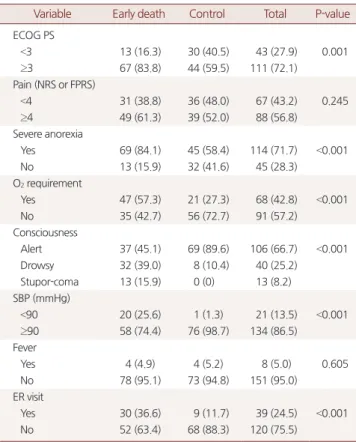
72시간 내 임종 환자에서 ECOG performance status 3점 이상으로 확인된 환자는 67명(83.8%) 대조군은 44명(59.5%)이었다(P=0.001). 심 한 식욕부진을 보이는 환자는 72시간 내 임종 환자 69명(84.1%), 대조 군에서는 45명(58.4%) 확인되었다(P<0.001). 안정 시 호흡곤란을 보이 는 환자는 대상 환자군 47명(57.3%), 대조군에서 21명(27.3%)이었다 (P<0.001). 72시간 내 임종 환자에서 의식 수준은 alert mentality 37명 (45.1%), drowsy 32명(39.0%), stupor-coma 13명(15.9%) 순으로 조사되었
고(P<0.001), 수축기 혈압은 90 mmHg 미만으로 측정된 환자가 20명 (25.6%), 대조군에서 1명(1.3%)으로 나타났다(P<0.001). 응급실 경유 입원은 72시간 내 임종 환자 30명(36.6%)으로 대조군 9명(11.7%)보다 많았다(P<0.001). 조절되지 않는 통증 호소와 발열 여부는 통계적으 로 유의한 차이를 보이지 않았다(Table 2).
단변량 분석에서 유의성을 보이는 변수(P<0.05)들을 대상으로 다 변량 분석을 시행한 결과 안정 시 호흡곤란(P=0.03), drowsy mentality 로의 의식 저하(P=0.021), 수축기 혈압의 90 mmHg 미만의 감소 (P=0.005)는 72시간 내 임종 환자의 특징으로 통계적으로 유의한 결 과를 보였다(Table 3).
3. 72시간 내 임종 환자와 대조군과의 혈액 검사적 특성 비교
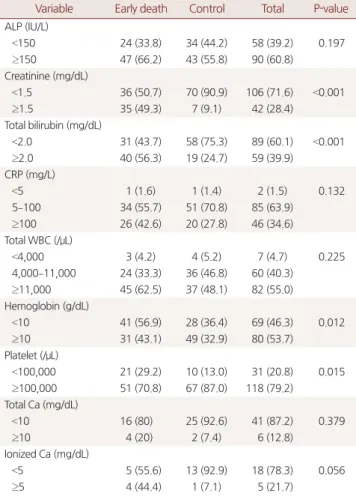
Table 4은 72시간 내 임종 환자와 대조군과의 혈액 검사적 특성 비 교 결과이다. 72시간 내 임종 환자에서 크레아티닌 1.5 mg/dL 이상 확 인된 환자는 35명(49.3%)으로 대조군 7명(9.1%)보다 높은 비율을 나 타냈다(P<0.001). 총 빌리루빈 2.0 mg/dL 이상 증가된 환자는 72시간 내 임종 환자 40명(56.3%), 대조군에서 19명(24.7%) 확인되었다Table 2. Differences of clinical characteristics by univariate analysis* Variable Early death Control Total P-value ECOG PS
<3 13 (16.3) 30 (40.5) 43 (27.9) 0.001
≥3 67 (83.8) 44 (59.5) 111 (72.1)
Pain (NRS or FPRS)
<4 31 (38.8) 36 (48.0) 67 (43.2) 0.245
≥4 49 (61.3) 39 (52.0) 88 (56.8)
Severe anorexia
Yes 69 (84.1) 45 (58.4) 114 (71.7) <0.001
No 13 (15.9) 32 (41.6) 45 (28.3)
O2 requirement
Yes 47 (57.3) 21 (27.3) 68 (42.8) <0.001
No 35 (42.7) 56 (72.7) 91 (57.2)
Consciousness
Alert 37 (45.1) 69 (89.6) 106 (66.7) <0.001
Drowsy 32 (39.0) 8 (10.4) 40 (25.2)
Stupor-coma 13 (15.9) 0 (0) 13 (8.2)
SBP (mmHg)
<90 20 (25.6) 1 (1.3) 21 (13.5) <0.001
≥90 58 (74.4) 76 (98.7) 134 (86.5)
Fever
Yes 4 (4.9) 4 (5.2) 8 (5.0) 0.605
No 78 (95.1) 73 (94.8) 151 (95.0)
ER visit
Yes 30 (36.6) 9 (11.7) 39 (24.5) <0.001
No 52 (63.4) 68 (88.3) 120 (75.5)
Values are presented as number (%).
ECOG PS, Eastern Cooperative Oncology Group performance status; NRS, nu- merical rating scale; FPRS, face pain rating scale; SBP, systolic blood pressure; ER, emergency room.
*Performed by chi-square test.
윤소정 외. 호스피스 입원 72시간 이내 임종한 말기 암환자의 특성 Korean Journal of Family Practice
KJFP
(P<0.001). 혈색소는 72시간 내 임종 환자 41명(56.9%)에서 10 g/dL 이 하로 측정되었고(P=0.012), 혈소판이 <100,000/μL 미만으로 감소한 환 자의 수는 21명(29.2%)으로 대조군에 비해 많았다(P<0.015). 알칼리 성 포스파타제, C-반응성 단백질, 백혈구 수, 칼슘 농도의 차이는 통 계적으로 유의하지 않았다(Table 4).
72시간 내 임종 환자와 대조군과의 혈액 검사적 특성 단변량 분석 에서 유의성을 보이는 변수(P<0.05)들을 대상으로 다변량 분석한 결 과 크레아티닌 1.5 mg/dL의 증가(P<0.001), 총 빌리루빈 2.0 mg/dL 이 상의 증가(P=0.011)는 72시간 내 임종 환자의 특징으로 통계적으로 유의한 결과를 보였다(Table 5).
고 찰
72시간 내 임종한 환자의 마지막 항암치료 후 호스피스 입원까지 의 기간의 중앙값은 한 달로 확인되었다. 대조군과 비교하여 유의한 차이를 나타내지는 않았으나, 이전 연구와 비교하여 본 연구대상자 들이 항암 치료 중단 시기와 입원 시기의 간격이 짧은 것으로 나타 났다.10)
72시간 내 임종 환자와 대조군과 비교한 임상 증상 단변량 분석에 서 통계적으로 유의하였던 요인 중 3점 이상의 ECOG 기능상태 지 수, 안정 시 호흡곤란, 의식 수준의 저하는 말기 암환자의 여명을 예 측하는 데 사용되는 완화의료 예후 지수(palliative prognostic index) 와 객관적 예후지수(objective prognostic score)와 같은 여명 예측 지 수에서 짧은 생존 기간을 예측하는 조건들에 부합한다.11-14) 다변량 분석에서 72시간 내 임종 환자의 특성으로 유의한 것으로 나타난 요 인은 안정 시 호흡곤란, drowsy mentality로의 의식 저하, 수축기 혈압 90 mmHg 미만의 감소였으며, 이는 환자들이 임종기에 가까워져 있
는 상태임을 알 수 있다. 이는 대상 환자들 중 짧은 여명이 예측된 환 자들이 다수 포함되어 있고, 호스피스 시설로 너무 늦게 전원되어 전 원 후 조기에 사망하는 경우가 많았음을 알 수 있다.15) 항암 치료의 연장, 환자와 보호자의 완화의료 치료의 수용 거부, 집에서 자가 간 호 중 환자 컨디션의 변화로 병원에 방문한 경우 등의 원인을 생각해 볼 수 있으나, 본 연구는 의무기록 자료를 바탕으로 한 후향적 연구 Table 4. Differences of laboratory characteristics by univariate analysis*
Variable Early death Control Total P-value ALP (IU/L)
<150 24 (33.8) 34 (44.2) 58 (39.2) 0.197
≥150 47 (66.2) 43 (55.8) 90 (60.8)
Creatinine (mg/dL)
<1.5 36 (50.7) 70 (90.9) 106 (71.6) <0.001
≥1.5 35 (49.3) 7 (9.1) 42 (28.4)
Total bilirubin (mg/dL)
<2.0 31 (43.7) 58 (75.3) 89 (60.1) <0.001
≥2.0 40 (56.3) 19 (24.7) 59 (39.9)
CRP (mg/L)
<5 1 (1.6) 1 (1.4) 2 (1.5) 0.132
5–100 34 (55.7) 51 (70.8) 85 (63.9)
≥100 26 (42.6) 20 (27.8) 46 (34.6)
Total WBC (/μL)
<4,000 3 (4.2) 4 (5.2) 7 (4.7) 0.225
4,000–11,000 24 (33.3) 36 (46.8) 60 (40.3)
≥11,000 45 (62.5) 37 (48.1) 82 (55.0)
Hemoglobin (g/dL)
<10 41 (56.9) 28 (36.4) 69 (46.3) 0.012
≥10 31 (43.1) 49 (32.9) 80 (53.7)
Platelet (/μL)
<100,000 21 (29.2) 10 (13.0) 31 (20.8) 0.015 ≥100,000 51 (70.8) 67 (87.0) 118 (79.2)
Total Ca (mg/dL)
<10 16 (80) 25 (92.6) 41 (87.2) 0.379
≥10 4 (20) 2 (7.4) 6 (12.8)
Ionized Ca (mg/dL)
<5 5 (55.6) 13 (92.9) 18 (78.3) 0.056
≥5 4 (44.4) 1 (7.1) 5 (21.7)
Values are presented as number (%).
ALP, aspartate aminotransferase; CRP, C-reactive protein; WBC, white blood cell; Ca, calcium.
*Performed by chi-square test.
Table 5. Laboratory characteristics of patients who expired in 72 hours by multivariate analysis*
Variable P-value OR 95% CI
Creatinine ≥1.5 mg/dL <0.001 7.445 2.911–19.040
Bilirubin ≥2.0 mg/dL 0.011 2.762 1.263–6.041
Hemoglobin <10.0 g/dL 0.072 2.017 0.938–4.334 Platelet <100,000/μL 0.259 1.733 0.667–4.503 OR, odds ratio; CI, confidential interval.
*Only variables that had a significance of P-value<0.05 in univariate analysis (Ta- ble 4) were used in the multivariable analysis by binary logistic regression.
Table 3. Clinical characteristics of patients who expired within 72 hours by multivariate analysis*
Variable P-value OR 95% CI
ECOG PS ≥3 0.791 1.130 0.457–2.795
Severe anorexia 0.140 2.004 0.796–5.047
O2 requirement 0.030 2.486 1.090–5.670
Consciousness
Alert 0.069
Drowsy 0.021 3.423 1.205–9.722
Stupor-coma 0.998 5.405 -
SBP <90 mmHg 0.005 22.454 2.577–195.616
ER visit 0.078 2.518 0.901–7.038
OR, odds ratio; CI, confidential interval; ECOG PS, Eastern Cooperative Oncology Group performance status; SBP, systolic blood pressure; ER, emergency room.
*Only variables that had a significance of P-value<0.05 in univariate analysis (Ta- ble 2) were used in the multivariable analysis by binary logistic regression.
So Jung Yun, et al. Terminally Ill Cancer Patients Who Expired within 72 Hours
Korean Journal of Family Practice
KJFP
이므로 늦게 호스피스 시설에 입원하게 된 원인에 대하여 정확한 확 인은 불가능하였다. 늦은 입원의 원인에 대하여 추후 전향적 연구 설계를 통해 연구될 필요성이 있다.
다변량 분석을 통하여 72시간 내 임종 환자에서 혈액 검사상 통계 적으로 유의하였던 특성은 크레아티닌의 증가, 총 빌리루빈의 증가 였다. 짧은 생존 기간에 영향을 미치는 요인에 이전의 논문16-18)에서 는 총 빌리루빈의 증가와 함께 백혈구 수의 증가도 확인되었으나, 본 논문에서의 72시간 내 급박한 임종을 한 환자의 특성으로서의 백혈 구 수 증가의 유의성은 확인되지 않아 차이를 보였다.
본 연구의 제한점은 단일 기관에 입원한 환자를 대상으로 하였기 때문에, 결론의 일반화를 위해서는 다기관 공동연구를 통한 연구가 필요할 것으로 생각된다. 다기관 공동연구를 통하여 많은 수의 대상 자가 확보된다면 원발암 병소를 구분하여 환자의 특성을 연구할 필 요가 있다. 또한 본 논문은 후향적 의무기록을 바탕으로 자료를 수 집하여 의무기록에서 갑작스런 임종의 원인이 될 수 있는 종양학적 응급 상황 등을 파악하기 어려웠다. 그리고 완화의료의 특성상 환자 의 변화에 대한 적극적 검사가 자제되기 때문에 급박한 임종의 원인 을 파악하는 것은 어려운 실정이다. 추후 전향적 연구를 통하여 급 박한 임종의 가능한 원인을 파악하고, 환자 개인의 호스피스 시설 입 원 시기 결정에 영향을 미쳤던 요인 등을 조사하는 것이 필요하겠다.
요 약
연구배경:
말기 암환자의 호스피스 시설 재원 일수가 짧을수록 효 과적인 완화의료를 제공받기 어렵다. 호스피스 시설의 단기 재원 환 자가 증가 추세에 있으나 입원 후 급박하게 임종한 환자들에 대하여 이전에 연구된 적이 없어, 본 논문은 호스피스 병동 입원 후 72시간 이내 급박한 임종을 맞은 환자의 증상과 특성을 비교 분석하였다.방법:
2010년 1월부터 2015년 3월까지 경기도 안양 소재 일개 병원의 완화의료 병동에 입원하여 72시간 이내에 임종한 환자 82명을 대상 으로 입원 후 21–28일 후 임종한 환자 77명을 대조군으로 비교연구 하였다. 72시간 이내에 임종한 환자의 일반적 특성, 임상적 특성, 혈 액 검사적 특성을 카이제곱 검정으로 단변량 분석하였고, 이분형 로 지스틱 회귀분석을 시행하여 다변량 분석하였다.결과:
72시간 내 임종한 환자 82명의 평균 재원 일수는 2.11일이었다 (표준 편차 0.703일). 다변량 분석 결과, 72시간 이내에 임종한 환자에 서 임상적으로 안정 시 호흡곤란(P=0.03), drowsy mentality로의 의식 저하(P=0.021), 수축기 혈압 90 mmHg 미만으로 감소(P=0.005)의 빈 도 증가를 보였다. 혈액 검사상의 특성 분석 결과, 크레아티닌의 증가 P<0.001), 총 빌리루빈의 증가(P=0.011) 소견이 유의하게 증가하였다.결론:
72시간 이내에 임종한 환자에서 임상적으로 안정 시 호흡곤 란, drowsy mentality로의 의식 저하, 수축기 혈압의 감소를 보였으며, 혈액 검사상 크레아티닌의 증가, 총 빌리루빈의 증가 소견의 빈도가 유의하게 증가하였다.중심단어:
완화 의료; 말기 암환자; 종양; 급박한 임종 REFERENCES1. kostat.go.kr [Internet]. Daejeon: Statistics Korea; c2015 [cited 2016 Feb 26].
Available from: http//kostat.go.kr.
2. Yun YH, Rhee YS, Nam SY, Chae YM, Heo DS, Lee SW, et al. Public attitudes toward dying with dignity and hospice. Palliative care. Korean J Hosp Palliat Care 2004; 7: 17-28.
3. Lunney JR, Lynn J, Foley DJ, Lipson S, Guralnik JM. Patterns of functional decline at the end of life. JAMA 2003; 289: 2387-92.
4. hospice.cancer.go.kr. [Internet]. Goyang: Hospice and Palliative Care; c2015 [cited 2016 Feb 26]. Available from: http//hospice.cancer.go.kr.
5. National Hospice and Palliative Care Organization. NHPCO’s facts and fig- ures. Hospice care in America. Alexandria: National Hospice and Palliative Care Organization; 2015.
6. Rickerson E, Harrold J, Kapo J, Carroll JT, Casarett D. Timing of hospice re- ferral and families’ perceptions of services: are earlier hospice referrals bet- ter? J Am Geriatr Soc 2005; 53: 819-23.
7. Kapo J, Harrold J, Carroll JT, Rickerson E, Casarett D. Are we referring pa- tients to hospice too late? Patients’ and families’ opinions. J Palliat Med 2005;
8: 521-7.
8. Younis T, Milch R, Abul-Khoudoud N, Lawrence D, Mirand A, Levine E.
Length of survival in hospice for cancer patients referred from a compre- hensive cancer center. Am J Hosp Palliat Care 2009; 26: 281-7.
9. Younis T, Milch R, Abul-Khoudoud N, Lawrence D, Mirand A, Levine EG.
Length of survival of patients with cancer in hospice: a retrospective analy- sis of patients treated at a major cancer center versus other practice settings.
J Palliat Med 2007; 10: 381-9.
10. Lee GJ, Ahn HS, Go SE, Kim JH, Seo MW, Kang SH, et al. Patient’s factors at entering hospice affecting length of survival in a hospice center. Cancer Res Treat 2015; 47: 1-8.
11. Lee IC, Kim CK, Suh SY, Kim YS, Cho KH, Kang HC, et al. Validation of scoring system for survival prediction in terminal cancer patients in Korea. J Korean Acad Fam Med 2007; 28: 682-9.
12. Lau F, Downing GM, Lesperance M, Shaw J, Kuziemsky C. Use of Palliative Performance Scale in end-of-life prognostication. J Palliat Med 2006; 9:
1066-75.
13. Harrold J, Rickerson E, Carroll JT, McGrath J, Morales K, Kapo J, et al. Is the palliative performance scale a useful predictor of mortality in a heteroge- neous hospice population? J Palliat Med 2005; 8: 503-9.
14. Virik K, Glare P. Validation of the palliative performance scale for inpatients admitted to a palliative care unit in Sydney, Australia. J Pain Symptom Man- age 2002; 23: 455-7.
15. McCarthy EP, Burns RB, Davis RB, Phillips RS. Barriers to hospice care
윤소정 외. 호스피스 입원 72시간 이내 임종한 말기 암환자의 특성 Korean Journal of Family Practice
KJFP
among older patients dying with lung and colorectal cancer. J Clin Oncol 2003; 21: 728-35.
16. Pirovano M, Maltoni M, Nanni O, Marinari M, Indelli M, Zaninetta G, et al.
A new palliative prognostic score: a first step for the staging of terminally ill cancer patients. Italian multicenter and study group on palliative care. J Pain Symptom Manage 1999; 17: 231-9.
17. Rosenthal MA, Gebski VJ, Kefford RF, Stuart-Harris RC. Prediction of life- expectancy in hospice patients: identification of novel prognostic factors.
Palliat Med 1993; 7: 199-204.
18. Hwang IC, Choi CH, Kim KK, Lee KS, Suh HS, Shim JY. Predictability of impending events for death within 48 hours in terminal cancer patients.
Korean J Hosp Palliat Care 2011; 14: 28-3.