627 http://dx.doi.org/10.9713/kcer.2015.53.5.627
PISSN 0304-128X, EISSN 2233-9558
Preparation of Porous Nanostructures Controlled by Electrospray
Dung The Nguyen*, In Wook Nah** and Kyo-Seon Kim*,†
*Department of Chemical Engineering, Kangwon National University, 1 Kangwondaehak-gil, Chuncheon-si, Kangwon 24341, Korea
**Center for Energy Convergence, Korea Institute of Science and Technology, Hwarangno 14-gil 5, Seongbuk-gu, Seoul 02792, Korea (Received 29 December 2014; Received in revised form 4 February 2015; accepted 12 February 2015)
Abstract − Various solid structures were prepared by electrospray technique. In this process, liquid flows out from a capillary nozzle under a high electrical potential and is subjected to an electric field, which causes elongation of the menis- cus to form a jet. In our study, by controlling the amount of polyvinyl pyrrolydone in precursor solution, the jet either disrupted into droplets for the formation of spherical particles or was stretched in the electric field for the formation of fibers. During the electrospray process, the ethanol solvent was evaporated and induced the solidification of precursors, forming solid particles. The evaporation of ethanol solvent also enhanced the mass transport of solutes from the inner core to the solid shell, which facilitated fabrication of porous and hollow structure. The network structures were also pre- pared by heating the collector.
Key words: Electrospray, Porous Structure, Droplet, Fiber, Structure Evolution
1. Introduction
Controlled synthesis of solid particles with diverse morphologies is utmost important in material science since the particle morpholo- gies almost determine their potential applications[1,2]. Develop- ment of new synthesis methods provides the control of particle size, morphology, component and unique properties for specific applica- tions. Among various synthesis methods, electrospray, a method of liquid atomization by means of electrical forces, has been widely used for micro- or nano-particle production with controlled mor- phology for various applications such as energy generation, filtra- tion, biosensors and tissue engineering[3-6]. It has been reported that electrospray allows the production of fine solid particles of small standard deviation from about 100 µm down to a nanometer-scale without significant change in chemical composition and physical properties of the material to be sprayed. Balachandran et al[7]. used electrospray method to produce zirconia particles within the range of 50- 500 μm by adjusting the applied ac frequency. Yun et al[8]. produced monodispersed microspheres with mean diameters in the range of 0.25-1.87 μm by electrospraying a mixture of polymethyl methacry- late (PMMA) and TiO2 suspensions. The TiO2 nanoparticles were nonagglomerated and well dispersed inside the PMMA matrices.
Recently, Choi et al[9]. successfully fabricated photocatalyst TiO2 nanofibers dispersed with SiO2 nanoparticles through electrospinning process. The introduction of SiO2 nanoparticles in TiO2 nanofibers
enlarged absorption of the photocatalyst in the visible region, result- ing in enhancement of photocatalytic activity.
The nano- and micro-structured particles from organic materials were also produced by electrospray technique for biotechnological purposes. For example, antibodies were electrosprayed to form parti- cles of diameter of 130-350 μm and remained biologically active after this process[10]. Wu et al[11]. fabricated elastin-like polypeptides (ELP) particles for drug delivery through electrospraying. A high loading amount of doxorubicin did not appreciably alter the particle dimension and shape. They evaluated the encapsulation and observed that the release of Dox from pH responsive ELP particles followed the pH-dependent solubility of the ELP. Recently, Almería et al[12].
produced spherical polylactic-co-glycolic acid (PLGA) particles with diameter range of 60 nm-2 µm and high monodispersity for bio- medical applications. The main parameters affecting particle size included solution electrical conductivity, flow rate and initial polymer volume fraction.
We obtained solid particles with porous structure by electrospray- ing a solution of polyvinyl pyrrolydone (PVP) and tetraethyl ortho- silicate (TEOS). As a powerful and convenient technique to observe particle morphology, ultra-high resolution SEM was used to visually and systematically characterize the structures of product particles [13].
The effects of processing conditions upon the structure formation were studied, and the possible mechanisms for pore generation were proposed based on our systematic observation.
2. Experimental
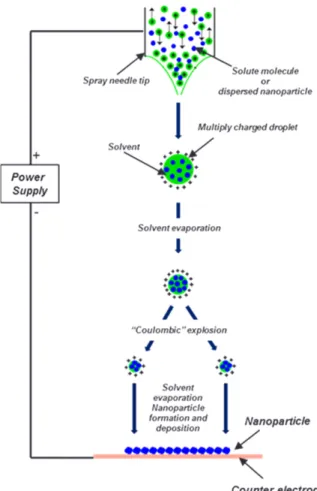
Fig. 1 shows schematic illustration of the electrospray setup and general mechanism of droplet formation during the electrospray pro- cess. The electrospray setup consisted of a syringe pump which
†To whom correspondence should be addressed.
E-mail: [email protected]
‡This article is dedicated to Prof. Kyun Young Park on the occasion of his retirement from Kongju National University.
This is an Open-Access article distributed under the terms of the Creative Com- mons Attribution Non-Commercial License (http://creativecommons.org/licenses/by- nc/3.0) which permits unrestricted non-commercial use, distribution, and reproduc- tion in any medium, provided the original work is properly cited.
loaded with a syringe equipped with a 21-gauge stainless-steel nee- dle, a high-voltage supply of 15 kV which connected to the needle and a counter electrode as ground collector. Polyvinyl pyrrolydone (PVP, Sigma, MW=55000) and tetraethyl orthosilicate (TEOS, Sigma-Aldrich, 98%) were used as precursors. In a typical experi- ment, a certain amount of PVP was dissolved in 8 mL ethanol solution (Deajung, 99.9%), followed by addition of 2 mL TEOS. The precur- sors were well mixed to obtain a homogeneous precursor solution.
The precursor solution maintained at high potential was continu- ously sprayed to an electric field by a syringe pump with controlla- ble feed rate. The electric field caused elongation of the meniscus of highly charged solution to form a jet and then deformed the jet into droplets. The charged droplets drifted downfield through the air toward the opposing electrode. The solvent evaporation at constant charge led to shrinkage of droplet and increase of charge intensity. At a given radius, the increasing repulsion between the charges over- came the surface tension at the droplet surface and caused a Cou- lomb explosion of the droplet, which resulted in generation of many smaller progeny droplets. The products were collected and then were characterized without further treatment. Morphologies of product particles were observed with a Hitachi S-4800 ultra- high resolution SEM equipment using a 15 kV electron beam with the resolution of 1 nm.
Electrospraying is a process of simultaneous droplet generation and charging by means of electric field. In our study, during moving toward the counter electrode, the ethanol solvent from the electro- sprayed droplets could continuously evaporate. The remaining pre- cursors, therefore, would solidify to form solid particles. A typical energy-dispersive X-ray spectroscopy (EDS) spectra of solid parti- cles obtained by the electrospray technique is shown in Fig. 2. The elements detected by EDS were largely comprised of C, O, and Si.
This result was consistent with the composition of the precursor used for electrospray, indicating the formation of composite material.
Fig. 3 shows the morphologies of electrosprayed particles obtained for different feed rates and amounts of PVP in precursor solution. As indicated in Fig. 3(a), spherical particles with mean diameter of about 1 µm were obtained for 0.5 g PVP and feed rate of 0.5 mL/hr. When the feed rate for precursor solution increased to 2 mL/hr, particles were obtained with broad size distribution, ranging from 1 µm to over 5 µm, as shown in Fig. 3(b). Faster feed rate of precursor solu- tion caused the faster movement of droplets, which would reduce the breakage of droplets by Coulombic explosion, and thus resulted in the generation of larger particles. Many holes on the surface of parti- cles and broken particles were observed, indicating that the solid par- ticles exhibited solid shell and empty core structure. It has been reported that, during solvent evaporation, the polymer solution becomes ther- modynamically unstable and phase separation develops into a poly- mer-rich and a polymer-poor phase[14]. The concentrated polymer phase solidifies shortly after phase separation and forms a stable solid shell, whereas the polymer-poor phase forms the pores or holes on the surface of the solid product eventually. Continuous evapora- tion of ethanol through the pores or holes facilitates mass transport of precursor from the inner core to the solid shell, which induces the formation of hollow core structure.
Fig. 3(c) shows morphology of the solid particles prepared for 2 g PVP and feed rate of 2 mL/hr. Clearly, particles were obtained with diameter ranging from 1 µm to over 5 µm and without breakage or holes on the surfaces. The solid shells became more stable and fully Fig. 1. Schematic illustration of the electrospraying setup and general
mechanism of droplet formation during the electrospray process.
Fig. 2. Typical energy-dispersive X-ray spectroscopy (EDS) spectra of the solid particles obtained by the electrospray technique.
covered the droplets since the PVP amount increased. The SEM analysis revealed the formation of individual solid particles. The absence of agglomeration and coagulation of product particles indicated that the charged droplets were self-dispersing in the air and were com- pletely transformed into solid during moving downfield through the air toward the collector.
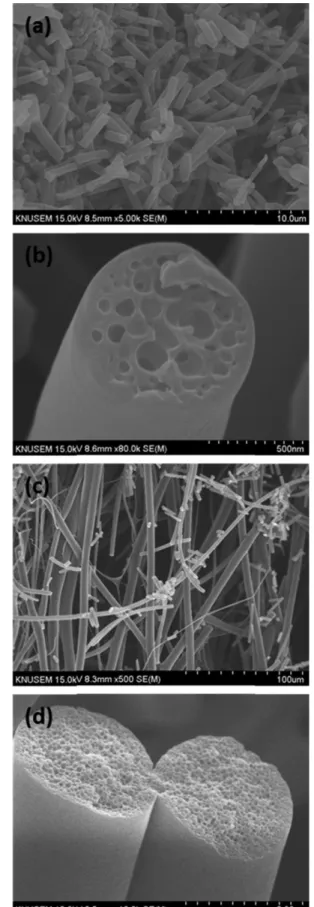
The morphology of product particles was controlled by increasing the amount of PVP in precursor solution, while keeping the feed rate of 2 mL/hr. As indicated in Figs. 4(a) and 4(b), a rod-like structure of particles with length less than 10 µm and diameter of cross section of about 0.5 µm was obtained for 3 g of PVP. By increasing the PVP amount in precursor solution to 4.5 g, the fiber structure with diame-
ter of cross section of about 5 µm was prepared as shown in Figs. 4(c) and 4(d). The increase of PVP amount in precursor solution caused Fig. 3. Morphologies of solid particles prepared for (a) 0.5 g PVP,
0.5 mL/hr; (b) 0.5 g PVP, 2 mL/hr; (c) 2 g PVP, 2 mL/hr.
Fig. 4. SEM images (a,c) and corresponding cross section (b,d) of particles prepared for 3 g and 4.5 g of PVP in precursor solu- tion, respectively. The feed rate was 2 mL/hr.
in the electric field to form a rod-like structure of particles and ultra- thin fibers. Figs. 4(b) and 4(d) clearly indicate the formation of porous structures with pore diameter in the range of 50 nm to 200 nm. The formation of porous structures resulted from the same principle as the formation of hollow structure of spherical particles. During the rapid evaporation of solvent, the solutes were concentrated and solidi- fied to form solid shell structures. The continuous evaporation of sol- vent and mass transport of solutes due to solvent evaporation left an imprint on the particles and fibers in the form of pores. The porous particles were potentially and practically applied in various applica- tions such as tissue engineering, drug delivery, catalysis, chemical sens- ing, and biomolecular analysis as reported and reviewed [5,6,11].
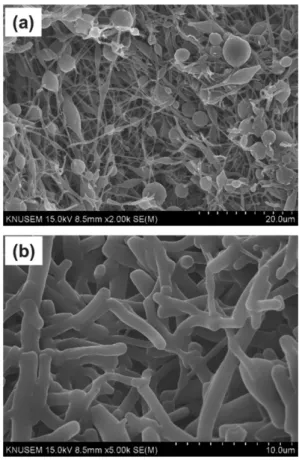
Fig. 5 shows the morphologies of solid particles obtained for 2 g PVP (Fig. 5(a)) and 3 g PVP (Fig. 5(b)) with feed rate of 2 mL/hr and at high temperature of collector. The collector was preheated and kept at 200oC during spraying process. In comparison with the morphologies of particles obtained for similar precursor solution but without heating the collector (Fig. 3(c) and Fig. 4(a)), network structures were produced instead of the formation of individual parti- cles. The heat from the collector could contribute the thermopho- retic force in opposite direction of the movement of the droplets, and thus could induce the collision of particles as well as reduce the
3. Conclusions
The electrospray technique can be used to fabricate particles with controlled morphology. In our research, by adjusting the PVP amount in precursor solution, broken spheres, dented spheres and fiber struc- tures were obtained. The network structures were prepared by heat- ing the collector. The evaporation of ethanol during the electrospray process induced solidification of precursors, resulting in formation of solid particles. The continuous evaporation of ethanol facilitated the mass transport of precursor from the core to the solid shell, which led to the formation of hollow core and porous structures. The porous particles could be of great interest for various applications such as tissue engineering, drug delivery, catalysis, chemical sensing, and biomolecular analysis due to their good design of porous structure with controllable pore size and size distribution.
Acknowledgments
This research was supported by the Converging Research Center Program through the Ministry of Science, ICT and Future Planning (Grant number 2014048827). Instrumental analysis was supported from the central laboratory of Kangwon National University.
References
1. Nguyen, D. T. and Kim, K.-S., “Controlled Synthesis and Bio- molecular Probe Application of Gold Nanoparticles,” Micron, 42, 207-227(2011).
2. Nguyen, D. T. and Kim, K.-S., “Functionalization of Magnetic Nanoparticles for Biomedical Applications,” Korean J. Chem. Eng., 31, 1289-1305(2014).
3. Jaworek, A., “Micro- and Nanoparticle Production by Electro- spraying,” Powder Technol., 176, 18-35(2007).
4. Jaworek, A. and Sobczyk, A.T., “Electrospraying Route to Nan- otechnology: An Overview,” J. Electrostat., 66, 197-219(2008).
5. Bhardwaj, N. and Kundu, S. C., “Electrospinning: A Fascinating Fiber Fabrication Technique,” Biotechnol. Adv., 28, 325-347(2010).
6. Jeong. J., Song, M., Chung, H., Na, I., Lee, J., Lee, H. and Park, K., “Performance and Durability of PEMFC MEAs Fabricated by Various Methods,” Korean Chem. Eng. Res., 52, 558-563(2014).
7. Balachandran, W., Machowski, W. and Ahmad, C. N., “Electrostatic Atomization of Conducting Liquids Using AC Superimposed on DC Fields,” IEEE Trans. Ind. Appl., 30, 850-855(1994).
8. Yun, K. M., Suryamas, A. B., Hirakawa, C., Iskandar, F. and Okuyama, K., “A New Physical Route to Produce Monodispersed Micro- sphere Nanoparticle - Polymer Composites,” Langmuir, 25, 11038- 11042(2009).
9. Choi, K.-I., Lee, W., Beak, S.-W., Song, J., Lee, S. and Lim, C.,
“Fabrication and Photocatalytic Activity of TiO2 Nanofibers Dispersed with Silica Nanoparticles,” Korean Chem. Eng. Res., 52, 667-671(2014).
Fig. 5. Morphologies of solid particles obtained at high temperature of collector (a) 2 g PVP, 2 mL/hr; (b) 3 g PVP, 2 mL/hr. The collector was pre-heated and kept at 200oC during spray- ing process.
10. Moerman, R., Frank, J., Marijnissen, J. C. M., Schalkhammer, T.
G. M. and van Dedem, G. W. K., “Miniaturized Electrospraying as a Technique for the Production of Microarrays of Reproducible Micrometer-sized Protein Spots,” Anal. Chem., 73, 2183-2189(2001).
11. Wu, Y., MacKay, J. A., McDaniel, J. R., Chilkoti, A. and Clark, R. L.,
“Fabrication of Elastin-Like Polypeptide Nanoparticles for Drug Delivery by Electrospraying,” Biomacromolecules, 10, 19-24(2009).
12. Almería, B. and Gomez, A., “Electrospray Synthesis of Mono- disperse Polymer Particles in a Broad (60 nm-2 µm) Diameter
Range: Guiding Principles and Formulation Recipes,” J. Colloid Interface Sci., 417, 121-130(2014).
13. Wu, Y. and Clark, R. L., “Controllable Porous Polymer Particles Generated by Electrospraying,” J. Colloid Interface Sci., 310, 529-535(2007).
14. Bognitzki, M., Czado, W., Frese, T., Schaper, A., Hellwig, M., Steinhart, M., Greiner, A. and Wendorff, J. H., “Nanostructured Fibers via Electrospinning,” Adv. Mater., 13, 70-72(2001).