두 개의 분리된 구개치근을 가진 상악 제 3대구치의 근관치료
최유리나*
원광대학교 치과대학병원 치과보존과
<Abstract>
Endodontic Treatment of Maxillary Third Molar with Two Separate Palatal Roots
Yoorina Choi
*Department of Conservative Dentistry, Wonkwang University Dental Hospital, Iksan, Korea
The presence of the microorganisms of untreated canals is one of the main reasons of the failure in the endodontic treatment. The knowledge of variations in the canal systems of the tooth is important for the successful endodontic treatment. In the maxillary molars, the presence of the two separate palatal roots is very rare variations. Although there have been several case reports of maxillary first and second molars, the case reports of maxillary third molars are very few. This case report presents the endodontic treatment of a maxillary third molar with two separate palatal roots. It is important to notice the clinical signs and analyze the radiographs carefully.
The use of a microscope is helpful for the visualization of pulpal chamber, and pulpal chamber floor should be investigated thoroughly with endodontic explorer. The straight-line access for all the canal orifices is important for the success in the endodontic treatment.
Key words : Variations of the root morphology, Maxillary third molar, Two separate palatal roots
Korean Journal of Oral and Maxillofacial Pathology 2016;40(6):925-929 ISSN:1225-1577(Print); 2384-0900(Online) Available online at http://journal.kaomp.org http://dx.doi.org/10.17779/KAOMP.2016.40.6.007
* Correspondence: Yoorina Choi, DDS, MSD. Department of Conservative Dentistry, Wonkwang University Dental Hospital.
Tel: +82-63-2932
E-mail: [email protected]
ORCID : 0000-0001-6869-8562
Ⅰ. INTRODUCTION
A successful endodontic treatment comprises the identification of all the canals, the disinfection of the whole canal systems through chemomechanical preparation, and proper obturation resulting in a hermetic seal. Thus, a thorough knowledge of the tooth morphology, including unusual variations, is an essential foundation for the successful therapy.
Among the variations of root morphology in maxillary molars, the presence of two palatal canals or roots has been consistently reported to be rare1-4). Libfeld and Rotstein reported a 0.4% occurrence rate of four separate roots in their radiographic evaluations of 1200 maxillary second molars2). In a study of 520 endodontically treated maxillary second molars, Peikoff et al. reported a 1.4% incidence of four separate roots and canals including two palatal roots3). Since Slowey first reported a maxillary second molar with two palatal roots, there have been several case reports concerning the identification of two separate palatal roots of maxillary first or second molars5-12). However, there have been few reports about maxillary third molars with two
Fig. 1 Intraoral periapical radiographs shows dental caries under the restoration of the right maxillary third molar.
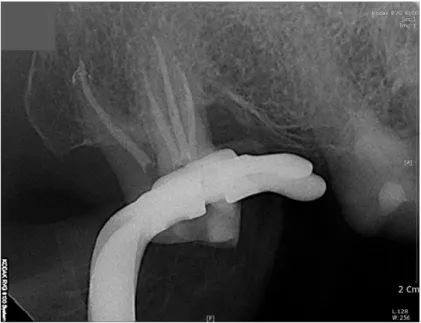
Fig. 2a, b. (a) Intraoral periapical radiograph was taken to confirm the working length of the mesiobuccal, mesiopalatal and distopalatal root canals. (b) Intraoral periapical radiograph was taken to confirm the working length of the distobuccal root canal.
separate palatal roots13).
This case report presents a maxillary third molar with two separate palatal roots.
Ⅱ. CASE REPORT
A 68-year-old male patient was referred to the Department of Conservative Dentistry, Wonkwang University Dental Hospital for treatment of a right maxillary third molar with dental caries. Clinical and radiographic examination revealed a deep carious lesion under a restoration on this right maxillary third molar (Fig. 1). Root canal treatment was
determined on this abutment tooth of a long bridge with extensive caries. The medical history was noncontributory.
The tooth was anesthetized and the previous restoration was removed. After removing dental caries, access to the pulpal chamber was achieved and the tooth was isolated with a rubber dam. The pulpal chamber floor was then explored using an endodontic explorer under a microscope.
Clinical and radiographic examination confirmed the presence of four canal orifices: mesiobuccal, distobuccal, mesiopalatal, and distopalatal (Fig. 2a, b). To improve straight-line access to the canal orifices, the access cavity was modified from a conventional triangular form to a trapezoidal form as the position of canal orifices (Fig. 3).
Fig 3 Clinical photo identified the four canal orifices. An imaginary line connecting all the canal orifices forms a trapezoidal shape.
The palatal side is wider than buccal side.
Fig. 4 Four canals were obturated using the continuous wave technique with GP cones and sealer.
The working length was determined using an electronic apex locator (Root ZX, Morita, Tokyo, Japan). All canals were cleaned and shaped using ProTaper nickel-titanium files (ProTaper Universal, Dentsply-Maillefer, Ballaigues, Switzerland) under irrigation with 2.5% sodium hypochlorite.
The canals were then dried with paper points and obturated using the continuous wave technique with the GP cone and AH plus sealer (Dentsply DeTrey GmbH, Konstanz,
Germany) (Fig. 4). After core build-up with dual cure composite resin (LuxaCore Z, DMG, Germany), the patient was referred for final restorations.
Ⅲ. DISCUSSION
The maxillary third molar often utilized as a strategic
abutment in cases where loss of the maxillary first and second molar has occurred, especially when dental implants cannot be applied14). However, endodontic treatment of maxillary third molars is often complicated. The root anatomy of the maxillary third molar varies greatly and has been described as unpredictable15).
Moreover, reports concerning maxillary third molars have been sporadically compared to those of first and second molars. Sidow et al. reported the maxillary third molars can have one to four roots and one to six canals15). By using the clearing technique, they investigated 150 extracted maxillary third molars and reported that 15% of maxillary molars had one root, 32% had two roots, 45% had three roots, and 7% had four roots15). Cleghorn et al. suggest that while the four-rooted anatomy in its various forms is very rare in the maxillary first molar, it is more likely to occur in the second or third maxillary molar16). However, the case reports about the maxillary third molar with two separate palatal roots are very few13), and even there was no presence of it in some studies about root canal morphology of maxillary molar teeth17, 18). It seems to be clear that the four-rooted anatomy in maxillary third molar is a very rare phenomenon.
Christie et al. proposed the following classification of maxillary teeth with two palatal roots after studying 16 cases of maxillary teeth with two palatal roots over a combined period comprising 40 years of full-time endodontic practice6).
type Ⅰ ; buccal roots are often "cow-horn" shaped and less divergent, while two widely divergent palatal roots are often long and tortuous;
type Ⅱ ; tooth has four separate roots, but the roots are often shorter, run parallel, have buccal and lingual root morphology, and have blunt root apices; and
type Ⅲ ; tooth has constricted root morphology. Canals are encaged in a web of root dentin. The distobuccal root
appears to stand alone and may diverge to the distobuccal.
Based on this classifications, the maxillary third molar presented here can be classified as a type Ⅰ molar.
In dental clinics, treatment can be a challenge when clinicians encounter unusual anatomy in patients’ teeth. It is important that knowing the verifying anatomy and tooth morphology and keeping in mind the variations.
Sometimes, anatomy of the crown can be a sign for root morphology. Teeth with two palatal roots often have wider mesiodistal dimensions of the palatal cusps6, 19). Benenati et al. indicated that the palatogingival groove of crown can be a sign for two palatal canals20).
Radiographic examination with conventional intraoral periapical radiographs in several directions would be helpful to overcome the limitations of 2-dimensional images. Recently, cone-beam computed tomography image can be useful to clarify internal root morphology19). A microscope may also be helpful for visualization of the pulpal floor and dentinal walls and for detecting signs of additional morphology (direction of the developmental root fusion line, remaining blood in the orifices, fins and isthmi, and champagne bubbling with sodium hypochlorite around remaining tissue within the undiscovered canals)12, 19). Following the indications, the pulpal chamber floor should be investigated thoroughly by using an endodontic explorer12). After identification of the canals, access opening should be modified from a conventional triangular form to a trapezoidal form to access the two palatal canals6). Following this procedure, teeth with no missing canals that had received the correct endodontic treatment should have a good prognosis.
Collectively, clinicians need to be thoroughly aware of the several variations of the canal systems of teeth. A complete knowledge of all clinical signs and anatomies is an essential prerequisite for proper endodontic treatment.
This can only be achieved following close analysis of the
radiographs and using clinical skills to detect canal orifices in the pulpal chamber with the assistance of a microscope and, in this manner, completing proper access for all the canal orifices.