Abstract
Background : Oseltamivir is an antiviral agent for the treatment and prophylaxis against influenza (A or B). During the 2009 pandemic of the H1N1 influenza, the use of oseltamivir rapid- ly increased worldwide. Further, with the increasing use of this agent, the number of reported adverse drug reactions (ADRs) to this drug, also had been increased. Korean Food and Drug Administration (KFDA) promoted intensive monitoring of oseltamivir associated ADRs, from August 2009 to January 2010.
Method : Regional Pharmacovigilance Center of Ajou University Hospital participated in the KFDA program by collecting ADRs of oseltamivir. ADRs were collected both, by voluntary reports and tele-monitoring, from January 2009 to December 2010. This included the oseltamivir- adverse reaction intensive monitoring period set by the KFDA. Severity and causality assess- ments were done by using WHO-UMC (Uppsala monitoring center) causality assessment system.
The ADRs were evaluated for the symptoms of the organ systems and the age groups. The rela- tionship between the number of ADRs and the number of prescriptions was analyzed.
Results : A total of 359 cases were collected. Eleven cases with unknown age and gender were
아주대학교병원 지역약물감시센터를 통해 수집된 Oseltamivir(Tamiflu
�) 유해반응 분석
아주대학교병원 약제팀, 아주대학교 약학대학
a, 아주대학교 의학대학 알레르기내과
bAnalysis of Oseltamivir(Tamiflu
�) Adverse Reactions Reported to Regional Pharmacovigilance Center of Ajou University Hospital
Ha Jin Chun, Jin Ok Kyun, Nam Kyung Je
a, Yun Mi Yu, Young Hee Lee, Young Min Ye
band Suk Hyang Lee
aDepartment of pharmacy, Ajou University Hospital College of Pharmacy, Ajou University
aDepartment of allergy, Ajou University School of Medicine
bSan-5, Wonchon-dong, Yeoungtong-gu, Suwon, 443-721, Korea
회원학술보고
배경 및 목적
Oseltamivir(Tamiflu
�)는 바이러스 neuraminidase 저해제로 인플루엔자 A, B 바이러스의 치료와 예방에 사용되어 왔다. 2009년 3월말에서 4월 초 H1N1 인플 루엔자 A 바이러스의 감염 사례가 멕시코에서 처음 발 견되었고
1), 2009년 6월 H1N1의 대유행이
2)공표되었으 며, 이에 따라 oseltamivir의 사용량이 전 세계적으로 급속히 증가하였다. 국내에서도 신종 인플루엔자 감염 자가 빠르게 증가함에 따라 2009년 8월부터 oseltamivir를 무상으로 공급하였으며
3), 2009년 5월부 터는 적응증에 포함되어있지 않던 1세 미만의 어린이에 게도 oseltamivir의 사용을 허용하여, 소아에서의 처방 량도 증가하였다
4).
국내에서의 사용량이 급증함에 따라 약물유해반응 사례수도 증가하였는데, 실제로 oseltamivir 유해반 응 보고건수를 보면 2000년도 국내 시판허가 이후 2009년 10월 14일 기준으로 약 10년간 수집된 사례 169건 중 139건이 2009년도에 보고된 사례였으며
5), 그 이후로도 급격한 상승을 보였다. 식품의약품안전 청은 이러한 oseltamivir의 약물유해반응을 집중적 으로 모니터하는 기간(2009년 8월~2010년 1월)을 정하여, 적극적인 유해반응 수집을 도모하였으며, 아 주대병원 지역약물감시센터에서도 기존의 자발적 약 물유해반응 보고의 수집과 함께 전화모니터링을 병 행하여, 이에 동참하였다. 그러나 oseltamivir의 사 용량이 급증하고 약물유해반응에 대한 관심이 큰 반 면, 아직까지 약물감시센터를 통한 사례분석보고는 not included. Causality Assessment showed 17.0% 'probable' and 80.8% 'possible', with no 'certain' cases. The most commonly reported events were gastrointestinal reactions (n=244, 59.7%), fol- lowed by neuropsychiatric cases (n=67, 16.4%). There were 24 (7.0%) serious adverse events (SAE).
The most frequent reports were in the age group of 1 to 11 (n=182, 2.8%), with the greatest num- ber of prescriptions. A noteworthy finding was that the frequency of neuropsychiatric reactions was the highest in the adolescent group. There were rare cases of ADRs, such as nightmare, hal- lucination, and neuropsychiatric change.
Conclusions : The number of prescriptions and ADRs tends to increase in the younger age group. In causality assessment, there was more 'possible' grade comparing to the other ADR data from Ajou Pharmacovigilance Center. Gastrointestinal adverse reactions are the most occurred ADRs. Neuropsychiatric adverse reaction occurred most in the adolescent group.
[Key words] Oseltamivir, Tamiflu, Adverse drug reaction
투고일자 2011. 9. 20; 심사완료일자 2011. 9. 30; 게재확정일자 2012. 1. 13미비한 상태이다.
이에 본 연구에서는 아주대병원 지역약물감시센터 를 통해 수집된 oseltamivir 약물유해반응 사례를 분석하여, 기존의 연구나 허가사항에서 알려진 결과 와 비교하고, 유해반응의 경향과 특성을 파악하여 향 후 oseltamivir 사용에 있어 유의할 사항을 알아보 고자 하였다.
연구방법 연구대상
대상은 2009년 1월부터 2010년 12월의 기간동안
자발적으로 보고된 oseltamivir 유해반응 사례였으 며, 이 기간 중 집중모니터링(2009년 8월~2010년 1 월)을 통해 수집된 사례를 포함하였다.
자료수집
자발적 보고의 경우 원내와 지역사회의 의료진이 진 료시 파악한 유해반응을 원내 OCS(order commu- nication system) 상에 직접 등록하거나 수기 보고 서(Table 1)로 제출한 정보를 수집하였다. 전화 모니 터링은 식약청의 집중모니터링 기간에 oseltamivir 를 처방받은 환자들을 대상으로 유선으로 연락하여, 상담지침서(Table 2)의 항목을 토대로 정보를 수집 하였다.
Table 1. Pharmacovigilance form of ADR report Table 2. Guideline for Oseltamivir monitoring in
Ajou pharmacovigilance center
수집된 정보와 의무기록을 기초로 WHO-UMC (Uppsala monitoring center) 지표를 통해 인과성을 평가하였으며, 그 평가의 기준은 Table 3과 같다. 평 가 자료는 환자의 병력과 약력, 병용약물 유무, 재투여 여부, 호전 여부와 문헌정보(oseltamivir의 허가사항
6)
, Drug Information Handbook 18th edition
7), MICROMEDEX
�1.0
8), UpToDate
�19.2
9)등)를 근거 로 하였다. 유해반응 발생 결과에 따라 사망, 생명위 협, 입원, 입원기간의 연장, 지속적 또는 중대한 불구 나 기능저하를 초래하는 경우에는 심각한 약물유해반 응(Serious Adverse Event, SAE)으로 분류하였다.
1차 평가를 진행한 후, 약물부작용모니터링 소위원회 의 전문의들이 최종적으로 평가하여 평가가 완료되 며, 최종 평가까지 완료된 유해반응은 식품의약품안
전청 이지드럭 사이트(http://ezdrug.kfda.go.kr)를 통해 보고되었다.
분석방법
수집된 정보에 대해 성별 및 ICH(International Conference on Harmonsation) guideline 분류 에 따라 연령별 발생건수를 분석하였고, 분류상의 신 생아(출생일~28일 미만)와 영아(28일 이상~24개월 미만)의 경우‘1세 미만’ 으로 포괄하였다. WHO- UMC 인과성 단계와 증상의 계열별 분포를 확인하 였으며, 계열별 분석시 단일 건에 여러 가지 유해증 상이 발현된 경우 두 가지 이상의 계열에 분류되는 것을 허용하였다. 연령에 따른 유해반응 발생건수는
Characteristics
Certain (100%)
Probable/ Likely (75%)
Possible (50%)
Unlikely
Unclassified/ Conditional
Unassessable/ Unclassifiable
Values
∙Event or laboratory test abnormality, with plausible time relationship to drug intake
∙Cannot be explained by disease or other drugs
∙Response to withdrawal plausible (pharmacologically, pathologically)
∙Event definitive pharmacologically or phenomenologically (i.e. an objective and specific medical disorder or a recognised pharmacological phenomenon)
∙Rechallenge satisfactory, if necessary
∙Event or laboratory test abnormality, with reasonable time relationship to drug intake
∙Unlikely to be attributed to disease or other drugs
∙Response to withdrawal clinically reasonable
∙Rechallenge not required
∙Event or laboratory test abnormality, with reasonable time relationship to drug intake
∙Could also be explained by disease or other drugs
∙Information on drug withdrawal may be lacking or unclear
∙Event or laboratory test abnormality, with a time to drug intake that makes a relationship improbable (but not impossible)
∙Disease or other drugs provide plausible explanations
∙Event or laboratory test abnormality
∙More data for proper assessment needed, or
∙Additional data under examination
∙Report suggesting an adverse reaction
∙Cannot be judged because information is insufficient or contradictory
∙Data cannot be supplemented or verified
Table 3. ADR causality assessment of WHO-UMC
실제 oseltamivir에 노출된 비율을 반영하지 못한 값으로, 이를 보정하기 위해 유해반응 모니터링 기간 의 처방량에 대비하여, 분포에 차이가 있는지 Chi- square test로 검정하였고, p값이 0.05미만일 때 통계적으로 유의성이 있는 것으로 판단하였다.
결과
수집된 359건의 사례 중에서 성별, 연령 정보가 불 명확한 11건을 제외한 총 348건의 사례에 대해 분석 하였다. 대상 집단의 성별분포는 여성 49.1%, 남성 50.9%로 차이가 없었으나, 연령대 별로는 1~11세의 연령대가 전체보고의 52.3%를 차지하였다. 자발적 보고가 15%인데 비해 전화 모니터링이 85%로 큰 비 중을 차지하였다(Table 4).
2% 이상의 빈도로 나타난 유해반응은 구토(19%), 설사(18.6%), 구역(15.5%), 어지러움(7.0%), 발진 (5.7%), 두드러기(5.5%), 무기력(5.5%), 두통
(4.2%), 복통(2.2%)의 순으로 나타났다(Table 5).
이중 심각한 약물유해반응의 경우 24건으로 전체의 7%에 해당하였고, 대표적으로 설사 11건(45.8%), 두 드러기 6건(25.0%), 구토 4건 (16.7%), 간수치 상승 2건(8.3%) 등의 사례가 있었다.
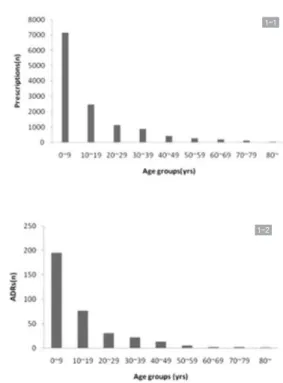
연령대에 따른 유해반응 건수의 분포를 보면 연령 이 증가할수록 사례가 감소하는 양상을 보였다(Fig.
1). 그러나 이것은 처방량을 반영하지 못한 값으로 전체 처방량 대비 유해반응 건수의 비율로 검토하였 을 때(Table 6), 청소년기(12~18세)의 유해반응 발 현 빈도가 가장 높게(3.1%) 나타났으며, 연령대에 따 른 유해반응의 발현빈도는 통계적으로 유의한 차이 는 없었다(p=0.51).
Oseltamivir의 WHO-UMC 인과성 평가 분포 (Table 7)에서는‘possible’ 이 80.8%인데 반하여, 'probable'은 17.0%였다. 이는 동일 모니터링 기간
Characteristics
GenderFemale Male Age (yrs)
<1 1~11 12~18 19~64 65≤
Type of report Voluntary Reports Reports by tele-monitoring Seriousness
Serious adverse events non-Serious adverse events
ADRs, n(%)
171(49.1) 177(50.9)
26(7.5) 182(52.3)
61(17.5) 75(21.6) 4(1.1)
55(15.0) 304(85.0)
25(7.0) 334(93.0)
Table 4. Demographic data
*Eleven ADR reports without age and gender were not included.
1-1
Fig. 1 Number of Prescriptions and ADRs by age groups
1-2
(2009년 1월~2010년 12월) 동안의 아주대병원 지역 약물감시센터 전체 약물에 대한 유해반응 데이터 중 인과성 분포에서‘possible(49.2%)’ 과‘proba- ble(43.0%)’ 이 유사한 빈도를 보였던 것과는 다른 양 상을 보였다. 이는 oseltamivir 유해반응사례의 경우, 대부분 다른 병용약물이 있어, 이로 인한 유해증상일 가능성을 배제할 수 없거나, 신종 인플루엔자 감염증 자체의 증상과 구별이 불분명한 데 원인이 있었다. 재 투여를 통해서 유해반응의 재발현을 확인한
‘certain(명확함)’ 의 인과관계를 가진 사례는 없었다.
Oseltamivir의 유해반응을 계열별로 분석(Table 8) 해보면, 문헌상의 발생빈도 순서와 유사하게
10-12)구역, 구토, 설사, 복통 등의 위장관계 증상이 244건(59.7%) 으로 가장 많았고, 신경정신계 유해반응이 67(16.4%) 건으로 그 다음을 차지하였다. 혈액계, 신장 유해반응
WHO-UMC Causality Assessment
Certain Probable
Possible Unlikely Total
Number of Oseltamivir ADR Reports (%)
0 (0) 61 (17.0) 290 (80.8)
8 (2.2) 359
Number of Total ADR Reports (%)
142 (3.7) 1653 (43.0) 1890 (49.2) 156 (4.1)
3841
Oseltamivir ADRs/
Total ADRs (%)
0.0 3.7 15.35.1 9.3
Table 7. ADR reports based on WHO-UMC Causality Assessment
Age (yrs)
<1 1~11 12~18 19~64 65≤
Total
ADRs (n)
26 18261 75 4 348
Prescriptions
1064 6480 1940 2958 247 12689ADRs/Prescription (%)
2.4 2.8 3.1 2.5 1.6 2.7Table 6. ADR reports out of total prescriptions by age groups
*Eleven ADR reports without age and gender were not included.
ADRs
Vomiting Diarrhea Nausea Dizziness Rash Urticaria Weakness Headache Abdominal Pain Dyspepsia SomnolenceAbdominal discomfort
n (%)
87 (19.0) 85 (18.6) 71 (15.5) 32 (7.0) 26 (5.7) 25 (5.5) 25 (5.5) 19 (4.2) 10 (2.2) 7 (1.5) 7 (1.5) 5 (1.1)Table 5. Frequent adverse reactions of oseltamivir
*Multiple classification is permitted.
은 보고되지 않았다. Oseltamivir에 의한 위장관계와 신경정신계 유해반응은, 본 센터에 보고된 전체 약물 에 대한 유해반응 데이터에서의 비율(위장관계 31.4%, 신경정신계 12.8%)보다 더 높은 비율을 차지하였고, oseltamivir에 의한 피부 유해반응(13.9%)은 전체 데 이터 중 비율(28.0%)에 비해 낮은 비율을 보였다.
Oseltamivir의 신경정신계 유해반응의 빈도가 높 은 점을 고려하여, 67례의 신경정신계 유해반응을 집중 분석한 결과 1~11세에서 15건, 12~18세에서 20건, 19~64세에서 22건, 65세이상에서 2건의 연 령분포를 보였으며, 0세에서의 보고는 없었다(Table 9). 처방량 대비한 유해반응의 빈도에서는 청소년층
*Eight ADR reports without age and gender were not included.
Age (yrs)
<1 1~11 12~18 19~64 65≤
Total
ADRs (n)
0 15 20 22 2 59Prescriptions
1064 6480 1940 2958 247 12689ADRs/Prescription (%)
0.0 0.2 1.0 0.7 0.8 0.5Table 9. Neuropsychiatric ADR reports by age groups
Classification
Gastrointestinal Neuropsychiatric Dermatologic Systemic Cardiovascular Hepatic & biliary Respiratory
Ears, eyes, nose, and throat Musculoskeletal
Hematologic Renal Miscellaneous Total
Number of Oseltamivir ADR Reports (%)
244 (59.7) 67 (16.4) 57 (13.9) 25 (6.1)
8 (2.0) 3 (0.7) 3 (0.7) 1 (0.2) 1 (0.2) 0 (0) 0 (0) 0 (0) 409
Number of Total ADR Reports (%)
1405 (31.4) 574 (12.8) 1252 (28.0)
399 (8.9) 150 (3.4) 79 (1.8) 95 (2.1) 71 (1.6) 60 (1.3) 220 (4.9)
137 (3.1) 27 (0.6) 4469
Table 8. ADR reports by systemic organ classification
*Multiple classification is permitted.
(12~18세)의 발생빈도(1.0%)가 가장 높게 나타났다.
증상 면에서는 어지러움, 두통, 졸음, 불면, 식욕부 진, 떨림 등의 증상이 대부분을 차지하였으나(Table 10), 기타로 분류된 증상 중 악몽, 환각, neuropsy- chiatric change와 같은 흔하지 않은 사례가 각각 1 건씩 있었으며, 이러한 흔하지 않은 사례들은 모두 WHO-UMC 지표상‘possible’ 에 해당하였다.
고찰
질병역학 통계상 실제 H1N1 인플루엔자A 바이러 스의 감염율은 미국의 경우 24세 이하에서 가장 높 았고
13), 2009년 4월에서 2010년 4월 10일까지의 발 생빈도는 0세에서 17세까지가 2천만례, 18세에서 64세에서 3천 5백만례, 65세 이상이 6백만례로 나 타난 바 있다
14). 자료수집 기간동안의 oseltamivir 처방량은 연령에 따른 역학적인 감염율과 같이 연령 이 낮을수록 증가하는 양상을 보였다. 환자의 복약 순응도(compliance)를 반영하지 못한 값이라는 점 에서 처방량과 실제 노출된 환자 수와는 차이가 있을 수 있다는 한계가 있지만, 과거 연령에 따른 oseltamivir의 compliance에 대한 연구가 없었던 것을 고려하여 실제 노출된 건수대신 처방량에 비교 해 보았을 때, 연령대에 따른 유해반응의 발현빈도도
처방량과 비슷한 추이를 보였다.
인플루엔자 치료에 대한 3상 임상시험에서 성인환 자 중 가장 빈번하게 보고된 이상반응은 구역과 구 토였으며, 인과관계와 무관하게 oseltamivir를 투 여한 환자에서 더 많이 보고된 이상반응은 구역, 구 토, 복통, 두통이었다. 예방요법에 대한 3상 임상시 험에서는 구역과 두통이 가장 빈번하게 보고되었으 며, 유해반응 양상은 치료요법에서의 결과와 유사하 였다
6). 본 연구에서 수집된 유해사례의 증상 경향 또 한 이전의 임상시험을 통해 나타난 자료와 유사한 양상을 보였다.
2004~2005년 계절성 인플루엔자 기간 동안 일본 에서 소아에 대한 oseltamivir의 신경정신계 유해 증상 보고가 있었고, 2006년의 약물감시를 통해 보 고 빈도가 더 증가하여 oseltamivir에 의한 신경정 신계 유해증상이 주목을 받았다. 이에 미국 FDA에 서는 2006년 11월 해당기간의 자료를 이전의 데이 터와 분석하였는데, 신경정신계 유해반응에 대한 oseltamivir의 상대적인 기여도는 명확하지 않다고 결론내렸다
15). 또한 oseltamivir의 무작위배정 위약 대조군 3상 임상시험에서는 신경정신계 유해반응의 발생이 oseltamivir를 투여한 사람에게서 더 높지 않음을 보여주었으며, 영국의 GPRD(General Practice Research Database)를 이용해 이루어진 분석에서는 인플루엔자 자체에 의해서도 신경정신 계 증상이 발생할 위험도가 유의적으로 높음을 보인 바 있다
16).
Oseltamivir의 국내 허가사항에도 10세 이상의 미 성년환자에 있어서는 인과관계는 불분명하지만 이 약의 복용 후에 이상행동이 발현하고 추락 등의 사고 에 이른 예가 주로 일본에서 보고되어 있음이 명시되 어 있으나, 실제 인과관계 가능성은 매우 낮은 것으 로 확인되었다. 그러나, 국내에서 고열 증상으로 oseltamivir를 복용한 10대 청소년이 악몽을 꾼 후 창으로 뛰어내린 사례가 보고된 바 있으며
17), 또한 Toovey 등의 연구에서는 미국, 일본의 단위처방량 당 oseltamivir 신경정신계 약물유해반응 보고에서 16세 초과의 성인보다 16세 이하의 어린이에서 더 높은 발현빈도를 보인 바 있다
16). 원인이 약제인지 질 환인지는 논의의 여지가 있지만, 본 연구의 자료에서 ADRs
Dizziness Headache Somnolence Insomnia Anorexia Tremor Others Total
n (%)
27 (40.3) 15 (22.4) 7 (10.4)2 (3.0) 2 (3.0) 2 (3.0) 12 (17.9)
67