한수지 53(5), 725-732, 2020
725
Copyright © 2020 The Korean Society of Fisheries and Aquatic Science pISSN:0374-8111, eISSN:2287-8815 Korean J Fish Aquat Sci 53(5),725-732,2020
Original Article
서 론
어류양식장에서수온은어류의성장과생산력에영향을미치 는결정적인역할을한다
(Beitinger and Bennet, 2000; Pörtner and Peck, 2010).
변온동물인어류는수온의변화에따라생리 적순응에의존하는온도순응자(Cooper et al., 2019)
이며,
어류의생리와행동은수온과밀접하게연관되며
(Huey and Ste-
venson, 1979; Cooper et al., 2019),
어류가생리적으로기능할 수있는온도범위가있다.
어류의호흡률은대사율을추정하기 위해이용되고있으며(Reyes et al., 2011),
산소소비율이대사 의척도가되고있다.
어류의산소소비율은수온을포함한다양 한환경요인에영향을받으며,
어류의건강과관련한다(Burton et al., 2011).
일반적으로어류의대사율은수온과직접적인관계를나타내며
,
수온10°C
증가에따라대사율이2-3
배증가하 며(Schmidt-Nielsen, 1997),
이는온도계수(Q
10)
으로나타낼수 있다.
변온동물에서수온변화에대한산소소비율에대한평가 는온도계수를이용하여서식지에서생존가능성을추정할수 있는지표가될수있다(Carvalho and Phan, 1997).
어류혈액 의생리·
생화학적특징은수온,
서식지의환경변화등에영향을 받으므로어류의건강도평가를위해어류의혈중생화학적분 석은매우유용한지표이다(Ferguson et al., 2010; Fazio et al., 2013).
어류의생존,
생리등에미치는수온의영향에대하여혈 액의스트레스반응으로분석한연구는red spot grouper (Cho et al., 2015), Atlantic cod Gadus morhua (Kunz et al., 2016), sea bass (Kir and Demirci, 2018)
등다양하다.
돌돔(Oplegna-
thus fasciatus)
은한국남해안의해상가두리에서양성되고있돌돔(Oplegnathus fasciatus)의 생존, 산소소비 및 생리학적 반응에 미치는 저수온의 영향
신윤경*·최영재·김원진 1
국립수산과학원 남해수산연구소, 1충청남도수산자원연구소
Survival, Oxygen Consumption and Stress Response of Parrotfish Oplegnathus fasciatus Exposed to Different Lower Temperature
Yun Kyung Shin*, Young Jae Choi and Won Jin Kim
1
Aquaculture Industry Research Division, South Sea Fisheries Research Institute, NIFS, Jeonnam Yeosu 59780, Korea
1Chung cheongnam-do Institute of Fisheries Resources, Chungnam Boryoung 33508, Korea
The sudden drop of water temperature in winter is very threatening factor that affects the productivity of farmed fish and the management in aquafarm. In this study, we investigated the effect of low temperature on the survival, oxygen consumption and stress responses of parrotfish Oplegnathus fasciatus due to acute drop of water temperature.
The survival rate of parrotfish Oplegnathus fasciatus was 5% at 6°C, 95% at 8°C and 100% at 10°C on the 4 th day of exposure in each experimental temperature. Low-lethal temperature for 4days of parrotfish Oplegnathus fasciatus (4 day-LT 50 ) was 6.99°C (confidence limit, 6.55-7.42°C). Oxygen consumption rate was significantly decreased with decreasing water temperature. Temperature coefficient (Q 10 ) was found to be 4.0 between 10°C and 8°C and 0.39 between 8°C and 6°C. As a result of investigating the stress response according to the drop in water temperature, the concentration of SOD (Superoxide dismutase), cortisol, glucose, total Ig, AST (Aspartate) and ALT (Alanine aminotransferase) increased with decreasing of water temperature. This study would be useful for the management of temperature about cultured fish.
Keywords: Low temperature tolerance range, Oplegnathus fasciatus, Survival, Stress response
*Corresponding author: Tel: +82. 61. 690. 8971 Fax: +82. 61. 685. 9073 E-mail address: [email protected]
This is an Open Access article distributed under the terms of the Creative Commons Attribution Non-Commercial Licens (http://creativecommons.org/licenses/by-nc/3.0/) which permits unrestricted non-commercial use, distribution, and reproduction in any medium, provided the original work is properly cited.
Received 26 May 2020; Revised 23 June 2020; Accepted 31 August 2020 저자 직위: 신윤경(연구관) 최영재(연구사) 김원진(연구사) https://doi.org/10.5657/KFAS.2020.0725
Korean J Fish Aquat Sci 53(5), 725-732, October 2020
신윤경
ㆍ
최영재ㆍ
김원진726
는온대성주요양식어종으로겨울철의급격한수온하강및수 온변동으로인해양성관리에어려움이있으며
,
저수온으로인 한피해가종종발생하고있는실정이므로,
겨울철양성관리를 위한하한수온및저수온으로인해나타나는돌돔의생리학적 변화와하한수온에대한정보는필요하다.
본연구는겨울철수온하강으로인해빈번하게폐사가발생하 고있는돌돔
(Oplegnathus fasciatus)
의양식현안을해소하고 양성관리를위한기초자료로활용하기위해돌돔의하한수온내 성범위,
대사반응및혈액학적반응에대한연구를수행하였다.
재료 및 방법
실험에 사용된돌돔
(Oplegnathus fasciatus)
은 경남 통영시 산양읍소재 해상가두리 양식장에서2018
년10
월에 구입하 여실험실로옮긴후1
톤유수식수조에서사육관리하였으며,
실험시작한달전부터수온
14±1°C
에순치시켜실험에사용하였다
.
순치기간동안염분은33.6±0.5 psu,
용존산소농도는9.7±0.5 mg/L
를유지하였으며,
먹이는수협사료(
침강골드3
호)
를매일2
회씩공급하였다.
저수온에대한하한내성수온을 분석하기위하여실험수온은10 (
대조구), 8, 6, 4, 2±0.5°C
였 으며,
염분은일반해수로서33.6±0.5 psu
였다.
대조구실험수온은
10±0.5°C
였으며, 2
주일간순치시킨후각실험수온으로하강하여급성수온노출실험을수행하였다
.
실험에사용된 개체는450
마리였으며,
실험어의크기는평균전장15.3±0.9 cm,
평균전중량75.4±16.6 g
이었다.
실험방법은450 L
수조를이용하여
180 L/h
를환수하는방법의유수식으로1
회실험시
4
일간수행하였으며, 3
회 반복실험을수행하였다.
실험수 온은냉각기(DA-1000B, Daeil, Busan, Korea)
와온도조절기(DOV-882F, Daeil, Busan, Korea)
를이용하여조정하였다.
생 존율은12
시간간격으로점검하고사망개체를선별하여생존 율로환산하여 구하였고,
반수치사수온(50% lethal tempera- ture)
은probit
법에의해분석(Finney, 1971)
하였으며,
사망개 체는실험어류가뒤집혀서아가미뚜껑의운동이정지되었을 때사망으로판정하였다.
모든실험은3
회반복하여평균값을 이용하였다.
산소소비율은수온하강에따른돌돔의저수온에 대한대사반응을파악하기위하여수온14, 12, 10, 8, 6±0.5°C
에4
일동안노출시킨후respirometer
와산소호흡측정기(Or- bis 3600, Orbis, Zurich, Switzerland)
를이용하여 실험전후respirometer
내용존산소의차로서구하였다.
온도계수(Q
10)
은 아래에나타낸Q
10의방정식(Schmidt-Nielsen, 1997)
을이용하 여산소소비율에대한순응영향을평가하였다.
Q
10=(Rate
2/Rate
1)
(10/Temp2-Temp1)여기서
Rate
2와Rate
1은T2
와T1
에서산소소비율을나타낸다.
돌돔의스트레스반응은각실험수온에노출시킨후4
일째살 아있는개체를대상으로돌돔의미부동맥에서3 mL
주사기를이용해혈액을채취하였다
.
채혈한혈액은capillary tube
에넣 고-4°C
에서10,000 rpm
으로10
분간원심분리하여혈장을분 리한후-80°C
에보관하고분석시에사용하였다.
혈장의glu- cose, ALT (alanine aminotransferase)
와AST (aspartate ami- notransferase)
는FUJI-CHEM 7000i (Fujifilim, Tokyo, Japan)
에서전용kitslide
를사용하여분석하였다.
혈장내SOD (su- peroxide dismutase), CAT (catalase), cortisol
은어류ELISA kit (Cusabio Biotech, Wuhan, China)
를사용하였으며, Versa- max SoftMax pro 6 (Morecular Devices, San Jose, CA, USA)
를이용하여파장450 nm
에서흡광도를측정하였다. Total Ig
은bradford assay
를통하여단백질양을측정하여파장595 nm
에서분석하였다.
혈장내malondialdehyde (MDA)
활성도는TBARS assay kit (Cayman, product number: 10009055)
를사 용하였고,
혈액내삼투질농도는삼투압측정기Osmomat 3000 (Gonotec, Berlin, Germany)
을이용하여분석하였다.
실험결 과에사용된유의성검정은SPSS 19.0
을이용하여one-way ANOVA
로통계처리후Duncan̓s multiple range test
로사후 검증하였다.
Fig. 1. Survival rate of parrotfish Oplegnathus fasciatus with de- creasing of water temperature.
0 20 40 60 80 100
1 2 3 4
Surviva l ra te (% )
Elapsed time (days) 2°C 4°C 6°C 8°C 10°C (control)
0 50 100 150 200
14 12 10 8 6
Oxygen consumption (mg O
2/kg/h)
Temperature (°C)
0 200 400 600
10 (control) 8 6 4
Osmol al ity (mOsm/kg)
Temperature (°C)
Fig. 2. Changes in oxygen consumption rate of parrotfish Oplegna- thus fasciatus with decreasing temperature.
0 20 40 60 80 100
1 2 3 4
Surviva l ra te (% )
Elapsed time (days) 2°C 4°C 6°C 8°C 10°C (control)
0 50 100 150 200
14 12 10 8 6
Oxygen consumption (mg O
2/kg/h)
Temperature (°C)
0 200 400 600
10 (control) 8 6 4
Osmol al ity (mOsm/kg)
Temperature (°C)
돌돔의 생존에 미치는 저수온의 영향
727
결 과
수온 하강에 따른 생존율
수온하강이돌돔의생존에미치는영향을알아보기위하여
,
실험어를대조구수온
10°C
에서2
주간순치시킨후실험수온8, 6, 4
및2°C
에급성으로노출시킨생존율결과를Fig. 1
에나 타내었다.
수온2°C
의경우에는노출후2
시간째모두폐사하 였으며,
수온4°C
에서는노출10
시간째부터어체가뒤집히기 시작하여노출18
시간째모두폐사하였다.
수온6°C
에서는노 출2
일째생존율30%,
노출4
일째5%
생존하였다.
반면수온8°C
에서는노출4
일째95%,
수온10°C
에서는실험기간동안 폐사개체는관찰되지않았다.
각실험수온에노출시킨4
일동 안돌돔의저수온에대한반수치사수온(LT
50)
은6.99°C (6.55- 7.42°C)
였다.
수온하강에 따른 산소소비율 변화
수온하강에따른돌돔대사율의변화를파악하기위하여수온
14, 12, 10, 8, 6±0.5°C
에4
일동안노출시킨후산소소비율을 측정하였다(Fig. 2).
산소소비율은수온14°C
에서115.1±14.8 mgO
2/kg/h
였으며, 10°C
에서70.6±3.9 mgO
2/kg/h,
수온8°C
에서는53.5±5.2 mgO
2/kg/h
으로수온하강에따라유의하게 감소(P<0.05)
하였다.
반면수온6°C
에서는64.5±8.1 mgO
2/ kg/h
으로8°C
에비해다소증가하는양상을보였다(Fig. 2).
수온 하강에 따른 스트레스 반응
수온하강에따른돌돔의스트레스반응을알아보기위하여
,
수온10°C, 8°C
및6°C
의경우,
각실험수온에4
일간노출시킨 후생존한개체를대상으로혈액내SOD, CAT, total Ig, corti- sol, glucose, malonelialdehyde (MDA), AST, ALT
및osmo- lality
의변화를분석하였다.
그러나4°C
의시험구는노출18
시간이내폐사하는점을감안하여폐사하기전실험어가뒤집혔 을때혈액채취후스트레스반응을분석하여수온
10°C, 8°C, 6°C
의시험구결과와비교하였다.
돌돔의혈액내활성산소제 거효소인SOD
활성도는수온4°C
에서가장높게나타났으며,
대조구
10°C
에비해수온이하강할수록유의하게증가하는경향을보였다
(P<0.05). CAT
농도는수온4°C
와6°C
간에유사하였으나
,
대조구10°C
와비교하여유의하게높은것으로나타났다
(P<0.05) (Fig. 3). Fig. 4
는수온하강에따른돌돔의혈중to- tal Ig, cortisol, glucose, malondialdehyde (MDA), AST, ALT
에대한스트레스반응을나타낸것이다.
수온하강에따른혈중total Ig
농도는대조구10°C
에서1.4±0.3 μg/μL
으로가장높 게나타났으며,
수온이하강함에따라유의하게감소하는경향 을보였고(P<0.05),
수온4°C
에서0.8±0.5 μg/μL
으로가장낮 은값을나타내었다(Fig 4).
반면, cortisol
은total Ig
와는다른 경향을보였으며,
수온4°C
에서가장높은농도2.005 ng/mL
를나타내었고,
수온하강에따라증가하였으며8°C
이하로하 강할수록수온간유의한차이를나타내었다(P<0.05) (Fig. 4).
Glucose
농도는4°C
에서가장높게나타났으며,
대조구에비해 수온이하강할수록증가하는경향을보여cortisol
농도의결과 와유사한경향을보였다.
또한수온하강에따른혈중MDA
농 도변화를관찰한결과, 4°C
에서가장높은농도인1.593 μM
를나타내었으며, 6°C
이상의수온에서는유의한차이를보이 지않았다.
혈중ALT
와AST
는수온4°C
에서가장높은농도를 나타내었으며,
대조구에서수온하강에따라유의하게증가하 였다(Fig. 4).
한편혈액내삼투질농도는대조구와수온8°C
와 유의한차이를나타내지않았으나(P>0.05),
수온6°C
노출구에 서가장높았으며, 4°C
에서는감소하는경향을보였다(Fig. 5).
고 찰
돌돔은한국의제주도를중심으로 남해안암초지대에주로 Fig. 3. Changes in the enzymatic activities of superoxide dismutase (SOD) and catalase (CAT) in blood of parrotfish Oplegnathus fasciatus exposed to different experimental temperature.
0 100 200 300 400
10 (control) 8 6 4
SO D (m U /m L)
Temperature (°C)
0 10,000 20,000 30,000 40,000 50,000 60,000
10 (control) 8 6 4
CAT (U/ m L)
Temperature (°C)
0 0.2 0.4 0.6 0.8 1 1.2 1.4 1.6 1.8 2
10 (control) 8 6 4
Total Ig (μg/μL)
Temperature (°C)
0 0.5 1 1.5 2 2.5
10 (control) 8 6 4
Cortisol (ng/mL)
Temperature (°C)
0 70 140 210 280 350
10 (control) 8 6 4
Glucose (mg/dL)
Temperature (°C)
0 0.4 0.8 1.2 1.6
10 (control) 8 6 4
Malondialdehyde (μM)
Temperature (°C)
0 20 40 60 80 100 120 140
10 (control) 8 6 4
ALT (U/dL)
Temperature (°C)
0 100 200 300 400 500 600 700
10 (control) 8 6 4
AS T (U /d L)
Temperature (°C)
신윤경
ㆍ
최영재ㆍ
김원진728
서식하는온대성고급어종으로
,
성어기사육을위한적정수온 은25°C
내외이다(Kim et al., 2008)
이다.
한국에서돌돔양식은
1987
년부터종묘생산기술개발을시작으로1993
년도에대량생산체제가구축되었으며
,
주로통영지역을중심으로해상 가두리에서양식되고있으나양성과정에서겨울철수온하강 기에종종대량폐사가발생하고있다.
어류양식장에서수온은 어류의성장과생산력에영향을미치는결정적인역할을하며(Beitinger et al., 2000; Pörtner and Peck, 2010),
어류의수온 내성범위는어류가생리적으로기능할수있는수온의범위를의미하므로이들의생리적범위내에서어류가선호
(Perez et al., 2003)
또는적절한수온(Huey and Stevenson, 1979)
이있 다고알려져있다.
본연구는겨울철저수온으로인한돌돔의폐사를줄이기위 해월동가능한수온의범위와저수온노출시나타나는생리적 반응을알아보기위해수행되었다
.
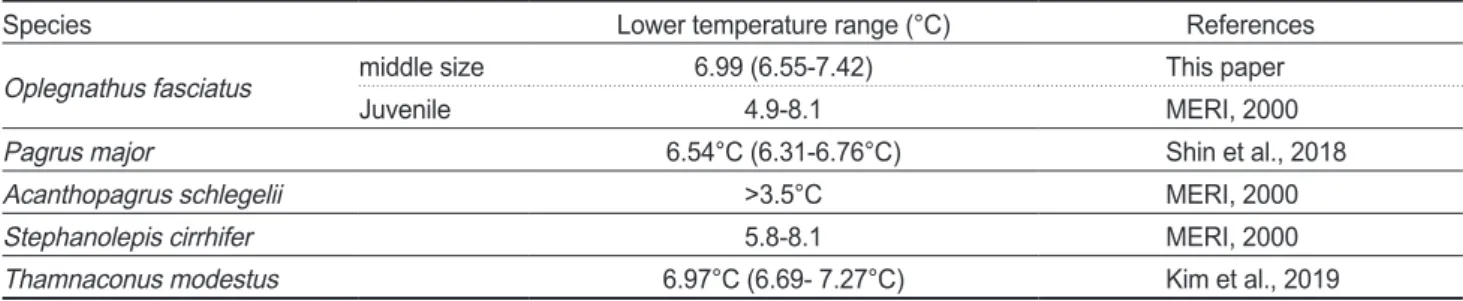
온대성양식어종의저수온 에대한반수치사수온은Table 1
에요약한것과같이농어목도 미과에속하는참돔의반수치사수온은6.54°C (6.31-6.76°C)
였으며(Shin et al., 2018),
감성돔의 경우생존가능한수온은 Fig. 4. Changes in total Ig, total cortisol, glucose, malondialdehyde, ALT and AST in blood of parrotfish Oplegnathus fasciatus exposed to different experimental temperature. ALT, Alanine aminoreansferase ; AST, Aspartate transaminonase.0 100 200 300 400
10 (control) 8 6 4
SO D (m U /m L)
Temperature (°C)
0 10,000 20,000 30,000 40,000 50,000 60,000
10 (control) 8 6 4
CAT (U/ m L)
Temperature (°C)
0 0.2 0.4 0.6 0.8 1 1.2 1.4 1.6 1.8 2
10 (control) 8 6 4
Total Ig (μg/μL)
Temperature (°C)
0 0.5 1 1.5 2 2.5
10 (control) 8 6 4
Cortisol (ng/mL)
Temperature (°C)
0 70 140 210 280 350
10 (control) 8 6 4
Glucose (mg/dL)
Temperature (°C)
0 0.4 0.8 1.2 1.6
10 (control) 8 6 4
Malondialdehyde (μM)
Temperature (°C)
0 20 40 60 80 100 120 140
10 (control) 8 6 4
ALT (U/dL)
Temperature (°C)
0 100 200 300 400 500 600 700
10 (control) 8 6 4
AS T (U /d L)
Temperature (°C)
돌돔의 생존에 미치는 저수온의 영향
729
3.5°C
이상으로보고(MERI, 2000)
되고있다.
또한복어목쥐치 과에속하는쥐치는5.8-8.1°C (MERI, 2000),
말쥐치는6.97°C (6.69-7.27°C)
으로보고(Kim et al., 2019)
되고있다.
이러한결 과는본연구의농어목돌돔과에속하는돌돔의반수치사저수 온6.99°C (6.55-7.42°C)
와유사하게나타나고있으며,
이는겨울철
7°C
이하수온이지속될때폐사가발생할수있는수온으로분석된다
.
그러나폐사를일으키는수온은어류의순치수온 에따라다소변할수있고(Reyes et al., 2011),
어류의폐사는 생존에필요한생리적과정을순치수온에최적화시키지못하 고,
어류의내적체온조정에실패했을때발생한다(Bellgraph et al., 2010; Reyes et al., 2011).
수온변화는수서동물의많은생리적과정에뚜렷한변화를 나타내며
,
생리적범위내에서수온증가는대부분의대사과정 을가속화한다.
어류의호흡률은대사율을추정하는도구로이 용되어오고있으며(Reyes et al., 2011),
대사의척도가되는산 소소비율은동물이내성을갖는모든범위내에서온도가증가 함에따라일정한비율로증가한다(Hazel and Prosser, 1974).
산소소비율은체내항정성조절과정과연결되는대사작용및 에너지흐름과관련되므로
(Salvato et al., 2001),
어류의대사율 은산소소비율측정으로추정할수있으며,
성장을위한적정수 온은온도계수(Q
10)
으로추정할수있다(Xiuping et al., 2019).
온도계수
(Q
10)
는온도에대한생물의민감도를나타내며,
온도변화후수서생물이조절할수있는대사능력의척도이다
(Ma- zumder et al., 2019).
온도계수
(Q
10)
의감소는어류의대사율이감소하는것을의미 하며(Díaz et al., 2007),
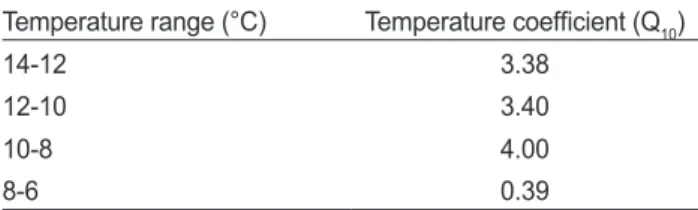
본연구에서돌돔의수온간Q
10(Table 2)
은14-12°C
의경우3.38, 12-10°C
에서3.40
으로유의한차이 를나타내지않았으나10-8°C
에서는4.0
으로증가한후8-6°C
범위에서0.39
으로가장낮았다.
이는6°C
이하에서 대사기능 이현저히감소하면서생존이어려워지는상태인것으로추정 된다.
어류에서급성저수온스트레스는세포막의유동성을저해하 고조직손상을유도하며
(Qi et al., 2013; Cheng et al., 2017),
활 성산소(ROS)
를증가시킬수있다(Chandra et al., 2000; Meng et al., 2014; Xu et al., 2018).
본연구에서 돌돔의항산화효 소SOD
와CAT
는수온하강에따라증가하였으며,
이는참돔(Shin et al., 2018)
과말쥐치(Kim et al., 2019)
등온대성양식 어류에서5°C
와6°C
수온에노출된후유의하게활성증가가나타난것과유사한결과를나타내어
6°C
이하저수온에서조직내
ROS
생성이증가하여이를제거하기위한방어기작(Paital, 2013)
으로SOD
와CAT
가증가한것으로추정된다.
척추동물의방어기전중후천적면역반응은항원의자극에의 해숙주가특이적인면역글로불린
(Igs)
을생산한다.
이들면역 글로블린은병원체를제거하거나혈액또는기관으로병원성 인자가유입되는것을막는기능(Rauta et al., 2012)
을하기때문에어류의
total Ig
은어류의체액성면역반응을측정할수있는지표로이용된다
(Rauta et al., 2012).
본연구에서돌돔의total Ig
은수온하강에따라감소하는경향을보여저수온에대한민감도가높은것으로나타났다
.
코티졸과글루코스는매우 중요한어류의스트레스반응지표(Sampaio and Freire, 2016)
로보고되지만,
극지방어류는겨울동안체온유지를위해높은 혈당을나타낸다(Ibarz et al., 2010).
본연구에서저수온에노 출된돌돔의혈중코티졸과글루코스가유의하게증가한점은 온대성어종이수온하강에순치하기위한중요한생리적반응 으로여겨진다.
ALT
와AST
는아미노산대사에필요한효소로서세포막활성 에중요한지표이다(Cheng et al., 2017).
또한저수온노출은간 에영향을주는스트레스요인으로ALT
와AST
효소활성의증 가를유도하며(Cheng et al., 2017; Sun et al., 2019),
젖산의축Table 1. The lower temperature range of temperature about cultured fishes
Species Lower temperature range (°C) References
Oplegnathus fasciatus middle size 6.99 (6.55-7.42) This paper
Juvenile 4.9-8.1 MERI, 2000
Pagrus major 6.54°C (6.31-6.76°C) Shin et al., 2018
Acanthopagrus schlegelii >3.5°C MERI, 2000
Stephanolepis cirrhifer 5.8-8.1 MERI, 2000
Thamnaconus modestus 6.97°C (6.69- 7.27°C) Kim et al., 2019
Fig. 5. Changes in Osmolality in blood of parrotfish Oplegnathus fasciatus exposed to different experimental temperature.
0 20 40 60 80 100
1 2 3 4
Surviva l ra te (% )
Elapsed time (days) 2°C 4°C 6°C 8°C 10°C (control)
0 50 100 150 200
14 12 10 8 6
Oxygen consumption (mg O
2/kg/h)
Temperature (°C)
0 200 400 600
10 (control) 8 6 4
Osmol al ity (mOsm/kg)
Temperature (°C)
신윤경
ㆍ
최영재ㆍ
김원진730
적
,
이온불균형과에너지소비등의생리적스트레스를유발시 키며,
행동장애를보임에따라결국저수온에기인한스트레스 로인해폐사를유도할수있다(Donaldson et al., 2008).
돌돔 은6°C
저수온노출에서ALT
와AST
가현저하게증가하는양 상을보였다.
저수온노출에대한유사한결과는hybrid grouper (Xiuping et al., 2019)
에서도나타나고있으며, sea bream
은저 수온기동안근육과간조직의글리코겐을이용하여혐기성대 사로유도되며.
혈액내젖산이축적된다(Samaras et al., 2016).
본연구에서돌돔은수온
6°C
에서삼투질농도가가장높았으 나,
말쥐치(Kim et al., 2019)
에서저수온간에유의한차이를보 이지않았으며,
참돔Pargus major (Shin et al., 2018)
과Alosa pseudoharengus (Stanleley and Colby, 1971)
에서는수온하강 에따라증가하는이온불균형을나타내었다.
어류와같은변온동물에서체온조절을위한행동반응은생존 을좌우하는매우중요한생리적반응이며
(Crawshaw, 1977),
대부분의어류는주로행동으로체온을조절한다고보고되고 있다(Bicego et al., 2007).
특히저수온쇼크의공통적인반응 은평형이상실되고반응이느리고유영력이감소하는데,
평형 상실은어류가도망갈수없도록하는결과를가져와결국은폐 사에이르게한다(Fuiman and Batty, 1997; Smith and Hubert,
2003).
본연구에서수온이하강함에따라돌돔의유영행동은둔화되고움직임이거의없이한쪽으로몰리는현상을보였으
며
, 6°C
이하수온에서는노출시간이길어짐에따라몸의균형을잃고뒤집힌체유영하다가폐사하였으며
,
폐사당시에는지 느러미주변과체표면에모세혈관출혈및피부괴사등의현상 이관찰되었다.
이는저수온쇼크에의해어류에서나타나는공 통적인현상으로(Fuiman and Batty, 1997; Smith and Hubert,
2003)
저수온에 노출된 말쥐치에서도 유사하게 관찰되었다(Kim et al., 2019).
따라서본연구의결과를종합해보면겨울철수온하강에따 른돌돔의하한내성수온은
6.99°C (6.55-7.42°C)
이었으며, 8°C
이하에서 산소소비율이 감소하여 온도계수(Q
10)
는 수온10- 8°C
간에4.0, 8-6°C
간에0.39
으로수온6°C
이하에서생존에영 향을미치는것으로나타났다.
또한수온하강에의한스트레스 반응결과하한내성수온범위이하에서면역글로블린의농도가 감소하고스트레스지표로이용되고있는SOD, glucose, cor-
tisol
의농도가증가하는현상등으로미루어볼때온대성양식어종인돌돔양성에서하한내성수온의범위를벗어날경우저
수온에의한치명적인영향을미칠수있을것으로생각된다
.
사 사
본 연구는
2020
년도 국립수산과학원 수산과학연구사업(R2020010)
의지원으로수행되었습니다.
References
Bellgraph BJ, McMichael GA, Mueller RP and Monroe JL.
2010. Behavioural response of juvenile Chinook salmone
Oncorhynchus tshawytscha during sudden temperature in-
crease and implications for survivor. J Therm Biol 35, 6-10.https://doi.org/10.1016/j.jtherbio.2009.10.001.
Beitinger TL and Bennet WA. 2000. Quantification of the role of acclimation temperature in temperature tolerance of fishes.
Environ Biol Fishes 58, 277-288.
Bicego KC, Barros RCH and Branco LGS. 2007. Physiology of temperature regulation: comparative aspects. Comp Bio- chem Physiol A 147, 616-639. https://doi.org/10.1016/j.
cbpa.2006.06.032.
Burton T, Killen SS, Armstrong JD and Metcalfe NB. 2011.
What causes intraspecific variation in resting metabolic rate and what are its ecological consequence?. Proc R Soc 278, 3465-3473. https://doi.org/10.1098/rspb.2011.1778.
Carvalho P and Phan V. 1997. Oxygen consumption and ammo- nia excretion of Xiphopenaeus kroyeri Heller (Penaeidae) in relation to mass temperature and experimental procedures shrimp oxygen uptake and ammonia excretion. J Exp Mar Biol Ecol 209, 143-156. https://doi.org/10.1016/S0022- 0981(96)02703-7.
Chandra J, Samali A and Orrenius S. 2000. Triggering and mod- ulation of apoptosis by oxidative stress. Free Radic Biol Med 3, 323-333. https://doi.org/10.1016/s0891-5849(00)00302- Cheng CH, Ye CX, Guo ZX and Wang AL. 2017. Immune and 6.
physiological responses of pufferfish Takifugu obscurus un- der cold stress. Fish Shellfish Immunol 64, 137-145. https://
doi.org/10.1016/j.fsi.2017.03.003.
Cho HC, Kim JE, Kim HB and Beak HJ. 2015. Effects of wa- ter temperature change on the hematological responses and plasma cortisol levels in growing of red spotted grouper,
Epinephelus akaara. Dev Reprod 19, 19-24. https://doi.
org/10.12717/devrep.2015.19.1.019.
Crawshaw LI. 1977. Physiological and behavioral reactions of fish to temperature change. J Fish Res Board Can 34, 730- 734. https://doi.org/10.1139/f77-113.
Cooper CJ, Mueller C and Eme J. 2019. Temperature tolerance and oxygen consumption of two South American tetras,
Paracheirodon innessi and Hyphessobrycon herbertaxel- rodi. J Therm Biol 86, 1024-1034. https://doi.org/10.1016/j.
jtherbio.2019.102434.
Table 2. Temperature coefficient (Q10) of parrotfish Oplegnathus fasciatus with decreasing water temperature
Temperature range (°C) Temperature coefficient (Q10)
14-12 3.38
12-10 3.40
10-8 4.00
8-6 0.39
돌돔의 생존에 미치는 저수온의 영향
731
Díaz, F, Re A, González R, Sánchez L, Leyva G and Valenzuela F. 2007. Temperature preference and oxygen consumption of the largemouth bass Micropterus salmoides (Lacépède) acclimated to different temperature. Aqua Res 38, 1387- 1394. https://doi.org/10.1111/j.1365-2109.2007.01817.x.
Donaldson MR, Cooke SJ, Patterson DA and Macdonald JS.
2008. Cold shock and fish. J Fish Biol 73, 1491-1530.
https://doi.org/10.1111/j.1095-8649.2008.02061.x.
Fazio F, Filiciotto F, Marafioti S, Di Stefano V, Assenza A, Pla- centi F and Mazzola SM. 2013. Automatic analysis to assess haematological parameters in farmed gilthead sea bream (Sparus aurata Linnaeus, 1758). Mar Freshw Behav Phys 45, 63-73. https://doi.org/10.1080/10236244.2012.677559.
Ferguson RMW, Merrifield DL, Harper GM, Rawling MD, Mustafa S, Picchietti S and Davies SJ. 2010. The effect of
Pediococcus acidilactci on the gut microbiota and immune
status of on-growing red tilapia Oreochromis niloticus.J App Microbiol 109, 851-862. https://doi.org/10.1111/
j.1365-2672.2010.04713.x.
Finney DJ. 1971. Probit analysis. 3rd. Cambridge University Press, London, U.K., 333.
Fuiman LA and Batty RS. 1997. What a drag is getting cold:
Partitioning the physical and physiological effects of tem- perature on fish swimming. J Exp Bio 200, 1745-1755.
Kim HJ, Lee HJ, Kim WJ and Shin YK. 2019. Survival, he- matological and histological changes of file fish Thamnaco-
nus modestus adult exposed to different lower temperature.
Korean J Ichthyol 31, 201-207. https://doi.org/10.35399/
ISK.31.4.3.
Kim KM, Lee JU, Moon TS, Lee CH, Yang MH, Kang YJ and Jo JY. 2008. Optimum feeding rate of parrot fish Oplegna-
thus fasciatus during the low temperature season. J Aquacul-
ture 21, 299-303.Kir M and Demirci Ö. 2018. Thermal tolerance and standard metabolic rate of juvenile European sea bass (Dicentrarchus
labrax, Linnaeus, 1758) acclimated to four temperatures. J
Thermal Biol 78, 209-213. https://doi.org/10.1016/j.jther- bio.2018.10.008.Kunz KI, Frickenhaus S, Hardenberg S, Johansen T, Leo E, Pörtner HO and Mark FC. 2016. New encounters in Arctic water a comparison of metabolism and performance of po- lar cod Boreogadus saida and Atlantic cod Gadus morhua under ocean acidification and warming. Polar Biol 39, 1137- 1153.
Hazel JR and Prosser CL. 1974. Molecular mechanisms of tem- perature compensation on poikilotherms. Ohysiol Rev 54, 620-677. https://doi.org/10.1152/physrev.1974.54.3.620.
Huey RB and Stevenson RD. 1979. Integrating thermal physiol- ogy and ecology of ectotherms: a discussion of approaches.
Am Zool 19, 357-366. https://doi.org/10.1093/icb/19.1.357.
Ibarz A, Padros F, Gallardo MA, Fernandez-Borras J, Blasco J and Tort L. 2010. Low temperature challenges to gilthead
sea bream culture: review of cold-induced alterations and
‘Winter Syndrome’. Rev Fish Biol Fisher 20, 539-556.
https://doi.org/10.1007/s11160-010-9159-5.
Meng X, Liu P, Li J, Gao B and Chen P. 2014. Physiological responses of swimming crab Portunus tributerculatus un- der cold acclimation: Antioxidant defense and heat shock proteins. Aquaculture 434, 11-17. https://doi.org/10.1016/j.
aquaculture.2014.07.021.
MERI (Marine Ecology Research Institute). 2000. Report of marine ecology research institute. Rep Mar Ecol Res Inst 2, 54-66.
Paital B. 2013. Antioxidant and oxidative stress parameters in brain of Heteropneustes fossilis under air exposure condi- tion; role of mitochondrial electron transport chain. Eco- toxicol Environ Saf 95, 69-77. https://doi.org/10.1016/j.
ecoenv.2013.05.016.
Perez E, Diaz F and Espina S. 2003. Themoregulatory behav- ior and critical thermal limits of the angelfish Pterophyllum
scalare (Lichtenstein) (Pisces: Cichlidae). J Therm Biol 28,
531-537. https://doi.org/10.1016/S0306-4565(03)00055-X.Pörtner HO and Peck MA. 2010. Climate change effects on fish- es and fisheries: towards a cause-and-effect understanding.
J Fish Biol 77, 1745-1779. https://doi.org/10.1111/j.1095- 8649.2010.02783.x.
Qi Z, Liu Y, Luo S, Chen C, Liu Y and Wang W. 2013. Mo- lecular cloning, characterization and expression analysis of tumor suppressor protein p53 from orange-spotted grouper,
Epinephelus coioides in response to temperature stress. Fish
Shellfish Immun 35, 1466-1476. https://doi.org/10.1016/j.fsi.2013.08.011.
Rauta PR, Nayak B and Das S. 2012. Immune system and im- mune responses in fish and their role in comparative im- munity study: A model for higher organisms. Immunol Lett 148, 23-33. https://doi.org/10.1016/j.imlet.2012.08.003.
Reyes I, Díaz F, Denise A and Pérez J. 2011. Behavioral ther- moregulation, temperature tolerance and oxygen consump- tion in the Mexican bullseye puffer fish Sphoeroides annu-
latus Jenyns (1842), acclimated to different temperatures. J
Thermal Biol 36, 200-205. https://doi.org/10.1016/j.jther- bio.2011.03.003.Mazumder SK, Ghaffar MA, Tomiyama T and Das SK. 2019.
Effects of acclimation temperature on the respiration physi- ology and thermal coefficient of Malabar blood snapper. Res Physiol Neurobiol 268, 103-113. https://doi.org/10.1016/j.
resp.2019.103253.
Salvato B, Cuomo V, Di Muro R and Beltramini M. 2001. Ef- fects of environmental parameters on the oxygen consump- tion of four marine invertebrates: a comparative factorial study. Mar Biol 138, 659-668.
Samaras A, Papandroulakis N, Costari M and Pavlidis M. 2016.
Stress and metabolic indicators in a relatively high (Euro- pean sea bass, Dicentrarchus labrax) and a low (meagre,
신윤경
ㆍ
최영재ㆍ
김원진732
Argyrosomus regius) cortisol responsive species, in different
water temperatures. Aquacul Res 47, 3501-3515. https://doi.org/10.1111/are.12800.
Sampaio FDF and Freire CA. 2016. An overview of stress physiology of fish transport: changes in water quality as a function of transport duration. Fish Physiol 17, 1055-1072.
https://doi.org/10.1111/faf.12158.
Schmidt-Nielsen K. 1997. Animal physiology: Adaptation and Environment. Cambridge University Press, London U. K., Shin YK, Kim YD and Kim WJ. 2018. Survival and physiologi-359.
cal responses of red sea bream Pagrus major with decreas- ing sea water temperature. Korean J Ichthyol 30, 131-136.
https://doi.org/10.35399/ISK.30.3.1.
Smith MA and Hubert WA. 2003. Simulated thermal tempering versus sudden temperature change and short-term survival of fingerling rainbow trout. N Am J Aquac 65, 67-69. https://
doi.org/10.1577/1548-8454(2003)065<0067:STTVST>2.0 .CO;2.
Stanley JG and Colby PJ. 1971. Effects of temperature on electrolyte balance and osmoregulation in the alewife
Alosa pseudoharengus in fresh and sea water. Trans Am
Fish Soc 100, 624-638. https://doi.org/10.1577/1548- 8659(1971)100<624:EOTOEB>2.0.CO;2.Sun ZZ, Tan XH, Liu QY, Ye HQ, Zou CY, Xu ML, Zhang YF and Ye CX. 2019. Physiological, immune responses and liver lipid metabolism of orange-spotted grouper Epineph-
elus coioides under cold stress. Aquaculture 498, 545-555.
https://doi.org/10.1016/j.aquaculture.2018.08.051.
Xiuping F, Qin X, Zhang C, Zhu Q and Chen J. 2019. Meta- bolic and anti-oxidative stress responses to low tempera- ture during the waterless preservation of the hybrid grouper (Epinephleus fuscogutatus♀×Epinephelus lanceolatus♂).
Aquaculture 508, 10-18. https://doi.org/10.1016/j.aquacul- ture.2019.04.054.
Xu ZH, Regenstein JM, Xie DD, Lu WJ, Ren XC, Yuan JJ and Mao LC. 2018. The oxidative stress and antioxidant re- sponses of Litopenaeus vannamei to low temperature and air exposure. Fish Shellfish Immunol 72, 564-571. https://
doi.org/10.1016/j.fsi.2017.11.016.