• 검색 결과가 없습니다.

SEARCHING FOR ULIRGS BY USING AKARI AND WISE

N/A
N/A
Protected

Academic year: 2021

Share "SEARCHING FOR ULIRGS BY USING AKARI AND WISE"

Copied!
3
0
0

로드 중.... (전체 텍스트 보기)

전체 글

(1)

Publications of the Korean Astronomical Society pISSN 1225-1534

32: 309 ∼ 311, 2017 March eISSN 2287-6936

⃝2017. The Korean Astronomical Society. All rights reserved. c https://doi.org/10.5303/PKAS.2017.32.1.309

SEARCHING FOR ULIRGS BY USING AKARI AND WISE Shuhei Koyama

1,2

& Hideo Matsuhara

2

1

Department of Physics, Tokyo Institute of Technology, Okayama, Meguro-ku, Tokyo, 152-8550, Japan

2

Institute of Space and Astronautical Science, Japan Aerospace Exploration Agency, Yoshinodai, Chuo-ku, Sagamihara, Kanagawa, 252-5210, Japan

E-mail: [email protected]

(Received July 14, 2015; Revised October 16, 2016; Accepted October 16, 2016)

ABSTRACT

Properties of ULIRGs (Ultra Luminous InfraRed Galaxies) are important to understand the cosmic star formation history. To investigate their properties up to z=0.3, we search for ULIRGs identified by using the AKARI/FIS Bright Source Catalogue and the WISE All-Sky catalog. By matching the AKARI 90 µm catalogue with the WISE catalog, we selected 3,452 galaxies. Additionally, combined with the SDSS DR10 spectroscopic data, we selected 952 galaxies with spec-z. We then computed total infrared luminosities using SED fitting technique, and identified 31 ULIRGs, 561 LIRGs and 344 IRGs. For these galaxies, we found an indication that ULIRGs selected by AKARI change the SED shape with redshift (z

= 0.1 - 0.3).

Key words: AKARI: WISE: infrared galaxies

1. INTRODUCTION

Investigating the properties of ULIRGs is important to understand the cosmic star formation history (Sanders

& Mirabel, 1996). In ULIRGs, the total infrared lumi- nosity (L

IR

) dominates the total bolometric luminosity, so observations at FIR are crucial. The AKARI/FIS provided us with an all-sky map at far-IR wavelengths, which allows us to accurately estimate infrared luminos- ity. Moreover, since the number density of ULIRGs is small, an all-sky survey most effectively can search for ULIRGs in the local universe.

The purpose of this work is to extract ULIRGs from the AKARI/FIS sources, and investigate their proper- ties. In this paper, we introduce (1)how to select galax- ies from the AKARI sources, (2,3)properties of individ- ual galaxies, and (4)average properties of a population of galaxies.

http://pkas.kas.org

Table 1

Luminosity classification of the AKARI-WISE-SDSS sample.

count < z >

ULIRGs 31 0.20

LIRGs 561 0.10

IRGs 344 0.057

2. SAMPLE SELECTION

2.1. AKARI Sample

The AKARI/FIS Bright Source Catalogue (Yamamura et al., 2010) contains 427,071 sources detected at 90 µm with flux values at 65 µm, 90 µm, 140µm, 160 µm. 90 µm flux has the best detection sensitivity in FIS bands.

Therefore, we selected sources from 90 µm flux. More- over, to extract galactic plane, we made galactic lati- tude |b| > 30

a condition. The resulting AKARI/FIS sources contain 24,083 sources at 90 µm.

309

(2)

310 S. KOYAMA & H. MATSUHARA

Figure 1. An example of SED fitting.

Figure 2. WISE color-color diagram for the AKARI-WISE galaxies. Red, green and blue circles show ULIRGs, LIRGs and IRGs respectively. Gray circles show sources w/o SDSS match.

2.2. AKARI-WISE Sample

Then, to add mid-IR fluxes, we cross-matched with the WISE All-Sky release Source Catalog (Cutri et al., 2012). This catalog contains 3.4 µm, 4.6 µm, 12 µm, 22 µm photometry. Using a matching radius of 12 arc sec, we obtained 3,452 AKARI-WISE sources.

2.3. AKARI-WISE-SDSS Sample

Additionally, to obtain the spectroscopic redshifts, we cross-matched AKARI-WISE sources with the SDSS DR10 spectroscopic catalog (Ahn et al., 2014) whose coverage is 6373.2 deg

2

. A final sample includes 952 galaxies that have mid-IR and far-IR photometries and spectroscopic redshifts.

3. COMPUTING IR LUMINOSITY

To estimate L

IR

of the selected galaxies, we performed SED fitting by using LePhare (Arnouts & Ilbert, 2011).

We used the SED templates of Chary & Elbaz (2001).

An example of the fitted SEDs is shown in Figure 1.

As a result of SED fitting, we obtained 31 ULIRG, 561 LIRG and 344 IRG candidates (Table 1).

Figure 3. Mean SEDs splitting into ULIRGs, LIRGs, IRGs.

Red, green and blue circles show ULIRGs, LIRGs and IRGs respectively. Each line connects the mean values of the data points in a single photometric band.

4. THE WISE COLOR-COLOR DIAGRAM

Figure 2 shows the color-color diagram for AKARI- WISE galaxies. As shown in this figure, ULIRGs (red circle) lie the upper side. From this result, it is expected that sources w/o SDSS match (gray circle) contain a lot of ULIRGs.

5. MEAN SEDs

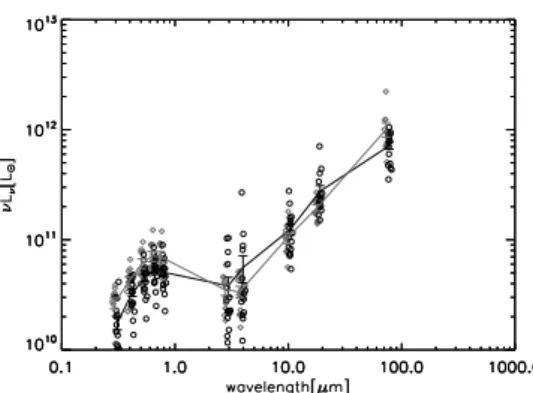
To examine average properties of the galaxies, we con- structed mean SEDs of the sample in luminosity and redshift bins. Averaging analysis was done by splitting the sample into three total luminosity bins (Figure 3).

Then we constructed mean ULIRGs SED in two redshift bins (Figure 4). There are 16 and 10 ULIRGs in z = 0.1 - 0.2 and z = 0.2 - 0.3 bins respectively.

• Figure 3 shows that while L

IR

increases by a factor of 100, the stellar component only increases by a factor of 10 from IRGs to ULIRGs.

• Figure 4 shows that AKARI-selected ULIRGs might change the mean SED shape with redshift (z=0.1-0.3).

6. CONCLUSION

From our analysis, we found the following results.

• This sample contains 31 ULIRGs, 561 LIRGs and 344 IRGs.

• From WISE color-color diagram, sources w/o SDSS match may contain a lot of ULIRG candidates.

• Mean SEDs split into bins based on L

IR

show that while L

IR

increases by a factor of 100, the stellar component increases by only a factor of 10 from IRGs to ULIRGs.

• AKARI-selected ULIRGs might change the mean

(3)

SEARCHING FOR ULIRGs BY USING AKARI AND WISE 311

Figure 4. Mean ULIRG’s SEDs in redshift bins. Black circles and gray diamonds show ULIRGs in z = 0.1 - 0.2 and z = 0.2 - 0.3 respectively. Each line connects the mean values of the data points in a single photometric band.

SED shape with redshift (z=0.1-0.3).

REFERENCES

Ahn, C. P., Alexandroff, R., Allende Prieto, C., et al., 2014, The Tenth Data Release of the Sloan Digital Sky Survey:

First Spectroscopic Data from the SDSS-III Apache Point Observatory Galactic Evolution Experiment, Apjs, 211, 17

Arnouts, S. & Ilbert, O., 2011, LePahre: Photometric Anal- ysis for Redshift Estimate, ascl:1108.009

Chary, R. & Elbaz, D., 2001, Interpreting the Cosmic In- frared Background: Constrains on the Evolution of the Dust-enshrouded Star Formation Rate, ApJ, 556, 562 Cutri, R. M., Wright, E. L., Conrow, T., et al., 2012, Ex-

planatory Supplement to the WISE All-Sky Data Release Products, Journal, (Issue), 1

Sanders, D. B. & Mirabel, I. F., 1996, Luminous Infrared Galaxies, ARA&A, 34, 749

Yamamura, I., Makiuti, S., Ikeda, N., et al., 2010,

AKARI/FIS All-Sky Survey Point Source Catalogues

(ISAS/JAXA, 2010), VizieR Online Data Catalog, 2298,

0

수치

Figure 2. WISE color-color diagram for the AKARI-WISE galaxies. Red, green and blue circles show ULIRGs, LIRGs and IRGs respectively
Figure 4. Mean ULIRG’s SEDs in redshift bins. Black circles and gray diamonds show ULIRGs in z = 0.1 - 0.2 and z = 0.2 - 0.3 respectively

참조

관련 문서

In order to investigate the feedback mechanism in detail, we select a unique sample containing ∼ 200 of the most luminous obscured QSOs by cross-matching the WISE catalog with

Although H-ATLAS achieves a better sensitivity at 100, 160 µm with the PACS in- strument, the AKARI All-Sky Survey is still valuable to characterise the far-infrared