• 검색 결과가 없습니다.

DUST-OBSCURED RADIO AGNS FROM THE WISE SURVEY

N/A
N/A
Protected

Academic year: 2021

Share "DUST-OBSCURED RADIO AGNS FROM THE WISE SURVEY"

Copied!
2
0
0

로드 중.... (전체 텍스트 보기)

전체 글

(1)

ISSN 1225-1534 (Print) http://dx.doi.org/10.5303/PKAS.2012.27.4.289 Publications of the Korean Astronomical Society

27: 289 ∼ 290, 2012 September

° 2012. The Korean Astronomical Society. All Rights Reserved. c

DUST-OBSCURED RADIO AGNS FROM THE WISE SURVEY

Minjin Kim

1,2,4

, Carol J. Lonsdale

3

, Mark Lacy

3

, Amy Kimball

3

, and Jim Condon

3

1

Korea Astronomy and Space Science Institute, Daejeon, 305-348, Korea,

2

The Observatories of the Carnegie Institution for Science, 813 Santa Barbara Street, Pasadena, CA 91101, USA,

3

National Radio astronomy

Observatory, Charlottesville, VA 22903, USA,

4

KASI-Carnegie Fellow E-mail: [email protected]

(Received July 01, 2012; Accepted July 29, 2012)

ABSTRACT

Feedback from accreting BH (AGN) is thought to be responsible for the co-evolution of BHs and galaxies. It is likely to be prominent in the most luminous dust-obscured quasars, particularly those containing radio sources too luminous to be powered by starbursts. In order to investigate the feedback mechanism in detail, we select a unique sample containing ∼ 200 of the most luminous obscured QSOs by cross-matching the WISE catalog with the FIRST and NVSS radio surveys.

We present overall statistics for the observed range of colors and radio/mid-IR flux density ratio.

We also present our efforts to understand the physical and evolutionary nature of these extreme feedback candidates using various telescopes such as Magellan, SOAR, Herschel, and ALMA.

Key words: infrared: telescope; conferences: proceedings; qausars: general

1. INTRODUCTION

Many studies during the last decade have found that central supermassive black holes (SMBH) are ubiqui- tous in massive galaxies and that their masses correlate with the properties of host galaxies, such as the veloc- ity dispersion and the bulge luminosity (Magorrian et al., 1998; Gebhardt et al., 2000). While the origin of these correlations has been controversial, it indicates that SMBHs and galaxies are closely linked in their evo- lution. The most convincing scenario invokes feedback from an active galactic nucleus (AGN) during mergers between gas rich galaxies regulating BH accretion and star formation. There are two feedback modes; (1) ra- diation pressure and thermal winds from a luminous AGN (“quasar mode” feedback) and (2) momentum transfer from radio jets (“radio mode” feedback).

In the merger-based feedback scenario, objects in the early stage are likely to be very luminous due to starbursts and highly accreting BH, and enshrouded by dust. There have been mounting evidence supporting feedback in radio galaxies and obscured IR-luminous systems (e.g., Lonsdale et al., 2003). Several recent

studies have found indications of radio jet feedback, in- cluding Guillard et al. (2012) who detect shock-excited H2 and warm dust in a sample of radio galaxies with high-velocity H I outflows. In this study, we focus on radio jet-induced feedback in highly obscured, high- accretion rate QSOs.

2. HIGHLY OBSCURED QSOs FROM WISE To find the most luminous obscured AGNs in the Uni- verse during the broad era 0.5 < z < 4 that includes the peak epoch of BH and host bulge building, we matched the WISE catalog, which covers the full sky at 3.4, 4.6, 12, and 22 µm with >2 orders of magnitude deeper sen- sitivity than previous large-area MIR surveys, with the 1.4 GHz NVSS and FIRST radio catalogs. The WISE survey is the first to have both the MIR sensitivity and the sky coverage needed to find the most luminous ULIRGs and QSOs throughout most of the Universe (Wright et al., 2010). Only at radio wavelengths is it possible to identify actively accreting BHs with no ob- scuration bias, and the WISE/radio match yields all

http://pkas.kas.org 289

(2)

290 KIM ET AL.

(a)

(d) (c)

(b)

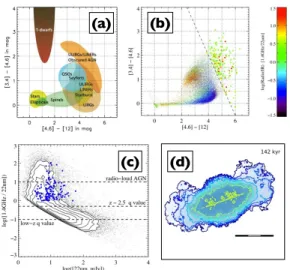
Fig. 1. (a) Distribution of WISE sources in MIR color- color space (Wright et al., 2010). (b) The large NVSS radio-detected sample shows a clear gradient in radio- loudness (color bar) from the starburst region to the QSO region. Our sample of MIR-red obscured AGNs/QSOs is shown as large dots. (c) The radio and MIR properties of our W4-selected WISE-radio sample (solid points), comparing the expected position of well-known radio populations, and the radio-infrared correlation at low and high redshifts (Ibar et al., 2008). Radio completeness cuts off at the bottom left. All of the selected sources are radio-intermediate or radio-loud. (d) High-resolution simulation of a 142-kyr old frustrated radio source (Wagner

& Bicknell, 2011). The scale bar is 600 pc in extent.

radio-intermediate and radio-loud MIR-luminous AGN in the NVSS sky.

We selected MIR sources with steep power-law or convex spectra dropping sharply at shorter wave- lengths. Specifically we selected a 22 µm flux-limited complete sample of 151 objects redward of the diago- nal line in Fig. 1 (right), with no image visible on the DPOSS r-band image so as to favor distant systems that are most likely to host luminous warm dusty co- coons powered by a heavily buried AGNs, and with compact radio counterparts to avoid large, evolved, FR II systems. Objects in our sample have no data in the literature beyond photometric points from large- area surveys. Thus we have performed a multiwave- length study on the sample, using various telescopes.

3. SUPPORTING OBSERVATIONS

We followed up our southern candidates with 345 GHz (870 µm) ALMA continuum observations. The goal of the ALMA observations is to determine the AGN vs. starburst dominance from the 22 µm/345 GHz flux density ratio, which is sensitive to warm/cool dust, and to place our obscured QSO sample in a sequence from systems dominated by cool, starburst-heated dust be- fore feedback mechanisms have their greatest impact to those dominated by AGN-heated warm dust. We have a Herschel priority 2 award for the full sample of 151 sources (imaging in all PACS & SPIRE bands) to deter- mine cool dust component temperatures, luminosities, and SF rates (SFRs). For a part of the sample (∼20), we obtained optical spectra using SOAR/Goodman to determine redshifts. Observing run for Magellan/FIRE is awarded. NIR spectrscopic data will give a clue on the detailed mechanism of AGN feedback.

REFERENCES

Ferrarese, L. & Merritt, D., 2000, A Fundamental Relation between Supermassive Black Holes and Their Host Galaxies, ApJ, 539, L9

Gebhardt, K., et al., 2000, A Relationship between Nuclear Black Hole Mass and Galaxy Velocity Dispersion, ApJ, 539, L13

Guillard, P., et al., 2012, Strong Molecular Hydrogen Emission and Kinematics of the Multiphase Gas in Radio Galaxies with Fast Jet-driven Outflows, ApJ, 747, 95

Ibar, E., 2008, Exploring the Infrared/Radio Correla- tion at High Redshift, MNRAS, 386, 953 Lonsdale, C. J., Smith, H. E., & Diamond, P. J.,

2003, VLBI Imaging of Luminous Infrared Galax- ies: Active Galactic Nucleus Cores in Markarian 231, UGC 5101, and NGC 7469, ApJ, 592, 804 Magorrian, J., et al., 1998, The Demography of Mas-

sive Dark Objects in Galaxy Centers, AJ, 115, 2285

Wagner, A. Y. & Bicknell, G. V., 2011, Relativistic

Jet Feedback in Evolving Galaxies, ApJ, 728, 29

Wright, E. L., et al., 2010, The Wide-field Infrared

Survey Explorer (WISE): Mission Description

and Initial On-orbit Performance, AJ, 140, 1868

수치

Fig. 1. (a) Distribution of WISE sources in MIR color- color-color space (Wright et al., 2010)

참조

관련 문서

8 When the wise man asked Lapio to share the fish, Lapio refused.. 9 Gradually, his fishing became less successful, but the wise man began

[r]

 The Dutch physicist Pieter Zeeman showed the spectral lines emitted by atoms in a magnetic field split into multiple energy levels...  With no magnetic field to align them,

Modern Physics for Scientists and Engineers International Edition,

Five days later, on 15 January 1975, the Portuguese government signed an agreement with the MPLA, FNLA and UNITA providing for Angola to receive its independence on 11

And if empire has been obscured in American historiography, the focus on diaspora and migration among Filipino-American scholars attempts to redress the invisibility of

Inclusion and Inclusiveness: Shared Vision of Youth for Local, National, and Global Village Inclusion at large stands for embracing populations with disabilities and

Ross: As my lawfully wedded wife, in sickness and in health, until