• 검색 결과가 없습니다.

INITIAL ANALYSIS OF EXTRAGALACTIC FIELDS USING A NEW AKARI/IRC ANALYSIS PIPELINE

N/A
N/A
Protected

Academic year: 2021

Share "INITIAL ANALYSIS OF EXTRAGALACTIC FIELDS USING A NEW AKARI/IRC ANALYSIS PIPELINE"

Copied!
3
0
0

로드 중.... (전체 텍스트 보기)

전체 글

(1)

Publications of the Korean Astronomical Society pISSN 1225-1534

32: 037 ∼ 039, 2017 March eISSN 2287-6936

2017. The Korean Astronomical Society. All rights reserved. c https://doi.org/10.5303/PKAS.2017.32.1.037

INITIAL ANALYSIS OF EXTRAGALACTIC FIELDS USING A NEW AKARI/IRC ANALYSIS PIPELINE Helen Davidge

1

, Stephen Serjeant

1

, and Chris Pearson

1,2,3

1

Department of Physical Sciences, The Open University, Milton Keynes, MK7 6AA, UK

2

RAL Space, Rutherford Appleton Laboratory, Chilton, Didcot, Oxfordshire, OX11 0QX, UK

3

Oxford Astrophysics, University of Oxford, Oxford, OX1 3RH, UK E-mail: [email protected]

(Received June 3, 2015; Revised October 21, 2016; Accepted October 21, 2016)

ABSTRACT

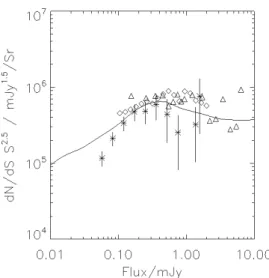
We present the first results of a new data analysis pipeline for processing extragalactic AKARI/IRC images. The main improvements of the pipeline over the standard analysis are the removal of Earth shine and image distortion correction. We present the differential number counts of the AKARI/IRC S11 filter in the IRAC validation field. The differential number counts are consistent with S11 AKARI NEP deep and 12 µm WISE NEP number counts, and with a phenomenological backward evolution galaxy model, at brighter fluxes densities. There is a detection of fainter galaxies in the IRAC validation field.

Key words: Methods: data analysis, Infrared: source counts

1. INTRODUCTION

There is currently no satellite observing in the mid- infrared, and none will be operational until 2018 at the earliest; the projected launch date of James Webb Space Telescope (JWST). Therefore best use must be made of existing archive data. The Infrared Camera (IRC) (On- aka et al., 2007), one of the two instruments on board the AKARI satellite (Murakami et al., 2007) has a large amount of archive data. The IRC consisted of nine pho- tometric bands from 2-24 µm. AKARI/IRC covers the wavelength desert between the Spitzer IRAC and MIPS instruments from 8-24 µm (Lorente et al., 2008). This paper reports on a new optimised general data reduc- tion pipeline specifically tailored for extragalactic fields.

Section 2 gives an overview of the improved pipeline.

Section 3 shows initial results of analysis of one the AKARI/IRC deepest extragalactic fields, the IRAC vali- dation field. This field was observed by the Spitzer space telescope and the Herschel Space Observatory. The field was also used by both telescopes as a calibration field.

Section 4 discuses the preliminary results, and Section 5 states the conclusions.

http://pkas.kas.org

Figure 1. Outline of new optimised pipeline steps

2. IRC DATA REDUCTION 2.1. Overview

There is a standard pipeline toolkit to process and anal- yse IRC images written by the AKARI instrument team (Lorente et al., 2008). We have developed a pipeline optimised for processing extragalactic images to extract the highest signal to noise point sources in deep field im- ages. Figure 1 summarises the steps of the new pipeline.

37

(2)

38 HELEN DAVIDGE ET AL.

Figure 2. Image of the IRAC validation field - S11 filter The new pipeline includes modules for improving cosmic ray detection, Earth shine removal, image distortion cor- rection and astrometry correction.

2.2. Removal of Earth shine

A major problem with many of the IRC observations is that the images are severely affected by reflected Earth shine. This creates large-scale features across the image.

The gradient of the large-scale features varies during a pointing. The Earth shine is removed from each im- age by fitting a boxcar median to the background flux of each image, and subtracting this from the original image.

2.3. Image distortion correction

The raw IRC images are geometrically optically dis- torted. The new pipeline has a unique distortion poly- nomial for each of the nine filters. The new pipeline maps the detector onto the sky using the correct distor- tion polynomial to create a dewarped image.

3. RESULTS

The first extragalactic field to be processed by the new pipeline is the IRAC validation field (IRAC VF). The mosaicked S11 filter image is shown in Figure 2. We present the galaxy number counts of the S11 filter data.

Source extraction was carried out using a optimal point source filer technique (Serjeant et al., 2003) that max- imises the signal to noise for isolated point sources on a flat background. For the error in the number counts for bins which contain small numbers of galaxies, the method from Serjeant et al. (2002) was used. Fluxes were calibrated using the IRC manual flux calibration (Lorente et al., 2008). Figure 3 shows the raw differen- tial galaxy number counts plotted with the S11 AKARI

Figure 3. Differential number counts. Stars are the AKARI S11 IRAC validation field raw number counts. Diamonds are AKARI IRC S11 NEP deep, triangles are 12 µm WISE NEP, the line is a phenomenological backward evolution galaxy model of Pearson et al. (2014)

NEP (north ecliptic pole) deep number counts (Murata et al., 2014), the 12 µm WISE NEP number counts (Jar- rett et al., 2011) and the phenomenological backward evolution model of Pearson et al. (2014). The model is multi-component and defined in the far-infrared, con- sisting of normal, star-forming and AGN populations.

The number counts have not been corrected for com- pleteness and reliability. These corrections should be small for the brighter 5σ selected sample but may be more significant at the faint end of the source counts.

For a more detailed analysis of the number counts, and analysis of other IRC filters see Davidge et al. (in prep).

4. DISCUSSION

The raw number counts for the IRAC VF from 0.1 to 0.4 mJy fit the model well. The IRAC VF has a smaller survey area than the NEP and thus the number counts have larger errors. Figure 3 shows the IRAC VF num- ber counts go deeper than the AKARI NEP deep num- ber counts. Correct removal of the large scale structure should improve the number counts, especially for fainter fluxes and could yield even fainter point sources.

5. CONCLUSIONS

The number counts for the S11 IRAC VF, S11 AKARI

NEP, 12 µm WISE NEP and model agree fairly well at

bright fluxes. The IRAC VF number counts are lower

at fainter fluxes, probably due to incompleteness in the

galaxy distribution. Using the new pipeline to process

the S11 IRAC VF, we have found fainter point sources

(3)

INITIAL ANALYSIS OF THE IRAC DARK FIELD USING A NEW AKARI/IRC ANALYSIS PIPELINE 39

and hence probed deeper than the AKARI NEP survey.

ACKNOWLEDGMENTS

The AKARI Project is an infrared mission of the Japan Space Exploration Agency (JAXA) Institute of Space and Astro-nautical Science (ISAS), and is carried out with the participation of mainly the following insti- tutes; Nagoya University, The University of Tokyo, Na- tional Astronomical Observatory Japan, The European Space Agency (ESA), Imperial College London, Univer- sity of Sussex, The Open University (UK), University of Groningen / SRON (The Netherlands), Seoul National University (Korea). The far-infrared detectors were de- veloped under collaboration with The National Institute of Information and Communications Technology.

REFERENCES

Davidge, H., Serjeant, S., Pearson, C., et al. in prep Jarrett, T. H., Cohen, M., Masci, F., et al., 2011, The

Spitzer-WISE Survey of the Ecliptic Poles, ApJ, 735, 112 Lorente, R., Onaka, T., Ita, Y., Ohyama, Y., Tanab, T., &

Pearson, C., AKARI IRC Data User Manual Version 1.4, 2008, http://www.ir.isas.jaxa.jp/AKARI/Observation/

Murakami, H., Baba, H., Barthel, P., et al., 2007, The In- frared Astronomical Mission AKARI, PASJ, 59, 369 Murata, K., Pearson, C. P., Goto, T., Kim, S. J., Matsuhara,

H., & Wada, T., 2014, The 2-24 µm source counts from the AKARI North Ecliptic Pole survey MNRAS, 444, 2346 Onaka, T., Matsuhara, H., Wada, T., et al., 2007, The In-

frared Camera (IRC) for AKARI – Design and Imaging Performance, PASJ, 59, sp2, S401

Pearson, C., Serjeant, S., Oyabu, S., et al., 2014, The first source counts at 18 m from the AKARI NEP Survey, MN- RAS, 444, 846

Serjeant, S., Gruppioni, C., & Oliver, S., 2002, The local star formation rate and radio luminosity density, MNRAS, 330, 621

Serjeant, S., Dunlop, J. S., Mann, R. G., et al., 2003, Submil-

limetre observations of the Hubble Deep Field and Flank-

ing Fields, MNRAS, 344, 887

수치

Figure 1. Outline of new optimised pipeline steps
Figure 2. Image of the IRAC validation field - S11 filter The new pipeline includes modules for improving cosmic ray detection, Earth shine removal, image distortion  cor-rection and astrometry corcor-rection.

참조

관련 문서