• 검색 결과가 없습니다.

A Study on 3-Dimensional Profilometry of Steam Generator Tube Using a New Eddy Current Probe

N/A
N/A
Protected

Academic year: 2021

Share "A Study on 3-Dimensional Profilometry of Steam Generator Tube Using a New Eddy Current Probe"

Copied!
11
0
0

로드 중.... (전체 텍스트 보기)

전체 글

(1)

A Study on 3-Dimensional Profilometry of Steam Generator Tube Using a New Eddy Current Probe

Young Kyu Kim*, Myung Ho Song** and Myung Sik Choi***

Abstract There are many types of the geometric transitions such as dent, bulge, protrusion, expansion, etc, on the inner and outer surfaces of heat exchanger tubes, steam generator tubes, and condenser tubes of nuclear power plants. Such geometric transition causes a local residual stress in heat exchanger tubes and acts as a structural factor accelerating the evolution of defects, in particular stress corrosion cracks. In the conventional eddy current test methods, the bobbin coil profilometry can provide 2-dimensional geometric information on the variation of the average inner diameter along the tube length, but the 3-dimensional distribution and the quantitative size of a local geometric transition existing in the tube cannot be measured. In this paper, a new eddy current probe, developed for the 3-dimensional profile measurement, is introduced and its superior performance is compared with that from the conventional bobbin coil profilometry for the various types of geometric transition. Also, the accuracy of the probe for the quantitative profile measurement is verified by comparing the results with that from the laser profilometry. It is expected that the new eddy current probe and techniques can be effectively used for an optimization of the tube expansion process, and the management of tubes with geometric transitions in service.

Keywords: Steam Generator Tube, Eddy Current Probe, Profilometry, Dent, Bulge, Eccentricity, Deflection

Received: March 19, 2010, Revised: May 7, 2010, Accepted: June 10, 2010. *School of Materials Science and Engineering, Hongik Univ. Choongnam 339-701, Korea **Engineering Research Department, Korea Institute of Nuclear Safety, Yuseong-gu, Daejeon 305-338, Korea ***Materials Research Division, Korea Atomic Energy Research Institute, Yuseong-gu, Daejeon 305-353, Korea, ✝Corresponding Author: [email protected]

Journal of the Korean Society for Nondestructive Testing Vol. 30, No. 3 (2010. 6)

1. Introduction

Various types of defects such as crack, wear, pit, and inter-granular attack occur on the inner and outer surfaces of heat exchanger tubes as well as steam generator tubes and condenser tubes of nuclear power plants and heat exchanger tubes of fossil power plants.

eddy current test(ECT) as a non-destructive examination(NDE) method is used to detect such defects (Siegel, 1996; NDE/ISI Issue Resolution Group, 1997). In addition to such defects, there exist various types of local and tiny shape change on inner and outer surfaces of tubes. Some are anomalies such as a dent

created when the tube diameter is reduced inward of the tube, the bulge and protrusion created when the tube diameter is increased outward of the tube, the over-expansion produced when the tube is expanded from the tube transition area to the top of tube-sheet excessively, the eccentricity made when the central axis of the tube passes cross each other, and the deflection made when the central axis of the tube is not concentric and turns aside.

The evaluation method for shape change of

a tube in the conventional ECT is the

profilometry using the bobbin probe. This

method provides the basic information for

(2)

Fig. 1 Photo of a new eddy current probe for measuring the geometric anomalies in heat exchanger tube

mean values of tube diametric changes of dent, bulge, over-expansion, etc., as the information of any point where the inner diameter change is located in the longitudinal direction of the tube, but never be able to detect the eccentricity or deflection of the tubes. Also in case a local shape change exists, there is the limitation that does not provide any information of the actual magnitude for the circumferential places, distribution angles, and real diametrical size of this change. The multi-coil array probes, as X-probe and intelligent probe that were recently developed, are able to detect the circumferential distribution and the size of shape change. However, because the electrical characteristics of individual coils are different from each other and the number of coils is limited, the uniform density of the eddy current in the circumferential direction does not form and because the 400 kHz or so of middle frequencies are overlapped for the dense distribution of the eddy current circumferentially, the reliability of quantitative measurement is lowered, provided that defects and structures exist on the outer surface of the tube and that large noise signals are reflected in the profile signal.

The shape change of the tube produces the local residual stress and results in the occurrence of corrosive cracks by activating the major structural factor. Therefore, the development of a probe that can measure the 3-dimensional size of tube shape change quantitatively is necessary to detect tubes with the premature shape changes and in service, and as a result, to ensure the operational safety through the evaluation on the influence of shape change affecting the initiation and propagation of defects.

In this paper, a comparative experiment using a newly developed probe to detect the shape change including expansion anomalies

such as dent, bulge, over-expansion, eccentricity, deflection, etc., 3-dimensionally and also to measure the longitudinal and circumferential locations, distribution, angles, and diametrical sizes of the tube was performed. Results from the profilometry using a new eddy current probe was compared with those from the conventional bobbin coil profilometry for specimens with 4 types of geometric transitions. Also, the accuracy for the quantitative profile measurement was verified by comparing the results from a new probe with those from the laser 3-dimensional profilometry.

2. Construction and Characteristics of Probe

The probe for shape change measurement developed in this study has two technical characteristics that can measure and evaluate the axial location and length of profile change, the circumferential location and distribution angle, and diametrical size 3-dimensionally.

Because this probe is a non-surface riding type, it can provide information on shape profile using the co-relationship between the size of signal amplitude induced by probe coils and the distance apart from the test specimen to coil and also this probe can make the information of continuous profile against the entire circumference of a tube using the rotating probe coil.

Fig. 1 is a photo of a new eddy current

probe for measuring the geometric transition of

heat exchange tube (Hur et al., 2006). The probe

is basically made of pancake type wound coil

and a coil supporting body and an axial or

(3)

circumferential coil can be added to this probe mechanically. The basic external form is similar to the surface riding MRPC(motorized rotating pancake coil) probe, but the inspection coil part is a non-surface riding type and is fixed on the outer surface of the supporting body. That is, the inspection coil was designed not to contact the inner surface of the tube and to constantly keep the invariable gap. Also, in order to be always located in the center of the tube inner diameter when the probe body moves and rotates inside the tube, the center fixed supporting feet that contact the inner surface of the tube elastically is mounted on the upper side and bottom side of the supporting body. The centering legs on the bottom side has the dual structure to prevent vibration force and centrifugal force from the rotating motor driving section to be transmitted to the probe body. In case of this probe, with the exception of the basic model, the distance between the coil and the inner surface of the tube and the probe length can be controlled mechanically and the probe can be fabricated in accordance with different inner diameters of various tubes used in operating nuclear power plants. In addition, this probe is compatible with eddy current equipments and evaluation software currently used in the inspection.

3. Experimental Method

3.1 Preparation of Profile Change Specimen

The profile change specimens are fabricated from steam generator tubes of KSNP(Korea Standard Nuclear Power Plant) with alloy 600 HTMA material. The outer diameter of the tube is 19.05 mm and its thickness is 1.07 mm.

The prepared specimens have 4 types of anomalies which are dent, bulge, eccentric expansion, and deflection expansion. For the specimen with a dent, the local area of the tube was dented inward mechanically and the specimen with 1 dent and the specimen with 2

dents located about 120° apart on the same circumference were fabricated. The specimen with a bulge has a local axial bulge shape which was made mechanically. For the specimen with eccentric expansion, the tube was inserted into the tube-sheet. Then the tube area located within the tube-sheet was only expanded by the explosive expansion method. To compare with the normal expansion condition, the concentric expansion tube in which the center axes of the tube were consisted in the upper side and bottom side of the tube expansion transition area as the boundary line was fabricated by the hydraulic expansion method. For the specimen with deflective expansion, the tube located within the tube-sheet was expanded mechanically after the tube from the upper side of the tube-sheet was tilted to about 0.6° from the axis of the tube-sheet hole. All specimens have no supports.

3.2 Eddy Current Testing

The new probes for measuring the profile change and the commercial bobbin probes were used in the eddy current signal collection and then the technical performance of the new probe was confirmed through the comparative evaluation of signals obtained from these probes.

In this eddy current test, Zetec MIZ-70

TM

data

acquisition system was used and the new probe

developed for the tube profilometry and

A-610-ULC bobbin probe were also used. To

calibrate the profiling signals quantitatively,

standard expansion tubes with inner diameters of

16.66 mm, 16.86 mm, and 17.66 mm respec-

tively, were fabricated and put to use. Test

frequencies for the new probe were 10, 100,

300, 400, 700 kHz and 10, 100, 300, 550,

800 kHz for the bobbin probe. The probe

running speed and rotating speed for the new

probe were 0.2 inch/sec and 600 rpm and

12 inch/sec for the bobbin probe.

(4)

(a)

(b)

(c)

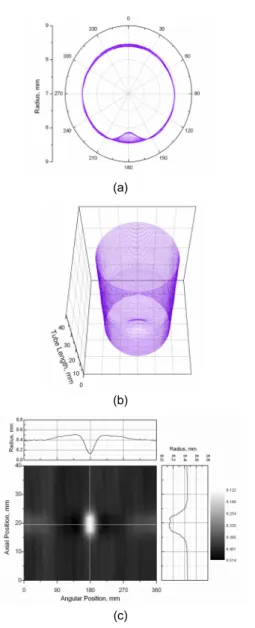
Fig. 2 Results of laser profilometry for a single dented tube: (a) 2-dimensional distribution of radius, (b) 3-dimensional distribution of radius, (c) Expanded distribution and variation of the radius along the axial and circumferential directions

Fig. 3 Results of bobbin profilometry for the same dented tube as that of Fig. 2

3.3 Laser 3-Dimensional Profilometry

To measure the 3-dimensional profile change of the prepared profiling specimens precisely and compare the accuracy of the developed eddy current probe based on the measured results quantitatively, the profiling of the prepared specimen was performed using the laser profilometry concurrently. The 3-dimensional profilometry using a laser beam is known to be the state of the art profiling technology with top class accuracy. LP-2000

TM

control unit and LPP-075 inserting and rotating laser probes were used for this experiment. The diameter of the laser beam measuring point was 0.13 mm and the measuring resolution was 0.013 mm.

4. Results and Discussion

4.1 Signal Analysis of Specimens with Dent

Fig. 2 shows the results of the laser 3-dimensional profiling for the profile-changed specimen with a single local dent on the tube circumference. Fig. 2(a), (b), (c) can help under- standing the dent profile, the same measuring results are indicated as 2-dimensional distribution of the radius, 3-dimensional distribution of the radius, and C-scan plot, respectively. The variations of the radius along the circumferential direction at the point of the longitudinal direction(horizontal line) with the minimum size and the variation of the radius along the longitudinal direction at the point of circumferential direction(vertical line) with the minimum size are shown in this expanded distribution drawing. From these results, the detected dent is a single local one and the calculated maximum size in the radius direction is 0.30 mm.

Fig. 3 shows the diameter change along the

length direction obtained from 800 kHz of the

bobbin probe for the same specimen. In this

figure, the x-axis is the location of tube length

direction and the y-axis is the diameter. Also,

(5)

Fig. 4 Result of eddy current profilometry using the new probe for the same dented tube as that of Fig. 2

(a)

(b)

(c)

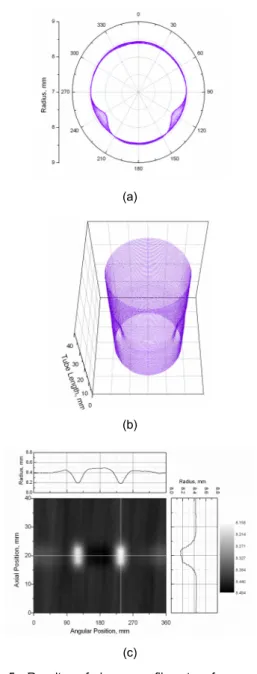
Fig. 5 Results of laser profilometry for a dual dented tube: (a) 2-dimensional distribution of radius, (b) 3-dimensional distribution of radius, (c) Expanded distribution and variation of radius along the axial and circumferential directions

the location value of the longitudinal direction and the measured diameter value of the corresponding location are shown at the same time. The bobbin probe provides the information on the location of the dent in the tube axial direction but cannot give any information on the number and distribution of the dent in the circumferential direction. The maximum value of the diametric reduction is calculated as being 0.08mm; this value is almost 1/4 of the actual maximum value of diametric reduction, which was 0.30 mm.

Results of the profilometry obtained from 700 kHz signals using a newly developed probe for the same profile change are shown in Fig. 4.

These results have almost the same radial distribution compared to the laser measured results shown in Fig. 2(c). That is, there is a local single dent and the maximum size of radial reduction is 0.30 mm. Also, these results are consistent with those from laser measurement.

Fig. 5 shows the results of the laser 3-dimensional profilometry for the specimen with 2 local dents located about 120° apart along the circumferential direction on the same level of the axial direction. According to these results and observation, it can be confirmed that the two detected dents are located 120° apart on the same circumference. Both are local and the maximum sizes in the radial direction of the two dents were both about 0.25 mm in the laser

profilometry.

Diametric changes along the axial direction

obtained from 800 kHz eddy current signals with

the bobbin probe for the same dented tube are

shown in Fig. 6. In this case, the bobbin probe

provides the information on the location of the

(6)

dent in the tube axial direction but cannot give any information on the number and distribution of the dent in the circumferential direction. The maximum value of diametric reduction was calculated as being 0.11 mm; this value is evaluated as being significantly smaller than the real maximum value of diametric reduction of two dents measured as 0.25 mm.

Fig. 7 shows the expanded distribution drawing of the profilometry results obtained from 700 kHz eddy current signals using a new probe for the same profile change. Results of nearly the same radial distribution from the eddy current profilometry using the new probe for the same dented tube were obtained compared to the laser profilometry ones of Fig. 5(c). That is, the two locally detected dents located 120° apart in the same circumference and the maximum sizes on the radial direction of the two dents are all about 0.25 mm, which is exactly the same as the laser profilometry results.

Fig. 6 Results of bobbin profilometry for the same dented tube as that of Fig. 5

Fig. 7 Results of eddy current profilometry using the new probe for the same dented tube as that of Fig. 5

4.2 Signal Analysis of Specimens with Bulge

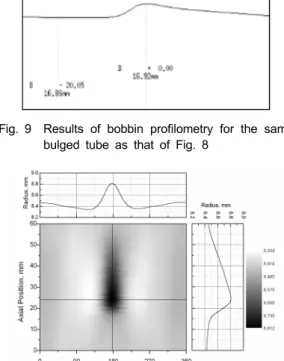
Results of the laser 3-dimensional profilometry for the tube with a single local bulge at any point in the axial direction of the tube are shown in Fig. 8. The detected bulge is a single and local type and the maximum size on its radial direction was calculated as approximately 0.50 mm.

(a)

(b)

(c)

Fig. 8 Results of laser profilometry for a bulged

tube: (a) 2-dimensional distribution of radius,

(b) 3-dimensional distribution of radius, (c)

Expanded distribution and variation of radius

along the axial and circumferential directions

(7)

Fig. 9 Results of bobbin profilometry for the same bulged tube as that of Fig. 8

Fig. 10 Result of eddy current profilometry using the new probe for the same dented tube as that of Fig. 8

The radial change in the longitudinal direction which is analyzed from the 800 kHz eddy current signals by the bobbin probe for the same tube is shown in Fig. 9. Also, in this case, the bobbin probe provides the information on the location of bulge in the tube axial direction but cannot provide any information on the number and distribution of the bulge in the circumferential direction. The maximum value of the diametric increase is calculated as being 0.06 mm; this value is almost 1/8 of the real maximum value of the diametric increase, which was 0.50 mm.

On the other hand, the profiling results obtained by a new probe are shown in Fig. 10.

These results are nearly similar in the radial distribution in comparison with the laser profiling results in Fig. 8(c). In detail, Fig. 10 shows that a single and local bulge exists in the

longitudinal direction and the maximum size of radial increase is 0.40 mm; this value is smaller than the laser profiling results, which was 0.50 mm. One reason is that the mode of bulge formed on this tube is the narrow shape with the width of approximately 40° of the circumferen- tial angle range(same as about 6 mm as circumferential length) as shown in Fig. 8(c).

Also, the other one is that the maximum bulge has a very sharp and radical profile change and the diameter of the inspection coil applied to a new probe is about 2 mm.

Therefore, in case that tube profile has a local and steep change, the field of view in the eddy current is relatively larger. As a result, the maximum size of the profile change is not reflected and the profiling results are underestimated than their actual sizes.

4.3 Signal Analysis of Specimens Expanded Eccentrically

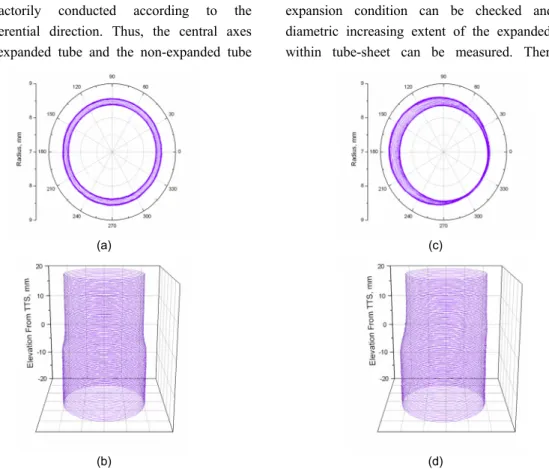
Fig. 11 shows results of the laser 2-dimensional and 3-dimensional profilometry for two types of tubes fixed within the tube-sheet by two expansion methods respectively. One is the concentric tube with the same central axes of the expanded tube and the non-expanded tube (hydraulic expansion, Fig. 11(a) and (b)). The other is eccentric tube with the different central axes (explosive expansion, Fig. 11(c) and (d)). In case of the concentric tube in Fig. 11(a) and (b), the profile change of the expansion transition area formed at the top of the tube-sheet shows the radius increase by the tube expansion through the uniform distribution in all radial directions. So the central axes of the expanded tube and the non-expanded tube are consistent.

While for the eccentric tube in Fig. 11(c) and

(d), the profile change of the expansion

transition area formed at the top of the

tube-sheet shows the abnormal radius increase by

the tube expansion through the irregular

distribution in a radial directions. Therefore the

(8)

(a) (c)

(b) (d)

Fig. 11 Results of laser profilometry: (a) 2-dimensional distribution of radius for the concentrically expanded tube, (b) 3-dimensional distribution of radius for the concentrically expanded tube, (c) 2-dimensional distribution of radius for the eccentrically expanded tube, (d) 3-dimensional distribution of radius for the eccentrically expanded tube

(a) (b)

Fig. 12 Results of bobbin profilometry for the same expanded tubes as those of Fig.11 (a) Tube expanded concentrically, (b) Tube expanded eccentrically

axes of the inside diameter for the expanded tube and the non-expanded tube are not consistent. The radius at 0° location of the circumferential angle is not increased. But in the opposite direction, the radius at 180° location as circumferential angle is largely increased. So we can note that the tube expansion is unsatisfactorily conducted according to the circumferential direction. Thus, the central axes of the expanded tube and the non-expanded tube

are not coincident.

Fig. 12 shows the radial changes in the

longitudinal direction analyzed from the 800 kHz

eddy current signal of the bobbin probe for the

same expanded tubes. From these results, the

difference of the profile change in the two types

of expanded tubes is not revealed. The

expansion condition can be checked and the

diametric increasing extent of the expanded tube

within tube-sheet can be measured. Therefore,

(9)

(a) (c)

(b) (d)

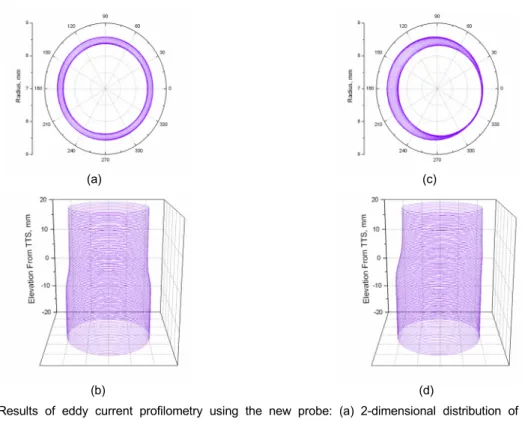
Fig. 13 Results of eddy current profilometry using the new probe: (a) 2-dimensional distribution of radius for the same concentrically expanded tube as that of Fig. 11, (b) 3-dimensional distribution of radius for the same concentrically expanded tube as that of Fig. 11, (c) 2-dimensional distribution of radius for the same eccentrically expanded tube as that of Fig. 11, (d) 3-dimensional distribution of radius for the same eccentrically expanded tube as that of Fig. 11

(a) (b)

Fig. 14 Results of laser profilometry for the expanded tube with deflection

(a) 2-dimensional distribution of radius, (b) 3-dimensional distribution of radius the profilometry using the bobbin probe cannot

distinguish between the particularities of the expansion profile nor can it provide the information on the uniformity of tube expansion such as eccentricity and deflection.

In addition, results of the profilometry obtained from 700 kHz of signals using a new probe for the same expanded tubes are shown in Fig. 13. These measured results are equal to

laser profilometry results as shown in Fig. 11.

That is, profile particularities between the tube

expanded concentrically in Fig. 13(a) and (b)

and the tube expanded eccentrically in Fig. 13(c)

and (d) can be clearly distinguished. Also, the

quantitative information for the uniformity of

tube expansion as the circumferential distribution

of radius increase is accurate compared to laser

profilometry results.

(10)

Fig. 15 Results of bobbin profilometry for the expanded tubes with deflection being same as that of Fig. 14

(a)

(b)

Fig. 16 Results of eddy current profilometry using the new probe for an expanded tube with deflection being same as that of Fig. 14. (a) 2-dimensional distribution of radius, (b) 3-dimensional distribution of radius

4.4 Signal Analysis of Specimens Expanded with Deflection

Fig. 14 shows the results of the laser 3-dimensional profilometry for the tube with deflection of the central axes of the expanded

tube within the tube-sheet and non-expanded tube out of the tube-sheet are concentric but tilted. In this figure, the central axes of the expanded tube and the non-expanded tube tilted at the boundary of the expansion transition area at the top of the tube-sheet is observed. The degree of tilting is measured as 0.65°.

The diametric changes in the longitudinal direction which are measured as 800 kHz data signals of the bobbin probe for the same expanded specimen are shown in Fig. 15. In this case, the expansion condition and the diametric increasing extent of the expanded area within the tube-sheet can be measured, while the particularity of the tube expansion profile observed in Fig. 14 cannot be identified by the bobbin probe profilometry.

On the other hand, the profile results obtained from the new probe for the same expanded specimen are shown in Fig. 16 and are almost similar to the laser profilometry results of Fig. 14. That is, on the basis of the expansion transition area at the top of the tube-sheet, the inner diametric central axes of the expansion area and the non-expansion area are tilted toward each other. The degree of tilt is 0.69°; this value is consistent with the tilt value that is calculated by the laser profilometry.

5. Conclusions

The results of this work demonstrated that the detection of anomalies and their quantitative measurement occurring on the inner and outer surfaces of heat exchanger tubes using a newly developed eddy current probe are possible. The following conclusions are drawn.

1) The new probe can detect local profile changes such as dent, bulge, over-expansion, etc. existing on the inner and outer surfaces of heat exchanger tubes.

2) Longitudinal locations of tube profile changes

can be detected and the circumferential

(11)

distribution and diametrical size that the conventional profile measurement using bobbin probe is not able to evaluate can be estimated 3-dimensionally.

3) The new probe can discriminate the specific anomalies of tube expansion area as eccentricity, deflection, etc. and the accuracy of its quantitative measurement is equal to that of 3-dimensional profile measurement results using the laser profilometry.

Acknowledgement

This work was supported by the 2010 Hongik University Research Fund.

References

NDE/ISI Issue Resolution Group (1997) PWR Steam Generator Examination Guidelines, Rev. 5, V. 1: Requirements, EPRI TR-107569-V1R5, EPRI

Hur, D. H., Lee, D. H., Choi, M. S. and Han, J.

H. (2006) Apparatus for Detecting State of Heat Exchanger Tube and Method Thereof, Rep. of Korea Patent No. 562358

Siegel, J. (1996) Detecting SG Tube Cracks in

Difficult Places, Nuclear Engineering Internation-

al, Vol. 41, p. 18

수치

Fig. 1 Photo of a new eddy current probe for  measuring the geometric anomalies in heat  exchanger tube
Fig. 2 Results of laser profilometry for a single  dented tube: (a) 2-dimensional distribution  of radius, (b) 3-dimensional distribution of  radius, (c) Expanded distribution and  variation of the radius along the axial and  circumferential directions
Fig. 4 Result of eddy current profilometry using the new probe for the same dented tube as that of Fig
Fig. 7 shows the expanded distribution drawing of  the profilometry results obtained from 700 kHz  eddy current signals using a new probe for the  same profile change
+5

참조

관련 문서

Table 4.1 Efficiency parameters in the flat plate solar collector using MWCNT nanofluid and water ··· 40.. Table 4.2 Efficiency parameters in the evacuated tube solar

In this study, thermal efficiency of a flat-plate solar collector and a U-tube solar collector using a CuO nanofluid and water as a working fluid was investigated according to

A study on the safety analysis of steam generator tube plugging level upward in Hanbit Unit #5,6..

The innovation of the mass media not only has changed the delivery process of a product but also has expanded into the image industry such as

The liquid has a specific gravity of 1.60 and negligible vapor pressure. Calculate the flowrate for incipient cavitation in the 75 mm section, assuming that the tube flows

• Flow in the reservoir and central core of the tube: primary forces are pressure and gravity forces.. • Selective withdrawal: Colder water is withdrawn into the intake channel

1) Zone of viscous action (boundary layer): frictional effects cannot be neglected. 2) Flow in the reservoir and central core of the tube: primary forces are pressure

증기발생기는 그림 2 – 1 과 같이 관내측(Tube Side)에는 원자로 냉각재가, 동체측(Shell Side)에는 급수가 흐르면서 열교환이 이루어지는 수직 U-tube형 열교환기로써