Korean Journal of Microbiology (2019) Vol. 55, No. 2, pp. 171-173 pISSN 0440-2413
DOI https://doi.org/10.7845/kjm.2019.9028 eISSN 2383-9902
Copyright ⓒ 2019, The Microbiological Society of Korea
Complete genome sequence of Cohnella sp. HS21 isolated from Korean fir ( Abies koreana) rhizospheric soil
Lingmin Jiang
1,2, Se Won Kang
1, Song-Gun Kim
1, Jae Cheol Jeong
1, Cha Young Kim
1, Dae-Hyuk Kim
2, Suk Weon Kim
1* , and Jiyoung Lee
1*
1
Biological Resource Center, Korea Research Institute of Bioscience and Biotechnology (KRIBB), Jeongeup 56212, Republic of Korea
2
Department of Bioactive Materials, Chonbuk National University, Jeonju 54896, Republic of Korea
구상나무 근권 토양으로부터 분리된 Cohnella sp. HS21의 전체 게놈 서열
지앙 링민
1,2・ 강세원
1・ 김성건
1・ 정재철
1・ 김차영
1・ 김대혁
2・ 김석원
1* ・ 이지영
1*
1
한국생명공학연구원 생물자원센터,
2전북대학교 생리활성소재과학과
(Received March 19, 2019; Revised May 7, 2019; Accepted May 7, 2019)
*For correspondence.
(J. Lee) E-mail: [email protected];Tel.: +82-63-570-5651; Fax: +82-63-570-5609 / (S.W. Kim) E-mail: [email protected];
Tel.: +82-63-570-5650; Fax: +82-63-570-5609
The genus Cohnella, which belongs to the family Paenibacillaceae, inhabits a wide range of environmental niches. Here, we report the complete genome sequence of Cohnella sp. HS21, which was isolated from the rhizospheric soil of Korean fir (Abies koreana) on the top of Halla Mountain in the Republic of Korea. Strain HS21 features a 7,059,027 bp circular chromo- some with 44.8% GC-content. Its genome contains 5,939 protein-coding genes, 78 transfer RNA (tRNA) genes, 27 ribosomal RNA (rRNA) genes, 4 noncoding RNA genes (ncRNA), and 90 pseudogenes. The bacterium contains antibiotic-related gene clusters and genes encoding plant cell wall-degrading enzymes.
Keywords: complete genome sequence, Korean fir, rhizospheric bacteria
The genus Cohnella was proposed by Kämpfer et al. (2006) to contain Gram-positive, spore-forming, aerobic, rod-shaped bacteria belonging to the family Paenibacillaceae. Species belonging to this group were found in a wide range of
environmental niches, including mammals (Khianngam et al., 2012), the starch production industry (Kämpfer et al., 2006), fresh water (Shiratori et al., 2010), plant root nodules (Flores- Félix et al., 2014), and soils (Huang et al., 2014; Lee et al., 2015). We have recently isolated the bacterium strain HS21 from the rhizospheric soil of Korean fir (Abies koreana) on Halla Mountain in the Republic of Korea. Phylogenetic analysis of its 16S rRNA gene sequence revealed that strain HS21 belonged to genus Cohnella and had the highest similarity to Cohnella luojiensis HY-22R
T(97.9%). HS21 was thus regarded as a novel species of Cohnella based on the novel species recognition threshold of 98.6% (Kim et al., 2014). To facilitate future research on this bacterium, and to improve the availability of Cohnella sp. genomes for comparative analysis, we determined the complete genome sequence of Cohnella sp.
HS21.
The strain HS21 was cultured in tryptic soy broth (TSB, Difco laboratories) and shaken at 150 rpm at 25°C for 5 days.
Genomic DNA was extracted and purified using the HiGene
TMGenomic DNA Prep Kit (BioFact) following the protocol
recommended by the manufacturer. The purified genomic
DNA was sequenced by the Macrogen facility (Macrogen)
172
∙ Jiang et al.미생물학회지 제55권 제2호
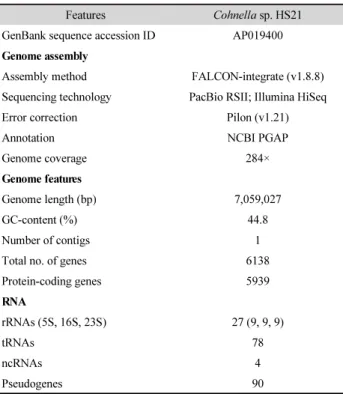
Table 1. General features and properties of the genome sequence of Cohnella sp. HS21
Features Cohnella sp. HS21 GenBank sequence accession ID AP019400 Genome assembly
Assembly method FALCON-integrate (v1.8.8) Sequencing technology PacBio RSII; Illumina HiSeq Error correction Pilon (v1.21)
Annotation NCBI PGAP
Genome coverage 284×
Genome features
Genome length (bp) 7,059,027
GC-content (%) 44.8
Number of contigs 1
Total no. of genes 6138
Protein-coding genes 5939
RNA
rRNAs (5S, 16S, 23S) 27 (9, 9, 9) tRNAs 78
ncRNAs 4
Pseudogenes 90
using the PacBio RSII (Pacific Biosciences Inc.) and the Illumina HiSeq 2500. The sequence reads were assembled using the FALCON-integrate (v1.8.8) assembler, and the contigs were polished using Pilon (v1.21). Genome annotation was performed using the NCBI Prokaryotic Genome Annotation Pipeline (PGAP) with best-placed reference protein set GeneMarkS 2 (v4.7).
The complete genome of HS21 consists of one circular chromosome that is 7,059,027 bp with 44.8% GC-content. A total of 5,938 protein-coding genes, 78 tRNA, 27 rRNA, 4 ncRNA, and 90 pseudogenes were annotated (Table 1). The housekeeping genes gyrA and gyrB in Cohnella sp. HS21 exhibit great similarity to those in Cohnella sp. 18JY8-7 (gyrA, 74.7%) and Paenibacillus sp. BIHB4019 (gyrB, 75%), respectively. The HS21 genome contains antibiotic resistance genes against antibiotics such as vancomycin B-type (vanW), daunorubicin/doxorubicin (drrA and drrB), tetracycline (tetA), and penicillin (pbpX and pbp4). It also contains genes asso- ciated with plant cell wall-degrading enzymes such as endo-β- xylanase A and endo-1,4-β-xylanase Z. The proteins in HS21 were classified using EggNOG (Huerta-Cepas et al., 2016) into the following major categories: “function unknown” (S, 30.2%),
carbohydrate transport and metabolism (G, 10.8%), transcription (K, 8.8%), general function prediction only (R, 7.1%), and signal transduction mechanisms (T, 6.7%).
Nucleotide sequence accession numbers
The complete genome sequence of Cohnella sp. HS21 has been deposited to GenBank under accession number AP019 400. The 16S rRNA gene sequence was registered at the National Center for Biotechnology Information under accession number MK418757. The strain is available at the Korean Collection for Type Culture (accession number KCTC 43028) and at the China Center for Type Culture Collection (accession number CCTCC AB 2019010).
적 요
Paenibacillaceae 계의 Cohnella 속은 다양한 환경 속에서 서식한다. 여기에 우리는 한국 한라산 꼭대기의 구상나무 (Abies koreana) 근권 토양으로부터 분리된 Cohnella sp. HS21 의 전체 게놈 서열을 보고한다. 균주 HS21은 원형 염색체 7,059,027 bp 와 44.8%의 GC 함량을 가지고 있다. 5,939개의 단백질 코딩 유전자와 78개의 트랜스퍼 (tRNA) 유전자, 27개 의 리보솜 RNA (rRNA) 유전자, 4개의 비 코딩 RNA 유전자 (ncRNA), 90개의 위 유전자가 존재했다. 박테리아는 항생제 관련 유전자 클러스터와 식물 세포벽 분해 효소를 코딩하는 유전자를 포함하고 있다.
Acknowledgements
This work was carried out with the support of the KRIBB research initiative program (KGM 5281913).
References
Flores-Félix JD, Carro L, Ramírez-Bahena MH, Tejedor C, Iqual JM, Peix A, and Velázquez E. 2014. Cohnella lupini sp. nov., an endophytic bacterium isolated from root nodules of Lupinus albus. Int. J. Syst. Evol. Microbiol. 64, 83–87.
Huang Z, Yu YJ, Bao YY, Xia L, Sheng XF, and He LY. 2014.
Cohnella nanjingensis sp. nov., an extracellular polysaccharide-
Genome sequence of Cohnella sp. HS21∙
173
Korean Journal of Microbiology, Vol. 55, No. 2
producing bacterium isolated from soil. Int. J. Syst. Evol.Microbiol. 64, 3320–3324.
Huerta-Cepas J, Szklarczyk D, Forslund K, Cook H, Heller D, Walter MC, Rattei T, Mende DR, Sunagawa S, Kuhn M, et al. 2016.
eggNOG 4.5: a hierarchical orthology framework with improved functional annotations for eukaryotic, prokaryotic and viral sequences. Nucleic Acids Res. 44, 286–293.
Kämpfer P, Rossello-Mora R, Falsen E, Busse HJ, and Tindall BJ.
2006. Cohnella thermotolerans gen. nov., sp. nov., and classification of ‘Paenibacillus hongkongensis’ as Cohnella hongkongensis sp.
nov. Int. J. Syst. Evol. Microbiol. 56, 781–786.
Khianngam S, Tanasupawat S, Akaracharanya A, Kim KK, Lee KC,
and Lee JS. 2012. Cohnella cellulosilytica sp. nov., isolated from buffalo faeces. Int. J. Syst. Evol. Microbiol. 62, 1921–1925.
Kim M, Oh HS, Park SC, and Chun J. 2014. Towards a taxonomic coherence between average nucleotide identity and 16S rRNA gene sequence similarity for species demarcation of prokaryotes.
Int. J. Syst. Evol. Microbiol. 64, 346–351.
Lee KC, Kim KK, Kim JS, Kim DS, Ko SH, Yang SH, and Lee JS.
2015. Cohnella collisoli sp. nov., isolated from lava forest soil.
Int. J. Syst. Evol. Microbiol. 65, 3125–3130.
Shiratori H, Taqami Y, Beppu T, and Ueda K. 2010. Cohnella fontinalis sp. nov., a xylanolytic bacterium isolated from fresh water. Int. J. Syst. Evol. Microbiol. 60, 1344–1348.