323
-P4-2
Chryseobacterium ginsengisoli sp. nov., isolated from mountain ginseng soil Korean Ginseng Center and Ginseng Genetic Resource Bank, Kyung Hee University Ngoc-Lan Nguyen, Yeon-Ju Kim, Van-An Hoang, Jin-Woo Min, Yan Jin, Chao Wang and
Deok-Chun Yang Objectives
During the course of investigating bacterial diversity of ginseng soil by culture dependent method, a large number of bacteria were isolated. At least 30 bacterial genera were found in ginseng soil. In this study we attempted to describe strain DCY63T, anovelstrain of Chryseobacteriumgenus.
Materials and Methods
◦ Soil samples were collected from surface of mountain ginseng root.
◦ Isolation. Five times diluted R2A agar plates were used for the bacterial isolation. Soil samples were diluted by serially sterile saline (0.85 % NaCl).
Phylogenetic tree
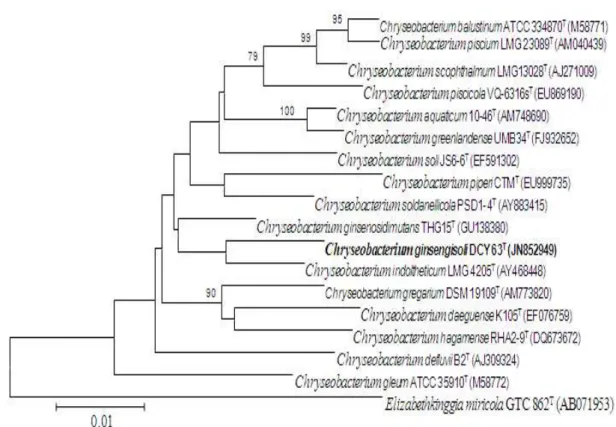
. The 16S rRNA gene was amplified. Phylogenetic trees were
constructed with the neighbor-joining (Saitou & Nei, 1987) with the Kimura two
parameter models (Kimura, 1983) and maximum-parsimony (Fitch, 1971) methods
using the MEGA4 (Takuma
etal.
,2007).
Morphological and physiological characteristics.
API 20NE, ID 32GN and API ZYM
tests were performed according to the instructions of the manufacturer (API
BioMérieux).
Chemotaxonomic characteristics
. Isoprenoid quinone was extracted from 100mg
freeze-dried cells and analyzed using HPLC (Hiraishi
etal
.,1996) with YMC-Triart C18
column(250x4.6mml.D.).
Polar
lipids
were
examined
by
two
dimensional
TLC(Minnikin,1984).
Fatty
acids
were
extracted,
methylated,
separated
by
gaschromatographyandidentificationofthemethylesterswereconductedbyusingTSBA
library(version6.1),SherlockMicrobialIdentificationSystem (MIDI) as described by Sasser
(1990).
DNA base composition
. The G+C mol% was determined by the method of Mesbah
etal
.(1989)usingareverse-phaseHPLC column (YMC-Pack Pro C18 RC, 150 x 4.6
mml.D.).
DNA-DNA hybridization experiments. Hybridization experiments were conducted fluorometrically by the method of Ezaki etal.(1989)withfivereplications.
324 -Results
Strain DCY63Tis Gramreaction-negative, aerobic, shortrod-shape, catalase- and oxidize –
positive. Growth occurs at 4 – 37 ℃ with optimum temperature 25 ℃. The pH range for growth is 5.0 – 8.5 and the optimum pH 7.0. Colonies are smooth, circular, yellow color and 1.0–2.0 mm in diameter after 2 days growth onto NB agar. The polar lipids are phosphatidylethanolamine (PE) as major lipid, four unidentified amino lipids and four unidentified lipids. The fatty acid profile of the isolate was compared. Major fatty acids of the strain DCY 63Tare iso-C
15:0,3OHiso-C17:0,summed feature 3 and summed feature 9. The
predominant isoprenoid quinone of strain DCY 63TisMK-6.The G+C content of genomic DNA of strain DCY 63T is 31.6 mol%. The levels of DNA-DNA relatedness between DCY 63TandC. indoltheticum, C. ginsenosidimutans andC.scophthalmum are less than 50 %. These values are low enough to classify strain DCY 63Tasadistinctspecies(Wayneetal.,1987).
The type strain DCY 63T(KCTC 23760T) was isolated from a ginseng soil in the Republic of Korea.