
Proteomic Analysis of the Skin of Rabbiteye Blueberry‘Bluegem’
10
0
0
전체 글
(2) 래빗아이 블루베리 ‘Bluegem’ 과피의 프로테옴 분석. 서언 블루베리는 진달래과(Ericaceae) 산앵두나무속(Vaccinium)에 속하는 관목성 식물로 각종 무기염류, 비타민류, 섬유질을 포 함하고 있으며, 과실의 식용 시 폐기될 부분이 거의 없으므로 다양한 영양성분의 이용 효율이 매우 높다(Kang et al., 2009). 블 루베리는 anthocyanin, flavonoid, lycopene등 같은 다양한 기능성 물질을 가지고 있으며 이들 성분은 항산화기능, 시력강화, 면역력 증진 및 뇌졸중 방지 등에 효과가 있는 것으로 알려져 있다(Routray et al., 2011; Chung et al., 2016). 특히 블루베리의 anthocyanin은 활성산소와 노화에 의한 알츠하이머와 파키슨병 같은 퇴행성 질환에 대한 그 효과가 검증 되었고, 자외선에 의한. 피부 노화를 억제하고, 콜라겐 파괴, 염증 등을 지연시킨다는 연구결과도 있다(Bae et al., 2009). 또한, 지방세포를 사멸시켜 다 이어트에 대한 효과가 있으며, 대장암, 유방암 및 자궁경부암 등에도 효과가 있음이 확인 되었다(Routray et al., 2011). 이러한 다 양한 기능성을 인정받아 뉴욕타임지에서는 블루베리를 ‘세계 10대 슈퍼 푸드’로 선정하였으며, 그 관심과 인기는 더욱 높아졌다. 프로테오믹스는 게놈(genome)에서 만들어지는 단백질의 총체를 의미하는 프로테옴을 연구하는 방법과 기술을 포괄적으로 의미하는 말로 ‘단백질체 분석학’이라고도 한다. 일반적인 과정은 추출된 단백질을 2차원전기영동(2-DE; two-dimensional electrophoresis)으로 전개한 후 각각의 단백질 spot을 coring 한 다음 질량 분석을 통하여 동정하는 것으로, 프로테옴의 대량 분. 석과 상호기능관계 지도의 작성, 구조분석 등을 통해 궁극적으로 특정 단백질과 이를 만드는 유전자의 기능을 동시에 밝혀낼 수 있다(Chen, 2006). 이와 같은 프로테오믹스의 방법과 기술을 이용하여 현재까지 포도, 망고, 파파야, 오렌지, 토마토 등을 비 롯한 다양한 과실에서 프로테옴의 분석이 실시되었다(Novikova et al., 2003; Palma et al., 2011; Zeng, et al., 2011; De Magalhães Andrade et al., 2012; Manaa et al., 2013; Wu et al., 2013). 특히 포도에서는 성숙단계 및 차광에 따른 과피의 프로테오. 믹스, ABA처리에 다른 프로테옴의 변화 등 다양한 보고가 있었으나(Deytieux et al., 2007; Marzia et al., 2010; Niu et al., 2013; Yuan et al., 2014), 블루베리의 프로테옴에 대한 분석은 아직까지 보고 된 바가 없다. 따라서, 본 연구에서는 래빗아이 블. 루베리인 ‘Bluegem’의 과피에서 발현되는 프로테옴을 분리·동정하기 위한 실험을 수행하였다.. 재료 및 방법 실험재료 본 실험에서는 래빗아이 블루베리(Vaccinium ashei) ‘Bluegem’을 사용, 2012년 8월에 수확하여 냉장 보관된 과실 중 평균무 게 2.1g, 평균 횡경 17.8mm, 종경 13.1mm인 과실의 과피를 과육과 분리하고 단백질 추출에 이용하였다.. 단백질 추출 및 이차원 전기영동(Two-dimensional electrophoresis; 2-DE) 단백질 추출은 과육과 분리된 블루베리 과피 2.5g을 액체질소에 마쇄하여 phenol법으로 실시하였다(Hurkman et al., 1986). 추출한 단백질은 Bradford 법으로 정량하였다(Bradford, 1976). 이차원 전기영동은 Lee et al.(2012)의 방법에 따라 실시되었 다. 등전점(isoelectronic-focusing; IEF) 전기영동은 17cm immobilized pH gradient gel(IPG) strip(pH4-7, Bio-rad, CA)에 단 백질을 로딩하고 PROTEAN IEF Cell(Bio-rad, CA)에서 실시하였으며, SDS-PAGE 12% polyacrylamide gel(30% acrylamide/ 0.8% bis-acrylamide 16mL, 375mM Tris-HCl(pH = 8.8) 10mL, dH2O 13.6mL, 10% SDS 0.4mL, TEMED 20µL, 10% APS 80µL)을 이용하여 PROTEAN® II xi Cell(Bio-rad, CA)에서 실시하였다. 2-DE가 끝난 gel은 Coomassie Brilliant Blue G-250(CBBG-250, Bio-rad, CA)를 이용하여 염색하였으며(Matsui et al., 1999). GS-800 Calibrated Densitometer(Bio-Rad)를 사용하여 스캔하였다. 5번의 전기영동을 실시하였으며, 가장 고화질의. 이미지를 갖는 gel을 선택하여 master gel로 정하고, 그 gel에서 육안으로 식별 가능한 단백질 spot의 각각에 고유 번호를 부여 하였다.. 68. Horticultural Science and Technology.
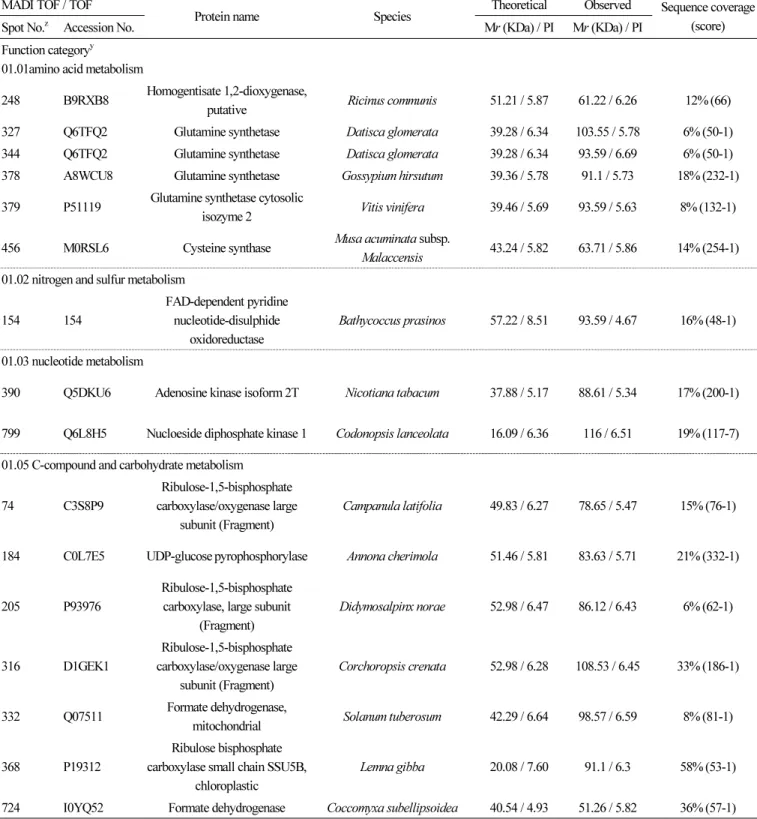
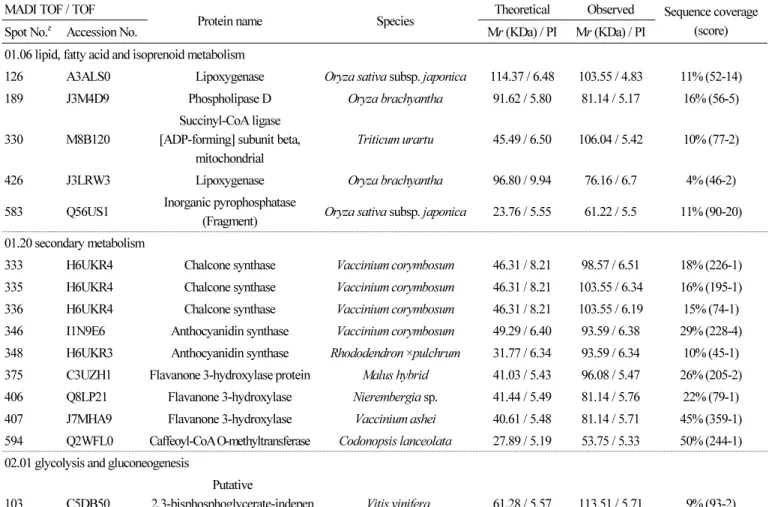
(3) 래빗아이 블루베리 ‘Bluegem’ 과피의 프로테옴 분석. MALDI-TOF/TOF MS의 측정, 데이터의 분석 및 정리 CBBG로 염색된 gel에서 단백질 spot을 coring하고, 탈색, reduction, alkylation 및 In gel digestion을 하였다(Kim et al., 2004). MALDI-TOF / TOF MS 분석은 355nm에서 작동하는 200 Hz ND: YAG laser를 사용하는 ABI 4800 Plus TOF-TOF Mass Spectrometer(Applied Biosystems, Framingham, MA, USA)로 실시하였다. MS / MS spectra는 검색엔진으로서 MASCOT (http://www.matrixscience.com)와 ProteinPilot v.3.0을 사용하여 NCBInr database(http://www.ncbi.nlm.nih.gov/)에서 50ppm. 의 peptide와 fragment ion mass tolerance로 검색되었으며, 동정된 단백질은 ‘GO-MIPS funcat conversion table’(http:// geneontology.org/external2go/mips2go)의 기준에 따라 분류되었다.. 결과 및 고찰 전개된 2-DE image에서 최대 810개의 단백질 spot이 육안으로 확인되었다. 이중 5반복의 실험 중 최소 3개의 gel에서 나타 나고 coring이 가능한 247개 단백질 spot의 MALDI-TOF / TOF MS분석을 실시하였다. 분석된 spot 중 score 값이 45이하인 것, signal peak가 검출되지 않은 것 등을 제외하고, 182개의 단백질 spot을 NCBI database에서 검색하였다. 검색된 단백질들 은 아래와 같이 ‘GO-MIPS funcat conversion table’의 기준에 따라 분류하고 정리하였다(Figs. 1, 2). 검색된 182개의 단백질 spot 중 74개는 unknown 또는 unclassified 단백질, 대사(metabolism)와 에너지 관련 단백질이 각각 30개, 14개 는 단백질 fate (folding, modification, destination)와 관련된 단백질, 10개는 cell rescue, defense 및 virulence와 관련된 단백질로 나타났다 (Table 1).. 대사(Metabolism)관련 단백질 단백질 spot 327, 344, 378, 379 및 456은 아미노산 대사와 관련된 glutamine synthetase로 동정되었는데, 포도 과피 단백질체 분석에서도 착색이 진행됨에 따라 그 발현량이 증가하는 것으로 보고되었다(Deytieux et al., 2007). Spot 390과 799는 nucleotide 대사와 관련된 adenosine kinase isoform 2T와 nucleotide diphosphate kinase로 각각 동정되었. 다. Adenosine kinase isoform 2T는 이전의 연구에서 토마토에 염과 Ca 처리 시 발현량이 감소되는 것으로 알려졌으며(Manaa et al., 2013), 동일 계통 고추의 세포질웅성불임 화분과 가임 화분을 비교하면 세포질웅성불임 화분에서 그 발현량이 더 낮은. 것으로 보고되었다(Wu, et al., 2013). Nucleotide diphosphate kinase는 파파야에서 성숙이 진행됨에 따라 발현량이 감소되는 것으로 알려져 있다(Huerta-Ocampo et al., 2012). C-compound 및 carbohydrate 대사와 관련된 단백질들로써 spot 74, 205, 316, 368은 RuBisCO로, spot 184는 UDP-glucose pyrophosphorylase로, spot 332, 724는 formate dehydrogenase로 각각 동정되었다. Lipid, fatty acid 및 isoprenoid 대사와 관련. 해서는 spots 126, 426이 lipoxygenase로, spot 189가 phospholipase로, spot 330이 succinyl-CoA ligase로, spot 583이 inorganic pyrophosphatase로 각각 동정되었다. Inorganic pyrophosphatase는 토마토와 살구에서 과실이 성숙됨에 따라 그 발현량. 이 감소되는 것으로도 확인되었다(Rocco et al., 2006; D’Ambrosioa et al., 2013). 이차대사(Secondary metabolism)와 관련해서는 anthocyanin의 생합성을 조절하는 다수의 효소단백질들이 동정되었는데, spot 333, 335, 336이 chalcone synthase로, spot 346, 348이 anthocyanidin synthase로, spot 375, 406, 407, 594가 flavanone 3-hydroxylase로, spot 202가 caffeoyl-CoA o-methyltransferase로 각각 동정되었다. 이전의 단백질체 관련 연구에서도 과실. 의 anthocyanin 생합성 경로에 관련된 다양한 효소 단백질들이 확인되었는데, 특히 포도에서 cinnamate-4-hydroxylase, 4coumarate-CoA ligase, chalcone synthase, chalcone isomerase, flavanone 3-hydroxylase, dihydroflavonol 4-reductase, anthocyanidin synthase, UDPG-flavonoid-3-o-glucosyltransferase, anthocyanidin reductase, leucoanthocyanidin reductase,. Horticultural Science and Technology. 69.
(4) 래빗아이 블루베리 ‘Bluegem’ 과피의 프로테옴 분석. flavonol synthase 등 다양하게 확인되었다(Routray et al., 2011; Kayesh et al., 2013).. 과실의 anthocyanin 생합성과 관련된 연구는 단백질체 연구 이전부터 효소활성과 유전자 발현에 대하여 많은 연구가 되어왔 다(Honda et al., 2002; Jaakola et al., 2002; Kim and Yun, 2015; Li et al., 2012; Zhang et al., 2017). Honda et al.(2002)는 사과 의 경우 과피에서 적색계통의 anthocyanin 축적 증가와 함께 chalcone synthase(CHS), flavanone 3-hydroxylase(F3H), dihydroflavonol 4-reductase(DFR), anthocyanidin synthase(ANS), UDP glucose: flavonoid 3-Oglucosyltransferase(UFGluT)의. 다섯 가지 유전자의 발현이 증가한다고 보고했다. 블루베리에서도 항산화 물질 특히 anthocyanin과 관련하여 유전자 수준에서 의 다양한 연구가 보고되었다. Li et al.(2012)는 블루베리 ‘Northland’를 이용하여 Illumina 염기서열 분석을 하여 얻은 결과를 통해 de novo assemblies를 수행 34,364개의 unigen을 생성하였고, 또한 블루베리 과실의 발달 과정에 따라 anthocyanin 함량. Fig. 1. High-resolution 2-DE of total proteins extracted from the skin of rabbiteye blueberry (Vaccinium ashei ‘Bluegem’). (A) Metabolism-related proteins, (B) energy-related proteins, (C) protein fate, cell rescue, defense, virulence-related proteins, and (D) miscellaneous proteins. The proteins were separated on IPG strips (pH 4-7), followed by SDS-PAGE on 12% polyacrylamide gels. Gels were stained with colloidal coomassie brilliant blue G-250. The spot numbers indicate proteins that were identified in the skin of rabbiteye blueberry.. 70. Horticultural Science and Technology.
(5) 래빗아이 블루베리 ‘Bluegem’ 과피의 프로테옴 분석. Fig. 2. Functional classification of proteins identified in blueberry skins. The proteins were grouped into functional categories using the ‘GO-MIPS funcat conversion table’.. 과 관련 유전자의 발현 수준을 비교해 본 결과 파란색 과실의 과피에서 CHA와 F3H 유전자의 발현수준이 높았다고 보고하였 다. 또한 블루베리의 F3H 유전자의 기능 분석에 대한 연구에서도 F3H을 포함한 CHS, DFR, 그리고 ANS anthocyanin 생합성 과 관련된 유전자 발현이 식물조직의 anthocyanin 함량과 상관관계가 있음을 확인시켜 주었다(Ziang et al., 2017). 동정된 단백 질 중 caffeoyl-CoA o-methyltransferase는 리그닌 생합성 경로에서 중요한 효소로, 포도에서는 적색과피보다 백색과피에서 더 많이 발현되는 것으로 보고되었다(Niu et al., 2013). 본 연구에서는 블루베리 과실의 발달 단계에 따라 단백질체를 비교 분 석하지는 않았지만, 과피에서 동정된 전체 단백질체를 확인한 것으로 추후 블루베리의 과실 발달 단계별로 발현되는 유전자 혹 은 단백질, 효소활성 비교분석에 대한 연구에 유용한 정보가 될 것으로 사료된다.. 에너지(Energy)관련 단백질 해당작용(glycolysis)과 glucogenesis 관련해서는 spot 103이 phosphoglycerate mutase로, spot 182, 197, 224가 enolase로, spot 356이 glyceraldehyde-3-phosphate dehydrogenase로, spot 372가 phosphoglycerate kinase로, spot 606이 triose phosphate isomerase로 각각 동정되었다. 토마토와 포도의 경우 성숙이 진행됨에 따라 해당작용과 관련된 효소들의 발현량이 감소. 하였지만, 살구에서는 오히려 반대의 경향을 나타내는 것으로 보고되었다(Rocco et al., 2006; D’Ambrosioa et al., 2013; Deytieux et al., 2013). 본 실험의 경우 블루베리 과피에서도 다양한 해당작용 관련 효소가 확인되었으므로, 과실 성숙 단계별. 로 각각의 발현량 변화를 구명할 필요가 있을 것으로 사료된다. 오탄당 인산 경로(pentose-phosphate pathway)와 관련된 단백질로써는 spot 466이 D-sorbitol-6-phosphate dehydrogenase 로 동정되었다. Pyruvate dehydrogenase complex와 관련해서는 spot 167이 dihydrolipoyl dehydrogenase로 동정되었는데, 이 효소단백질은 포도의 착색기 때 ABA를 처리하면 과육에서 발현량이 감소하는 것으로 알려졌다(Marzia et al., 2010).. Horticultural Science and Technology. 71.
(6) 래빗아이 블루베리 ‘Bluegem’ 과피의 프로테옴 분석. 발효(fermentation)와 관련된 단백질로써 spot 383은 alcohol dehydrogenase로 동정되었다. Alcohol dehydrogenase는 포도 과피의 차광 처리 시 그 발현이 감소되는 것으로 보고되었는데(Niu et al., 2013), 살구에서도 과실이 성숙함에 따라 dihydrolipoyl dehydrogenase와 더불어 alcohol dehydrogenase의 발현이 감소되는 것으로 알려졌다(D’Ambrosioa et al., 2013). TCA cycle과 관련해서는 spot 322가 isocitrate dehydrogenase로, spot 90이 succinate dehydrogenase로, spot 106, 107이 Table 1. Identification of proteins expressed in the skin of rabbiteye blueberry by MALDI-TOF / TOF MS MADI TOF / TOF z. Spot No.. Accession No.. Protein name. Species. Theoretical. Observed. Mr (KDa) / PI. Mr (KDa) / PI. Sequence coverage (score). y. Function category 01.01amino acid metabolism 248. B9RXB8. Homogentisate 1,2-dioxygenase, putative. Ricinus communis. 51.21 / 5.87. 61.22 / 6.26. 12% (66). 327. Q6TFQ2. Glutamine synthetase. Datisca glomerata. 39.28 / 6.34. 103.55 / 5.78. 6% (50-1). 344. Q6TFQ2. Glutamine synthetase. Datisca glomerata. 39.28 / 6.34. 93.59 / 6.69. 6% (50-1). 378. A8WCU8. Glutamine synthetase. Gossypium hirsutum. 39.36 / 5.78. 91.1 / 5.73. 18% (232-1). 379. P51119. Glutamine synthetase cytosolic isozyme 2. Vitis vinifera. 39.46 / 5.69. 93.59 / 5.63. 8% (132-1). 456. M0RSL6. Cysteine synthase. Musa acuminata subsp. Malaccensis. 43.24 / 5.82. 63.71 / 5.86. 14% (254-1). FAD-dependent pyridine nucleotide-disulphide oxidoreductase. Bathycoccus prasinos. 57.22 / 8.51. 93.59 / 4.67. 16% (48-1). 01.02 nitrogen and sulfur metabolism 154. 154. 01.03 nucleotide metabolism 390. Q5DKU6. Adenosine kinase isoform 2T. Nicotiana tabacum. 37.88 / 5.17. 88.61 / 5.34. 17% (200-1). 799. Q6L8H5. Nucloeside diphosphate kinase 1. Codonopsis lanceolata. 16.09 / 6.36. 116 / 6.51. 19% (117-7). Campanula latifolia. 49.83 / 6.27. 78.65 / 5.47. 15% (76-1). 01.05 C-compound and carbohydrate metabolism 74. C3S8P9. Ribulose-1,5-bisphosphate carboxylase/oxygenase large subunit (Fragment). 184. C0L7E5. UDP-glucose pyrophosphorylase. Annona cherimola. 51.46 / 5.81. 83.63 / 5.71. 21% (332-1). 205. P93976. Ribulose-1,5-bisphosphate carboxylase, large subunit (Fragment). Didymosalpinx norae. 52.98 / 6.47. 86.12 / 6.43. 6% (62-1). 316. D1GEK1. Ribulose-1,5-bisphosphate carboxylase/oxygenase large subunit (Fragment). Corchoropsis crenata. 52.98 / 6.28. 108.53 / 6.45. 33% (186-1). 332. Q07511. Formate dehydrogenase, mitochondrial. Solanum tuberosum. 42.29 / 6.64. 98.57 / 6.59. 8% (81-1). 368. P19312. Ribulose bisphosphate carboxylase small chain SSU5B, chloroplastic. Lemna gibba. 20.08 / 7.60. 91.1 / 6.3. 58% (53-1). 724. I0YQ52. Formate dehydrogenase. Coccomyxa subellipsoidea. 40.54 / 4.93. 51.26 / 5.82. 36% (57-1). 72. Horticultural Science and Technology.
(7) 래빗아이 블루베리 ‘Bluegem’ 과피의 프로테옴 분석. Table 1. continued MADI TOF / TOF z. Spot No.. Protein name. Accession No.. Species. Theoretical. Observed. Mr (KDa) / PI. Mr (KDa) / PI. Sequence coverage (score). 01.06 lipid, fatty acid and isoprenoid metabolism 126. A3ALS0. Lipoxygenase. Oryza sativa subsp. japonica. 114.37 / 6.48. 103.55 / 4.83. 11% (52-14). 189. J3M4D9. Phospholipase D. Oryza brachyantha. 91.62 / 5.80. 81.14 / 5.17. 16% (56-5). 330. M8B120. Succinyl-CoA ligase [ADP-forming] subunit beta, mitochondrial. Triticum urartu. 45.49 / 6.50. 106.04 / 5.42. 10% (77-2). 426. J3LRW3. Lipoxygenase. Oryza brachyantha. 96.80 / 9.94. 76.16 / 6.7. 4% (46-2). Q56US1. Inorganic pyrophosphatase (Fragment). Oryza sativa subsp. japonica. 23.76 / 5.55. 61.22 / 5.5. 11% (90-20). Chalcone synthase. Vaccinium corymbosum. 46.31 / 8.21. 98.57 / 6.51. 18% (226-1). 583. 01.20 secondary metabolism 333. H6UKR4. 335. H6UKR4. Chalcone synthase. Vaccinium corymbosum. 46.31 / 8.21. 103.55 / 6.34. 16% (195-1). 336. H6UKR4. Chalcone synthase. Vaccinium corymbosum. 46.31 / 8.21. 103.55 / 6.19. 15% (74-1). 346. I1N9E6. Anthocyanidin synthase. Vaccinium corymbosum. 49.29 / 6.40. 93.59 / 6.38. 29% (228-4). 348. H6UKR3. Anthocyanidin synthase. Rhododendron ×pulchrum. 31.77 / 6.34. 93.59 / 6.34. 10% (45-1). 375. C3UZH1. Flavanone 3-hydroxylase protein. Malus hybrid. 41.03 / 5.43. 96.08 / 5.47. 26% (205-2). 406. Q8LP21. Flavanone 3-hydroxylase. Nierembergia sp.. 41.44 / 5.49. 81.14 / 5.76. 22% (79-1). 407. J7MHA9. Flavanone 3-hydroxylase. Vaccinium ashei. 40.61 / 5.48. 81.14 / 5.71. 45% (359-1). 594. Q2WFL0. Caffeoyl-CoA O-methyltransferase. Codonopsis lanceolata. 27.89 / 5.19. 53.75 / 5.33. 50% (244-1). 02.01 glycolysis and gluconeogenesis 103. C5DB50. Putative 2,3-bisphosphoglycerate-indepen dent phosphoglycerate mutase. Vitis vinifera. 61.28 / 5.57. 113.51 / 5.71. 9% (93-2). 182. Q6RIB7. Enolase. Glycine max. 47.98 / 5.31. 83.63 / 5.89. 14% (92-2). 197. Q9LEE0. Enolase. Spinacia oleracea. 48.36 / 5.49. 73.67 / 5.89. 14% (86-1). 224. M4Q9V0. Enolase. Triticum aestivum. 48.45 / 5.49. 68.69 / 6.46. 17% (83-3). 356. J3RTS9. Glyceraldehyde-3-phosphate dehydrogenase. Cuscuta pentagona. 32.38 / 6.72. 96.08 / 5.62. 23% (54-2). 372. A5CAF8. Phosphoglycerate kinase. Vitis vinifera. 50.16 / 8.26. 93.59 / 6.05. 13% (76-1). 606. P21820. Triosephosphate isomerase, cytosolic. Coptis japonica. 27.24 / 5.54. 43.79 / 6.7. 21% (106-2). Vitis vinifera. 34.51 / 5.88. 58.73 / 6.58. 9% (53-5). Dihydrolipoyl dehydrogenase. Ricinus communis. 54.14 / 6.96. 86.12 / 6.61. 17% (59-1). Alcohol dehydrogenase, putative. Ricinus communis. 40.01 / 6.39. 88.61 / 6.64. 4% (67-1). 59.09 / 5.67. 103.55 / 6.8. 18% (83-1). 02.07 pentose-phosphate pathway 466. G7JJX4. NADP-dependent D-sorbitol-6-phosphate dehydrogenase. 02.08 pyruvate dehydrogenase complex 167. B9RZW7. 02.16 fermentation 383. B9R8D9. 02.10 tricarboxylic-acid pathway (citrate cycle, Krebs cycle, TCA cycle) 106. B9FMV0. Malic enzyme. Oryza sativa subsp. japonica. Horticultural Science and Technology. 73.
(8) 래빗아이 블루베리 ‘Bluegem’ 과피의 프로테옴 분석. Table 1. continued MADI TOF / TOF z. Spot No.. Accession No.. Protein name. Species. Theoretical. Observed. Mr (KDa) / PI. Mr (KDa) / PI. Sequence coverage (score). 02.10 tricarboxylic-acid pathway (citrate cycle, Krebs cycle, TCA cycle) 107. P34105. NADP-dependent malic enzyme. Populus trichocarpa. 65.47 / 6.50. 103.55 / 6.64. 14% (67-1). 322. Q9ZWI1. Isocitrate dehydrogenase. Daucus carota. 46.27 / 6.53. 103.55 / 6.7. 15% (142-1). 455. B6E504. 42.52 / 8.51. 63.71 / 5.97. 14% (180-2). Chloroplast malate dehydrogenase Brassica rapa subsp. pekinensis. 468. I6YI03. Mitochondrial malate dehydrogenase. 469. Q645N1. Malate dehydrogenase. Solanum lycopersicum. 36.35 / 8.87. 58.73 / 6.29. 21% (317-1). 487. Q8L5A6. Malate dehydrogenase. Solanum tuberosum. 35.86 / 8.87. 113.51 / 6.24. 11% (60-1). 488. Q8L5A6. Malate dehydrogenase. Solanum tuberosum. 35.86 / 8.87. 111.02 / 6.22. 11% (110-1). Succinate dehydrogenase [ubiquinone] flavoprotein subunit 1, mitochondrial. Arabidopsis thaliana. 70.24 / 5.86. 116 / 6.03. 20% (237-6). Photosystem I assembly protein Ycf4. Takakia lepidozioides. 21.18 / 9.22. 101.06 / 4.94. 35% (81-1). Riccia sorocarpa. 31.31 / 8.94. 103.55 / 6.56. 22% (45-1). Linum usitatissimum. 30.89 / 6.00. 58.73 / 6.46. 9% (126-2). 02.13 respiration 90. O82663. 02.30 photosynthesis 43. B3IUF2. 02.45 energy conversion and regeneration 18. Q09R37. ATP synthase subunit alpha (Fragment). 58. F6HFL0. ATP synthase subunit beta. Vitis vinifera. 59.70 / 5.84. 86.12 / 4.9. 15% (103-1). 112. D0VMT0. ATP synthase subunit beta. Volvox carteri f. nagariensis. 53.16 / 5.27. 103.55 / 5.9. 27% (56-1). 125. F2D5B2. ATP synthase subunit beta. Hordeum vulgare var. distichum. 59.43 / 5.85. 106.04 / 4.91. 29% (769-3). 149. F2D5B2. ATP synthase subunit beta. Hordeum vulgare var. distichum. 59.43 / 5.85. 93.59 / 5.18. 25% (422-1). 162. F2D5B2. ATP synthase subunit beta. Hordeum vulgare var. distichum. 59.43 / 5.86. 83.63 / 5.28. 28% (671-1). 178. Q36862. ATP synthase subunit alpha. Beta vulgaris subsp. vulgaris. 55.31 / 5.69. 78.65 / 6.38. 20% (340-1). 194. D8TI16. ATP synthase, subunit gamma, chloroplast. Volvox carteri. 39.43 / 9.18. 76.16 / 5.74. 13% (54-4). 660. Q09R42. ATPase alpha subunit. Trichocolea tomentella. 29.29 / 8.46. 101.06 / 5.79. 23% (47-2). B4FS99. ATP synthase D chain, mitochondrial. Zea mays. 19.91 / 5.19. 68.69 / 5.17. 24% (77-1). 703 z. Spot numbers identified from the 2D gel presented in Fig. 1. Functional categories are based on the ‘GO-MIPS funcat conversion table’ provided by the Munich Information Center for Protein Sequences (MIPS).. y. malic enzyme으로, spot 455, 468, 467, 487, 488이 malate dehydrogenase로 각각 동정되었다. Isocitrate dehydrogenase는 복. 숭아 과실의 성숙과 함께 그 발현량이 증가하는 것으로 보고되었다(Nilo et al., 2012). Succinate dehydrogenase는 MIPS 분류 에서 02.13인 호흡(respiration) 관련 단백질에 속하는 것으로 되어 있지만, TCA cycle과 관련된 효소로 적색 과피의 포도 보다 백색 과피의 포도에서 착색기 전에 더 많이 발현하는 것으로 보고되었다(Niu et al., 2013). Malic enzyme은 malate dehydrogenase로도 불리는데, 포도의 경우 착색기 때 ABA를 처리하면 과육에서 발현량이 증가하나, malic acid의 함량은 착색기 전부. 터 이미 높은 상태로 그 함량의 변화가 없는 것으로 보고되었다(Marzia et al., 2010). 광합성의 명반응계와 관련해서는 광계I의 생합성에 관여하는 단백질로 spot 34가 Ycf4로, spot 18, 58, 112, 125, 149, 162,. 74. Horticultural Science and Technology.
(9) 래빗아이 블루베리 ‘Bluegem’ 과피의 프로테옴 분석. 178, 194, 660, 703가 ATP synthase로 각각 동정되었다. 명반응계에서 ATP synthase는 엽록체의 틸라코이드에 위치하며 ADP와 Pi를 ATP로 전환하는 과정을 촉매화하는데, 다수의 ATP synthase가 동정되는 것으로 보아 블루베리 과피에서도 다량. 의 ATP가 생합성 되는 것으로 사료된다.. 초록 본 실험에서 래빗아이 블루베리 ‘Bluegem’의 과피에서 발현되는 프로테옴을 이차원 전기연동으로 분석한 결과 총 810개의 단백질들이 확인되었으며, 이 중 182개의 단백질들에 대하여 MALDI-TOF / TOF 분석을 실시하였다. 동정된 단백질의 약 30% 는 대사와 에너지 관련 단백질이었다. 대사 관련 단백질 중에는 블루베리에서 다량 함유되어 있는 것으로 알려진 anthocyanin 생합성을 조절하는 chalcone synthase, anthocyanidin synthase, flavanone 3-hydroxylase 등이 다수 동정되었다. 에너지 관련 단백질 중에는 glucogenesis에서 작용하는 phosphoglycerate mutase, enolase, glyceraldehyde-3-phosphate dehydrogenase, phosphoglycerate kinase, triose phosphate isomerase 등이 동정되었고, 광합성 명반응과 관련해서는 다수의 ATP synthase가. 동정되었다. 그 외에도 peptidyl prolyl isomerase 등을 포함한 protein fate와 heat shock protein 70등을 포함한 cell rescue, defense와 virulence 관련 단백질 등 다양한 단백질들이 존재하는 것으로 확인 되었다. 한편, 분석된 단백질 spot 중 40%에 달하. 는 74개는 알려지지 않았거나 미분류된 단백질로 동정되었으며, 이에 대한 추가적인 분석이 필요한 것으로 사료되었다. 추가 주요어: 안토시아닌 생합성, MALDI-TOF / TOF 질량분석, 이차원 전기영동, Vaccinium ashei. Literature Cited Andrade Jde M, Toledo TT, Nogueira SB, Cordenunsi BR, Lajolo FM, do Nascimento JR (2012) 2D-DIGE analysis of mango (Mangifera indica L.) fruit reveals major proteomic changes associated with ripening. J Proteomics 75:3331-3341. doi.org/10.1016/j.jprot. 2012.03.047 Bae JY, Lim SS, Kim SJ, Choi JS, Park J, Ju SM, Han SJ, Kang IJ, Kang YH (2009) Bog blueberry anthocyanins alleviate photoaging in ultraviolet B irradiation-induced human dermal fibroblasts. Mol Nurt Food Res 53:726-738. doi.org/10.1002/mnfr.200800245 Bradford MM (1978) A rapid sensitive methods for the quantization of microgram quantities of protein utilizing the principles of protein-dye binding. Anal Biochem 72: 248-255. doi.org/10.1016/0003-2697(76)90527-3 Chen S, Harmon AC (2006) Advances in plant proteomics. Proteomics 6:5504-5516. doi.org/10.1002/pmic.200600143 Chung SW, Yu DJ, Lee HJ (2016) Changes in anthocyanidin and anthocyanin pigments in highbush blueberry (Vaccinium corymbosum cv. Bluecrop) fruits during ripening. Hortic Environ Biotechnol 57:424-403. doi.org/10.1007/s1358 D’Ambrosio C, Arena S, Rocco M, Verrillo F, Novi G, Viscosi V, Marrad M, Scalonia M (2013) Proteomic analysis of apricot fruit during ripening. J Proteomics 78:39-57. doi.org/10.1016/j.jprot.2012.11.008 Deytieux C, Geny L, Lapaillerie D, Claverol, M. Bonneu S, Donéche B (2007) Proteome analysis of grape skins during ripening J Exp Bot 58:1851-1862. doi.org/10.1093/jxb/erm049 Honda C, Kotoda N, Wada M, Kondo S, Kobayashi S, Soejima J, Zang Z, Tsuda T, Moriguchi T (2002) Anthocyanin biosynthetic genes are coordinately expressed during red coloration in apple skin. Plant Physiol Biochem 40:955-962. doi.org/10.1016/S0981-9428 (02)01454-7 Huerta-Ocampo JA, Osuna-Castro JA, G. Lino-López GJ, Barrera-Pacheco A, Mendoza-Hernández G, León-Rodríguez AD, Barba de la Rosa AP (2012) Proteomic analysis of differentially accumulated proteins during ripening and in response to 1-MCP in papaya fruit. J Proteomics 75:2160–2169. doi.org/10.1016/j.jprot.2012.01.015 Hurkman WJ, Tanaka CK (1986) Solublization of plant mambrane proteins for analysis by to-dimensional gel electrophoresis. Plant Physiol 81:802-806. doi.org/10.1104/pp.81.3.802 Kang GH, Moon DY, Seong KC, Kim SC, Kim CH, Jang GC, Lee JS, No NY (2009) Blueberry farming standards handbook-164. Rural Development Administration, Wanju, Korea, pp 78-88 Kayesh E, Shangguan L, Korir NK, Sun X, Bilkish N, Zhang Y, Han J, Song C, Cheng ZM, et al (2013) Fruit skin color and the role of anthocyanin. Acta Physiol Plant 35:2879-2890. doi.org/10.1007/s11738-013-1332-8 Kim JG, Yun HK (2015) Current status and prospects of blueberry genomics research. J Plant Biotechnol 42:36-341. doi.org/. Horticultural Science and Technology. 75.
(10) 래빗아이 블루베리 ‘Bluegem’ 과피의 프로테옴 분석. 10.5010/JPB.2015.42.4.336 Kim ST, Kim SG, Hwang DH, Kang SY, Kim HJ, Lee BH, Lee JJ, Kang KY (2004) Proteomic analysis of pathogen-responsive proteins from rice leaves induced by rice blast fungus, Magnaporthe grisea. Proteomics 4:3569-3578. doi.org/10.1002/pmic.200400999 Li X, Sun H, Pei J, Dong Y, Wang F, Chen H, Sun Y, Wang N, Li H, et al (2012) De novo sequencing and comparative analysis of the blueberry transcriptome to discover putative genes related to antioxidants. Gene 511:54-61. doi.org/10.1016/j.gene.2012.09.021 Lee JJ, Park KW, Kwak YS, Ahn JY, Jung YH, Lee BH, Jeng JC, Lee HS, Kwak SS (2012) Comparative proteomic study between tuberous roots of light orange- and purple-fleshed sweetpotato cultivars. Plant Sci 193-194:120-129. doi.org/10.1016/j.plantsci.2012. 06.003 Manaa A, Faurobert M, Valot V, Bouchet JP, Grasselly D, Causse M, Ahmed HB (2013) Effect of salinity and calcium on tomato fruit proteome. OMICS 17:338-352. doi.org/10.1089/omi.2012.0108 Marzia G, Ge´ny L, Delrot S, Schuber A (2010) Proteomic analysis of the effects of ABA treatments on ripening Vitis vinifera berries. J Exp Bot 61:2447–2458. doi.org/10.1093/jxb/erq079 Matsui NM, Smith-Beckerman DM, Epstein LB (1999) Staining of preparative 2-D (2-D proteome analysis protocols). Methods Mol Biol 112:370-311 Nilo PR, Campos-Vargas R, Orellana A (2012) Assessment of Prunus persica fruit softening using a proteomics approach. J Proteomic 75:1618-1638. doi.org/10.1016/j.jprot.2011.11.037 Niu N, Cao Y, Duan W, Wu B, Li S (2013) Proteomic analysis of grape berry skin responding to sunlight exclusion. J Plant Physiol 170: 748-757. doi.org/10.1016/j.jplph.2012.12.020 Niu N, Wu B, Yang P, Li S (2013) Comparative analysis of the dynamic proteomic profiles in berry skin between red and white grapes (Vitis vinifera L.) during fruit coloration. Sci Hortic 164:238-248. doi.org/10.1016/j.scienta.2013.09.046 Novikova GV, Moshkov IE, Smith AR, Hall MA (2003) Nucleoside diphosphate kinase is a possible component of the ethylene signal transduction pathway. Biochemistry 68:1342–1348. doi.org/10.1023/B:BIRY.0000011656.90378.e4 Palma MJ, Corpas FJ, del Río LA (2011) Proteomics as an approach to the understanding of the molecular physiology of fruit development and ripening. J Proteomic 74:1230-1243. doi.org/10.1016/j.jprot.2011.04.010 Rocco M, D’Ambrosio C, Arena S, Faurobert M, Scaloni A, Marra M (2006) Proteomic analysis of tomato fruits from two ecotypes during ripening. Proteomics 6:3781-3791. doi.org/10.1002/pmic.200600128 Routray W, Orsat V (2011) Blueberries and their anthocyanins: Factors affecting biosynthesis and properties. Rev Food Sci Food Saf 10:303-320. doi.org/10.1111/j.1541-4337.2011.00164.x Wu Z, Cheng J, Qin C, Hu Z, Yin C, Hu K (2013) Differential proteomic analysis of anthers between cytoplasmic male sterile and maintainer lines in Capsicum annuum L. Int J Mol Sci 14:22982-22996. doi.org/10.3390/ijms141122982 Yuan X, Wu S, Li H, Wang Y, Liu F, Cai H, Akowuah NA, Wang Y (2014) Biochemical and proteomic analysis of ‘Kyoho’ grape (Vitis labruscana) berries during cold storage. Postharvest Biol Technol 88:79-87. doi.org/10.1016/j.postharvbio.2013.10.001 Zeng Y, Pan Z, Ding Y, Zhu A, Cao H, Xu Q, Deng X (2011) A proteomic analysis of the chromoplasts isolated from sweet orange fruits [Citrus sinensis (L.) Osbeck]. J Exp Bot 62:5297–5309. doi.org/10.1093/jxb/err140 Zhang C, Guo Q, Liu Y, Liu H, Wang F (2017) Molecular cloning and functional analysis of a flavanone 3-hydroxylase gene from blueberry. J Hortic Sci Biotechnol 92:57-64. doi.org/10.1080/14620316.2016.1224604. 76. Horticultural Science and Technology.
(11)
수치


관련 문서
Three serous ovarian cancer gels were compared with three normal ovarian tissue gels as controls and protein spots which had been up or down-regulated in the epithelial
MALDI-TOF analysis of specific protein spots indicated that trafficking protein particle complex I, triosephosphate isomerase, hypothetical protein
In addition, we identified 105 phosphopeptides associated with 88 proteins that were only quantified under calcium-limited conditions up-phosphorylation group and 72 phosphopeptides
In the 2D electrophoresis, the concentration of five proteins including complement C3 precursor, alpha-1- antitrypsin(AAT), vitamin D binding protein
Among the HCPs identified in both batch (1934 proteins) and fed-batch cultures (2145 proteins), approximately 73–74% of them were identified throughout the cultures, including the
CONCLUSION(S): Functions of identified proteins were mainly involved in RNA metabolism, heat shock protein (HSP), and redox related protein... Rehydration 용액에 6 시간
Five proteins were dominantly expressed in the ECT- treated rat brain tissues with a statistical significance; S100 protein beta chain (S100B), 14-3-3 protein zeta/delta, simi- lar
Protein spots were then chosen for MS only if they showed greater than two-fold expression changes compared with the average percent volume values
